
Brown R. Society and Economy in Modern Britain 1700-1850
Подождите немного. Документ загружается.

for questioning this optimistic view of literacy for England as a whole. There was significant regional variation. Levels were
highest in the market towns and old regional centres with their commercial trades dependent upon numeracy and writing
abilities. They were lower in the expanding industrial centres, falling in the late eighteenth and early decades of the nineteenth
centuries as growing population swamped the available provision of schools. It was into this vacuum that the Sunday schools
were able to fit. There were important differences in literacy among different occupations. It was universal among the gentry,
the professions and retailers and lower among servants, miners and labourers. Literacy among all social groups was not a
prerequisite for economic change.
Improvements in literacy were largely the result of an increase in elementary education. In England and Wales Charity
schools were established after 1698 by the Society for Promoting Christian Knowledge largely run by Anglican clergymen
and until the 1760s were a dynamic area of growth in education. They were reinforced after 1780 by the Sunday schools. The
movement began in Gloucester but expanded rapidly. By 1851 there were 23,135 schools with over 2 million enrolled
children. Thomas Lacquer argues, in his Religious Respectability: Sunday Schools and Working Class Culture 1780–1850,
that three-quarters of all working-class children aged 5–15 were attending these schools by 1851. The extent to which Sunday
schools sustained the literacy rate has, however, been questioned. After 1800 many schools ceased teaching writing and
Lacquer’s view that they created a working-class culture of respectability and self-reliance has been criticized by those who
see them as middle-class conservative institutions for the reform of working-class children from above.
This voluntary principle was continued into the nineteenth century with the establishment of the National and British
School Societies. There was some continuum in elementary education for the poor in many areas of the country though this
could easily break down in the areas of dynamic demographic adjustments. In Wales Griffith Jones began the circulating
schools movement after 1730. In order to win souls he believed that people should be taught to read the Bible. This meant short-
term schooling in a given area. Itinerant schoolmasters, often teaching in Welsh, taught both children and adults—to read
using the Bible and Anglican Book of Common Prayer as readers. This movement certainly provided an intellectual stimulus
to the Welsh language and laid the foundations for adult education. It created an interest in education which Thomas Charles
could build on after 1779 with Welsh Sunday schools. In Scotland, by contrast to England and Wales where education was
based on voluntary principles, there had been vigorous attempts in the 1690s by the Scots Parliament to establish universal
schooling and this led to higher literacy figures.
How precisely literacy was translated into economic change is difficult to say. The demands made upon an individual’s
education in many occupations did not change between 1700 and 1850. But what did change was the amount of reading
material available—between 1700 and 1760 the provincial newspaper became an important medium for education and politics
among all levels of society and printed materials generally were more available. People became more informed and, from the
1770s, more critical through the medium of literacy. This liberating impulse was paralleled by the force of social control
exerted by Griffith Jones, the Wesleys and others through determining the type of literature people read.
There was an important distinction between the voluntary schools, which were largely concerned with inculcating basic
skills and proper social attitudes, and institutions concerned with training in particular occupational skills. In many
outworking occupations this training took place in the home. Straw-plaiting and lace-making were both taught in this way in
Bedfordshire, Buckinghamshire and parts of Oxfordshire until well into the nineteenth century. Apprenticeship was in the
same category, though it fell into disrepute in some trades after the 1750s. It generally applied to a more ‘skilled’ occupation
and was a process that lasted several years.
This crudely instrumental attitude to education among the bulk of society can be contrasted with the broader curricular
objectives of education for the male minority. Girls from the middle and upper levels of society by contrast often received
little more than basic educational skills and what education they had was to prepare them for the running of the home. For
girls education was certainly concerned with social control and, literally, with social reproduction. There were about 500
endowed grammar schools in England and Wales, and every large Scottish burgh had its own. The strict idea of a classical
education had been under increasing attack for its lack of relevance since the 1690s and some grammar schools did respond to
contemporary educational needs. This was not limited to Scotland as has often been assumed and was, if anything, motivated
by a wish for profit. Increased competition between private schools and academies meant that modernizing the curriculum
could bring in more pupils. Two new streams of subjects were introduced: the ‘scientific’ (mathematics, chemistry, physics,
astronomy) and the ‘commercial’ (modern languages, accountancy, commercial law, navigation, geography). The modernized
curriculum was particularly evident in the academy where classical education was supplemented by courses in scientific and
practical subjects. Some were specialized like the naval academies at Chelsea (1777) and Gosport (1791) but many were for
Dissenters barred from official study at Oxbridge (though they could attend Scottish universities).
Evidence from the eighteenth and early nineteenth centuries points to a general increase in education affecting all levels of
society and that this increase dated from the early eighteenth century. Its relationship with economic change is somewhat
more problematic. Education imparts skills and attitudes. But to what extent did the expanding economy require a greater
stream of ‘educated’ people? Industrial and commercial developments after 1700 led to an increased need for a better-
educated managerial and workforce: artisans and clerks who could make calculations and read plans, write letters and keep
126 SOCIETY AND ECONOMY IN MODERN BRITAIN 1700–1850
accounts. Education could also ‘tame’ or ‘civilize’ the working population, educating them into the discipline of an industrial
and urban society. This notion presumes that workers before 1700 were resigned and contented, that the congregation of large
numbers of workers in an urban environment was politically dangerous and that industrial life required a different sort of
worker from rural life. It also sees education as something being imposed on the labouring population whereas in the
eighteenth and early nineteenth centuries much education was demanded and paid for by the poor. At the same time charity
schools were increasingly funded by those who employed labour and who saw the advantages of a better-educated labour
force. Education was a necessary but not sufficient explanation for economic growth.
Economic growth and the law
The relationship between economic growth and the law is more difficult to establish and has been neglected by economic
historians.
23
The relationship is generally seen in terms of law responding to changes in the economy. M.W.Flinn wrote of
government regulation that ‘Certainly there was no material change in effective policy growth which could have any bearing
on the pace of economic growth before the early nineteenth century.’ His view is paralleled by Peter Mathias.
24
Their
argument, for the relatively unimportant nature of law, depends much on the withering away of legal restrictions from the
1660s and that, as a result, very little legislative change or action was necessary for economic change to occur. Both,
however, qualify their generalizations in the cases of patent law and joint-stock enterprises. Generally, to both Flinn and Mathias,
the importance of law was a negative one barring change rather than promoting it. Discussion centred on the role of
government in the dismantling of the mercantile system and the establishment of laissez-faire as the appropriate medium for
economic growth.
This view denies a positive role to law in hindering or encouraging growth and of an interaction between law and economic
change with causation flowing both ways. In Britain by the early eighteenth century the concept of property—political, social
and legal—was not confined to the ownership of ‘real things’ like land or coalmines but also to the ownership of ‘non-
tangible’ claims to property like mortgages, debts, copyrights and company shares. It was well established before widespread
economic change occurred that loans, patents or dividends were part of a person’s property. These rights to property were
generally settled through the common law courts which were practical, useful, capable of wide application and were quick to
respond to social pressures and economic incentives. As R.M.Hartwell says: ‘Where there was conflict in eighteenth-century
England between law and economy, it was generally because of Statute Law imposed, rather than because of Common Law
interpreted.’
25
Law was also closely linked with the social structure. The rise in the social and political importance of merchants in the
seventeenth century saw the growing incorporation of mercantile law into the common law. The eighteenth century saw
commercial law replace land law as the increasingly important part of the common law. Hartwell argues that
This mutually beneficial combination of ascendant merchant, independent legal profession and flexible Common Law
was a powerful lever for economic change, either unhindered by legal restriction or positively aided by legal
encouragement. Changes in law were obviously important…to the legal needs of a manufacturing society.
26
The view that changes in the economy were followed by changes in the law conforms largely to the one-way causal relationship
between economy and law put forward by Marxist writers. But was it as simple as that? Changes in economic behaviour,
either by producers or consumers, leads to changes in the efficiency of the market. If the industrial revolution was really about
establishing an increasingly efficient market then conditions for that to occur must have existed. Economic change
necessitated investment and capital mobility. In particular there needed to be mobility of short-term capital which depended
on two things: the general acceptance of a price for money in the form of interest and of means for transmitting money in the
form of bills of exchange. This meant the rejection of the doctrine of usury, removing legal restrictions on interest and the
legal protection of negotiable bills. The distinction between interest that was usurious and that which was not had been
established in the sixteenth century and was extended in the early eighteenth century to apply to loans over 5 per cent. Certain
transactions were exempted but, supplemented by the rules of Equity, the Elizabethan statute remained the basis of the laws
of usury until its repeal in 1854. This meant that lenders in the eighteenth century knew that they acting legally if they lent at
5 per cent or below and that their lending would be backed by law in case of default. Courts had recognized the use of bills of
exchange by the seventeenth century and by the early eighteenth century they had become a flexible paper currency of great
convenience. Without the establishment of certain legal positions by the early to mid-eighteenth century the creation of a
market economy would have been much more difficult. The view expressed by Lord Mansfield that ‘the law should exist to
assist and not to frustrate the needs of the mercantile community’ was widely accepted by contemporaries.
THE SOCIAL AND INSTITUTIONAL BASES FOR ECONOMIC CHANGE 127
TOWARDS A ‘CONSUMER SOCIETY’
In 1688 Gregory King estimated that there were 2,000 ‘eminent merchants and traders’, 8,000 ‘lesser merchants and traders’
and 50,000 ‘shopkeepers and tradesmen’ in England and Wales. They were the core of the system of distribution, wholesaling
and retailing which expanded with economic growth after 1700. Manufacturing became more specialized and
localized commodity production was separated from consumers. This same separation existed between manufacturer and the
producer of raw materials. In 1700 most retailing and wholesaling functions were not generally concentrated in fixed shops
and warehouses but were performed by low-cost forms of organization—most internal trade was carried on at fairs and
markets and by itinerant pedlars and hawkers. Fixed forms of organization became more common during the eighteenth
century as communications improved, production increased, the market became more affluent and consumer demand was
stimulated.
Distribution
The system of distribution changed as the market expanded and production increased since sales all the year round could
produce significant economies of scale in manufacturing industries. Agriculture responded to the growing needs of urban
markets and a rather different system of distribution emerged. Some manufacturers developed their own systems of
distribution with showrooms and warehouses. This was particularly the case with Josiah Wedgwood. Others, like Boulton and
Watt, used their own agents or engaged the services of a general agent. Many firms established direct links with the
consumer, negating the role of the middlemen. The ‘Manchester men’, used by Lancashire cotton firms, were early
commercial travellers. They carried their patterns with them from which the consumer could order. Matthew Boulton used a
similar system and his outriders carried a pattern book containing over 1,400 designs. Widespread opposition from
manufacturers in many areas, including Liverpool, Manchester, Halifax, Wakefield, Wigan and Paisley, led to the withdrawal
of a bill in 1785 which aimed to protect the interests of shopkeepers by outlawing the activities of itinerants.
The distribution of agricultural products changed during the eighteenth century. Livestock fairs retained their importance
until well into the nineteenth century. These periodic fairs were well suited for disposing of cattle and sheep but generally the
fair lost ground to regular markets. The food requirements of London and the expanding cities meant more regular and
frequent markets. Wholesale buying was often dominated by a few merchants. Corn sent direct to London was sold at the
markets of Bear Key and Queenhithe. From the 1750s the Corn Exchange supplemented these by displaying samples which were
sold as lots. The trade was concentrated since the Exchange was a private enterprise, divided into 80 shares held by corn
factors, Kentish hoymen and buyers. By 1800 this meant that fourteen factors controlled almost all the trade. The result of this
concentration was that prices in London, Birmingham in the Midlands, Newcastle and Edinburgh in the north and Cardiff and
Chester for Wales determined prices in their surrounding areas.
Patterns of retailing
Changing patterns of wholesaling were paralleled by changing patterns in retailing. Fairs lost their importance here while,
particularly in the urban market, the number of fixed shops grew and itinerant dealers increased their trade. Basic needs for
most of society could be satisfied in the market-place but in larger towns permanent shops developed in trades with large
volumes of sales: groceries, clothing, textiles and luxury goods. In 1774 Edinburgh had 169 grocers, 45 milliners, 52 tailors,
21 booksellers and jewellers, 20 ironmongers, 12 tobacconists, 8 confectioners, 4 stationers and 2 music shops. In London a
distinction emerged in the mid-eighteenth century between the late-night shops of the well-lit and paved West End catering
for the rich and the muddled shops of the City which traded with the capital’s ordinary inhabitants. The gaps in this network
were filled by street traders: in 1850 there were about 41,000 in London selling fish, fruit, vegetables and milk.
Did these changes in distribution and retailing constitute a consumer revolution? R.M.Hartwell, writing in the late 1960s,
thought not
As D.Davis writes: ‘Until at least halfway through the nineteenth century the size of shops, the kind of people who ran
them and their methods of buying and selling were all much the same as they had been a hundred years before.’ There
was no revolution in retail trade until after 1850.
27
This view seems to neglect the dramatic increase in internal trade necessary to satisfy the needs of the growing population and
the changes that did occur in the pattern of both distribution and retailing goods. The emphasis of internal trade changed, as
did its techniques. The process of modernization applied to selling and buying goods. In that sense it was a revolutionary
change. Like education and law, changes in satisfying consumer demands were an essential part of the process of economic
128 SOCIETY AND ECONOMY IN MODERN BRITAIN 1700–1850
growth. They created an environment that allowed manufacturers to base their growth upon known and growing demand and
enabled change to occur.
THE STATE AND ECONOMIC GROWTH
The state can, through its control of legislation and coercion, take action to prevent something occurring, slow down the
process or encourage it. It can do nothing and allow individuals within society to take action. But the ability of any state to
contain pressures or to coerce is always limited. Also, the state embodies in its politicians and bureaucrats, what Sidney
Checkland calls, ‘a supervising intelligence’ which considers the options that confront it in order to make choices between
them. There is also the shifting dynamic of power between different groups in society which leads to their constant
redefinition, generating new opportunities for some and resentment and frustration for others. Ideologies alter in response to
pressures and changes. What role did the state play in the economic changes that occurred between 1700 and 1850?
28
Throughout this period the state and its government were dominated by the land. It was the major source of economic,
social and political power through which control of the economy in general was mediated. P.Deane characterizes the generally
accepted position as follows:
One of the myths that has grown up about the industrial revolution in England is that it happened in the absence of rather
than because of government intervention, that government’s role in the process was to efface itself as rapidly as possible
in order to allow private enterprise to pursue its beneficent part in generating sustained economic growth.
29
This myth owed its origins to some misunderstanding of Adam Smith’s ‘doctrine of the invisible hand’ as stated in The
Wealth of Nations:
[an individual] generally, indeed, neither intends to promote the public interest nor knows how much he is promoting it…
he intends only his own gain, and he is in this, as in many other cases, led by an invisible hand to promote an end which
was no part of his intention. If the economic changes that occurred after 1700 were a response to market pressures in
what ways did the public policy of the state help these changes to take place?
Laissez-faire and an interventionist state—a paradox resolved?
It is generally agreed that between 1780, but particularly after 1815, and 1850 there was a change in the ideology of the state
away from direct intervention towards an idea of laissez-faire. There is no doubt that between 1760 and 1850 a mass of
restrictions and rules concerning economic activity were swept away. Much of the paternalistic legislation controlling
apprenticeship, wages, usury, the formation of joint-stock companies and trade were either repealed or fell into disuse. This
has been seen as part of the triumph of laissez-faire, which supposed that these restrictions had been effective in hampering
economic activity. In practice, however, by the early eighteenth century many regulations were simply evaded or ignored.
Widespread smuggling, for example, got round trading restrictions. The extent of evasion can be seen from the reduction of
import duties on tea from 119 per cent to 12.5 per cent in 1784, which was followed by a rise in the amount of tea entering
Britain legally from under 5 million lb to nearly 16.5 million lb. Smuggling had become unprofitable. Some of the
circumstances responsible for state restrictions on different aspects of the economy lay in the political development of Britain.
The Navigation Acts were an attempt to maintain the Atlantic trading system against commercial enemies. Trading
monopolies, like that of the East India Company, provided means for administering an informal empire. Corn Laws
represented protection for the landed interest. Regulation of the labour market was a compromise between fear of the outcome
if labour was permitted to bargain too strongly or move too easily and the need for a reliable and responsive labour supply.
Their rationale lay in perceived needs or fears and was perpetuated by continuing power positions. There was no economic
strategy integrated in thought or action.
Despite the emergence of laissez-faire as a counter-ideology, the state continued to play a major role in regulating the
economy throughout this period. This was clearly evident in control over the monetary and banking systems, over debt and
taxation and over change in agriculture. Control of the labour supply and its behaviour was strengthened through legislation
over combinations and the ending of wage regulation. The state could use market control in order to sponsor improvement in
the infrastructure though the extent to which it did so varied. Parliament was the great authorizer of canal companies, turnpike
trusts and railway companies. In 1834 local weights and measures were finally abolished and the state then imposed a set
standard. The legal system enforced business contracts and by its maintenance of civil order and its protection of property
provided the necessary conditions for business confidence. It could mobilize the economic resources necessary for war. The
role of the state was more interventionist in Wales, Scotland and Ireland than in England, though development in
communication were often motivated more by fears for security than by economic advantage. Despite the emergence of laissez-
THE SOCIAL AND INSTITUTIONAL BASES FOR ECONOMIC CHANGE 129
faire as the ideology of non-intervention in economic affairs, the state created the necessary framework within which change
could occur. It is paradoxical that laissez-faire spawned by political economy, should be seen by contemporaries and later
historians as epitomizing an economic system which was, by its increasingly complex nature, to become far more regulated
than mercantilism.
CONCLUSIONS
When examining the social and institutional bases for economic change it is important to distinguish between intentional and
unintentional consequences of actions. There was no blueprint for economic change produced by the state. Neither
developments in education nor the law were motivated entirely by economic considerations. Services industries grew in
response to the initial changes in the economy. The social structure was adaptable and flexible but it could also be reactionary
and traditional in attitude. Not one of the areas considered in this chapter caused economic changes on its own. All each did was
to create an environment within which change could occur, if that was what individuals wanted.
NOTES
1 ‘Y.Y.Y.’ (David Robinson) ‘The Church of England and the Dissenters’, Blackwood’s Edinburgh Magazine, 16 (1824), p. 397.
2 On the issue of change see M.Argyle ‘The Social Psychology of Social Change’, in M.Argyle et al. Social Theory and Economic
Change, Tavistock, 1967, pp. 87–102.
3 E.D.Domar Essays on the Theory of Economic Growth, Oxford University Press, 1957, p. 22.
4 H.Perkin, ‘The Social Causes of the Industrial Revolution’ (1968), in his The Structured Crowd, Harvester Press, 1981, p. 28. This
question of ‘social revolution’ is examined in more detail in his The Origins of Modern English Society 1780–1880, Routledge &
Kegan Paul, 1970.
5 The nature of British society and the ways in which it changed is examined in chapters 13–16 where several points raised here are
examined in more detail.
6 H.Perkin op. cit. 1981, p. 38.
7 ibid. pp. 40–2.
8 Quoted ibid. p. 41.
9 M.W.Flinn ‘Social Theory and the Industrial Revolution’, in M.Argyle et al. op. cit. p. 14.
10 The question of education is examined as an enabling factor in more detail on pp. 214–18.
11 B.Porteus Charges to the Clergy, London, 1786.
12 M.Weber The Protestant Ethic and the Spirit of Capitalism, Allen & Unwin, 1930. A useful discussion of writings on religion and
the social environment can be found in D.Thompson The Dynamics of the Industrial Revolution, Edward Arnold, 1973, pp. 122–40.
13 M.W.Flinn op. cit. pp. 22–31 examines the Dissenting connection in more detail.
14 A brief discussion of services can be found in E.Pawson The Early Industrial Revolution, Batsford, 1979, pp. 160–91.
15 On the development of the professions in the early eighteenth century see G. Holmes Augustan England: Professions, State and
Society, Allen & Unwin, 1982.
16 R.M.Hartwell ‘The Neglected Variable: the Service Sector’, in his The Industrial Revolution and Economic Growth, Methuen, 1971,
p. 209.
17 ibid. pp. 213–4.
18 Canals and roads are examined in chapter 7, finance and banking in chapter 9 and railways in chapter 11.
19 R.M.Hartwell ‘Two Services: Education and Law’, in R.M.Hartwell op. cit. p. 229. M.Sanderson Education, Economic Change and
Society, 1780–1850, Macmillan, 1982, is a useful summary of views.
20 C.Hill Reformation to Industrial Revolution, Penguin, 1979; P.Laslett The World We Have Lost, Cambridge University Press, 1965.
21 E.Hobsbawm Industry and Empire, Penguin, 1968.
22 N.J.Smelser Social Change in the Industrial Revolution, Routledge & Kegan Paul, 1959, p. 286.
23 R.M.Hartwell op. cit. provides a useful starting point on the issue of law and economic growth.
24 M.W.Flinn The Origins of the Industrial Revolution, Longman, 1966, p. 93; P.Mathias The First Industrial Nation, Methuen, 2nd
edn, 1983, pp. 31–3.
25 R.M.Hartwell op. cit. p. 253.
26 ibid. p. 254.
27 ibid. p. 219. See also N.McKendrick et al. The Birth of a Consumer Society, Hutchinson, 1983 and H. and L.H.Mui Shops and
Shopkeeping in Eighteenth Century England, Routledge, 1989.
28 On the role of the state in economic change between 1700 and 1850 the most straightforward accounts can be found in P.Deane The
First Industrial Revolution, Cambridge University Press, 1965 and P.Lane The Industrial Revolution, Weidenfeld & Nicolson, 1978.
S.Checkland British Public Policy 1776–1939, Cambridge University Press, 1983 provides a more detailed analysis and P.Corrigan
and D.Sayer The Great Arch, Blackwell, 1985 gives a more radical critique.
29 P.Deane op. cit. p. 202.
130 SOCIETY AND ECONOMY IN MODERN BRITAIN 1700–1850

11
Railways—the great connectors
It burst rather than stole or crept upon the world. Its advent was in the highest degree dramatic. It was even more
so than the discovery of America….
1
Canals will last my lifetime, but what I fear are those damned tramways.
2
The British railway system may have come into being to meet the needs of rapidly expanding mining and textile industries
but it had a dramatic impact on both the British economy and society in general. It symbolized the ‘spirit of the age’ in a way
that no other development did, with the possible exception of the factory or mill. It made possible the development of an
integrated and national economic system where canals and turnpike roads had not. Railways brought people closer together by
cutting down the time spent travelling, broke down parochialism and regionalism and made the products of economic change
more readily available. It was ‘the great connector’. John Ruskin wrote that
all along the iron veins that traverse the frame of our country, beat and flow the fiery pulses of its exertions, hotter and
faster every hour. All vitality is concentrated throughout those throbing arteries into the central cities; the country is
passed over like a green sea by narrow bridges, and we are thrown back in continually closer crowds upon the city gates.
3
The inscription in the porch of the south door of Ely cathedral for William Pickering and Richard Edger, who were killed in a
railway accident, best expressed Victorian attitudes to the railway. Religion and technology were fused.
The Spiritual Railway
The line to heaven by Christ was made
With heavenly truth the rails were laid
From Earth to Heaven the line extends
To Life Eternal where it ends.
Repentance is the Station then
Where passengers are taken in
No Fee for them is there to pay
For Jesus is himself the way
God’s Word is the first Engineer
It points the way to Heaven so clear
Through tunnels dark and dreary here
It does the way to Glory steer
God’s Love the Fire, his Truth the Steam,
Which drives the Engine and the Train.
All you who would to Glory ride
Must come to Christ, in him abide
In First and Second and Third Class,
Repentence, Faith and Holiness
You must the way to Glory gain
Or you with Christ will not remain
Come the poor Sinners, now’s the time
At any Station of the Line

If you’ll repent and turn from Sin
The train will stop and take you in.
After 1830 the four distinctive features that define a modern railway as a means of transport—a specialized track, mechanical
traction, the accommodation of public traffic and the conveyance of passengers—came together. By 1850 the basis of a
railway network had been established throughout Britain.
TWO TECHNOLOGICAL DEVELOPMENTS
Tramways
The development of the railway network after 1830 was the result of two technological developments coming together—the
tramway and the steam locomotive. Tramways can be traced back to the sixteenth century and were used to ease the passage
of horse-drawn or man-drawn waggons carrying heavy goods over muddy roads. By the early seventeenth century they were
being used in Nottinghamshire and Durham to transport coal from the pits to wharves on rivers. By 1660 they were in
widespread use round coalfields in Shropshire, the north-east, the Severn valley and in Scotland. Waggons with brakes and
metal wheels were used by Ralph Allen on a tramway he built in 1728 to supply stone for the building of Bath. Advances in
iron production led to cast iron being used to cover wooden rails at Coalbrookdale in 1767 and by the 1790s rails made
entirely of cast iron appeared. More durable wrought iron rails began to be produced in 1808, by which time the wooden rails
had virtually disappeared. By 1810 there were some 300 miles of railways in the British Isles though, despite Bridgewater’s
fears, they were chiefly short-distance feeders to water transport, but some, like the Surrey Iron Railway and Oystermouth
Railway near Swansea, carried passengers. Before the advent of steam locomotion railways were well known and well
developed but they remained a local phenomenon.
4
Application of steam power
The adaptation of the steam engine to these railways was a relatively slow process. Steam locomotion was an idea much in
people’s minds before it actually happened. The power of steam was well appreciated, just as people today are aware of the
potential of atomic power.
5
James Watt developed rotary motion in 1781 and this had aroused widespread interest in the
possibility of steam-powered transport. It could be adapted to rail haulage as a stationary engine hauling waggons on a cable.
By 1800 it was being used in the northern coalfields and until 1830 it was looked upon as a practicable alternative to the
locomotive.
Watt to Trevithick
Watt was suspicious of the use of high-pressure steam, which he considered dangerous. Whether this explains why he took out
a patent for a high-pressure engine in 1785 is debatable but by 1800, when it expired, engineers were aware of the pressing
need to improve methods of mechanical haulage and were free to adapt the steam engine to locomotive motion. Watt had
developed a condensing engine using steam at pressures of up to 10 lb per square inch. Expansion engines, necessary for
locomotion, used steam at higher pressures, at least 25 lb per square inch. It was Richard Trevithick (1771–1833) who showed
that Watt’s fears about boilers exploding were groundless. He was a Cornish mining engineer and manager and took out a
patent for a high-pressure engine using steam at 50 and then a 100 lb per square inch. He had already built and used two steam
carriages in 1801 and 1803. Although he had shown the feasibility of the idea he had difficulty in following it up. Samuel
Homfray, the South Wales ironmaster, was attracted by his experiments and invited him to build a locomotive for the railway
from Penydaren to Abercynon. Problems with breaking the cast-iron tramway occurred for both this engine and Trevithick’s
second locomotive constructed for Christopher Blackett, owner of the Wylam colliery near Newcastle. His third engine,
‘Catch-me-who-Can’, built in 1808 was a venture into blatant publicity and operated on a circular track near the present
Euston station in London. It aroused public interest but no commercial prospect came from it. These disappointments led
Trevithick to give up locomotives but he was certainly the pioneer, the person with the necessary imagination. In 1868 the
leading technical journal Engineering said of him that
Trevithick was the real inventor of the locomotive. He was the first to prove the sufficiency of the adhesion of the
wheels to the rails for all purposes of traction on lines of ordinary gradient, the first to make the return flue boiler, the
first to use the steam jet in the chimney and the first to couple all the wheels to the engine.
132 RAILWAYS—THE GREAT CONNECTORS
Trevithick to Stephenson
The major problems which Trevithick left to be solved were how to strengthen the rails and to increase the power of the
locomotive in relation to weight so that it could outclass the best horses in speed. These were the problems which occupied a
handful of people, mainly in the north, for the next twenty years. The increasing use of wrought-iron rails after 1810 resolved
the first difficulty. The second problem took longer. John Blenkinsop used a ‘rack and pinion’ system on his locomotives as a
way of increasing pulling power. It proved to be an evolutionary dead-end as far as England was concerned though it did find
a later use in railways built in mountainous areas. William Hedley and Christopher Blackett were responsible for the next
group of locomotives. Hedley distributed the weight of his locomotives over eight driving wheels to prevent breaking the rails.
George Stephenson (1781–1848) brought locomotives and the potential of railways to public prominence. He was a self-
taught man who worked at the Killingworth colliery in Northumberland from 1795. By 1812 he already had a solid record of
achievement as an enginewright and mechanic behind him. In 1814 his employer, Lord Ravensworth, provided the finance for
his first engine, the ‘Blucher’. It was based largely on Blenkinsop’s ideas without the central cog-wheel and with steam-
springs to make travelling less rough. The basic design laid down in the Blucher was not altered in the next seven years and
he built sixteen ‘Killingworth’ engines. ‘Locomotion’, built for the Stockton-Darlington line was essentially of this type. They
could haul up to 70 tons at 5 miles per hour but the use of the open-flue boiler meant that if the load was too great they simply
ran out of steam. Unlike Blenkinsop and Hedley, Stephenson built his engines for several rather than one line. Between 1800
and 1823 only 28 locomotives had, however, been built and none of them were decisively superior to horse traction. The seal
of the Newcastle and Carlisle Railway, opened in 1835, showed a horse-drawn waggon. Even ten years after the opening of
the Stockton-Darlington railway steam locomotion had not entirely triumphed.
The 1820s-‘take off’
It was the 1820s that the ‘take-off’ for railways occurred.
6
In that decade the Stephensons engineered three railways. The
Hetton Railway, built for the Marquis of Londonderry, showed how efficiently the combination of locomotive, stationary
engines and self-acting inclines could be. It was opened in 1822, was 8 miles long and rose over 800 feet from the River Wear
to the collieries. In 1821 Edward Pearce offered Stephenson the job of engineering the new Stockton-Darlington public
railway, a distance of 27 miles. Pearce originally intended to use horses to pull waggons but Stephenson persuaded him of the
power of steam. It was finally opened in September 1825, and carried both coal and passengers. The building of this railway
coincided with the first sustained propaganda on behalf of the railway as a nationwide carrier. Some of the most important
developments of the 1830s like the London to Birmingham Railway, were mooted at the same time but were suspended in the
financial crisis during late 1825 and were not revived during the economic recession of the late 1820s. The potential of the
‘coming railway’ age was expressed in 1825 in the following way by Henry Booth, treasurer of the Liverpool and Manchester
railway:
When the steam-coach is brought fully into use, practice will teach us many things respecting it, of which theory leaves
us ignorant. With the facilities for rapid motion…there is nothing extravagant in expecting to see the present extreme
rate of travelling [10 miles per hour] doubled. We shall then enjoy being carried at a rate of 400 miles per day….
Commodities, inventions, discoveries, opinions, would circulate with a rapidity hitherto unknown, and above all, the
intercourse of man and man, nation and nation, province and province, would be prodigiously increased.
The Manchester-Liverpool railway
The Stockton-Darlington Railway was still only a local railway, but it did stimulate the patent interest of the commercial
classes in Manchester and Liverpool. They argued that canals were too slow and too expensive and in the Prospectus of 1824
for the railway maintained that
It is not that the water companies have not been able to carry goods on more reasonable terms, but that, strong in their
enjoyment of their monopoly, they have not thought it proper to do so…. IT IS COMPETITION THAT IS WANTED….
Though Stephenson and his son Robert (1803–59) were not originally chosen as its builders, by 1826 they had taken on the
task. There was initially opposition from the Trustees of the Bridgewater Canal and from the earls of Derby and Sefton across
whose estates the railway would run. The opposition of vested interests to change continued after 1830 as did the conservatism
of ordinary people:
SOCIETY AND ECONOMY IN MODERN BRITAIN 1700–1850 133

What is to be done with all those who have advanced money in making and repairing turnpike trust roads? What was to
become of the coach-makers and harness-makers, coach-masters, coachmen, inn-keepers, horse-breeders and horse-
dealers? The beauty and comfort of country gentlemen’s estates would be destroyed by it…. It would be the greatest
nuisance, the most complete disturbance of quiet and comfort in all parts of the kingdom, that the ingenuity of man
could invent….
There were also important technical problems: the boggy area of Chat Moss near Manchester, the deep cutting at Mount
Olive, the tunnel under Liverpool from Edgehill to the docks and the viaduct to carry the railway over the Sankey canal.
Despite these obstacles, the railway was completed in four years. The Rainhill Trials in 1829 settled the disputed question of
the mode of traction to be employed on the line. The directors offered a prize of £500 to the designers of a locomotive, not
exceeding 6 tons in weight, which could pull a load at least three times its weight at not less than 10 m.p.h. Stephenson’s
Rocket was the only engine to comply with these conditions, through the use of the multi-tubular boiler, reaching speeds of 30
m.p.h. The track was opened on 15 September 1830 not without incident (William Huskisson, an MP for Liverpool, was run
down and killed). What marked off the Liverpool-Manchester Railway from earlier undertakings was that it combined all the
essential features of a railway: there was a clear emphasis on passenger traffic, from which it drew half its revenue from the
start; it carried freight and was run entirely by mechanical traction. The Railway Age had arrived.
A ‘RAILWAY REVOLUTION’
In the two decades after 1830 the ‘railway revolution’ took place. There was no attempt to plan a proper railway network,
resulting in a haphazard system with frequent duplication. Yet during the 1830s the foundations of the main lines were laid in
Britain and by 1840 some 1,500 miles of track were in use. Britain’s economic growth was at its maximum rate during the
1820s and 1830s and there were ample funds available for investment.
7
Between 1825 and 1835 54 Acts were passed authorizing
the construction of railways, of which the most important was the London and Birmingham Railway opened in 1838. The
characteristics of expansion between 1833 and 1840 are summarized in Table 11.1.
Trade recession in 1837 and the poor harvests from 1838 to 1841 pushed up the bank rate and reduced the availability of
credit, undermining business confidence. Railway expansion continued when the more important lines, sanctioned earlier,
were completed. London was linked by
Table 11.1 Railway Acts 1833–40 and what they sanctioned
Year Companies Mileage Capital (£m) Railway share index (June 1840=100)
1833 4 218 5.5 69.3
1834 5 131 2.3 67.8
1835 8 201 4.8 71.1
1836 29 955 22.9 111.1
1837 15 543 13.5 81.4
1838 2 49 2.1 91.1
1839 2 54 6.5 79.9
1840 − − 2.5 86.4
Source: R.C.O.Matthews A Study in Trade Cycle History, London, 1954, p. 107.
railway to Birmingham in 1838, with Bristol and Southampton in 1840, Brighton in 1841 and Dover in 1843. In Wales
Merthyr Tydfil was linked to Cardiff in 1841 and in Scotland a railway was built across the Lowlands linking Ayr, Glasgow
and Edinburgh in 1842. East Anglia lagged behind in both canal and railway development. Railways were chiefly concerned
with passengers, who were more profitable than freight, and until the early 1840s canals were still the chief carrier of bulky
goods and were still making good profits. From the 1840s the shift in freight was away from canals and towards railways. The
importance of canals and of turnpike trusts, which often ran parallel to the railways, was eclipsed.
The revival of the economy from 1843 led to a revival in railway promotion.
8
Better harvests in 1842 and 1843, Peel’s
reduction of tariff duties and the low interest rate of 2.5 per cent underlay the ‘railway mania’ of 1844–7. The extent of this
can be seen in Table 11.2.
Table 11.2 Railway Acts 1841–50 and what they sanctioned
Year Companies Mileage Capital(£m) Railway share index (June 1840=100)
1841 1 14 3.4 83.8
134 RAILWAYS—THE GREAT CONNECTORS
Year Companies Mileage Capital(£m) Railway share index (June 1840=100)
1842 5 55 5.3 89.4
1843 3 90 3.9 98.2
1844 50 805 20.5 121.3
1845 120 2,896 59.5 149.0
1846 272 4,540 132.6 139.4
1847 184 1,295 39.5 117.1
1848 82 373 15.3 95.5
1849 35 16.5 3.9 77.1
1850 3 6.75 4.1 70.4
Source: Railway Returns quoted in P.S.Bagwell The Transport Revolution from 1770, Batsford, 1974, p. 94.
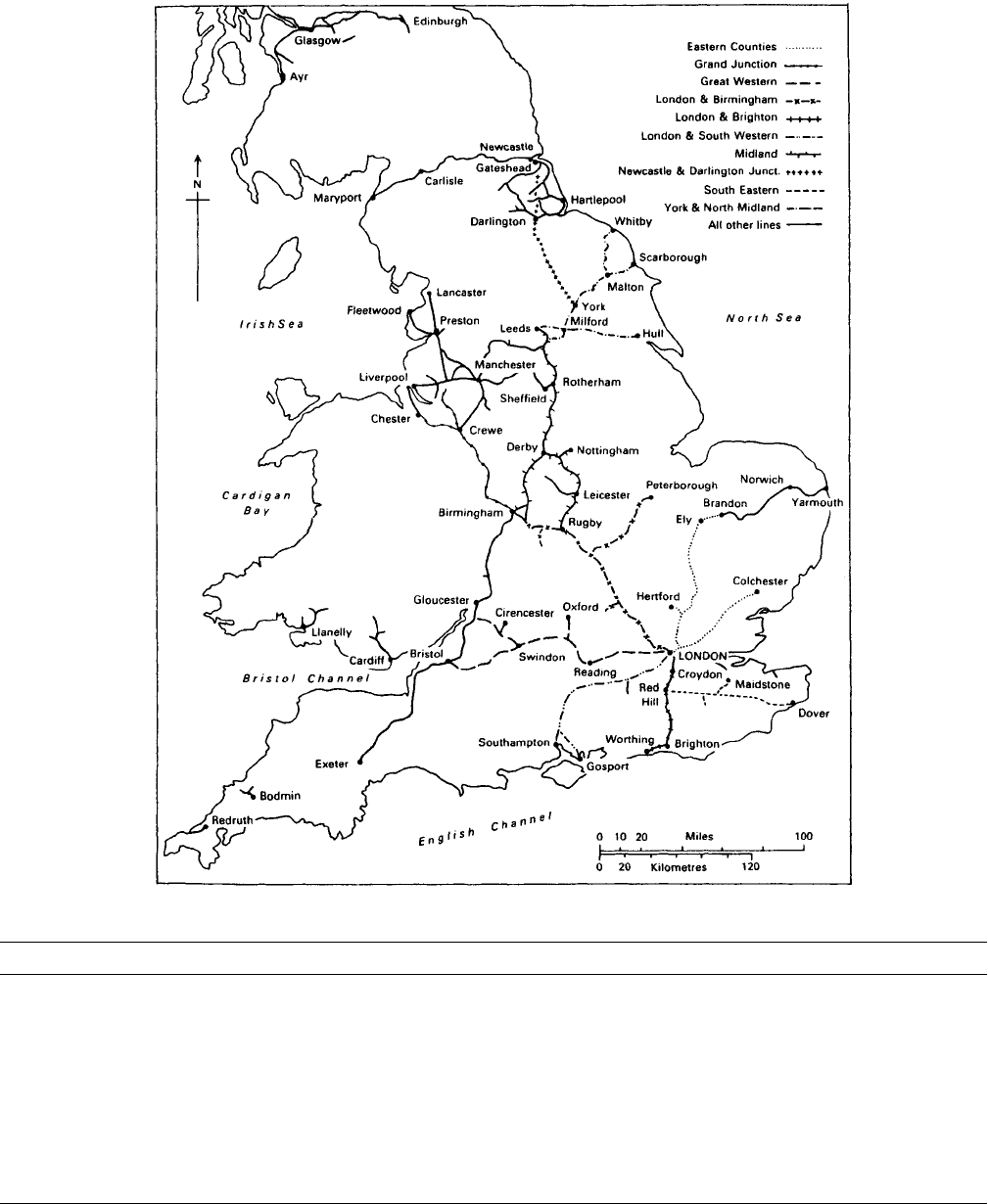
Figure 11.1 The railway system in 1845
Source: H.J.Dyos and D.H.Aldcroft British Transport, Leicester University Press, 1971, pp. 120–1.
SOCIETY AND ECONOMY IN MODERN BRITAIN 1700–1850 135