
Brown R. Society and Economy in Modern Britain 1700-1850
Подождите немного. Документ загружается.

Impressive though these figures are, they do not take into account the 600 schemes which never reached their first reading.
A substantial proportion of the schemes which actually got through Parliament were never carried out. However, the lines that
were laid down as a result of projects passed during these years brought the total mileage open to just under 7,500 mile by
1852.
9
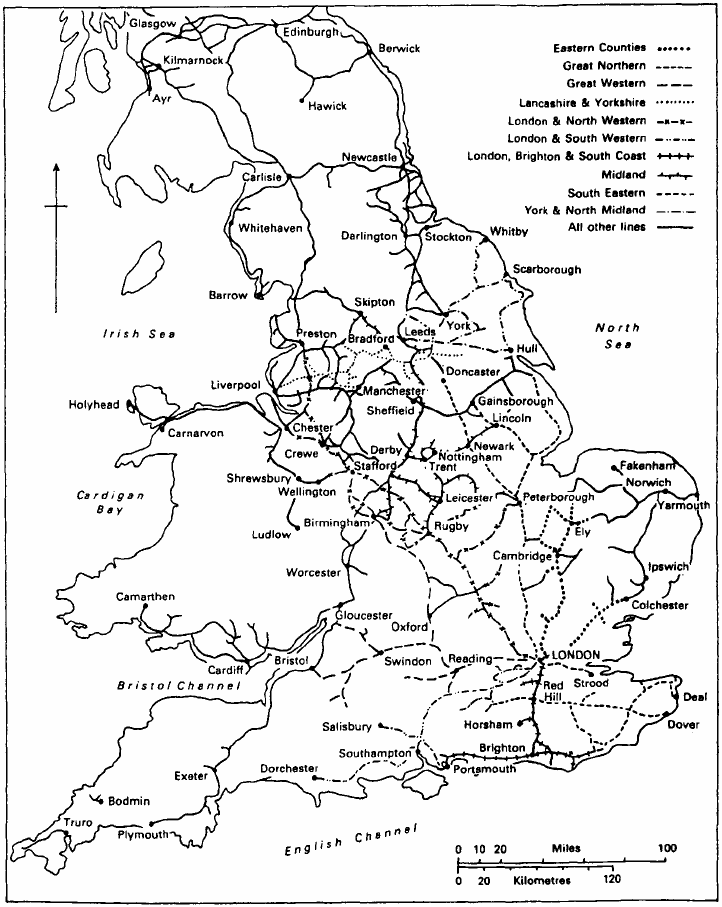
By the early 1850s there were two through routes to Scotland, a tight network in the Midlands, Yorkshire and Lancashire,
East Anglia had been opened up with a line to Norwich and Yarmouth via Colchester and there were lines through to the
coasts of both South and North Wales. The major gaps that remained were in the south and south-west, the Scottish Highlands
and in mid-Wales. By 1852, though a great deal still remained to be done, the railway system in England, Wales and, to a
lesser extent Scotland, was in all essentials already complete, with London at its heart. The system had reached physical
maturity and the formative influences of its youth and adolescence had left indelible marks. The problems of the railways in
the twentieth century had their origins in the genesis of the system between 1830 and 1860.
Railways in Ireland
The development of railways in Ireland followed a similar pattern to mainland Britain. The first line, the 6-mile long Dublin-
Kingstown line, was opened in 1834 but ten years later only two further lines were open to traffic: the 32-mile Dublin-
Drogheda line opened in 1844 and the 17.75-mile stretch of the Ulster Railway which reached Portadown in 1842. The boom
in railway building in Ireland began in 1844–5 and coincided with the second wave of railway speculation in England. The
major reason for the lacuna between 1834 and 1844 lay in the inadequacy of Irish capital formation and the consequent need
to attract English investment into Irish schemes. By 1850 half of private capital subscribed for Irish railways came from
English sources. By 1847 the mania in Ireland had passed its peak and, unlike on the mainland, some government capital was
essential to sustain the confidence of investors. Government loans accounted for only £1.5 million out of the total capital
investment of £12.5 million up to 1852. Though this was only a small part of total investment government involvement was
an important element in attracting cautious investors after the investment boom of 1844–6 was exhausted and only three out
of the nineteen Irish railways opened by 1853 were constructed without government loans. The increase in opened railway
track in Ireland in the 1840s was dramatic: in 1845 only 65 miles of track were opened but by 1849 there were 428 miles
opened and 183 under construction. This rose to 865 miles in 1854. By the early 1850s lines were in operation to five major
urban centres: Belfast, Cork, Galway, Limerick and Waterford. The railways were remunerative, partly because of the halving
of English construction costs and partly because the companies avoided the poorer regions.
BUILDING RAILWAYS AND MOVING GOODS
Investment
The success of the Liverpool-Manchester Railway and the demonstration of the superiority of the locomotive led to a major
change in attitudes to investment in railways.
10
Most railway companies were inaugurated by private Acts of Parliament
which gave their directors permission to raise money by issuing shares: they were joint-stock companies. The procedure for
obtaining parliamentary sanction, which involved an ad hoc committee of inquiry, could be slow and costly, particularly if
there was opposition. This could come from interests which might be damaged by a railway, particularly canal and stage-
coaching companies, but mainly from large landowners whose estates were to be transected. They had to be compensated,
sometimes heavily. In the 1820s a great deal of persuasion, through advertisements in the press and publicized promotional
meetings, was necessary to get the public to consider, let alone invest in, railways. In the 1830s and 1840s all that was
normally necessary was the publication of a prospectus with invitations to the public to apply for shares. These were allocated
to the chosen investors, who paid a deposit and only paid the full nominal value of the shares once parliamentary
authorization was given.
The industrial north-west was a major source of investment capital in the early decades of the nineteenth century and
provided much of the capital for the early railway projects. Half of the shares for the Liverpool-Manchester Railway were
taken up by Liverpool (47 per cent) and Manchester (3 per cent). The Marquess of Stafford, the major proprietor of the
Bridgewater Trust, took 24 per cent. Of the remaining 26 per cent, 20 per cent came from London and 6 per cent from other
places. This dominance of the north-west remained until the 1840s. 78 per cent of the capital for the Manchester and Leeds
Railway, opened in 1841, came from Yorkshire, Lancashire and Cheshire, with more than half coming from Manchester
alone. Lancashire capital was dominant outside the north and provided a large part of the capital for the London and
Southampton, Great Western and Eastern Counties railways. The belief during the railway mania of 1845 that ‘the rage for
shares infected all classes from peers to peasant’
11
is not based upon any real analysis of the available evidence. There is little
136 RAILWAYS—THE GREAT CONNECTORS
to suggest that wage-earners held any significant proportion of railway capital. In England and Wales most capital came from
industrial and commercial sources, with the landed interest playing a far less significant role than in canal and turnpike trust
promotions. This was paralleled in Scotland where the promotion of the early railways was undertaken chiefly by merchants
and coalmasters, some of whom were also leading figures in the iron industry.
Railway shares in the 1830s paid dividends of up to 9 per cent. The mania of the 1840s resulted in the promotion of many
uneconomic schemes and excessive competition between companies. This led to a sharp fall in the return on investments. The
average dividend on share capital fell from 5.48 per cent in 1845 to 3.31 per cent in 1850. The result of this was a slackening
of eagerness to subscribe to ordinary shares and a move to the greater security offered by preference shares and debentures.
The expansion of the rail network led to a trend toward concentration and amalgamation through mergers and takeovers
(Table 11.3). Early companies had been formed to build single lines from one place to another, which led to a multiplicity of
companies, usually small. There were about 200 in 1843. To the investor amalgamation offered the prospect of more
economic use of capital and the potential of higher profits. 1846 saw twenty amalgamations and there were nine the following
year. For example, in 1846 the Manchester & Leeds Railway and five smaller companies came together adopting, in 1847, the
name of the Lancashire & Yorkshire Railway. The most important figure in this process was George Hudson, ‘the railway
Figure 11.2 The railway system in 1852
Source: H.J.Dyos and D.H.Aldcroft British Transport, Leicester University Press, 1971, pp. 136–7.
SOCIETY AND ECONOMY IN MODERN BRITAIN 1700–1850 137

king’. In 1836 he launched the York and North Midland Railway and then in 1844, from the merger of three lines, created the
Midland Railway which radiated from Derby. With this as his base Hudson aimed at controlling the traffic from London to
the north-east, also pushing a line to the south-west as far as Gloucester and Bristol, moving north into Scotland and into East
Anglia. By the mid-1840s he controlled 1,500 miles of line and capital of £30 million. In doing this he over-extended himself
and went bankrupt in 1849.
The pattern of railway investment can be taken from three separate series:
12
Kenwood’s series of British gross investment,
excluding land purchase, legal and parliamentary costs, but including spending on repairs and renewals; Mitchell’s estimate
of gross capital formation by United Kingdom railways and Hawke and Reed’s raised capital data (paid-up capital and loans).
Table 11.3 Railway investment 1825–55 (annual averages, £m)
Kenwood Mitchell (i) Mitchell (ii) Hawke & Reed
1825–9 0.25 – – 0.28
1830–4 0.55 0.63* 0.53* 0.79
1835–9 4.69 6.52 5.62 6.44
1840–4 5.76 6.22 5.58 7.27
1845–9 20.03 29.02 25.18 31.02
1850–4 9.58 11.12 9.06 11.26
Mitchell (i) includes the cost of land purchase, while Mitchell (ii) does not. * covers 1831–4.
The extent to which railway investment played a part in the overall process of economic growth is an issue of some
importance. Mitchell has shown the speed with which the railways became a significant element in domestic investment, with
gross capital formation consuming 2 per cent of national income by the late 1830s. It was, however, in the 1840s that the
dramatic shift occurred, with investment not far short of 7 per cent of national income in 1847 and an average of 4.5 per cent
between 1845 and 1849. Railway investment was sizeable but what part did it actually play in the growth process? Did
railway promotions lead economic growth or were they the product of favourable economic conditions? There is general
agreement that while railway promotion was an undoubted influence on general economic activity from the 1830s, its role
was supportive rather than leading. Railway investment, up to the early 1850s, tended to be concentrated in the upswing of the
trade cycle and the lag between promotion and construction meant that the contra-cyclical influence of railway-building was
central in providing employment when the economy generally was depressed.
How far did factors endogenous to the railway industry influence patterns of investment? Speculation has to be stimulated
by something. The developments in railway technology and the success of the Liverpool-Manchester Railway encouraged
promotional activity in the early 1830s before the speculative boom of 1835–6. The schemes after 1844 are usually attributed
to a revival in business confidence. But endogenous factors were also important. Alterations in parliamentary standing orders
made promotion more difficult after 1838 and easier after 1842. Gladstone’s Act of 1844 referred to the possibility of a state
purchase after 21 years of new companies earning 10 per cent or more and this helped to encourage over-optimism. The
timing of railway investment and the business cycle before 1850 suggests that boom conditions encouraged company
promotions and that, while the importance of speculative investment must be admitted, the presence of endogenous factors
indicates that promotion was not only influenced by itself but influenced the prevailing economic climate.
British railways were built by private enterprise and with private capital, unlike those of continental Europe where
governments intervened in route-planning and contributed to the costs of construction. Whether this was alone responsible for
the high costs of constructing the British railway system is open to question but the average cost per mile was over £40,000
compared to £36,000 in Belgium, £27,000 in France and only £11,000 in the United States. It is important to take into
account the high price of land, the nature of the terrain, especially in the north, Wales and Scotland and the perfectionism on
the part of the engineers. One has only to look at the routes, stations, bridges etc. designed by Brunel to understand the
spiralling nature of costs. Despite all their over-capitalization and heavy fixed charges, most British companies remained
profitable throughout the nineteenth century.
Construction
The achievement of the railways is even greater when the method of their construction is examined. Until the 1850s, when
some steam-driven equipment was introduced, railways were built by hand and dynamite by the railway navvies.
13
In the
1880s a railway chaplain, D.W.Barrett, wrote that
138 RAILWAYS—THE GREAT CONNECTORS
The term navvy is simply an abridgement of the longer and less poetical word navigator, which savours too much of the
sound of alligator to be pleasant. And in fact some people have a rough idea that the navvy is a sort of human alligator
who feeds on helpless women and timid men and frightens children into fits.
In 1851 J.R.Francis, the contemporary historian of the early railways, wrote of navvies in his A History of the English Railway
as
Rough alike in morals and manners, collected from the wild hills of Yorkshire and Lancashire, coming in troops from
the fens of Lincolnshire, and afterwards pouring in masses from every country in the empire; displaying an unbending
vigour and an independent bearing; mostly dwelling apart from the villagers near whom they worked; with all the
propensities of an untaught, undisciplined nature; unable to read and unwilling to be taught; impetuous, impulsive and
brute-like, regarded as the pariahs of private life, herding together like beasts of the field, owning no moral law and
feeling no social tie, they increased with an increased demand, and from thousands grew hundreds of thousands. They
lived but for the present; they cared not for the past; they were indifferent to the future.
Not all agreed with this pessimistic picture. Brunel, for example, thought that navvies were very manageable ‘if well treated’.
In Dombey and Son Charles Dickens described the digging of a cutting at Camden Hill:
Houses were knocked down; streets broken through and stopped; deep pits and trenches dug in the ground; enormous
heaps of earth and clay thrown up; buildings that were undermined and shaking, propped by great beams of wood.
Here, a chaos of carts, overthrown and jumbled together…there confused treasures of iron soaked and rusted in
something that had accidentally become a pond. Everywhere were bridges that led nowhere; thoroughfares that were
wholly impassable; Babel towers of chimneys, wanting half their height; temporary wooden houses and enclosures in the
most unlikely situations; carcasses of ragged tenements and fragments of unfinished walls and arches and piles of
scaffolding and wilderness of bricks and giant forms of cranes and tripods straddling above nothing. There were a
hundred thousand shapes and substances of incompleteness, wildly mingled out of their places, upside down, burrowing
in the earth, aspiring in the air, mouldering in the water…. In short, the yet unfinished and unopened Railway was in
progress; and, from the very core of all this dire disorder, tailed smoothly away, upon its mighty course of civilisation
and improvement….
In the 1840s and 1850s with the exception of those employed in agriculture and textiles, navvies made up the largest
occupational group in Britain. An average of 60,000 men were engaged annually in railway construction between 1831 and
1870 or about 1 per cent of the occupied male labour force. Construction booms led to sudden surges in demands for labour,
and especially for unskilled labourers, who made up over 80 per cent of those recruited. During 1847 some 6,455 miles of line
were being built by over 256,000 men, 4 per cent of the male workforce. The annual wages in 1845–9 were about £11
million, or 2 per cent of the national product. It is little wonder that to the communities upon which they descended, they were
an army.
The construction of a railway line was subject to an elaborate division of labour. In charge was a consulting engineer
responsible to a board of directors for the progress and successful completion of the line. He in turn contracted out to various
people parts of the route, though the more important sections tended to be given to the leading firms like those of Samuel
Morton Peto, who in 1850 was employing 15,000 people, or Thomas Brassey. For example, in the case of the London-
Southampton line Joseph Locke, the engineer, employed Brassey to build the key stretch between Basingstoke and
Winchester and used lesser men for other sections of the route. Contractors then subcontracted the work and at the base of the
managerial structure was the ‘butty man’ or ‘ganger’ who did limited tasks like removing an agreed amount of waggon loads
of earth from a cutting. Some butty men were specialists in particular things like drainage, bricklaying or cutting. The
workforce itself fell into two types: skilled men, like bricklayers or carpenters, who were paid about 5s. a day, and unskilled
workers who were paid half that rate. Among the unskilled the Irish predominated, especially in the north of England and
Scotland. In southern England and Wales redundant agricultural labourers were more frequently employed. For the navvies
life was unruly and violent in both their work and ordinary lives. Shortcuts were taken in building since time was often too
short to fulfil contracts. Earth was often undermined too far. The construction of the Woodhead tunnel in Cheshire between
1839 and 1845 brought the issue to public attention. Thirty-two men were killed and there were twenty-three cases of
compound fractures, seventy-four of simple fracture and 140 cases of serious burns and blast wounds.
William Jackson, miner, No. 5 shaft. He was looking over John Webb’s shoulder, while he was stemming a hole
charged with powder, when the blast went off, blowing the stemmer through Jackson’s head and killed him on the spot.
SOCIETY AND ECONOMY IN MODERN BRITAIN 1700–1850 139

Edwin Chadwick wrote of this tunnel that
The losses in this one work may be stated as more than three per cent killed and fourteen per cent wounded. The deaths
in the four battles of Talavera, Salamanca, Vittoria and Waterloo were only 2.11 per cent of privates; and in the last
forty-one months of the Peninsula War the mortality of privates was 4.2 per cent in battle, 11.9 per cent of disease….
The Woodhead scandal did result in a Select Committee on Railway Labourers being set up in 1846, but it did not act upon
Chadwick’s suggestion that contractors should be liable to pay compensation to employees or their next of kin for accidents
and deaths even when it was the worker who was at fault. Chadwick reminded the committee that in France, where it was the
law, the accident rate had been significantly reduced. Sympathy was expressed for his proposals but government was
unwilling to intervene and before long the number of navvies decreased rapidly.
Increasing traffic
Railway traffic—both passenger and freight—grew steadily from 1830, though reasonably reliable evidence was only
collected from the early 1840s (see Table 11.4).
Table 11.4 United Kingdom railway traffic 1842–50.
Year Passengers Freight Total revenue (£m)
Numbers £m Tons £m
1842 24.5 3.1 5.4 1.6 4.8
1846 43.8 4.7 17.0 7.6 7.6
1850 72.9 6.8 38.0 6.4 13.2
Source: Railway Returns (Mail, parcels etc. were counted as freight).
Initially the aim of most railway companies was to supply improved transport facilities for existing customers. The trunk-
line railways, which eventually dominated the system, established by specializing in high-tariff business, taking passengers
from stage-coaches and high-value goods from the road carriers but, not until the 1840s from canals and coastal shipping.
Both in price and in reliable, round-the-year service railways were unmatched by their rivals. Between 1830 and 1845 railways
undercut stage-coaches by up to 20 per cent and canals by about 40 per cent. During the 1840s as the system expanded, there
were two significant changes in the type of business railways handled. From the mid-1840s an increasing emphasis was
placed on heavy freight. Between 1835 and 1845 companies had derived 75 per cent of their gross revenue from passengers
but by 1850 this had fallen to below 50 per cent. The market-widening effects of railway freight operations were limited
before 1850. It was not until the early 1840s that locomotives were equal to hauling heavy goods trains. Amalgamations and
the administration of the Railway Clearing House certainly facilitated long-distance freight traffic, but until the 1850s this
was generally limited to short distances. The second change was the shift in passenger traffic to third class. In 1845–6 third-
class passengers made up half of the total numbers and produced only a fifth of the total revenue. By 1870 the proportions had
risen to 65 and 44 per cent respectively. This change was largely the result of intensified competition between companies,
encouraged by government policy which led to companies pursuing a larger-volume-lower-margin business.
The search for larger traffic volumes after 1845 had the effect of lowering the average rates of railway companies. Between
1845 and 1858 passenger fares fell by as much as 30–40 per cent. There was a similar trend in freight where the low-tariff
mineral trade, especially coal, became an increasingly dominant element. New trades were encouraged in perishable goods—
fish, meat, fresh milk and vegetables and led to a vast improvement in urban diets. The fish trade of the Great Eastern Railway
was the envy of other companies. The London & South-Western Railway and Great Western Railway even invested their
rivalry in steam vessels to intercept fish at sea. Railways helped to open up a number of new industrial sites: iron and
anthracite in south Wales, coal in the north-east and Yorkshire and iron ore in Northamptonshire. The extension of services
was accompanied by an improvement in communications at all levels— postal services, newspaper and telegraph—all closely
dependent on rail facilities. Railways reduced the cost and greatly improved the quality and volume of Britain’s transport.
The state and the railways
Railways may have been developed by private enterprise but government could not entirely escape involvement in railway
matters from the very outset.
14
Railway companies needed parliamentary approval, not merely for sanctioning the company,
but for authority to purchase land, if necessary by compulsory purchase. Parliament also laid down maximum charges for
140 RAILWAYS—THE GREAT CONNECTORS
particular goods in the same way that it had regulated the tolls charged by canal companies. It was, however, not long before
Parliament recognized the futility of endeavouring to maintain the same competition between railway companies as existed
between road-carriers and canals. Select Committees of either Lords or Commons were established in every year between
1835 and 1840 and in 1843, 1844, 1846 and 1849, while a Royal Commission reported in 1846. These investigations often led
to fresh legislation which either attempted to circumscribe the powers or limit the freedom of the railway companies.
Parliament’s major concern, from the outset, was to protect the interests of the railway user from the monopolistic tendencies
on the part of the railway companies.
By the early 1840s with company promotions, amalgamations, manipulations and speculation the issue of the monopolistic
pretension of companies came to a head. The Railway Act of 1840 set up a Railway Department at the Board of Trade to
collect information from the companies, to promote public safety and, where necessary, to initiate prosecutions. The 1842 Act
extended state control over issues of rail safety. The 1844 Act went further. The Department became the Railway Board. In
the case of new lines, railway profits could not exceed 10 per cent on capital and Parliament gave the Board of Trade powers
to force the rate of carriage down or compulsorily purchase companies which did so. In addition all companies were
compelled to run a daily passenger service each way, stopping at all stations with a maximum charge of one penny a mile—
the ‘Parliamentary Train’. An inspectorate was set up to enforce minimum standards of safety, signalling and braking and
telegraph systems. In 1846 Parliament intervened in the ‘Battle of the Gauges’—between the ‘standard’ gauge used by
Stephenson and others in the north and Midlands and the ‘broad’ gauge used by Brunel in the south—in favour of the
‘standard’. This meant that, in the long term, lines were at least compatible in terms of engines and rolling stock. In 1846 a
Railway Department, called the Commissioners of Railways, was set up, separate from the Board of Trade, to control directly
the rates charged, but it was suspended in 1851. Despite the control of profits through pricing policy and enforcement of basic
services and safety railway companies made substantial profits throughout the 1840s and Henry Booth wrote that:
The effects of this extraordinary improvement in the means of travelling, especially since the introduction of railways,
have been as striking on the manners as on the industry of all classes…. During the spring London is crowded with
visitors of all ranks and orders from the remotest provinces, and during the summer and autumn vast numbers of the
citizens are spread over the country….
MOVING PEOPLE
‘The great connector’
The Illustrated London News in September 1850 noted that
‘the people’, popularly so called, have been enabled, thanks to railways and to the organisation of cheap pleasure-trips,
to indulge in travels to distances which their forefathers had neither time nor money to undertake…. Now travelling
bids fair to become not only the necessity of the rich, but the luxury of the poor. The great lines of railways in England,
by granting facilities for ‘monster’ or excursion trains at cheaper rates, have conferred a boom upon the public.
Railways were the great connectors but also the great liberators.
15
The Great Exhibition of 1851 would not have been as
successful without the ‘monster’ trains and this confirmed their importance in increasing population mobility. Examination of
census returns in Suffolk for 1851 and 1861 showed that movement was up and down the lines. Alexander Somerville, in his
autobiography published in 1848, summed up the wonder of the railway
All sights which I had seen in London and elsewhere…shrank into comparative nothingness when, after reaching
Liverpool, I went into the country for a week, in the neighbourhood of Prescot and saw (each day I sought to see it, each
hour of the day I could have seen it again) the white steam shooting throughout the landscape of trees, meadows and
villages, and the long train, loaded with merchandise, men and women and human enterprise, rolling along under the
steam. I had seen no sight like that; I have seen nothing to excel it since. In beauty and grandeur, the world has nothing
beyond it.
Railways allowed people to move ‘out of town’ to the burgeoning suburbs or to go away for holidays. Though slow to
develop because of the economic conditions of the 1830s and 1840s, the seaside trip, either for a day or for longer, had become
part of the cultures of the growing working and middle classes by the 1860s. New towns developed and expanded in close
SOCIETY AND ECONOMY IN MODERN BRITAIN 1700–1850 141
proximity to urban centres as holiday resorts: Blackpool for the Lancashire area, Scarborough for Yorkshire and Southend for
London. Charles Dickens described the new railway hotel—the Grand at Folkestone—as follows
If you are for public life at our Great Pavilionstone Hotel, you walk into that establishment as if it were your club; and
find ready for you, your news-room, dining-room, smoking room, billiard room, music-room, public breakfast, public
dinner, twice-a-day (one plain, one gorgeous), hot baths and cold baths…. If you want to be bored, there are plenty of
bores always ready for you and from Saturday to Monday, in particular, you can be bored (if you like) through and
through…. You shall find all nations of the earth and all styles of shaving and not shaving, hair cutting and hair letting
alone, for ever flowing through our hotel. Couriers you shall see by hundreds; fat leather bags for five-franc pieces,
closing with violent snaps, like discharge of fire-arms, by thousands; more luggage in a morning than, fifty years ago,
all Europe saw in a week.
The hotels, of which this is one example, multiplied as travel became more common on the Continent as in Britain. They were
the passenger equivalents of the freight depot, palaces from which, with the aid of Thomas Cook’s travel agency and
Murray’s, Bradshaw’s and Baedeker’s guides, people set out to explore the culture of their own and foreign countries.
Railways as ‘social levellers’?
Were railways ‘the great levellers’ as some contemporaries believed? If by this was meant that railways led to British society
becoming less class oriented then probably not, but if they meant that there was an increase in awareness about people and in
communication, in all senses of that word, then certainly yes. Railways were feared by some people in the 1820s and 1830s
since they would, in Wellington’s words, ‘allow the lower orders to move around’, as a potential threat to aristocratic control.
This conservatism was quickly abated, yet in Sybil (1845) Benjamin Disraeli’s Lord de Mowbray upholds the traditional
view:
‘I rather counted on him’, said Lord de Mowbray, ‘to assist me in resisting this joint branch line here; but I was
surprised to learn that he had consented.’
‘Not until the compensation was settled’, innocently remarked Lady Marney: ‘George never opposes them after that.
He gave up his opposition to the Marham line when they agreed to his terms.’
‘And yet,’ said Lord de Mowbray, ‘I think if Lord Marney would take a different view of the case and look to the
moral consequences, he would hesitate. Equality, Lady Marney, equality is not our metier. If we nobles do not make a
stand against the levelling spirit of the age, I am at a loss to know who will fight the battle. You may depend that these
railways are very dangerous things.’
Good business, as demonstrated by Lord Marney in fiction and the Marquess of Stafford in fact, soon overcame this
conservatism and railways became the progressive spirit of the age. A survey of the Essex economy in 1907 stated that ‘It was
not easy to lay rails in the soft Essex soil and a good deal of the country is still untouched by railroads and therefore quietly
unprogressive in spirit.’ It is the ‘and therefore’ which is significant here. Railways ended the isolation of different areas of
the country; parochialism died out. In 1839, the Quarterly Review, optimistically and prematurely, maintained that railways
had ended barbarism in manners and social customs: ‘by the power of steam every nation is enabled to see, without flattery,
its own faults clearly reflected in his neighbour’s mirrors’.
Yet railways started the standardization of language and speech which was carried more speedily forward in the twentieth
century by the influence of radio and television. The Cambrian, Taff Vale, Chester and Holyhead and other railways in Wales
were powerful agencies in the decline of the speaking of Welsh.
Railways and economic demand
There was an increased demand for coal, both for steam power and for use in the iron industry on which the railway depended.
Wrought-iron rails were the major product purchased, but there was also a demand for locomotives, rolling stock and bridges.
Though this may have been significant in the development of the iron industry in the late 1840s, railway’s share of total iron
output and home demand fluctuated. G.R. Hawke’s conclusion is nothing if not direct. Railways, he asserts, ‘were not
essential to the existence of an iron industry…nor were they responsible for technical advances and external economies in the
finishing processes and rolling mills’.
16
The diffusion of the ‘hot-blast’ process in the 1830s and the surge of export demand in the 1840s are now stressed as the
decisive influences on the expansion of the industry as a whole. However, railway demand did stimulate growth of iron
production in particular areas. This was evident in South Wales. Industries in Cleveland and south Staffordshire also appeared
142 RAILWAYS—THE GREAT CONNECTORS
to have received a welcome stimulus from railway demand but in Scotland they were not dependent on the orders of Scottish
railways. It is possible to conclude that domestic railways alone took under 10 per cent of pig-iron output between 1835 and
1869 and were dominant for only a short time in the 1840s.
Railway construction stimulated demand for other products, notably coal, timber and building materials and engineering
products. In terms of total production, railway’s impact on the coal industry was small. In the peak years of 1844–51 between
6 and 10 per cent of coal output went into making iron for railway uses. The rail network required locomotives, rolling stock
and signalling equipment. In the late 1830s and 1840s about 20 per cent of the industry’s output was in the form of railway
rolling stock. Towns grew up round the established engineering centres at Swindon, Crewe, Rugby and Doncaster. The brick-
making industry expanded as the result of the numerous bridges, stations, aqueducts, viaducts and embankments being built.
By 1845 some 740 million bricks had been used in the fifteen years since the opening of the Liverpool-Manchester
Railway and in the 1840s between 25 and 30 per cent of brick production went into railways.
How much did the railways really contribute to British economic growth after 1830? Contemporaries did not hesitate in
assuming a direct relationship between the growth of the railway network and economic growth, but historians today are more
cautious. The notion that railways rescued Britain from a serious investment crisis in the 1830s and 1840s—a ‘crisis of
capitalism’—is seen as an exaggeration. G.R.Hawke concluded, on slim evidence, that in 1865 railway services represented a
social saving of between 7 and 11 per cent of the net national income of England and Wales. His conclusions have not been
accepted uncritically and there is a need for further research into the impact of railways on engineering and retail trading,
general communications and business skills and technological change and industrial location in what Sir John Clapham
17
termed
The Early Railway Age’. His certainty is not as acceptable today. Railways did not occupy the central place in Britain’s
industrialization of the mid-nineteenth century and were not indispensable to economic growth. But their impact was greater
than that of any other single innovation in the period and they were seen by contemporaries as tangible proof of the spirit of
‘progress’. Railways represented the confidence of industrialization.
NOTES
1 An American writing, in 1870, on the impact of the Liverpool-Manchester Railway.
2 Francis Egerton, Duke of Bridgewater made this statement around 1800.
3 John Ruskin Seven Lamps of Architecture, London, 1849.
4 The development of railways is examined in M.J.T.Lewis Early Wooden Railways, London, 1970.
5 On the development of steam locomotion to 1830 see P.S.Bagwell The Transport Revolution from 1770, Batsford, 1974, pp. 90–2,
H.J.Dyos and D.H.Aldcroft British Transport, Leicester University Press, 1969, pp. 111–18 and H.Perkin The Age of the Railway,
Panther, 1970, pp. 70–2.
6 The central role of the Stephensons is explored in L.T.C.Rolt George and Robert Stephenson: the Railway Revolution, 1960 and in
R.H.G.Thomas The Liverpool and Manchester Railway, Batsford, 1980. See also L.T.C.Rolt Isambard Kingdom Brunel, 1957.
7 Dyos and Aldcroft op. cit. pp. 118–26 gives a more detailed account of developments in the 1830s.
8 On the railway mania in the 1840s see ibid. pp. 126–32.
9 There are many studies of the regional history of railways and histories of individual railway companies. Many are listed in the
bibliographies in P.S. Bagwell op. cit. and Dyos and Aldcroft op. cit.
10 On investment in railways see P.S.Bagwell op. cit. pp. 95–8 and Dyos and Aldcroft op. cit. pp. 189–94. T.R.Gourvish Railways and
the British Economy 1830–1914, Macmillan, 1980, pp. 9–26 gives an up-to-date survey of the literature. More detailed studies can be
found in S.Broadbridge Studies in Railway Expansion and the Capital Market in England 1825–1873, 1970 and M.C.Reed
Investment in Railways in Britain 1820–1844, 1975. Several articles, cited in T.R.Gourvish op. cit., are also of use especially
T.R.Gourvish and M.C. Reed on financing Scottish lines, and G.R.Hawke and M.C.Reed’s survey of financing throughout the
nineteenth century. See also J.Lee ‘The Provision of Capital for Early Irish Railways’, Irish Historical Journal, 16, (1968).
11 W.T.Jackman The Development of Transportation in Modern England, new edn, edited by W.L.Chaloner, Cass, 1962, p. 584.
12 A.G.Kenwood ‘Railway Investment in Britain 1825–1875’, Economica, 32, (1965), B.R.Mitchell ‘The Coming of the Railway and
United Kingdom Economic Growth’, Journal of Economic History, 24 (1964) and G.R.Hawke and M.C.Reed ‘Railway Capital in the
United Kingdom in the Nineteenth Century’, Economic History Review, 22 (1969).
13 On the construction of railways and the role of navvies see T.Coleman The Railway Navvies, Penguin, 1968 and H.Perkin op. cit. pp.
77–95.
14 On the role of the state and the development of the railway see Dyos and Aldcroft op. cit. pp. 156–65 and P.Bagwell op. cit. pp. 169–
98. H.Parris Government and the Railways in Nineteenth Century Britain, Routledge & Kegan Paul, 1965 is a more detailed study
though his thesis on the role of government should be examined in relation to A.J.Taylor Laissez-faire and State Intervention in
Nineteenth Century Britain, Macmillan, 1972.
15 The effects of railways are best approached through Dyos and Aldcroft op. cit. pp. 178–200, P.Bagwell op. cit. pp. 107–37 and
H.Perkin op. cit. pp. 96–150. J.R.Kellett Railways and Victorian Cities, Routledge & Kegan Paul, 1969 looks at the effect of railways
on urban development using five case studies.
16 G.R.Hawke Railways and Economic Growth in England and Wales 1840–1870, Oxford University Press, 1970, p. 245.
SOCIETY AND ECONOMY IN MODERN BRITAIN 1700–1850 143
17 J.Clapham The Economic History of Modern Britain; Vol. I, The Early Railway Age 1820–1850, Cambridge University Press, 1926.
144 RAILWAYS—THE GREAT CONNECTORS
12
The economic revolutions—an overview
The ‘forces’ operating in history cannot be defined or put in abstract terms, but one can behold them, observe
them, and develop a sympathy for their existence.
1
Between 1700 and 1850 major change occurred in people’s experience and perception of the economic worlds in which they
lived. These changes are often encapsulated in the concept of an ‘industrial revolution’. The previous nine chapters have
examined change from a much broader viewpoint, relating changes in population, communications, agriculture, trade,
banking, finance and industrial organization to ‘revolutionary’ and ‘non-revolutionary’ industrial innovation. This chapter
will attempt to draw together this discussion and raise questions about the historiography of industrial change. It will pose a
series of questions which place the economic revolutions in a conceptual framework.
Harold Perkin wrote in 1969 that
It was a revolution in men’s access to the means of life, in control of their physical environment, it opened the road for
men to complete mastery of their physical environment without the inescapable need to exploit each other…it was more
than an industrial revolution.
2
Perkin and many other historians have written much about the industrial revolution as the ‘great discontinuity’, the divide
between what Peter Laslett called a ‘world we have lost’ and the modern world. In popular imagination it is supposed to have
ended traditional society in England and initiated fundamental social change. It is supposed to have completely altered
people’s lives, liberating them from the constraints of Nature and, for the first time, giving them control over their
environment. The cotton mill powered by steam epitomized both the promise and the exploitation of the ‘new’ economic order.
How accurate a representation of the past are these perspectives and why have historians adopted them?
HISTORIOGRAPHY
The historiography of the industrial revolution can be traced back to the 1820s when the term was evidently coined in
France.
3
It was given academic currency by Blanqui in the 1830s, translated into German by Marx and Engels in the 1840s
and popularized in English by Arnold Toynbee in his The Industrial Revolution, published in 1884. For writers like this it has
always served a polemic purpose and this tendency continues today. From the outset the notion of an ‘industrial revolution’
has been a forum of debate between groups of historians and polemicists who viewed it from different perspectives.
4
Two
broad traditions of explanation for, and response towards, industrialization can be identified. One tradition, which was well
developed by the 1830s involves a favourable evaluation of the effects of industrialization based primarily on materialistic
criteria. Industrialization was seen as the epitome of individualism, a personal expression of the liberationist capitalist economic
system. Thomas Carlyle, for example, wrote
Were we required to characterise this age of ours by any single epithet, we should be tempted to call it, not an Heroical,
Devotional, Philosophical, or Moral Age, but, above all others, the Mechanical Age. It is the Age of Machinery, in
every outward and inward sense of that word…. What changes too, this addition of power is introducing into the Social
System; how wealth has more and more increased…. Not the external and physical alone is now managed by machinery,
but the internal and spiritual also….
5
A contradictory tradition emerged from the experience and observation of industrialization which challenged the basic
assumptions of the materialistic approach. It evaluated both the causation and impact of the industrial revolution in terms of