
Brown R. Society and Economy in Modern Britain 1700-1850
Подождите немного. Документ загружается.


loss, exploitation and deprivation from a more humanistic perspective that went beyond the purely economic. William Blake
wrote of more than just ‘dark satanic mills’ in his poem ‘Jerusalem’
And all the Arts of Life they chang’d into the Arts of Death in Albion.
The hour-glass contemn’d because its simple workmanship
Was like the workmanship of the plowman, & the water wheel
That raises water into cisterns, broken & burn’d with fire
Because its workmanship was like the workmanship of the shepherd;
And in their stead, intricate wheels invented, wheel without wheel,
To perplex youth in their outgoings & to bind to labours in Albion
Of day & night the myriads of eternity: that they may grind
And polish brass & iron hour after hour, laborious task,
Kept ignorant of its use: that they might spend the days of wisdom
In sorrowful drudgery to obtain a scanty pittance of bread,
In ignorance to view a small portion & thinks that All,
And call it Demonstration, blind to the simple rules of life.
6
A ‘social change’ school
Within these two traditions four different, though overlapping, schools of thought about what really mattered during the
industrial revolution can be distinguished. First, a ‘social change’ school, which owes its origins to Arnold Toynbee’s belief
that ‘the essence of the Industrial Revolution is the substitution of competition for medieval regulation which had previously
controlled the production and distribution of wealth’. To Toynbee, the industrial revolution was first and foremost a change in
the way economic transactions occurred between people—the emergence of a market economy—and this led to fundamental
changes in the way society was structured. There is a strong polemical element in this approach. To Toynbee and others some
judgement on the value for people of the change to a market economy could be made. Simplistically ‘pessimistic’ and
‘optimistic’ perspectives have been put forward—perspectives which play an important role in ‘the standard of living
debates’—and which have political overtones since they highlight the value of the whole process of ‘modernization’.
Organization
The second viewpoint places emphasis on industrial organization, on the structure and scale of firms and the rise of the
factory system. This can be traced back to Marx’s interpretation of the rise of ‘Machinofactures’ but has its classic exposition
in Paul Mantoux’s The Industrial Revolution in the Eighteenth Century, published in 1929. Related to this was the emphasis
on the move from ‘working’ capital (raw materials for industry, seed for agriculture) to ‘fixed’ capital (machines, mines,
structures).
Development economics
The third school of thought arose after 1945 in response to the emergence of development economic theory, particularly that
of Simon Kuznets, which highlighted the question of economic growth. W.W.Rostow’s The Stages of Economic Growth,
published in 1960, is perhaps the most famous exemplar of this perspective. The emphasis is upon growth of national
incomes, the rate of capital formation, investment ratios and growth in the labour force. It raised a question—why was Britain
the first nation to industrialize?—which was directly applicable to underdeveloped countries. New Economic History, with its
emphasis on trends, large collections of industries and individuals rather than single people, on the collective experience of
growth and with hypothetical models, has its origins in this quantitative approach to change.
Technological change
The final school of thought places its emphasis on the impact of technology and the diffusion of new technical knowledge. This
approach, found especially in David Landes’ The Unbound Prometheus, published in 1969, was about more than just
‘gadgets’. It emphasizes technology’s impact on the organization of labour, consumer manipulation, marketing and
distribution techniques.
146 SOCIETY AND ECONOMY IN MODERN BRITAIN 1700–1850
Problems with these perspectives
Valuable insights have been achieved through these approaches to economic change. But they are all in some way partial.
This is clearly demonstrated by the different chronologies of change each propounds. The social change school places its
focus on the period between 1760 and 1850 between which two dates, it is maintained, there was a transition from a
paternalist to a class ideology of social organization and structure. The industrial organization school also begins in 1760 but
ends in 1840 by which time the factory system was firmly embedded as the dominant mode of industrial organization. The
macroeconomic group pushes the starting point back to the 1740s, in the case of Deane and Cole, and forward to the 1780s
for W.W.Rostow and ends in 1830 when the essential features of an industrialized economy based on growth mechanisms had
been established. Finally, the technological school emphasizes the proliferation of invention and innovation between 1760 and
1800. These differing chronologies raise as many questions as they answer and many of the propositions on which they are based
have been critically analysed in the previous chapters. For example, there certainly was a proliferation of inventions and
innovations between 1760 and 1800 in certain sectors of the economy but not all and, as the application of the steam engine
showed, invention did not mean diffusion. Many existing approaches to examining economic change in the eighteenth and
early mid-nineteenth centuries place a quite justifiable emphasis on a particular aspect of change. However, they do not
provide the overview necessary to integrate the various elements that existed into a coherent whole. The remainder of this
chapter will examine four issues in an attempt to provide that coherent overview—the question of ‘perspective’, the question
of ‘time’, the question of ‘causation’ and the question of whether the concept of an ‘industrial revolution’ still has relevance
and value for historians—and will end with some consideration of the overall economic trends which can be identified
between 1700 and 1850.
THE QUESTION OF ‘PERSPECTIVE’
A ‘total’ experience
How far does looking at the industrial revolution from different perspectives alter how it can be perceived? The first issue is
one of ‘totality’—is it possible to see the industrial revolution in its ‘total’ setting? One criticism of quantitative economic
history is that, as Georges Lefebvre ruefully commented, ‘living, suffering man does not appear in it’. Statistics are one type
of evidence historians can construct and use but they only provide trends or tendencies which need to be fleshed out. The
industrial revolution did not just happen, it happened to people who acted, reacted, opposed and supported its events in
different ways. This means that historians should, in Fogel’s words,
portray the entire range of human experience, to capture all of the essential features of the civilization they were
studying and to do so in a way that would clearly have relevance to the present.
7
But what is the ‘entire range of human experience’ and ‘all of the essential features of the civilization’? The problem is that many
historians of the industrial revolution have not really considered these problems and, where they have, there is little consensus
on possible solutions. ‘Total’ history is unlikely to be practicable for a single country if all the sources are to be mastered and
a full integration of the variety of experiences achieved. The geographical limits of the enquiry have to be drastically
narrowed, which paradoxically often means that ‘total’ history turns out in practice to be local history. Le Roy Ladurie
exemplified this approach in his study of rural Languedoc, writing that he examined
the long-term movements of an economy and of a society—base and superstructure, material life and cultural life,
sociological evolution and collective psychology, the whole within the framework of a rural world which remained very
largely traditional in nature.
8
Most writings on the industrial revolution at this level concentrate on a specific industry or town rather than a region. There is
a powerful argument for looking at regional developments in Britain in a ‘total’ sense to create ‘models’ for change and
continuity as a means of getting the ‘total’ experience of Britain into its proper perspective.
Historians have traditionally been suspicious, if not antagonistic, towards the notion of ‘historical models’. What issues could
be raised, for example, from a model based around ‘people in society’, their ‘actions and interactions’, ‘beliefs and
prejudices’ and ‘pasts and presents’ as a means through which historians can mediate their discussion of change and
continuity in the eighteenth and nineteenth centuries? Consider the issue of ‘pasts and presents’. This necessitates an
examination of individual and collective mentalities, the multi-dimensional private experiences within the context of multi-
dimensional public spheres, the inherited experiences that underpinned existing cultural values and how these values were
THE ECONOMIC REVOLUTIONS—AN OVERVIEW 147
adapted and changed. This means the conscious drawing in of expertise, skills and concepts from other disciplines and the
possible need for collaboration with other specialists. This attacks the essential individualism of much history writing and the
autonomy of history as a discrete subject. The traditional approach, though it often works when historians examine events
within a tight chronological framework using narrative techniques, is less valuable for considering long-term developments. If
history is about re-creating and giving meaning as well as providing valid explanations and interpretations based on an
objective analysis of evidence then any approach or technique which helps to illuminate this is perfectly valid. The ‘total’
approach using models to explicate the nature of development through time is necessary to achieve understanding of the
industrial revolution.
A ‘national’ perspective—an approach through Britain
The second issue concerns the question of national perspectives. England, Wales, Scotland and Ireland had contrasting
experiences between 1700 and 1850, a consequence of different resources, climate and histories. Most studies of the
industrial revolution, however, have England and, to a lesser extent, Wales as their focal points. The general texts on British
economic change between 1700 and 1850 almost without exception focus on England, drawing in examples from Scotland,
Wales and Ireland to illustrate points rather than within the mainstream of discussion. The result of this has been that the
English perspective has been accepted as the ‘norm’. This process begins in schools where the periphery is examined only
when it has an effect or impact on England. Did anything of any note happen in Ireland between 1801 and 1850 apart from the
Great Famine? In Scotland, Wales and Ireland most pupils do courses on their own country as well as England, but rarely on
the other two areas making up the United Kingdom. The effect of this can be seen in three ways. First, it reinforces ignorance
which is carried into higher education and results in a failure to establish a dialogue between the English experience and the
experiences of the other countries. Secondly, it perpetuates myths, and finally it means that British history actually means
English history.
So how does looking at issues from a broader perspective help in understanding the process of historical development
between 1700 and 1850? Take, for example, demographic growth. Why has English growth been considered the norm for
demographic analysis? There is a problem with the available evidence, which may account for this. In England parish
registers are available from almost all parishes but in Wales only about a third have survived and the figures are much lower
for Scotland and Ireland. Examination of the chronology of population change between 1700 and 1850 in the four areas
shows marked differences. The populations of both Ireland and Scotland grew at faster rates than England between 1700 and
1750:25 per cent, 21 per cent and 16 per cent respectively. England’s rate of growth was less than Ireland’s between 1750 and
1800, 0.7 per cent per annum compared to Ireland’s 1 per cent per annum. Scotland’s population revolution did not really
begin until after 1800 when Ireland’s had lost its momentum. The late eighteenth-century situation, when Ireland’s rate of
growth was three times Scotland’s, was reversed. Differences in general trends are borne out by looking at particular reasons
for growth. The introduction of the potato in Ireland, but also in Highland Scotland, arguably had an impact on birth rates. Did
it remove constraints which had held population down? Why were prenuptially conceived births lower in Ireland than in
England and Wales but highest in Scotland? With all these differences the impact of population growth needs to be evaluated
much more carefully. The formula that ‘population growth=growing demand=stimulus to economic growth’ is an
oversimplification. Ireland did not undergo dramatic industrial changes between 1750 and 1800 when its population was
growing, while Scotland’s burst of industrial activity in the 1770s predates population growth by twenty years.
The division of the British economy into its four national parts goes part of the way towards the approach put forward by
Sidney Pollard in his Peaceful Conquest: the Industrialisation of Europe 1760–1970, Oxford University Press, 1981. He
argues that the industrial revolution was an affair that took place in the context of national and regional economies. Regions
frequently had distinct technological traditions and forms of industrial organization which affected their development. For
example, in the Forest of Dean, the Derbyshire lead-mining district and the stannaries of Cornwall regional practices and
styles were enshrined in distinctive laws. This approach allows historians to examine the ‘total’ experience of the different
economies contemporaries could encounter and consider the comparative advantage of one form of industry over others. Britain
did not have a unified economy in the eighteenth and early nineteenth centuries. Economic change was essentially a local or
regional rather than national affair.
‘Leading sectors’ and change ‘in slow motion’
There has been an understandable tendency to examine the industrial revolution in terms of the ‘leading sectors’ of cotton,
iron, coal and steam —dramatic, promethean, revolutionary, apocalyptic, expansive. Does this emphasis misrepresent the
reality of contemporary experience? Does it result in an unbalanced view of the productive sectors of the economy? Does it
simply miss things out? Existing histories of the industrial revolution certainly present change ‘writ large’ but was rapid
148 SOCIETY AND ECONOMY IN MODERN BRITAIN 1700–1850
economic growth the experience of all regions of Britain? How can historians blend the cataclysmic vision of David Landes in
his Unbound Prometheus which Maxine Berg sees as
the bold sweep of technology’s advance. It came like a republican army, confident in its principles and its moral
precepts, and thus overcoming all economic, social and historical barriers…. Landes’s Industrial Revolution, whose pre-
ordained triumph was so obvious and so right, was based on the achievements of new machinery, new power sources
and new raw materials.
9
with the perspective of historians like A.E.Musson?
in most industries there was no technical revolution in the century before 1850…traditional handicrafts still
predominated…there had been no widespread introduction of steam-power mechanisation and the factory system…the
typical British worker in the mid-nineteenth century was not a factory operator in a factory but still a traditional
craftsman or labourer or domestic servant.
10
On the one hand the industrial revolution is seen in a revolutionary context while the alternative perspective is one of
industrial revolution ‘in slow motion’. Recently the idea of change in slow motion has gained currency and the views of Sir
John Clapham have been revived and expanded by Nick Crafts and Maxine Berg. Both argue that it is essential to consider
change in a longer perspective, beginning in the late seventeenth or early eighteenth century, and have reached certain broad
conclusions. First, they argue that growth in the ‘leading sectors’ of the economy was atypical and that, in most industries,
expansion was much slower and extended over a longer time-scale. This is combined, secondly, with the reassessment of
Gregory King’s and Joseph Massie’s analyses of population. England and Wales were much more industrial and commercial
in 1700 than King would have historians believe, which means that the extent of movement from agriculture to industry was
not as great as originally thought. Thirdly, the move from traditional industries to factory-based, steam-powered industries was
not as dramatic as contemporaries believed. Finally, Britain did not attain particularly high levels of industrial output per
worker and the triumph of the industrial revolution lay in increasing the labour force rather than obtaining higher productivity
from those already employed.
THE QUESTION OF ‘TIME’
Two examples can be used to illustrate the less than revolutionary nature of change and the need for a more careful
application of chronology to developments. Stationary steam engines have long been regarded as the single most important
invention underlying the industrial revolution.
11
They were the ‘prime movers’ supplying inexhaustible energy for working
machines that produced consumer goods. Historians who have concentrated on the late eighteenth century emphasize the
importance of James Watt and particularly his development of rotary motion. This view neglects two things: first, the
importance of developments in steam before 1780 and, secondly, the improvements made in existing power sources. There is
no doubt about the importance of Watt’s improvements in the 1780s but just how dramatic were their effects?
A.E.Musson writes that
It is not generally appreciated that in 1800 steam power was still in its infancy, that in the vast majority of manufactures
there had been little or no power-driven mechanization, and that where such mechanization had occurred water-power
was still much more widespread and important than steam. And after 1800, the ‘triumph of the factory system’ took
place much more slowly than had generally been realized; waterwheels long continued to be built and used, while most
manufacturing operations remained largely unmechanized until after 1870.
12
Concentration on large-scale industries like cotton led historians to overestimate the extent to which steam was applied to
other industries. Not until the diffusion of high-pressure stationary engines after 1840 was there substantial reduction in fuel
costs and an increase in the speed at which machines could run. The fullest application of steam power had to wait until
accurate and reliably engineered machines had been developed.
Historians like antitheses, and central to people’s image of the industrial revolution stands the ‘dark satanic mill’ and the
contrasting domestic method of production.
13
This image, however, owes more to polemic than to the realities of the past.
Engels and Marx may have used it in their radical critique of proletarian conditions and capitalist exploitation but closer
examination demonstrates that the stark contrast is questionable and that there was continuity between the factory and pre-
factory stages of development. Hand or outworking continued to play a major role in the British economy until after 1850.
This essential continuity has been given increased credibility through the concept of ‘proto-industrialization’. Industrial
change, it is argued, could not have taken place without the previous development of forms of production which provided the
THE ECONOMIC REVOLUTIONS—AN OVERVIEW 149
key changes in the use of land, labour, capital and entrepreneurship. Revolutionary change may well have taken place in
cotton and iron and steam power may have provided a more reliable source of energy but three-quarters of British
manufacture was in diverse, dispersed and unspectacular industries.
The domestic system was a method of mass production, in which ‘skill’ played little part, no less than the factory system
that emerged after the mid-eighteenth century. There was already a clear distinction between capitalists, who controlled and
financed industries, and wage-earners. There was continuity between both systems with firms active in setting up factories
already active in the putting-out system. The chronology and character of change varied from region to region as the
comparative advantage of one economic activity over another was realized. Some areas, like East Anglia and the Cotswolds,
‘deindustrialized’ because changes in other sectors of the economy resulted in different economic imperatives and
opportunities emerging. Recent work has re-emphasized the distinction between the domestic system and the skilled urban
artisan structure of small commodity production and the self-employed craftsman. Consumer preference in Britain was for
differentiated hand-produced goods and the artisan trades suited this heterogeneity with the need for short production runs of
unique items. Changes in the industrial organization were far more complex than merely a move from domestic to factory
systems and the development of a domestic consumer market based entirely on machineproduced standardized goods was a
product of the late not the early nineteenth century.
It is necessary therefore when considering the chronology of economic change between 1700 and 1850 to be quite clear
what specific chronology is being examined. Change in some industries may have been rapid and revolutionary but historians
should not assume that all industries followed this atypical pattern. J.C.D.Clark echoes A.E.Musson in writing that the
very term ‘Industrial Revolution’…vastly exaggerates eighteenth-century Englishmen’s perceptions of the change they
were living through…. Most sectors of the economy witnessed substantial growth before 1832, but only cotton
increased exponentially. Not until the 1830s and 1840s, when the railway and the steamship arrived, did the output of
iron and coal surge ahead. Not until then did mass-production and powered machine tools spread to many industries.
Meanwhile the economy was dominated by its traditional sectors and by traditional technologies, slowly evolving. In
1832 Britain was still essentially horse-drawn and sail-driven.
14
THE QUESTION OF ‘CAUSATION’
The question of causation is generally approached through the question ‘Why was there an Industrial Revolution?’.
15
This is
then usually focused on why the textile, iron and coal industries expanded and what the impact of the diffusion of steam power
was. Important though these questions are, they neglect the broader economic experiences of Britain between 1700 and 1850.
The question ‘Why did the industrial revolution occur in Britain rather than France or the Netherlands or Germany?’ misses
the crucial point that industrial change did not occur in Britain as a whole but in Lancashire or the Central Lowlands of
Scotland or South Wales or round Belfast and that there was no necessary connection between development in one area and
those in others. Trying to discover whether it was population growth or increased demand or agricultural change or any other
thing which actually started economic change again seems to miss the point.
Accounting for the industrial revolution is an extremely difficult undertaking since economic changes had an effect—
however small—on all aspects of society. Some circumstances which were present in Britain facilitated change and, in that
sense, can be said to be causal. Others impeded progress but change occurred despite them. Historians have recently used
counterfactual analysis—the ‘what would have happened if approach—to assess the indispensability of the different elements
that existed particularly in the eighteenth century. Certain issues emerge from this. First, if change occurred over a much
longer period than traditionally believed, this approach may prove valuable in assessing the long-term impact of, for example,
agriculture, on other sectors of the economy. Secondly, given the nebulous nature of the industrial revolution, is it possible to
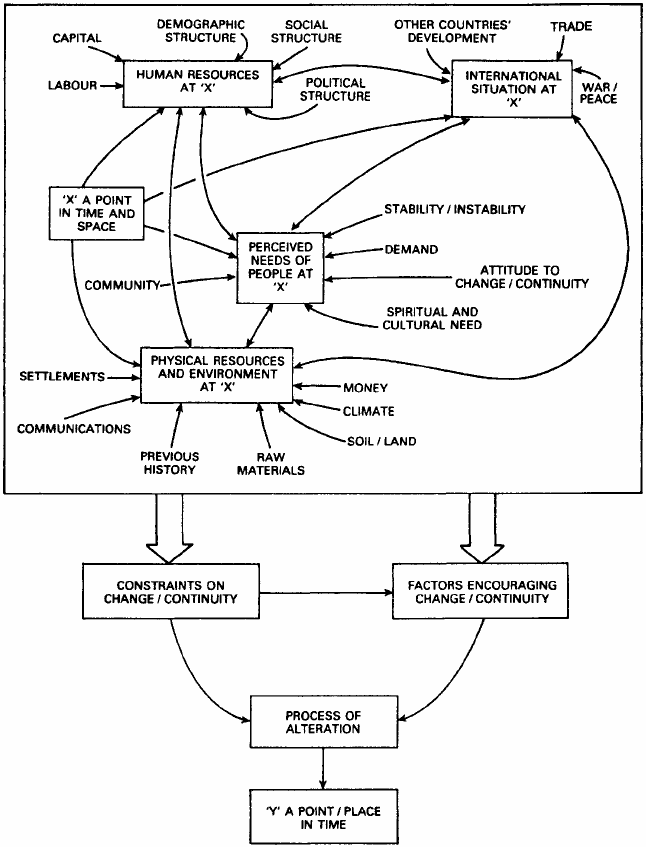
identify causes at anything more than a superficial level? Historians have to be specific in terms of the sector, geographical
area and time-span concerned. This can be expressed in the simple model shown in Figure 12.1.
THE PROBLEM OF ‘MEANING’
Finally, the problem has been that historians have tended to explain the industrial revolution as a unidimensional phenomenon
whereas for contemporaries change or continuity were mediated not in national terms but in terms of regional, local and
individual experiences. It was the diversity of change and continuity that marked Britain out in the eighteenth and first half of
the nineteenth centuries.
Is the concept of an ‘industrial revolution’ still of value to historians, given this diversity? A recent debate on this issue
occurred between Michael Fores and A.E.Musson.
16
Fores is concerned with whether or not industrial societies have
experienced a revolutionary break from the past with a change of attitudes, beliefs and new ‘institutions’. He relates this to the
notion of ‘practical engineers’ being responsible for all industrial development, regardless of science and technology, and
150 SOCIETY AND ECONOMY IN MODERN BRITAIN 1700–1850
concludes that, since there was no revolutionary change in techniques, practical craftsmen were still the same sort of people
gradually developing new artefacts. In this argument there was no industrial revolution. Musson submits this to a penetrating
critique, demonstrating the weakness of an argument that fails to place emphasis on the role of science and technology.
Michael Fores does, however, provide a useful discussion of the four possible meanings of ‘industry’/industrialization:
(i) ‘industry’ as a particular sector of economic life—the mining industry or agriculture;
(ii) ‘industry’ as a specifically manufacturing sector of an economy;
(iii) ‘industrialization’ as a process whereby a factory system is established;
(iv) ‘industrialization’ as a process by which a non-traditional ‘modern’ life is produced characterized by urban living and more
‘rational’ guidance and discipline for performance at work.
The extent to which there was ‘discontinuity’ in the chronology of change and the nature of growth in the economy in the
eighteenth and first half of the nineteenth centuries depends which of these meanings historians emphasize. It is useful to
regard Britain in this period as having a dual economy in which two economies coexisted. There were those areas which,
though not stagnant, developed gradually along conventional lines with slow productivity growth (generally below 1 per cent
per annum) and slowly rising ratios between capital and labour. This economy contained agriculture, construction, domestic
industries and ‘traditional’ trades. A modern sector, containing cotton, iron, engineering, mining, transportation and some
Figure 12.1 Economic development: a simple model
THE ECONOMIC REVOLUTIONS—AN OVERVIEW 151
consumer goods like pottery and paper, characterized by higher productivity growth (up to 4 per cent per annum) coexisted
with this traditional sector. J.Mokyr says that:
Two-sector growth models imply that abrupt changes in the economy as a whole are a mathematical impossibility. Even
if change in the modern sector itself were discontinuous, its share in the economy would grow only gradually, while the
traditional sector would lose ground only slowly. In the long run the force of compound growth rates was such that the
modern sector swallowed the entire economy.
17
The value of the notion of an ‘industrial revolution’ remains, but viewed in the context of the economy as a whole not just
cotton or iron or steam.
ECONOMIC FLUCTUATIONS
Economic change is not a steady process but one subject to fluctuation. Some fluctuations result from forces within the
economic process itself, either internal to a particular economy or the result of forces operating in an international context.
Other pressures are ‘exogenous’ or imposed on the economy from causes which are not part of the economic system.
Harvests
In the eighteenth and early nineteenth centuries, harvests and wars both had a profound exogenous impact on economic
development. There was no regularity to either which could be built into any economic forward planning. Agriculture was the
largest single component, either in the national income, capital and its labour force. T.S.Ashton rightly commented that ‘What
was happening at Westminster or in the City was of small account compared with what was happening in the heavens.’
18
.
Harvests affected the economy as a whole in different ways. Their effect was most obvious on purchasing power. Poor
harvests pushed the price of food up and depressed the purchasing power of most of the population for other goods. Farmers
were the only people to benefit from higher food prices. Bad harvests also had an impact in the international economy through
the need to import corn, a trend which increased after the 1760s. The corn trade was, however, still sporadic and dependent on
the state of the British harvest. This created a sudden adverse balance of payments to be paid for largely in bullion. It also led
to depressed home demand and poor harvests were often followed by slumps in manufacturing industries. This uneven rhythm
of harvest crises can be traced throughout this period: 1710, 1725, 1767, 1773, 1783, 1792–3, 1795–6, 1799–1800, 1815–16,
1829, 1838, 1847.
War
War could kill, or create a foreign market. Capturing a French sugar island could make prices tumble, while losing it could
push them up again. Control of the seas could allow merchants to obtain new markets as, for example, with the South
American boom of 1807–8. Bad news or a defeat could result in a panic on the banks and the money market, as in 1745, 1793
and 1797. Internally, industries with a role to play in war expanded while some consumer industries were sapped by high
wartime taxation. During the French Wars betwen 1793 and 1815 the iron industry expanded because of government demands
for military and naval hardware. Peace in 1815 brought over-capacity and until 1820 there was a painful period of
readjustment to normal conditions. This process was also evident in food production, where higher prices encouraged
expansion using money borrowed at high rates of interest. Peace brought lower prices and depression on arable land for farmers
saddled with higher mortgage repayments than their declining profits allowed.
Trade cycles
The cycle in both foreign and internal trade, of between four and seven years, is a much more regular indication of economic
fluctuation. As the role of foreign trade in the national income expanded with the changes in the structure of the economy, the
more the economy became exposed to its fluctuations. Poor harvests, war and political unrest could all affect the import of
goods. Changed income conditions in Britain led quickly to modifications in demand for imports. Full warehouses meant that
it would take time for stocks to be cleared. Potential customers could wait for prices to fall even lower and this fall in trading
activity had a ‘knock-on’ effect on industries working for export markets, which similarly became depressed. Production
could be cut or wages lowered, both of which had the effect of further depressing the purchasing power and spending of
people working in those industries. Once stocks had run down the reverse sequence occurred. Demand and prices picked up,
confidence and optimism returned and the economy revived.
152 SOCIETY AND ECONOMY IN MODERN BRITAIN 1700–1850
This ‘boom-slump’ sequence can be seen clearly between 1815 and 1850. The French Wars led to a buoyant economy and
prosperity mounted steadily from 1811 after Napoleon’s continental blockade broke up. For over thirty years the British
economy had been subject to a powerful growth stimulus. Industrial output increased rapidly. Agriculture and trade expanded.
Between 1815 and 1820 there was a period of readjustment to peacetime conditions. A short post-war boom as exports of
cotton goods, hardware and iron were rushed to starved markets ended in 1818 and the economy plunged into depression
reaching its nadir in 1819. Agriculture did not have the benefit of this boom and prices fell disastrously for the already heavily
mortgaged farmers. The response—the Corn Law of 1815 —did not resolve the farmers’ dilemma of how to cope with being
wedged between falling prices and fixed costs. Profitable outlets for investment almost ceased to exist and, despite long-term
interest rates falling, there was insufficient incentive for businessmen to embark on new ventures.
By 1821 there were real signs of a general recovery which lasted until the mid-1830s. Industrial output accelerated and
investment, both abroad and at home, went on continuously. Exports expanded. This growth was, however, not without its
problems. Its tentative nature in the 1820s was clearly demonstrated in the financial crisis of 1825 and in the loss of economic
confidence in 1829 and 1831, a result of poor harvests in 1828 and 1830. From 1832 to 1836 there was heavy investment at
home in railway shares, and exports were boosted by loans to America which stimulated Anglo-American trade.
Between 1815 and 1836 it had become increasingly clear that continued expansion for British industry depended on stable
foreign markets. Between 1836 and 1842 there was an intense depression which began in industry, was deepened after the
severe financial crisis of 1839 and exacerbated by unpredictable harvests. Heavy grain imports were necessary, especially in
1838 and 1839, with the consequent loss of gold abroad and monetary stringency at home. Declining foreign investment,
particularly in America, further depressed trade. Revival after 1842 was led by investment in transportation and by the
removal of tariff control by Peel’s government, creating conditions in which growth could occur.
The swings of the trade cycle took place within a rising long-term trend. Over-capacity was ultimately absorbed by a
growing population and a growing demand coming from a rising national income. Short-term expansion was an unstable
affair of boom and slump, inflation and deflation. Yet, as Peter Mathias argues ‘At every point the problems of short-run
economic fluctuations rested upon the fundamental forces operating for long-run economic expansion.’
19
CONCLUSIONS
The traditional views of the industrial revolution have recently been re-examined and a picture of the economic changes of the
eighteenth and early nineteenth centuries based on growth ‘in slow motion’ have been re-emphasized. Certain questions still
need to be considered. How far did unequal development in England, Scotland, Wales and Ireland affect the ‘revolutionary’
nature of the changes in the industrial economy? Is an approach through interconnected studies of defined regions more
valuable than through nation states? What was the balance between traditionally organized and forward-looking industries?
Reinterpretation of a historical phenomenon of such importance as the industrial revolution will occur in each succeeding
generation as new perspectives are examined, regional studies are produced and chronologies and causations adjusted.
Economists may want to learn lessons from the past but they should reflect on the prognosis made by the Italian historian
Croce that ‘the only lesson that we learn from the past is that we learn no lessons from the past’.
NOTES
1 Leopold von Ranke ‘The Great Powers’, in G.G.Iggers and K.von Moltke (eds) The Theory and Practice of History, Indianapolis
University Press, 1973, p. 100.
2 H.Perkin in The Origins of Modern English Society 1780–1880, Routledge, 1969, pp. 3–5.
3 The history of the expression ‘industrial revolution’ can be examined in Sir George Clark The Idea of the Industrial Revolution,
Glasgow, 1953.
4 The voluminous historiography of the industrial revolution can be best approached through M.W.Flinn Origins of the Industrial
Revolution, Longman, 1966, pp. 1–18, G.G.Iggers New Directions in European Historiography, Methuen, 1985, pp. 154–74 and
J.Mokyr (ed.) The Economics of the Industrial Revolution, Allen and Unwin, 1985, pp. 1–52, especially 3–6. E.A.Wrigley Continuity,
Chance and Change. The Character of the Industrial Revolution in England, Cambridge University Press, 1988, is a major
revisionist study.
5 T.Carlyle ‘Signs of the Times’ (1829), in A.Shelston (ed.) Thomas Carlyle— Selected Writings, Penguin, 1971, pp. 64–5.
6 William Blake Poems and Prophecies, Dent, 1972, pp. 238–9.
7 R.W.Fogel and G.R.Elton Which Road to the Past?, Yale University Press, 1983, p. 19.
8 E.Le Roy Ladurie The Peasants of Languedoc, University of Illinois Press, 1966, p. 289.
9 M.Berg The Age of Manufactures 1700–1820, Fontana, 1985, p. 23.
10 A.E.Musson The Growth of British Industry, Batsford, 1978, pp. 252–3, 141.
THE ECONOMIC REVOLUTIONS—AN OVERVIEW 153
11 This is examined in detail in chapter 5.
12 A.E.Musson ‘Industrial Motive Power in the United Kingdom 1800–1870’, Economic History Review, 2nd Series, 29 (1976), p. 416.
13 This is examined in detail in chapter 6.
14 J.C.D.Clark English Society 1688–1832, Cambridge University Press, 1985, p. 65.
15 On the question of causes see the editorial introduction to J.Mokyr (ed.) op. cit., the essays in part two of R.M.Hartwell The Industrial
Revolution and Economic Growth, Methuen, 1971 and the collection of essays by different authors in R.M.Hartwell (ed.) The Causes
of the Industrial Revolution in England, Methuen, 1967.
16 Michael Fores ‘The Myth of a British Industrial Revolution’, History, 66 (1981); A.E.Musson ‘The British Industrial Revolution’,
ibid., 69 (1982).
17 J.Mokyr (ed.) op. cit., p. 5.
18 T.S.Ashton Economic Fluctuations in England 1700–1800; Oxford University Press, 1955, p. 2.
19 P.Mathias The First Industrial Nation, Methuen, 2nd edn 1983, p. 216.
Addendum:
The following appeared too late to be considered but develop the general line outlined in this chapter: P.Mathias and
J.A.Davis (eds) The First Industrial Revolutions, Blackwell, 1989 is an excellent summary of the current situation; A. Digby
and C.Feinstein (ed.) New Directions in Economic and Social History, Macmillan, 1990 reprint articles from ReFRESH and
R.Brown Economic Revolutions 1750–1850, Cambridge University Press, 1991 attempts a synthesis in the introduction.
154 SOCIETY AND ECONOMY IN MODERN BRITAIN 1700–1850

13
Rent
Now, in every country of civilized men, acknowledging the rights of property, and by means of determined
boundaries and common laws united into one people or nation, the two antagonist powers or opposite interests of
the State, under which all other State interests are comprised, are those of permanence and of progression.
1
Nothing is more certain than that our manners, our civilisation, and all the good things which are connected
with manners and with civilisation, have, in this European world of ours, depended for ages upon two principles,
and were, indeed, the result of both combined: I mean the spirit of a gentleman and the spirit of religion.
2
David Ricardo divided society into three economic powers: rent, capital and wages. The next three chapters will sketch the
major developments in British society between 1700 and 1850 through an examination of those groups which broadly
corresponded to these three ways of living. They will be followed by a consideration of changing social ideologies in which
‘paternalism’ and ‘class’ will be evaluated. In the eighteenth and, to a lesser extent, in the nineteenth centuries a person’s
identity was characterized in relation to birth, property, occupation and rank in the social order. Women were generally
defined through either their father’s or husband’s social status. Power, economic and political, lay in the possession and
exploitation of land. Landowners either farmed their own land or rented it out to tenant farmers. It is with these social groups
that this chapter is concerned.
LANDOWNERSHIP
In terms of rent the major distinction was between those who received rent (rentiers) and those who paid it (tenant farmers). In
England there were major changes in landownership between the fifteenth and eighteenth centuries which consolidated the
position of the great landowners and the gentry and made them into the dominant economic, political and social force in the
country.
Table 13.1 Land ownership in England 1436–1873
Social group Percentage of land held in
1436 1690 1790 1873
Great owners 15–20 15–20 20–25 24
Gentry 25 45–50 50 55
Yeoman freeholders 20 25–33 15 10
Church and Crown 25–35 5–10 10 10
Source: G.E.Mingay The Gentry, Longman, 1976, p. 59, table 3.1.
Up to 1700 there was an increase in the numerical importance of both gentry and yeomen at the expense of Church and
Crown. The development of the gentry was the first stage in the monopolization of land by a rentier class. The eighteenth
century saw the second stage with the concentration of land in the hands of great owners and gentry at the expense of the
smaller freeholders. The ‘agricultural revolution’ consolidated capitalist relations of production in the countryside.
Agriculture ceased, almost imperceptibly, to be simply a way of life and became an ‘industry’. The distinction between
‘landowner’ and ‘farmer’ was sharpened. As Table 13.1 shows, great landowners and gentry increased their hold over land
after 1690 as the smaller owners were forced to sell land with the failure of their incomes to meet rising expectations. The
growth of the large estate in England was associated with the consolidation of tenancies into larger agricultural units. It is,
however, important to put this in perspective. Though the economic and territorial dominance of the large farm was