
Brown R. Society and Economy in Modern Britain 1700-1850
Подождите немного. Документ загружается.

Standard of Living in the Industrial Revolution, Methuen, 1975, IEA The Long Debate on Poverty, Institute of Economic Affairs,
1974, B.Inglis Poverty and the Industrial Revolution, Panther, 1972, P.K.O’Brien and S.L.Engerman ‘Changes in Income and its
Distribution during the Industrial Revolution’, in R.Floud and D.McCloskey (eds) The Economic History of Britain since 1700, Vol.
1, Cambridge University Press, 1981, pp. 164–81, and papers by P.H.Lindert and J.G.Williamson and G.N.von Tunzelmann in
J.Mokyr (ed.) The Economics of the Industrial Revolution, Allen & Unwin, 1985. On diet see J.Burnett A History of the Cost of
Living, Penguin, 1969, pp. 128–281 and Plenty and Want, Scolar Press, 1969, pp. 15–122.
7 M.W.Flinn ‘Trends in Real Wages 1750–1850’, Economic History Review, 27 (1974).
8 Lindert and Williamson, op. cit.
9 J.L.Hammond ‘The Industrial Revolution and Discontent’, Economic History Review, (1929–30), pp. 224–5.
10 The ‘urban question’ is considered in more detail in chapter 18.
11 E.P.Thompson ‘Time, Work-Discipline and Industrial Capitalism’, Past and Present, 38, (1967), pp. 56–97. See also D.A.Reid ‘The
Decline of St. Monday 1776–1876’, ibid., 71 (1976).
12 S.Pollard The Genesis of Modern Management, Penguin, 1968 clearly documents changing attitudes.
13 E.H.Hunt British Labour History 1815–1914, Weidenfeld, 1982.
14 On the question of the family see J.Rule op. cit. pp. 168–89 for a summary of recent developments.
15 Political Register 14 April 1824.
16 On working women the classic study is I.Pinchbeck Women Workers and the Industrial Revolution originally published in 1930,
reprinted Virago, 1985 with an introduction by Kerry Hamilton. The emergence of women’s history has supplemented and, on
occasions, modified Pinchbeck’s thesis. See in particular S.Alexander ‘Women’s Work in Nineteenth-century London: a Study of the
Years 1820–1850’, in J.Mitchell and A.Oakley (eds) The Rights and Wrongs of Women,’ Penguin, 1976, M.Berg The Age of
Manufactures 1700–1820, Fontana, 1985, especially pp. 129–78 and E.Richards ‘Women in the British Economy since 1700: an
Interpretation’, History, 59 (1974). J.D.Young Women and Popular Struggle, Edinburgh, 1985 has much of value on Scottish and
English working women. Two works published too late to be considered are: B.Hill Women, Work and Sexual Politics in Eighteenth
Century England, Basil Blackwell, 1989 and D.Thompson Women in the Nineteenth Century, The Historical Association, 1990.
17 Quoted more fully in E.H.Hunt op. cit, p. 25.
18 ibid.
19 From the declaration of the Miners Association of Great Britain and Ireland in 1842, quoted ibid. p. 186.
20 D.Bythell The Handloom Weavers, Cambridge University Press, 1969 is the most detailed study but should be supplemented by the
relevant parts of M.I.Thomis The Town Labourer and the Industrial Revolution, Batsford, 1974 and Responses to Industrialisation,
David & Charles, 1976.
21 D.Bythell The Sweated Trades, Batsford, 1981.
22 For a more detailed discussion of the agricultural labourer see chapter 17.
23 On the navvy see chapter 11.
24 There is much on trade unionism in the general books especially E.H.Hunt op. cit., but see also J.Rule The Labouring Classes in
Early Industrial England 1750–1850, Longman, 1986, pp. 253–349 and K.D.Brown The English Labour Movement 1700–1951, Gill
& Macmillan, 1982, pp. 28–50. The following more detailed studies of unionism should be consulted: A.Fox History and Heritage:
The Social Origins of the British Industrial Relations System, Allen & Unwin, 1985, H.Pelling History of British Trade Unionism,
Penguin, 1963 and in various more recent editions and A.E.Musson British Trade Unionism 1800–1875, Macmillan, 1972. C.Wrigley
‘The Webbs: Working on Trade Union History’, History Today, May 1987 is a useful assessment of a classic study of trade unionism.
25 On eighteenth-century unionism see C.R.Dobson Masters and Journeymen: A Pre-History of Industrial Relations 1717–1800, Croom
Helm, 1980 and J. Rule The Experience of Labour in Eighteenth Century Industry, Croom Helm, 1981. W.Hamish Fraser Conflict
and Class: Scottish Workers 1700–1838, John Donald, 1988 is essential for the Scottish dimension. J.Rule (ed.) Trade Unionism
1750–1850 The Formative Years, Longman, 1988 contains important essays.
26 For unions under the Combination Acts see A.E.Musson op. cit. for the historiographical debate. E.P.Thompson The Making of the
English Working Class, Gollancz, 1963 and M.D.George ‘The Combination Laws’, Economic History Review, 6, 1936 provide
contrasting interpretations. A.Aspinall (ed.) The Early English Trade Unions, Batchworth, 1949 documents developments. M.Berg
The Machinery Question and the Making of Political Economy, Cambridge University Press, 1980 is essential on responses to the
new technology, and J.Rule op. cit on apprenticeship.
27 M.D.George op. cit., pp. 176–7.
28 For unionism after repeal see H.Browne The Rise of British Trade Unions 1825–1914, Longman, 1979, R.G.Kirby and A.E.Musson
The Voice of the People: John Doherty, 1798–1854, Trade Unionist, Radical and Factory Reformer, Manchester University Press,
1975, W.H.Fraser Trade Unionism’, in J.T.Ward (ed.) Popular Movements 1830–1850, Macmillan, 1970, pp. 95–115. On the
GNCTU see W.H.Oliver The Consolidated Trades Unions of 1834’, Economic History Review, 18 (1964), pp. 77–95 and J.Rule (ed.)
op. cit. J.Marlow The Tolpuddle Martyrs, Deutsch, 1971 is a popular study.
29 Quoted in K.D.Brown op. cit., p. 50.
196 SOCIETY AND ECONOMY IN MODERN BRITAIN 1700–1850
16
The impact of economic growth—a social revolution?
The bond of attachment is broken, there is no longer the generous bounty which calls forth a grateful and honest
and confiding dependence.
1
There is no community…there is aggregation…modern society acknowledges no neighbours.
2
Both these nineteenth-century statements—the first by the poet Robert Southey, the second from a later Scottish source raise
the question of how British society was organized and the ways in which it had changed as a result of economic and urban
growth. In this chapter I want to consider whether a ‘social’ revolution took place between 1700 and 1850 and how people were
differentiated within society.
PERSPECTIVES ON SOCIETY
What different perspectives can historians who want to examine society use and what do they tell us about the workings of
society?
3
How applicable are they to British society between 1700 and 1850? Two approaches —from the ‘top’ and the
‘bottom’—have been used to illuminate particular aspects of eighteenth- and nineteenth-century British Society. ‘Minority
history’ traditionally concentrated on the activities of the powerful minority, those who held economic and political power.
‘Minority historians’ emphasize the importance of those who wield power in any society. They examine those who held power
at a particular time, how this altered over time and how effective the various ruling groups were. These were the elites within
society as a whole and within the localities. One major question which underlies this chapter is ‘How far did economic change
affect the entire nature of elites in Britain?’ ‘Majority historians’, by contrast, are concerned with society beyond the
boundaries of the elites and with the attempts of these ‘outsider groups’ to challenge the hegemony of the elites. They are
concerned with the conditions of the mass of the people. It is the interface between ‘high’ and ‘low’ society where notions of
radical change and consensual continuity can be most clearly seen.
It is important to have some notion of the ‘wholeness’ of society, whether nationally or within a given locality because it
was the overall structure of society that people were reacting against or attempting to preserve. It is equally important,
however, to establish the relationships between the different social elements. Individuals must be understood, given meaning
and significance, not in isolation, but within their web of social relationships. Individual biographies can be explained only by
reference to the whole of society—structuralists term this ‘decentring the subject’, pushing individuals away from the centre
stage and explaining them within a larger, universal system.
ELITES
A theory of elites
The word ‘elite’ only entered the English language, according to the Oxford English Dictionary in 1823, but did not become
widespread until the late nineteenth century.
4
What do we mean by an elite? ‘Elite’ applies to any who ‘lead’ in any social
category of social activity: to actors and sportsmen as well as political or economic leaders. There are essentially three
dimensions involved in the study of elites: the organization or structure of elite groups; the factors involved in recruitment to
elite positions and the distribution of ‘effective’ power exercised by those in elite positions.
In analysing the structure of elites it is important to identify their level of both ‘social’ and ‘moral’ integration. ‘Moral’
integration concerns the degree to which those in elite positions shared common ideas and a common moral ethos and the
extent to which they were conscious of their overall solidarity. ‘Social’ integration concerns the frequency and nature of the
social contacts and relationships between elite groups. These may take various forms: marriage alliances between different
elite families; the existence of personal ties of acquaintance and friendship between the different elite sectors; and the
frequency of direct ‘consultative’ ties between them. During the eighteenth century there was considerable integration within
elite groups based on a broad paternalistic ideology in which patronage played a central role.
Recruitment to elite positions depends on how far it is relatively ‘open’ to those drawn from varied socio-economic
backgrounds or ‘closed’ in favour of those from privileged groups. It is not sufficient to distinguish degrees of ‘openness’ or
‘closure; it is also important to examine the channels through which such recruitment takes place. It is possible to identify a
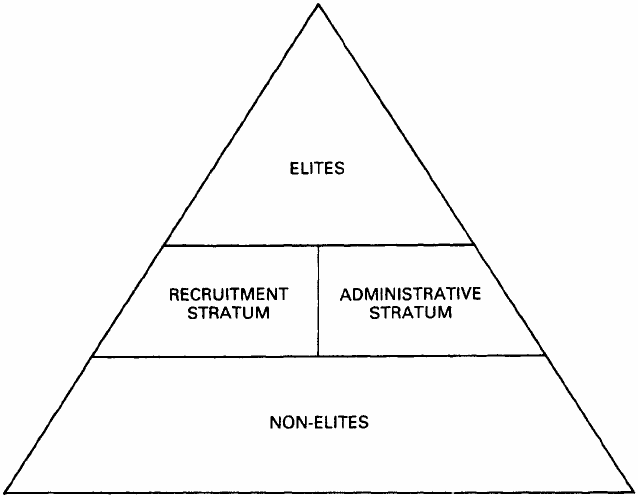
‘sub-elite’ which consists of two types of people who may or may not move up into the elite proper: a ‘recruitment’ stratum,
and an ‘administrative’ stratum.
The notion of recruitment may be taken further and three types of ‘circulation’ can be distinguished. Within the elites
themselves there is some circulation. Secondly, individuals from the sub-elite may succeed in entering existing elites. Economic
change in the eighteenth century brought new social groups, like financiers, traders and manufacturers into this category, from
which, like the Peels, Gladstones and Guests, they could enter the landed elite. Thirdly, individuals from the non-elites may
form new elite groups which then engage in a struggle for power with the existing elites. It was not until the mid-nineteenth
century that the economic and political power of the landed elite was effectively challenged.
In dealing with ‘effective’ power it is important to distinguish between how far power was ‘diffused’ throughout society
and how far it was ‘centralized’. In the eighteenth century ‘effective’ power, both economically and politically, lay with those
who owned land, though increasingly ‘control’ over the land was vested in tenants. Landowners constituted a ‘ruling class’
making eighteenth-century society what some historians have seen as a ‘one-class’ society.
A landed elite
Between 1700 and 1800 the landed elite was dominant and received ideological support from the mercantile, financial and
professional elites. The unified nature of those elite groups owed much to links either by family or by patronage. This elitist
position has been called the ‘Old Corruption’, of which three main aspects can be emphasized. First, these elites possessed
considerable strength and resilience and had sufficient confidence in their dominance not to be seriously challenged until the
1790s. Secondly, the social hierarchy was inegalitarian and privileged but not ossified or brittle. There was continual
adaptation—money being seen as the key to entry, allowing the successful to buy landed property which alone gave status.
Thirdly, the ruling order managed to achieve considerable consensus for their position in a restless society. Roy Porter sums
this up:
Figure 16.1 Elites and recruitment
198 A SOCIAL REVOLUTION
The hope was to win acquiescence and endorsement by influence and persuasion—bluster, grandeur, liberality,
promises, show and swank, the open door left just ajar. Those in power and their media mouth-pieces dangled before
people’s eyes ambition, self-respect, new enjoyments, polite values and fashionable life styles…
5
Their hegemony was cultural, as well as economic.
This cultural hegemony was evident in the ritualized theatrical qualities of eighteenth- and nineteenth-century rule. The
theatre of law was one part of this, as were the ritual of conspicuous consumption and the ‘civilized’ nature of the social life
of the elite—elegant mansions with ‘classical’ façades and landscaped gardens, fenced-off parks, the hunt, the duel, reserved
pews in church, coaches and footmen, the blending of rural and urban in the ‘London season’—another. E.P.Thompson points
to the reciprocity between this patrician society and the plebeian culture during this period.
6
The visibility of success and
power, and the ritual of punishment, were crucial symbols of the legitimacy of the elite groups in society.
A hierarchical society
The underlying basis of this elitist society was one of mutual and reciprocal obligation within a hierarchical framework.
Harold Perkin writes that
The old society, then was a finely graded hierarchy of great subtlety and discrimination, in which men were acutely
aware of their exact relation to those immediately above and below them, but only vaguely conscious except at the very
top of their connections with those on their own level…. There was one horizontal cleavage of great import, that
between the ‘gentleman’ and the ‘common people’, but it could scarcely be defined in economic terms….
7
Deferential attitudes were due to those above and paternalistic attitudes to those below. A Berkshire vicar wrote in 1795 that
it is manifest that our laws consider all the inhabitants of a parish as forming one large family, the higher and richer part
of which is bound to find employment and subsistence for the lower and labouring part.
8
This was a form of social organization which, despite all its obvious inequalities and injustices, was acceptable to the vast
majority of people in England and Scotland, where landlords were usually of the same nationality and culture. It was less the
case in Wales and Ireland, where landlords were often ‘Anglicized’ and from both an alien culture and religion.
‘Patriarchalism’
J.C.D.Clark argues that a dominant ‘patriarchalism’ survived and flourished in the eighteenth and early nineteenth centuries.
9
He points to the continued importance of the patriarchal writings of Sir Robert Filmer and contemporary neglect of the work
of John Locke in the eighteenth century —a society based on patriarchal principals was more acceptable to contemporaries
than one based on contractual principles. What mattered in the patriarchal ideology was not what was later parodied as ‘forelock
tugging’ but sympathetic involvement by the elites in the lives of the rest of society, the expectations of reciprocity, the common
outlook, identification of interests and, if necessary, sheer coercion to maintain the civil stability of a hierarchical social
structure. Power, wealth, and, Clark argues, faith characterized this social system:
Patriarchal doctrine, then, was sustained after 1688 not so much by the polemical needs of a dynastic regime as by the
continued domination of society by the Anglican Church on the one hand, and, on the other, by the aristocracy and
gentry.
10
Symbolically and in fact English society in the eighteenth and early nineteenth centuries was hierarchical, authoritarian and
confessional in character: ‘A Christian faith and moral code was a common possession of all social strata: the realm of the
communal, of what was later designated “public goods”, was largely the realm of religion…’.
11
Rank, station, duty and
decorum were central social values throughout this period and, until the evolution of ‘class’, hierarchical subordination was
scarcely diluted:
What destroyed the ancien regime in England…was not chiefly the widespread adoption of a democratic world view,
but the advance of Dissent, Roman Catholicism and religious indifference…. The Confessional State had been partly
undermined by 1828 not by its intellectual invalidity or some new awakening to it but by the erosion of the numerical
position of the Church of England….
12
SOCIETY AND ECONOMY IN MODERN BRITAIN 1700–1850 199
Patriarchalism governed relationships at all levels of society. Apprenticeship, for example, was more than induction into
particular skills; it was an immersion in the social experience or common wisdom of the community. Practices, norms and
attitudes were, as a result, reproduced through successive generations within an accepted framework of traditional customs
and rights that has been called ‘the moral economy’.
But was this a ‘consensus’ view of society? It was in so far as society was reciprocally organized—responsibilities were the
obverse of duties. Many of the disturbances in the eighteenth and early nineteenth centuries were directed at perceived
infringements of the ‘moral economy’—low wages or high prices could provoke food riots, new technology a mob response.
The appeal was to custom, to paternalistic Tudor and Stuart legislation, to established and traditional practice. The eventual
breakdown of this consensus, which had not been fully accomplished by 1850, was the result of economic change, the
expansion of towns which were broadly outside the paternal net, changing religious observance which broke the ‘bond of
dependency’ between squire, parson and labourer, and what Thomas Carlyle called ‘the abdication on the part of the
governors’, the dismantling of protective paternalistic legislation.
Paternalism
Patriarchal social ideology continued to have currency despite this breakdown in consensus and the emergence of the ‘class’
alternatives. David Roberts provides a useful model of paternalism in early Victorian society.
13
He argues that the paternalist
saw society in the following way.
14
First, it should be authoritarian, though tempered by common law and ancient liberties.
Secondly, it should be hierarchical. Thirdly, it should be ‘organic’ with people knowing their appointed place. Finally, it
should be ‘pluralistic’, consisting of different hierarchical ‘interests’ making up an organic whole.
Within this structure paternalists had certain duties and held certain assumptions. First was the duty to rule, a direct
consequence of wealth and power. J.B.Summner wrote in 1847:
Charge them that are rich in this world, that they do good, that they be rich in good works, ready to distribute, willing to
communicate…. There will always be many naked to be clothed, many hungry to be fed, many sick and afflicted to be
relieved….
15
Parallel to this was the obligation to help the poor, not merely passively but with active assistance. Paternalists also believed
in the duty of ‘guidance’, a firm moral superintendence. The Reverend Buller, vice-chairman of the Linton Guardians in
Cambridgeshire wrote in 1836 that
With respect to the behaviour of the poor [after the introduction of the workhouse] the farmers in general bear testimony
to their improvement in civility to their employers, their greater care to keep their place, and their endeavours to get
their children into service….
16
In the Second Report of the Poor Law Commissioners the Earl of Hardwicke said
I have no doubt that by a steady, and just administration of the law taking each case on its merits, we shall next year be
able to give you a report that will show a greater saving, together with a large improvement in the moral state of the
community.
17
Poverty could be blunted but never removed. ‘Just’ prices and ‘fair’ wages and rent were not merely rhetorical devices for
maintaining order but could be regulated by the magistracy, though increasingly they were not. Money was suspect, Roberts
goes so far as saying hated, because it was ‘rootless’, free from obligation and without duties. Paternalists looked to the past,
emphasizing its continuities, and David Roberts sums this up as those:
who believe that society can be best managed and social evils mitigated by men of authority, property and rank
performing their respective duties towards those in their community who are bound to them by personal ties of
dependency.
18
This idea of a ‘moral’ society was the ethos of an economic and cultural hegemony that looked with nostalgia to the past and
with unease to the future. But it was osmotic, absorbing ‘new’ wealth and applied as much to industrialists like the Ashworths,
Peels and Gregs as to landowners and clergymen.
200 A SOCIAL REVOLUTION
Patronage
Central to the paternalistic ethic was patronage, recently shown to have retained its importance throughout the nineteenth
century.
19
Samual Johnson, with typical spleen, defined a patron in his 1755 Dictionary as ‘Commonly a wretch who supports
with insolence, and is paid with flattery’. Patronage involved a ‘lopsided’ relationship between individuals—a patron and a
client—of unequal status, wealth and influence; what has been called a ‘package deal’ of reciprocal advantage to the
individuals involved. Bourne argues that the rationale behind patronage can be ‘affective or instrumental, collaborative or
exploitive, long-term or a single isolated transaction…’.
20
Perkin maintains that patronage was second in importance only to
property and was ‘the instrument by which property influenced recruitment to those positions in society which were not
determined by property alone’.
21
Government patronage was central to employment and advancement in the public services, armed forces and Royal Navy.
Private patrons had in their gift church livings, local government offices, work for lawyers, estate agents, chaplains,
secretaries, tutors, governesses, tenancies of farms and land. The East India Company was a major source of non-aristocratic
patronage. Politics was dominated by patronage and, before the development of party discipline, it provided the only effective
means for individuals to ensure political support. Patronage provided jobs for electors, employment for placemen and rewards
for supporters. Crown patronage was essential if a minister was to secure a safe majority in the House of Commons but
between 1780 to 1830 the ‘influence of the Crown’ declined. Wellington, even with the resources of the Crown behind him,
could not avoid defeat in the 1830 general election.
‘Politically useful’ offices like sinecures were suppressed after 1780 and the ‘influence of the Crown’ declined but, Bourne
argues, to assume that there was a general decline in patronage is to ‘fundamentally misconceive’ the issue:
Far from being hostile to patronage many of the political, social and economic changes of the early nineteenth century
greatly increased the amount of patronage which was available.
22
The future lay with the increasing number of ‘administratively necessary’ offices. The prison, factory, health and schools
inspectorate were all staffed through patronage. Local government paralleled this. ‘Efficient’ patronage was used by rival
elites within communities as an extension of party politics. Offices may have been filled by personal nomination but the
individuals chosen had to possess some basic competence—a notion of ‘merit’ which received a wider and fairer application
after the Northcote-Trevelyan report of 1854, though patronage comfortably withstood much of the onslaught of merit until
the 1870s.
Patronage was characteristic of an unequal face-to-face society. It crossed class barriers, bringing together potentially
hostile groups, helping to stabilize and legitimize inequality. Pursuing patronage was not irrational but a recognition by
individuals of their sense of belonging to a social system, engendering a sense of solidarity between patrons and clients. Only
when the reciprocity of patronage broke down was there bitterness, recrimination and hostility. Patronage was fundamental to
the emergent middle-class, providing real resources but also psychological and moral support. Only the urban industrial
middle-class of the north was apathetic towards patronage. But the bulk of the middle class was located in the genteel world
of the professions and propertyless independent incomes, far less entrepreneurial and competitive than their industrial
equivalents. Patronage survived as an integral part of society until after 1850, increasing the sense of solidarity and co-
operation of the like-minded. As long as a common area of shared values existed patronage continued to have broad
application and utility.
Client relationships became less important as labour became more mobile and became centred in urban communities.
Archdeacon Wilber-force said in 1840 that ‘Where…are the old bonds of mutual affection and respect—of natural care of the
one side and generous trust upon the other, by which the peasantry and gentry were united?’
23
‘CLASS’
Problems of theory
An alternative to the vertical relationships of a patriarchal hierarchical society lay in the horizontal solidarities of ‘class’.
24
Richard Dennis, in his study of nineteenth-century industrial cities, wrote that ‘Evidently the road to class analysis crosses a
minefield with a sniper behind every bush…it may not be possible to please all the people all of the time…’.
25
The theoretical problems with the concept of ‘class’ in the early nineteenth century are immense, leading many historians to
use the term in a loose sense. What did contemporaries understand by the idea of ‘class’? How many classes were there?
What do historians understand by ‘class consciousness’ and how, if at all, does it differ from ‘class perception’? Was there a
‘working class’ in 1800 or 1830 or 1850? R.S.Neale suggests that historians have used five main approaches to class. His
classification ranges from those who use the conventional three-class model (aristocracy, middle class and working class),
SOCIETY AND ECONOMY IN MODERN BRITAIN 1700–1850 201
linked to an assumed, but generally undefined, notion of class consciousness, and based on contemporary perceptions, to
those who use or have adapted Marxist or other sociological models where class consciousness is the central concept. In
practice, Neale admits, most historians range, consciously or not, over all of these approaches, which leads to considerable
methodological pluralism.
Putting people into ‘classes’
Placing individuals in particular social classes is notoriously difficult. Occupation, status, perception, attitudes, location are
variables which can all affect classification. Take occupations. They may be ranked by income, but where should historians
draw the boundaries between different income groups? Navvies were, by early nineteenth-century standards, quite well paid,
handloom weavers were not. Should navvies be put into a higher social grouping as a consequence? What about the ‘skill
factor’ or the economic conditions? Does everybody necessarily belong to one class or another or, as Richard Dennis asks, ‘do
some people exist outside class structure or even belong to more than one class, depending upon the circumstances in which
they find themselves?’
Does occupation create group solidarity and is this the same as ‘class consciousness’? Class has been defined strictly in
terms of the means of production, irrespective of attitudes or actions. But the attitudes of workers varied. Neale, for example,
argues that it is possible to identify two working classes, one proletarian, the other deferential. Morris, by contrast, maintains
that these two attitudes are merely different responses to the same objective class situation. Neale is also criticized because his
deferential workers and his privatized, individualistic ‘middling’ class cannot be classes at all because they lack class
consciousness. The years since the publication of E.P.Thompson’s The Making of the English Working Class (1963) have
done little to clarify the situation, and answers to the central questions of ‘when?’, ‘how?’ and ‘why?’ have been surprisingly
inconclusive.
Before the early nineteenth century it is difficult to talk of ‘classes’ as such. Laslett described early modern England as a
one-class society, on the grounds that the landed elite were conscious of their commonality of interest at a national level.
Critics have argued that this was not the case because it takes two to play at class: class interest can only be defined through
class conflict. This seems to neglect the fact that the landed elite were very conscious of their social position and
responsibilities and that they clearly constituted an economic ‘interest’ in the same way that the ‘cotton interest’ and ‘mining
interest’ did in the nineteenth century. Perkin argues that class was ‘latent’ and Thompson has maintained the paradoxical
notion of ‘class struggle without class’ in the eighteenth century. Both identified a traditional popular culture that was
rebellious and resisted inroads into the ‘moral economy’ from market forces and capitalist relationships within a hierarchical
structure. Thompson suggests that changing landownership and land use began to fracture traditional rural social ties, a
process assisted by urban growth and changing religious observance. The system of ‘dependency’ was beginning to break
down.
‘Two nations’?
It is not surprising that many contemporaries interpreted early Victorian society as a two-class society. Disraeli popularized
the idea of ‘two nations’, the rich and the poor. Elizabeth Gaskell wrote of Manchester that she had ‘never lived in a place
before where there were two sets of people always running each other down’. Tory Radicals were not alone in using the two-class
model. Engels referred to the working class in the singular and offered a model dominated by two classes, bourgeoisie and
proletariat, in which other classes existed but were becoming increasingly less important. Recent Marxist historians,
E.P.Thompson and John Foster, have also applied this model. For Thompson class experience was largely the result of the
productive relations into which people entered. The essence of class lay not in income or work but in class consciousness, the
product of contemporary perceptions of capital and labour, exploiter and exploited.
In the years between 1780 and 1832 most English working people came to feel an identity of interest as between
themselves, and against their rulers and employers…the working class presence was, in 1832, the most significant
factor in British political life.
27
But this unified notion did not apply to all the working population. Iowerth Prothero has examined London artisans and found
that, in those trades with traditional organization and practices, the workers were conscious of the value of their skills and the
product of their labour. They did not generally perceive themselves as a class in conflict with their employers nor generally
with the middle class. But they were opposed to the ‘unacceptable face of capitalism’ which they believed downgraded their
skills and attacked their notions of respectability and independence. Foster, in his study of three industrial towns, maintains
that 12,000 workers sold their labour to 70 capitalist families. The middle class of tradesmen, shopkeepers and small masters
were deeply divided in their social and political behaviour, though politically aligned with the working class on many
202 A SOCIAL REVOLUTION
political issues. Attempting to explain away this petit bourgeoisie has been criticized by, for example, Neale, who interposes
his ‘middling’ classes within both working and middle classes. Foster argues that the working population went through three
stages in developing consciousness. They were, first, ‘Labour conscious’ where their major concern ceased to be consumer
prices but improvements in their own wages; then ‘class conscious’, where industrial problems became politicized (as in the
1830s and 1840s) and where workers were inclined to revolutionary ideas and practices; and finally there was ‘liberalized
consciousness’ by which the bourgeoisie, aided by growing economic prosperity, was able to attach important sections of the
working population to its consensus ideology.
Three classes?
The majority of contemporary and modern analysts have adhered to the three-class model. Harold Perkin argues that, as a
result of industrialization, urban growth and the midwifery of religion, a class society emerged between 1789 and 1833 or,
more precisely, between 1815 and 1820. For Perkin class was characterized ‘by class feeling, that is, by the existence of
vertical antagonisms between a small number of horizontal groups, each based on a common source of income.’
28
The paternalistic view of society was not, however, destroyed by these class antagonisms and the potential conflict of
emergent class society was contained by modification of existing institutions. For Perkin, compromise was a central reason
for the persistence of older social values and structures and only an ‘immature’ class society is characterized by violence.
Each class developed its own ‘ideal’ and by 1850, Perkin argues, three can be identified: the entrepreneurial ideal of the
middle class, a working class ideal and an aristocratic ideal based respectively on profits, wages and rent. The struggle
between ideals was, Perkin maintains, ‘not so much that the ruling class imposes its ideal upon the rest, but that the class
which manages to impose its ideal upon the rest becomes the ruling class’.
29
In Perkin’s model the mature class society that
emerged by the 1850s, despite the differences that existed between classes, was not marked by overt conflict but by tacit
agreement and coexistence under the successful entrepreneurial ideal.
A ‘five-class’ model
The three-class model may well be inadequate for explaining early Victorian society because it does not take account of the
‘middling’ group who were distinct from both the middle class and the bulk of the working class. This group was, by
definition, transient—becoming or ceasing to be ‘middle’—and demands a more dynamic view of society than the rigid
models discussed above. R.S.Neale developed his ‘five-class model’ as a consequence. He argues that there are different forms
of working-class consciousness: proletarian, deferential and privatized, which he identifies with Working Class A, Working
Class B and Middling. The middle and upper classes he defines as in the three-class model. Working Class A was the
industrial proletariat, urban, factory employees, politically and class conscious, seeking material improvement through class
action. Working Class B was deferential and dependent on those with higher status— agricultural labourers, casual and non-
factory urban labour, domestic servants and most working women (whatever their husbands’ class). Its identity was expressed
through social interaction, religious affiliation and acceptance of charity, not through political activity. Though non-deferential,
the Middling class—skilled artisans, shopkeepers, aspiring professional men—pursued an ‘individuated or privatized’ way of
life that developed into self-help as a means of social advancement. This model emphasizes less quantifiable criteria such as
values, customs and language rather than objective and measurable economic criteria such as size of income, occupation or
size of assets. It is deliberately dynamic and provides a fluidity of approach lacking in the more conventional models.
Organization often takes second place to consciousness and perception. Craig Calhoun uses the concept of ‘community’ as
a means of identifying those social organizations which determined social action. He concludes that traditional communities
were the foundation and unifying bond for collective radical action—he cites Luddism and the abortive Pentrich rising of
1817 as examples of this. In fact, these were examples of collective action within the framework of the ‘moral economy’—
not class but ‘populist’ action—with the nature of the action determined by the perception of the threat to the community.
According to Calhoun, the working class that emerged was reformist rather than revolutionary, concerned more with
modifying existing socio-economic structures than creating a new one.
A class society?
If it is legitimate to speak of a class only when a group is united in every conceivable way—socially, politically,
economically, geographically, in terms of response—then the concept of class is rendered virtually meaningless. Classes are
not and never were monolithic blocks of identical individuals. The critical question is whether working people in the first half
of the nineteenth century consciously acted as members of a class or in other roles. Historians have interpreted early
nineteenth-century society in different ways. At one extreme of the spectrum are those who argue that class and class action were
SOCIETY AND ECONOMY IN MODERN BRITAIN 1700–1850 203
abnormal and that individual interest was far more powerful than class loyalty. On the other there were historians who see social
developments in terms of a scenario in which class conflict played an integral and inevitable role.
It is possible to reach certain broad conclusions from this tendentious debate. First, by 1850 there was a middle class with
clearly defined ‘consciousness’ based upon notions of respectability and self-help and with a strong organizational base. That
consciousness had percolated down and reinforced traditional artisan values. Secondly, there were important distinctions
within the working population—rural/urban, agricultural/industrial, skilled/unskilled, technologically obsolete/innovative
occupations— which helped to determine attitudes and perceptions. Thirdly, it is possible to identify different degrees of
‘class consciousness’ among the working population which found itself in a somewhat ambiguous relationship with the more
homogeneous middle-class ideology. Its attempts to form national organizations lacked coherence and community, locality
and region played a far more important role. Finally, consumer interests— prices of food, real and actual wages, levels of
employment—largely determined the actions of the working population. The majority were unwilling to pursue actively a
programme of social change outside the existing social, economic and political environment. The threat of revolution was a
tactic in this process rather than a likely eventuality. The distinction between those working people who wanted change
through evolution or revolution is central to explaining different ‘class’ attitudes.
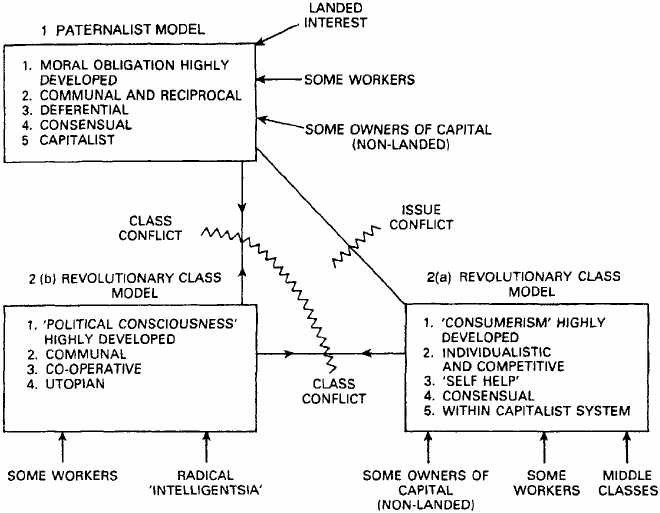
During the first half of the nineteenth century there was complex interaction between three rather than two views of society
and social change. On the one hand there was the paternalist view based upon traditional hierarchical principles with implicit
inequalities but reciprocal obligations. On the other hand there were two class models. A ‘revolutionary’ model, based on
horizontal social groupings, had co-operation between workers and a critique of industrial capitalism as its unifying
characteristics and class conflict as its motive force. An ‘evolutionary’ model was also based on horizontal groupings but
these were individuated, competitive and operated within the existing urban and industrial environment. Change was the
result of negotiating on specific issues to make the existing system fairer and consensual in character. These ideas can be seen
in Figure 16.2.
A ‘social revolution’?
The attitudes and values which underpinned British society changed between 1700 and 1850 but did that change constitute a
‘social revolution’? If by ‘social revolution’ historians mean fundamental changes in the structure of power, a reduction in
social inequality, the creation of an egalitarian society or the redistribution of wealth then changes of such importance did not
occur in this period. But if historians mean that society changed in response to altering economic conditions then the case for
a ‘social revolution’ may be stronger. Change in social attitudes and values was the result of dialogue between the older
notion of ‘paternalism’ and the newer conceptions of ‘class’. Whatever the pressures that drove people into classes it would
Figure 16.2 The nature of society: a tripartite model
204 A SOCIAL REVOLUTION
be unwise to discount the impact of the appeal to individual, and not class, solutions to the problems created by an industrial
and urban environment. In 1700 there was a clear differentiation between those in society who possessed visible landed
wealth and those who did not. By 1850 society had become more complex with the growth of alternative sources of wealth
and the dramatic expansion of a ‘middle class’ that had been very small in 1700. The ‘labouring population’ of 1700 had
become more heterogeneous with the expansion in older occupations and the creation of new ones in response to economic
change and demographic growth. This change occurred gradually, though not without dramatic effects on certain
occupational groups. Historians have identified three further ways in which individuals were differentiated in society between
1700 and 1850 which transcend, but also contribute to, the ‘paternalist-class’ debate: religion, gender and race.
DIFFERENTIATION BY OTHER MEANS
Religion
Throughout society the language of religion was part of a common culture. For much of the eighteenth century this did not
constitute a problem.
30
Until 1828–9 Britain was, in theory as well as practice, a ‘confessional state’ in which ‘citizenship’
was defined in terms of adherence to the Church of England. The strong squire-parson alliance, ideally suited to the majority
of rural parishes, provided much of the moral underpinning for the paternalist dependency system. Though given legislative
toleration. Catholicism and Dissent were clearly discriminated against by the penal legislation of the 1660s and 1670s which
prevented individuals from holding public office and achieving ‘real’ social status. ‘Occasional conformity’ was one way of
getting round these restrictions but, at least in England, Catholicism and Dissent had lost their social and cultural impetus and
had become increasingly demoralized and introverted. After 1750, in response to internal dissatisfaction with the Church of
England and its failure to respond to the newly created industrial and urban environment, an evangelical revival took place.
Led by the Wesleys, Methodism developed outside the establishment. A movement for ‘moral improvement’ occurred within
it.
The real problem after 1770 is to know what religion contemporaries were talking about and the depth to which Christianity
was rooted beyond an outward conformity and the widespread evidence of religious feeling. Three aspects of religious life can
be identified. At one level, religion is made up of a quest for individual truth and salvation. Many people throughout this
period aspired sincerely to a rich interior life, an ardent piety which the evangelical movement exploited to full advantage. At
a second level, that of organized religion, Christianity was an institution and religion a social and moral force providing a
generally agreed framework for the ‘Christian life’. Very few people denied all religious ties and did not belong, at least
nominally, to a Church or sect. Finally, there was the level which transcended sectarian boundaries, an
undenominational heritage of Christianity which influenced social and personal relationships. Churches, chapels and
cathedrals provided visible symbolism of history, heresy and heritage. This period would be incomprehensible unless the
power of the Bible and its constant presence in people’s minds and hearts is taken into account—Bible quotations, Bible
language and Bible pictures provided a common mental landscape.
It is the ‘associational’ dimension of religiosity that is of particular importance here. Was there a relationship between
religious observance and an individual’s social position? In broad terms the social appeal of the churches can be compared to
a ‘sandwich’. The Church of England corresponded to the top and bottom slices of society—the aristocratic elite and the
‘lower orders’—while the interior of the sandwich consisted of middle-class Nonconformists. Roman Catholicism took up a
similar position to the Church of England, with its small aristocratic fringe and proletarian support (a consequence largely of
Irish immigration) being strong at the two extremities of the social hierarchy. In practice, however, social responses to
religion were less clear-cut. Methodism penetrated into the working-class areas and both town and country and there was an
extension of Anglican activity among the middle class, making the situation less clearcut in 1850 than it had been in 1750.
Increasingly, only rural labourers remained in part loyal to the established Church, while the urban working class slid towards
indifference. This was brought out clearly in the religious census of 1851—there is clear evidence of the small number of
churchgoers in London, as well as in Birmingham, Manchester and Newcastle.
31
The degree to which religion prompted or restrained social change is a matter of disagreement among historians. Did
Methodism prevent social and political revolution? In general terms Catholicism, Anglicanism and Nonconformity reinforced
social inequalities, their Christianity was profoundly inegalitarian. They highlighted the importance of moral constraint and
attacked ‘popular’ culture through their support for temperance and the role of Sunday, and the doctrine that ‘sins of the flesh’
were the supreme vice. Respectability and the Gospel became inseparable—by 1850 Christianity had become a thin veneer
covering and defining ‘proper’ social relationships.
SOCIETY AND ECONOMY IN MODERN BRITAIN 1700–1850 205