
Brown R. Society and Economy in Modern Britain 1700-1850
Подождите немного. Документ загружается.

land will have different interests, to a degree, from those without land, just as subsistence producers will have, again to
a degree, differing concerns from simple commodity producers…the social formation of the English countryside was a
complex one, rather than the simple polarisation favoured by historians generally, with capitalists (large or small), on
the one hand, and labour on the other being the only classes of significance….
33
NOTES
1 John Clare ‘Enclosure’, in John Clare: Selected Poems, ed. J.Reeves, Heinemann, 1954, pp. 22–3.
2 Chapter 4 examines the revolutions on the land, chapter 13 those for whom paying or receiving rent was central to their lives and
chapter 16 discusses the notion of paternalism..
3 M.Stanford The Nature of Historical Knowledge, Basil Blackwell, 1986, pp. 56–75 contains a useful methodological discussion of
evidence.
4 R.Gough The History of Myddle, ed. D.Hey, Penguin, 1981 and a more modern analysis by D.Hey An English Rural Community:
Myddle under the Tudors and Stuarts, Leicester University Press, 1974. K.Wrightson English Society 1580–1680, Hutchinson, 1982,
also contains much of value.
5 R.Gough op. cit. p. 117.
6 ibid. p. 224.
7 ibid. pp. 138–9.
8 ibid. pp. 217–21.
9 David Baker has edited the 1782 census with an introduction which explains its problems as a source: The Inhabitants of Cardington
in 1782, Bedfordshire Historical Record Society, Vol. 52, 1973. N.L.Tranter has written two articles on Cardington: ‘Population and
Social Structure in a Bedfordshire Parish: the Cardington List of Inhabitants, 1782’, Population Studies, 21, 1967, pp. 261–82 and
‘The Social Structure of a Bedfordshire Parish in the mid-Nineteenth Century’, International Review of Social History, 18 (1973),
pp. 90–106.
10 N.L.Tranter, 1973, op. cit. p. 91.
11 The brief analysis of Risby and Houghton Regis is based on census enumerators’ returns and on a pamphlet Victorian Risby produced
by pupils of King Edward VI Upper School, Bury St Edmunds in 1975.
12 On rural industry see G.E.Mingay (ed.) The Victorian Countryside, Routledge & Kegan Paul, 1981 and G.E.Mingay Rural Life in
Victorian England, Heinemann, 1977, pp. 107–25, 169–83.
13 See D.R.Mills Lords and Peasants in Nineteenth Century Britain, Croom Helm, 1980, pp. 64–97 for a useful discussion of ‘open’
and ‘closed’ villages. See also D.R.Mills (ed.) English Rural Communities, Macmillan, 1973 and D. Spring The English Landed
Estate in the Nineteenth Century: Its Administration, Baltimore, 1963. K.D.M.Snell Annals of the Labouring Poor, Cambridge
University Press, 1985 and A.Armstrong Farmworkers, Batsford, 1988 are essential. P.Horn Life and Labour in Rural England 1760–
1850, Macmillan, 1987 contains documents.
14 Mills, 1980, op. cit. p. 76.
15 See J.Burnett A Social History of Housing 1815–1985, 2nd edn, Methuen, 1986 for the question of rural housing.
16 E.P.Thompson Whigs and Hunters: The Origins of the Black Act, Allen Lane, 1975 is indispensable on this issue as well as being an
excellent read. On poaching generally see H.Hopkins The Long Affray—The Poaching Wars in Britain 1760–1914, Seeker &
Warburg, 1985 and P.B.Munsche Gentlemen and Poachers: The English Game Laws 1671–1831, Cambridge University Press, 1981.
17 The most valuable studies of rural radicalism in the early nineteenth century are J.P.Dunbabin Rural Discontent in Nineteenth
Century Britain, Faber, 1974, A.J.Peacock Bread or Blood, Gollancz, 1965, on the 1816 disturbances, and E.J.Hobsbawm and
G.Rudé Captain Swing, Penguin, 1973 edn. See also R.Wells ‘Rural Rebels in Southern England in the 1830s’, in C.Emsley and
J.Walvin (eds) Artisans, Peasants and Proletarians 1760–1860, Croom Helm, 1985, pp. 124–65.
18 I have drawn very heavily on B.J.Davey Ashwell 1830–1914: the Decline of a Village Community, Leicester University Press, 1980.
19 ibid. p. 9.
20 ibid. p. 15.
21 ibid.
22 ibid. p. 18.
23 ibid. pp. 21–2.
24 ibid. p. 26.
25 See above, chapter 16.
26 Mills, 1980, op. cit. pp. 145, 147.
27 T.C.Smout ‘The Landowner and the Planned Village in Scotland 1730–1830’, in N.T.Phillipson and R.Mitchison (eds) Scotland in
the Age of Improvement: Essays in Scottish History in the Eighteenth Century, Edinburgh University Press, 1970.
28 D.W.Howell Land and People in Nineteenth-Century Wales, Routledge & Kegan Paul, 1977.
29 ibid. p. 149.
30 ibid. pp. 151–2.
31 S.Clark and J.S.Donnelly (eds) Irish Peasants: Violence and Political Unrest 1780–1914, University of Wisconsin Press, 1983
contains a useful discussion of peasantry in Ireland.
226 CHANGE IN THE COUNTRYSIDE 1700–1850
32 M.Reed ‘The Peasantry of Nineteenth Century England: a Neglected Class?’, History Workshop, 18 (1984), pp. 53–76.
33 ibid. p. 71.
SOCIETY AND ECONOMY IN MODERN BRITAIN 1700–1850 227
18
The impact of economic growth—the urban explosion 1700–1850
No, Sir, when a man is tired of London, he is tired of life, for there is in London all that life can afford.
1
Towns are not like villages, subject it may be, to the oversight and guidance of a single family, or a single
clergyman.
2
The notions of the ‘country’ and the ‘town’ have always roused strong feelings, evoked powerful images and created
fundamental contrasts.
3
Round the ‘country’ have gathered either the idea of a natural way of life, of peace, innocence and
simple virtue or the belief that the countryside was a place of ignorance, backwardness and limitation. Round the ‘town’
clustered either the idea of it as a centre of achievement, of learning and communication or as a place of worldliness, noise,
ambition and corruption. Like all stereotypes these polarities contain some truth. The previous chapter considered the
persistence and varied modification of rural communities during a period of economic and demographic change. This chapter
will examine those changes from the viewpoint of expanding urban centres.
TOWN AND CITY—A PROBLEM OF DEFINITION
What do historians understand by a ‘town’ or ‘urban area’?
4
There is no real agreement on what constitutes either a town or a
city. Is it a physical collection of streets or houses, or is it a centre for exchange and trade? Is it a particular kind of society or
the more nebulous notion of a ‘frame of mind’? Has it a certain size or specific density? Using ‘size’ as the criterion illustrates
the problem of definition very clearly. Some countries have adopted a simply numerical value. A town or city is bigger than a
village community. There is no real problem with this if historians are dealing with very large settlements. But the boundary
between a village and a town at the lower end of the scale is far less precise. In Denmark, for example, a settlement of 200
people constitutes a town today while in Greece the figure is 1,000 and in the United States, 2,500. There are circumstances when
a numerically small settlement may have urban characteristics, like density, markets, administrative functions and others in
which a numerically large settlement may still obviously be a village because of its agrarian occupational structure. ‘Size’
cannot, on its own, be used as a clear indicator of urban settlements.
The same problem of definition applies to the distinction between a town and a city. Saying that a city is a town which has
been ‘designated’ a city tends to confuse perhaps more than it enlightens. Historically, in Britain cities have been associated with
cathedrals. However justified this may have been it is difficult to think of St Asaph or Ely as cities in the same way as
Manchester or Birmingham. The difficulty of definition stems from a desire for clarity which historically simply did not exist.
While it is possible to identify those settlements in 1700 which had charters designating them towns and giving them certain
rights many were little different from larger village communities in terms either of social structure or economic emphases.
Rural and urban merged, in many cases almost imperceptibly. ‘Urban-ness’ or ‘rural-ness’ was a matter of degree.
Functions
Definitions, whether in economic or legal terms, or merely in terms of size, may not help historians seeking to understand the
nature of urbanism, but it is still important to understand what the functions of towns and cities were in Britain in the early
eighteenth century. Three major functions can be identified. First, towns reflected the economies of their surrounding areas
and in a complementary way the region was dependent on the town or city for all those specialist functions which hinge on
exchange and manufacture and service. Economic functions fell into several categories. Towns were important as ‘marketing’
centres especially for foodstuff coming from the surrounding rural area, though increasingly from a broader area, into the
urban area. This was a central economic function since towns had a higher proportion of non-food producers. Towns also
acted as marketing centres for goods produced in rural proto-industries and for manufactured goods produced in the towns
themselves. Broadly, towns were centres of commerce and increasingly of the services associated with trade—banking,
communications and finance generally. The rural and urban economies complemented each other. Secondly, towns acted as a
social focus either as centres of intellectual and cultural life—universities and theatres, for example, were in towns—or as a
focus of ‘opportunity’ for individuals who wanted upward social mobility. The latter is a reflection of the medieval notion
that ‘town air is free air’ and the belief that the streets of towns were ‘paved with gold’. Given early eighteenth-century
sanitary arrangements, nothing could have been further from the truth. The vast majority of those who sought wealth and
fortune in towns and cities found that they had only replaced the poverty of the countryside for the poverty of the town.
Thirdly, towns and cities were administrative centres for the courts of law, bishops’ palaces, local and central government and
the expanding bureaucracy of the modern state.
Social and economic heterogeneity
Towns and cities were characterized by both social and economic heterogeneity. Though many of the smaller British towns
maintained the same face-to-face characteristics as a villages and hamlets, demographic growth contributed to a loss of
personal contact and to the substitution of different forms of communication, to diversity and specialization and to anonymity.
During the eighteenth and first half of the nineteenth centuries the old urban social structure was modified by a loss of face-to-
face contact, decline in the importance of kinship and a weakening of family ties. Urban instability became the norm and
social mobility took on an increased significance. Towns and cities ceased to be communities in the same way that villages
were.
THE EIGHTEENTH-CENTURY URBAN SETTING
How does the study of British towns between 1500 and 1700 fit into this general framework?
5
Using the typology of G.
Sjoberg,
6
Clark and Slack argue that:
there are five basic and readily recognizable characteristics of English pre-industrial towns: first, an unusual
concentration of population; second, a specialist economic function; third, a complex social structure, fourth, a
sophisticated political order; and fifth, a distinctive influence beyond their immediate boundaries.
7
As we have already seen, there are problems with trying to set any precise lower level to the size of a town or to quantify
when it ceased to be a village. In 1696 Gregory King included all places with between 150 and 200 houses, implying a population
as low as 600 people. But this has to be related to specialized economic functions. The larger the town the greater the
economic diversity. The other three characteristics were common to the majority of towns, though they were not all shared by
smaller centres. The town was characterized by a more overtly stratified social pyramid than was found in the countryside.
There were sharp and visible differences in wealth and status, the latter underlying much of the institutional fabric of urban
life. But urban elites experienced a far higher turnover rate than their rural counterparts, more a reflection of higher levels of
migration than social mobility. Towns had often secured political privileges: from the grants of markets, freedom from tolls
and the jurisdiction of hundred or manorial courts to chartered status as boroughs. This led to the development of councils and
courts, municipal officials and guilds to regulate the political and economic life of the community. Size determined the degree
of social and political complexity and the extent to which the town had extra-urban influence. Clark and Slack admit that five
elements of their urban definition ‘are inevitably rather rough tools for social analysis. But it is reassuring to find them
reflected in contemporary views of the town, imprecise through these were’.
8
In 1700 Britain had a large number of towns in relation to its size and its total population, but they were almost all quite
small.
9
There were up to 500 market centres with mainly local spheres of influence with populations of between 400 and 2,
000. There were about fifty towns of between 2,000 and 5,000 people with regional importance. Less than thirty towns had a
population of over 5,000 people and only ten had more than 10,000 people. These were the major provincial centres. London
was the exception.
Country towns
The small English country towns were marketing centres and had grown in importance in the seventeenth century with the
expansion of internal trade. They acted as centres of trade between local producers and consumers and as collecting and
distributing points for a wider regional trade. Although the majority of their inhabitants did not work on the land, their
livelihoods were directly related to farming. Many of the occupations of tradesmen and craftsmen—tailors, blacksmiths, millers,
shoemakers— were found in the countryside and others were directly concerned with either processing agricultural products
or making farming implements. Some of these small towns were specialist centres. Burford in Oxfordshire was a posting
station and because of this was full of inns and specialized in harness-making. Shoreham in Sussex was dependent on
THE URBAN EXPLOSION 1700–1850 229
shipbuilding. In industrial areas such as the textile regions of the West Riding or south Lancashire, most towns were service
centres, a link between the area and much of the rest of the country. Populations tended to be denser and less dependent on
farming. The townsmen worked up or distributed raw materials like wool, yarn or bar metal, storing and dispatching finished
products outside the area. In general these towns were far less self-sufficient and relied on corn and other foodstuffs imported
into the area. Historians have asked several questions about these smaller towns in the eighteenth century: how far was the
earlier period of prosperity followed by decay and eclipse as the direction of internal trade tended to move in favour of the
larger country towns with their better communication? Was there a limited revival in the course of the eighteenth century with
the renewal of agricultural expansion?
Regional centres
English towns with populations of between 2,000 and 5,000 inhabitants were generally regional commercial centres, whose
hinterlands included several market towns and were often county towns. The market might be well known outside the area for
the sale of specialized goods produced in the region, besides handling larger quantities of goods than the smaller towns. They
had a wider range of distributive, manufacturing and service functions, were local social centres, attracted the gentry and their
families to the assizes and quarter sessions or to the diocesan centres.
Of the English towns with between 5,000 and 10,000 inhabitants about half were regional centres similar to those described
above, though only Bury (Lancashire) and Bury St Edmunds (Suffolk) relied mainly on this role. Seven other regional centres
in agricultural areas—Canterbury, Ipswich, Leicester, Nottingham, Salisbury, Worcester and Shrewsbury— were supported
by industry in the town or in its hinterland. C.W.Chalklin argues that there seems to have been a limit to the size of regional
centres in farming areas unless they provided additional employment for their growing populations. Eight towns relied almost
entirely on industry. The economies of Birmingham, Coventry, Leeds, Manchester and perhaps Tiverton (Devon) were based
on their own manufacture and the services provided for a largely industrial hinterland. Chatham, Portsmouth and Plymouth
depended on naval shipbuilding. Finally there were three ports: Liverpool, Hull and Sunderland. They were not county towns
or diocesan centres and their chief role lay in the countrywide waterborne distribution of a range of important products. The
number and population of towns dependent on industry swelled in three major ways. First, they were distributing and
collecting centres for the industry of their hinterlands. Secondly, because of the increased population supported by industrial
areas outside the towns, there was more work for urban shopkeepers and craftsmen. Thirdly, manufacturing processes were
done in most of these towns especially the finishing processes.
Provincial centres
Apart from London, there were six or seven towns with over 10,000 inhabitants which served as provincial centres—York,
Exeter, Newcastle, Bristol and Norwich, plus Colchester and Yarmouth. The place of London, with its population of a quarter
of a million in 1700, was paramount. It was important as the economic and social centre of the kingdom. It was the hub of
overseas and internal trade and has been characterized by F.J.Fisher as ‘an Engine of Economic Growth.’
The Scottish, Welsh and Irish urban experience
In Scotland the leading city in 1700 was Edinburgh with a population of about 45,000. Its importance rested on a wide range
of commercial, industrial, political and cultural functions. The ordinary royal burghs were the rough equivalent of the English
boroughs but were usually substantially smaller. In the sixteenth and seventeenth centuries they had suffered increasing
economic competition from the aggressive merchants of Edinburgh and from the smaller baronial burghs established by local
landowners to curtail the trading privileges of the larger towns. By 1700 some of the royal burghs had recovered their vitality,
helped by expanding trade with England and the colonies and by the ending of their more restrictive commercial practices. The
baronial burghs became the market towns of Scotland, closely integrated with the local agrarian economy, but their position
was threatened after 1700 by the growth of long-distance trade.
Scottish and Welsh country towns followed the same pattern as their English equivalents. In Wales the old fortified
boroughs lost their medieval military and political functions after the 1536 Act of Union. Urban growth moved away to more
open towns which either, as in the case of Denbigh, grew up outside the walls of the decaying fortified centres or, like
Dolgellau or Presteigne, developed as market centres which had close ties with the surrounding countryside. As in England,
the smaller towns expanded in the seventeenth century but by 1700 the main growth points were larger towns and ports such
as Swansea and Cardiff, which benefited from the expansion of the coal trade with England while the smaller towns fell under
the increasing domination of local landowners.
In Ireland Dublin was the major urban centre with a population of about 60,000 by 1700. It was the country’s leading port
and presided over a network of internal trade as well as being a major textile-producing centre. Historians know most about
230 SOCIETY AND ECONOMY IN MODERN BRITAIN 1700–1850

the country towns planted in Ulster in the seventeenth century. Prior to this the only towns of any significance were
Carrickfergus and Newry. Expansion was retarded by political instability and the Irish rebellion of the 1640s and Belfast had
a population of only 4,000 in 1700. However, the growth of trade with England and the spread of the linen trade, both evident
by 1700, led to a marked upswing in urban fortunes during the first half of the eighteenth century.
URBAN GROWTH 1700–1800
Between 1500 and 1700 urban growth throughout the British Isles had been centred on the small market towns and for many
larger urban centres this had been a period of difficulty. During the eighteenth century the pendulum swung towards the larger
centres. London and the main regional centres flourished as did many country towns. Most striking was the prosperity of the
major ports and centres of manufacturing production.
Changing distribution of population
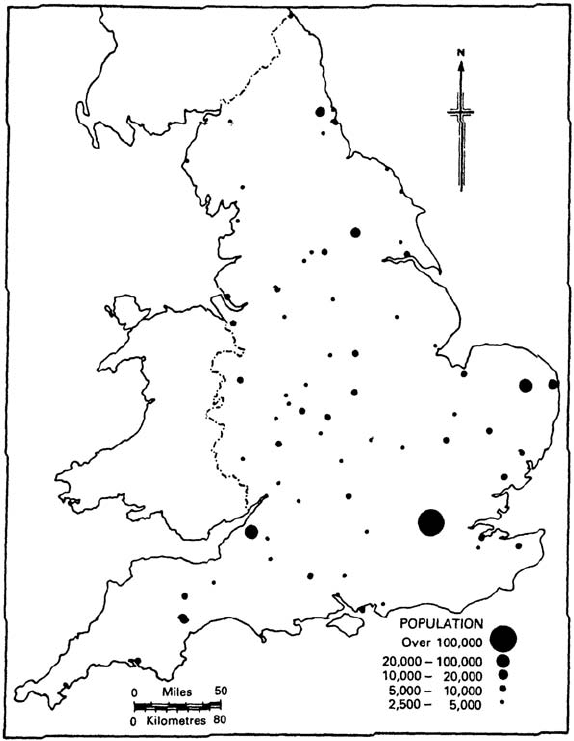
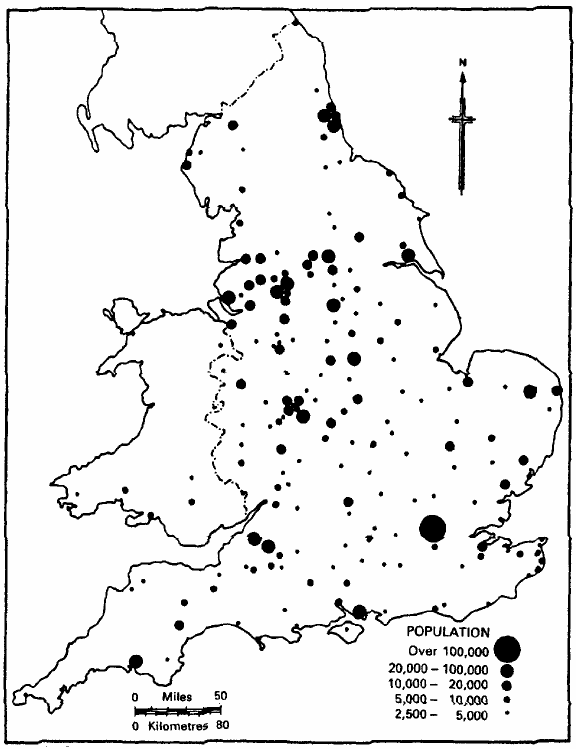
The change in the distribution of population in towns and cities between 1700 and 1800 can be seen in Tables 18.1 and 18.2.
Table 18.1 Population of England and Wales living in towns of 2,500+ inhabitants in 1700 and 1801
Size of town No. of towns Urban population
1700 1801 1700 1801
100,000+ 1 1 575,000 948,040
20,000–100,000 2 15 52,000 702,473
10,000–20,000 4 33 55,000 428,040
5,000–10,000 24 45 168,000 313,759
2,500–5,000 37 94 120,000 332,859
Total 68 188 970,000 2,725,171
Source: P.J.Corfield The Impact of English Towns, Oxford University Press, 1982, p. 8.
Table 18.2 Percentage of population of England and Wales in towns of 2,500+ inhabitants in 1700 and 1801
Size of town 1700 1801
Over 100,000 11.1 10.7
20,000–100,000 1.0 7.9
10,000–20,000 1.1 4.8
5,000–10,000 3.2 3.5
2,500–5,000 2.3 3.7
All towns 18.7 30.6
Source: ibid. p. 9.
Between 1700 and 1801 the number of people living in towns in Britain increased from under a fifth of the total population
to almost a third. London played a major role but the most significant growth was in the large provincial centres particularly
those with expanding industries and trade. Agricultural and manufactured production and colonial imports were expanding.
Town and village retail shops were spreading. Merchants, wholesalers and other middlemen increased in number and
specialization. Urban professions grew and the increased wealth of the middle class helped the development of a small
leisured class which congregated in urban centres. Towns expanded their role as centres for processing, manufacture and
distribution. Regional centres, by contrast, appear to have expanded to their optimal size.
Pattern of growth
The pattern of growth, however, was not even among these larger centres, Both Bristol and Liverpool prospered but one more
so than the other. This can be seen in Table 18.3.
THE URBAN EXPLOSION 1700–1850 231

Table 18.3 The changing urban hierarchy 1700–1801
Rank in 1801 1700 1750 1801
1. London 550,000 657,000 960,000
2. Manchester 10,000 18,000 84,020
3. Liverpool 6,000 22,000 78,000
4. Birmingham 7,000 23,700 74,000
5. Bristol 20,000 50,000 64,000
6. Leeds 6,000 16,000 53,000
7. Plymouth 6,500 14,000 43,194
8. Norwich 30,000 36,196 36,832
15. Exeter 14,000 16,000 17,000
17. York 11,000 11,400 16,145
Source: R.Pawson The Early Industrial Revolution, Batsford, 1978, pp. 213–4.
The reasons for this are complex. Liverpool had a rapidly expanding hinterland, not merely in south Lancashire but, through
the canal system, in the Midlands. By 1795 it had overtaken London as the major cotton importer. Bristol did not have such a
valuable hinterland and its harbour was less convenient and accessible than Liverpool’s deep-sea port. Bristol also lagged
behind Liverpool in dock improvements and this complacency was symptomatic of the different attitudes of the two
communities. Bristol had a well established trade with Ireland by 1700 and was the leading port of the slave trade. Liverpool
had no difficulty breaking into this trading system and was second to London in the Anglo-American trade by 1750.
Liverpool’s more northerly trading routes were safer from French privateers in the long wars after 1793 than either London or
Bristol.
The importance of the hinterland is reflected in the growth of the east coast ports. In 1700 Hull and King’s Lynn both had
about 6,000 inhabitants. Yarmouth, the great herring fishing centre and outport of Norwich, was bigger, with about 10,000.
All had extensive agricultural hinterlands and yet by 1801 Hull had outstripped the other two, 27,000 compared to Lynn’s 10,
000 and Yarmouth’s 15,000. Unlike King’s Lynn and Yarmouth. Hull’s hinterland consisted of the West Riding textile area,
the Sheffield cutlers but also the Nottingham hosiers and Manchester cotton manufacturers.
Urban growth and industrial development
The development of industry was the most important influence in English provincial urban growth. By contrast in East Anglia,
southern England and the West Country, stagnating or declining textile manufacture retarded the expansion of the towns
which it served. The largest town was Norwich whose industry declined relative to that of Lancashire and particularly the
West Riding. Norwich’s population was at best stagnant after 1750 and may have declined in the 1780s and 1790s as
competition intensified. Regional roles contracted in the textile centres of Worcester, Shrewsbury, Salisbury and Exeter but these
towns did have alternative functions. Smaller textile centres which did not have any alternatives were very badly hit. Tiverton
lost inhabitants and not until 1821 did numbers recover to those of a century before. Urban growth tended to be concentrated
in the more prosperous textile-producing areas especially after 1750. This was most marked in Lancashire, particularly
Manchester. Its population (including that of Salford) rose from less than 20,000 in the 1750s to over 84,000 in 1801. In view
of its nodal position in south Lancashire and its historical development as a regional centre, it is understandable that cotton
merchanting should have concentrated in Manchester. Because it controlled the market and manufacture of cloth, Manchester
played a major role in cloth bleaching and printing and became the main supplier of certain specialized services to the
industry. Finally, Manchester’s importance lay in the general services it provided as the regional capital of south-east Lancashire.
In the other developing textile areas, urban growth was also impressive. The expansion of the woollen and worsted
industries was the main cause of expansion in the West Riding textile areas. Unlike Manchester, Leeds did not have as
complete a dominance over its hinterland. Although the population of Leeds grew about five times in the eighteenth century
and reached over 48,000 by 1821, Wakefield rivalled it as an importer of food and raw materials into the region; much of the
worsted trade passed through the piece halls of Halifax and Bradford and, because of the lack of interest from long-established
Leeds merchants, large-scale manufacturing did not take the hold in the vicinity of Leeds that it did at Huddersfield, Bradford
and Halifax after 1780. Despite this, Leeds was still larger than these other towns in 1801. The reasons lay in its position as a
major communication and trading centre. The creation of the Aire and Calder Navigation in 1699 placed Leeds at its western
end and the turnpike system that developed in the 1740s and 1750s had strengthened its links with other centres. These
transport developments enhanced Leeds’ role as the main cloth market of the region and were accompanied by its
development as the main food market, wholesale distributor and entertainment centre of the region.
232 SOCIETY AND ECONOMY IN MODERN BRITAIN 1700–1850
Nottingham and Leicester were also areas where rapid expansion took place from the 1750s. Leicester’s population doubled
to almost 17,000 between 1750 and 1801 while Nottingham’s expanded quickly from the 1740s, reaching 17,771 in 1779 and
28,861 by 1801. Both were county towns and therefore social centres and their market function was important. This rapid
expansion was, however, largely the result of the growing prosperity of the hosiery industry. While part of the knitting work
was put out into neighbouring villages and smaller market towns like Hinckley and Mansfield, the number of knitters using
small workshops or house rooms in both Leicester and Nottingham rose with the general growth of the industry.
The production of metal goods was also an important stimulus to urban development. In the Black Country Birmingham
consolidated its metropolitan role in the later eighteenth century, becoming the hub for production and distribution in the area.
This role was enhanced by its position in the canal network, which linked it with other Black Country towns like Dudley,
Wolverhampton and Walsall and more distant centres like Nottingham, Coventry, Oxford and Liverpool. Several factors
contributed to the multiplication of small workshops making guns, buttons, metal toys and jewellery in Birmingham itself: the
availability of cheap coal after the Birmingham canal was opened in 1770, the general reputation of the town among retailers
outside the area and the existence of marketing services. Between 1780 and 1820 the other towns in the Black Country were
completely overshadowed by Birmingham, though all were local marketing centres as well as sites for metal workshops.
In the metalware-producing area of the West Riding, the population of Sheffield almost trebled in the later eighteenth
century: 12,983 inhabitants in 1755, 26,538 in 1788 and 35,344 (including the suburb of Brightside Bierlow) in 1801. Unlike
Birmingham, Sheffield’s hinterland was small and it remained geographically isolated with no canal reaching the city until
1819. The skilled and specialized nature of cutlery production and tool-making and the proximity of water power helps to
explain urban concentration, though similar manufacturing existed in the hamlets and villages of the area.
The organization of the shipbuilding industry, with the various trades concentrated in the yards, gave a special economic
structure to the dockyard towns. Unlike the manufacturing areas of Lancashire, Yorkshire and the Midlands, the service trades
and general crafts relied specifically on the people in these towns and minimally on the population outside. The Channel
Figure 18.1 Towns with 2,500+ inhabitants in England and Wales, 1700
Source: P.J.Corfield The Impact of English Towns, 1700–1800, Oxford University Press, 1982, p. 12.
THE URBAN EXPLOSION 1700–1850 233
dockyard towns of Plymouth and Portsmouth grew fastest, though intermittently, throughout this period, stimulated
particularly by the American and French Wars after 1775. The long peace after 1815 brought this rapid expansion to an end.
Merthyr Tydfil was the only Welsh town of more than 10,000 people in 1821 which depended on manufacturing or mining.
It was an isolated village in the mountains of Glamorgan until ironworks were established there in 1757. Ironstone, water power,
timber and coal were all on hand though rapid expansion had to wait until the puddling and rolling process of the 1780s which
allowed all the stages of ironmaking to be concentrated in one place. By 1801 Merthyr was the largest town in Wales, with a
population of 7,705 and by 1821 had reached 17,704. Elsewhere industrial production was not large enough to produce towns
of more than 5,000 people. Amlwch in Anglesey, a centre for mining and smelting copper ore from the Parys Mountain after
1770, appeared to be growing as quickly as Merthyr Tydfil. Its fortunes after 1800 were in marked contrast to Merthyr and
revealed the effects of dependence on a single industry. While Merthyr prospered during the war years, there was a decline in
employment in the Amlwch copper industry and its population fell.
Locating urban growth
In general, the larger of the rapidly growing industrial towns were in four main areas—south-east Lancashire, the West
Riding, the Black Country and the east Midland counties of Nottinghamshire and Leicestershire— and even in these areas
there were only six centres with more than 25,000 inhabitants in 1821, and thirteen with more than 15,000. What was new
was the rate of growth rather than the creation of new towns or the transformation of primarily agricultural centres. Merthyr was
the biggest exception to the general tendency that the industrial towns grew out of long-established roots. Although each town
had its own distinctive social and economic characteristics, certain general factors explain the rapid growth of the larger
Figure 18.2 Towns with 2,500+ inhabitants in England and Wales. 1801
Source: P.J.Corfield The Impact of English Towns 1700–1800, Oxford University Press, 1982, p. 14
234 SOCIETY AND ECONOMY IN MODERN BRITAIN 1700–1850
centres. First, several types of manufacture, not all exclusively urban, were the basis of their economic prosperity. Secondly,
some of these industries were highly specialized and this necessitated a pool of skilled artisans and some geographical
concentration of workshops. Thirdly, finishing trades, especially textiles, were largely urban. The volume of goods being
handled encouraged trades involved to group themselves around places of transfer (inns, markets, warehouses). Fourthly,
production in factories was increasingly urban, especially after 1800. This can be explained by access to a growing urban
labour force, but also the effect of encouraging labour from the surrounding countryside into the urban centres. Finally, towns
provided general services for all the inhabitants of their hinterland and this attracted specialized crafts, trades and markets for
the service of the whole region. This was aided by the role of the towns as centres for communication (turnpike roads, canals
and later railways). As C.W.Chalklin says, ‘big manufacturers and small independent artisans alike had an incentive to
migrate to metropolitan centres such as Birmingham and Manchester’.
10
Spas and seaside resorts
The development of spas and seaside resorts was perhaps the only original urban development of eighteenth-century England.
The expansion of inland spas and the emergence of seaside resorts was, as Chalklin says,
the result of the growing wealth and numbers in the middle and upper classes…the number of people able to make a
summer visit or to live permanently at a resort was increasing fast…the opportunity to drink or bathe in the medicinal
waters…was [often] a pretext cloaking the real motive, the lure of the entertainments provided by parades, assembly
rooms and card rooms and theatres.
11
Bath remained the undisputed leader of the inland spas and its population continued to grow. By 1801 it had 34,160
inhabitants and an influx in the second decade of the nineteenth century pushed this up to 46,588 in 1821. Why was Bath so
successful? First, it was accessible. Improvements to the River Avon in the early eighteenth century assisted in the carriage of
goods. Bath also rapidly established coach services and the need for good roads attracted some of the earliest investment in
turnpikes. Accessibility alone was, however, insufficient to promote a spa and a second reason for Bath’s success lay in its
provision of suitable amenities. The eighteenth century saw the building of Georgian Bath to satisfy the need for good-quality
accommodation. Rebuilding in the old lower town near the Abbey was complemented by the growth of an upper town to the
north and west. John Wood, architect and developer, was the central figure in this process starting with Queen’s Square (built
between 1728 and 1735) and ending with the Royal Crescent (of 1767–75). Visual unity was achieved through the widespread
use of local stone, much of it from quarries on Combe Down owned by Ralph Allen, an entrepreneur and powerful local
figure. Domestic developments were paralleled by the growth of public buildings: theatres, pump rooms, assembly rooms,
baths. Aesthetic unity was accompanied by an archiecture of manners, of codes of etiquette.
The third reason for Bath’s success lay in the nature of its patronage. Initial social prestige was achieved by the summer
visits of Queen Anne in 1702 and 1703 and throughout the eighteenth century Bath drew strongly on aristocratic and
fashionable London society. But its clientele was not exclusive. There was awareness of social rank here, as elsewhere in this
period, but not segregation. Bath had relative social openness, an openness that became more obvious with the emergence of
the middle classes in the late eighteenth century. Its size increased and with it some loss of exclusiveness and fashion
occurred. Cheltenham, Tunbridge Wells, Leamington Spa and Harrogate provided alternative places to ‘take the waters’.
Lastly Bath depended for its success on the promotion of an attractive image which was fostered by Beau Nash in the early
eighteenth century. He established, during his long period as Master of Ceremonies from 1705 to 1761, the image of the city
as the natural home for elegant leisure and a code of proper behaviour and routine for all, irrespective of social origin.
The growth of the seaside resort reflected the growing scale and diversification of the leisure industry and provided
increasing competition for the inland spas. Sea-bathing had been advocated on medicinal grounds since the mid-seventeenth
century and bathing-machines were in use in Scarborough by the 1730s. In 1749 Dr Richard Russell wrote an influential tract
advocating drinking and bathing in seawater for the treatment of glandular complaints and in 1754 he settled in Brighton,
beginning an extensive promotion of the resort. Brighton’s population grew rapidly after 1750: in 1761 about 2,000 people;
1783, 3,500; 1794, 5,669; 7,339 by 1801 and 24,429 by 1821. It did not overtake Bath as the premier leisure resort until 1851.
Like Bath, Brighton gained social prestige from royal patronage, with the Prince of Wales visiting regularly from 1783
onwards, and it developed its own social code and routine. There were other settlements on the east and south coast which
attracted leisure classes from the 1750s onwards: Margate, a cheaper version of Brighton; Weymouth, visited by George III in
1789 and 1805; Eastbourne, Scarborough, Worthing and Littlehampton. Their population was generally small and in the
eighteenth century, except for Bath and Brighton, the contribution made by resorts to the overall growth of towns was small.
After 1800, however, the English spas and resorts showed a faster rate of growth (in aggregate) than the great manufacturing
towns and ports.
THE URBAN EXPLOSION 1700–1850 235