
Brown R. Society and Economy in Modern Britain 1700-1850
Подождите немного. Документ загружается.


Table 17.2 Cardington households by social and occupational status
Description of household No. of households % No. of people %
Farmer 32 11.3 204 14.1
Tradesman 26 9.2 155 10.7
Craftsman 28 9.9 131 9.0
Labourer 187 65.7 920 63.4
Others 11 3.9 41 2.8
TOTAL 284 100.0 1,451 100.0
Source: N.L.Tranter ‘The Social Structure of a Bedfordshire Parish in the Mid-nineteenth Century’, International Review of Social
History, 18 (1973), p. 90.
‘Farmers’, the wealthier and more substantial members of the community, made up only a small proportion of the total
population while agricultural day labourers and people involved in the usual trading and craft activities characteristic of rural
parishes made up the large majority of the population. As in 1782 the overwhelming proportion of resident females aged over
five was occupied in domestic handicraft trades of various kinds, though principally lace-making. As Tranter says: ‘If the
social structure of Cardington changed in any respect during the first half of the nineteenth century, it did so against a
background of economic continuity.’
10
Risby and Houghton Regis
There were important similarities and differences between Risby (population 355), in Suffolk, and Houghton Regis
(population 2,196), in southern Bedfordshire, and Cardington in 1851.
11
All three parishes had the same basic social structure
—leading landowners, a ‘parish elite’ and a labouring population. Most of the population in each parish was either born there
or in close proximity. Less than one in ten came from outside either Suffolk or Bedfordshire. Parishes, at least in southern
England, were distinctly parochial. Risby was an overwhelmingly agricultural parish: agricultural labourers made up 80 per
cent of its total population. In Cardington and Houghton Regis rural industries were of more importance: for example, only 14
per cent were specified as ‘Ag Labs’ in Houghton Regis. The reason lay in the proximity of the hat-making trade in Luton and
Dunstable leading to the growth of a domestic-based straw-plaiting industry in Houghton Regis absorbing up to 40 per cent of
the population.
INDUSTRY IN THE VILLAGE
What was the significance of industry in villages?
12
First, it enabled population to have a better standard of living than would
have been possible by relying on agriculture alone. Secondly, it had important socio-economic implications within the village
community. In areas where a craft or industry was well developed, another significant social group was added to landless
labourers, farmers, landowners and tradesmen. Industrial groups were, however, closely integrated with the rest of the
community through the existence of dual occupations. This could—though in the cases of Cardington and Houghton Regis,
where industry was essentially done by women and children, it did not—lead to a challenge to the hegemony of the landed
elite. In the south Yorkshire parish of Ecclesfield, for example, nail-making was important in the north and cutlery on the
southern Sheffield side. Workers in both these occupations farmed as well and, in the early eighteenth century, one household
in eight contained a smithy. Many of the nailers and cutlers were better off than those who made a living entirely from
farming and some were able to rank with the yeoman. Rural industries were still expanding in 1800 but by 1850 several
important industrial processes—e.g. brick-making, framework knitting, handloom weaving—had begun to use coal and/or
steam power. At the same time the railways became an effective system and the country craftsmen found their livelihoods
threatened by cheaper, mass-manufactured products.
‘OPEN’ AND ‘CLOSED’ VILLAGES
Risby, Cardington and Houghton Regis were all ‘open’, as opposed to ‘closed’ villages.
13
In broad terms an ‘open’ village
was controlled by its freeholders while a ‘closed’ village was controlled solely by large landowner(s). In 1832 there were 308
rural townships in Leicestershire with a density of owners ranging from only 5 acres per owner in industrialized Mountsorrel
to 2,273 acres per owner at Stapleford, an estate village where the Earl of Harborough was sole proprietor. Of the 134 villages
which were closed, 39 were classified as estate villages while the remaining 95 had absentee landlords. The 174 open villages
were even more varied than the closed villages. The number of owners varied from barely 10 to well over 100 and from an
average of 5 acres per owner to over 200. Mills argues that
216 CHANGE IN THE COUNTRYSIDE 1700–1850

it is possible to consider two situations which are conceptually distinct —one in which a large number of owners, including
owner-occupiers, form the basis of a well developed ‘peasant’ community, the other where the land is merely divided
between so many owners that no one of them, or even a caucus of two or three, can be said to have a controlling
interest.
14
What implications do these divisions have for change in the countryside? The characteristics of open and closed villages are
summarized in Table 17.3.
Table 17.3 Open and closed villages: a typology
Open Closed
Large populations Small populations
High population density Low population density
Rapid population increases Slow population increases
Many small proprietors Large estates
Peasant families Gentlemen’s residences
Small farms Large farms
High poor rates Low poor rates
Rural industries and craftsmen Little industry and few craftsmen
Plentiful shops/public houses Few shops/public houses
Housing poor but plentiful Housing good but in short supply
Nonconformity common Strong Anglican control
Radical and independent Deference strong in politics and social organizations
Poachers Gamekeepers
Source: D.R.Mills Lord and Peasant in Nineteenth Century Britain, Croom Helm, 1980, p. 117, table 6.1.
Population density and population growth was much lower in closed than open parishes. In Bedfordshire, for example, the
25 closed parishes had one person per 5.61 acres, while in the 90 open parishes the figure was one person per 3.34 acres. One
important consequence of this was that open villages often provided labour for farms in closed villages. Specialist workers,
like stockmen and gamekeepers, were found cottages in the closed village but day labourers would be drawn in from the
neighbouring open villages, particularly at harvest time. In this way some integration occurred between open and closed
communities. The use of gangs, especially in eastern England, was partly a result of the shortage of harvest labour in closed
villages and of unemployment in open villages. The latter was also a reason why labourers walked to work in neighbouring
towns.
The estate system of large farms was found particularly in the arable areas of lowland England. Smaller family holdings,
except in areas like the Fens, Kent and the Vale of Evesham, were found mainly in pastoral areas, especially in northern and
western England, and in the areas of wood pasture in south-east England, like the Weald and the Chilterns. Pastoral farming
favoured a peasantry and provided a basis for industrial growth because it was less demanding on capital, was less prone to
drastic economic fluctuations, could be made profitable on a smaller scale than arable farming and it made widespread use of
cheaper female labour. Pastoral farming was less labour-intensive and could consequently be combined with domestic
production more easily than arable farming more easily. The early stockingers in the east Midlands, where there was no scope
for absorbing surplus labour in farming, were often substantial tradesmen or open-village farmers who had capital available
for the purchase of stocking frames. Comparative economic advantage led areas in southern England and East Anglia away
from industry into more innovative arable farming, which absorbed most of the available capital and labour. The occupational
structures of arable and pastoral areas developed distinctive features.
There were important differences between open and closed parishes in terms of the quality of housing.
15
The poor housing
standards of the large, often overcrowded, open villages contrasted with the formally planned estate village. Demand for
housing resulted in higher rents than in closed villages and sanitation and water supplies were frequently inadequate. The
control over housing which the landlord commanded in closed villages was part of the process of social control, an expression
of patriarchal influence in the same way that control was exerted through religion. The squire and parson wielded
considerable influence in closed parishes—they have been called ‘miniature welfare states’—and there was little possibility of
Nonconformity or independent thinking developing. The estate system made tenants and labourers dependent on squire and
parson and was only challenged where there were substantial peasant holdings and freeholdings or where there was a distinct
artisan grouping. Contemporaries may have emphasized that non-attendance at church was the root cause of lack of deference
in open parishes but this neglects the pervasiveness of control of the closed parishes. Vertical social control of closed villages
SOCIETY AND ECONOMY IN MODERN BRITAIN 1700–1850 217
took several forms. Control through housing was one expression of this. Tenancy agreements often specified attendance at
church. When the Earl of Radnor built the Berkshire village of Coleshill, to replace dispersed cottages, he gave as his reasons
First To put the inhabitants under the influence of public opinion
Second To put them near the Church
Third To put them near the School
Fourth To put them near the Post Office
Fifth To put them near the shop by which the labourer saves 15 per cent of his wages.
The closed village, in theory and frequently in practice, was a controlled society, deferential, dependent, compliant.
Open villages and dispersed settlements were often more politically radical than closed, nucleated villages. Rights tended to
be based on custom rather than law and were vigorously defended. This can be seen in reactions to the Black Act of 1723
which turned many forms of rural protest and crime, such as deer-stalking, ‘blacking’ (poaching in disguise), cutting trees and
maiming cattle, into capital offences.
16
Crown property in Windsor had long been used by squatters to relieve population
pressure. The forests also provided important additional employment and resources —charcoal-making, lime-burning, brick-
making, obtaining sand and gravel, making articles out of wood—for small freeholders in hamlets and dispersed settlements.
Lax forest administration had led to the emergence of customary practices which supported a local economy that was
traditional rather than capitalistic and market-oriented. The introduction of Whig gentry, who obtained the forest offices
which they exploited with callous disregard for traditional customs, led to conflict. The Black Act can be seen as a piece of
legislation designed to reinforce Whig economic hegemony which was threatened by lack of social deference from the
inhabitants of open parishes. Recent research has, however, suggested a narrowly political motive, namely the Jacobite
attitude of the foresters. The resurgence of ‘blacking’ in an organized form was the response. Deer was poached, less for its
food value than as a symbol of Whig authority which threatened traditional economy, crops and agrarian rights. In Ireland
turnip crops were destroyed for the same reason in the early nineteenth century. Protest could also occur because traditional
economic elites prevented capitalist practices being introduced. In the early nineteenth century, for example, smuggling was
carried out by the rising class of tradesmen resentful of the domination of the landed elite in the Blaxhall district of Suffolk.
The early nineteenth century saw a growth of rural protest as population growth outstripped rural demands for labour—in
both farming and industry—and where the poor laws demoralized the labouring population. It may not have been organized
and systematic but it was certainly not ephemeral.
17
Hobsbawm and Rudé found that the open-closed dichotomy was less
clear-cut than presented by contemporary writers. Tradesmen and Nonconformist preachers, whose mere presence was a
challenge to the authority of the landed elite, were frequently in the forefront of protests. They may have had a direct
grievance about farm wage levels— relevant in terms of the purchasing power of labourers—but it was more a question of
their social identification with the labouring population and their general position as community leaders, the result of superior
education and ‘knowledge of the world’. Open villages contained a higher proportion of tradesmen, artisans and small family
cultivators who were economically, socially and ideologically independent of the landed elite and who had less to lose by
protesting than the labourers in closed villages. Open villages contained more pauperism and unemployment than closed
villages, particularly in southern England with its highly fluctuating demand for labour. Loyalty in open villages was to self
and family rather than to the estate and in this situation protest was more likely to occur.
ASHWELL—A VILLAGE IN DEPTH
Ashwell, in northern Hertfordshire, was described by Arthur Young in 1804 as ‘a poor, open parish’.
18
It had about 750
inhabitants in the early years of the nineteenth century and the problems they encountered were paralleled, to a lesser or
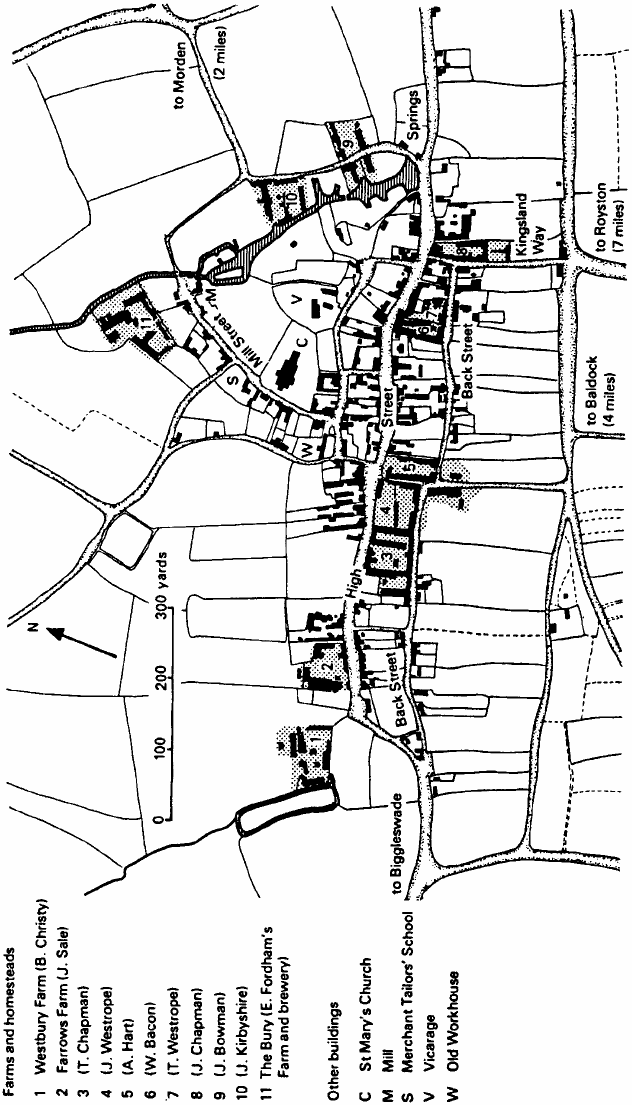
greater extent, by villagers all over southern England. The larger houses, inns and one or two shops were found in the High
Street but the most important feature was the dozen farmhouses scattered along its length, each with barns and other buildings
round a central yard with a ‘home close’ of pasture land behind. In Back Street, which ran parallel to High Street, were the
workshops and homes of the craftsmen and tradesmen of the village. There was also a village church (St Mary’s), a mill, a
Merchant Taylors’ School and the Old Workhouse (Figure 17.1). Young noted the poor nature of roads to Ashwell and Davey
is undoubtedly correct in writing
Isolated by its position, unnoticed and unnoticing, Ashwell depended almost entirely on its own resources, and was
mainly concerned with the day-to-day struggle to ensure that those resources could meet its needs.
19
218 CHANGE IN THE COUNTRYSIDE 1700–1850
A village economy
The village economy was based on farming 4,000 acres of chalk soil. Within the parish, largely farmed under an open system
until 1863, there was a heavy dependence on grain crops with barley as the most productive. The late enclosure of all but 300
acres in the western part of the parish was largely because two-thirds of the land was in the hands of several absentee landlords
and there was consequently a lack of drive to enclose —B.G.Snow of London owned 600 acres, C.S.Tinling of Devon over 1,
000 plus several other private and institutional estates such as those of St John’s College, Cambridge and of the Bishop of
London. In the 1841 census, of the 21 men who classified themselves as ‘farmers’, two-thirds were almost exclusively tenant
farmers and of the seven owner-occupiers only four (John and Thomas Chapman, 231 and 306 acres respectively, Richard
Westrope 255 acres and Edward Fordham 147 acres) had substantial acreages. Ashwell showed considerable continuity of tenant
farmers —the Tinling estate changed hands three times between 1830 and 1914 but two of its most important farms remained
in the hands of the Sale and Christy families throughout. The dominant pattern of agriculture in
Ashwell lay in several large farms—the average size of farm in the 1840s was 163 acres and ten farms were between 200
and 300 acres. Ashwell may not have been enclosed but some farmers appear to have consolidated their strips into more
compact units. In 1840 Farrows Farm, for example, had its 330 acres divided up as follows: 62 acres in 18 lots of enclosed
land, 56 acres in 55 strips in North Field, 59 acres in 69 strips in Redland Field, 80 acres in 73 strips in Claybush Fields and
70 acres in 56 strips in Quarry Field. The Sale family acquired land in the west of the parish to consolidate their holdings but
it was a slow process and by 1840 little real progress had been made. There were only 23 acres of common pasture in the
parish and grazing rights were strictly controlled by the Vestry and the pinder, who collected animals from the farms, returned
them at the end of the day and ensured that no one abused their common rights. The large farmers kept sheep which were
systematically folded over their own strips to manure the soil. The poor seem to have had few common rights other than
crossing the open fields on the maze of footpaths.
Grain was the major crop of all the farms. In the 1810s Farrows Farm grew on average 80 acres of wheat, 70–80 acres of
barley and 25–30 acres of oats (largely for home consumption by eight horses). Higher wheat prices, as for example between
1813 and 1818, led to wheat being sown at the expense of barley. Farmers used the new methods of farming, as far as their
small plots of land would allow. Production at Farrows Farm shows evidence of convertible husbandry, cultivation of clover
and turnips (over 100 acres in total), beans, peas, potatoes and coleseed. This enabled the Sale family to maintain 150 sheep
(for meat and wool as well as manure), cows (largely for the dairy products and meat for home consumption) and pigs.
Farming in Ashwell has been described as ‘not prosperous [but] it is clear that it might be described as thriving’.
20
Arthur Young was wrong to see Ashwell as poor and backward simply because it had open fields.
A diverse community
Agriculture was the foundation of Ashwell’s life but entries in nineteenth-century directories which stated that the inhabitants
were ‘wholly engaged in agricultural pursuits’ are misleading. Rural communities, depending on their location, were more or
less self-supporting. In 1841, for example, Ashwell contain 14 individuals who classed themselves as carpenters, 9
bricklayers, 5 blacksmiths, 7 shoemakers, 4 millers, 2 bakers, 6 publicans, 3 thatchers, 3 saddlers, 2 carriers, 3 grocers, a brewer,
a barber, a rope-maker, a painter and glazier and a well-established family of rat-catchers. Though some of these individuals
were employed by others, there were master-craftsmen in each of the major occupations and, including unskilled labourers
and apprentices, almost a hundred men (about 25 per cent of the male adult population) were involved in crafts and trade.
Davey
21
argues that they were ‘wholly’ involved but this is unlikely and many could have combined crafts and trade with
work in agriculture at critical times in the farming year. These men were, however, a distinct social group with greater status
and security than the mass of agricultural labourers, and their work frequently took them outside the parish. For example,
Abraham Thorne, a master-wheelwright, plied his trade in a number of villages within a 10-mile radius of Ashwell and often
arranged business on his regular visits to Royston market.
Agricultural labourers formed the largest occupational group in the village—about 50 per cent of adult males in 1841, 54
per cent in 1851 and 57 per cent in 1861. They formed a definable rural proletariat with only five owning any land in 1840
(only 10 acres in total). The farm servant, hired for the year, was uncommon in Ashwell and most labourers were employed
on a weekly or daily basis. Their position became increasingly insecure after 1810. In the 1810s the 330 acres of Farrows
Farm were worked by eight men and four or five boys. The men earned between 1s. 8d. and 2s. 3d. per day. It was extremely
rare for them to be laid off and wet weather often meant higher wages since they were then used for threshing. In addition a
shepherd and housekeeper were employed at a basic rate of 10s. per week, a lower weekly rate than for general labourers but
they were slightly more secure in their jobs. From this one example it can be seen that there was considerable variety in the
employment and pay of labourers, depending on their work, their ability and their age. The low level of Ashwell’s poor rates
between 1800 and 1820 can be explained by the existence of weaving, bonnet-making and some lace-making and by the growth
of the more lucrative straw-plaiting. Women and children did most of the straw-plaiting and until the 1840s when several
SOCIETY AND ECONOMY IN MODERN BRITAIN 1700–1850 219
factors began collecting the plaits, sold their products at Hitchin market on Saturday mornings. This could bring an income of
up to £1 a week in the first half of the nineteenth century and played a major part in the family budget. As Davey says, ‘It remained
a vital factor in the Ashwell labourer’s economy, and seems to have rescued him from that grinding poverty which was the lot
of so many of his fellows elsewhere.’
22
Figure 17.1 Ashwell in the 1840s
Source: B.J.Davey Ashell1830–1914: The decline of a village community, Leicester University Press, 1980, p. 10.
220 CHANGE IN THE COUNTRYSIDE 1700–1850
Education
The standard of education in Ashwell was potentially high. The 1841 census identified four schools. There was a free school
for boys administered by the Worshipful Company of Merchant Taylors but most children went to ‘plait schools’ where basic
literacy and numeracy were taught in addition to straw-plaiting. Most children appear to have attended school at some time in
their lives though many ‘lost the habit’ once they were employed in jobs which did not use reading, writing or arithmetic. An
emphasis on boys’ education can be seen among tradesmen and among the farmers who sent their sons to small private
schools in the east coast towns.
Housing
By contrast the standard of labourers’ housing and sanitation was low. The thatch and chalk clunch buildings were infested
with vermin, and open cesspits, polluted water and filthy streets bred infection. Improvements were made only after larger and
more powerful local government agencies took an active role. Throughout this period the village was self-governing. There
was no squire and the burden of government fell on the Vestry, a body which officially included all the ratepayers and owners
in the parish, but in practice only the vicar and between 10 and 20 people attended. It had wide-ranging powers including
administering local charities, controlling parish land and property, maintaining roads and bridges, settling open-field disputes
and sometimes offering village opinion on national political issues. It appointed two unpaid overseers and a Surveyor of the
Highways, who tended to be farmers, and a constable, who was usually one of the craftsmen, frequently the blacksmith in
Ashwell. Davey comments: ‘In a truly representative, if not fully democratic way, it [the Vestry] was the government of the
community, by and for the community….’
23
This may be an over-optimistic viewpoint because whatever community of interest and economic independence there was
in Ashwell was to be shattered by economic change after 1830.
Change and continuity
What were the issues which affected Ashwell in the first half of the nineteenth century? The most obvious was a dramatic
expansion of population, which doubled between 1801 and 1851 from 715 to 1,425 inhabitants. There is no evidence to
suggest that this was any more than a natural increase of the indigenous population with immigration playing no significant role.
The major effect of this was the need to find work in the village for these increased numbers. Farmers could not afford to employ
more men and plaiting was more widely adopted in the 1830s and 1840s. Plaiting was, however, almost exclusively women’s
work and dependent on an external market for its produce. Men increasingly looked to the crafts and trades for employment,
to the extent that a third of all adult men were employed in them in 1851. Ashwell was a barley-growing area and beer-
making became increasingly important as an employer of labour. By 1851 the brewing trade employed at least 30 men and
probably gave part-time work to many more.
These new opportunities were insufficient to absorb all the surplus labour and high levels of unemployment, particularly
among farm workers, were evident from the early 1830s. Davey estimates that 15 per cent of labouring men were unemployed
in this period.
24
This put increasing pressure on the system of poor relief operating in the parish. Ashwell had established a
workhouse in 1727 and had six cottages which it rented out to old people at nominal rents. Most of the unemployed were
given ‘outdoor relief, doles in money or in kind given on personal application to the overseers. Ashwell had no fixed
‘Speenhamland’-type system and each application was treated on its merit. This required considerable judgement on the part
of the overseers and became expensive as unemployment began to rise. In 1815 poor relief cost the parish £250 per annum; by
1821 this had risen to over £300 and by 1830–4 it amounted to £500 per annum.
The Vestry approached this problem by using two strategies, motivated perhaps by the Swing Riots, rural disturbances
affecting large areas of southern England in 1830 which, though they did not touch Ashwell, came perilously close. First, it
provided work. In late 1831 14 major farmers agreed to employ one man for every 40 acres they farmed for a year and in June
1835 some surplus labourers were employed digging stones at the quarries. Secondly, the Vestry encouraged emigration. In
1836 a contribution of £60 was made to defray the expense of poor people wishing to emigrate to Canada. Nine young men—
the group most hit by unemployment—left the village in late May 1836 for this purpose. This was repeated in 1854, though
only £15 was provided.
The poor and the police
Ashwell’s attitude to the poor was broadly paternalistic. Those more wealthy inhabitants had a moral duty to mitigate the
effects of unemployment and economic depression for the less well-off. This protection, however, only extended to
individuals from the parish and ‘strangers’ and vagrants were generally ‘encouraged’ to leave as quickly as possible. The
SOCIETY AND ECONOMY IN MODERN BRITAIN 1700–1850 221
relative autonomy which the parish had in dealing with its poor is generally thought to have ended after 1834 with the
implementation of the Poor Law Amendment Act.
Responsibility for the poor passed to the Royston Union, with Ashwell represented on the Board of Guardians by one
elected member though Mr T.Westrope, one of the major owner-occupiers, sat as an ex officio member because he was a JP.
A new workhouse, opened in 1837, was built just outside Royston and this generated considerable hostility here as in other
localities. Opposition round Royston was mobilized by two local clergymen but did not lead, as elsewhere, to the violent
destruction of the workhouse. Ashwell was declared an ‘outdoor area’, like many parishes in large rural Poor Law Unions and
the new workhouse seems to have had a similar role to the parish workhouse. It was the last resort for the utterly destitute, the
severely sick, abandoned children and some of the aged. But the stigma of the workhouse threw a long shadow and outdoor relief
after 1834 was far less benevolent than before. The new relieving officers, often from outside the parish, tended to be less
sympathetic than the locally appointed overseers.
The most obvious impact of the 1834 Act was a substantial reduction in the poor rates: they were roughly halved and
remained at between £250 and £300 per annum until the 1870s. The Vestry continued to take some interest in the plight of the
poor though its decision to sell the six old people’s cottages in 1851 reflected the effective transfer of responsibility. But the
parish still looked after its own and from 1835 onwards a large number of Friendly Societies and Benefit Clubs were
established in the village with some financial support from the Vestry. Most labourers were members of some sort of club by
1850 and few could not support themselves during temporary unemployment due to illness.
The independence of the village was also affected by the establishment of the County Police Force in 1842 replacing the
local constable elected by the Vestry with full-time professionals, the new PCs. They had more time than the local constable
to enforce the law and many people saw this as interference with established custom, even when the custom was technically
illegal. Petty poaching, long a feature of village life, was now prosecuted more vigorously and after 1842 a constant stream of
Ashwell men appeared before the courts.
Migration from the parish increased after 1830 with some 150 men leaving between the 1841 and 1851 censuses. This
reflected the inability of Ashwell to absorb the growing population, which became increasingly dependent on external
markets for the products of straw-plaiting and brewing and a depressed agricultural sector. It was not only poor relief and
policing that were now outside parish control. Economically Ashwell was far more obviously dependent on the market in
1850 than it had been in 1800. Paternalist relations were being replaced by more stridently capitalist ones. The crisis for
Ashwell came after 1850 in the period that historians have called ‘the Golden Age’ for farming.
From the specific to the general
How representative was the experience of the inhabitants of Ashwell of other villagers in England? In two important respects
it was not. First, Ashwell did not undergo the, often traumatic, experience of enclosure. Secondly, though there is evidence
for the increasing importance of domestic production it never replaced agriculture as the main occupation in Ashwell unlike
villages in other areas where manufacturing production expanded.
In other respects, however, the problems and tensions in this community had parallels throughout England. First, it had to
cope with major environmental problems—poor housing for the bulk of the population, low levels of sanitation and deficient
drinking water and widespread ill-health. Secondly, Ashwell experienced a reduction in the control which it had over its own
affairs, particularly over dealing with the poor and with law enforcement, though the Vestry continued to adopt paternalist
strategies for mitigating, if not eliminating, problems. Thirdly, customs, which had previously legitimized actions and been
the arbiter of village affairs, were diluted by an increasingly strict application of ‘legal’ as opposed to ‘moral’ rights. This led,
fourthly, to a questioning of the paternalist system of social organization.
25
In Ashwell this was an implicit rather than explicit
process, a case of gradual modification of attitudes rather than dramatic change. There is no evidence of food riots or
disturbances in Ashwell itself but the labouring population would undoubtedly have been aware of events outside the parish
and this may have influenced both their attitudes and those of the major employers. Finally, Ashwell was a community in
which the effects of changing emphases in the economy were having some impact. Within fifty years it went from having
sufficient labour to being in surplus. This surplus could not be absorbed in agriculture without dramatically reducing farmers’
profits. The results—an increase in poor rates and the move towards domestic production—were evidence of falling profit
margins in arable farming after 1815. Ashwell, to a certain degree, mirrored the impact of change in agrarian communities
throughout England.
SCOTLAND
In 1700 most parts of Scotland had a largely subsistence economy, though the Highlands and Islands were least developed.
The clan system which dominated these areas was based on military service and kinship. The main type of settlement in early
eighteenth-century rural Scotland was a hamlet of multiple tenants know as a ‘ferm-toun’ in the Lowlands and sometimes as a
222 CHANGE IN THE COUNTRYSIDE 1700–1850
‘bailie’ in the Highlands. Payment of rent was mainly in kind and in labour until feudal tenure was abolished in 1746. During
the eighteenth century the Scottish landscape underwent a process of rapid change—this was far more ‘revolutionary’ than in
England. The result, according to Dennis Mills, was that
Wales approximated to the English peasant system, being a more developed form of peasant society, while Scotland
exhibited most of the characteristics of the estate system…[so that] Not only in the highland zone, but throughout
Scotland the lasting impression is of a landed class which carried all before it on a journey to full-blooded capitalism
and outdid the English in speed and thoroughness.
26
The old clusters of small farms typical of the ferm-touns disappeared and were replaced by large, modern farms with sleeping
quarters for single servants and cottages for married men. The subsistence economy of common fields (run-rigs), peasant holding
and common pasture were swept away and replaced by estates owned by capitalist farmers and worked by a landless
proletariat. In crofting areas, the old clustered settlements were replaced by separate and dispersed crofts. The speed and
thoroughness of change was made possible by four things. First, there was no equivalent to the English yeoman or class of small
owner-occupier, which could have acted as a barrier to the creation of consolidated estates. Secondly, there was a general
absence of long-standing customary rights in arable land. Thirdly, Scottish landowners were given a far freer hand than their
English counterparts in enclosing land by Acts in 1661, 1685, 1695 and 1770. Finally, the failure of the Jacobite rebellions led
to widespread confiscation of land, particularly in the Highlands. There was no effective challenge to the dominant position of
large landowners in the Scottish rural economy.
This dominance was reflected in the planned village movement, the Scottish parallel to the English estate system.
However, the rationale behind the planned villages rose out of landlord need for local consumption and servicing points in an
emergent commercial economy. As a result many planned villages started out as industrial and commercial centres concerned
with simple processing activities, and only later diversified into textile production. Scottish landowners supported this movement
for two main reasons. First, this absorbed labour made surplus by enclosure and ‘improvement’. Secondly, they supported
industrial growth because it increased their rents and allowed continuation of social control over industrial workers. Planned
villages let them do this and if a successful industrial village evolved into a town they tended to withdraw.
There is some disagreement over how many planned villages were founded in the eighteenth and early nineteenth
centuries: estimates vary between 130 and 268. T.C.Smout’s analysis omits landlord villages not physically replanned from
his total of 130.
27
He distinguishes eight main groupings of planned villages: group I in north-east Scotland in which crofters
were rehoused as a result of Highland clearances; group II near Aberdeen were largely agrarian but often included fishing and
weaving; group III in the central Highlands were planned to achieve social control over the clans; group IV on the western
coast were mainly fishing and harbour settlements; group V was a linen group based on yarn sent out from Perth and Dundee;
group VI were factory villages round Glasgow and Paisley; and groups VII and VIII in the Southern Uplands had origins in
farming, industry and trade.
The control which Scottish landowners had over the economy was reflected in the operation of the Scottish Poor Law.
Landlords were able to develop sectors of the economy, which in England were often controlled by the emergent bourgeoisie,
and consequently absorb unemployed farm servants. They were aided in this by the nature of the Scottish Poor Law which
gave no relief to the able-bodied, only the destitute and kept the level of relief to the bare minimum; only one in ten parishes
were assessed, with funds provided in the others by voluntary church collection. In terms of poor relief, at least until all
parishes were assessed after 1846, there was no sharp contrast between neighbouring parishes as there was in England.
The degree to which the clan system was in decay in the early eighteenth century is a matter of disagreement among
historians. Certainly by 1700 the Highlands provided important supplies of labour, wool, sheep, cattle and kelp for the
Lowland towns. Culloden and its aftermath may be seen as a dramatic continuation of trends already evident. The Highlands
were becoming increasingly commercialized and by the first half of the nineteenth century most Highland landowners had
either to embark on clearances or sell out to Lowlander or even English capitalists. The unity of interest and language that
existed in the Highlands in 1700 was replaced by lack of understanding between nineteenth-century proprietors and their
crofting tenants.
Crofting arose out of the collapse of the clan system and complete reliance on a subsistence economy. In addition to arable
farming it relied on the sale of animals and wood and additional employment in fishing and weaving. It replaced the
hierarchical clan system with co-operation between independent households particularly for certain agricultural operations
like ‘souming’ (control of the common pastures) and ‘fanks’ (roundups of animals). The boundary between bare subsistence
and profit for crofters was a narrow one and clearances were one method employed to remove the impoverished. They were
replaced by capitalized tenant farmers who used the same land for large-scale sheep and cattle farming. Crofters did not have
any security of tenure and landlords were able to proceed without too much opposition. This modernization of the Highland
economy resulted in widespread emigration from Scotland. Some of the dispossessed crofters migrated to the Lowlands,
firstly seasonally and then permanently, while others were allocated inferior land, often on the coast where fishing and kelp-
SOCIETY AND ECONOMY IN MODERN BRITAIN 1700–1850 223
burning were important occupations. Landlords encouraged this until technical changes in glass manufacture led to the
decline of kelping in the 1820s. Landlords then brought sheep into the coastal areas, promoting emigration to reduce
unemployment.
Landlord and crofter had different priorities during this period. Landlords and large tenant farmers were concerned with
maximizing profits on the basis of substantial capital expenditure. The crofter, by contrast, lacked the capital to engage in large-
scale farming and was concerned to maximize social solidarity. Potato-growing, which required minimum capital outlay, gave
good return on a small acreage and used family labour, was widely adopted in the late eighteenth and early nineteenth
centuries as a way of countering landlord pressure. Even so, eviction was a constant threat.
Landlord and crofter differed linguistically, politically and religiously. Crofters clung to Gaelic long after it had been
abandoned by the gentry and town dwellers. The Free Church which, like the Primitive Methodists in England, was
sympathetic to the problems of the labouring population, was able to make significant advances in crofting areas. Crofters
appear to have been radical or Liberal in political persuasion, following the lead of the Scottish urban population, rather than
Tory like their landlords. But as Mills says: ‘So the landed classes in Scotland produced a rural landscape of large dispersed
farmsteads and planned villages having greater freedom of action than their counterparts in England.’
WALES
Kinship played an important role in the development of rural Wales though the dilution of its tribal system predated the end
of the Scottish clans by 200 years. As in Scotland by 1700 larger farms were associated with dispersed settlements, though in
general the typical Welsh farm remained small, a process exacerbated by enclosure. The Welsh gentry was anglicized before
their Scottish counterparts and their authority was reinforced by the adoption of primogeniture, which allowed the
accumulation of estates. Smaller farmers still clung to the traditional ‘gavelkind’, a form of partible inheritance which divided
rather than consolidated land.
Sixty per cent of land in Wales was in the form of estates over 1,000 acres compared to only 53 per cent in England. Only
13 per cent of land was, however, in estates over 10,000 acres compared to 25 per cent in England. This reflected a weakness
of estate management and the lower productivity of Welsh land. The Welsh gentry did not rent land to well-capitalized
tenants, who could act as agrarian improvers, as in England and Scotland. Husbandry techniques remained largely unimproved
— drainage, the key to good farming, was poor; green crops and roots were sparsely grown; there was little attention to
livestock breeding and implements were crude. Tenurial relations did to some extent hinder change and fear of rent increases
was often a crucial obstacle to improvement. For many—landowner and tenant—land was not regarded as a commercial
speculation but simply a means of providing a livelihood. Even the railways, while altering the system of marketing, did not
provide the vital injection of enterprise and capital into Welsh agriculture after 1835.
Welsh rural society was relatively classless below the gentry. The rising commercial and professional middle class
belonged to urban rather than rural Wales. Kin not class provided social cohesion, a consequence, perhaps, of the poverty of a
semi-subsistence economy. Land hunger was also a problem and many men worked as labourers for part of their lives before
taking a holding of their own. It is, however, possible to distinguish between different types of small farmer: those labourers
and cottagers who farmed up to 20 acres and who often supplemented their earnings from farming as quarrymen, gardeners,
coal miners and craftsmen; medium-sized farmers with 20 to 80 acres relying on sons and close relatives or who employed
more than two labourers for manpower, and large farms with over 80 acres.
Is it sufficient to argue that the lack of change in Welsh rural society was the result of under-capitalization by both the large
landowners and the smaller gentry? Why did landlords not play a constructive role in providing fixed capital in generous
amounts? The traditional argument is that many landlords were non-resident and took little interest in their estates apart from
the collection of rents, that there was insecurity of tenure and lack of tenant compensation for improvements and that the
employment of English and Scottish agents created tensions between tenant and owner. David Howell has challenged this
view in his study of Welsh landownership in the nineteenth century.
28
He suggests that
Hereditary Welsh owners, large and small alike, far from being wholly out of sympathy with their tenants, possessed an
inborn sense of responsibility for their welfare…. Tenants felt no strong sense of insecurity. They were charged fair and
often lenient rents, competition for holdings being the decisive factor in determining rents.
29
and that
the ‘Welsh Land Question’—the agrarian indictment against the landowners—was largely the invention of Welsh
Nonconformist Radicalism towards achieving political democracy and national fulfilment, and that…Radical leaders…
often pressed anti-landlord allegations which had no basis in fact.
224 CHANGE IN THE COUNTRYSIDE 1700–1850
If anything, Howell argues, it was the dramatic growth of Nonconformity in early nineteenth-century Wales which challenged
the traditional political and social hegemony of landlords by introducing a different set of values:
The landowners were disappointed and affronted at what they considered to be the ungrateful behaviour of people
whose welfare they had always sought to promote. They undoubtedly felt ‘betrayed’ and strongly resented the perfidy
of the meddling preachers…. The ‘chapel screw’ was a power which landlords could not hope to meet; in fact spiritual
influence replaced economic sanction as a subtle form of coercion.
30
There are two problems with Howell’s argument. First, much of his evidence comes from the records of a relatively few large
estates, partly because they have survived while those of smaller estates have not. Secondly, where smaller estate papers have
survived they strongly support traditional views of Welsh landowners and their attitude towards their tenants. What Howell
has done is to provide a case more balanced than that presented through the vast political propaganda associated with The
Land Question’ but this does not alter either the case for undercapitalization of Welsh farming generally or the major
contrasts between English and Welsh experience.
IRELAND
Population growth was the dominant feature of Irish rural change between 1700 and 1850. From less than 2.5 million in 1750,
Ireland’s population rose to 4.4 million in 1791, reached 6.8 million in 1821 and 8.2 million in 1841. The impact of this on the
shape of the agrarian social structure is not in doubt.
31
The number of labourers and cottiers increased markedly. By 1845
cottiers (who held less than 5 acres) and wage-labourers outnumbered small and large farmers by two to one. If small farmers
(who held land between 5 and 15 acres) are ranked with cottiers and labourers, the people in these three categories were four
times as numerous as the elite of larger farmers (holders of over 15 acres).
There was constant tension over the mismatch between needs and resources in Ireland. Increases in food production, oats as
well as potatoes, were achieved by the forcible conversion of pasture to arable. This tactic was usually accompanied by efforts
to regulate the price of ‘conacre’ (land rented seasonally by labourers to grow their potatoes). Parallel to this were attempts to
make Irish farming more commercial, a process stimulated by Britain’s swelling food requirements. This led to an extension
of the area devoted to corn crops in Ireland. These two processes, however, had divergent effects. Population growth led to
the increased subdivision of Irish holdings while commercial farming necessitated larger estates. The shift away from pastoral
farming exacerbated existing cultural tensions within Irish society particularly over the payment of clerical taxes or tithes.
Between 1735 and 1823 livestock and livestock products were largely exempt from tithes and the burden of supporting the
clergy of the Protestant Church of Ireland fell on those engaged in arable farming. The shift to tillage resulted in religious and
particularly economically motivated opposition. In Munster and parts of Leinster potatoes were tithable, unlike the rest of
Ireland, and there was a clear relationship in these areas between demographic growth, increased potato cultivation and unrest
because of tithes.
The transformation of the agrarian social structure, the commercialization of agriculture and its almost exclusive
dependence on the, sometimes depressed, British grain market together produced increasing tension between the large farmers
and the rural poor. Though land was owned by a small elite, fewer than 10,000 aristocrats and gentry, their estates were sub-
let to such an extent that for the majority of the rural poor their landlord was not the owner of the soil but a large farmer.
These farmers were mostly leaseholders, with extended tenure at a fixed rent for the term of the lease. Before 1790 terms of
three lives or thirty-one years, whichever lasted longer, were quite common, though shorter terms probably dominated after
then. Small farmers and especially cottiers were usually tenants-at-will. As a result large farmers could adjust the rents their
tenants paid while being themselves protected by the fixed lease. Labourers and cottiers often became victims of the
narrowing margin between what they had to pay for food and land and the means they possessed for doing so. They were
economically squeezed by rising rents, falling real wages and tithes.
CONCLUSIONS
British rural society exhibited both continuity and change between 1700 and 1850. A contrast is often drawn between the
English rural social structure of large landlords, tenant farmers and hired labourers and the peasant economies of Scotland,
Wales and Ireland. But rural society was far more complex. Scotland, particularly the Lowlands, exhibited many of the
characteristics of the English estate system. Elements of a peasant economy can be identified in England.
32
The dangers of
oversimplification have been brought out by Mick Reed:
Capitalist producers do not all have identical material interests. Industrialists and farmers, landlords and tenants, have
different interests in some respects, and make up different fractions of the capitalist class. Similarly peasant producers with
SOCIETY AND ECONOMY IN MODERN BRITAIN 1700–1850 225