
Brown R. Society and Economy in Modern Britain 1700-1850
Подождите немного. Документ загружается.

URBAN GROWTH AFTER 1800
The process of urban growth that began in the eighteenth century continued unabated after 1800.
12
Urban populations
increased much faster than that of Britain as a whole. The major difference between eighteenth-and nineteenth-century urban
growth was qualitative rather than quantitative—the development of ‘urbanization as a way of life’:
Furthermore this phenomenon was not only quantitative, in the demographic and economic order of things, but also
qualitative, socially and culturally, turning British mentalities and conditions of life upside down.
…in the course of this urbanisation a new visual scheme emerged together with a new system of social relations and a
new life style—in brief a new civilisation came into being.
13
What has been called ‘galloping urbanization’ occurred in the first half of the nineteenth century. The urban population grew
by an average of 27 per cent every decade between 1801 and 1851, a movement which accelerated after 1820 and reached its
peak between 1841 and 1851 when it was accentuated by the influx of Irish immigrants. Towns with populations of more than
2,500 absorbed 67 per cent of the total increase of England’s population between 1801 and 1841. Rural regions had a large
excess of births over deaths, a result of migration from country areas towards urban centres and of the transfer of labour from
agriculture to industry and services.
Industrial concentration and urban growth
Industry was increasingly concentrated in towns which before 1800 often had been more commercial than industrial. This
concentration was due to the expansion of large-scale industry, the increasing use of steam power, railway building which
improved the supply of foodstuffs and raw materials to larger centres, external economies resulting from the development of
industries and services ancillary to the staple industries in each centre as well as the existence of a ready labour force. Growth
was cumulative once industrial activities had taken root in a town and conditions developed favourable to a new growth. In
some cases industrial and communication developments created specialist new towns. Railway towns like Crewe, Swindon,
Rugby and Doncaster developed at the site of important junctions or railway workshops. There were also towns, like Barrow-
in-Furness and Middlesbrough, resulting from the working of new ore deposits and the ironworks which were set up near
them. But these were exceptional cases; it was usually existing towns which developed and there was little change in the
urban hierarchy between 1800 and 1850.
Rural-urban migration
Rural-urban migration gathered momentum in the 1830s and 1840s but the extent to which urban growth was primarily the
result of this varied from one place to another. In 1851 more than half the adult populations of Leeds, Sheffield and Norwich
were born in the town but the percentage fell to a quarter in Manchester, Bradford and Glasgow and was even smaller in
Liverpool. In London immigration seems to have been responsible for about half of the total increase between 1800 and 1850
and this gave rise to serious problems of integration and assimilation for the many newcomers, particularly in the Irish
colonies, who lived in defined areas. Apart from the Irish, the nature of migration to towns was not one of long-distance
moves. Within England there was no large-scale inter-regional migration, but a complex of small local movements. In
particular there was no significant movement from the agricultural south to the industrial north. The northern industrial towns
recruited their immigrants from the surrounding country areas and ‘they also had a strong natural increase due to high
fertility. Industrial regions produced their own labour-force…which became an essential factor in the change of demographic
balance between north and south.’
14
Rates of growth depended on the type of town. Small market towns without significant industrial resources grew more slowly
than the total urban population. Towns of between 2,500 and 20,000 inhabitants accounted for 14.5 per cent of the total
population of England and Wales in 1801 and only 15.3 per cent in 1841. On the other hand rapid progress was registered by
both the many medium-sized industrial centres such as the cotton towns of Lancashire, mining towns like Wigan, ironmaking
or processing towns like Wolverhampton and seaside resorts and inland spas. The most dramatic urban growth, however,
occurred in the large and very large towns. In 1801 there were 16 towns with between 20,000 and 100,000 inhabitants and
only one over 100,000 but by 1841 there were 48 and 7 respectively. With the exception of London—these were the large
provincial and particularly regional capitals like Manchester, Birmingham, Liverpool, Sheffield and Leeds.
Engels argued in 1845 that ‘What is true of London, is true of Manchester, Birmingham, Leeds, is true of all great towns….
Everywhere barbarous indifference, hard egotism on one hand, and nameless misery on the other….’
15
and J.G.Kohl, a
German visitor to Britain a year earlier commented:
236 SOCIETY AND ECONOMY IN MODERN BRITAIN 1700–1850
The manufacturing cities of England are none of them very attractive or pleasing in appearance, but Leeds is, perhaps,
the ugliest and least attractive town in all England. In Birmingham, Manchester and other such cities, among the mass
of chimneys and factories, are scattered, here and there, splendid newsrooms, or clubs, and interesting exchanges, banks,
railway stations, or Wellington and Nelson monuments. Leeds has none of these.
16
What characterized England’s urban development after 1700 was the diversity of experience it created. Urban growth was
neither as uniform as Engels intimated nor as monotonous and uninviting as Kohl believed.
A DIVERSITY OF URBAN GROWTH
What created this diversity? Kohl attributed Birmingham’s lack of distinctive architecture to its industrial structure of small
workshops compared to Manchester’s large factories. Alexis de Tocqueville visited both cities in 1835, commenting
At Manchester a few great capitalists, thousands of poor workmen and little middle class. At Birmingham, few large
industries, many small industrialists. At Manchester workmen are counted by the thousand, two or three thousand in the
factories. At Birmingham the workers work in their own houses or in little workshops in the company of the master
himself…. Separation of classes, much greater at Manchester than at Birmingham.
17
Certainly, housing in Manchester and Birmingham was very different. In Birmingham few houses were divided into flats,
cellars were little utilized and the quality of street cleansing and drainage was better than in Manchester and other Lancashire
towns. Birmingham’s better housing was attributed by contemporaries to its social structure as much as to better natural
drainage. As Richard Dennis says:
It is tempting to arrange England’s industrial cities along a continuum of social and spatial structure from Manchester at
one extreme, by way of Leeds where factories in the woollen industry were smaller than in Lancashire cotton, to
Sheffield and Birmingham, the principal examples of workshop industry. But such a continuum ignores the major
seaports…and it suggests, falsely, that the satellites of each of the major cities could also be ranged along a continuum
paralleling that of the regional capitals.
18
Engels may have described Manchester as ‘the classic type of a modern manufacturing town’ but how typical was it, or
Birmingham, of England’s urban growth and problems? Contemporaries reflected the obsessions of the age, the cultural and
political prejudices of observers and the expectations of their readers more than any discussion of an ‘objective’ reality. There
is the danger of caricature in the search for literary effect as, for example, in Dickens’ description of the monotony of
Coketown in Hard Times. It was important to writers like Engels that all towns should be alike, a viewpoint motivated by the
need to convince readers of the universality of the class struggle, of unscrupulous landlords and of exploitation in the
marketplace and in work. Official reports in the 1840s also stressed the ‘sameness’ of problems to justify central government
intervention and national legislation. The reality was one of intense diversity rather than ‘sameness’—this is evident even in
Dickens’ Hard Times —and nineteenth-century towns and cities do not fit easily into any Manchester-Birmingham continuum,
useful though this model is for historians. The first effect of industrialization may have been to differentiate communities but
contemporaries maintained that all towns experienced, or thought they experienced, the same problems. Historians have
identified various dimensions by which towns and cities differed: socio-political structure, the strength and diversity of
religious adherence, the significance of migrant populations and a variety of demographic characteristics, as well as by
economic function and size.
Socio-political structures
Two dimensions—socio-political structure and religious affiliation—illustrate the diversity of urban growth. John Foster
shows the diversity of social and political response in medium-sized industrial towns.
19
He argues that difference in class
formation between Oldham, South Shields and Northampton initially followed the Manchester-Birmingham continuum. There
was a clear distinction between employed and employer in Oldham while Northampton had a self-employed or small master
petit bourgeoisie. It was in the impersonal factory character of the former, Foster argues, that a strong sense of working-class
consciousness developed and where there was considerable potential for working-class political control. Foster’s conflict
model has, however, not gone unchallenged. Oldham factories were on a smaller scale, averaging only 79 workers per cotton
mill in 1841 compared to 281 in Blackburn. Working-class control in Oldham was achieved, D.S.Gadian maintains,
20
not by
conflict but by inter-class collaboration and that control was lost in the 1840s when the interests of employers and workers
diverged. Gadian argues that Oldham was not the place to illustrate Foster’s thesis:
THE URBAN EXPLOSION 1700–1850 237
In such communities as Stockport, Blackburn, Manchester, Bolton and Ashton-under-Lyne, where large-scale factory
industry had developed furthest, working and middle class reformers were unable or unwilling to achieve the effective
level of class collaboration that was managed in Oldham and Rochdale.
21
In the West Riding woollen industry mechanization occurred later, units of production were smaller and employers showed
less interest in the conditions of the working population. The result was a heightened sense of political activism rather than
trade unionism. In Lancashire, by contrast, ownership of production lay with large and often paternalistic owners and here it
was trade unions that were important in an attempt to control production through negotiating better working conditions and
wages. This accounts for the less politicized nature of working-class action in urban Lancashire.
Religious affiliations
It was possible to distinguish between towns in terms of the political party and religious denomination associated with the
dominant groups. Mill-owners and ironmasters were not all liberal Nonconformists. Many originated in local landed society
or in the ranks of commerce and often subscribed to a form of radical Tory Anglicanism. This was reflected in their
paternalistic attitudes to workers. The effect of this can be illustrated by comparing Burnley with Blackburn, Preston and
Bolton. Burnley was the last cotton district to develop in the first half of the nineteenth century. Employers were more often
new arrivals than from local families and were neither rich enough nor sufficiently confident to provide the paternalism
offered by long-established employers in the other towns. Wages were lower, working conditions poorer, continuity of
employment less assured in Burnley and consequently politicized working-class action was more common. In Blackburn,
Bolton and Preston conditions were better and there was a closer correlation between the political and religious affiliations of
employers and workers.
The religious profile of towns can be ascertained from the 1851 Religious Census. K.S.Inglis has developed an index of
attendance which simply divides total attendances in an area (including double attendances) by total population.
22
Though
there are problems with this approach some interesting patterns emerge. The index of attendance for the whole of England and
Wales was 61 but, with the exception of York and Wakefield, the only towns to exceed this were south of the River Trent. All
the major textile towns of north-west England, the principal towns of north-east England and Liverpool, Manchester,
Birmingham and Leeds recorded an index of below 49.7 (the average of all towns of more than 10,000 inhabitants). The
pattern becomes more complicated when the denominational structure of each town is considered. Liverpool, Preston,
Manchester, Bolton and Blackburn all shared high attendance at Catholic churches and relatively low attendance at
Nonconformist chapels, but other Lancashire towns—Oldham and Bury, for example—deviated from this pattern. Salford and
Macclesfield had equal proportions of all three religious groups and shared this profile with Newcastle, Walsall and Coventry.
URBAN GROWTH IN WALES, SCOTLAND AND IRELAND
Wales
Urban growth in Wales, Scotland and Ireland was, with notable exceptions, far less dramatic than in England. In 1700 Welsh
towns were small in size. Towns of military origin like Caernarfon had evolved as administrative centres and the county
towns were the sites for the Court of Great Sessions which met twice annually and for the quarter sessions. Both these types
of town became centres for lawyers and professional men whose services were in increasing demand as economic activity
accelerated.
During the eighteenth century Welsh towns were undergoing change though architecturally and from the standpoint of
town planning they did not compare favourably with some English or even Irish towns that were developing at this time.
There is Georgian architecture in Wales but it is fairly well distributed. Georgian houses can be found in Beaumaris, Brecon,
Ruthin, Haverfordwest, Aberystwyth, Chepstow and Monmouth. Two trends in urban life became apparent by the early
nineteenth century: first, the desire for economic expansion and second, the growth of civic pride. Increased resources resulted
in a growth of public buildings: the development of Nonconformity led to the building of considerable numbers of chapels;
town and guild halls were built using corporation money and private subscriptions.
Improved communications between towns and especially with London played a central role in urban development. By 1765
Brecon was connected to London by post-coach and by 1800 Cardiff had daily coach services to London. This encouraged the
opening of inns along the routes which acted as post-offices. Much transport was seaborne and river ports as well as small
coastal towns owed their prosperity to this. The expansion of agriculture, seasonal fishing and the development of industry in
their hinterland contributed to their prosperity. Aberystwyth, for example, profited from mining developments and by 1800
238 SOCIETY AND ECONOMY IN MODERN BRITAIN 1700–1850
the town was largely under the control of mining speculators. It procured a Harbour Act in 1780 which increased trade and led
to a growth in the number of merchants who opened businesses in the town.
As in England, spas became very popular in Wales after 1700. Theophilus Evans is credited with discovering wells at
Llanwrytd and Builth. By 1740 Llandrindod Wells was the ‘Welsh Bath’ and Trefriw became the spa of North Wales, though
was never as popular as the spas of Brecknockshire and Radnorshire. The inland spas, unlike their English counterparts, were
less able to compete with the rise of seaside resorts. Some parish authorities paid the expenses of invalids to go to the seaside
for a cure, Lampeter, for example, as early as 1779. Swansea, already developing as an industrial centre by 1800, also wanted
to be regarded as a fashionable resort. The laying of a horse tramway in 1804 to convey visitors to Mumbles was the world’s
first passenger railway. Resorts in north-east Wales were slower to develop but Abergele was described in 1797 as a much-
frequented place and Colwyn and Llandudno had already begun to develop by the 1830s.
Industrial development played the most important part in Welsh urban development. Towns which were not incorporated were
often centres of various trades because they were free from guild control. Dolgellau became a centre for cloth finishing and
Bala for the stocking and hat trade; Wrexham, with a variety of small artisan workshops, became a centre for cloth dealers
from Yorkshire as well as a banking centre for a growing industrial area. The Severn valley towns of Welshpool, Newtown
and Llanidloes were the only places, with the exception of the lower Teifi valley, where a factory-based industry was
successfully established. The effect of industrial growth on urban development was most apparent in South Wales and by
1801 Merthyr Tydfil had a population of over 7,000 people, increasing by half every decade between 1801 and 1851.
Developments at Aberdare were comparable with those at Merthyr but at the heads of the Monmouthshire valleys
industrialization caused more diffuse settlement. Settlement around Ebbw Vale was dispersed along the Ebbw Fawr and Ebbw
Fach valleys and the town grew out of a collection of industrial villages. Pontypool, a centre of ironworking and tinplate
manufacture, was also a settlement strung out in a linear pattern along the river. Tredegar was probably the nearest to a nucleated
town in this area. In the early nineteenth century industrial South Wales saw a dramatic increase in population, largely
through immigration. The Welsh-speaking population gathered at the top of the valleys especially round Beaufort, with the
English and Irish further down. Racial, linguistic and religious differences as well as geography retarded their assimilation
with important consequences for public order as the ‘Scotch Cattle’ violence demonstrated in the 1820s and 1830s.
Scotland
The balance of Scotland’s population did not alter radically until the 1780s, and in this predominantly rural society towns
were small. Edinburgh was the exception, with a population of over 47,000 in the early eighteenth century. It had the
reputation for the worst tenement housing in Europe where people’s social status depended on the layer of the tenement in
which they lived. The better-off sections of society were sandwiched between the less well-off. Edinburgh built upwards
rather than outwards because of defensive and geographical limitations. Large-scale expansion was, however, made possible
by the building of the New Town from the 1760s. This partly political decision was designed to attract Scottish gentry back
from London by turning Edinburgh into a modern social and economic metropolitan centre. James Craig’s plan, accepted in
1767, aimed at preventing some of the old difficulties and defects and a 1771 Act limited the height of houses to three storeys
on the main streets and two on intermediate streets. His plan was based on a gridiron pattern with a square at each end
connected by three parallel avenues (Princes, George and Queen Streets). Initial enthusiasm for the project waned after the
collapse of the Ayr Bank in 1772 and vigorous house construction did not restart until the mid-1780s. After 1800, when the
streets in Craig’s plan were practically all built up, the New Town was extended to both north and west with the addition of many
new squares (Charlotte Square designed by Robert Adam after 1800 for example), circuses and avenues, and building enjoyed
a considerable boom until 1830. Though the City Council regulated the design of houses in a very general fashion, there was
no attempt to impose architectural uniformity until the Adams family became involved in the 1790s. Consequently the overall
effect lacked the homogeneity of Bath and the new houses provided accommodation for only a fraction of the Scottish people.
The building of the New Town led to a social segregation which the tenements did not. The wealthy, urban gentry, merchants
and professional people moved to the New Town leaving the traders, shopkeepers, artisans and poor in the Old Town.
Glasgow’s growth from a modest cathedral and college town to a major trading and industrial centre relied on the Clyde
estuary to the west and deposits of coal and iron to the east. Unlike Edinburgh, Glasgow did not suffer from geographical
restrictions. It developed along the Clyde valley, which explains why Glasgow grew faster, particularly after 1780. Clustered
round the Clyde were industrial centres for which Glasgow was the focus: Paisley, Kilmarnock, Motherwell, Airdrie,
Coatbridge. The experience of these satellite towns had much in common with the industrial metropolis of Glasgow. Textiles
initially set the tenor of life but during the first half of the nineteenth century heavy industry, iron and mining became more
important. Some towns remained largely agrarian, continuing to service farming regions and providing marketing points. The
market towns of Perth, Inverness and Dumfries, like their English and Welsh counterparts, expanded but not on the same
scale as the industrial centres. What industries they had tended to be closely related to agriculture.
THE URBAN EXPLOSION 1700–1850 239
Like Edinburgh and Glasgow, the two remaining principal Scottish cities —Aberdeen and Dundee—had long histories.
Aberdeen did not grow at a comparable rate to the cities of the Lowlands largely because of its northern location. As a result
it did not have the same environmental or social problems as Glasgow and Edinburgh. Neither did it suffer from excessive
economic specialization or narrow market dependence. Whereas Glasgow attracted the Irish and the Highlanders on a large
scale, migration into Aberdeen was highly regional. Aberdonians were to a very large degree north-eastern stock. By 1850
Aberdeen had certain striking characteristics. First, it possessed economic resilience based on the adaptability of business
leaders who found new means of investment and employment when old ones faded. The railways, linked to the improved port
facilities, stimulated and focused trade. Secondly, its population grew slowly and was absorbed into the economic structure
without the political problems experienced in Glasgow and its satellite towns. Even when Aberdeen’s cotton industry was at
its height there was no large industrial proletariat. Thirdly, Aberdeen did not adopt either the heavy industrial
development associated with Glasgow or Edinburgh’s combination of the professions, landed wealth and small-scale
enterprise. In the eighteenth and early nineteenth centuries it traded with the Baltic, had a fishery industry and was the
marketing and cultural centre for the agrarian north-east. Improvements to farming in its hinterland after 1770 brought increasing
prosperity to Aberdeen, which acted as the collecting centre for shipping farm produce south. In 1832 a new process for
polishing granite added to the city’s exports. But textiles supplied most employment and throughout this period Aberdeen was
the regional centre for the putting-out system of linen and woollen spinning and weaving, sustaining employment and
incomes in the crofts and village cottages. The development of the factory system threatened the small-scale subsistence
farming of the area and crofters had already moved to the city in considerable numbers by 1800. By 1845 a quarter of
Aberdeen’s population was employed in factories along the River Don. By 1850 Aberdeen, unlike Glasgow or Dundee, had a
diversified textile sector, shared by cotton, wool and linen. But distance from southern markets and lack of coal were both severe
handicaps and after the collapse of the railway boom in 1847 local manufacturers experienced considerable difficulty. Only
two textile factories survived the 1850s. The collapse of an industry from 81,000 bales of textiles leaving Aberdeen harbour in
1845 to only 9,000 ten years later brought widespread unemployment and it was not until after 1860 that a changed and more
specialized textile manufacture revived.
Dundee developed a mixture of small industries, including textiles, during the eighteenth century. But from the 1820s jute
challenged flax as Dundee’s staple textile. Mills, together with working-class tenements, defined the town and flax and jute
dominated everything. Dundee was a polarized city, economically and socially. It lacked a substantial middle class and,
largely as a result, was highly proletarianized with clear and generally antagonistic relations between the jute masters and
their factory workers. Though Dundee had other industries, by 1850 jute dominated the life of the city which depended on a
fairly narrow set of markets. To this was added the social imbalance that stemmed from the jute labour force in which women
predominated. This created a low-wage industry and led to increasing congestion of labour round the mills in industrial
slums. In many families the women were the wage-earners and there was often a reversal of sex roles: masterful women
dominated husbands who ‘boiled the kettle’. There was also a fierce class distinction among women between the aristocratic
weavers and the more lowly spinners.
By 1850 Scotland had four principal city regions and four distinctive modes of urban life. In many senses Scotland had two
national capitals— Edinburgh and Glasgow—which, though only 40 miles apart and sharing a common heritage, were
distinctive geologically, climatically, racially and spiritually. Dundee and Aberdeen were outlying urban cores. Glasgow, the
giant among Scottish cities, had developed a pattern of heavy industry based upon world markets. Edinburgh enjoyed the
advantages of a metropolitan centre and its service industries, though its growth had been limited to half that of Glasgow.
Aberdeen showed the ability to adapt to changing circumstances and markets. Dundee, by contrast, became a city dominated
by a single product and the low-wage female labour it had generated.
Ireland
Ireland was also a predominantly rural country and in 1725 under 10 per cent of the population lived in the eight largest
towns. Most towns were small, apart from Dublin and Cork. Dublin was the largest town in Ireland and its population was
already growing rapidly in the 1720s and 1730s while the national population grew only slowly, a reflection of changes in
economic organization which enhanced its importance. The proportion of the customs revenue from imports and exports
collected in Dublin rose from 40 per cent in the second half of the seventeenth century to over 50 per cent by the 1750s. The city
also handled most of Ireland’s foreign banking needs, except those of Cork. Capital was provided for the development of the
linen industry in Ulster and the bulk of the linen produced was, at least initially, exported through Dublin. The development
of inland transport focused on Dublin with the first stage-coaches radiating from the city. By 1800 Dublin’s population was
almost 200,000. Cork, with a population of between 70,000 and 80,000 by 1800 (plus some 20,000 in adjacent rural districts),
was the only Irish town to bear comparison with Dublin in the eighteenth century. Cork had an extensive trade in butter, beef
and yarn and, apart from Dublin, was the only extensive banking centre in the country. It was Ireland’s most cosmopolitan
240 SOCIETY AND ECONOMY IN MODERN BRITAIN 1700–1850
port, one of the major ports of the entire Atlantic economy, and supplied provisions to every country in Europe. Dublin, by
contrast, focused its trade on mainland Britain.
In 1725 eight of the ten major towns were ports. Kilkenny, the only large inland town, ranked next in importance to Dublin,
Cork and Limerick. Of the 23 major towns and cities in 1798 six were inland towns: in rank order, Kilkenny, Clonmel,
Bandon, Cashel, Lisburn and Armagh. Existing towns grew significantly after 1750 and many unimportant villages also grew
rapidly, expanding round a market for livestock, produce or cloth. Although towns were neither more numerous nor larger in
the north. Towns with an active linen market, like Dungannon, Armagh and Strab-ane, were brought prosperity by commerce
rather than the manufacture of cloth.
Towns could not have expanded without the growth of inland and foreign trade. All the major towns were deeply involved
in trade, especially as seaports. They were connected with the interior by road or waterways and improved transport facilities
and internal markets grew up as part of an internal network of communications serving the ports. Villages and small towns
flourished around markets and these subsidiary centres grew rapidly in the second half of the eighteenth century.
The first half of the nineteenth century, particularly between 1815 and 1841, saw towns as a whole failing to keep pace as
they had earlier with rural population growth and few major towns, apart from Dublin and Belfast, expanded during this
period. Many medium and smaller centres stagnated and some even declined. Maritime centres like Kinsale and Cobh, tied up
with naval requirements, are examples of this. Estate towns and villages, and textile centres outside the north, also stagnated.
This did not apply to all towns. The rapid increase in communications resulted in some towns expanding their economic
importance and this was reflected in growing populations. Location was the key reason for this. For example, Youghal,
Middleton, Mallow, Kanturk and Tralee grew while ports like Dingle, Cobh and Kinsale and industrial centres like Bandon
declined or stagnated. In Galway, Gort, Tuam and Ballinaslow—market centres— grew while Loughrea, a textile centre,
declined. As the main centre of the import-export trade, Dublin continued to grow, reaching 232,726 by 1841, even if its
textile industries were in decline. The linen towns in counties Cavan, Monagham and Longford ceased to expand but Derry,
Dungannon and Coleraine and the linen market towns of Armagh, Down and Antrim grew, even if only modestly. Belfast and
some of its satellite towns grew. Belfast, in particularly, saw rapid growth: 18,320 in 1791, 37,277 in 1821 and 75,308 in
1841. Newtownards and Bangor also grew rapidly in the same period. The three were, with their spinning mills and urban
cotton weavers, the first industrial towns of Ireland.
Urban growth in Wales, Scotland and Ireland occurred at different rates and for different reasons between 1700 and 1850.
While in Ireland growth was concentrated largely in the eighteenth century, the expansion in South Wales was largely after
1780. In each of these countries, unlike England, urbanization began from a much smaller base, though the social and
environmental problems thrown up were common to all the United Kingdom.
LONDON
London was the exception among British towns throughout this period.
23
Its size and dominance made it a model for any
aspiring provincial town. It was a very complex place, not falling into any one specialist category. London was the capital city,
the locus of both court and government, an international port and finance centre, focus of a growing overseas empire, an
immense market and centre for internal trade, a communication centre, the location of a number of substantial manufacturing
industries and a social resort. By comparison with other European capitals, London was outstanding for its size and economic
and social diversity.
In 1700 London and its environs had a population of 575,000 people, rising to 900,000 by 1801. During the eighteenth
century London showed signs of structural change and its population did not increase much more rapidly than the population
of the country as a whole. London retained immense powers of attraction, and demographic growth was fuelled by
immigration from rural Britain. Urban mortality rates were high, particularly in the first half of the century, and the London
conurbation needed a minimum annual recruitment rate of 8,000 people to maintain its growth. Up to three-quarters of those
living in London during the eighteenth century may have been born outside the capital. It was a magnet for considerable
Welsh, Scottish and Irish migration in the course of the century. By the 1780s there were some 14,000 Catholic households,
mainly Irish in origin and centred in St Giles and Holborn. There were fewer Protestant Scots and their residences were more
dispersed. Foreign communities settled in the eighteenth-century capital: some 20,000 Jews largely in the East End, French
Huguenots in Spitalfields and small numbers of Negroes from North American shipping. London’s ‘pull’ over migrants
became more geographically constricted after 1700 and rural migrants from the north and Midlands were more likely to turn
to more local growth points.
London’s own economy showed signs of change in the eighteenth century. It remained a huge and demanding market for
food and raw materials —in the 1720s Defoe vividly described the impact of the economic tentacles of the capital on local
economies. This trade grew after 1700 and became better organized though by the 1790s all the major wholesale produce
markets—Billingsgate, Bear Key and Queenhithe, Smithfield and Covent Garden—were experiencing severe congestion.
Trade in grain and meat became increasingly concentrated. The London grain market was in the hands of fourteen major
THE URBAN EXPLOSION 1700–1850 241
dealers by 1800 and so was Smithfield. In other wholesale trades control was less marked and markets were organized more
diversely.
A large proportion of all English imports and exports was conveyed through London. In 1700 a quarter of the capital’s
workforce may have been employed on trades connected with the port. An increase in the size of ships after 1700 produced
major problems from congestion and delays and in 1796 a parliamentary committee was set up to investigate remedies. This
led to a spate of dock-building in the first decade of the nineteenth century: the West India Dock opened in 1802, the London
Dock at Wapping in 1805, the East India Dock in 1806 and the Surrey Docks on the south bank the following year. Most of
London’s trade lay with mainland Europe and in the East and West Indies trades, resulting in its growing role as a centre for
the lucrative re-exporting trade, London became a great entrepôt, a clearing house. By contrast it played little part in Anglo-
Irish trade and the bulky coal-export business. As a result London’s overall proportion of England’s overseas trade fell
gradually from 75.8 per cent in 1699–1701, to 69.8 per cent in 1752–3 and 63.4 per cent by 1790.
London’s role as the major English trading centre was, however, confirmed by its growing specialization as an
international banking and financial centre. Marine insurance was institutionalized round Lloyd’s coffee-house. Stockbrokers
met in the Exchange coffee-house. A central banking clearing house was established in Lombard Street in 1775. These
institutions, with the Bank of England, provided specialist services for provincial and manufacturing business communities
and during the eighteenth century London superseded Amsterdam as Europe’s premier money market.
Increasing specialization also occurred among London’s heterogenous industries. Most permanent were those associated
with London’s role as port and entrepôt. Colonial raw materials were refined and processed. London specialized in the
construction of large ocean-going ships, particularly for the East India trade. Commerce-linked industries expanded after 1700
with the growth of foreign and internal trade. London was the only mass market in 1700 and, despite the growth of other
centres, largely retained that position throughout the eighteenth century, if not to 1850.
Commercial and industrial growth resulted in a greatly strengthened service economy. The central position of the law
courts encouraged the growth of the legal profession. London was also a major educational centre, though it did not have a
university until after 1828. The medical profession was to be found in large numbers in the capital either in private practice or
attached to the large London hospitals. It was a social centre, attracting the polite to Court for the winter season, for ‘culture’
in the clubs, salons, galleries and theatres and for the semi-licit market in sexual services.
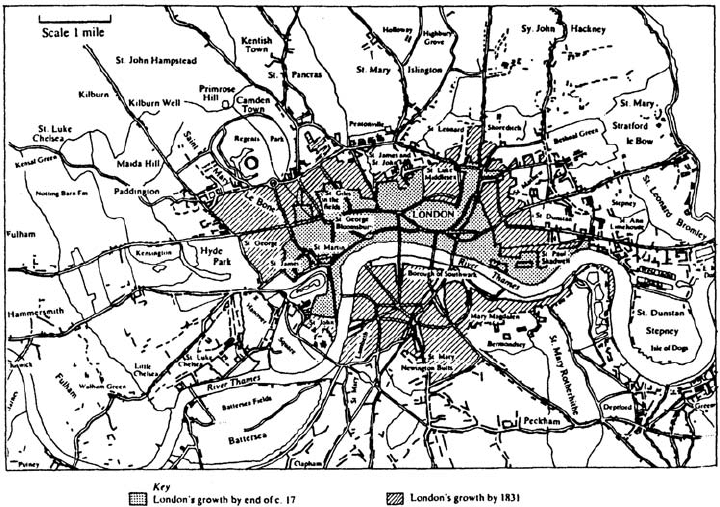
In 1700 London was a fairly compact urban area hugging the great bend of the River Thames from Westminster to
Wapping. By 1800 it had, however, begun to extend northwards away from the river. Two further bridges were built in the
eighteenth century, Westminster Bridge in 1750 and Blackfriars in 1769, giving three access points to the south. In 1801
about 15 per cent of the population of this ‘greater London’ lived south of the river. Within this growing urban area different
sections of the town catered for different specialisms and these distinctions were evident in housing and economic and social
structures. Fashionable society focused on the West End of London, itself expanding north and west. Most of the great estate
developments of the eighteenth century were concentrated here. This fashionable society was serviced by large amounts of
labour and the West End was not as monolithic as its architectural image might suggest. Close to the respectable West End
was Seven Dials in the parish of St Giles, one of the most populous, poverty-stricken and notorious areas of eighteenth-
century London. It contained a third of the capital’s beggars and was considered one of London’s most dangerous
criminal ‘rookeries’. The old centre in the City of London was much less fashionable and its population fell from an estimated
87,000 in 1750 to 78,000 by 1801. What new building there was tended to confirm the City’s increasing importance as a
financial and business centre: the Mansion House between 1739 and 1753, the repair of London Bridge in 1757–9 when it lost
the last of its shops and the gothic refronting of the Guildhall in 1789.
A large and fast-expanding industrial and commercial zone spread out to the north, east and south from the old city centre.
As many of the trades were domestic these were among London’s most densely populated residential areas. The metropolitan
complex was surrounded by a loosely organized outer ring of suburban villages, where City merchants and West End
grandees retreated to escape the crowds, smog and smell of town. Hampstead, Highgate, Epping and Stratford attracted the
affluent City gentry.
London’s population continued to grow in the first half of the nineteenth century, reaching 2,362,236 by 1851.
Concentrated urban development south of the river was still limited, principally to Lambeth, Southwark and Bermondsey,
though Kennington, Newington, Walworth and Camberwell were being rapidly filled in, a process aided by more bridges
being built across the Thames. To the north suburbs extended no further than Camden Town or Islington and to the west
Kensington Gardens marked the boundary. On the east, although the marshes of the River Lea were a limitation on
expansion, the city still fell considerably short of them. Railways opened up further expansion. In many ways London
remained a pre-industrial city but this was in the process of changing. Gas lighting made streets safer at night: Pall Mall was
illuminated as early as 1807. The establishment of the Metropolitan Police in 1829 led to the introduction of a system of
official regulation and restraint; this reinforced changes in people’s behaviour, which Dorothy George saw beginning in the
second half of the eighteenth century.
242 SOCIETY AND ECONOMY IN MODERN BRITAIN 1700–1850
London’s importance as a centre of manufacturing industry in the nineteenth century is frequently overlooked by
historians. London was, and remained throughout the nineteenth century, the country’s principal centre of production. London
was a centre for many craft industries and several were highly localized: silk, in decline after 1800, in Spitalfields; leather in
Bermondsey; hatting in Southwark; clock and watch-making in Clerkenwell; coach-making round Long Acre and sugar-
refining in Whitechapel. This intense concentration of some industries in small, separated areas together with its opposite, the
dispersal of many industries throughout London, helps to explain why many contemporary observers, and historians who use
their work, give the impression that London was not the capital of manufacturing industry.
In London the typical unit of production and distribution in the first half of the nineteenth century was small. In 1851 about
20,700 masters employed less than six men, only 217 masters employed more than 50 men, and 80 masters over a hundred.
By the 1840s many workers believed that the number of large employers had increased and were continuing to emerge out of
the shoals of small masters. Though London had a large number of independent artisans and many workers were hand craftsmen
often working at piece rates, there is little doubt that the second quarter of the nineteenth century saw the emergence of a
metropolitan proletariat. In the 1851 census 80 per cent of the total active population can be assigned to the ‘working class’.
London was also a centre of a luxury market serving not only its more permanent residents but the wealthy of the whole
nation. This ensured the continuance of quality production and highly skilled craftsmen, even if they increasingly worked
within a capitalist structure. On the other hand there was a vast mass market to be satisfied. This was achieved not by using
steampower mechanization or factory production but by expanding the workforce, lowering wages (particularly for women)
and as a result manufacturing low-priced goods. The development of capitalist practices and ‘sweated’ trades ran parallel. By
these means metropolitan craftsmen too were proletarianized and their ‘independence’ successfully attacked. Despite
superficial socio-economic similarities between Birmingham and Sheffield, class collaboration between the bourgeoisie and
the artisans did not flourish in London.
URBAN CONDITIONS—A PUBLIC HEALTH PROBLEM
Towns had always been insanitary, overcrowded and unhealthy. Rapid urban and industrial growth exacerbated these problems
and led to awareness that the social hazards being created far exceeded any previously experienced.
24
There were enormous
technical problems to be resolved. Some towns already had piped water supplies in the early eighteenth century and George
Sorocold of Derby was one of the first engineers to specialize in this branch of engineering. But water was delivered in
wooden or lead pipes and was totally untreated. It was not until 1817 that wooden pipes were forbidden in London. By 1800
water was being purified by being passed through filter beds first used in the dyeing and bleaching industries. This was not
Figure 18.3 The growth of London 1700–1831
Source: M.Reed The Georgian Triumph 1700–1830, Routledge & Kegan Paul, 1983, p. 152.
THE URBAN EXPLOSION 1700–1850 243
extended to drinking water until 1804 in Paisley and the filter beds built at Chelsea in 1827 were the first in London. Water
closets were quite common in better-quality houses by 1800 but they were connected to cesspools rather than sewers and the
former were rarely emptied. What sewers there were generally discharged into rivers. This created further pollution and health
hazards since rivers provided drinking water for large sections of the working population. The Thames became so heavily
polluted that the smell from ‘the Great Stink’ compelled Parliament to abandon its sittings on several occasions.
There were several reasons why urban conditions were not improved until after 1850. First, there was a total ignorance of
the existence of water-borne bacteria throughout this period. The relationship between filthy conditions and poor health was
not established conclusively until the 1830s and 1840s. Despite local surveys dealing with the relationship between conditions
and disease like those for London and Chester in 1774, Manchester in 1795, Dublin in 1806 and James Kay’s survey of
Manchester in 1832, it was not until the publication of Edwin Chadwick’s Report on the Sanitary Condition of the Labouring
Population of Great Britain in 1842, the Royal Commission on the Health of Towns 1844–5, which had been set up to
validate Chadwick’s personal finding, and the establishment of a relationship between infected water supplies and the
incidence of cholera by John Snow that ‘official’ opinion recognized the extent of the problem.
Secondly, what efforts were made between 1700 and 1830 tended to be on a purely local and ad hoc basis. This was done
by applying to Parliament for a local act to set up a body of improvement commissioners. By 1830 there were over 300 such
bodies, nearly a hundred of which were in London. They were run by groups of men, appointed for life by the act, filling
vacancies by co-option, with specific functions (for example, paving, cleansing or lighting streets). They could either hire
labour or contract the work out and could levy a rate to meet the expense. The quality of the ‘improvements’ achieved varied
but even the most efficient commissions tended to confine their attention to the central streets. Side streets, alleys, courts and
lanes largely remained untouched. Improvement commissions may have had ‘good intentions’ but their efforts were hampered
by lack of technical knowledge, disputes over their jurisdiction and legal powers and by the refusal of householders to fund
what they considered unnecessary improvements.
Thirdly, existing urban government did not have the necessary administrative organizations to provide effective control
over building and town planning for removing sewage and piping purified water. Some of the older towns had corporations
but these were often self-elected and corrupt and lacked powers to exercise real local control over the environment. Newer
cities, like Birmingham and Manchester, without corporations, were still governed under the parochial arrangements that pre-
dated expansion. The Municipal Corporation Act of 1835 reformed the variegated nature of urban government opening it to a
significant degree of middle-class control but, with notable exceptions, this made little real difference to urban conditions.
Improvement still relied largely on local efforts. In the 1840s the largest cities obtained local acts to cope with their own
circumstances: Leeds in 1842 and 1848; Manchester in 1848; and, the Liverpool Sanitary Act of 1846 which made the
Corporation in effect a health authority, empowering it to appoint an engineer, an Inspector of Nuisances and, above all, a
Medical Officer of Health.
Fourthly, these local acts were partially a reaction against growing pressure for national action on public health and the
belief that local communities knew best how to cope with their problems. Pressure for state action tended to increase only
when there was a sudden and tragic visitation of an epidemic. A short-lived Board of Health was set up in 1805–6 under the
threat of yellow fever. But it was the cholera outbreaks of 1831–2 and 1848–9, a disease which did not discriminate by social
class, that struck fear into the hearts of local and national governors and led to some state control. The possibility of state
intervention raised a series of important questions in the 1830s and 1840s. First, how were improvements to be financed?
Local resources for social utilities were always scarce and, except during epidemics, sewerage was not a popular issue. If
localities were unable or unwilling to finance ‘improvements’ where should the money come from? Central government? If
so, should it be raised by national taxation? Secondly was it right that local powers should be taken over by national bodies?
This question was at the heart of the problem of public health throughout the first sixty years of the nineteenth century.
Increasing central government powers attacked individual liberty and property rights. For Chadwick local control meant
inaction, the result of either demarcation disputes between competing inefficient commissions or deference to interested
parties among electors and elected. For urban communities central control meant fear of impersonal, impartial and powerful
administrators. Support for the Public Health Act of 1848, initially accepted because of the return of cholera, vaporized in
1849–50 and the demise of the General Board of Health and the retirement of Chadwick in 1854 were largely unmourned.
By 1850 the ‘sanitary idea’ had not been achieved. This was a result of the immensity of the task and the weight of local
opposition to central control. It was also the result of Chadwick’s personality. His dogmatism, arrogance and impatience,
which marred his ability to implement supported change, limited the effectiveness of reform. It was easy for anti-centralizers
like Joshua Toulmin Smith to attack centralization as an attack on people’s ‘liberties’ and on the principle of representation,
and The Times could focus the issue round a caricature of Chadwick’s personality.
244 SOCIETY AND ECONOMY IN MODERN BRITAIN 1700–1850
CONCLUSIONS
The vitality of urban life betwen 1700 and 1850 was a compound of many diverse experiences. There is no simple index of
urban economic and social structure or performance. The difference between the reality of development in individual towns
and the more generalized evaluations by historians needs to be considered. Urban society was just as diverse as its rural
counterpart. Given this stricture, is it possible to make any generalized statements about the role of towns in the expanding
economy between 1700 and 1850?
Urban economic life was both flexible and adaptable. Towns were vast reservoirs of skilled and unskilled labour. Jobs were
generated within towns by the simple economic interaction of a sheer mass of people. The productivity of towns was matched
by wages generally higher than those in the surrounding countryside. In the north, where towns offered alternative
employment, this had the effect of pushing up rural wages, while in the south lack of urban and industrial opportunities kept
them depressed. The expanding urban population had a stimulating effect on the commercialization and development of the
agrarian economy, though foreign imports played an increasingly important role after 1760. Towns were crucial nodal centres
for exchange and distribution, generating pressure for improvements in the systems of transport and communications. Urban
growth was often a stimulus to river, road and later rail improvements and docks and canals were often built to facilitate
movement of raw materials and finished products. Towns increasingly played an important role in the development of
industry. From being marketing and finishing centres, some towns developed as major centres of production in their own
right. They were the locations of an extensive and broadening range of service industries: banking, insurance, law, medicine,
education, government, and were accumulators and circulators of investment capital. Finally, towns had a society that was
relatively open, fluid, competitive and acquisitive and which propagated a new market-oriented consumer ethos. It was this
which many contemporaries criticized as leading to worldliness, emulation and the desire for luxury.
Whether there was a causal relationship between ‘new’, ‘free’ towns and growth and ‘old’ incorporated towns and
stagnation is a matter of debate among historians.
25
Economic regulation, which existed in non-incorporated centres though in
different forms from the older guilds, mattered less than location, resources, natural or ‘improved’ communication, labour
supply and business enterprise. Urbanization is not the ever-elusive ‘first cause’ of Britain’s industrial revolution but it
represented and fostered structural transformation.
The responses of contemporaries to urban growth were ambivalent. Voltaire saw the pursuit of industry and urbane
pleasures as the marks of the city and therefore of civilization. Adam Smith argued that the city secured and extended the
industry of the country, and was a centre of freedom and order while recognizing that as a market and manufacturing centre it
was liable to breed a volatile and insecure people. There was a new urbanity in the writings of Swift, Pope and Johnson. Yet
for Hogarth, Fielding, Gay and Defoe there was a darker reality. Hogarth’s ‘Gin Alley’, Gay’s Beggar’s Opera and Defoe’s
Moll Flanders represent urban development as being opposed to the idea of civilized order. This ambivalence continued after
1800. For William Cobett London was the ‘Great Wen’, monstrous and diseased. To Charles Dickens cities were fearful,
unnatural, anonymous places. Towns were no longer face-to-face communities with close and obvious links to their rural
hinterlands. The pre-industrial sense of community of interest and balance between urban and rural had been lost by 1850.
NOTES
1 Samuel Johnson in 1777, quoted in E.Pawson The Early Industrial Revolution, Batsford, 1978, p. 192.
2 R.Vaughan The Age of Great Cities, London, 1843, p. 153.
3 This issue is explored in more detail in R.Williams’ seminal The Country and the City, Chatto & Windus, 1973 and some of its
implications for an industrialized society in M.Weiner English Culture and the Decline of the Industrial Spirit 1850–1950,
Cambridge University Press, 1982.
4 E.Jones Towns & Cities, Oxford University Press, 1966 provides a useful and accessible, if somewhat dated, introduction to the
nature of urban expansion and life.
5 On the development of the early modern town see the reader edited by P. Clark The Early Modern Town, Longman, 1976 and
P.Clark and P.Slack English Towns in Transition 1500–1700, Oxford University Press, 1976. H.J. Dyos (ed.) The Study of Urban
History, Edward Arnold, 1968 is the central work on ‘setting the agenda’ for urban historians. D.Fraser and A.Sutcliffe (eds) The
Pursuit of Urban History, Edward Arnold, 1983 takes the ‘Dyos agenda’ forward into the 1980s.
6 G.Sjoberg The Preindustrial City: Past and Present, 1960 is the starting-point for anyone wanting to theorize about the pre-industrial
city. Though not without its critics and flaws, it is still a valuable book to read.
7 Clark and Slack op. cit. pp. 4–5.
8 ibid. p. 6.
9 On the town in the eighteenth century see C.W.Chalklin The Provincial Towns of Georgian England, Edward Arnold, 1974,
especially chapters 1 and 2 and P.J.Corfield The Impact of English Towns 1700–1800, Oxford University Press, 1982. A.McInnes
The English Town 1660–1760, The Historical Association, 1978 provides a brief overview. For Wales see H.Carter The Towns of Wales,
THE URBAN EXPLOSION 1700–1850 245