
Caers J. Modeling Uncertainty in the Earth Sciences
Подождите немного. Документ загружается.

P1: OTA/XYZ P2: ABC
JWST061-07 JWST061-Caers April 6, 2011 13:20 Printer Name: Yet to Come
7.2 PROBABILITY-BASED APPROACHES 111
as expressed through these conditional probabilities into a single model probability based
on all sources, namely:
What is P(A|B
1
, B
2
,...)?
One way is to perform a single calibration involving all the data sources at once to get
this combined conditional probability, but this is often too difficult or it would require
a high quality and rich calibration data set. A single calibration with many variables
requires a lot of data in order for this calibration to be accurate. Often such exhaustive
data sets are not available. Also, these partial conditional probabilities may be provided by
experts from very different fields. In climate modeling, for example, one may have very
different data sources, such as tree ring growth, ice cores, pollen and sea floor sediment
cores, to predict climate changes, each requiring a very different field of expertise. It
would be too difficult to put all data in one basket and then hope to directly get a good
prediction of climate change.
In other words, some way to combine these individual conditional probabilities into
a joint conditional probability is needed. A simple and quite general way of doing this
combination of probabilities is provided here, knowing that other methods exists in the
literature, but typically they require making similar assumptions. To understand better the
issues in doing this, consider a very simple binary problem: two sources of information
(events B
1
and B
2
) inform that the chance it will rain tomorrow (event A) is significant,
in fact:
r
From the first source B
1
we have deduced (by calibration for example) that there is a
probability of 0.7 of event A occurring.
r
From the second source B
2
we obtain a probability of 0.6.
r
The “historical” probability of it raining on the date “tomorrow” is 0.25.
r
We know that the two sources B
1
and B
2
do not encapsulate the same data (calibration
data or experts opinion).
The question is simple: what would you give as the probability for it to rain tomorrow?
The answer to this question is not unique and depends how much “overlap” there is in the
information of each source in determining the event A. Clearly, if the two sources (e.g.,
experts, calibration data) use the same data to come to their respective conditional proba-
bilities then there is a conflict. This is often the case in practice, since no two procedures
for modeling conditional probabilities need to yield the exact same result because of vari-
ous modeling and measurement errors. But we will assume here that at least theoretically
we do not have such conflict.
What is also relevant is that the “prior” or “background” conditional probability is
0.25. In fact, what is very relevant is that both sources predict a higher than usual probabil-
ity of it raining. To capture this amount of “overlap” a new term is introduced, namely that
of data redundancy. Redundancy measures how much “overlap” there is in the sources of

P1: OTA/XYZ P2: ABC
JWST061-07 JWST061-Caers April 6, 2011 13:20 Printer Name: Yet to Come
112 CH 7 CONSTRAINING SPATIAL MODELS OF UNCERTAINTY WITH DATA
information in terms of predicting an event. If there is complete overlap then the infor-
mation sources are redundant (and you can throw one away). Redundancy should not be
confused with dependency. Redundancy is always with regard to a target event (A =“rain-
ing tomorrow”). Dependency is the degree of association between information sources B
1
and B
2
regardless of the target A. As a consequence, redundancy will change when the
target A changes. Sometimes information is completely redundant. For example, if you
buy 100 copies of the same New York Times (100 information sources), then you will
not get more information about a news item than buying the paper just once. However,
buying two different newspapers to get information about one story may provide more in-
sight then just buying one (if they do not share a common information source of course)
If you let 100 experts look independently at some data to draw a conclusion about some
phenomenon, then they will be less redundant than when you put all the experts in the
same room, where they may try to agree on what is happening, thereby influencing each
other, or resort to “herding,” that is, following the voice of a single expert and therefore
be more redundant.
Redundancy is difficult to “measure” or quantify, it requires making assumptions about
the nature of the information sources with respect to the target unknown. If it is difficult
to determine, we can start by making an assumption or hypothesis and then check if the
results we get are reasonable. One such assumption that can be made is as follows:
The relative contribution of information B
2
to knowledge of A is the same regardless of the
fact that you have information B
1
This statement indeed contains some assumption on redundancy, that is, how we use B
2
to determine A is the same whether we know B
1
or not (it does not say we are not using
B
1
!). What follows is then a quantification of this statement in terms of probabilities.
Consider firstly the following quantities derived from conditional probabilities:
b
1
=
1 − P(A|B
1
)
P(A|B
1
)
, b
2
=
1 − P(A|B
2
)
P(A|B
2
)
, a =
1 − P(A)
P(A)
Each such scalar value can be seen as a distance, namely if b
1
= 0 then P(A|B
1
) = 1,
hence B
1
tells everything about A, while if b
1
= infinite then B
1
makes sure that A will
not happen. What we would like to know is:
x =
1 − P(A|B
1
, B
2
)
P(A|B
1
, B
2
)
⇒ P(A|B
1
, B
2
) =
1
1 + x
If we look closely at our hypothesis, then we can equate the following:
b
2
− a
a
= the relative contribution of information source B
2
when not having B
1

P1: OTA/XYZ P2: ABC
JWST061-07 JWST061-Caers April 6, 2011 13:20 Printer Name: Yet to Come
7.2 PROBABILITY-BASED APPROACHES 113
Notice how this is a relative contribution, namely relative to what is known before
knowing the information B
1
. Before knowing B
1
we have prior information P(A)orin
terms of distance, simply a.
x − b
1
b
1
= the relative contribution of information source B
2
when B
1
is available
The relative contribution is now relative to knowing B
1
. Hence, our hypothesis can be
formulated into an equation as follows:
b
2
− a
a
=
x − b
1
b
1
⇒ x =
b
1
b
2
a
or P(A|B
1
, B
2
) =
a
a + b
1
b
2
If we return to our example, then we can use the above equations to calculate
P(A|B
1
, B
2
) = 0.91
which suggests that we have more certainty about it raining from these two data sources
than from considering each data source separately. In other words, the model assumption
enforces “compounding” (or re-enforcement) of information from the two sources.
7.2.4 Application to Modeling Spatial Uncertainty
Next consider how to use this model of data redundancy in the context of spatial uncer-
tainty. Recall that spatial uncertainty was represented by generating many Earth mod-
els that reflect a spatial model of continuity. Using the above ideas a new set of alter-
native Earth models that are in addition to the spatial continuity model also reflective
of other data sources can now be built. Consider the example of geophysical data and
consider determining the presence or absence of sand at each grid block in an Earth
model. Consider that we have determined the function P(A = sand|B
2
); B
2
is the geo-
physical information. This means that at every location in the grid where we have a geo-
physical measurement, this measurement can be replaced with a conditional probability
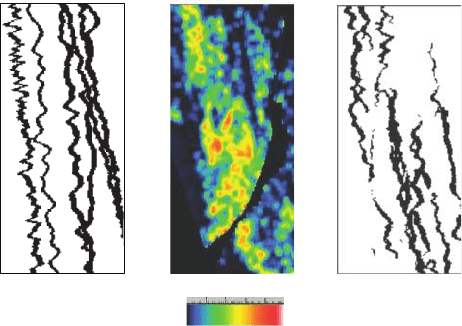
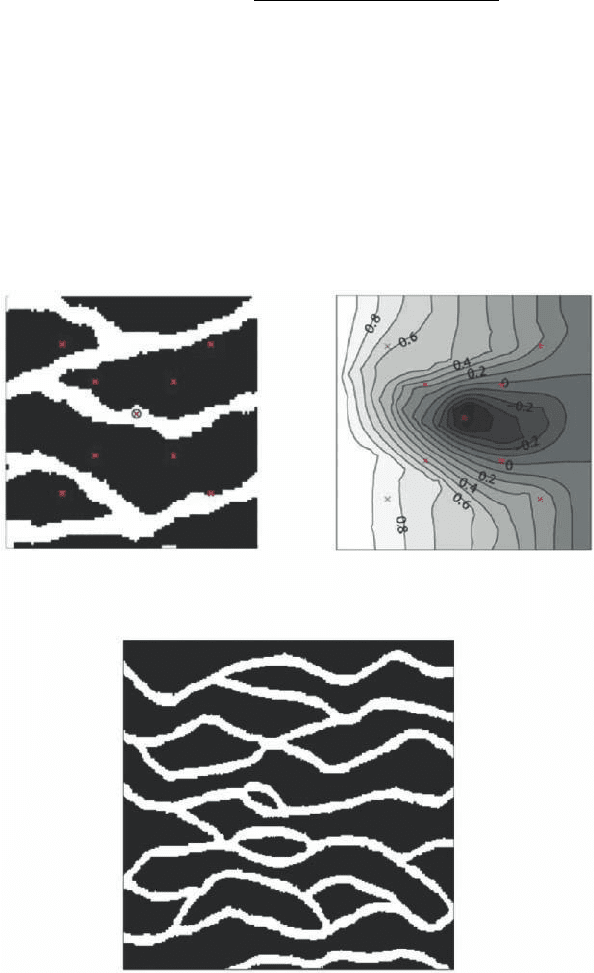
by means of the calibration function. Figure 7.3 shows the actual case, the color in the
middle plot represents this probability of sand for the given geophysical information (in
this case, seismic data, which is not shown). Next to this data, is the spatial continuity as
expressed in the training image on the left. What we are trying to accomplish here, is to
create an Earth model that has more sand channels where the probability of sand is higher.
This is simply done by means of an extension of the sequential simulation methodology.
Recall the sequential simulation algorithm:
1 Assign any sample (hard) data to the simulation grid.
2 Define a random path that loops over all the grid cells.
P1: OTA/XYZ P2: ABC
JWST061-07 JWST061-Caers April 6, 2011 13:20 Printer Name: Yet to Come
114 CH 7 CONSTRAINING SPATIAL MODELS OF UNCERTAINTY WITH DATA
10
Figure 7.3 Training image (left), probability derived from seismic (middle), Earth model (right).
3 At each grid cell:
a Determine the uncertainty of that unsampled grid value given the data and the previ-
ously simulated cells values in terms of a probability distribution.
b Sample a value from this probability distribution by Monte Carlo simulation and
assign it to the grid.
Step a in this algorithm consists now of three steps:
1 Determine from the 3D training image P(A|B
1
) by scanning.
2 Determine from the sand probability cube (at that grid cell location) the probability
P(A|B
2
).
3 Use the above equations to determine P(A|B
1
, B
2
) (note that P(A) is the proportion of
sand).
In step b a Monte Carlo simulation is performed using P(A| B
1
, B
2
). Figure 7.3 (right)
shows an example Earth model created with this algorithm.
7.3 Variogram-Based Approaches
When dealing with continuous properties that do not have a very distinct spatial variation,
it was discussed in Chapter 5 that variogram-based models of spatial continuity could
be an appropriate choice. Indeed, the 3D training image and Boolean models of spatial
continuity assume that there is a distinct and specific spatial variation present that needs
to be modeled, either through objects or through a conceptual 3D image.
P1: OTA/XYZ P2: ABC
JWST061-07 JWST061-Caers April 6, 2011 13:20 Printer Name: Yet to Come
7.3 VARIOGRAM-BASED APPROACHES 115
Exhausv
e so
data Co-
located
so
data
z
1
(u
1
)
z
1
(u
3
)
z(
u
)
?
z
1
(
u
2
)
z
1
(u
1
)
z
1
(
u
3
)
z(u
)
?
z
1
(u
2
)
z
2
(u)
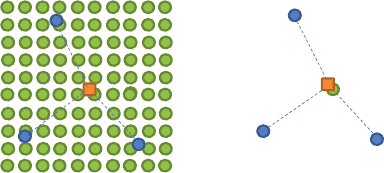
Figure 7.4 Two configurations of soft data: exhaustive and co-located.
The question is now how to constrain these variogram-based Earth models to addi-
tional data sources such as, for example, the 3D geophysical image of Figure 7.1. Recall
that variogram models are based on the degree of correlation between data values. Indeed,
we actually started the discussion on variograms with the correlogram, and derived such
correlogram from scatter plots and the calculation of correlation coefficient between scat-
ter plots. To additionally constrain the models to another data source we will be relying
on the same principle. In traditional geostatistics, this other data source is also termed
“soft data.”
Consider a configuration of data similar to that discussed when introducing the notion
of Kriging (Figure 7.4). However, in addition “soft data” are available which are typically
exhaustive, as would be the case of geophysical or remote sensing data. Accounting for all
this data is difficult, so the situation is often simplified by retaining only the co-located
(or at least a much more limited amount) data value. If the soft data are indeed much
more smoothly varying, see for example Figures 7.1 and 7.3, then this is a reasonable
assumption. The smooth variation in the soft data makes such data redundant towards de-
termining the unknown value. We can now simply extend linear estimation to include this
additional data value (note that this data value may have a different unit of measurement
than the hard data):
z
∗
1
(u) =
n
␣=1
␣
z
1
(
u
␣
)
+
n+1
z
2
(u)
This additional weight will depend on the degree of correlation between the value of
the soft data z
2
measured at u and the variable being modeled. Such information can
be obtained simply by creating a scatter plot such as in Figure 7.2 and calculating the
correlation coefficient between the “hard variable” z
1
and the “soft variable z
2
.” This
makes sense intuitively: if that correlation were to be zero, than the weight
n+1
should
be zero because the soft data is uninformative, while if that correlation is one, then the soft
data gets all the weight, while the rest gets assigned zero weights. The actual derivation
and calculation of these weights is left out here; it is a topic for geostatistics books. What
is important to remember is that, in addition to the variogram model, one needs to know
additionally at least the correlation coefficient.
P1: OTA/XYZ P2: ABC
JWST061-07 JWST061-Caers April 6, 2011 13:20 Printer Name: Yet to Come
116 CH 7 CONSTRAINING SPATIAL MODELS OF UNCERTAINTY WITH DATA
Once we know how to use Kriging to include the additional data source the sequential
Gaussian simulation algorithm is adapted as follows:
1 Transform the sample (hard) data to a standard Gaussian distribution.
2 Transform the soft data to a standard Gaussian distribution.
3 Assign the data to the grid.
4 Define a random path that loops over all the grid cells.
5 For each grid cell:
a Determine by Kriging the weights assigned to each neighboring data value or previ-
ously simulated value, including the weight associated to the soft data.
b Determine the Gaussian distribution with as mean the Kriging mean and as variance
the Kriging variance.
c Draw a value of that distribution.
6 Back-transform all the values into the original distribution function.
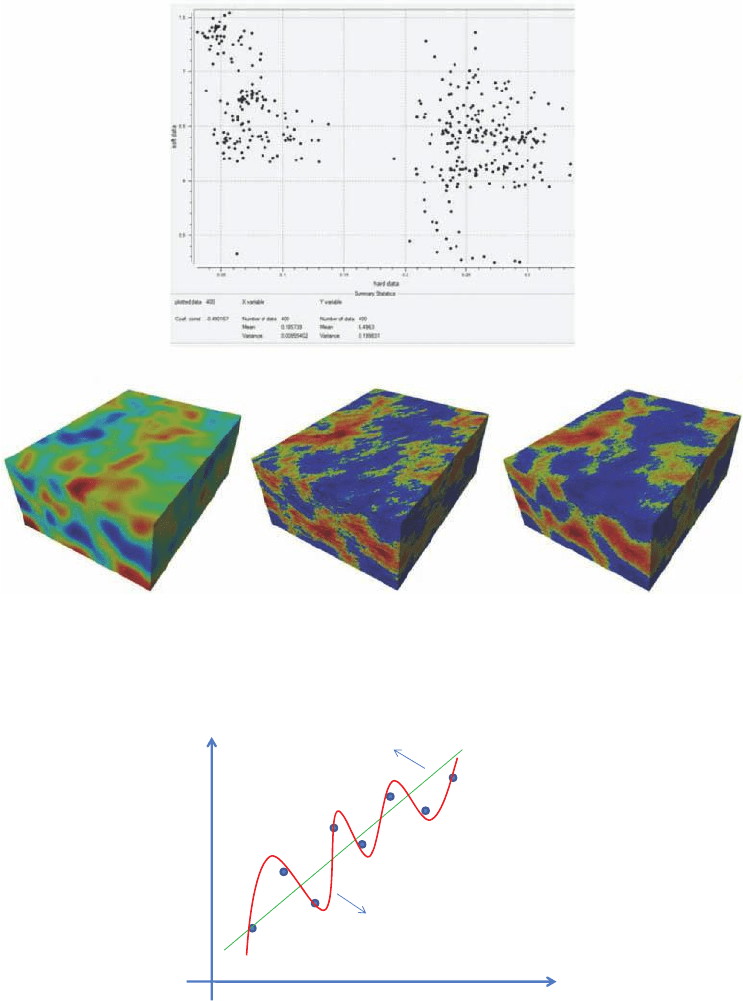
Figure 7.5 shows an example. We have five wells with measurements of porosity (Fig-
ure 7.1). The scatter plot is shown and a correlation coefficient of −0.49 is calculated.
Next this correlation coefficient is included in the sequential simulation algorithm and
one Earth model generated ( Figure 7.5). If the correlation coefficient is altered to −0.85
then another Earth model is obtained (Figure 7.5) that share many more features with the
soft data (where the high and low values occur) than using a lower correlation.
7.4 Inverse Modeling Approaches
7.4.1 Introduction
In the above probabilistic approach the information content of each data source is cap-
tured with a conditional probability as modeled from a calibration data set. This approach
is quite useful to get a model of uncertainty quickly, for the given data set, if such cali-
bration data sets are reliable and informative about the relationship between the variable
being modeled (e.g., temperature) and the data source (e.g., satellite data). Sometimes a
calibration data set may not be available, or such data may provide incomplete informa-
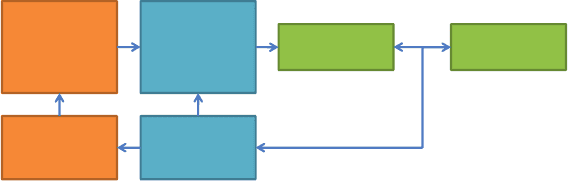
tion about that relationship. Consider a simple example. Suppose we have a calibration
data set such as in Figure 7.6, the variable being modeled is A while the data source is
B. If the probabilistic methods are employed, such as in Figure 7.2, then in such methods
we tend to assume that the relationship is linear, there is no other reason for assuming
P1: OTA/XYZ P2: ABC
JWST061-07 JWST061-Caers April 6, 2011 13:20 Printer Name: Yet to Come
7.4 INVERSE MODELING APPROACHES 117
Scaer plot
So data ρ = -0.49 ρ = -0.85
Figure 7.5 Example of sequential simulation with soft data.
A
B
Ap
p
ear
s
to
be
the
logical
choice
withou
t
any
more
informaon
Ap
p
ear
s
to
be
the
logical
choice
i
f
relaonship
is
periodic
Figure 7.6 Two ways of modeling the relationship between A and B.
P1: OTA/XYZ P2: ABC
JWST061-07 JWST061-Caers April 6, 2011 13:20 Printer Name: Yet to Come
118 CH 7 CONSTRAINING SPATIAL MODELS OF UNCERTAINTY WITH DATA
anything else (or at least no “data” are suggesting this). Consider now that we have some
more information about the relationship between A and B, namely, that there exists a
physical law and we deem (an assumption) that this physical law applies to variables A
and B; moreover, the physical law states that the relationship is periodic (oscillating with
a certain frequency). Assuming the physical law would then result in a relationship as
shown in Figure 7.6, quite different from the one assumed by a probabilistic approach.
Inverse modeling aims at including both probabilistic (uncertainty) as well as physical
(deemed deterministic in the book) relationships between “model” and “data” with the
aim of constraining a model of uncertainty with that data. Inverse modeling is more dif-
ficult and time consuming than applying a probabilistic approach but may lead to more
realistic models of uncertainty. However, such realism is only relevant to the particular
decision problem at hand (recall the discussion between physical and deterministic mod-
eling in Chapter 3). The value of information chapter provides methods for making this
judgment call (Chapter 11).
7.4.2 The Role of Bayes’ Rule in Inverse Model Solutions
Figure 7.7 describes the various elements involved (refer also to Figure 3.2) in inverse
modeling. A spatial model containing all relevant variables is built; this requires spatial
input parameters (Chapters 5 and 6). The data are considered to be a “physical response”
(a seismic signal, a pressure pulse, a temperature change over time) emanating from the
Earth because of some testing applied to it. For example, we can hit the ground with our
boot at location X and measure the vibrations over time at location Y. These vibrations
provide data over some region of the subsurface between X and Y. A forward model
consists of modeling (through partial differential equations for example) or simulating
(on a computer) how these vibrations travel from source X to location Y for an assumed
spatial variation of all properties in the Earth (as modeled in an Earth model for example).
The response obtained from the forward model is the forward response. This forward
response can then be compared with the data. If there is a mismatch (), then something
needs to be adjusted, that is, changed. Many things (Figure 7.7) can be changed namely:
1 The random seed (or set of uniform random numbers) used to generate the Earth model.
2 The input parameters used to generate the Earth model.
Spaal
model
Forward
model
Forward
response
Data
Spaal
parameter
s
+
seed
F
orwar
d
model
parameters
Δ
Figure 7.7 Elements of inverse modeling.
P1: OTA/XYZ P2: ABC
JWST061-07 JWST061-Caers April 6, 2011 13:20 Printer Name: Yet to Come
7.4 INVERSE MODELING APPROACHES 119
3 The physical parameters related to the forward model/response.
4 The initial and boundary condition related to the forward model/response.
5 The physical law(s) itself on which the forward model is based.
6 The data may not be correct or prone to error, so it may not be necessary to match data
exactly.
One can iterate many times, that is, changes can be applied to the Earth model, the
forward response calculated and the mismatch updated. In doing so, two questions are
should be considered:
1 What do we change?
2 How do we change things (parameters, conditions, laws)?
There is no unique method that will address these questions exactly; often this is based
on judgment and the level of expertise in this area of modeling and often requires a
combination of techniques. Question 1 has already been addressed somewhat in this book
(Chapter 4). In addressing question 1, two guidelines should be considered:
1 We should change that which impacts matching the data better.
2 We should change that which impacts the decision question for which the models are
constructed
The traditional view in inverse modeling is to consider only question 1, that is, estab-
lishing what parameter or variable matters to matching the data. However, it may not be
necessary to match the data exactly if that does not impact the decision question, or if
the variable we are changing does not impact the decision question. Chapter 11 on value
of information provides some ideas on how to address obtaining a balance between these
two questions.
To figure out what is most sensitive (either to data or decision question), we also refer
to Chapters 10 and 11 on response uncertainty and value of information for additional
techniques in determining sensitivity. The second question has many answers, that is,
there are many methods that can be applied, but each of these methods can be framed
with probability theory and Bayes’ rule. Before doing so, consider a typical example
problem.
Consider an Earth model as m, for example a 3D grid of possibly multiple properties.
Consider the data set as d, that is, a list of observations (such as a time series of amplitudes
that represent the above mentioned vibrations); take that the observations are exact, that
P1: OTA/XYZ P2: ABC
JWST061-07 JWST061-Caers April 6, 2011 13:20 Printer Name: Yet to Come
120 CH 7 CONSTRAINING SPATIAL MODELS OF UNCERTAINTY WITH DATA
is, no measurement error. If we take A = M and B = D (capital for random variables bold
to denote vectors), then Bayes’ rule simply becomes:
P(M = m|D = d) =
P(D = d|M = m)P(M = m)
P(D = d)
A synthetic (i.e., constructed) example that will be further explored is shown in
Figure 7.8. A pumping test is applied to a synthetically generated field of hydraulic con-
ductivity (a measure of how well each fluid flows in a porous medium) that has a binary
type of spatial variation (channels vs background), the channels have higher conductivity
than the background and these values are known. What is not known is the location of
the channels, we only know the “style” of channeling as expressed in the training image
100
80
60
40
20
0
020
250
250
200
200
150
150
100
100
50
50
40 60 80 100
20 40 60 80 100
“True”
pressure
map
Trainin
g
image
R
eferenc
e
“truth”
Figure 7.8 Case study for inverse modeling.