
Caers J. Modeling Uncertainty in the Earth Sciences
Подождите немного. Документ загружается.


P1: OTA/XYZ P2: ABC
JWST061-07 JWST061-Caers April 6, 2011 13:20 Printer Name: Yet to Come
7.4 INVERSE MODELING APPROACHES 121
below (we assume this also known, although in most cases it would be uncertain as well).
M is therefore a vector of 100 × 100 binary variables (1/0), for each grid-block indi-
cating whether or not a channel is present. The pump test at the central well location in
Figure 7.8 is done such that the pressure in the surrounding area will decrease. To simu-
late this pressure decrease a “pressure simulator,” based on the physics of flow in porous
media, is employed. This gives nine pressure readings at the nine locations marked by red
crosses in Figure 7.8; hence d is a nine-dimensional vector containing these nine pressure
readings. The question is now to find all the possible variations of spatial distribution of
channels that match these nine data.
To explain the role of Bayes’ rule, consider first a simpler example, where m and d are
discrete and univariate variables. This allows easy modeling of probabilities. The above
example is returned to later. Consider that d has been measured and has value d = 1.
m has 10 possible outcome 0, 10, 20, ..., 100; however, even prior to considering any
data it is known that some outcomes m are more probable than others. For example, m
can be the proportion of sand in a deltaic aquifer system. Around the world, one may
have examined many aquifer systems similar to the one being considered and from such
examination a table of “prior” frequencies has been tabulated as follows:
m
Prior probability
P(M = m)
00
10 5
20 20
30 30
40 25
50 10
60 10
>60 0 in %
Suppose d is some physical measurement (units don’t matter) and we have a physical
law that provides the forward response of g as applied to m as follows
m g(m)
01
10 1
20 1
30 2
40 2
50 2
60 3
>60 4
P1: OTA/XYZ P2: ABC
JWST061-07 JWST061-Caers April 6, 2011 13:20 Printer Name: Yet to Come
122 CH 7 CONSTRAINING SPATIAL MODELS OF UNCERTAINTY WITH DATA
It is clear that if d = 1 then only three solutions are possible, m = 0, 10, and 20. What
is the probability for each solution? Are they equal? If Bayes’ rule is considered, then this
depends on the prior probabilities for those three solutions namely P(M = m) = 0, 5 and
20% as well as the prior for d. We do not have the prior for d, but we don’t need it, since
we know that probabilities P(M = m|D = d) for all m must add up to one, hence we can
simply re-standardize 5% and 20% (M = 0 cannot occur according to the prior) to sum
up to one and obtain:
P(M = 10|D = 1) = 20%
P(M = 20|D = 1) = 80%
P(D) could have been determined as follows (Chapter 2):
P(D = d) =
100
m=0
P(D = d|M = m)P(M = m)
Note that in this case P(D = d |M = m) is one if m = 0, 10 and 20% and zero in all
other possibilitie:, so
P(D = 1) = 100% × 0% + 100% × 5% + 100% × 20% = 25%
Suppose now that there is measurement error. What exactly is a “measurement error”?
In probabilistic terms it means that if we would repeat the same measurement many times,
we would get different results, that is we can measure at one instance d = 1 but it could
be incorrect; for example, if we measure again, we could have measured d = 2 instead.
However, measuring something (d = 1) does not tell us what the measurement error is.
How then can this error be quantified in a general way? First, it makes sense that the
measurement error is function of what is being measured: some quantities (m) are easier
to measure than others. For example, it may be easier to measure a large quantity than
a very small quantity. To model this dependency, one can therefore use a conditional
probability of the form P(D = d|M = m) to express measurement error, that is, if M
is a certain value m, what is then the probability of the measurement occurring? If this
probability is one for a particular d then there is no error. This probability is termed a
likelihood probability and can only truly be determined if the measurements for various
m are repeated. In practice, often this cannot be done (too costly), so we can assume some
likelihood probability, rely on past experience or try and make models of errors (for both
measurement and the model g), which are not covered in this book. Suppose that these
likelihoods have been determined and are:
P(D = 1|M = 10) = 75% and P(D = 1|M = 20) = 25%

P1: OTA/XYZ P2: ABC
JWST061-07 JWST061-Caers April 6, 2011 13:20 Printer Name: Yet to Come
7.4 INVERSE MODELING APPROACHES 123
If Bayes’ rule is applied, again in the case that D = 1 is measured, we obtain:
P(M = 10|D = 1) =
75 × 5
75 × 5 + 25 × 20
= 0.428
P(M = 20|D = 1) =
25 × 20
75 × 5 + 25 × 20
= 0.572
Note that there is a risk in specifying the prior and a likelihood probability independently:
it may occur that for all conditional events M = m in the likelihood, all prior probabilities
are zero (or just very small). This occurs often in practice.
In real Earth modeling M and D are multidimensional but the same probability rules
apply. As discussed in various previous chapters, the goal is to create several Earth models
as representative of a model of uncertainty. Firstly, consider generating Earth models
without the data d. Any technique described in Chapters 6–8 can be used to generate
them. We denote these Earth models as m
(1)
, m
(2)
, ..., m
(L)
and consider them “sampled”
from some prior model P(M). However, this prior probability is not explicitly stated as
done for the simple example above, it would be too difficult because of the high dimension
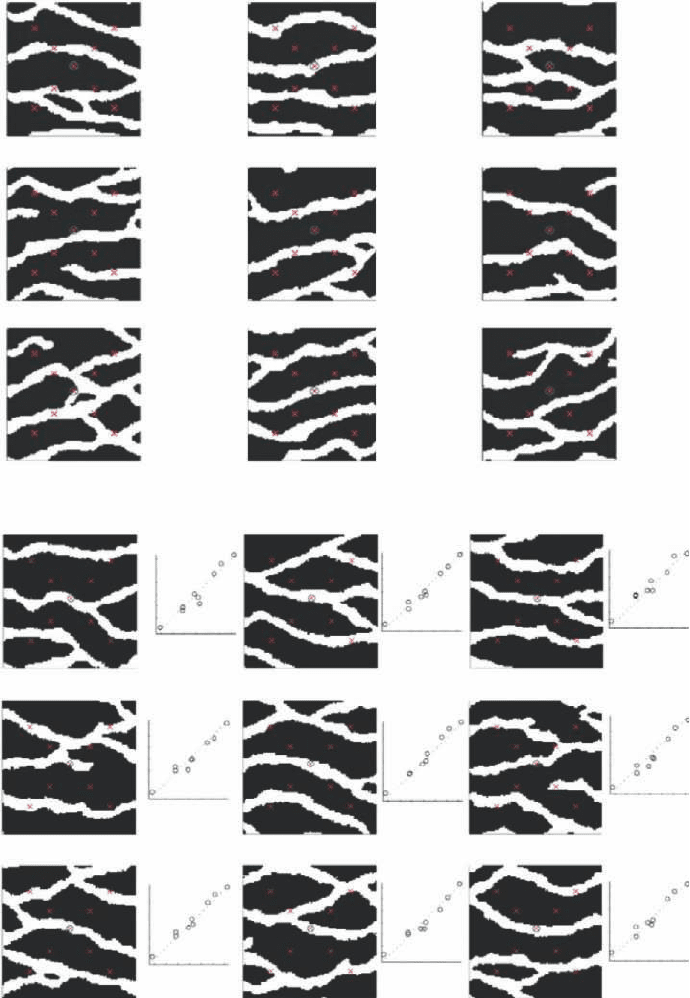
of m. This set of models is termed “prior Earth models.” For the case study of Figure 7.8,
nine such prior Earth models m
(j)
are shown in Figure 7.9 and generated with the training-
image based techniques described in Chapter 6. Next, among this possibly large set (much
more than nine!) it is necessary to search for Earth models that match the data
m
(i)
such that g(m
(i)
) = d
if no uncertainty nor error are assumed in the data–model (D–M) relationship. This new
set of models represents the “posterior” distribution P(M = m|D = d) or the posterior
uncertainty (posterior to including data; Chapter 3). The models are termed “posterior
Earth models.” If measurement error occurs then no exact matching is desired (see next
section for finding models in this case). However, the problem may be that (i) no such
models can be found or (ii) it could be very difficult (CPU demanding) to find multiple
posterior Earth models if the function g takes a long time to evaluate, such as in the case
of a numerical simulator. In the first case, there is likely an inconsistency between the set
of prior models that was chosen and the data–model relationship (the physical law); this
is a common problem. For the second case specialized techniques are needed; these are
briefly discussed at the end of this chapter.
Several conclusions can be drawn from this discussion on the role of Bayes’ rule:
r
If Bayes’ rule and probability theory are used as a modeling framework, then any in-
verse solution m depends on the (subjective) prior probability that is stated and the
data–model relationship (physical law), which may be prone to error or uncertainty
because the data has measurement error or the physical law may not be well known.
Bayes’ rule is also clear that one cannot escape stating a prior probability, that is, if
one doesn’t know this prior probability then simply taking all probabilities equal or
Gaussian for that matter is a very specific and equally subjective choice of a prior prob-
ability.
P1: OTA/XYZ P2: ABC
JWST061-07 JWST061-Caers April 6, 2011 13:20 Printer Name: Yet to Come
124 CH 7 CONSTRAINING SPATIAL MODELS OF UNCERTAINTY WITH DATA
100
80
60
40
20
Prior Earth modelsPosterior Earth models
20 40 60 80 100
100
RMSE=0.0917
RMSE=0.0645
RMSE=0.0929
RMSE=0.0850
RMSE=0.0746
RMSE=0.0931
RMSE=0.0789
RMSE=0.0733
RMSE=0.0685
data
model
0.5
0.5
0
0
-0.5
-0.5
80
60
40
20
20 40 60 80 100
Figure 7.9 Nine prior Earth models and nine posterior Earth models. The RMSE indicates how
well they match the data at the nine observation locations. The small cross-plots on the right of
each Figure show the mismatch of the nine pressure measurements.
P1: OTA/XYZ P2: ABC
JWST061-07 JWST061-Caers April 6, 2011 13:20 Printer Name: Yet to Come
7.4 INVERSE MODELING APPROACHES 125
r
The error in the data–model relationship is modeled as a conditional probability and
this error may depend on what is being measured, that is, small things may be harder
to measure than big things.
r
There may be inconsistency between the prior and the data–model relationship. Often
in practice one chooses these two probabilities separately; for example a geologist may
be responsible for generating several prior models and a hydrologist may be responsible
for specifying the physics of subsurface flow as well as determine any errors that may
exist in gathering real field data. This will be common in any modeling of uncertainty
that requires many disciplines. These two persons may specify two probabilities that
are inconsistent, or implicitly assume that one is correct and the other is not, without
any specific evidence as to why (often the data, that is, likelihood probability is chosen
as correct and not the prior).
7.4.3 Sampling Methods
7.4.3.1 Rejection Sampling
Bayes’ rule does not tell us how to find solutions to inverse problems, in other words, it is
not a technique for finding “posterior Earth models”; it just tells us what the constraints
are to finding them. A simple technique for finding inverse solutions is called the rejection
sampler. In fact, rejection sampling is much in line with Popper’s view on model falsi-
fication (Chapter 3), that is, we can really only “reject” those models that are proven to
be false from empirical data. Although, Popper’s principle is more general than a typical
rejection sampler, namely, he considered everything imaginable to be uncertain, includ-
ing physical laws, while in rejection sampling we typically assume only Earth models to
be uncertain. Popper’s idea, jointly with Bayes’ rule emphasizes the important role of the
prior, namely, all that can be imagined should be included in this prior, only then, with
data, can we start rejecting that what can be proven false by means of data.
Consider first that we want to match the data exactly, then rejection sampling consists
of doing the following:
1 Generating a (prior) Earth model m consistent with any prior information.
2 Evaluating g(m).
3 If g(m) = d, then keeping that model; if not, reject it.
4 Go to step 1 until a desired amount of models has been found.
In this simple form of rejection sampling, models that do not have an exact match
to the data (as defined by g(m) = d) are rejected. The Earth models accepted follow
Bayes’ rule, since only models created from the prior are valid models. If the prior is
inconsistent with g, that is, no models can be found, then either g or the way the prior
P1: OTA/XYZ P2: ABC
JWST061-07 JWST061-Caers April 6, 2011 13:20 Printer Name: Yet to Come
126 CH 7 CONSTRAINING SPATIAL MODELS OF UNCERTAINTY WITH DATA
models are generated should be changed. Often, there is no unique, objective criterion
to choose which one should be changed. Note that in order to generate a prior model,
several sources of uncertainty could be considered: the training image, the random seed,
the variogram, the mean and so on, and each of these “parameters” can be changed.
In step 1 parameters are changed randomly, for example if we have uncertainty about
the training image, and two possible training images have been specified, one with 35%
probability and the other with 65% probability, then 35% of the Earth models should
be generated using training image 1. This is the exact meaning of “Earth models are
consistent with prior information.” If more parameters are uncertain, then each parameter
is drawn randomly at least if all parameters are considered as being independent variables
(recall Chapter 2).
In most cases it is not necessary to achieve a perfect match to the data, since many
errors exist in specifying the data-to-model relationship. This uncertainty is specified
through the conditional probability P(D|M). In that case, the following adaptation
(no proof given here) of the rejection sampler has been proven to be consistent with
Bayes’ rule:
1 Generate a (prior) Earth model m consistent with any prior information.
2 Evaluate g(m).
3 Accept the model m with probability p = P(D = d|M = m)/P
max
.
4 Go to step 1 until a desired amount of models has been found.
Step 3 needs a little more elaboration. P
max
is the maximum value of the conditional
probability P(D = d|M = m). Accepting a model with a given probability p is done as
follows:
a Draw from a uniform distribution a value p
*
(Chapter 2).
b If p
*
≤ p, then accept the model, otherwise reject it.
We apply the rejection sampler to the synthetic case study of Figure 7.8. The only
unknown is the location of the channels, so there is only “spatial uncertainty,” there is
no “parameter uncertainty” (the training image and any other parameter are assumed
known). To specify the likelihood probability proceed as follows
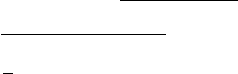
P
(D = d|M = m) exp
−
RMSE(m, d)
2
2
2
with = 0.03 and
RMSE =
1
9
9
k=1
(g
i
(m) − d
i
)
2
P1: OTA/XYZ P2: ABC
JWST061-07 JWST061-Caers April 6, 2011 13:20 Printer Name: Yet to Come
7.4 INVERSE MODELING APPROACHES 127
RMSE or Root Mean Square Error
0
0
0.2
0.4
0.6
Likelihood
0.8
1
0.5 1 1.5 2
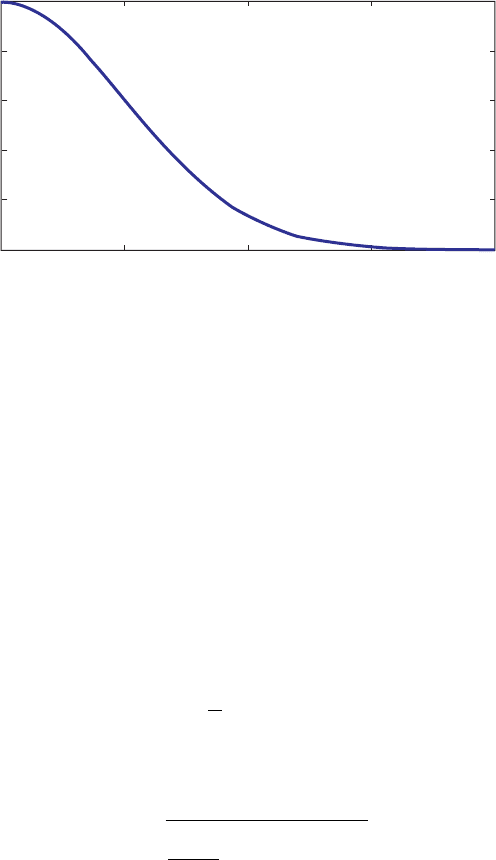
Figure 7.10 Example of a likelihood function, in this case a Gaussian likelihood; note that
P
max
= 1.
see also Figure 7.10. RMSE is the Root Mean Squared Error. This function, termed a
Gaussian likelihood, becomes smaller when the mismatch between data and forward re-
sponse is larger, the error as stated between the nine pressure data d
i
and the nine forward
simulated pressure responses g
i
(m). In Figure 7.9, nine out of 150 Earth models that
match the data are shown; these are termed the posterior Earth models. To obtain these
150 Earth models, it was necessary to iterate the rejection sampler about 100 000 times,
that is, 100 000 models m were generated and tested with the above procedure. A sum-
mary of these models is shown in Figure 7.11. To summarize a set of Earth models what
is termed the ensemble average (EA) is calculated. This is the cell-wise average of all the
images in a set:
EA =
1
L
L
=1
m
()
Next, the ensemble standard deviation can also be calculated
ESD =
1
L − 1
L
=1
(m
()
− EA)
2
which can be regarded as some measure of local variability between the images. If one
adds up images that are binary then the probability of occurrence (of channel in this case)
is obtained. Figure 7.11 shows the ensemble average of the pressure maps (termed heads)
for 150 prior Earth models and the 150 posterior Earth models. Clearly, the pressures
are different between prior and posterior, which means that the data is informative about
what is being modeled, hence the standard deviation of the posterior ensemble is smaller
than that of the prior ensemble, with most of the reduction occurring near the location
of the central pumping well. Remark also that the prior is not informative at all about
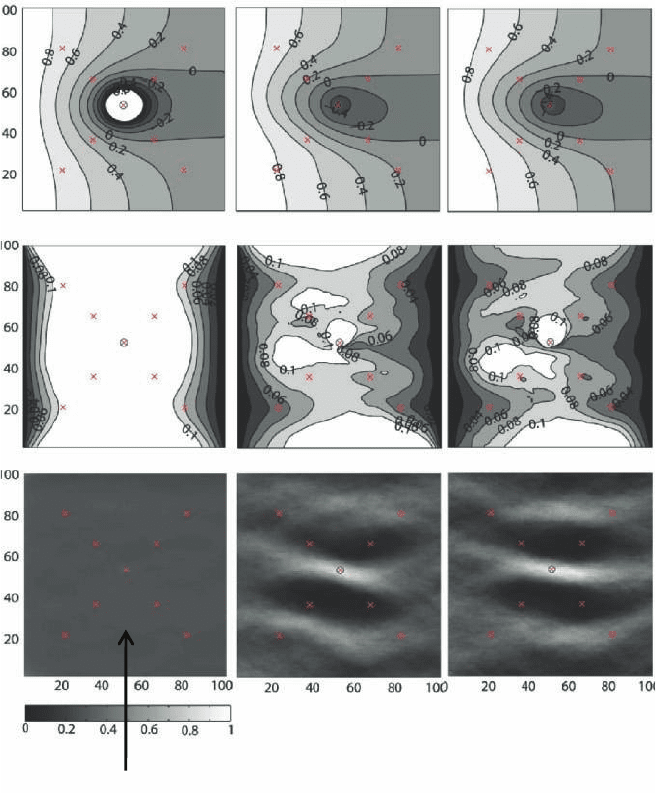
P1: OTA/XYZ P2: ABC
JWST061-07 JWST061-Caers April 6, 2011 13:20 Printer Name: Yet to Come
128 CH 7 CONSTRAINING SPATIAL MODELS OF UNCERTAINTY WITH DATA
Prio
r
model
(n
o
data)
Rejeco
n
sampling
(100.00
0
evals)
Metr
o
poli
s
sampling
(810
8
evals)
EA
(Ensembl
e
average)
ESD
(Ensembl
e
std
dev)
Probabilit
y
of
channe
l
occurring
prior
is
non
-
informave
about
channel
locaon
Figure 7.11 Ensemble average, standard deviation and probability of channel occurring for
(a) no data used, (b) the rejections sampler and (c) the Metropolis–Hastings sampler.
the specific location of the channels (therefore the gray plot in the left-hand corner). The
prior only informs the “style” of channel distribution.
7.4.3.2 Metropolis Sampler
The rejection sampler is called an “exact” sampler in the sense that it follows perfectly
Bayes’ rule. However, this perfection comes at a price: it may take an enormous amount

P1: OTA/XYZ P2: ABC
JWST061-07 JWST061-Caers April 6, 2011 13:20 Printer Name: Yet to Come
7.4 INVERSE MODELING APPROACHES 129
of CPU time to obtain enough posterior Earth models in the ensemble to get an adequate
model of uncertainty. It may be argued that following Bayes’ rule exactly is not desired.
This is a valid argument since many components within the framework of modeling un-
certainty are indeed uncertain, such as the prior probability, the data and the physical law,
and, as discussed in Chapter 3, there is no objective criterion to verify/validate that these
are correct. As with any law, principle and rule, Bayes’ rule leads only to “internal consis-
tency” (Chapter 3). Bayes’ rule should therefore be seen as a template or framework, not
a truth, within which many problems can be solved and moreover solved consistently ac-
cording to a well established probability principle. Completely abandoning this rule may
(but not necessarily) lead to an artificial reduction of uncertainty as will be discussed in
the next section.
A slightly different but much more efficient (less iterations needed) sampler from the
rejection sampler is the Metropolis sampler. There are many forms of this sampler, but in
one of its most simple form it works as follows (again, no proof is given):
1 Generate a (prior) Earth model m consistent with any prior information.
2 Propose a change to m, but make sure this change is still consistent with any prior
information. Call this change m
*
.
3 If P(D = d | M = m) < P(D = d | M = m
*
) then
accept m
∗
(call m now m
∗
)
or
accept m
∗
with probability p =
P(D = d|M = m
∗
)
P(D = d|M = m)
4 Go back to step 2 and iterate many times “until convergence.”
5 Keep the Earth model that remains after convergence.
The mechanism here is such that models with increased likelihood probability are
accepted all the time, but even models that have lower likelihood probability can still be
accepted. If only models m
*
with increased likelihood were accepted then we would get
trapped quickly, that is, we wouldn’t find any improvement to matching the data better.
In step 2, also termed the “proposal step,” one has a lot of degree of freedom and most
of the practical success of this algorithm lies in finding good change mechanisms. An
example “change” would simply be to create a completely new Earth model m
*
but this
is often inefficient, more gradual changes are often preferred. Rather we want to make
changes where it matters (as to matching the data better for example) by considering
the most sensitive parameters or areas in the Earth model deemed more consequential.
However, any such change should be consistent with the prior information, that is, we
P1: OTA/XYZ P2: ABC
JWST061-07 JWST061-Caers April 6, 2011 13:20 Printer Name: Yet to Come
130 CH 7 CONSTRAINING SPATIAL MODELS OF UNCERTAINTY WITH DATA
cannot make arbitrary changes that could that are in conflict with such prior (see the
comments on the role of Bayes’ rule).
Step 4 needs more elaboration. The theory states that one should iterate the above
algorithm an infinite number of times to get an Earth model that follows Bayes’ rule and,
hence, be equivalent to the rejection sampler. This is evidently not practical, since the
goal here is to obtain models relatively fast. Instead, we iterate till we do not observe
much change in some statistical summaries of the Earth models found.
Applying the Metropolis algorithm to our example (we won’t elaborate on the proposal
mechanism, this is for more advanced books) gives the results in Figure 7.11 which show
results similar to the rejection sampler except that is takes many fewer iterations, namely
approximately 8000, to generate 150 Earth models (or about 50 flow simulations per
posterior Earth model).
7.4.4 Optimization Methods
Not all techniques for finding inverse solutions use Bayes’ rule as a guide. These tech-
niques are generally termed optimization methods, they are often much more efficient
than the sampling techniques, such as rejection sampler and Metropolis sampler, but gen-
erally do not produce realistic models of uncertainty. In fact, the aim of optimization tech-
niques is not to model uncertainty, it is simply to find an Earth model that matches the
data and has some other desirable properties. Optimization techniques such as gradient-
based optimization, Ensemble Kalman filters, genetic algorithm, simulated annealing or
search methods such as the neighborhood algorithm focus directly on the data matching
problem:
Find m such that g(m) = d
or more generally
Find m such that
P
(D = d|M = m) is maximal
or in the context of a Gaussian type likelihood:
Find m such that RMSE(m) is minimal
The basic difference between a sampling technique such as rejection sampling and an
optimization method lies in the way m is changed and how such change is accepted or
rejected. Recall that during sampling m is changed consistent with any prior information.
In gradient-based optimization methods for example, the change is made such that a de-
crease of RMSE (or increase of likelihood) is obtained for each iteration step (techniques
on how to do this are not discussed here; this is for optimization books to elaborate on).
However, the decrease determined by the optimization method (i) depends on the partic-
ular method of optimization used (e.g., what gradient method is used) and (ii) does not
necessarily account for prior information (such as for example expressed in a training