
Caers J. Modeling Uncertainty in the Earth Sciences
Подождите немного. Документ загружается.

P1: OTA/XYZ P2: ABC
JWST061-05 JWST061-Caers March 29, 2011 9:6 Printer Name: Yet to Come
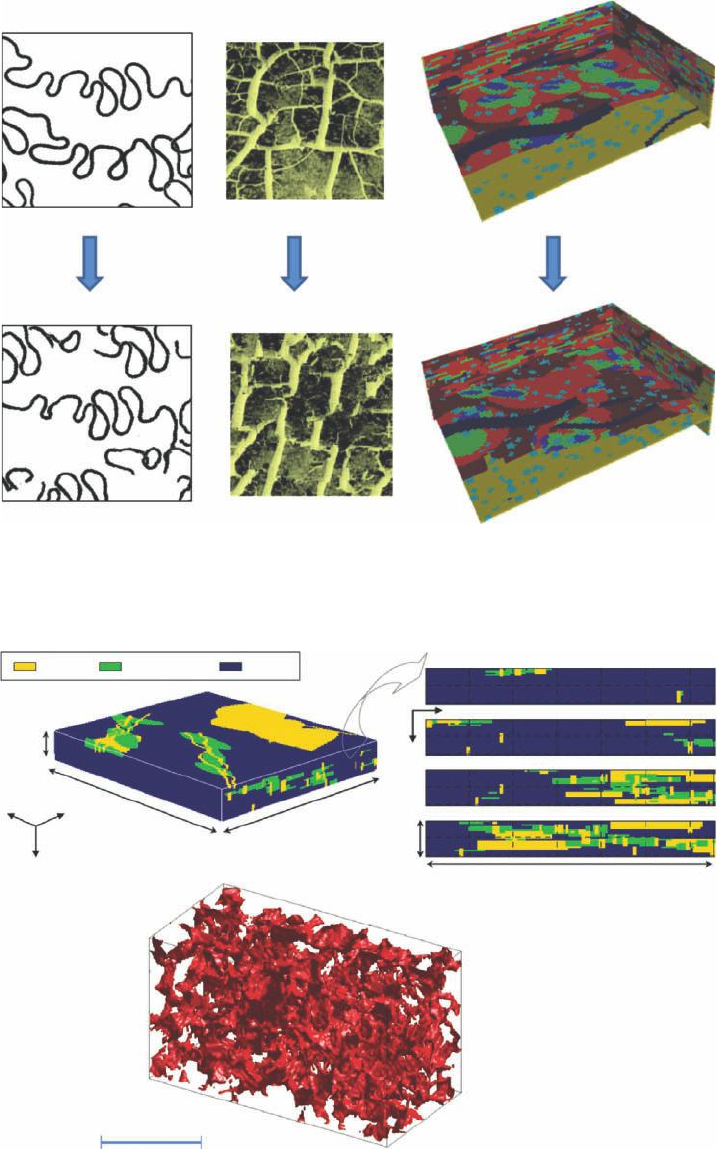
Training images
Earth models mimicking the training image paerns
Figure 5.11 A few example training images and Earth models produced from them exhibiting
similar patterns.
sand
y
x
x
z
z
112 (m)
15 (km)
13 (km)
overbank shale
112 (km)
05
microns
13 (km)
Figure 5.12 3D Training image example at the basin scale and pore scale (red = pore space).
P1: OTA/XYZ P2: ABC
JWST061-05 JWST061-Caers March 29, 2011 9:6 Printer Name: Yet to Come
92 CH 5 MODELING SPATIAL CONTINUITY
Further Reading
Caers, J. and Zhang, T. (2004) Multiple-point geostatistics: a quantitative vehicle for integrating geologic
analogs into multiple reservoir models, in Integration of outcrop and modern analog data in reservoir
models (eds G.M. Grammer, P.M. Harris and G.P. Eberli), AAPG Memoir 80, American Association
of Petroleum Geologists, Tulsa, OK, 383–394.
Deutsch, C.V. and Journel, A.G. (1998) GSLIB: The Geostatistical Software Library, Oxford University
Press.
Halderson, H.H. and Damsleth, E. (1990) Stochastic modeling. Journal of Petroleum Technology, 42(4),
404–412.
Holden, L., Hauge, R., Skare, Ø., and Skorstad, A. (1998) Modeling of fluvial reservoirs with object
models. Mathematical Geology, 30, 473–496.
Isaaks, E.H. and Srivastava, R.M. (1989) An introduction to applied geostatistics, Oxford University
Press.
Ripley, B.D. (2004) Spatial statistics, John Wiley & Sons, Inc., New York.
P1: OTA/XYZ P2: ABC
JWST061-06 JWST061-Caers March 30, 2011 19:10 Printer Name: Yet to Come
6
Modeling Spatial Uncertainty
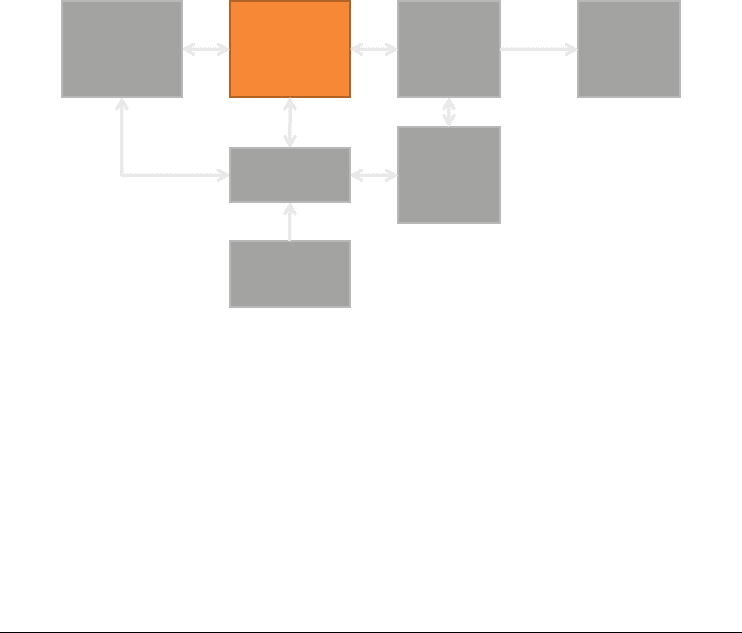
The set of models that can be generated for a given (fixed) spatial continuity model represents
a type of uncertainty that is termed spatial uncertainty or model of spatial uncertainty. It is
important to recognize that this is only one component in the large model of uncertainty that
is being built in this book.
Physical
model
Spaal
Stochasc
model
Spaal
Input
parameters
Forecast
and
decision
model
Physical
input
parameters
Raw
observaons
Data sets
response
uncertain
uncertain
uncertain certain or uncertain
uncertain/error
uncertain
uncertain
6.1 Introduction
A variogram model, Boolean model or 3D training image provides a model for the spatial
continuity of the phenomenon being studied. This was the topic of the previous chapter.
In this chapter methods for generating an Earth model that reflects what is captured in
this spatial continuity model are discussed. Recall that an Earth model is simply a 3D
grid filled with one or more properties. It will be seen that this creation is not a unique
process; many Earth models that are reflective of the same spatial continuity can be cre-
ated. The set of models that can be generated for a given (fixed) spatial continuity model
Modeling Uncertainty in the Earth Sciences, First Edition. Jef Caers.
© 2011 John Wiley & Sons, Ltd. Published 2011 by John Wiley & Sons, Ltd.
93
P1: OTA/XYZ P2: ABC
JWST061-06 JWST061-Caers March 30, 2011 19:10 Printer Name: Yet to Come
94 CH 6 MODELING SPATIAL UNCERTAINTY
represents a type of uncertainty that is termed spatial uncertainty or model of spatial un-
certainty. It is important to recognize that this is only one component in the large model
of uncertainty that is being built in this book. If conceptually the Earth is understood
as infinitely long one-dimensional layers, then only one model can be created: a layered
model. If channel-type structures are assumed to exist and modeled in a Boolean model,
then there are many ways to spatially distribute these channels in 3D space in a way that
is geologically realistic following the geological rules specified by the Boolean model. In
this chapter various techniques to accomplish this are discussed, then, in the next chapter,
it is shown how this spatial uncertainty can be further constrained with various sources
of data.
6.2 Object-Based Simulation
As discussed previously, object models allow the shape of objects occurring in nature to
be realistically represented. The aim of an object-based algorithm is to generate multi-
ple Earth models by dropping onto the grid objects in such a way that they fit the data.
For now only one data source is considered: point observations. These are simply ob-
servations (of a certain volume or support) that are assumed to be of the same size as
the model grid cell and are direct observations of the phenomenon. In this case, we have
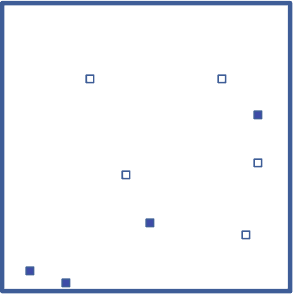
observations of the object type at specific locations (Figure 6.1).
Object-based models are evidently more “rigid” than cell-based, since “morphing” a
set of objects into a model constrained to all data is not as trivial as changing a few indi-
vidual grid cells to achieve the same task. This is particularly true for large, continuous
objects such as sinuous channels. The existing software implementations therefore rely
on an iterative approach to constrain such models to data. A trial-and-error procedure
is required to obtain models that reflect correctly the Boolean model and to adequately
match data. Boolean Earth models that are not constrained to any data locally can be
generated; this is called in geostatistical jargon “unconditional simulation.”
Figure 6.1 Point data with two categories.
P1: OTA/XYZ P2: ABC
JWST061-06 JWST061-Caers March 30, 2011 19:10 Printer Name: Yet to Come
6.2 OBJECT-BASED SIMULATION 95
For unconditional Boolean simulation with one object type, an Earth model can be
simply simulated without iteration by placing the objects randomly in the Earth model
grid and continuing until the desired proportion of objects is achieved. However, when
multiple interacting objects need to be placed in the same grid or when the placement
of objects need to follow certain rules, it is often necessary to “iterate,” for example by
moving the objects around until the rules expressed in the Boolean model are respected.
Iteration is required since it would be too hard to achieve this by a stroke of luck in
the first iteration. The same holds when there are data that need to be matched. These
iterative approaches start by generating an initial model that follows the pre-defined shape
description but does not necessarily fit the local data or follow all the rules. The most
critical part in making the iterative approach successful is the way in which a new object
model is generated, perturbed from the initial or current one. The type of perturbation
performed will determine how efficient the iterative process is, how well the final object
model matches the data and how well the pre-defined parameterization of object shapes
is maintained. One iteration step in this iterative scheme consists of:
r
proposing a perturbation of the current 3D Earth model;
r
accepting this perturbation with a certain probability ␣: this means that there is some
chance, namely 1 − ␣, that a model perturbation that improves the data matching will
be rejected. This is needed in order to cover as much as possible all possible spatial
configurations of objects that match equally well the data.
Several theories on so-called Markov chains (a process whereby the next iteration
accounts only for the previous one) have been developed on defining the optimal pertur-
bation and on determining the probability ␣ at each iteration step and are specific to the
type of objects present. These are not discussed in this book, as this is more advanced ma-
terial. Importing objects and arbitrarily morphing them to match the data could be done
easily. But then odd or unrealistic shapes may be generated. The key lies in determining
values for ␣ that achieve two goals: (1) matching data and (2) reflecting the predefined
Boolean model.
Regardless of the numerous smart implementations, the most challenging obstacle in
using object-based algorithms lies in the mismatch between the object parameterization
and the actual data. Some discrepancy exists between the simplified geometrical shapes
and actual occurrence in nature; reducing that discrepancy may call for considerable CPU
demand due to long iterations. It is often not possible to predict the level of discrepancy
prior to starting the object-based algorithms. While the object-based approach is a general
approach in the sense that any type of object could be modeled, the iterative approaches
to constraining such models to data are usually object specific.
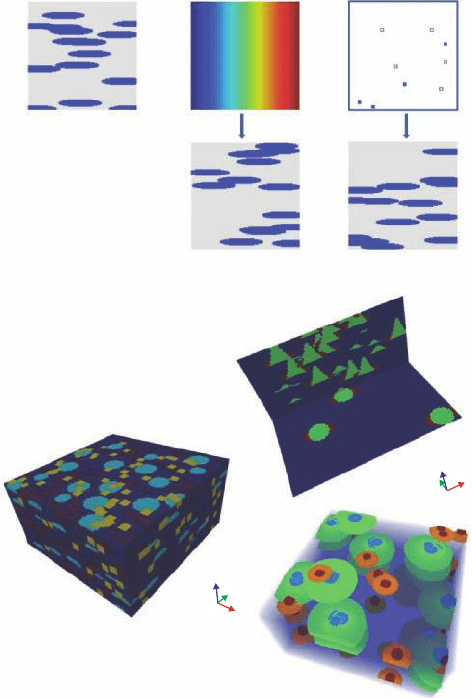
A few examples of typical rules and geometries used on object simulation are shown
in Figure 6.2. Case 1 has a simple elliptical object randomly distributed with a proportion
of 30%. Case 2 shows the same elliptical object, but having a proportion that varies in
space according to the map shown in Figure 6.2 (red color meaning higher proportion).
Case 3 shows an Earth model constrained to the data of Figure 6.1. Case 3 shows
P1: OTA/XYZ P2: ABC
JWST061-06 JWST061-Caers March 30, 2011 19:10 Printer Name: Yet to Come
96 CH 6 MODELING SPATIAL UNCERTAINTY
Cas
e
1
Case 2 Case 3
Cas
e
4
Cas
e
5
Cas
e
6
z
y
x
z
y
x
Figure 6.2 A few example cases of object simulations.
randomly placed objects consisting of two parts (also termed elements). Case 4 shows
two objects (the red and the green) that never touch each other, while the yellow and
green always touch each other. Case 5 shows a complex stacking of an object that
consists of two parts (termed elements). Case 6 shows a complex 3D object simulation
that combines various features of the previous cases. This Earth model is reflective of the
growth of two types of carbonate mounds consisting of an inner core with different rock
properties as the outer shell.
6.3 Training Image Methods
6.3.1 Principle of Sequential Simulation
Most of the geostatistical tools for modeling spatial uncertainty are cell based (pixel
based). The statistical literature offers many techniques for stochastically simulating 3D
P1: OTA/XYZ P2: ABC
JWST061-06 JWST061-Caers March 30, 2011 19:10 Printer Name: Yet to Come
6.3 TRAINING IMAGE METHODS 97
A
case
wit
h
a
2x2
grid
St
ep
1.
Pic
k
a
cell
Ste
p
2.
Assig
n
probability
52%
Ste
p
3.
Assig
n
color
St
ep
4.
Pic
k
a
cell
100%
Ste
p
5.
Assig
n
color
Ste
p
6.
Fina
l
result
Anothe
r
possible
model
A
training
image
Figure 6.3 Step-by-step description of sequential simulation for a 2 × 2 grid.
Earth models. The size of Earth models (millions of cells) prevents most of them of being
practical either because of CPU or RAM (memory) issues. One methodology that does
not suffer from these limitations is sequential simulation. The theory behind the sequen-
tial simulation approach is left to advanced books in geostatistics, the how-and-why it
works can be intuitively explained. In a nutshell: starting from an empty Cartesian grid a
model is built one cell at a time by visiting each grid cell along a random path, assigning
values to each grid cell, until all cells are visited. Regardless of how grid cell values are
assigned, the value assigned to a grid cell depends on the values assigned to all the pre-
viously visited cells along the random path. It is this sequential dependence that forces a
specific pattern of spatial continuity into the model.
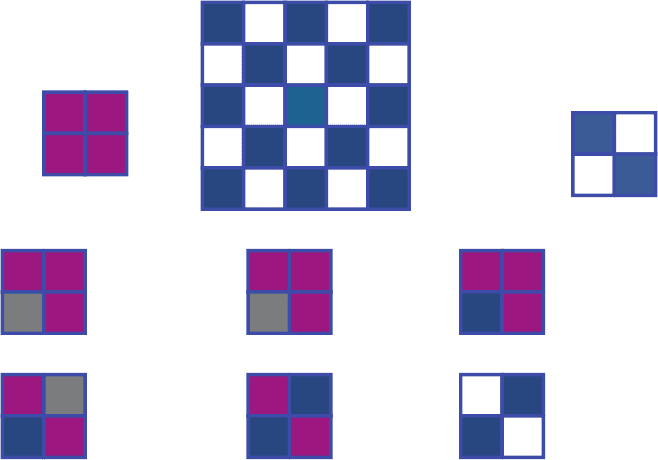
Consider the example in Figure 6.3. The goal is to generate a binary model for a 2 × 2
grid that displays a checkerboard pattern similar to the training image shown at the top of
Figure 6.3. The sequential simulation of this 2 × 2 grid proceeds as follows:
Step 1. Pick any of the four cells.
Step 2. What is the probability of having a blue color in this cell? Since there are not yet
any previously determined cells, that probability is equal to the overall estimated
percentage of blue pixels, in this case 13/25 = 52% because there are thirteen
blue cells and twelve white cells in the training image.
Step 3. Given the 52% probability, determine whether by random drawing a blue or white
color will be given this cell. Suppose the outcome of this random drawing is blue.
P1: OTA/XYZ P2: ABC
JWST061-06 JWST061-Caers March 30, 2011 19:10 Printer Name: Yet to Come
98 CH 6 MODELING SPATIAL UNCERTAINTY
Step 4. Pick randomly another cell.
Step 5. What is the probability of having a blue color in this cell given that the previous
visited cell has been simulated as blue? Now, this depends on the particular be-
lieved arrangement of blue and white cells, that is, the spatial continuity model.
Given the pattern depicted in the training image, the only possible outcome is to
have a blue cell, hence the probability equals 100%.
Step 6. The other two cells will be simulated white for the same argument.
By changing the order in which cells are visited or by changing the random drawing
(steps 3 and 5) a different result will be obtained. For this particular case, there can be
only two possible final models each with an almost equal chance of being generated. In
geostatistical jargon, each final result is termed a “realization”. In this book it is called an
“Earth model.”
6.3.2 Sequential Simulation Based on Training Images
Figure 6.3 shows that sequential simulation forces a pattern in the 2 × 2 model that is
similar to the pattern of a training image. In terms of actual 3D Earth modeling this means
that the training image expresses the pattern one desires the Earth model to depict. The
sequential procedure explained step-wise above is essentially similar for complex 3D
models with large 3D training images. At each grid cell in the Earth model, the probabil-
ity of having a certain category, given any previously simulated categories, is calculated.
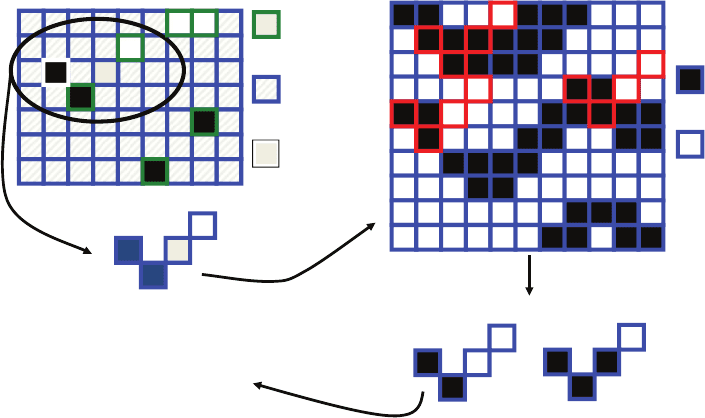
Take for example, the situation in Figure 6.4. The probability of the central cell being
?
?
Paern
found
two
mes
“data
event”
Probability for central value to be “Cat 1”=
1/3
Cat 1
Cat 0
Simulaon
grid
Training
image
Previously
simulated
Not
yet
simulated
Cell informed
by
Point
data
(value
frozen)
Paern
found
one
me
Figure 6.4 Scanning a training image to obtain a conditional probability.
P1: OTA/XYZ P2: ABC
JWST061-06 JWST061-Caers March 30, 2011 19:10 Printer Name: Yet to Come
6.3 TRAINING IMAGE METHODS 99
channel sand given its specific set of neighboring sand and no-sand data values, is calcu-
lated by scanning the training image in Figure 6.4 for “replicates” of this data event: three
such events are found of which one yields a central sand value, hence the probability of
having sand is 1/3. By random drawing, a category is assigned. This operation is repeated
until the grid is full. This procedure results in a simulated Earth model which will display
a pattern of spatial continuity similar to that depicted in the training image.
In actual cases, data provide local constraints on the presence of certain val-
ues/categories. In sequential simulation, such constraints are handled easily by assigning
(freezing) category values to those grid cells that have point data (= data that inform
directly the cell value) (Figure 6.4). The cells containing such constraints are never vis-
ited and their values never re-considered. The sequential nature of the algorithm forces
all neighboring simulated cell values to be consistent with the data. Unlike object-based
algorithms, sequential simulation methods allow constraining to well data in a single pass
over all grid cells, no iteration is required.
6.3.3 Example of a 3D Earth Model
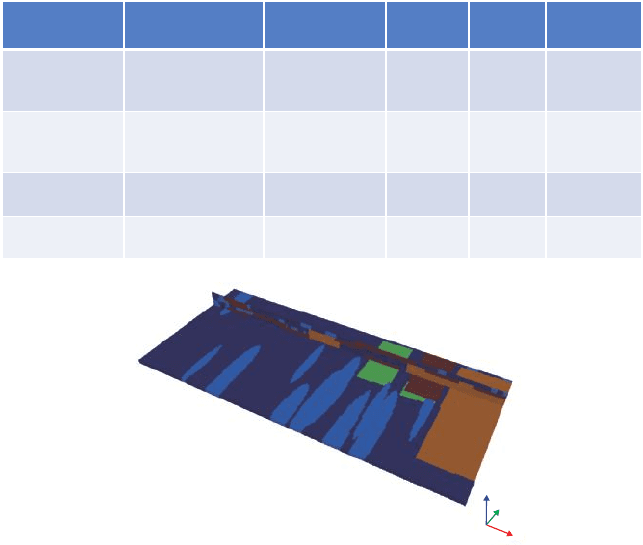
Consider the example of modeling rock types in a tidal dominated system further illus-
trates the concept of importing realistic geological patterns from training images. A grid
of 149*119*15 cells with grid cell size of 40 m*40 m*1 m is considered (Figure 6.5). The
Background
shales
Estuarine
sands
Tida
l
sand
flats
Transgressive
lags
Tida
l
bars
Facies
type
Conceptual
descripon
Stragraphy
Length
(m)
Width
(m)
Thickness
()
Tidal
bars
Elo
n
gate
d
ellipses
w
/
upper
sigmoidal
cros
s
-
secon
2000-4000Anywhere 3-7500
Tidal
Sa
nd
flats
Sheets
(rectangular)
Anywhere
Ero
d
e
d
by
sand
bars
610002000
Estuarine
sands
Sheets
(rectangular)
To
p
of
the
reservoir
820004000
Transgressive
lags
Sheets
(rectangular)
To
p
of
the
est
u
ari
ne
sands
410003000
z
y
x
Figure 6.5 Table with rock type relations and geometrical description. The corresponding train-
ing image was generated using an unconstrained Boolean simulation method.
P1: OTA/XYZ P2: ABC
JWST061-06 JWST061-Caers March 30, 2011 19:10 Printer Name: Yet to Come
100 CH 6 MODELING SPATIAL UNCERTAINTY
model includes five rock types: shale (50%), tidal sand bars (36%), tidal sand flats (1%),
estuarine sands (10%) and transgressive lags (3%). Using an unconditional object-based
method a training image was constructed using the following geological rules:
r
Tidal sand flats should be eroded by sand bars.
r
Transgressive sands should always appear on top of estuarine sands.
r
An object parameterization for each facies type, except the background shale, is given
in Figure 6.5.
In addition to these geological rules and patterns, trend information is available from
well-logging and seismic data. Trend information is usually not incorporated in the train-
ing image itself but input as additional constraints for generating an Earth model. Since
in sequential simulation an Earth model is built cell-by-cell, the trend information can
be enforced into the resulting Earth model directly, no iteration is required. The training
image needs only reflect the fundamental rules of deposition and erosion (the geological
concept) and needs not be constrained to any specific data (well, vertical and aerial pro-
portion variations, and seismic data). In geostatistical jargon, the training image contains
the nonlocations specific stationary information (patterns, rules), while reservoir specific
data enforces the trend. In this example, the following trend information was considered:
r
Because of coastal influence, sand bars and flats are expected to prevail in the south-east
part of the domain.
r
Shale is dominant at the bottom of the model, followed by sand bars and flats, whereas
estuarine sands and transgressive lags prevail in the top part.
Using the point data obtained from 140 wells, an aerial proportion map and a vertical
proportion curve are estimated for each category. Figure 6.6 shows a single Earth model
generated using this approach. The model matches the imposed erosion rules, depicted
by the training image of Figure 6.6, matches exactly all data from 140 wells and follows
the trends described by the proportion map and curves. The generated geometries are not
as crisp as the Boolean training image model; there are some limitations as to what this
technique can achieved but the overall joint capability of matching the data and producing
realistic looking 3D models makes this an appealing technique.
6.4 Variogram-Based Methods
6.4.1 Introduction
While generating Earth models using Boolean and training image-based techniques is
relatively easily to explain and understand, generating an Earth model with a variogram
is less straight forward and requires a lot theory that will not be covered here. The aim,