
Carson Ph., Mumford C. Hazardous Chemicals Handbook (Справочник по опасным химическим веществам)
Подождите немного. Документ загружается.

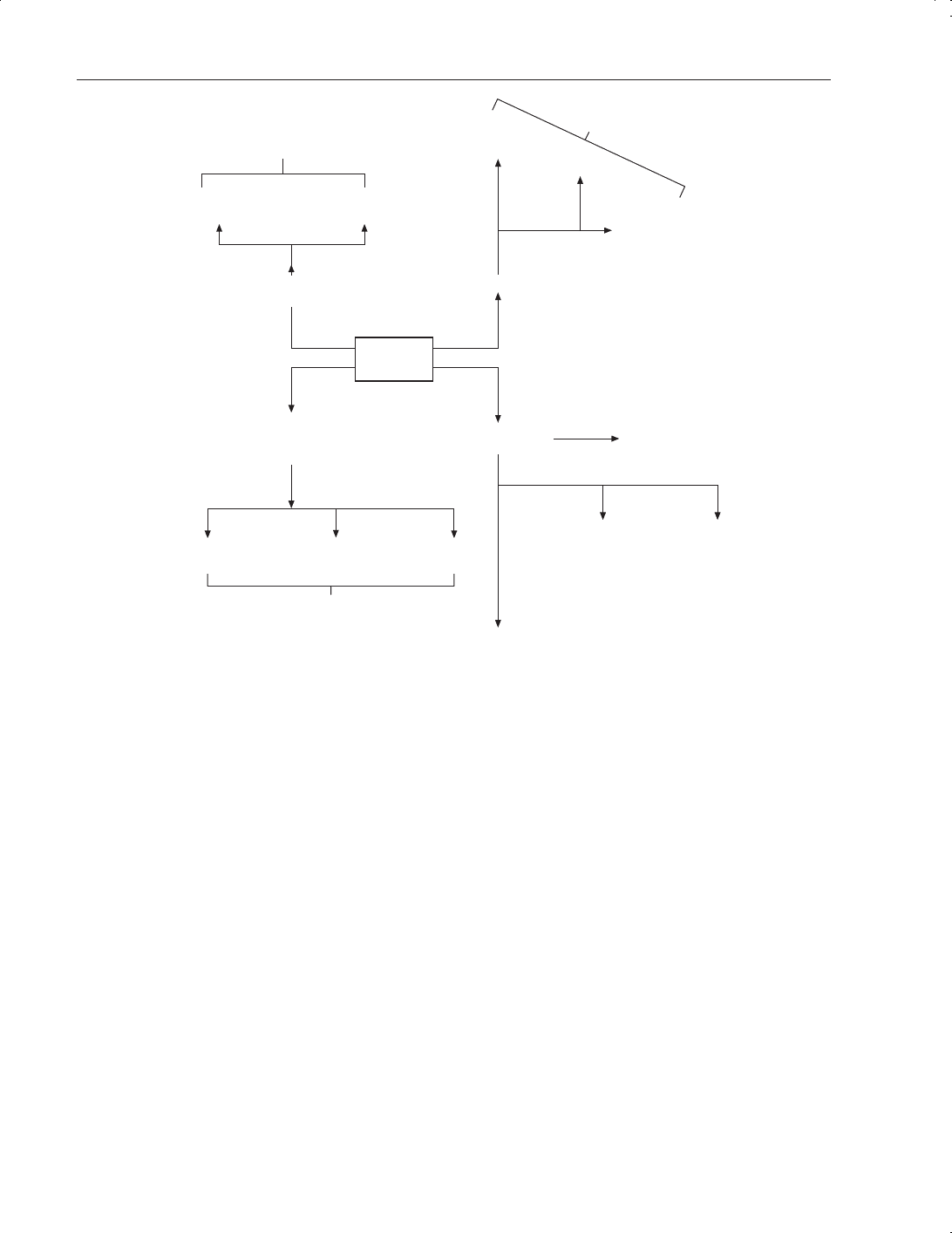
Reaction with
water
Ignition of
flammable gases Inflames
Over-pressurization*
of container
Admixture with
another specific
chemical
Violent
reaction/explosion
Toxic
gases
Flammable
gases
Self-reaction or
decomposition
Flammable gases
Toxic
gases
Explosion
Over-pressurization of container*
Flammable
gases
Toxic gases
Vigorous
reaction
Over-pressurization*
of container
Over-pressurization*
of container
Exothermic
reaction with air
Specific
chemical
*Unless venting/pressure relief is provided
Precautions for safe handling
• Store and use in such a way that accidental ingress of water, or contact with it, is avoided
(roofs of storage areas should be regularly maintained to minimize leaks).
• Provide covered storage, off the ground, away from sprinkler systems, safety showers, overhead
water lines or condensate lines.
• Keep away from water taps or sinks.
• Store under a chemically-inert medium when appropriate (stocks should be checked regularly
to ensure that an adequate level of inert medium is maintained).
• Segregate from other flammable materials, e.g. solvents and combustibles.
• Use appropriate eye/face protection, overalls and gloves.
Toxic hazards from mixtures
Undesirable emissions of toxic gases may occur as a result of mixing relatively common chemicals.
Refer to Table 7.4. Chemicals which are incompatible in this way must be brought into contact
only under strictly controlled conditions.
Figure 7.1
Possible reactive chemical hazards (consequences are not mutually exclusive)
TOXIC HAZARDS FROM MIXTURES 229

230 REACTIVE CHEMICALS
Table 7.1 Water-sensitive chemicals: consequences of water contact
Acetyl bromide T
Acetyl chloride T V
Acetylcholine bromide T
Aluminium (powder) F
Aluminium alkyls F V
Aluminium isopropoxide F
Aluminium lithium hydride F
Aluminium selenide T
Aluminium phosphide F T
Boron tribromide T
Calcium (granules) F
Calcium carbide F
Calcium hydride F
Calcium phosphide F T
Chlorosulphonic acid T V
Disulphur dichloride T V
Ethoxides, alkaline V
Lithium (metal) F V
Lithium aluminium deuteride F
Lithium aluminium dihydride F
Lithium borohydride F
Lithium hydride F
Lithium methoxide F
Magnesium (powder) F
Magnesium alkyls F
Magnesium phosphide F T
Methoxides, alkaline F V
Nickel sulphide T
Phosphorus pentasulphide F T
Phosphorus sesquisulphide F T
Phosphorus pentachloride T
Phosphorus pentabromide T
Potassium (metal) F V
Potassium borohydride F
Potassium methoxide F
Silicon tetrachloride T V
Sodium (metal) F V
Sodium aluminium hydride F
Sodium borohydride F T
Sodium hydride F
Sulphur dichloride T V
Sulphuric acid, fuming (Oleum) T V
Sulphur tetrachloride T V
Sulphuryl chloride T V
Thionyl chloride T V
Titanium tetrachloride T V
Trichlorophenylsilane T
Trichlorosilane F
Zinc (powder) F
Zinc alkyls TV
Zirconium (powder) F
F Flammable gases
T Toxic products
V Vigorous reaction

Precautions
• Provision of adequate training, instruction, and supervision.
• Prohibition on unauthorized mixing, e.g. of cleaning agents or ‘wastes’.
• Correct labels.
• Segregated storage, to avoid accidental mixing.
• Dispose of wastes and ‘empty’ containers by different routes.
• Specific precautions against the inherent hazards of each individual chemical.
Reactive hazards from mixtures
Many chemicals are ‘incompatible’ because a violent reaction may occur on mixing. This can, in
some conditions, result in an explosion. Refer to Table 7.5.
An appraisal is needed of all chemicals which may be present, even if unintentionally (e.g. as
intermediates, byproducts or wastes) and how they can react under the most extreme conditions
Table 7.2 Examples of reactive chlorine compounds
Compound Description Reactivity
Acetyl chloride Colourless, fuming, corrosive liquid Decomposes violently with water to
CH
3
COCI Flash point 4°C produce heat and toxic fumes: HCI
When heated, emits phosgene
Aluminium chloride Orange, yellow, grey or white Reacts with air moisture to form corrosive
(anhydrous) powder which is a severe HCI gas
AICI
3
respiratory irritant and can cause Violent reaction when a stream of water hits
skin/eye burns a large amount
Do not use water in vicinity
Benzoyl chloride Colourless, fuming, corrosive liquid Reacts strongly with water or water
C
6
H
5
COCI with a strong odour vapour, producing heat and toxic/corrosive
Combustible: flash point 72°C fumes
Generates phosgene gas when Use of water must be considered carefully
heated
Calcium hypochlorite Water soluble white crystals or Water spray may be used but evolves CI
2
gas
Ca(CIO)
2
powder with strong chlorine freely at ordinary temperatures with
odour moisture
Non-flammable but can evolve CI
2
and O
2
May undergo decomposition
Sulphur monochloride Yellowish-red oily fuming liquid Decomposes when contacted by water, to
S
2
CI
2
with a strong odour produce heat and toxic/corrosive fumes
Combustible: flash point 118°C Do not allow water to enter containers:
Ignition temp. 233°C reaction can be violent
Liquid and vapours are irritating Wash down spills with flooding amounts
of water
Titanium tetrachloride Colourless to light yellow fuming Reacts vigorously with water, liberating heat
TiCI
4
corrosive liquid and corrosive HCI gas
Vapour is irritating Reacts more strongly with hot water
Use water spray to keep exposed containers
cool in fire
REACTIVE HAZARDS FROM MIXTURES 231

232 REACTIVE CHEMICALS
Table 7.3 Variation in reactivity of hydrides with humid air or water
Substance Reaction (ambient temperature)
Humid air Water
Aluminium borohydride (Al(BH
4
)
3
) Explosive Explosive
Aluminium hydride (AlH
3
) Slow Moderate
Antimony hydride (Stibine) (SbH
3
) Rapid Very slow
Arsenic hydride (Arsine) (AsH
3
) Moderate Very slow
Barium hydride (BaH
2
) Rapid Rapid
Beryllium borohydride (Be(BH
4
)
2
) Explosive Explosive
Beryllium hydride (BeH
2
) Slow Slow
Calcium hydride (CaH
2
) Moderately fast Rapid
Cerium hydride (CeH
3
) Pyrophoric Slow
Caesium hydride (CsH) Inflames Violent
Copper hydride (CuH) Rapid Slow
Diborane (B
2
H
6
) Explosive Moderate
Lead hydride (PbH
4
) Instant (unstable gas) —
Lithium aluminium hydride (LiAH
4
) Rapid Violent
Lithium borohydride (LiBH
4
) Rapid Vigorous
Lithium hydride (LiH) Can ignite Rapid
Magnesium aluminium hydride (Mg(AlH
4
)
2
) Vigorous Vigorous
Magnesium borohydride (Mg(BH
4
)
2
) Very slow Violent
Magnesium hydride (MgH
2
) Known to ignite Rapid
Pentaborane (B
5
H
9
) Ignites Rapid
Phosphorus hydride (Phosphine) (PH
3
) Pyrophoric Very slow
Potassium borohydride (KBH
4
) Very slow Very slow
Potassium hydride (KH) Inflames Vigorous
Rubidium hydride (RbH) Inflames Violent
Silicon hydride (Silane) (SiH
4
) Explosive Rapid
Sodium aluminium hydride (NaAlH
4
) Rapid Ignites, may explode
Sodium borohydride (NaBH
4
) Slow Slow
Sodium hydride (NaH) Ignites Violent
Uranium hydride (UH
3
) Pyrophoric Moderate
Table 7.4 Toxic hazards from incompatible chemical mixtures
Substances in column 1 must be stored/handled so that they cannot accidentally contact corresponding substances in
column 2 because toxic materials (column 3) would be produced.
Column 1 Column 2 Column 3
Arsenical materials Any reducing agent Arsine
Azides Acids Hydrogen azide
Cyanides Acids Hydrogen cyanide
Hypochlorites Acids Chlorine or hypochlorous acid
Nitrates Sulphuric acid Nitrogen dioxide
Nitric acid Copper, brass any heavy metals Nitrogen dioxide (nitrous fumes)
Nitrites Acids Nitrous fumes
Phosphorus Caustic alkalis or reducing agents Phosphine
Selenides Reducing agents Hydrogen selenide
Sulphides Acids Hydrogen sulphide
Tellurides Reducing agents Hydrogen telluride

Table 7.5 Reactive hazards of incompatible chemicals
Substances in column 1 must be stored/handled so that they cannot contact corresponding substances in column 2 under
uncontrolled conditions, or violent reactions may occur.
Column 1 Column 2
Acetic acid Chromic acid, nitric acid, hydroxyl-containing compounds, ethylene
glycol, perchloric acid, peroxides, or permanganates
Acetone Concentrated nitric and sulphuric acid mixtures
Acetylene Chlorine, bromine, copper, silver, fluorine or mercury
Alkali and alkaline earth metals, Carbon dioxide, carbon tetrachloride, or other chlorinated
e.g. sodium, potassium hydrocarbons. (Also prohibit, water, foam and dry chemical on fires
lithium, magnesium, calcium, involving these metals – dry sand should be available)
powdered aluminium
Anhydrous ammonia Mercury, chlorine, calcium hypochlorite, iodine, bromine or hydrogen fluoride
Ammonium nitrate Acids, metal powders, flammable liquids, chlorates, nitrites, sulphur,
finely-divided organics or combustibles
Aniline Nitric acid, hydrogen peroxide
Bromine Ammonia, acetylene, butadiene, butane or other petroleum gases,
sodium carbide, turpentine, benzene, or finely-divided metals
Calcium oxide Water
Carbon, activated Calcium hypochlorite
Chlorates Ammonium salts, acids, metal powders, sulphur, finely-divided organics
or combustibles
Chromic acid and chromium Acetic acid, naphthalene, camphor, glycerol, turpentine, alcohol or
trioxide other flammable liquids
Chlorine Ammonia, acetylene, butadiene, butane or other petroleum gases,
hydrogen, sodium carbide, turpentine, benzene or finely-divided metals
Chlorine dioxide Ammonia, methane, phosphine or hydrogen sulphide
Copper Acetylene, hydrogen peroxide
Fluorine Isolate from everything
Hydrazine Hydrogen peroxide, nitric acid, or any other oxidant
Hydrocarbons (benzene, butane, Fluorine, chlorine, bromine, chromic acid, peroxides
propane, gasoline, turpentine, etc.)
Hydrocyanic acid Nitric acid, alkalis
Hydrofluoric acid, anhydrous Ammonia, aqueous or anhydrous
(hydrogen fluoride)
Hydrogen peroxide Copper, chromium, iron, most metals or their salts, any flammable
liquid, combustible materials, aniline, nitromethane
Hydrogen sulphide Fuming nitric acid, oxidizing gases
Iodine Acetylene, ammonia (anhydrous or aqueous)
Mercury Acetylene, fulminic acid (produced in ethanol – nitric acid mixtures), ammonia
Nitric acid (conc) Acetic acid, acetone, alcohol, aniline, chromic acid, hydrocyanic acid,
hydrogen sulphide, flammable liquids, flammable gases, or nitratable
substances, paper, cardboard or rags
Nitroparaffins Inorganic bases, amines
Oxalic acid Silver, mercury
Oxygen Oils, grease, hydrogen, flammable liquids, solids or gases
Perchloric acid Acetic anhydride, bismuth and its alloys, alcohol, paper, wood, grease, oils
Peroxides, organic Acids (organic or mineral), avoid friction, store cold
Phosphorus (white) Air, oxygen
Potassium chlorate Acids (
see also
chlorates)
Potassium perchlorate Acids (
see also
perchloric acid)
Potassium permanganate Glycerol, ethylene glycol, benzaldehyde, sulphuric acid
Silver Acetylene, oxalic acid, tartaric acid, fulminic acid (produced in
ethanol–nitric acid mixtures), ammonium compounds
Sodium See alkali metals (above)
Sodium nitrite Ammonium nitrate and other ammonium salts
Sodium peroxide Any oxidizable substance, such as ethanol, methanol, glacial acetic
acid, acetic anhydride, benzaldehyde, carbon disulphide,
glycerol, ethylene glycol, ethyl acetate, methyl acetate or furfural
Sulphuric acid Chlorates, perchlorates, permanganates
REACTIVE HAZARDS FROM MIXTURES 233

234 REACTIVE CHEMICALS
(e.g. concentration, agitation, temperature, pressure) likely to arise. Sometimes special testing is
required.
For reactions with air or water, refer to pyrophoric chemicals (Chapter 6).
In acid-base reactions, the heat of neutralization of aqueous acids and bases can be sufficient
to cause ‘spitting’ from containers when the concentrated reagents interact. This is also encountered
when concentrated sulphuric acid is diluted (refer to Table 7.1); the acid should always be added
cautiously to water and not vice versa. Eye and skin protection is obligatory when using such reagents.
Oxidizing agents
Oxidizing agents, although not normally spontaneously flammable, often represent a source of
oxygen that can support combustion. They will react readily in contact with reducing reagents.
Hence an oxidizing agent will invariably accelerate the rate of burning of a combustible material.
In finely divided state such mixtures may react explosively.
Some common oxidizing agents are classified according to stability in Table 7.6.
Table 7.6 Common oxidizing agents classified according to stability
Classification Example
Relatively stable Aluminium nitrate
• Increase the burning rate of combustible materials Ammonium persulphate
• Form highly flammable or explosive mixtures Barium nitrate/peroxide
with finely divided combustible materials Calcium nitrate/peroxide
Cupric nitrate
Hydrogen peroxide solutions (8–27.5% by weight)
Lead nitrate
Lithium peroxide/hypochlorite
Magnesium nitrate/perchlorate
Nickel nitrate
Nitric acid (concentrations ≤70%)
Potassium dichromate/nitrate/persulphate
Silver nitrate
Sodium dichromate/nitrate/nitrite/perborate/
persulphate/chlorite (≤40% by weight)
Strontium nitrate/peroxide
Zinc peroxide
Moderately unstable/reactive Ammonium dichromate
• Undergo vigorous decomposition on heating Barium chlorate
• Explode when heated in a sealed container Calcium chlorate/hypochlorite
• Cause spontaneous heating of combustible Chromium trioxide (chromic acid)
materials Hydrogen peroxide solutions (27.5–91% by weight)
Nitric acid (concentrations >70%)
Potassium bromide/chlorate/permanganate/peroxide
Sodium chlorate/permanganate/peroxide/chlorite
(>40% by weight)
Strontium chlorate
Unstable Ammonium chlorate/perchlorate/permanganate
• Explode when catalysed or exposed to heat, Benzoyl peroxide
shock or friction Guanidine nitrate
• Liberate oxygen at room temperatures Mercury chlorate
Methyl ethyl ketone peroxide
Potassium superoxide

Safe handling
• Handle and store the minimum quantities practicable for the process or experiments in progress.
• Segregate the materials from other chemicals, particularly reducing agents, paper, straw, cloth
or materials of low flash point.
• Handle in the most dilute form possible in clearly designated areas, away from potential
ignition sources.
• Provide and use appropriate eye/face protection, overalls and gloves.
Hazards arising from the oxidation of organic compounds are greater when the reactants are
volatile, or present as a dust or an aerosol. Liquid oxygen and various concentrated acids, e.g.
nitric, sulphuric or perchloric acid, and chromic acid are strong oxidizing agents. The use of
perchloric acid or perchlorates has resulted in numerous explosions; their use should be avoided
when possible (refer to Table 7.5).
Explosive chemicals
Explosions involving flammable gases, vapours and dusts are discussed in Chapter 6. In addition,
certain chemicals may explode as a result of violent self-reaction or decomposition when subjected
to mechanical shock, friction, heat, light or catalytic contaminants. Substances containing the
atomic groupings listed in Table 7.7 are thermodynamically unstable, or explosive. They include
acetylides and acetylenic compounds, particular nitrogen compounds, e.g. azides and fulminates,
peroxy compounds and vinyl compounds. These unstable moieties can be classified further as in
Table 7.8 for peroxides. Table 7.9 lists a selection of potentially-explosive compounds.
More specific definitions of ‘explosives’ appear in legislation, e.g. in the UK under the Explosives
Act 1875 as amended, which covers:
• High explosives which detonate to produce shock waves. Materials which are easily detonated
by mechanical or electrical stimuli are termed ‘primary explosives’. Those requiring an impinging
shock wave to initiate them are ‘secondary explosives’.
• Pyrotechnics which burn to produce heat, smoke, light and/or noise.
• Propellants which burn to produce heat and gas as a means of pressurizing pistons, start
engines, propel projectiles and rockets.
The precautions with any particular explosive depends on the hazard. In the UK explosives are
classified as: 1 – Gunpowder; 2 – Nitrate mixture; 3 – Nitro compound; 4 – Chlorate mixture;
5 – Fulminate; 6 – Ammunition and 7 – Fireworks.
For the purposes of safety distances in connection with the issue of licences for factories and
magazines, explosives have been categorized as: X – fire or slight explosion risks or both, with
only local effect; Y – mass fire risks or moderate explosion risk, but not mass explosion risk;
Z – mass explosion risk with serious missile effect; ZZ – mass explosion risk with minor missile
effect.
Hazards can be illustrated by reference to Table 7.10 (showing the explosive effects of small
quantities of high explosives in a 6 m × 6 m single-storey building) and to Figure 7.2 (relating the
size of fireball to quantity of burning pyrotechnic, high explosive or propellant). With pyrotechnics
the hazard is related to the violence with which the chemical burns. One scheme used to classify
pyrotechnics is given in Table 7.11. This is used to restrict quantities in use/storage and for
EXPLOSIVE CHEMICALS 235

236 REACTIVE CHEMICALS
Hydroxylammonium salts– N
+
– OH Z
–
CC
CNO
CNO
2
CC
Metal
CC
X
C
NN
=
CN
2
NO
2
NO
2
C
CONO
CNO
2
O
O
CC
C NOMetal
NO
2
NO
2
C F
N – Metal
N – N = O
N – NO
2
C – N = N – C
C – N = N – O – C
C – N = N – S – C
C – N = N – O – N = N – C
C – N = N – S – N = N – C
C – N = N – N – C
R
– N = N – N = N –
– C – O – O – H
– C – CO – OOH
– C – O – O – C –
– C – CO – OOR
– O – O – Metal
– O – O – Non–metal
N Cr – O
2
– N
3
C – N
2
+
O
–
– C – N
2
+
S
–
N
+
– HZ
–
Acetylenic Compounds
Metal Acetylides
Haloacetylene derivatives
Diazirines
Diazo Compounds
Nitroso Compounds
Nitroalkanes, C–Nitro and Polynitroaryl compounds
Polynitroalkyl compounds
Acyl or alkyl nitrites
Acyl or alkyl nitrates
1,2–Epoxides
N–Metal Derivatives
Metal Fulminates or aci – nitro salts
Fluorodinitromethyl compounds
N–Nitroso Compounds
Azo Compounds
N–Nitro Compounds
Arenediazoates
Bis–arenediazo oxides
Arenediazo aryl sulphides
Trizazenes (R=H, –CN, –OH, –NO)
Bis–arenediazo sulphides
High–nitrogen compounds tetrazoles
Alkylhydroperoxides
Peroxides (cyclic, diacyl, dialkyl)
Metal peroxides, peroxoacid salts
Peroxoacids
Aminechromium peroxo–complexes
Azides (acyl, halogen, non–metal, organic)
Arenediazoniumolates
Diazonium sulphides and derivatives, ‘xanthates’
Hydrazinium salts, oxosalts of nitrogenous bases
Peroxyacids
Peroxyesters
Table 7.7 Atomic groupings characterizing explosive compounds
Bond groupings Class

Diazonium carboxylates or salts
Aminemetal oxosalts
Halo–Arylmetals
Halogen Azides, N–Halogen compounds, N–Haloimides
Difluoroamino compounds
Alkyl perchlorates, Chlorite salts, Halogen oxides,
Hypohalites, Perchloric acid, Perchloryl Compounds
– C – N
2
+
Z
–
(N–Metal)
+
Z
–
Ar–Metal–X
X–Ar–Metal
N–X
–NF
2
–O–X
RSOOR′
O
O
O
NCOOR
ROOCOOR
O
ROCOOR′
O
R(CO
3
R′)
n
R′(O
3
CR)
2
RCOOCOR′
O
O
RSOOSR
O
O
O O
RSOOCR
O
O
O
ROCOOCOR
O O
RCOOCR′
O
O
R(CO
3
H)
n
RSO
2
OOH
R
m
Q(OOR)
n
R
m
QOOQR
n
ROOR′
O
–
OO
–
C
contain the grouping:
ROOH
R
m
Q(OOH)
n
(Q = metal or metalloid)
Hydroperoxides
α-Oxy- and α-peroxy-hydroperoxides and peroxides
Peroxides
Peroxyacids
Diacyl peroxides
Peroxyesters
Table 7.7 Cont’d
Bond groupings Class
Table 7.8 Classification of organic peroxides
Peroxide class General structures or characteristic group
EXPLOSIVE CHEMICALS 237

238 REACTIVE CHEMICALS
Table 7.9 Selected potentially explosive compounds
(a) Peroxy compounds
(i)
Organic peroxy compounds
Acetyl cyclohexane-sulphonyl peroxide (70%)
Acetyl cyclohexane-sulphonyl peroxide
(28% phthalate solution)
o-
Azidobenzoyl peroxide
t-Butyl mono permaleate (95% dry)
t-Butyl peracetate (70%)
t-Butyl peroctanoate
t-Butyl perpivalate (75% hydrocarbon solution)
t-Butyl peroxy isobutyrate
Bis-hexahydrobenzoyl peroxide
Bis-monofluorocarbonyl peroxide
Bis-benzenesulphonyl peroxide
Bis-hydroxymethyl peroxide
Bis (1-hydroxycyclohexyl) peroxide
2,2-Bis (t-butylperoxy) butane
2,2-Bis-hydroperoxy diisopropylidene peroxide
Barium methyl peroxide
Benzene triozonide
Cyclohexanone peroxide (95% dry)
Diacetyl peroxide
Di-
n
-butyl perdicarbonate (25% hydrocarbon
solution)
2:4-Dichlorobenzoyl peroxide
(50% phthalate solution)
Dicaproyl peroxide
Dicyclohexyl perdicarbonate
Di-2-ethylhexyl perdicarbonate
(40% hydrocarbon solution)
Dimethyl peroxide
Diethyl peroxide
Di-t-butyl-di-peroxyphthalate
Difuroyl peroxide
Dibenzoyl peroxide
Dimeric ethylidene peroxide
Dimeric acetone peroxide
Dimeric cyclohexanone peroxide
Diozonide of phorone
Dimethyl ketone peroxide
Ethyl hydroperoxide
Ethylene ozonide
Hydroxymethyl methyl peroxide
Hydroxymethyl hydroperoxide
1-Hydroxyethyl ethyl peroxide
1-Hydroperoxy-1-acetoxycyclodecan-6-one
Isopropyl percarbonate
Isopropyl hydroperoxide
Methyl ethyl ketone peroxide
Methyl hydroperoxide
Methyl ethyl peroxide
Monoperoxy succinic acid
Nonanoyl peroxide (75% hydrocarbon solution)
1-Naphthoyl peroxide
Oxalic acid ester of t-butyl hydroperoxide
Ozonide of maleic anhydride
Phenylhydrazone hydroperoxide
Polymeric butadiene peroxide
Polymeric isoprene peroxide
Polymeric dimethylbutadiene peroxide
Polymeric peroxides of methacrylic acid
esters and styrene
Polymeric peroxide of asymmetrical diphenylethylene
Peroxyformic acid
Peroxyacetic acid
Peroxybenzoic acid
Peroxycaproic acid
Polymeric ethylidene peroxide
Sodium peracetate
Succinic acid peroxide (95% dry)
Trimeric acetone peroxide
Trimeric propylidene peroxide
Tetraacetate of 1,1,6,6-tetrahydroperoxycyclodecane
(ii)
Inorganic peroxy compounds
Peroxides
Hydrogen peroxide (>30%)
Mercury peroxide
Peroxyacids
Peroxydisulphuric acid
Peroxynitric acid
Peroxy ditungstic acid
Peroxyacid salts
Sodium peroxyborate (anhydrous)
Sodium triperoxychromate
Sodium peroxymolybdate
Sodium peroxynickelate
Sodium diperoxytungstate
Potassium peroxyferrate
Potassium peroxynickelate
Potassium hyperoxytungstate
Potassium peroxy pyrovanadate
Calcium diperoxysulphate
Calcium peroxychromate
Zinc tetraaminoperoxydisulphate
Ammonium peroxyborate
Ammonium peroxymanganate
Ammonium peroxychromate
Superoxides
Potassium superoxide
Ozone (liquid >30%)
Potassium ozonide
Caesium ozonide
Ammonium ozonide
Inorganic peracids and their salts
(common examples
which are particularly hazardous)
Ammonium perchlorate
Ammonium persulphate
Ammonium pernitrate
Perchloric acid (>73%)
Performic acid
Silver perchlorate
Tropylium perchlorate