
Carson Ph., Mumford C. Hazardous Chemicals Handbook (Справочник по опасным химическим веществам)
Подождите немного. Документ загружается.


Table 8.2 Working temperatures of cryogenic slush baths
Bath liquid Temperature
(°C)
Carbon tetrachloride – 23
Chlorobenzene – 45
Solid carbon dioxide – 63
in acetone or methylated spirits
(1)
– 78
Toluene – 95
Carbon disulphide – 112
Diethyl ether – 120
Petroleum ether – 140
(1)
Liquid nitrogen is omitted from this mixture and the solvent is used to improve the heat transfer characteristics of cardice.
Typical insulating materials include purged rockwool or perlite, rigid foam such as foam-glass
or urethane, or vacuum. However, because perfect insulation is not possible heat leakage occurs
and the liquefied gas eventually boils away. Uncontrolled release of a cryogen from storage or
during handling must be carefully considered at the design stage. The main hazards with cryogens
stem from:
• The low temperature which, if the materials come into contact with the body, can cause severe
tissue burns. Flesh may stick fast to cold uninsulated pipes or vessels and tear on attempting
to withdraw it. The low temperatures may also cause failure of service materials due to
embrittlement; metals can become sensitive to fracture by shock.
• Asphyxiation (except with oxygen) if the cryogen evaporates in a confined space.
• The very large vapour-to-liquid ratios (Table 8.1) so that a large cloud, with fog, results from
loss of liquid.
• Catastrophic failure of containers as cryogen evaporates to cause pressure build-up within the
vessel beyond its safe working pressure (e.g. pressures ≤280 000 kPa or 40 600 psi can develop
when liquid nitrogen is heated to ambient temperature in a confined space).
• Flammability (e.g. hydrogen, acetylene, methane), toxicity (e.g. carbon dioxide, fluorine), or
chemical reactivity (fluorine, oxygen).
• Trace impurities in the feed streams can lead to combination of an oxidant with a flammable
material (e.g. acetylene in liquid oxygen, solid oxygen in liquid hydrogen) and precautions
must be taken to eliminate them.
• Several materials react with pure oxygen so care in selection of materials in contact with
oxygen including cleaning agents is crucial.
Key precautions are given in Table 8.3.
The cryogens encountered in greatest volume include oxygen, nitrogen, argon and carbon
dioxide. Their physical properties are summarized in Table 8.4.
Liquid oxygen
Liquid oxygen is pale blue, slightly heavier than water, magnetic, non-flammable and does not
produce toxic or irritating vapours. On contact with reducing agents, liquid oxygen can cause
explosions.
LIQUID OXYGEN 259

260 CRYOGENS
Gaseous oxygen is colourless, odourless and tasteless. It does not burn but supports combustion
of most elements. Thus upon vaporization liquid oxygen can produce an atmosphere which
enhances fire risk; flammability limits of flammable gases and vapours are widened and fires burn
with greater vigour. It may cause certain substances normally considered to be non-combustible,
e.g. carbon steel, to inflame. In addition to the general precautions set out in Table 8.3, the
following are also relevant to the prevention of fires and explosions:
• Prohibit smoking or other means of ignition in the area.
• Avoid contact with flammable materials (including solvents, paper, oil, grease, wood, clothing)
and reducing agents. Thus oil or grease must not be used on oxygen equipment.
• Purge oxygen equipment with oil-free nitrogen or oil-free air prior to repairs.
• Post warning signs.
• In the event of fire, evacuate the area and if possible shut off oxygen supply. Extinguish with
Table 8.3 General precautions with cryogenic materials
Obtain authoritative advice from the supplier.
Select storage/service materials and joints with care, allowing for the reduction in ductility at cryogenic temperatures.
Provide special relief devices as appropriate.
Materials of construction must be scrupulously clean, free of grease etc.
Use only labelled, insulated containers designed for cryogens, i.e. capable of withstanding rapid changes and extreme
differences in temperature, and fill them slowly to minimize thermal shock.
Keep capped when not in use and check venting.
Glass Dewar flasks for small-scale storage should be in metal containers, and any exposed glass taped to prevent glass
fragments flying in the event of fracture/implosion.
Large-scale storage containers are usually of metal and equipped with pressure-relief systems.
In the event of faults developing (as indicated by high boil-off rates or external frost), cease using the equipment.
Provide a high level of general ventilation taking note of density and volume of gas likely to develop: initially gases will
slump, while those less dense than air (e.g. hydrogen, helium) will eventually rise.
Do not dispose of liquid in a confined area.
Prevent contamination of fuel by oxidant gases/liquids.
With flammable gases, eliminate all ignition sources (refer to Chapter 6). Possibly provide additional high/low level ventilation;
background gas detectors to alarm, e.g. at 40% of the LEL. With toxic gases, possibly provide additional local ventilation;
monitors connected to alarms; appropriate air-fed respirators. (The flammable/toxic gas detectors may be linked to
automatic shutdown instrumentation.)
Limit access to storage areas to authorized staff knowledgeable in the hazards, position of valves and switches.
Display emergency procedures.
Wear face shields and impervious dry gloves, preferably insulated and of loose fit.
Wear protective clothing which avoids the possibility of cryogenic liquid becoming trapped near the skin: avoid turnups and
pockets and wear trousers over boots, not tucked in.
Remove bracelets, rings, watches etc. to avoid potential traps of cryogen against skin.
Prior to entry into large tanks containing inert medium, ensure that pipes to the tank from cryogen storage are blanked off
or positively closed off: purge with air and check oxygen levels.
If in doubt, provide air-fed respirators and follow the requirements for entry into confined spaces (Chapter 13).
First aid measures include:
Move casualties becoming dizzy or losing consciousness into fresh air and provide artificial respiration if breathing stops.
Obtain medical attention (Chapter 13).
In the event of ‘frost-bite’ do not rub the affected area but immerse rapidly in warm water and maintain general body
warmth.
Seek medical aid.
Ensure that staff are trained in the hazards and precautions for both normal operation and emergencies.

water spray unless electrical equipment is involved, when carbon dioxide extinguishers should
be used.
Liquid nitrogen and argon
Liquid nitrogen is colourless and odourless, slightly lighter than water and non-magnetic. It does
not produce toxic or irritating vapours. Liquid argon is also colourless and odourless but significantly
heavier than water. Gaseous nitrogen is colourless, odourless and tasteless, slightly soluble in
water and a poor conductor of heat. It does not burn or support combustion, nor readily react with
other elements. It does, however, combine with some of the more active metals, e.g. calcium,
sodium and magnesium, to form nitrides. Gaseous argon is also colourless, odourless and tasteless,
very inert and does not support combustion.
The main hazard from using these gases stems from their asphyxiant nature. In confined,
unventilated spaces small leakages of liquid can generate sufficient volumes of gas to deplete the
oxygen content to below life-supporting concentrations: personnel can become unconscious without
warning symptoms (Chapter 5). Gas build-up can occur when a room is closed overnight.
Also, because the boiling points of these cryogenic liquids are lower than that of oxygen, if
exposed to air they can cause oxygen to condense preferentially, resulting in hazards similar to
those of liquid oxygen.
Liquid carbon dioxide
Liquid carbon dioxide is usually stored under 20 bar pressure at –18°C. Compression and cooling
of the gas between the temperature limits at the ‘triple point’and the ‘critical point’ will cause it
Table 8.4 Physical properties of selected cryogenic liquids
Property of liquid Oxygen Nitrogen Argon Carbon
dioxide
Molecular weight 32 28 40 44
Boiling point
(at atmospheric pressure) °C –183 –196 –186 –78
Freezing point °C –219 –210 –190 —
Critical temperature K 154.8 126.1 150.7 —
Density of liquid
(at atmospheric pressure) kg/m
3
1141 807 1394 1562
(solid)
Density of vapour
(at NBP) kg/m
3
4.43 4.59 5.70 2.90
Density of dry gas at 15°C
and at atmospheric pressure kg/m
3
1.34 1.17 1.67 1.86
Latent heat of vaporization at NBP
and atmospheric pressure kJ/kg 214 199 163 151
Expansion ratio (liquid to gas at
15°C and atmospheric pressure) 842 682 822 538
(1)
Volume per cent in dry air % 20.95 78.09 0.93 0.03
NBP Normal boiling point
(1)
From liquid CO
2
at 21 bar –18°C.
LIQUID CARBON DIOXIDE 261

262 CRYOGENS
to liquefy. The triple point is the pressure temperature combination at which carbon dioxide can
exist simultaneously as gas, liquid and solid. Above the critical temperature point of 31°C it is
impossible to liquefy the gas by increasing the pressure above the critical pressure of 73 bar.
Reduction in the temperature and pressure of liquid below the triple point causes the liquid to
disappear, leaving only gas and solid. (Solid carbon dioxide is also available for cryogenic work
and at – 78°C the solid sublimes at atmospheric pressure.)
Liquid carbon dioxide produces a colourless, dense, non-flammable vapour with a slightly
pungent odour and characteristic acid ‘taste’. Physical properties are given in Table 8.5 (see also
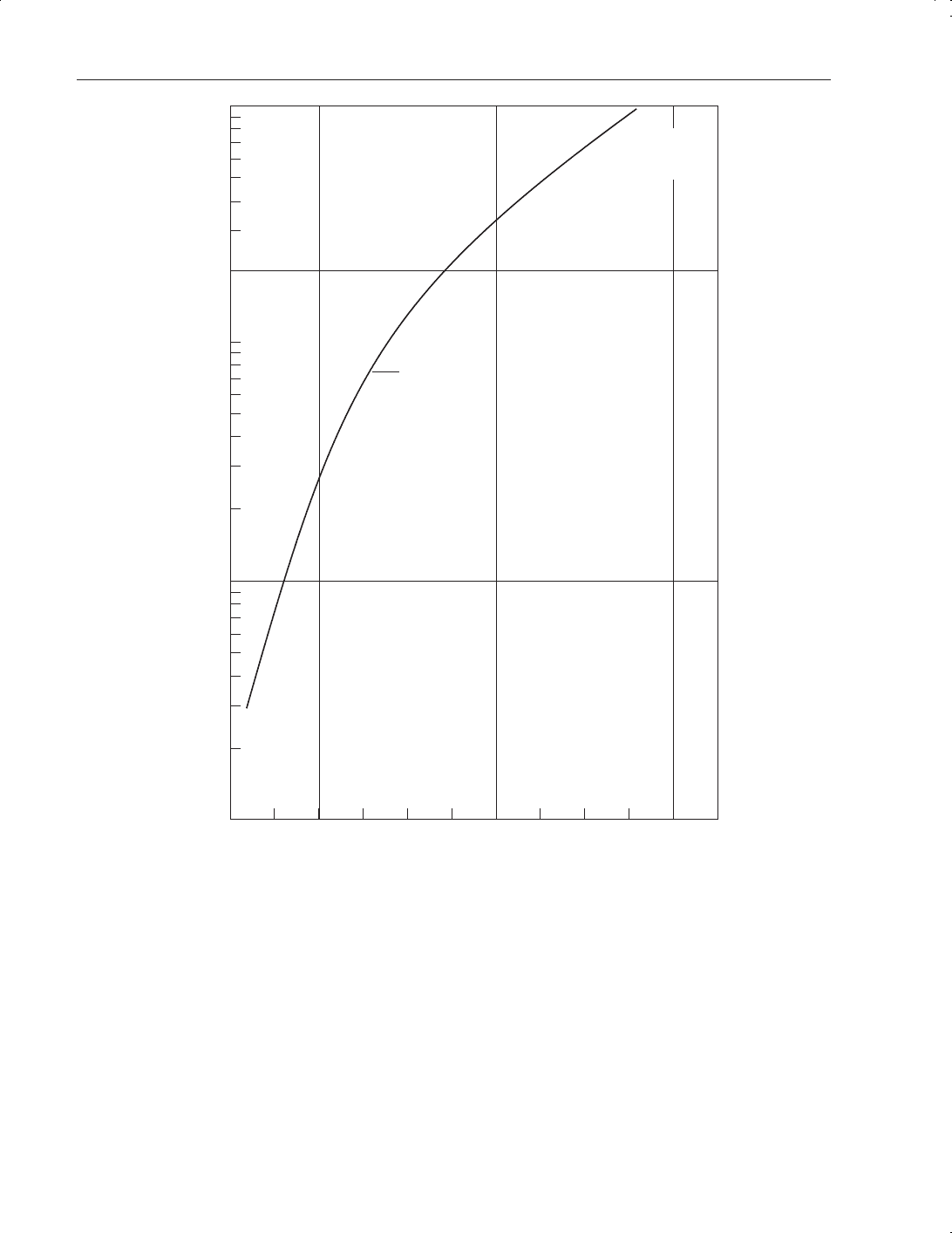
page 277). Figure 8.1 demonstrates the effect of temperature on vapour pressure.
Table 8.5 Physical properties of carbon dioxide
Molecular weight 44.01
Vapour pressure at 21°C 57.23 bar
Specific volume at 21°C, 1 atm 547 ml/g
Sublimation point at 1 atm – 78.5° C
Triple point at 5.11 atm – 56.6°C
Density, gas at 0°C, 1 atm 1.977 g/l
Specific gravity, gas at 0°C,
1 bar (air = 1) 1.521
Critical temperature 31°C
Critical pressure 73.9 bar
Critical density 0.468 g/ml
Latent heat of vaporization
at triple point 83.2 cal/g
at 0°C 56.2 cal/g
Specific heat, gas at 25°C, 1 atm
C
p
0.205 cal/g °C
C
v
0.1565 cal/g °C
ratio C
p
/C
v
1.310
Thermal conductivity at 0°C 3.5 × 10
–5
cal/s cm
2
°C/cm
at 100°C 5.5 × 10
–5
cal/s cm
2
°C/cm
Viscosity, gas at 21°C, 1 atm 0.0148 cP
Entropy, gas at 25°C, 1 atm 1.160 cal/g °C
Heat of formation, gas at 25°C – 2137.1 cal/g
Solubility in water at 25°C, 1 atm 0.759 vol/vol water
Inhalation of carbon dioxide causes the breathing rate to increase (Table 8.6): 10% CO
2
in air
can only be endured for a few minutes; at 25% death can result after a few hours exposure.
The 8 hr TWA hygiene standard (see Chapter 5) for carbon dioxide is 0.5%; at higher levels life
may be threatened by extended exposure. The following considerations therefore supplement
those listed in Table 8.3:
• Ensure that operator exposure is below the hygiene standard. (Note: For environmental monitoring,
because of its toxicity, a CO
2
analyser must be used as distinct from simply relying on checks
of oxygen levels.)
• When arranging ventilation, remember that the density of carbon dioxide gas is greater than
that of air.
• Ensure that pipework and control systems are adequate to cope with the pressures associated
with storage and conveyance of carbon dioxide, which are higher than those encountered with
most other cryogenic liquids.
Freezing point
Critical
pressure
1071.6 p.s.i.a.
at 31°C
1251007550250–25–50–75–100–125–150°F
52372510–4–18–32–46–60–73–87–101°C
1000
900
800
700
600
500
400
300
200
100
90
80
70
60
50
40
30
20
10
9
8
7
6
5
4
3
2
1
Temperature
Vapour pressure (psia)
Figure 8.1
Carbon dioxide vapour pressure versus temperature
Liquefied natural gas
Liquefied natural gas is predominantly methane. The cryogenic properties of methane are:
Boiling point –162°C
Critical temperature –82°C
Critical pressure 45.7 atm
Liquid-to-gas ratio 1 to 637
by volume
LIQUEFIED NATURAL GAS 263

264 CRYOGENS
The impurities in LNG result in slightly different properties, and there are significant variations
depending upon its source of supply.
Natural gas is considered non-toxic but can produce an oxygen deficient atmosphere (p. 153).
It is odourless (therefore an odorant is added for distribution by pipeline). Its physical properties
are similar to those of methane, i.e.:
Ignition temperature 537°C
Flammable limits 5% to 15%
Vapour density 0.55
However, the safety considerations with LNG must account for:
• The tendency, for economic reasons, to store it in very large insulated containers.
• The requirement for special materials of construction to cater for storage at –162°C, and for
design of plant to cope with thermal differences.
• The prevention of leaks, since liquid may generate large quantities of flammable gas.
• The addition of odorants after vaporization, i.e. the liquid is odour-free.
• The gas generated by vaporization is cold and therefore denser than air, i.e. it tends to slump.
LPG and methane are discussed further in Chapter 9.
Table 8.6 Effect of carbon dioxide exposure on breathing rates
CO
2
in air (vol. %) Increased lung ventilation
0.1–1 slight, unnoticeable
2 50% increase
3 100% increase
5 300% increase; breathing becomes laborious

9
Compressed gases
Whilst gases are sometimes prepared in situ for cost and safety reasons (e.g. to remove the risk
associated with their transport, storage and piping to point of use) they are more often stored on
an industrial scale at low pressure, either under refrigerated conditions, e.g. cryogens (Chapter 8),
or at ambient temperature in ‘gasholders’, which ‘telescope’ according to the quantity of gas and
are fitted with water or oil seals to prevent gas escape. Smaller quantities of gas at high pressure
are usually stored in bottle-shaped gas cylinders. They find widespread use in welding, fuel for
gas burners, hospitals, laboratories etc. The construction of compressed gas cylinders ensures
that, when first put into service, they are safe for their designated use. Serious accidents can,
however, result from ignorance of the properties of the gases, or from misuse or abuse. Great care
is needed during the transportation, handling, storage and disposal of such cylinders.
Compressed gases can often be more dangerous than chemicals in liquid or solid form because
of the potential source of high energy, low boiling-point of some liquid contents resulting in the
potential for flashing (page 50), ease of diffusion of escaping gas, low flashpoint of some highly
flammable liquids, and the absence of visual and/or odour detection of some leaking materials.
The containers also tend to be heavy and bulky.
Compressed gases, therefore, present a unique hazard from their potential physical and chemical
dangers. Unless cylinders are secured they may topple over, cause injury to operators, become
damaged themselves and cause contents to leak. If the regulator shears off, the cylinder may
rocket like a projectile or ‘torpedo’ dangerously around the workplace. Other physical hazards
stem from the high pressure of a cylinder’s contents, e.g. accidental application of a compressed
gas/air hose or jet into eyes or onto an open cut or wound, whereby the gas can enter the tissue
or bloodstream, is particularly dangerous.
A further hazard exists when compressed air jets are used to clean machine components in
workplaces: flying particles have caused injury and blindness. Cylinders may fail if over-pressurized
or weakened by the application of heat. Liquefied gases, e.g. butane or propane, respond more
rapidly to heat than the permanent gases such as nitrogen or oxygen. Cylinders are normally
protected by pressure relief valves, fusible plugs or bursting discs.
Low boiling-point materials can cause frostbite on contact with living tissue. While this is an
obvious hazard with cryogenics, e.g. liquid nitrogen or oxygen, cylinders of other liquefied gases
also become extremely cold and covered in ‘frost’ as the contents are discharged (page 47).
Precautions also have to be instituted to protect against the inherent properties of the cylinder
contents, e.g. toxic, corrosive, flammable (refer to Table 9.1). Most gases are denser than air;
common exceptions include acetylene, ammonia, helium, hydrogen and methane. Even these may
on escape be much cooler than ambient air and therefore slump initially. Eventually the gas will
rise and accumulate at high levels unless ventilated. Hydrogen and acetylene, which both have
very wide flammable limits (Table 6.1), can form explosive atmospheres in this way.
More dense gases will on discharge accumulate at low levels and may, if flammable, travel a
considerable distance to a remote ignition source.

266 COMPRESSED GASES
Table 9.1 Compressed gases: hazards and construction materials for services
Gas Hazard
(1)
Materials of construction for ancillary services
(2)
Compatible Incompatible
Acetylene F Stainless steel, aluminium, Unalloyed copper, alloys
wrought iron containing >70% copper,
silver, mercury, and cast iron
Air O Any common metal or plastic
Allene F Mild steel, aluminium, brass, Copper, silver and their alloys,
or stainless steel PVC and neoprene
Ammonia C F T Iron and steel Copper, zinc, tin and their alloys
(e.g. brass), and mercury
Argon Any common metal
Arsine F T Stainless steel and iron
Boron trichloride C T Any common metal for dry Any metal incompatible with
gas hydrochloric acid when moist
Copper, Monel, Hastelloy B, gas is used
PVC, polythene and PTFE if
moist
gas is used
Boron trifluoride C T Stainless steel, copper, Rubber, nylon, phenolic resins,
nickel, Monel, brass, cellulose and commercial
aluminium for
dry
gas PVC
≤200°C. Borosilicate glass
for low pressures. For
moist
gas, copper and polyvinylidene
chloride plastics
Bromine pentafluoride C T O Monel and nickel
Bromine trifluoride C T O Monel and nickel
Bromotrifluoroethylene F T Most common metals so long Magnesium alloys and
as gas is dry aluminium containing >2%
magnesium
Bromotrifluoromethane Most common metals
1,3-Butadiene F T Mild steel, aluminium, brass, PVC and Neoprene plastic
copper or stainless steel
Butane F Any common metal
1, Butene F Any common metal
Carbon dioxide T Iron, steel, copper, brass, For moist gas avoid materials
plastic for dry gas. For attacked by acids
moist gas use stainless
steel or certain plastics
Carbon monoxide F T Copper-lined metals for Iron, nickel and certain other
pressures <34 bar. Certain metals at high pressures
highly alloyed chrome steels
Carbon tetrafluoride Any common metal
Carbonyl fluoride C F T Steel, stainless steel, copper
or brass for dry gas.
Monel, copper or nickel
for moist gas
Carbonyl sulphide F T Aluminium and stainless steel
Chlorine C T O Extra heavy black iron or Rubber (e.g. gaskets)
steel for dry gas. Drop
forged steel, PTFE tape.
Moist gas requires glass,
stoneware (for low
pressures) and noble
metals. High silica, iron,
Monel and Hastelloy show
some resistance

Chlorine trifluoride C T O Monel and nickel, PTFE and
Kel-F, soft copper, 2S
aluminium and lead are
suitable for gaskets
Chlorodifluoromethane Steel, cast iron, brass, Silver, brass, aluminium, steel,
copper, tin, lead, copper, nickel can cause
aluminium at normal decomposition at elevated
conditions temperatures. Magnesium
Neoprene or chloroprene alloys and aluminium
rubber and pressed fabrics containing >2% magnesium.
are suitable for gaskets Natural rubber
Chloropentafluoroethane Neoprene or chloroprene Silver, brass, aluminium, steel,
rubber and pressed fabrics copper, nickel can cause
are suitable for gaskets decomposition at elevated
temperatures. Magnesium
alloys and aluminium
containing >2% magnesium.
Natural rubber
Chlorotrifluoroethane F T Most common metals
Chlorotrifluoromethane As for chlorodifluoromethane
Cyanogen F T Stainless steel, Monel and
Inconel ≤65°C. Glass-lined
equipment. Iron and steel at
ordinary temperatures
Cyanogen chloride C T Common metals for dry gas.
Monel, tantalum. Glass for
moist gas
Cyclobutane F Most common metals
Cyclopropane F Most common metals
Deuterium F Most common metals
Diborane F T Most common metals. Rubber and certain
Polyvinylidene chloride, hydrocarbon lubricants
polyethylene, Kel-F PTFE
graphite and silicone
vacuum grease
Dibromodifluoromethane Copper or stainless steel Aluminium for wet gas
1,2-Dibromotetra- C Most common metals for dry Zinc
fluoroethane gas. Stainless steel, titanium
and nickel for moist gas
Dichlorodifluoromethane As for chlorodifluoromethane
Dichlorofluoromethane As for chlorodifluoromethane
Dichlorosilane C F T Nickel and nickel steels and Stainless steel for moist gas
PTFE
1,2-Dichlorotetra- As for chlorodifluoromethane
fluoroethane
1,1-Difluoro-1- F Most common metals under Hot metals can cause degradation
chloroethane normal conditions to toxic corrosive products
1,1-Difluoroethane F Most common metals under Hot metals can cause degradation
normal conditions to toxic corrosive products
1,1-Difluoroethylene F Most common metals
Dimethylamine C F T Iron and steel Copper, tin, zinc, and their alloys
Dimethyl ether F T Most common metals
2,2-Dimethyl propane F Most common metals
Ethane F Most common metals
Ethyl acetylene F Steel and stainless steel Copper, other metals capable of
forming explosive acetylides
COMPRESSED GASES 267
Table 9.1 Cont’d
Gas Hazard
(1)
Materials of construction for ancillary services
(2)
Compatible Incompatible

268 COMPRESSED GASES
Ethyl chloride F T Most materials for dry gases
Ethylene F Any common metal
Ethylamine C F T Iron and steel. Reinforced Copper, tin, zinc and their
neoprene hose alloys
Ethylene oxide F T Properly grounded steel Copper, silver, magnesium and
their alloys
Fluorine C T O Brass, iron, aluminium,
magnesium and copper at
normal temperatures.
Nickel and Monel at
higher temperatures
Fluoroform Any common metal
Germane F T Iron and steel
Helium Any common metal
Hexafluoroacetone C T For dry gas Monel, nickel,
Inconel, stainless steel,
copper and glass –
Hastelloy C-line equipment
Hexafluoroethane Any common metal for
normal temperatures.
Copper, stainless steel and
aluminium ≤150°C
Hexafluoropropylene Any common metal for dry gas
Hydrogen F Most common metals for At elevated temperature and
normal use pressure hydrogen
embrittlement can result
Hydrogen bromide C T Most common metals when dry. Most metals when gas is moist.
Silver, platinum and tantalum Galvanized pipe or brass or
for moist gas. Heavy black bronze fittings
iron for high-pressure work.
High-pressure steel,
Monel or aluminium pipe.
Hydrogen chloride C T Stainless steel, mild steel for Galvanized pipes or brass or
normal conditions of bronze fittings
temperature and pressure.
When moist use silver,
platinum or tantalum.
Moist or dry gas use
backed carbon, graphite.
High pressure work in heavy
black iron pipework. High
pressure Monel or aluminium
iron bronze valves
Hydrogen cyanide F T Low-carbon steel at normal
temp. and stainless steel
for higher temperatures
Hydrogen fluoride C T Steel in the absence of sulphur Cast iron or malleable fittings
dioxide contaminants in the
gas and at temperatures
<65°C. Monel, Inconel,
nickel and copper for
liquid or gas at elevated
temperature
Hydrogen iodide C T Stainless steel, mild steel Moist gas corrodes most metals
under normal temperature
and pressure
Table 9.1 Cont’d
Gas Hazard
(1)
Materials of construction for ancillary services
(2)
Compatible Incompatible