
Carson Ph., Mumford C. Hazardous Chemicals Handbook (Справочник по опасным химическим веществам)
Подождите немного. Документ загружается.


Table 7.18 Characteristics of some different types of reaction
Oxidation Feedstocks generally hydrocarbons
Hazard of fire/explosion arises from contact of flammable material with oxygen
Reactions highly exothermic: equilibrium favours complete reaction
Polymerization Exothermic reaction which, unless carefully controlled, can run-away and create a thermal
explosion or vessel overpressurization
Refer to Table 7.20 for common monomers
Certain processes require polymerization of feedstock at high pressure, with associated
hazards
Many vinyl monomers (e.g. vinyl chloride, acrylonitrile) pose a chronic toxicity hazard
Refer to Table 7.19 for basic precautions
Halogenation The commercially important halogens are chlorine, bromine, fluorine, iodine. Refer to Table
5.19 for properties
All are highly toxic
Reactions are highly exothermic and chain reactions can occur, which may result in detonation
Hydroprocesses Hydrogen is chemically stable and relatively unreactive at ordinary temperatures; most
processes utilizing it require a catalyst. Above 500°C it reacts readily with oxygen and
confined flammable mixtures explode violently if ignited
Main hazards: fire, explosion, metallurgical problems arising from hydrogen attack
Nitration Hazards arise from the strong oxidizing nature of the nitrating agents used (e.g. mixture of
nitric and sulphuric acids) and from the explosive characteristics of some end products
Reactions and side reactions involving oxidation are highly exothermic and may occur
rapidly
Sensitive temperature control is essential to avoid run-away
Alkylation Hazards arise from the alkylating agents, e.g. dimethyl sulphate (suspected human carcinogen),
hydrogen fluoride (highly toxic irritant gas)
Thermal alkylation processes require higher temperatures and pressures, with associated
problems
High pressure reactions High inventories of stored pressure (e.g. in pressurized reactors or associated plant) can
result in catastrophic failure of the pressure shell
Table 7.19 Basic precautions in monomer storage
Indoors
Cool, well-ventilated area
Non-combustible construction
Segregated from other flammables/reactants
Outdoors
Well-spaced tanks, possibly with water cooling, refrigeration, buried
Some monomers (e.g. acrylic acid) may require provisions to avoid freezing
Provision for inhibitor/stabilizer addition
Provision for atmosphere inerting may be required
• Venting to a knock-out vessel, to remove non-gaseous substances. (This may be followed by a
scrubbing unit for gases or a flare-stack.)
The kinetics and thermodynamics of the reaction, and of possible side reactions, need to be
understood. The explosive potential of chemicals liable to exothermic reaction should be carefully
appraised.
A thorough assessment should be made before undertaking:
HAZARDS ARISING IN CHEMICALS PROCESSING 249

250 REACTIVE CHEMICALS
Table 7.20 Properties of common monomers
Flash Ignition Flammable Specific Vapour Boiling Properties
point temp. limits gravity density point
(°C) (°C) (% by vol. (Water (Air = 1.0) (°C)
in air) = 1.0)
Acetaldehyde –38 185 4.0–55.0 0.8 1.5 21 Colourless fuming liquid
(Acetic aldehyde, Pungent odour
ethanal) Irritant
CH
3
CHO Water soluble
Can polymerize
exothermically, form
explosive peroxides, or
react violently with other
chemicals
Acrolein –26 278 2.8–31.0 0.8 1.9 53 Colourless/yellow liquid
(Allyl aldehyde, Pungent unpleasant odour
propenal) Water soluble
CH
2
:CHCHO Irritant
Can polymerize
exothermically with
strong alkalis, heat or light
Can form peroxides
Acrylic acid 54 – – 1.1 2.5 140 Colourless, water soluble
(Propenoic acid, liquid
propene acid) Freezing point 14°C
CH
2
:CHCOOH Polymerizes readily with
oxygen
Must be inhibited
Acrylonitrile 0 481 3.0–17.0 0.8 1.8 77 Colourless, partially water
(Vinyl cyanide, soluble liquid
propenenitrile) Experimental carcinogen
CH
2
:CHCN Polymerizes violently with
organic peroxides or
concentrated caustic
alkalis
Highly toxic
Usually inhibited
1,3-Butadiene –76 450 2.0–11.5 0.6 1.9 –4 Colourless, odourless
(Butadiene, liquefiable gas
vinylethylene) Polymerizes readily,
CH
2
:CHCH:CH
2
particularly if O
2
or
traces of catalyst present
Can form explosive peroxides
Normally contains inhibitor
(liquid phase) and
antioxidant
Epichlorhydrin 32 – – 1.2 3.3 115 Colourless, partly water
(Chloropropylene soluble liquid
oxide) Highly toxic
CH
2
:OCHCH
2
Cl Polymerizes exothermically
with acids, bases, certain
salts and catalysts
Can react with water
Ethyl acrylate 15 – 1.8–– 1.2 – 100 Colourless liquid
CH
2
:CHCOOC
2
H
5
Acrid odour
Polymerizes readily,
accelerated by heat, light,
organic peroxides
Irritant

Ethylene oxide <–18 429 3.0–100 0.9 1.5 11 Colourless gas at room
CH
2
:CH
2
temperature
Irritant to eyes and
O respiratory tract, and an
experimental carcinogen
Polymerizes uncontrollably
with immense explosive
force on contact with
certain chemicals (e.g.
ammonia)
Formaldehyde gas 430 7.0–73.0 – 1.1 –21 Colourless
(Oxymethylene) Water soluble gas producing
HCHO formalin solutions
Suffocating odour
Polymerizes readily
Highly toxic
Respiratory sensitizer
Methacrylic acid 77 – – – – 158 Colourless, water soluble
CH
2
:C(CH
3
)COOH liquid
Polymerizes readily unless
inhibited or stored <15°C
Irritant
Methyl acrylate –3 – 2.8–25.0 1.0 3.0 80 Colourless liquid
CH
2
:CHCOOCH
3
Acrid odour
Extremely irritating to
respiratory system, skin
and mucous membranes
Methyl methacrylate 29 – 2.1–12.5 0.9 3.4 101 Colourless liquid
CH
2
:C(CH
3
)COOCH
3
Acrid odour
Styrene 32 490 1.1–6.1 0.9 3.6 145 Colourless/oily yellow liquid
(Vinyl benzene) Penetrating odour
C
6
H
5
CH:CH
2
Polymerizes slowly in air or
light, accelerated by heat
or catalysts
Ignition/explosion possible
Usually inhibited
Store <21°C
Vinyl acetate –8 427 2.6–13.4 1.1 3.0 72 Colourless, partially water
CH
3
COOCH:CH
2
soluble liquid
Faint odour
Polymerizes with heat or
organic peroxides
Vinyl chloride –78 472 4.0–22.0 1.0 2.1 –14 Colourless, sweet smelling
(Chloroethene) liquefiable gas
CH
2
:CHCl Polymerizes with light, heat,
air or catalysts
Normally inhibited
Human carcinogen
Vinylidene chloride –10 458 5.6–11.4 1.3 3.3 37 Colourless volatile liquid
(Dichloroethylene-1,1) Polymerizes unless inhibited
CH
2
:CCl
2
Decomposes at 457°C
HAZARDS ARISING IN CHEMICALS PROCESSING 251
Table 7.20 Cont’d
Flash Ignition Flammable Specific Vapour Boiling Properties
point temp. limits gravity density point
(°C) (°C) (% by vol. (Water (Air = 1.0) (°C)
in air) = 1.0)
252 REACTIVE CHEMICALS
(a) (b) (c)
(d) (e) (f)
Temperature Temperature Temperature
Temperature Temperature Temperature
Reaction rate Reaction rate
Incorrect kinetic
assumptions
Incorrect initiation
Insufficient mixing
Temperature too low
Impurities (inhibitors)
Feed rate too fast
Accumulation of
reactants or
intermediates
Insufficient
cooling
Emergency loss of
cooling, stirring
Impurities (catalysts)
that accelerate rate
Incorrect assumptions
on heat balance
Temperature of heat
transfer fluid too high
Storage temperature too high
Triggering of
undesired reaction
ANDAND
Heat accumulation,
uncontrollable
temperature rise
Thermal runaway
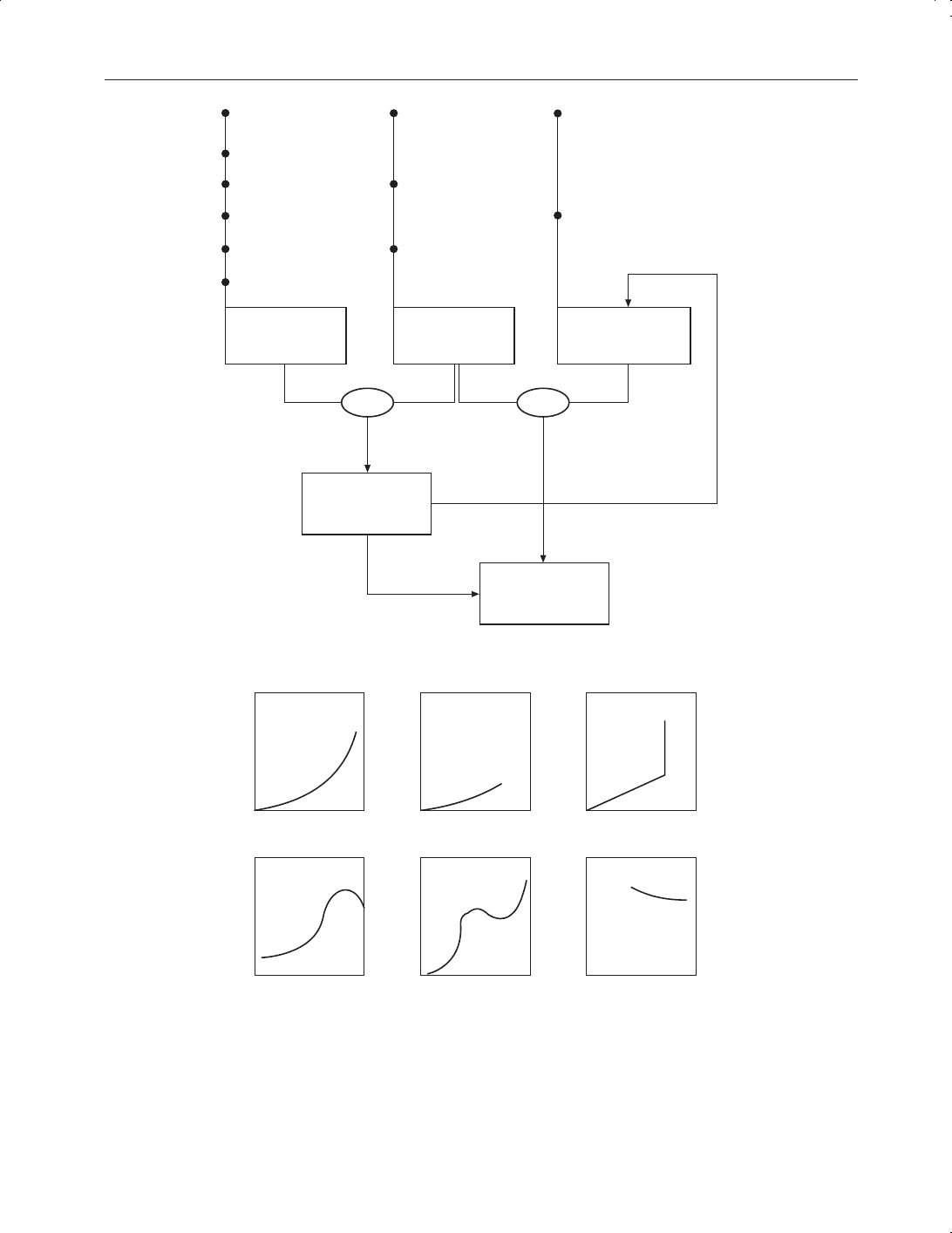
Figure 7.4
Common causes of thermal runaway in reactors or storage tanks
Figure 7.5
Types of reaction rate/temperature curve
a Rapid increase with temperature – normal characteristic
b Slow increase in rate with temperature – characteristic of some heterogeneous reactions
c Very rapid increase at one point – the ignition point in an explosion
d Decrease in rate at higher temperature – characteristic of catalytic reactions
e Decrease in rate at intermediate temperatures, followed by an increase
f Slow decrease in rate with temperature

Table 7.21 Safety features in chemical engineering operations
Inventory Reduce inventory of chemicals:
Continuous operation may be preferable to batch
Low residence time contacting equipment may be better than cheaper alternatives
etc.
Monitoring Monitor temperature, pressure flow, composition, freedom from contamination and other
appropriate properties of all streams where relevant. Consider automatic control
Isolation Provide for isolation from upstream and downstream operations. Consider provision of
automatic and/or remotely operated isolation. Consider isolation for cleaning needs
Contaminants Provide measures to remove unacceptable contaminants from feed materials, process
streams and services, e.g. entrained liquid, tramp metal, unwanted particulate solids
Pressure/temperature Operate at moderate temperature and pressure where possible. Avoid superheated
liquids, which will flash-off, if practicable
Allow for effects of over-/under-temperature, over-/under-pressure. Following assessment
(e.g. by HAZOP)
Continuous flow With continuous flow operations consider (e.g. using a HAZOP procedure) the effects of:
No flow
Reduced flow
Reverse flow
Increased flow
Contaminated flow
Flow of a substituted material, etc.
Start-up/shutdown Provide for safe start-up, including purging if necessary
Provide for safe shutdown:
Normal
By a trip
On standby
In various emergency situations, etc.
Instrumentation Provide safety instrumentation in addition to process instrumentation
Consider high–high and low–low alarms. Consider automatic activation of emergency
responses, e.g. venting, emergency cooling, recycling, discharge of liquid streams,
shutdown
High/low temperature
pressure
flow
level
etc.
linked to trips for automatic operation where appropriate
Protective features Provide protective as well as control features, e.g. pressure and vacuum relief, explosion
suppression relief, advance inerting, containment
Waste streams Cater for routine and emergency, safe discharge of all waste streams, e.g. atmospheric
venting, possibly after treatment, discharge of liquid effluents including out-of-specification
streams, discharges of particulate or bulk solids
Common-mode failure Avoid common-mode failure possibilities with services, control systems, safety systems
etc.
• Scale-up (since it may result in a decrease in heat transfer capacity per unit mass of reactant).
• Modifications in reactor geometry, agitation and control (e.g. instrumentation, cooling, venting).
• Changes in reaction materials, (e.g. source, purity, concentration), diluents, catalysts charging
procedures.
• Changes in operating conditions.
The characteristics of some potentially hazardous reactions are summarized in Tables 7.18 and
7.22.
Many processes require equipment designed to rigid specifications together with automatic
control and safety devices. Consideration should be given to the control, and limitation of the
effects, of equipment malfunction or maloperation including:
HAZARDS ARISING IN CHEMICALS PROCESSING 253

254 REACTIVE CHEMICALS
Table 7.22 Hazard rating of chemical reactions
Reaction Degree of Reaction Degree of
hazard hazard
Reduction
Clemmensen D
Sodium-amalgam D
Zinc–acetic acid E
Zinc–hydrochloric acid E
Zinc–sodium hydroxide E
Ferrous ammonium sulphate E
Lead tetraacetate E
Meerwein–Pondorff D
Lithium aluminium hydride B
Dialkyl aluminium hydride B
Rosenmund A
Catalytic high pressure A
Catalytic low pressure B
Oxidation
Hydrogen peroxide – dilute aqueous E
Air or I
2
(mercaptan to
disulphide) D
Oppenauer D
Selenium dioxide D
Aqueous solution nitric acid,
permanganate, manganic
dioxide, chromic acid,
dichromate E
Electrolytic B
Chromyl chloride C
Ozonolysis A
Nitrous acids A
Peracids – low molecular
weight or two or more
positive groups A
Peracids – high molecular
weight B
t
-Butyl hypochlorite C
Chlorine C
Alkylation
Carbon–carbon
Alkali metal C
Alkali metal alcoholate D
Alkali metal amides and hydrides C
Reformatsky E
Michael E
Grignard B
Organometallics, such as
dialkyl zinc or cadmium–
alkyl or aryl lithium B
Alkali acetylides A
Diels–Alder D
Arndt–Eistert A
Diazoalkane and aldehyde A
Aldehydes or ketones and
hydrogen cyanide C
Carbon–oxygen
Williamson D
Formaldehyde – hydrochloric
acid E
Ethylene oxide C
Dialkyl sulphate D
Diazoalkane A
Carbon–nitrogen
Cyanomethylation C
Chloromethylation D
Ethylenimine C
Ethylene oxide C
Quaternization D
Condensation
Erlenmeyer D
Perkin D
Acetoacetic ester D
Aldol D
Claisen D
Knoevenagel D
Condensations using catalysts
such as phosphoric acid;
AlCl
3
; KHSO
4
; SnCl
4
;
H
2
SO
4
; ZnCl
2
NaHSO
2
;
POCl
2
; HCl; FeCl
2
E
Acyloin C
Diketones with hydrogen sulphide C
Diketones with diamines→
quinazolines D
Diketones with NH
2
OH→
isoxazolines D
Diketones with NH
2
NH
2
→
pyrazoles C
Diketones with semicarbazide
→ pyrazoles D
Diketones with ammonia→pyrazoles D
Carbon disuphide with
aminoacetamide→thiazolone A
Nitriles and ethylene diamines
→ imidazolines D
Amination
Liquid ammonia B
Aqueous ammonia E
Alkali amides C
Esterification
Inorganic E
Alkoxy magnesium halides B
Organic:
Alcohol and acids or acid
chloride or acid anhydride D
Alkyl halide and silver salts of
acids E
Alkyl sulphate and alkali
metal salt of acid D
Alkyl chlorosulphates and

alkali salts of carboxylic acid D
Ester-exchange D
Carboxylic acid and diazomethane A
Acetylene and carboxylic
acid-vinyl ester A
Hydrolysis, aqueous nitriles,
esters E
Simple metathetical replacement D
Preparation and reaction of
peroxides and peracids
Concentrated A
Dilute D
Pyrolysis
Atmospheric pressure D
Pressure B
Schmidt B
Mannich D
Halogenation
SO
2
X
2
, SOX
2
, SX, POX
2
, PX
5
D
HX D
Cl
2
, Br
2
C
Nitration
Dilute D
Concentrated B
Named reactions
Aldol reaction is the condensation of an aldehyde to produce longer-chain hydroxy aldehydes
2CH CHO CH CHOH CH CHO
3
NaOH
32
→⋅
Arndt-Eistert reaction is used to convert an acid compound into the next higher homologue by reaction with diazomethane
RCOCl + 2CH
2
N
2
→ R · COCH
2
CO
2
H + 2N
2
+ CH
3
Cl
Claisen reaction is the condensation of benzaldehyde with aliphatic aldehydes and ketones containing α-hydrogen
C H CHO + CH CHO C H CH==CH CHO + H O
65 3
NaOH
65 2
→⋅
C H CHO + CH COCH C H CH==CH CO CH + H O
65 3 3
65 3 2
→⋅⋅
Clemmensen reaction is the reduction of carbonyl compounds with amalgamated zinc and concentrated hydrochloric acid
R CO R RCH R
e
i
H
+
2
⋅⋅→
Diels-Alder is the preparation of cyclic olefins from dienes and a dienophile
Hazardous
A Highly flammable
Develops high pressure instantly
Highly toxic
Special
B Flammable, perhaps explosive, mixtures form
C Flammable, or generates toxic ubstances
Conventional
D Slightly flammable
Generates or uses mildly toxic
substances
E Non-flammable
Does not use or generate toxic
substances
HAZARDS ARISING IN CHEMICALS PROCESSING 255
Table 7.22 Hazard rating of chemical reactions
Reaction Degree Reaction Degree
of of
hazard hazard
C
C
C
C
C—R
C
+
C
C
C
C
C
C—R
C
C
C—R
C
+
C
C
C
C
C
C—R
C
C

256 REACTIVE CHEMICALS
Erlenmeyer reaction is the condensation of aromatic aldehydes with hippuric acid to form azlactones (important intermediates
in the preparation of amino- and keto-acids)
C
6
H
5
CHO + CH
2
CO
2
H
NHCOC
6
H
5
C
6
H
5
CH C C O
NO
C
C
6
H
5
Grignard reaction is the use of alkyl magnesium halides to form a host of products by reaction with a variety of chemicals
RMgX + H
2
O → RH + Mg(OH) · X
RMgX + R′OH → RH + Mg(OR′) · X
RMgX + NH
3
→ RH + Mg(NH
2
) · X
RMgX + RN=C → R—N(MgX)=CR + R—N=C(R)MgX
Knoevenagel reaction is the synthesis of α, β-unsaturated acids by reaction of aldehydes and compounds with active
methylene groups in the presence of an organic base
RCHO + CH (CO C H ) R CH==C(CO C H ) + H O
2225
base
2252 2
→⋅
↓ KOH
R CH==CH CO H R CH==C(CO H)
2
150–200
22
⋅⋅← ⋅
°
Mannich reaction is the condensation between formaldehyde, ammonia, or a primary or secondary amine (preferably as the
hydrochloride), and a compound containing at least one active hydrogen atom
R CH NO + HCHO + NH Cl R C
|
NO
CH NH HCl + H O
24
2
2
22 2
⋅→⋅
Meerwein-Pondorff reduction is the synthesis of alcohols by heating carbonyl compounds with aluminium isopropoxide in
isopropanol and distilling off acetone by-product
R
2
C=O + (CH
3
)
2
CHOAl
3
→ R
2
CHO Al
3
+ CH
3
CO CH
3
→ R
2
CHOH
Michael condensation is the addition of a compound with an active methylene group to an α, β-unsaturated keto-compound
CH (CO C H ) + (CH ) C==CH CO CH (CH ) C
CH(CO C H )
CH COCH + C H O
2 2252 32 3
CHO
32
|
225
2325
–
25
–
→
Oppenauer reaction is oxidation of secondary alcohols to ketones using aluminium t-butoxide
RCH(OH)R + CH COCH RCOR + CH CH(OH)CH
33
catalyst
33
′
→
′
Perkin condensation is the reaction between aromatic aldehydes and aliphatic acid anhydrides (in the presence of the
sodium salt) to form β-arylacrylic acid
C H CHO + (CH CO) O C H CH==CH CO H
65 3 2
CH CO Na
65 2
32
→
Reformatsky reaction is the formation of β-hydroxyesters by reaction of α-bromoacid ester and a carbonyl compound,
usually in the presence of zinc
′
→
′
R CO + RCH(Br)CO C H R C(OH)CHR CO C H
2 225
Zn
225
Rosenmund reaction is the action between acid chloride and hydrogen in the presence of palladium catalyst to produce
aldehydes
RCOCl + H R CHO + HCl
2
Pd
→⋅
Schmidt reaction is the reaction between carbonyl compounds and hydrazoic acid in the presence of e.g. concentrated
sulphuric acid
RCHO + HN RCN + RNH CHO
3
H
2
SO
4
→
R CO R==HN R CONHR + N
3
H
2
SO
4
2
⋅⋅ →⋅
Williamson reaction is the synthesis of ethers by action of heat on a mixture of alkyl haldie and sodium or potassium alkoxide
ROK + R′X → ROR′ + KX

• Stirrer failure, mechanical or electrical.
• Attainment of abnormal reaction conditions, e.g. overpressure, over-temperature, segregation
of reactants, excessive reaction rate, initiation of side reactions.
• Power failure, affecting agitator, pumps, instruments.
• Error in valve, switch or associated equipment operation.
• Failure to actuate agitation at the proper time.
• Instrument failure, pressure, flow, temperature, level or a reaction parameter, e.g. concentration.
• Failure of instrument air or electricity.
• Loss of inert gas blanket.
• Failure of relief devices, e.g. pressure relief valves or rupture discs.
• Failure of coolant, refrigerant, or other utilities.
• Failure of high or low pressure alarms or cut-outs.
• Addition of wrong material or wrong quantities.
• Addition of materials in incorrect sequence.
• Failure to add material, e.g. short-stop or inhibitor, at correct stage.
• Spillage of material.
• Improper venting to atmosphere, i.e. other than via vents with flame arresters or scrubbers, or
via a knockout drum, or to the correct flare systems.
• Restricted or blocked vent.
• Restricted material flows in or out.
• Leakage of materials out, e.g. due to a gasket failure, or air in.
HAZARDS ARISING IN CHEMICALS PROCESSING 257

8
Cryogens
Cryogenics, or low-temperature technology, is the science of producing and maintaining very low
temperatures usually below 120 K, as distinct from traditional refrigeration which covers the
temperature range 120 to 273.1 K. At or below 120 K, the permanent gases including argon,
helium, hydrogen, methane, oxygen and nitrogen can be liquefied at ambient pressure as exemplified
by Table 8.1. Any object may be cooled to low temperatures by placing it in thermal contact with
a suitable liquefied gas held at constant pressure. Applications can be found in food processing,
rocket propulsion, microbiology, electronics, medicine, metal working and general laboratory
operations. Cryogenic technology has also been used to produce low-cost, high-purity gases
through fractional condensation and distillation. Cryogens are used to enhance the speed of
computers and in magnetic resonance imaging to cool high conductivity magnets for non-intrusive
body diagnostics. Low-temperature infrared detectors are used in astronomical telescopes.
Table 8.1 Properties of common cryogens
Gas Boiling point Volume of gas produced on evaporation
(°C)
of 1 litre of liquid (litres)
Helium – 269 757
Hydrogen – 253 851
Neon – 246 1438
Nitrogen – 196 696
Fluorine – 187 888
Argon – 186 847
Oxygen – 183 860
Methane – 161 578
Krypton – 151 700
Xenon – 109 573
Chlorotrifluoromethane – 81 –
Carbon dioxide – 78.5 553
Every gas has a critical temperature above which it cannot be liquefied by application of
pressure alone (Chapter 4). As a result, gases used, e.g., as an inert medium to reduce oxygen
content of atmospheres containing flammable gas or vapour (Chapter 6) are often shipped and
stored as cryogenic liquid for convenience and economy.
In the laboratory, a range of ‘slush baths’ may be used for speciality work. These are prepared
by cooling organic liquids to their melting points by the addition of liquid nitrogen. Common
examples are given in Table 8.2. Unless strict handling precautions are instituted, it is advisable
to replace the more toxic and flammable solvents by safer alternatives.