
Carson Ph., Mumford C. Hazardous Chemicals Handbook (Справочник по опасным химическим веществам)
Подождите немного. Документ загружается.


Sodium hydroxide E G G E E
Aliphatic hydrocarbons
Hydraulic oil F G F G E
Paraffins F G E G E
Petroleum ether F G E F G
Pine oil G G E G E
Aromatic hydrocarbons
(2)
Benzene NR F G F G
Naphtha NR F F F G
Naphthalene G G E G E
Toluene NR F G F G
Turpentine F G R F G
Xylene NR F G F G
(1)
Halogenated hydrocarbons
(2)
Benzyl chloride F F G F G
Carbon tetrachloride F F G F G
Chloroform F F G F G
Ethylene dichloride F F G F G
Methylene chloride F F G F G
Perchloroethylene F F G F G
Trichloroethylene F F G F G
Esters
Amyl acetate F G G F G
Butyl acetate F G G F G
Ethyl acetate F G G F G
Ethyl butyrate F G G F G
Methyl butyrate F G G F G
Ethers
Diethyl ether F G E F G
Aldehydes
Acetaldehyde G E E E E
Benzaldehyde F F E G E
Formaldehyde G E E E E
Ketones
Acetone G G G F G
Diethyl ketone G G G F G
Methyl ethyl ketone G G G F G
Alcohols
Amyl alcohol E E E E E
Butyl alcohol E E E E E
Ethyl alcohol E E E E E
Ethylene glycol G G E E E
Glycerol G G E E E
Isopropyl alcohol E E E E E
Methyl alcohol E E E E E
Amines
Aniline F G E E E
Butylamine G G E E E
Ethylamine G G E E E
Ethylaniline F G E E E
Methylamine G G E E E
Methylaniline F G E E E
Triethanolamine G E E E E
Table 13.12 Cont’d
Glove material
Chemical Natural rubber Neoprene Nitrile Normal PVC High grade PVC
PERSONAL PROTECTION 439

440 OPERATING PROCEDURES
Miscellaneous
Animal fats F G G G E
Bleaches NR G G G E
Carbon disulphide NR F G F G
Degreasing solution F F G F G
Diesel fuel NR F G F E
Hydraulic fluids F G G G E
Mineral oils F G E G E
Ozone F E G E E
Paint and varnish removers F G G F G
Petrol NR G G F G
Photographic solutions G E E G E
Plasticizers F G E G E
Printing inks G G E G E
Refrigerant solutions G G E F G
Resin oil F G G G E
Vegetable oils F G G G E
Weed killers G E E G E
White spirit F G G F G
Wood preservatives NR G G F G
E Excellent
F Fair
G Good
NR Not recommended
(1)
Resistance not absolute, but the best available.
(2)
Aromatic and halogenated hydrocarbons will attack all types of natural and synthetic gloves. Should swelling occur, switch
to another pair, allowing the swollen gloves to dry and return to normal.
Impervious clothing is essential when handling corrosive chemicals, liquids liable to cause
dermatitis, or chemicals toxic by skin absorption.
All protective clothing should be maintained in a sound condition, cleaned/washed/replaced
regularly as appropriate, and be stored apart from everyday clothing. With toxic chemicals a
double locker system is advisable. With highly toxic substances, e.g. lead compounds or asbestos-
based substances, separate storage of personal clothing and protective clothing is specifically required.
Protective footwear
Protective footwear includes shoes, boots with steel toecaps, full boots, e.g. Wellingtons. The
choice of material determines durability, acid resistance, oil resistance, heat resistance, non-slip
characteristics, impact resistance etc.
Washing facilities
Wherever chemicals are handled, adequate washing facilities are required conveniently situated
with respect to the workplace. These comprise wash-basins or troughs with a constant supply of
hot and cold or warm water; soap or liquid hand cleanser; clean towels or hot-air driers or
disposable paper towels. Typical minimum standards are:
Normal work One wash-basin per 10 workers
Handling toxic or irritant chemicals One wash-basin per 5 workers
Table 13.12 Cont’d
Glove material
Chemical Natural rubber Neoprene Nitrile Normal PVC High grade PVC

Table 13.13 Properties of protective clothing materials
Material Advantages Disadvantages
Cotton Lightweight, reasonably Liable to shrinkage unless Suitable for under-gloves
hard-wearing, no static treated
generation More flammable than wool
Resists penetration of direct Vulnerable to hot splashes
splashes of corrosive
Unaffected by oils
Wool Resists rapid penetration of Not resistant to hot splashes
direct splashes (more Takes up water and dirt
effective than cotton) Difficult to wash
Resists penetration of dust
High absorption and porosity
absorbs perspiration
Artificial fibres Hardwearing Not resistant to hot splashes Ceramic coating of fibres
(nylon, Terylene) Terylene has good acid High initial cost can render dust-proof
resistance Can allow dust to pass through
Static electricity can cause
rapid soiling
PVC Impervious Not resistant to hot splashes Used alone or
Non-flammable Causes sweating unless impregnated on fabric
Chemically and well ventilated For gloves armlets, hats,
biologically resistant bibs, spats, suits
Abrasion resistant
Paper Hygienic (disposable) Liable to wetting if not Possibly used for
Fairly resistant to chemicals treated with polythene disposable underwear
if treated with polythene film or for clothing for
film No strength visitors
Flammable Used under headgear
Not resistant to hot splashes (disposable)
Polythene Hygienic Low abrasion resistance Suitable for disposable
May be disposable Not resistant to hot splashes gloves or headgear
Impervious Low melting point could
cause adhesion to skin
In some circumstances, where clothing has to be changed, bathing facilities, e.g. showers, are
required. The provision of suitable and sufficient washing facilities and showers, if required by
the nature of the work, at readily accessible places is required in the UK under Reg. 21 of the
Workplace (Health, Safety and Welfare) Regulations 1992. Specific needs are also covered in
other legislation, e.g. the Control of Lead at Work Regulations, and the Control of Asbestos at
Work Regulations 1987 (as amended 1998).
Facilities for rest and food
Rest facilities should be provided in readily accessible places. To avoid contamination of food, or
accidental ingestion of chemicals, these should include facilities to eat meals in a separate location.
Medical screening
The medical background of workers must be considered for work involving certain chemicals,
e.g. radioactive substances, sensitizers. (Refer to Chapter 5.)
MEDICAL SCREENING 441

442 OPERATING PROCEDURES
Monitoring standards
Management must institute procedures to assess levels of compliance with agreed standards for
safety. Techniques include environmental and/or biological monitoring, health surveillance, safety
audits, safety inspections, and procedures for accident reporting, investigation and analysis.
Communication is essential, e.g. by provision of information (on specific chemicals, processes,
etc.), safety meetings, notices, safety bulletins etc.
Training
Education, training and supervision are essential for the safe handling of chemicals. Training
requirements vary according to position within the organization, and hence responsibility.
Topics should embrace a knowledge of the hazards and precautions, including the use and
maintenance of protective devices including personal protection, under both normal and abnormal
operating conditions including emergencies.

14
Marketing
Chemicals vary from commodity substances in bulk to household cleaning products in small
packages. Mixtures of chemicals, such as formulated products, are usually termed ‘preparations’
which constitute 95% of commercially-available dangerous chemicals. Manufacturers, suppliers
and importers of all chemicals have a legal obligation to ensure that their products are fit for use,
properly packed, labelled and transported, and to provide the user with information on the hazards
and precautions to ensure they can be used safely and without harm to the environment. (See
Table 14.1 for UK legislation.) The hazards of dangerous substances, as opposed to dangerous
preparations, must also appear in advertisements for those chemicals.
Important aspects of classification labelling and packaging chemicals are regulated in the UK
by the Chemicals (Hazard Information and Packaging for Supply) Regulations 1994 (‘CHIP’).
These are applicable to any substance dangerous for supply excluding specific categories, e.g.
cosmetic products, controlled drugs, foods, medicines and medical products, munitions, wastes,
radioactive substances.
Classification
If a chemical is hazardous it is first classified into an appropriate category of danger to assist in
the provision of the correct information and packaging.
This can be done by:
• use of the classification given to it by the supplier. (A check is necessary that the classification
is accurate and also that processing has not invalidated it);
• use of an Approved Supply List from the UK Health and Safety Executive which covers most
chemicals but not mixtures; or
• classification by reference to relevant information.
A list of danger categories is given in Table 14.2. Note that chemicals may possess several
hazards, e.g. nitric acid is classed as both an oxidizer and a corrosive. If a chemical is not in one
of these categories it is not generally considered to be dangerous. If the hazards of a new chemical
have not been established it should be labelled ‘Caution – substance not yet fully tested’. Mixtures
can be classified either from results from tests on the preparation, or by calculation to predict the
health effects of the product based on the properties of individual components and their concentration
in the mixture. Preparations need to be classified for both physico-chemical and health effects
but, to date, not for environmental effects.
Under CHIP there is a requirement for suppliers to exercise all due diligence in classifying a

444 MARKETING
Table 14.1 Legislation affecting the classification, packaging, labelling and carriage of dangerous substances in Great
Britain (including their movement in harbours and harbour areas)
The Chemicals (Hazard Information and Packaging for Supply)
Regulations 1994 as amended
The Carriage of Dangerous Goods by Road Regulations
1996
The Carriage of Dangerous Goods (Classification,
Packaging and Labelling) and Use of Transportable
Pressure Receptacles Regulations 1996
The Carriage of Dangerous Goods by Road (Driver
Training) Regulations 1996
The Carriage of Explosives by Road Regulations 1996
The Carriage of Dangerous Goods by Rail Regulations
1996
The Packaging, Labelling and Carriage of Radioactive
Materials by Rail Regulations 1996
Radioactive Material (Road Transport) (Great Britain)
Regulations 1996
The Health and Safety at Work etc. Act 1974 (Application
to Environmentally Hazardous Substances) Regulations
1996 as amended
The Ionizing Radiations Regulations 1999
The Dangerous Substances in Harbour Areas Regulations
1987 (‘DSHA’)
Control the classification, provision of labels and safety data
sheets, and safe packaging of chemicals by supplier.
Covers the mode of dispatch of dangerous goods by road
including bulk and tanker transport; suitability of containers
and vehicles; examination and testing; information
requirements; loading and unloading; procedures for
emergencies and parking; exemptions.
Governs the classification of dangerous goods; consignment
in packages and their markings/labelling; the design,
manufacture, modification and repair of transportable
pressure receptacles and their approval and certification,
marking and filling; the role of approved persons and the
need for records.
Addresses the instruction, training and certification of drivers
of road vehicles used for the carriage of dangerous goods.
Scope includes mode of transport in both passenger vehicles
and bulk carriage; suitability of vehicle and container;
approval; quantity limits; mixed loads; information and
documentation; safety and security during carriage;
equipment; precautions against fire and explosion and in
the event of accidents and emergencies; age limits for
those engaged in the carriage.
Governs the transport of dangerous goods by rail in small
containers, large containers, tanks and wagons. Covers
classification of dangerous goods; suitability, examination
and testing of container; information including labelling.
Also included is training and instruction; loading and
unloading; marshalling; prohibition of overfilling, mixed
loads and temperature-controlled substances; security and
emergency procedures and special requirements for
carriage of explosives.
Covers package design, approval, test procedures, notification
of consignment, information requirements (for package
and transport container).
Includes radiation limits, prior approval, QA programmes,
testing procedures, information/documentation
requirements, and marking/labelling/placarding.
Extends the scope of Health and Safety at Work etc. Act 1974
to include environmentally-hazardous substances including
transportation of such dangerous goods and the control
of volatile organic carbon emissions from storage and
distribution of petrol.
Apply to all work activities with radioactive materials, including
transport. The main provisions relevant to transport are
those relating to driver training and the need, under some
circumstances, to prepare contingency plans for
emergencies and enforced stoppages.
Control the carriage, loading, unloading and storage of all
classes of dangerous substances, including explosives, in
all harbours and harbour areas in Great Britain. Movement
of dangerous substances by road, rail and sea is covered.

substance. Checks which may be required if reliance is placed on classification by a manufacturer
are:
• reference to the Approved Supply List;
• use of experience about the reliability and experience of the supplier;
• use of common sense and experience;
• comparison with similar substances or preparations;
• comparison with any classification for carriage;
• enquiries with the supplier or other competent persons;
• checking with information in reference textbooks.
Packaging
A hazardous chemical must be supplied/conveyed in a package (drum, keg, cylinder, bottle, etc.)
suitable for the purpose. In particular:
• The receptacle and any associated packaging must be designed, constructed, maintained and
closed so as to prevent the escape of any of the contents of the receptacle when subjected to the
stresses and strains of normal handling. A suitable safety device (e.g. pressure relief valve) may
be fitted.
• The receptacle and any associated packagings (in so far as they are likely to come into contact
with the dangerous substance) must be made of materials (a) which are not liable to be
adversely affected by the substance, and (b) which are not liable to react with the substance to
form any other dangerous substance.
• Where the receptacle is fitted with a replaceable closure, the closure must be designed so that
the receptacle can be repeatedly reclosed without the contents escaping.
• The packaging of certain dangerous chemicals (e.g. those labelled ‘toxic’, ‘very toxic’ or
‘corrosive’ must be fitted with child-resistant closures, or tactile danger warnings (for the
blind) if sold to the public.
Suppliers should perform a hazard analysis on each product. For example, aerosols can pose fire,
explosion or inhalation risk. Basic precautions with an aerosol dispenser are:
• Assume that the aerosol contains a liquid of flammability equivalent to that of petrol and treat
it as such.
• Do not use an aerosol spray when smoking, or near any other source of ignition, e.g. an electric
fire, hot-plate, open-flame heater or boiler etc.
• Do not throw used aerosol dispensers onto bonfires.
• Do not let young children have access to aerosol dispensers, full or empty.
Table 14.1 Cont’d
Require that explosives shall not be transported unless they
have been classified by the classifying authority (i.e. the
HSE, and the MOD for military explosives, in the UK)
(except for journeys made specifically for classification
and then only under certain conditions).
The Classification and Labelling of Explosives Regulations
1983 (‘CLER’)
PACKAGING 445
446 MARKETING
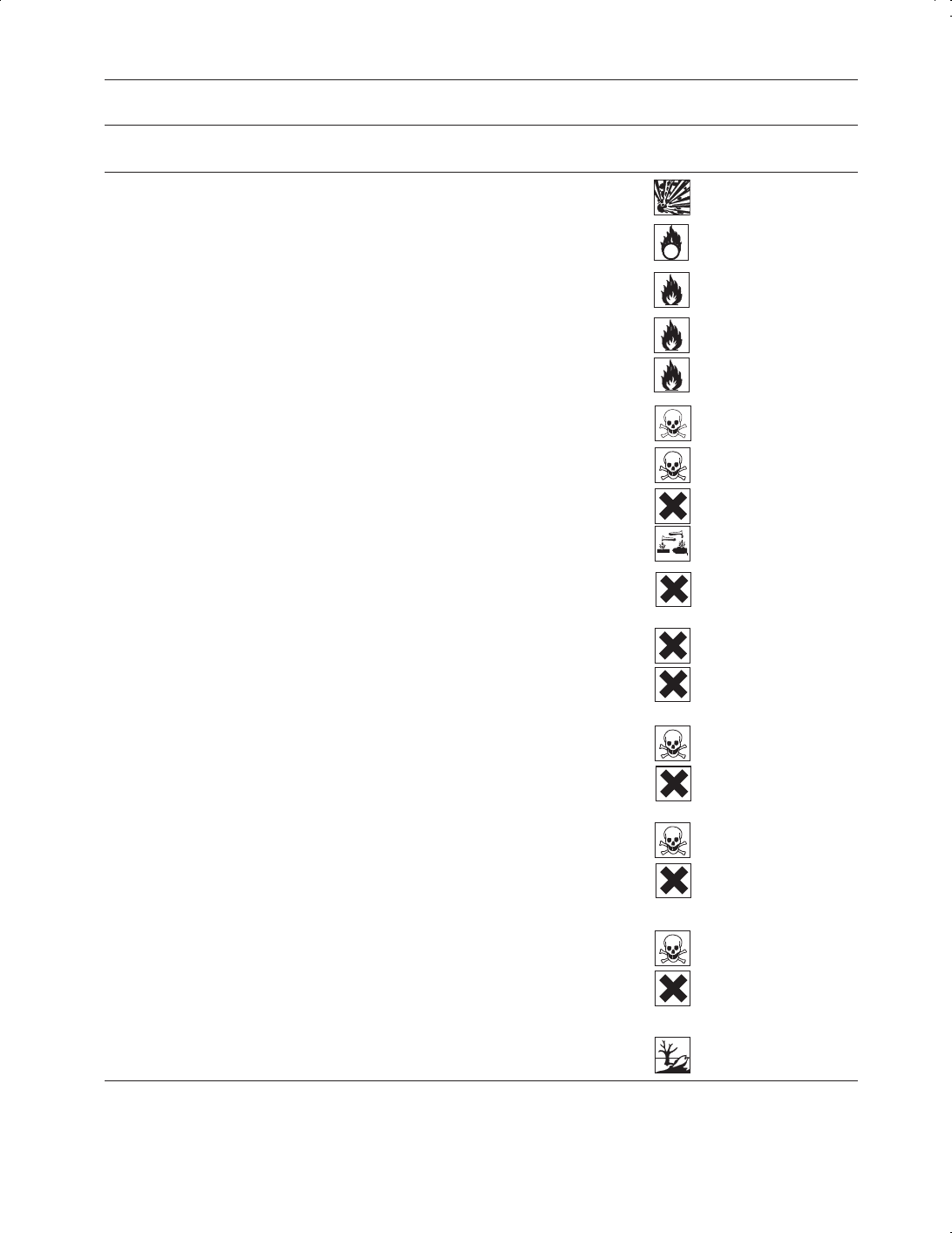
Table 14.2 Indication of dangers with chemical products
Category of danger Indication of Symbol Symbol
danger letter
Physico-chemical Explosive Explosive E
Oxidizing Oxidizing O
Extremely Extremely
F+
flammable flammable
Highly flammable Highly flammable F
Flammable Flammable –
Health Very toxic Very toxic T+
Toxic Toxic T
Harmful Harmful Xn
Corrosive Corrosive C
Irritant Irritant Xi
Harmful Xn
Sensitizing
Irritant Xi
Carcinogenic Toxic T
Categories 1 and 2
Category 3 Harmful Xn
Mutagenic Toxic T
Categories 1 and 2
Category 3 Harmful Xn
Toxic for
reproduction Toxic T
Categories 1 and 2
Category 3 Harmful Xn
Environmental Dangerous for the Dangerous for the N
environment environment

EXPLOSIVE
It is the responsibility of the supplier to draw these precautions to the attention of the user in the
best way practicable.
Labelling
If a dangerous chemical is supplied in a package then the package must be labelled. Clearly this
is not practical if the chemical is delivered in bulk or via a pipeline.
The elements of a label are:
• Full name and address and phone number of supplier.
• Chemical name or, if a preparation, the trade name.
• Indication of danger and associated symbol.
• Risk and safety phrases.
Requirements for labelling of containers for supply may differ from those for conveyance. Key
features of a supply label are to identify the substance (the chemical name in most cases) and any
hazards and safety precautions. Supply labels are black on yellow/orange. In Europe the classification,
packaging and labelling of dangerous substances is covered by Directive 67/548/EEC as amended.
This requires labels to identify appropriate risk and safety phrases (Tables 14.3 and 14.4) depending
upon product properties. A substance is considered dangerous if in Part 1A of an approved list or
if it exhibits hazardous properties as defined in Schedule 1 for supply, or Schedule 2 for conveyance
as shown in Tables 14.5 and 14.6. Substances not tested should be labelled ‘Caution – substance
not yet fully tested’. Criteria for risk phrases are provided, e.g. as in Table 14.7 for toxic compounds.
Explosive chemicals tend to be governed by separate legislation, e.g., in the UK, The Classification
and Labelling of Explosives Regulations 1983. These require the HSE to classify any explosive
before it may be supplied. Under the scheme, explosives are labelled according to a classification
based on hazard division (Table 14.8), and on compatibility (Table 14.9), which takes into account
their sensitivity, explosivity and chemical nature. Labels are diamond shaped: the top half is
reserved for the pictograph and division number, the bottom half shows the hazard code and the
classification number. Figure 14.1 shows the label for Class 1, Division 1.1, 1.2 or 1.3 explosive.
Figure 14.1
Example of label for explosive (Division 1.1, 1.2 or 1.3)
LABELLING 447

448 MARKETING
Table 14.3 ‘Risk’ phrases from the Approved List
1. Explosive when dry
2. Risk of explosion by shock, friction, fire or other sources of ignition
3. Extreme risk of explosion by shock, friction, fire or other sources of ignition
4. Forms very sensitive explosive metallic compounds
5. Heating may cause an explosion
6. Explosive with or without contact with air
7. May cause fire
8. Contact with combustible material may cause fire
9. Explosive when mixed with combustible material
10. Flammable
11. Highly flammable
12. Extremely flammable
13. Extremely flammable liquefied gas
14. Reacts violently with water
15. Contact with water liberates extremely flammable gases
16. Explosive when mixed with oxidizing substances
17. Spontaneously flammable in air
18. In use, may form flammable/explosive vapour–air mixture
19. May form explosive peroxides
20. Harmful by inhalation
21. Harmful in contact with skin
22. Harmful if swallowed
23. Toxic by inhalation
24. Toxic in contact with skin
25. Toxic if swallowed
26. Very toxic by inhalation
27. Very toxic in contact with skin
28. Very toxic if swallowed
29. Contact with water liberates toxic gas
30. Can become highly flammable in use
31. Contact with acids liberates toxic gas
32. Contact with acids liberates very toxic gas
33. Danger of cumulative effects
34. Causes burns
35. Causes severe burns
36. Irritating to eyes
37. Irritating to respiratory system
38. Irritating to skin
39. Danger of very serious irreversible effects
40. Possible risk of irreversible effects
41. Risk of serious damage to eyes
42. May cause sensitization by inhalation
43. May cause sensitization by skin contact
44. Risk of explosion if heated under confinement
45. May cause cancer
46. May cause heritable genetic damage
47. May cause birth defects
48. Danger of serious damage to health by prolonged exposure
49. May cause cancer by inhalation
50. Very toxic to aquatic organisms
51. Toxic to aquatic organisms
52. Harmful to aquatic organisms
53. May cause long-term adverse effects in the aquatic environment
54. Toxic to flora
55. Toxic to fauna
56. Toxic to soil organisms
57. Toxic to bees
58. May cause long-term adverse effects in the environment
59. Dangerous for the ozone layer