
Carson Ph., Mumford C. Hazardous Chemicals Handbook (Справочник по опасным химическим веществам)
Подождите немного. Документ загружается.


• physico-chemical, toxicological and ecotoxicological properties of the substance;
• recommended precautions, disposal and emergency procedures;
• proposals for classification and labelling.
The notification dossier may also contain a risk assessment prepared by the notifier. The precise
contents of a notification will depend on, e.g., the quantity of the substance to be placed on the
market and, to an extent, on the properties and uses of the substance. The thresholds for notification
and a summary of the information requirements are given in Table 14.12.
All testing to support notification must be performed by methods specified in Annex V to
Directive 79/831/EEC and in accordance with the principles of good laboratory practice (GLP).
GLP is concerned with the organizational processes and conditions under which laboratory studies
are planned, performed, monitored, recorded and reported.
Laboratories wishing to claim GLP compliance are normally registered with Competent Authorities
who issue statements of compliance following successful periodic inspections of the premises to
monitor compliance with the relevant legislation. In the UK compliance with the Good Laboratory
Practice Regulations 1999 is audited by the Medicines Control Agency.
INFORMATION 459

15
Transport of chemicals
Transportation of a chemical between the supplier and/or agent and the user may introduce
special risks in addition to those which can arise from the inherent chemical and physical properties.
Comprehensive labelling and identification procedures, and information supply, covered in Chapter
14, aim to avoid any confusion over the nature of the chemical and recommended handling,
storage and emergency procedures. However, different parties have to oversee, and take responsibility
for, the chemical at different stages during its movement between sites, e.g. loading/storage,
transport by various methods, storage in transit, unloading. Moreover, third parties can be prone
to injury, and property or the environment can be subjected to damage, if loss of containment
occurs. Security is a concern throughout.
The transportation of chemicals is therefore highly regulated. In addition to general transport
legislation numerous statutory provisions govern the carriage of hazardous substances by air,
road, rail and sea. These tend to address the need for:
• documentation;
• suitability of container, examination, testing and certification of tanks;
• classification, packaging and labelling of dangerous goods;
• carriage information;
• duties of consignors, operators, drivers, etc.;
• adequate information and warning labels to be displayed on containers, tanks, and wagons;
• training of crews/drivers and others engaged in the transport process;
• loading and unloading;
• security and other safety measures including emergency arrangements;
• special requirements.
Some categories of hazardous materials are covered by specific regulations as exemplified in the
UK by the Carriage of Explosives by Road Regulations 1996; the Radioactive Material (Road
Transport) (Great Britain) Regulations 1996; and the Packaging, Labelling and Carriage of
Radioactive Material by Rail Regulations 1996. It is the duty of all those engaged in the transportation
of hazardous chemicals to identify the relevant legislation and to comply with all appropriate
detailed requirements. In addition to local legislation and guidance, the transportation of chemicals
by air, rail, road and sea is the subject of international conventions, e.g. the Intergovernmental
Marine Consultative Organization Dangerous Goods Code, European Agreement concerning the
International Carriage of Dangerous Goods by Road, The International Regulations concerning
the Carriage of Dangerous Goods by Rail, and the International Air Transport Association Restricted
Articles Regulations. Table 15.12 lists dangerous goods forbidden for transport by air.
This chapter provides an insight into general principles associated with the transportation of
hazardous substances; reference is made to selected regulations for illustrative purposes.

Irrespective of the mode of carriage, the safe transport of chemicals is the responsibility of:
• the producer;
• any hauliers involved; and
• the recipient, e.g. during unloading.
Effective communication between them is a vital consideration.
Road transport
Dangerous substances
Typical division of responsibilities in a road transport operation are shown in Figure 15.1. Producers
transporting their own products need to establish a system to ensure that all necessary information
and instructions are provided for safe handling under all foreseeable conditions. This will
require:
• The enforcement of codes of practice, working procedures and general instructions incorporating
all possible safety factors.
• Specific training and instruction of transport staff on actions to be taken in emergencies, e.g.
fire, spillage on land, spillage entering drains.
• The institution, or development in consultation with the customer, of a safe unloading procedure
(e.g. as exemplified in Table 15.18 for non-pressurized hazardous liquids).
These need to comply with all statutory legislation relevant to the specific chemical (e.g. if
dangerous substances are carried into a UK port the operator must, under the Dangerous Substances
in Harbour Areas Regulations 1987, give prior notice to the Harbour Master and in some cases the
berth operator). The vehicles must be of the correct design and construction for the load carried
and be maintained in sound condition. Various regulations, codes of practice and guidelines cover
the labelling of containers and vehicles to identify the substances and their hazards in an emergency.
In the UK, the conveyance by road of dangerous chemicals in road tankers of any capacity and
in tanks exceeding 3 m
3
is controlled by the Carriage of Dangerous Goods by Road Regulations
1996 as amended. Dangerous substances are defined as those named in an approved list or falling
into the classifications in a schedule. Except for a slightly different definition for ‘other dangerous
substances’ and ‘multi-load’, the latter classification is similar to that in Table 14.1.
Conveyance includes loading, transportation, unloading, cleaning and purging. A check-list of
selected operator duties (excluding duties in relation to the unloading of petroleum spirit, covered
by Schedule 4) arising where appropriate under these regulations is given in Table 15.1. The
regulations also provide instruction on the form of hazard warning labels (Figure 15.2). In the
event of an emergency, drivers should normally carry out the actions listed in Table 15.2.
The provision of written instructions in the form of a TREMCARD developed by CEFIC is
exemplified by Figure 15.3.
Explosives
For the carriage of explosives by road the nature of the substance, the suitability of both the
container and vehicle, and the quantity of explosive carried are paramount considerations. Private
ROAD TRANSPORT 461
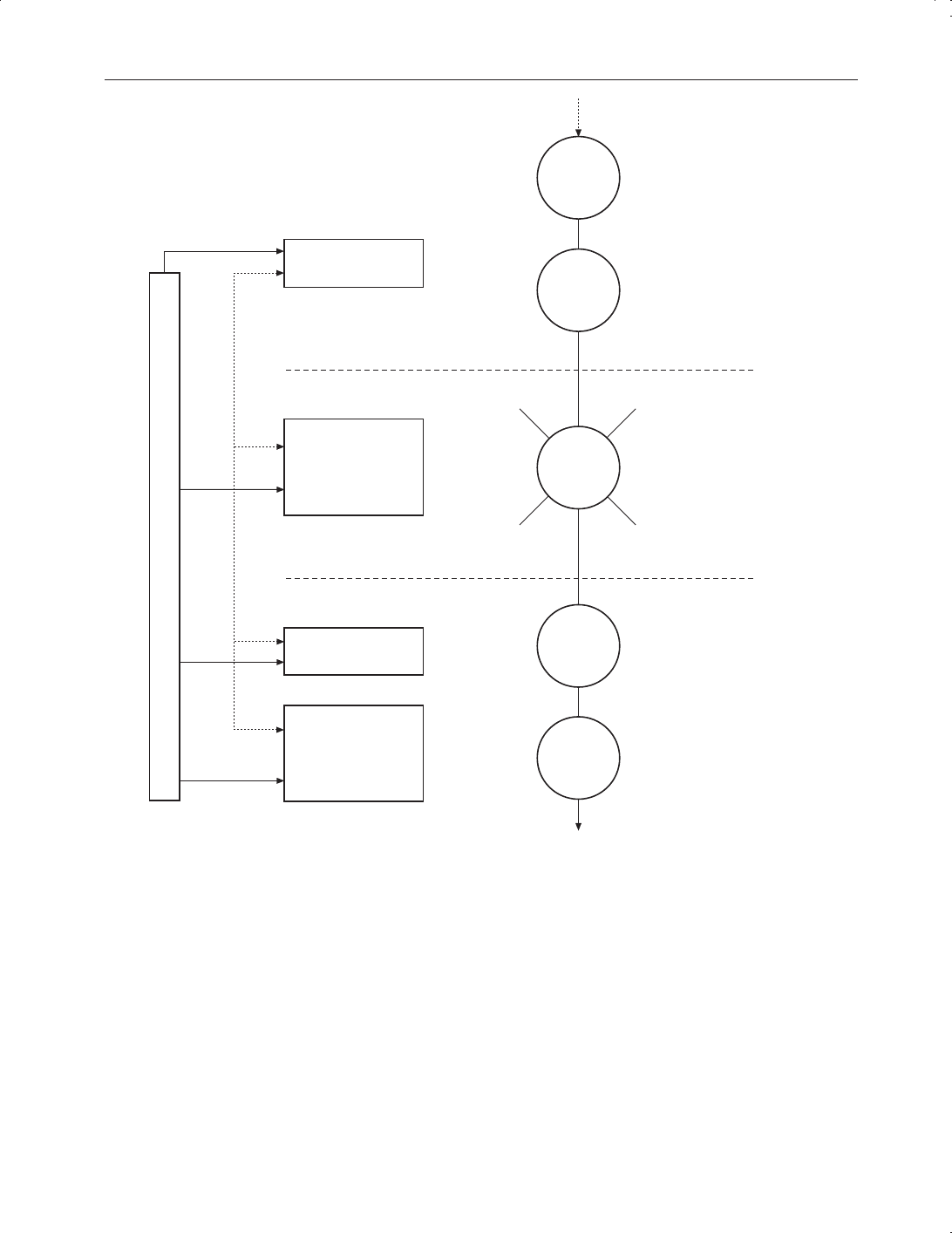
462 TRANSPORT OF CHEMICALS
Storage
Customer’s premises
or agent’s depot
Transportation
(By the manufacturer,
a haulage contractor,
an agent or the
customer)
Vehicles
Road
Routes
Packages and
labels
Intermediary
(An agent)
Use
(By a customer, who
may be part of the
manufacturing
organization)
Drivers
Production
(The manufacturer)
Information and influence
Legislation and codes of practice
Factory
Dispatch
The load
(in transit)
Receipt
Storage
light goods vehicles may be suitable only for small quantities of explosives (other than those in
Compatibility Group S) and an ordinary goods vehicle is suitable for an intermediate quantity of
most types of explosives. However, specially constructed vehicles are essential for more dangerous
types of explosives or for the largest loads permitted under regulations. Cognizance must be taken
of whether the vehicle is fuelled by diesel oil, petrol or LPG and whether or not it is an articulated
vehicle. For the purposes of the UK Carriage of Explosives by Road Regulations 1996, road
vehicles are classified as I, II or III (Table 15.3 – with type I defined as a vehicle other than type
II or III). The characteristics of type II and III vehicles are also summarized in Table 15.3. (Whilst
specialized, this illustrates the range of design features available for vehicles carrying thermally-
unstable chemicals generally.) The selection of vehicle for a particular task will be influenced by
Figure 15.1
Responsibilities for safe transport of chemicals by road

Table 15.1 Selected Operator duties under the Carriage of Dangerous Goods by Road Regulations 1996*
Operator of tanker or Ensure compliance with requirements specified in relevant approved documents and
tank container schedules to the regulations.
Dangerous goods only transported if the letter Y appears in appropriate columns of
Approved Carriage list and Schedules 5 and 6 are complied with, and tank pressures
do not exceed the maximum working pressure as per certifications.
Ensure specialist advice is always available on hazardous contents.
Ensure the tank, container or vehicle is suitable for journey taking cognizance of the
properties and volume of load.
Ensure the vehicle has no more than one trailer or semi-trailer.
Ensure packages of sensitive materials are suitably protected.
Ensure tanks are certified by competent authority/approved person.
Pass tank certificates to new owner when ownership changes.
Obtain consignor’s declaration where relevant.
Obtain from consignor information listed in Section 13.
Take reasonable steps to ensure goods are fit for carriage.
Not permit driver to;
• carry anyone other than crew member;
• open package unless authorized;
• bring sources of ignition into vehicle;
• carry food unless adequately protected.
Provide sub-contract operators and drivers relevant information from Section 14.
Display information as per Schedule 10.
Keep transport documentation relating to each journey for 3 months after completion
of journey.
Prevent carriage of materials which are liable to explosion.
Ensure loading, stowage, unloading and cleaning of containers, tanks and containers
creates no additional risk.
Clean contaminated vehicles before re-loading.
Establish emergency and parking arrangements as set out in Part VI.
* The full SI 1996 No. 2095 should be consulted for complete details.
the explosive Division Group (see Table 14.8), the Compatibility Group (see Table 14.9) and the
quantity to be transported, as summarized by Table 15.4.
Radioactive substances
The transportation of radioactive material by road in the UK is prohibited:
ROAD TRANSPORT 463

464 TRANSPORT OF CHEMICALS
White
Orange
5
Orange
4
Orange
2
Orange
1
3
• in a public service vehicle;
• in a vehicle carrying explosives;
• generally in damaged packages;
• if inadequately labelled.
Radiation limits for individual packages for shipment by road are dictated by the type of package
and the activity of the radionuclide. The Radioactive Material (Road Transport) (Great Britain)
Regulations provide rules for calculating package limits. Radiation limits for road consignments
in the UK under ‘exclusive use’ are given in Table 15.5. Instructions are provided on restrictions;
Figure 15.2
Hazard warning panels and labels
Space 1
Emergency action codes
specified for that substance in Column 3 of Part 1 of the approved list
Space 2
Substance identification number and name
as specified for that substance in Part 1 of the approved
list
Space 3
Hazard warning sign for the classification
of the substance as specified in Part 1 of the approved list
Space 4
Telephone number
where expert advice can be obtained at all times when the substance is being
conveyed by road
Space 5
Name of the manufacturer or owner
of the substance
Table 15.2 Emergency procedures for drivers
Arrange for the police and emergency services to be alerted
Arrange for assistance to be given to any person injured or in immediate danger
If considered safe to do so – having regard to the nature of the emergency, the substance and the emergency
equipment available – follow a selection of the following procedures in an appropriate order:
Stop the engine
Turn off any battery isolating switch
If there is no danger of ignition, operate the emergency flashing device
Move the vehicle to a location where any leakage would cause less harm
Wear appropriate protective clothing
Keep onlookers away
Place a red triangle warning device at the rear of the vehicle and near any spillage
Prevent smoking and direct other vehicles away from any fire risk area
Upon the police/fire brigade taking charge:
Show the written information, e.g. Tremcard, to them
Tell them of action taken and anything helpful about the load, etc.
At the end of the emergency, inform the operator.
The written information given to the driver should include:
The name of the substance
Its inherent dangers and appropriate safety measures
Action and treatment following contact/exposure
Action in the event of fire and fire-fighting equipment to be used
Action following spillage on the road
How and when to use any special safety equipment

UN No. 1088 CEFIC TEC (R)-687
TRANSPORT EMERGENCY CARD April 1974
(Road) Class llla ADR
Cargo ACETAL
(Acetaldehyde Diethyl Acetal)
Colourless liquid with perceptible odour.
Immiscible with water, lighter than water.
Nature of Highly inflammable (flashpoint below 21°C).
hazard Volatile.
The vapour is invisible, heavier than air and spreads along ground.
Can form explosive mixture with air particularly in empty uncleaned receptacles.
Heating will cause pressure rise, with risk of bursting and subsequent explosion.
The vapour has narcotic effect.
The substance has irritant effect on eyes.
Protective Goggles giving complete protection to eyes.
devices Plastic or rubber gloves.
Eyewash bottle with clean water.
EMERGENCY ACTION – Notify police and fire brigade immediately
• Stop the engine
• No naked lights. No smoking
• Mark roads and warn other road users
• Keep public away from danger area
• Use explosion-proof electrical equipment
• Keep upwind
Spillage
• Shut off leaks if without risk
• Absorb in earth or sand and remove to safe place
• Subsequently flush road with water
• Prevent liquid entering sewers, basements and workpits, vapour may create explosive atmosphere
• Warn inhabitants – explosion hazard
• If substance has entered a water course or sewer or contaminated soil or vegetation, advise police
Fire
• Keep containers cool by spraying with water if exposed to fire
• Extinguish with water spray, dry chemical, alcohol foam or halons
• Do not use water jet
First aid
• Remove soaked clothing immediately and wash affected skin with plenty of water
• If substance has got into the eyes, immediately wash out with plenty of water for several minutes
• Seek medical treatment when anyone has symptoms apparently due to inhalation or contact with
eyes
Additional information provided by manufacturer or sender
TELEPHONE
Prepared by CEFIC (CONSEIL EUROPEAN DES FEDERATIONS DE L’INDUSTRIE CHIMIQUE,
EUROPEAN COUNCIL OF CHEMICAL MANUFACTURER’S FEDERATIONS)
Zurich, from the best knowledge available: no responsibility is accepted that the information is sufficient
or correct in all cases. Obtainable from NORPRINT LIMITED, BOSTON, LINCOLNSHIRE
Applied only during road transport
English
Figure 15.3
CEFIC TREMCARD
ROAD TRANSPORT 465

466 TRANSPORT OF CHEMICALS
Table 15.3 Characteristics of type II and type III vehicles for carriage of explosives
Feature Type II Type III
General construction • Compression ignition engine • Compression ignition engine
requirements • Designed, constructed and • Vehicle design to be closed with
equipped to protect explosive from loading surface continuous.
external hazards and weather Special attention to heat-resistant
• Closed or securely sheeted and fire-proofing properties of the
• Trailers to be adequately braked or body. Doors all lockable and
restrained upon detachment from placed and constructed as to
towing vehicle overlap joints
• Any trailers to be fitted with
effective braking system acting on
all wheels, actuated by the towing
vehicle and automatically upon
breakage of the coupling. Trailers
equipped with only inertia braking
devices limited to a maximum load
of 50 kg net explosive mass
Electrical requirements • Max. rated voltage of 24 V • Max. rated voltage of 24 V
• Electrical installation of load- • Electrical installation of load-
carrying compartment to be dust- carrying compartment to be dust-
protected (at least IP54 or protected (at least IP54 or
equivalent) or in case of equivalent) or in case of
Compatibility Group J (see Table Compatibility Group J (see Table
14.9) flame-proof Ex d (at least 14.9) flame-proof Ex d (at least
IP65 or equivalent) IP65 or equivalent)
Wiring
• Conductors of sufficient size so as
to prevent overheating, and
adequately insulated. All circuits
to be protected by fuses or
automatic circuit breakers, except
for specified battery connections
• Cables securely fastened and
positioned so that conductors are
adequately protected against
mechanical and thermal stresses
Battery master switch
• A switch to break electrical circuits
placed as close as possible to the battery
• Readily accessible, distinctively marked
direct or indirect control devices
installed, one in driver’s cab and
one on outside of vehicle. The cab
version shall be within immediate
reach, but protected against
inadvertent operation
• Switch should not constitute a fire
risk in an explosive atmosphere
and be capable of opening whilst
engine is running, without causing
any dangerous excess voltage
• IP54 protection for cable
connections on battery master switch
• Battery terminals should be
electrically insulated or covered
by insulated battery box cover.
Batteries not located under bonnet
to be fitted in vented box

Tachograph
• Electrical supply provided via safety
barrier connected directly to battery
and all the equipment certified to
EN 50 020
Electrical installations at rear of driver’s cab
• Designed, constructed, installed and
protected so as to prevent ignition
or short-circuit under normal conditions
of use, and risks minimized upon
impact or deformation
Fire prevention
Vehicle cab Vehicle cab
• Driver’s cab constructed of • Driver’s cab constructed of
material not readily flammable material not readily flammable
Fuel tank Fuel tank
• Tanks supplying the engine to be • Tanks supplying the engine to be
constructed so that fuel leakages constructed so that fuel leakages
drain to ground without contact of drain to ground without contact of
hot parts of vehicle or load hot parts of vehicle or load
Engine Engine
• Engine to be located forward of • Engine to be located forward of
the load compartment (or under the load compartment (or under
the load such that excess heat the load such that excess heat
poses no hazard to the load) poses no hazard to the load)
Exhaust system Exhaust system
• Constructed and located such that • Constructed and located such that
excess heat poses no hazard to load excess heat poses no hazard to load
Vehicle endurance brake
• Systems emitting high
temperatures placed behind the
rear wall of the cab to be equipped
with thermal shield appropriately
fixed and located
• The thermal shield should protect
the braking system from outflow
or leakage of the load
Combustion heaters Combustion heaters
• Prohibited with certain specified • Prohibited with certain specified
exceptions for cabs exceptions for cabs
Table 15.3 Cont’d
Feature Type II Type III
marking, labelling and placarding; contamination levels; prior approval; quality assurance
programmes; test procedures; documentation; stowing and responsibilities. For example, during
the transport of radioactive material the driver should:
• ensure none of the material is lost, escapes, or is unlawfully removed;
• not leave the vehicle unattended in a place to which the public has access;
• generally not park the vehicle for a continuous period of longer than one hour unless when
parked there is clear space of at least 2 metres on both sides and at both ends of the vehicle;
• keep on the vehicle transport documentation until the package has been delivered.
The driver must notify the police and consignor in the event of an emergency such as material
loss, escape or unlawful removal; if package has been opened or damaged, or if the vehicle has
overturned, suffered serious damage, or is involved in a fire.
ROAD TRANSPORT 467

468 TRANSPORT OF CHEMICALS
Rail transport
Dangerous substances and explosives
The carriage of hazardous chemicals by rail in the UK is governed by, e.g., the Carriage of
Dangerous Goods by Rail Regulations 1996. These regulations cover the transport in bulk in
wagons and large containers, small containers and carriage in tanks. Mixed loading of certain
goods is prohibited. Packages bearing a danger sign with a classification code specified in column
1 of Table 15.6 shall not be loaded in the same container or wagon with any package or small
container bearing a danger sign with any classification codes specified in column 2. Small containers
bearing danger signs and classifications in column 1 must not be loaded in the same container or
wagon with packages or small containers bearing danger signs and classification codes in column
Table 15.4 Choice of vehicle to match the proposed load of explosive
Division Compatibility group Special goods Ordinary goods Private light
(see Table 14.8) and form (see Table 14.9) vehicle vehicle goods vehicle
1.1 A 50 kg Nil Nil
Substances of G 5 tonnes 50 kg 1 kg
B 5 tonnes 500 kg 10 kg
Substances of C or D 16 tonnes 500 kg 50 kg
F 5 tonnes 50 kg 50 kg
Articles of G 5 tonnes 5 tonnes 50 kg
Articles of C, D, E or J 16 tonnes 5 tonnes 50 kg
Articles of L 5 tonnes 5 tonnes 50 kg
1.2 Any 16 tonnes 5 tonnes 50 kg
1.3 Any 16 tonnes 5 tonnes 50 kg
1.4 B, C, D, E, F or G 16 tonnes 16 tonnes 50 kg
S Unlimited Unlimited Unlimited
1.5 D 16 tonnes 5 tonnes 50 kg
1.6 N 16 tonnes 5 tonnes 50 kg
* * 500 kg 50 kg 10 kg
* Unclassified explosives carried solely in connection with an application for their classification.
Table 15.5 Radiation levels for a road consignment of radioactive material under ‘exclusive use’
The radiation level for a consignment transported under exclusive use by a vehicle shall not exceed:
(a) 10 mSv/h at any point on the external surface of any package or overpack, and may only exceed 2 mSv/h provided that:
(i) the vehicle by which the consignment is transported is equipped with an enclosure which, during routine transport,
prevents the access of unauthorized persons to the interior of the enclosure;
(ii) provisions are made to secure the package or overpackage so that its position within the vehicle remains fixed
during routine transport; and
(iii) there are no loading or unloading operations between the beginning and the end of the shipment;
(b) 2 mSv/h at any point on the outer surfaces of the vehicle, including the upper and lower surfaces, or in the case of an
open vehicle, at any point on the vertical planes projected from the outer edges of the vehicle, on the upper surface of
the load, and on the lower external surface of the vehicle; and
(c) 0.1 mSv/h at any point 2 m from the vertical planes represented by the outer lateral surfaces of the vehicle, or, if the
load is transported in an open vehicle, at any point 2 m from the vertical planes projected from the outer edges of the
vehicle.