
Carson Ph., Mumford C. Hazardous Chemicals Handbook (Справочник по опасным химическим веществам)
Подождите немного. Документ загружается.

High-
efficiency
cyclone
Self-induced
spray de-
duster
Electrostatic
precipitator
High-energy
venturi
scrubber
Fabric filter
Medium
efficiency
cyclone
100
100
90
80
70
60
50
40
30
20
10
0
50 10 5 1 0.5 0.1
Particle diameter (µm)
Collection efficiency (%)
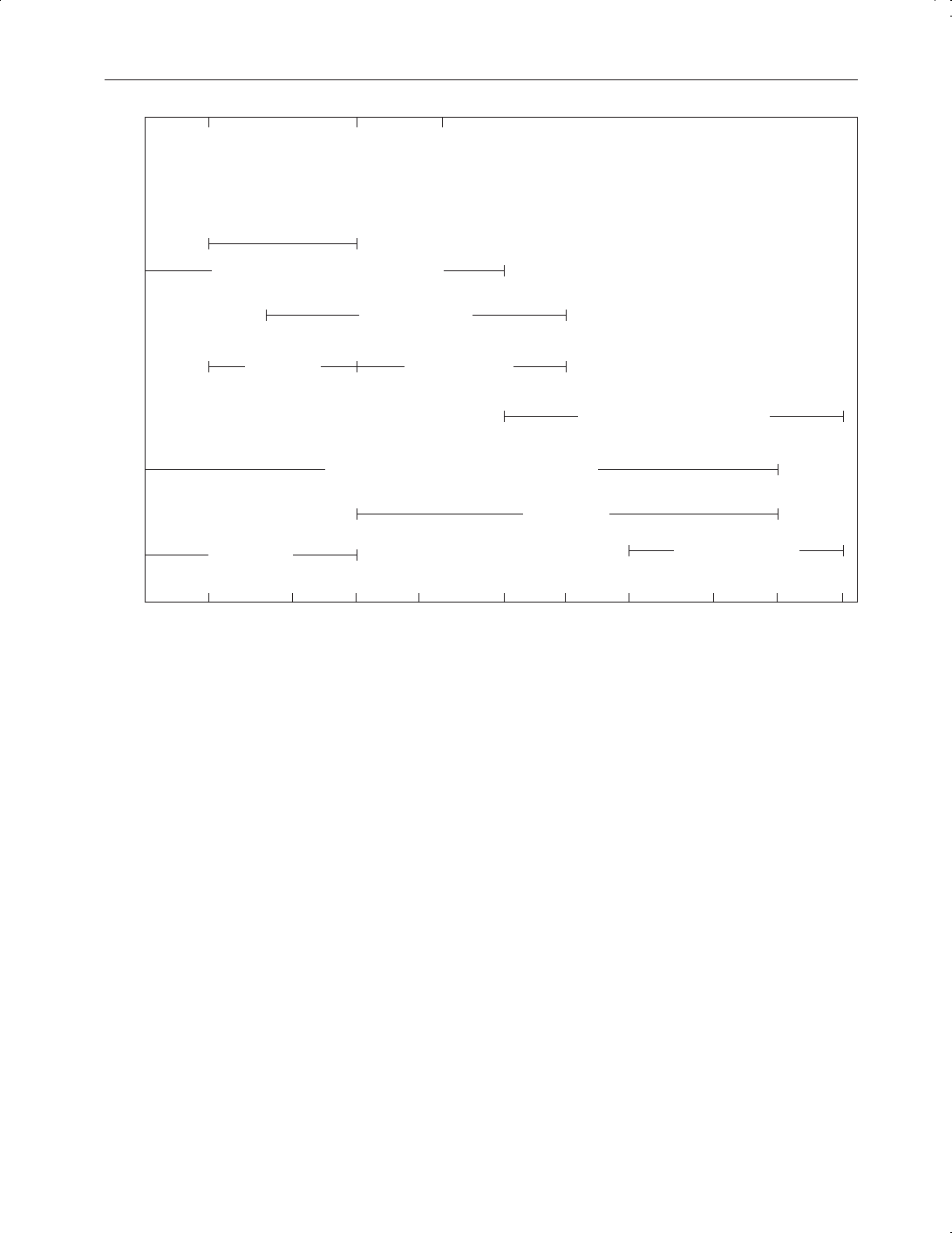
in droplet diameter. The range of droplet diameters associated with various processes, and the
types of equipment used for their separation, are exemplified in Figure 17.4.
Processes for the control of atmospheric emissions are summarized in Table 17.9. Some of
these involve the types of chemical engineering operations referred to in Chapter 7; the added
complications are:
• the inlet pollutant concentrations may be quite low;
• the total stream flowrates may be large;
• the target outlet concentrations are probably subject to stringent regulation to very low levels.
As with pollution control equipment generally, a high degree of reliability is required.
Liquid effluent treatment operations
Any of the variety of chemical engineering operations or unit processes listed in Table 17.10 may
be used to treat aqueous effluents. Oxidation includes both chemical and biological processes;
the latter include trickling filters or an activated sludge bed.
Process operation and the storage and handling of effluents and chemicals involve potential
chemical and biological hazards (Chapter 5). Safeguards of the type outlined in Chapters 12 and
13 are essential, particularly since the activities are often on a site’s periphery and have low
manning levels.
EC policy is that waste oils from use as lubricants should be recycled or used as fuel as far as
possible. Some EC countries have a more regulated organizational framework for collection and
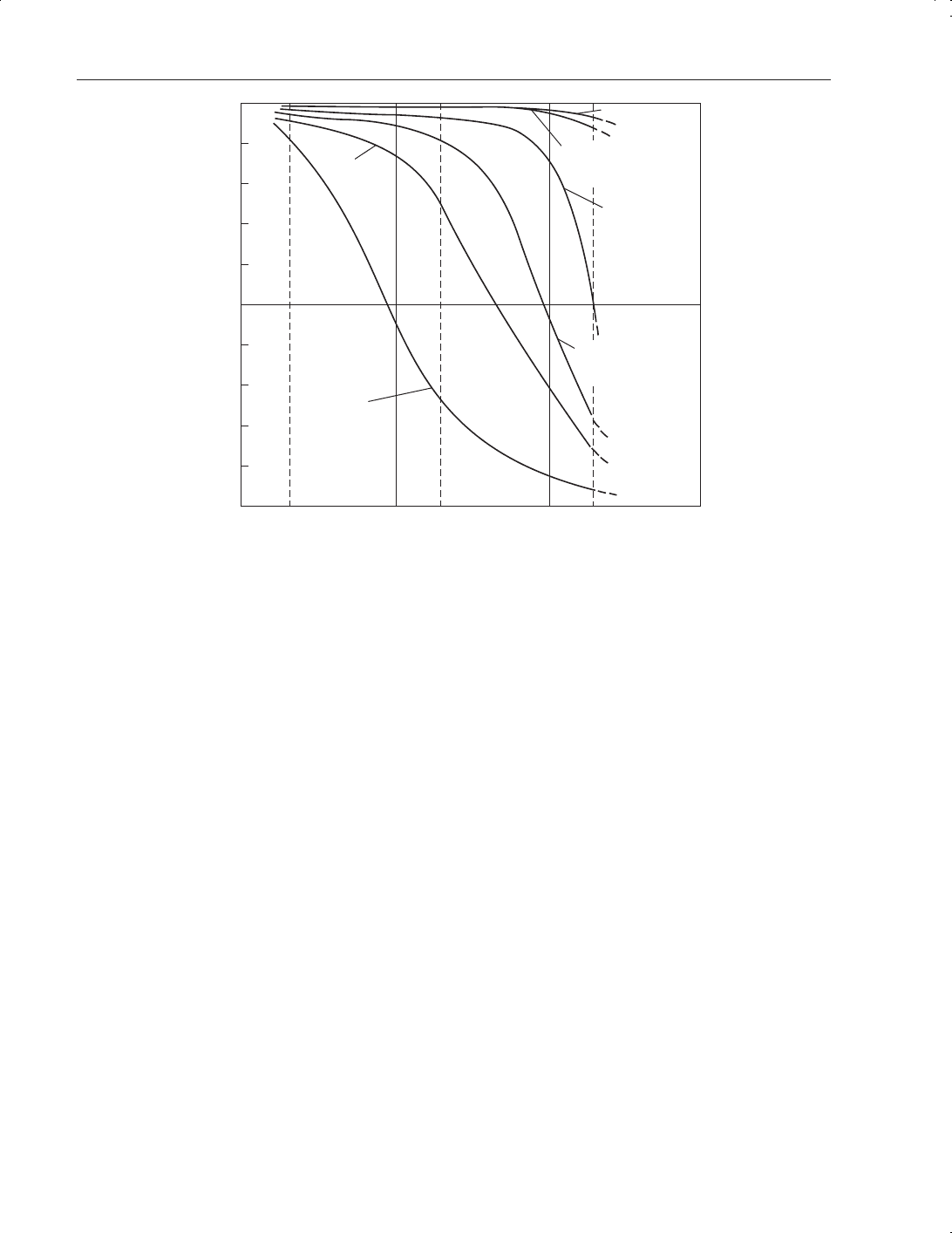
Figure 17.3
Particle arrestment efficiencies for different equipment
LIQUID EFFLUENT TREATMENT OPERATIONS 529
530 CHEMICALS AND THE ENVIRONMENT
carry-over from
water cooling and
spray cooling towers
Rain drops
Drizzle Mist
baffle, louvre
separators
knitted-mesh
demisters
knock-out drums/collectors with knitted-mesh
condensate from high-pressure
compression plant
condensate
from gas coolers
condensate from
intercoolers ion
compression plant
spray produced by bubbles at a liquid
vapour interface
entrainment from
evaporators, distillation and
absorption columns
cyclones, centrifugal
separators
Process applications
1000
500 200 100 50 20 10 5 2 1 0.5
Droplet diameter (µm)
Operating
range of
equipment
Fog
demisters
recycling of used oil. Used oil can be drained from machinery during routine servicing and should
be stored in a central store using suitable leak-proof containers. Different types of oil should be
stored separately. Used oils must not be disposed of into soakaways, watercourses, drains and
sewers. The requirement of ‘no visible oil’ is often specified for releases to water, usually taken
to mean no more than 20 ppm depending on droplet size. Used oils should only be disposed of to
registered waste oil carriers. Alternatively waste oil can be burnt for heating provided that approval
is given by the local authority Environmental Health Department for the installation of the burner.
The disposal of waste oils is largely governed in the UK by the EPA 90. Waste oils are a
‘Special Waste’ covered by Special Waste Regulations. Establishments handling more than 500
litres per annum have a duty to maintain records. There are also requirements for record keeping
where waste oils contain toxic impurities and so become ‘Special Waste’.
PCBs and PCTs are particularly troublesome liquids because of their toxicity and persistence
in the environment. They are defined as polychlorinated biphenyls, polychlorinated terphenyls,
monomethyl-dibromo-diphenyl methane, monomethyl-dichloro-diphenyl methane or monomethyl-
tetrachlorodiphenyl methane. With low electrical conductivity and heat resistance they found
wide use as dielectric fluids and were formerly used as hydraulic fluids. PCBs have not been
made in the UK since 1977 and whilst most new uses for the substance are banned in most
countries, around two-thirds of the 1.5 million tonnes manufactured in Europe and the US prior
to 1985 still remain in equipment such as transformers. PCTs have been used in the past in a
restricted range of specialist industrial applications.
Figure 17.4
Mists and sprays; applications of separators

Table 17.9 Treatment methods for gaseous waste
General methods Alternatives
Centrifugal techniques Centrifuge
Cyclone
Coalescence
Condensation
Destruction Chemical reaction
Incineration
Direct recycle
Dispersion
Electrostatic precipitation
Filtration Needle bonded fabric
Reverse jet
Reverse pressure
Shaker type
Gravity settlement
Total enclosure
Wet scrubbing Absorption tower
Fluidized bed scrubber
Impingement scrubber
Irrigated target scrubber
Pressure spray scrubber
Rotary scrubber
Self-induced spray scrubber
Spray tower
Venturi scrubber
Waste gas treatment system
Dry methods Pollutant Wet methods
Absorption Gas Wet scrubbing
Destruction
Direct recycling
Dispersion
Total enclosure
Destruction Liquid Centrifugal techniques
Coalescence
Destruction
Gravity settlement
Total enclosure
Wet scrubbing
Centrifugal techniques Solid Electrostatic precipitation
Destruction Wet scrubbing
Direct recycling
Electrostatic precipitation
Filtration
Gravity settlement
Total enclosure
LIQUID EFFLUENT TREATMENT OPERATIONS 531

532 CHEMICALS AND THE ENVIRONMENT
Table 17.10 Treatment methods for liquid effluent
Treatment method Example
Chemical
Cementation Copper recovery
Chlorination Cyanide oxidation
Coagulation,
see
Flocculation
Electrolytic processes Metal recovery
Emulsion breaking Soluble oil recovery
Flocculation Sewage treatment
Hydrolysis Cellulose waste
Incineration Waste oils
Ion exchange Metal recovery
Leaching Metal-bearing sludges
Neutralization Waste acid, waste alkali
Oxidation Phenol removal
Ozonization Cyanide oxidation
Precipitation Metals
Reduction Hexavalent chromium
Thermal decomposition Recycling hydrochloric acid
Physical
Adsorption Removal of volatile organics
Cooling Water reuse
Crystallization Recovery of inorganic salts
Dewatering,
see
Filtration
Dialysis Desalination
Distillation Solvent recovery
Drying Pig manure
Electrodialysis Desalination
Evaporation Sulphuric acid recovery
Filtration Sewage sludge
Flotation Dairy wastes
Foam fractionation Metal separation
Fractionation,
see
Distillation
Freezing Desalination
Heating Demulsification
Phase separation Oily wastes, hydrocarbons
Reverse osmosis Desalination
Screening Sewage
Sedimentation Suspended solids removal
Solvent extraction Metal recovery
Stripping Ammonia removal, solvent removal
Ultrafiltration,
see
Dialysis, Reverse osmosis
Biological
Activated sludge Sewage
Anaerobic digestion Food wastes
Chemical production Ethanol
Disinfection Sewage plant effluent
High-rate filtration Phenol removal
Oxidation,
see
Activated sludge, High-rate
filtration, Trickling filter
Reduction,
see
Anaerobic digestion
Single-cell protein production Organic waste
Trickling filter Sewage

Under the requirements of the Environmental Protection (Disposal of Polychlorinated Biphenyls
and other Dangerous Substances) (England and Wales) Regulations, SI 2000/1043, equipment
containing PCBs is now required to be: identified, registered with the Environment Agency,
labelled so that the PCB presence can be identified, and decontaminated without endangering
health and safety to reduce the level of PCBs in equipment to less than 50 ppm (less than 0.005%
in weight). It was, however, regarded as acceptable to achieve a level between 50 and 500 ppm
and to dispose of equipment by 31 December 2000 unless the exemptions set out under the
Environmental Protection (Disposal of Polychlorinated Biphenyls and other Dangerous Substances)
Regulations, apply.
Control of solid waste
The overall stages in handling waste are summarized in Figure 16.2. The treatment methods
applicable to it are listed in Table 17.11.
The range of precautions required during handling, transfer, and disposal, e.g. by landfill,
depend upon the risk including the nature and degree of contamination and the work to be
undertaken.
It will, however, encompass personal protective equipment: a high standard of personal hygiene;
enclosure, possibly pressurization and regular cleaning of vehicle cabs; vehicle washing facilities;
site security, and control of designated dirty areas. Air monitoring and medical surveillance may
be required.
Monitoring and auditing
Auditing
The basic database for the control of environmental pollution is a pollution inventory, viz. a
tabulation of emissions, discharges and wastes from the factory or activity covering all operating
phases. This includes:
• atmospheric emissions; continuous, occasional and fugitive emissions during normal operation,
start-up, shutdown, etc.;
• aqueous discharges; to sewers, direct to controlled waters, etc.;
• solid wastes; by type, origins, routes;
• noise; by reference to environmental noise surveys with identification of special features, tonal
characteristics and intermittency;
• transport; normal plus any hazardous cargoes.
An environmental audit is a systematic, documented, periodic and objective evaluation of how
well environmental organization, management and equipment are performing. The aim is to help
safeguard the environment by:
• assessing compliance with company policies, including compliance with all regulatory
requirements; and
• facilitating management control of environmental practices.
MONITORING AND AUDITING 533

534 CHEMICALS AND THE ENVIRONMENT
Table 17.11 Treatment methods for solid waste
Treatment method Examples/comments
Chemical
Calcination Gypsum
Chlorination Tin removal
Cooking Inedible offal
Froth flotation Coal recovery
Glass
Hydrolysis Household refuse
Vegetable waste
Incineration Household refuse, rubber tyres
Leaching Gives an aqueous solution for treatment as liquid waste
(Table 17.4)
Oxidation Weathering
Pyrolysis Household refuse
Polystyrene
Sintering Colliery spoil
Millscale
Physical
Adhesion Household refuse
Agglomeration Pulverized fuel ash
Ballistic separation Household refuse
Baling Cans, paper, cardboard
Centrifugation Animal oil separation
De-oiling swarf
Classification (air) Household refuse
Classification (wet) Plastic
Comminution Mining wastes
Motor vehicles
Compaction Household refuse
Dewatering Sewage sludge
Dissolution Forms a liquid waste for treatment as in Table 17.4
Drying Filter cake
Electrostatic separation Household refuse
Foaming Slag
Freezing Meat products
Granulation Slag
Impalement Household refuse
Jigging Household refuse
Magnetic treatment Iron removal from slag
Household refuse
Melting Selective non-ferrous metal recovery
Pelletization Iron and steel fines
Pulverization Household refuse
Swarf
Quenching Incinerator residues
Screening Clinker
Settlement China clay wastes
Shape separation Household refuse
Sliding separation Household refuse, agricultural wastes
Biological
Anaerobic digestion Farm waste
Bacterial leaching Low-grade copper ore
Composting Household refuse
Degradation Plastic
Fermentation Requires solution or dilute slurry,
see
Table 17.4

Audits may differ. Some concentrate on particular facets, e.g. waste minimization, energy
conservation. A management audit will probably cover organizational structures and relationships,
communications, procedures acceptance and implementation, training and quality assurance. A
technical audit will consider the performance of plant and equipment, monitoring and inspection
programmes. Items for inclusion in auditing are listed in Table 17.12.
Table 17.12 Some items in a typical environmental pollution audit
• Checks on environmental policy, organization and responsibilities, legislation, training records, emergency plans, performance
targets, means of investigating incidents and written work instructions.
• Listing gaseous emissions, concentrations, smoke characteristics; prevailing winds and exposed zones; toxicity or nuisance
potential; effects of synergism or poor atmospheric dispersing conditions. Consent limits. Compliance record keeping.
• Querying the adequacy of chimneys and stacks, scrubbers and particulates collection equipment (e.g. filters, cyclones).
• Listing effluents, their analyses and discharge from processes. Querying flammability, corrosivity, toxicity, miscibility,
reactivity. Checking the reliability of treatment and analysis. Consent limits. Compliance record keeping.
• Listing of ‘solid’ wastes, quantities, analyses and physical form (e.g. solid, slurry, suspension, sludge); ‘toxicity’ and
flammability. Checking the reliability and legality of waste disposal options, including any transportation offsite. Record
keeping.
• Bunding of storage areas, segregation of waste storage areas, security of landfill sites, etc.
• Soil contamination.
• Monitoring (preferably continuous). Record keeping (on- and off-site).
• Checking for land contamination, e.g. analysis of soil samples. Record keeping.
• Checks on waste removal. (Whilst a producer is under no obligation to audit his waste’s final destination, such a visit is
a prudent means of demonstrating the steps taken to prevent subsequent illegal treatment of the waste.)
• Checking noise levels (on- and off-site).
Specific attention is given to auditing for compliance with legislation, including the requirements
of IPC, BATNEEC and BPEO.
Monitoring
Monitoring of emissions, discharges and disposals is a prerequisite of control. Depending upon
the waste stream, sampling and analysis may be continuous or periodic. Measurement methods
for physico-chemical properties and chemical analysis of waste streams are very diverse. The data
obtained are used both for monitoring to ensure adequate control and compliance with legislation,
and for process plant design and operation – including recycling and recovery. A selective list of
methods for physico-chemical properties is given in Table 17.13 and for chemical analysis in
Table 17.14.
All the parameters on which various consents (or permissions to dispose of, waste streams) are
based must be reliably measured and recorded. This is easier to achieve with gaseous emissions
(Chapter 10) and liquid effluents than with heterogeneous solid wastes. Systematic analysis of
solid wastes will cover as a minimum the information in Table 17.15.
The gold standard for environment management systems is BS EN ISO 14001 as summarized
by Table 17.16.
MONITORING AND AUDITING 535

536 CHEMICALS AND THE ENVIRONMENT
Table 17.13 Methods for measurement of physico-chemical properties
(R = routine test)
Gaseous wastes
Property For consideration Methods
Gases generally
Calorific value Incineration with/without heat Calculation from published data
recovery Calorimeters
Concentration of gaseous (R) Disposal constraints Chemical analysis (q.v.)
pollutant Design of treatment/disposal/ Chromatography
recovery plant
Density Dispersion Chancel flask, or effusiometer
Design of disposal/treatment
plant
Dewpoint Design of treatment/disposal/ Tabulated
recovery plant Hygrometer ASTM method
Condensation
Flammable limits Fire and explosion hazard Tabulated
Control of combustion
Flammability Fire and explosion hazard s
ee
Calorific value and
Control of combustion Flammable limits
ASTM methods
Ignition temperature Fire and explosion hazard Adiabatic compression
Control of combustion Concentric tube
Tabulated
Moisture content
see
Dewpoint Subjective testing
Potential nuisance ASTM methods
Disposal Proprietary meters
Necessity for treatment
Pressure Design of treatment/disposal/ Gauges
recovery plant Transducer
Manometer
Solubility of pollutant (R) Design of separation/ Wide range
treatment plant ASTM methods
Tabulated
Temperature (R) Corrosion resistance Thermometer
Design of treatment/disposal Thermocouple
plant Resistance treatment
Materials of construction Pyrometer
ASTM methods
Velocity (R) Design of disposal/treatment Pitot tube
plant Anemometer
Orifice plate, etc.
Rotameter
Gas meters
ASTM method
Viscosity Design of disposal/treatment Calculated or tabulated
plant
Liquids suspended in gases
(
see also
Liquid wastes)
Concentration of liquid Design of treatment/recovery Sampling and analysis
pollutants (R) plant
Legislation
Density of liquid Design of treatment/recovery ASTM methods
plant Pyknometer
Hydrometer
Relative density balance
Tabulated

Electrical properties Electrostatic precipitation Direct testing
Flammability and related Fire/explosion hazard
see
Non-aqueous liquids
properties Incineration
Droplet size distribution Design of treatment/recovery Numerous including:
plant • Holography
Environmental impact • Light scatter
• ASTM methods
pH of liquid Corrosion resistance Indicators
Environmental impact Test meter
pH meter
Surface tension of liquid Coalescence for removal Tabulated
Design of treatment/recovery ASTM methods
plant
Viscosity of liquid Design of treatment plant for ASTM methods
removal Viscometer
Tabulated
Solids suspended in gases
(
see also
Solid wastes)
Concentration of solid in gas (R) Design of treatment or Sampling
recovery plant Density meter
Legislation
Density (bulk) Design of treatment or Direct measurement
recovery plant and handling ASTM methods
equipment
Density (particle) Design of separation Displacement
equipment Pyknometer
Tabulated
ASTM methods
Electrical properties Electrostatic precipitation Direct testing
Flammability and related Fire and explosion hazard ASTM methods
properties Dust explosion hazard
see
Solid wastes
Hygroscopicity Collection and removal of solid Direct measurement with
exposure
ASTM method
Particle geometry Design of separation Observation
equipment ASTM method
Toxic hazard
Particle size distribution (R) Design of separation
equipment
Toxic hazard
Environmental impact Wide range including:
• Microscopy
• Holography
• Light scatter
• Sieving
Solubility (R) Solubility for removal by Wide range
dissolution Tabulated
Wettability Suitability for removal by Experimentation
scrubbing ASTM method
Liquid wastes
Aqueous liquids
Ash Incineration Ignition
BOD (Biological Oxygen Type of treatment required Dilution
Demand) (R) Legislation and controls Manometry
Table 17.13 Cont’d
Property For consideration Methods
MONITORING AND AUDITING 537

538 CHEMICALS AND THE ENVIRONMENT
COD (Chemical Oxygen Legislation and controls Oxidation by dichromate
Demand)
Colour (R) Legislation and controls Visual comparison
ASTM methods
Density (bulk) Extent of contamination Hydrometer
Design of treatment or Pyknometer
recovery plant Relative density balance
General
Density (liquid droplet) Emulsion breaking Hydrometer
Stability Pyknometer
Design of treatment or Relative density balance
recovery plant Tabulation
ASTM methods
Density (solid particle) Design of treatment or Displacement
recovery plant (gravity Pyknometer
settling) Tabulated
ASTM methods
Flowrate (R) Design of treatment or Wide range including:
recovery plant • Meters
• Orifice plates
• Pitot tubes
• Venturi meters
Non-aqueous liquid content Design of treatment or Breaking emulsion
recovery plant Solvent extraction
ASTM methods
Odour Legislation and controls Subjective, empirical
Nuisance
Particle size distribution Design of treatment or
see
Suspensions in gases
recovery plant
Permanganate value Legislation and controls Oxidation with permanganate
pH (R) Corrosion Test paper
Legislation and controls pH meter
Titration
Surface tension Foaming ASTM methods
Design of treatment/recovery Tabulated
plant Capillary height
Bubble pressure
Drop
Suspended solids (R) Design of treatment/recovery Filtration
plant Centrifuge
Legislation and controls ASTM methods
Taste Contamination of potable Subjective and/or empirical
water ASTM methods
Temperature (R) Legislation and controls Thermocouple
Thermometer
Resistance thermometers
ASTM methods
Total dissolved solids (R) Legislation and controls Evaporation
Design of treatment/recovery Electrical conduction
plant ASTM methods
Turbidity Legislation and controls ASTM method
Turbidity meter (
see also
Suspended solids)
Vapour pressure Fire and explosion hazard Viscometer
Design of treatment/recovery ASTM methods
plant Tabulated
Vapour-release (toxic,
odorous)
Table 17.13 Cont’d
Property For consideration Methods