
Charles D. Maginnis. Pen Drawing. An Illustrated Treatise
Подождите немного. Документ загружается.


PEN DRAWING
AN ILLUSTRATED TREATISE
BY CHARLES D. MAGINNIS
F.A.I.A., LL.D.
FELLOW AM. ACAD. ARTS AND SCIENCES
FORMERLY INSTRUCTOR IN ILLUSTRATION, COWLES ART SCHOOL
INSTRUCTOR IN PEN DRAWING, BOSTON ARCHITECTURAL CLUB
SEVENTH EDITION
ACKNOWLEDGMENT
To Mr. David A. Gregg and to Mr. Bertram G. Goodhue, who have generously made special
drawings for this little book, and to the Publishers who have courteously allowed me to make
use of illustrations owned by them, my thanks and my cordial acknowledgements are due.
C. D. M.
LIST OF ILLUSTRATIONS
FIGURE
1. JOSEPH PENNELL. From The Century Magazine (The Century Co: New York)
2. MAXIME LALANNE. From "La Hollande à Vol d'Oiseau," by H. Havard (A. Quantin:
Paris)
3. MAXIME LALANNE. From "La Hollande à Vol d'Oiseau," by H. Havard (A. Quantin:
Paris)
4. RESTORATION HOUSE, ROCHESTER, ENGLAND. Drawing from a Photograph
5. JOSEPH PENNELL. From "Highways and Byways in North Wales" (Macmillan Co:
London)
6. BERTRAM G. GOODHUE. Drawn for "Pen Drawing"
7. HERBERT RAILTON. From "Coaching Days and Coaching Ways," by W. Outram
Tristram (Macmillan & Co: London)
8. BERTRAM G. GOODHUE. Drawn for "Pen Drawing"
9. C. D. M. Drawn for "Pen Drawing"
10. C. D. M. Drawn for "Pen Drawing"
11. MARTIN RICO. From La Ilustracion Española y Americana
12. C. D. M. Drawn for "Pen Drawing"
13. DANIEL VIERGE. From "Pablo de Ségovie," by Francisco de Quevedo (Léon
Bonhoure: Paris)

14. MARTIN RICO. From La Ilustracion Española y Americana
15. ALFRED BRENNAN. From St. Nicholas (The Century Co: New York)
16. LESLIE WILLSON. From Pick-Me-Up (London)
17. DRAWING FROM PHOTOGRAPH. From Harper's Magazine (Harper & Brothers:
New York)
18. JOSEPH PENNELL. From "The Sâone: A Summer Voyage," by Philip Gilbert
Hamerton (Seeley & Co: London)
19. JOSEPH PENNELL. From "The Sâone: A Summer Voyage," by Philip Gilbert
Hamerton (Seeley & Co: London)
20. JOSEPH PENNELL. From Harper's Magazine (Harper & Brothers: New York)
21. E. DANTAN. From L'Art (Paris)
22. J. F. RAFFAËLLI. From Gazette des Beaux-Arts (Paris)
23. C. D. M. Drawn for "Pen Drawing"
24. D. A. GREGG. From "Architectural Rendering in Pen and Ink," by D. A. Gregg (Ticknor
& Co: Boston)
25. DANIEL VIERGE. From "Pablo de Ségovie," by Francisco de Quevedo (Léon
Bonhoure: Paris)
26. DANIEL VIERGE. From "Pablo de Ségovie," by Francisco de Quevedo (Léon
Bonhoure: Paris)
27. HARRY FENN. From The Century Magazine (The Century Co: New York)
28. REGINALD BIRCH. From The Century Magazine (The Century Co: New York)
29. JOSEPH PENNELL. From The Century Magazine (The Century Co: New York)
30. BERTRAM G. GOODHUE. From The Architectural Review (Bates & Guild Co: Boston)
31. JOSEPH PENNELL. From "Charing Cross to St. Paul's," by Justin McCarthy (Seeley &
Co: London)
32. LEONARD RAVEN HILL. From Pick-Me-Up (London)
33. DANIEL VIERGE. From "Pablo de Ségovie," by Francisco de Quevedo (Léon
Bonhoure: Paris)
34. P. G. JEANNIOT. From La Vie Moderne (Paris)
35. PORCH OF AN ENGLISH CHURCH. From a Photograph
36. D. A. GREGG. Drawn for "Pen Drawing"
37. 37. NORMANDY MOAT-HOUSE. From a Photograph
38. 38. C. D. M. Drawn for "Pen Drawing"
39. STREET IN HOLLAND. From a Photograph
40. C. D. M. Drawn for "Pen Drawing"
41. C. D. M. Drawn for "Pen Drawing"
42. GEORGE F. NEWTON. From "Catalogue of the Philadelphia & Boston Face Brick Co."
(Boston)
43. C. D. M. Drawn for "Pen Drawing"
44. C. D. M. Drawn for "Pen Drawing"
45. FRANK E. WALLIS. From The Engineering Record
46. HARRY ALLAN JACOBS. From The Architectural Review (Bates & Guild Co: Boston)
47. D. A. GREGG. From "Architectural Rendering in Pen and Ink," by D. A. Gregg (Ticknor
& Co: Boston)
48. D. A. GREGG. From The Brickbuilder (Rogers & Manson: Boston)
49. HERBERT RAILTON. From "Coaching Days and Coaching Ways," by W. Outram
Tristram (Macmillan & Co: London)
50. D. A. GREGG. From The American Architect (The American Architect and Building
News Co: Boston)
51. WALTER M.CAMPBELL. From The American Architect (The American Architect and
Building News Co: Boston)

52. HERBERT RAILTON. From "Coaching Days and Coaching Ways," by W. Outram
Tristram (Macmillan & Co: London)
53. A. F. JACCACI. From The Century Magazine (The Century Co: New York)
54. CLAUDE FAYETTE BRAGDON. From The Brickbuilder (Rogers & Manson: Boston)
55. HARVEY ELLIS. From The Inland Architect (The Inland Publishing Co: Chicago)
56. C. E. MALLOWS. From The British Architect (London)
57. C. D. M. Drawn for "Pen Drawing"
58. C. D. M. Drawn for "Pen Drawing"
59. C. D. M. Drawn for "Pen Drawing"
60. C. D. M. Drawn for "Pen Drawing"
61. A. B. FROST. From Scribner's Magazine (Charles Scribner's Sons: New York)
62. ALFRED G. JONES. From a Book Plate
63. WALTER APPLETON CLARK. From Scribner's Magazine (Charles Scribner's Sons:
New York).
64. A. CAMPBELL CROSS. From Quartier Latin (Paris)
65. MUCHA. From a Poster Design
66. HOWARD PYLE. From "Otto of the Silver Hand," by Howard Pyle (Charles Scribner's
Sons: New York)
67. WILL H. BRADLEY. From a Poster Design for The Chap-Book (Herbert S. Stone & Co:
Chicago)
68. P. J. BILLINGHURST. From a Book Plate
69. "BEGGARSTAFF BROTHERS." From a Poster Design
70. EDWARD PENFIELD. From a Design for the "Poster Calendar" (R. H. Russell & Son:
New York)
71. LOUIS J. RHEAD. From a Poster Design for "Lundborg's Perfumes"
72. J. W. SIMPSON. From a Book Plate
CONTENTS
CHAPTER I.—Style in Pen Drawing
CHAPTER II.—Materials
CHAPTER III.—Technique
CHAPTER IV.—Values
CHAPTER V.—Practical Problems
CHAPTER VI.—Architectural Drawing
CHAPTER VII.—Decorative Drawing

CHAPTER I
STYLE IN PEN DRAWING
Art, with its finite means, cannot hope to record the infinite variety and complexity of Nature,
and so contents itself with a partial statement, addressing this to the imagination for the full and
perfect meaning. This inadequation, and the artificial adjustments which it involves, are tolerated
by right of what is known as artistic convention; and as each art has its own particular
limitations, so each has its own particular conventions. Sculpture reproduces the forms of
Nature, but discards the color without any shock to our ideas of verity; Painting gives us the
color, but not the third dimension, and we are satisfied; and Architecture is purely conventional,
since it does not even aim at the imitation of natural form.
The Conventions of Line Drawing Of the kindred arts which group themselves under the head
of Painting, none is based on such broad conventions as that with which we are immediately
concerned—the art of Pen Drawing. In this medium, Nature's variety of color, when not
positively ignored, is suggested by means of sharp black lines, of varying thickness, placed more
or less closely together upon white paper; while natural form depends primarily for its
representation upon arbitrary boundary lines. There is, of course, no authority in Nature for a
positive outline: we see objects only by the difference in color of the other objects behind and
around them. The technical capacity of the pen and ink medium, however, does not provide a
value corresponding to every natural one, so that a broad interpretation has to be adopted which
eliminates the less positive values; and, that form may not likewise be sacrificed, the outline
becomes necessary, that light objects may stand relieved against light. This outline is the most
characteristic, as it is the most indispensable, of the conventions of line drawing. To seek to
abolish it only involves a resort to expedients no less artificial, and the results of all such
attempts, dependent as they necessarily are upon elaboration of color, and a general indirectness
of method, lack some of the best characteristics of pen drawing. More frequently, however, an
elaborate color-scheme is merely a straining at the technical limitations of the pen in an effort to
render the greatest possible number of values.
It may be worth while to inquire whether excellence in pen drawing consists in thus dispensing
with its recognized conventions, or in otherwise taxing the technical resources of the instrument.
This involves the question of Style,—of what characteristic pen methods are,—a question which
we will briefly consider.
What Constituted "Style" It is a recognized principle that every medium of art expression
should be treated with due regard to its nature and properties. The sculptor varies his technique
according as he works in wood, granite, or marble; the painter handles his water-color in quite
another manner than that he would employ on an oil-painting of the same subject; and the
architect, with the subtle sense of the craftsman, carries this principle to such a fine issue as to
impart an individual expression even to particular woods. He knows that what may be an
admirable design when executed in brass may be a very bad one in wrought-iron and is sure to
be an absurdity in wood. An artistic motive for a silver flagon, too, is likely to prove ugly for
pottery or cut-glass, and so on. There is a genius, born of its particular properties, in every
medium, which demands individual expression. Observe, therefore, that Art is not satisfied with
mere unrelated beauty of form or color. It requires that the result confess some sensible relation
to the means by which it has been obtained; and in proportion as it does this, it may claim to
possess that individual and distinctive charm which we call "Style." It may be said, therefore,
that the technical limitations of particular mediums impose what might properly be called natural
conventions; and while misguided ambition may set these conventions aside to hammer out
effects from an unwilling medium, the triumph is only mechanical; Art does not lie that way.
The Province of the Pen Ought the pen, then, to be persuaded into the province of the brush?
Since the natures of the two means differ, it does not stultify the water-color that it cannot run
the deep gamut of oil. Even if the church-organ be the grandest and most comprehensive of
musical instruments we may still be permitted to cherish our piano. Each has its own sphere, its
own reason for being. So of the pen,—the piccolo flute of the artistic orchestra. Let it pipe its
high treble as merrily as it may, but do not coerce it into mimicking the bassoon.
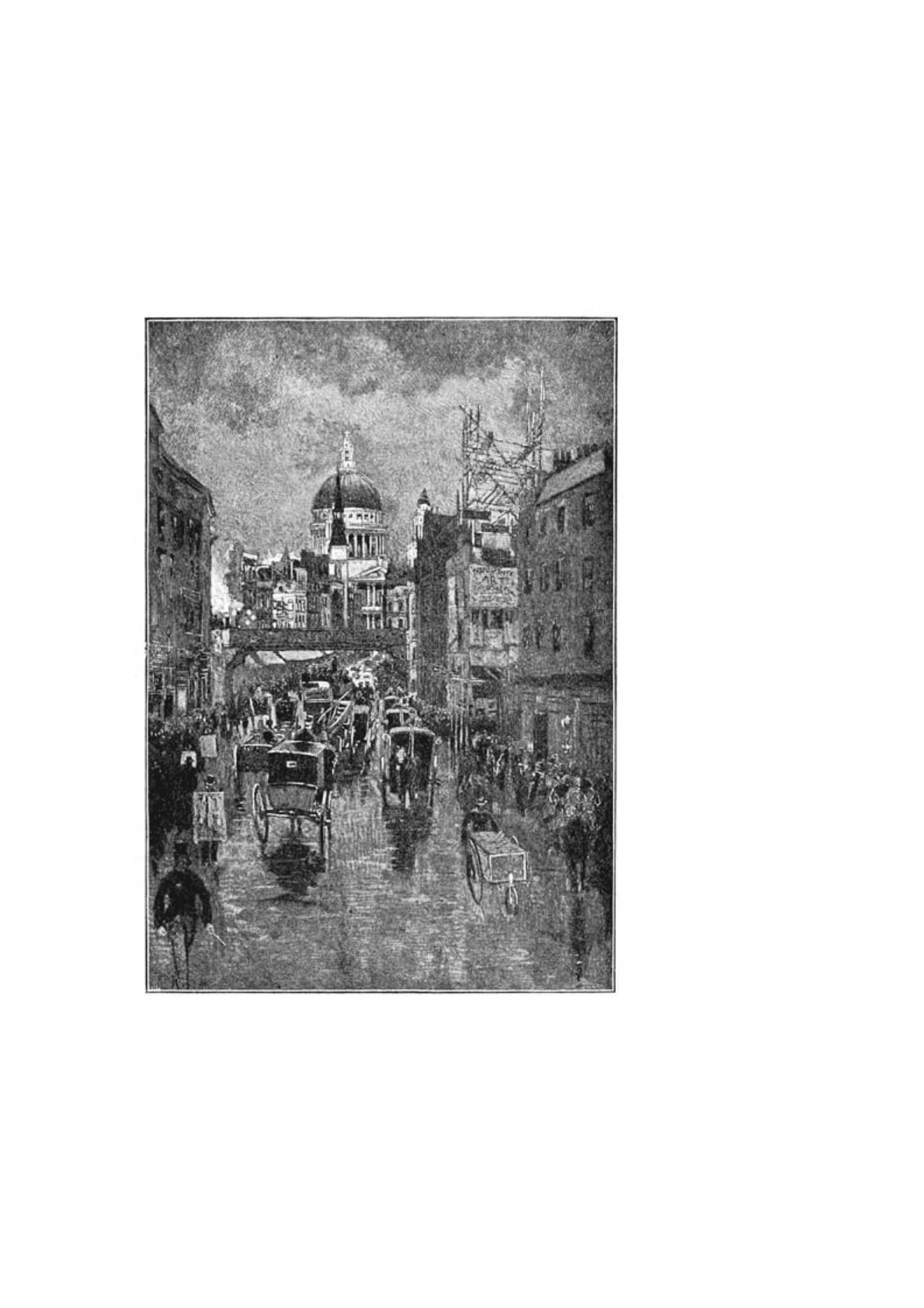
FIG. 1
JOSEPH PENNELL
Pen drawing is most apt to lose its individuality when it begins to assume the characteristics of
wash-drawing, such as an elaborate massing of grays, small light areas, and a general
indirectness of method. A painter once told me that he was almost afraid to handle the pen,—"It
is so fearfully direct," he said. He understood the instrument, certainly, for if there is one
characteristic more than another which should distinguish pen methods it is Directness. The
nature of the pen seems to mark as its peculiar function that of picking out the really vital
features of a subject. Pen drawing has been aptly termed the "shorthand of Art;" the genius of
the pen-point is essentially epitome.
If we turn to the brush, we find its capacity such that a high light may be brought down to a
minute fraction of an inch with a few swift strokes of it; whereas the tedious labor, not to speak
of the actual technical difficulties, encountered in attempting such an effect of color with pen
and ink, indicates that we are forcing the medium. Moreover, it is technically impossible to
reproduce with the pen the low values which may be obtained with the brush; and it is unwise to
attempt it. The way, for example, in which Mr. Joseph Pennell handles his pen as compared with
that in which he handles his brush is most instructive as illustrating what I have been
maintaining. His pen drawings are pitched in a high key,—brilliant blacks and large light areas,
with often just enough half-tone to soften the effect. His wash-drawings, on the contrary, are so
utterly different in manner as to have nothing in common with the others, distinguished as they
are by masses of low tone and small light areas. Compare Figs. 1 and 5. Observe that there is no
straining at the technical capacity of the pen or of the brush; no attempt to obtain an effect in one
medium which seems to be more naturally adapted to the other. Individuality is imparted to each
by a frank concession to its peculiar genius.
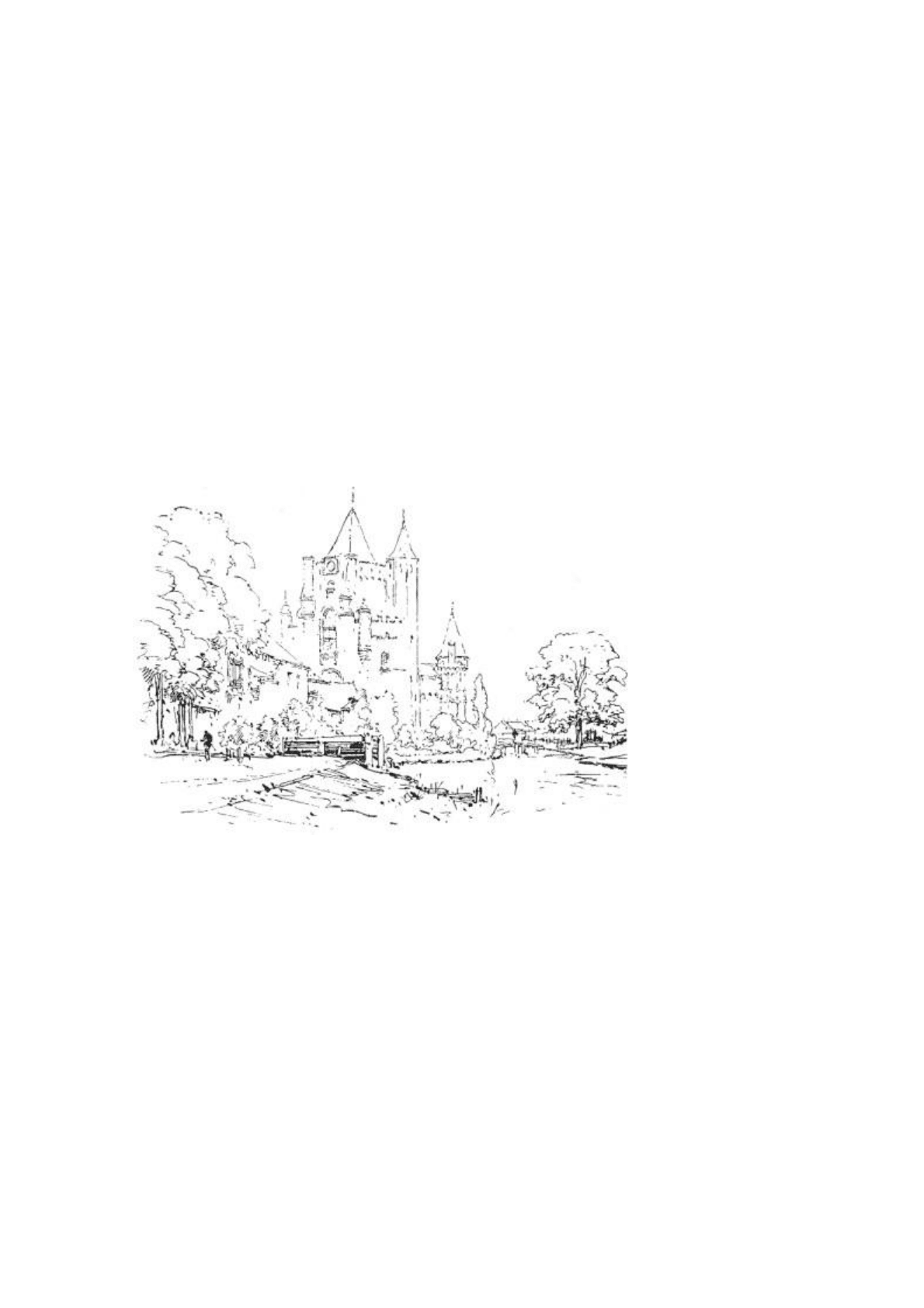
FIG. 2
MAXIME LALANNE
Examples of Good Style I have said that the chief characteristic of pen methods is Directness. I
think I may now say that the chief element of style is Economy of Means. The drawing by M.
Maxime Lalanne shown in Fig. 2 is an excellent example of this economy carried to its extreme.
Not a stroke could be spared, so direct and simple is it, and yet it is so complete and
homogenous that nothing could be added to make it more so. The architecture is left without
color, and yet we are made to feel that it is not white—this subtle suggestion of low color being
obtained by a careful avoidance of any strong black notes in the rendering, which would have
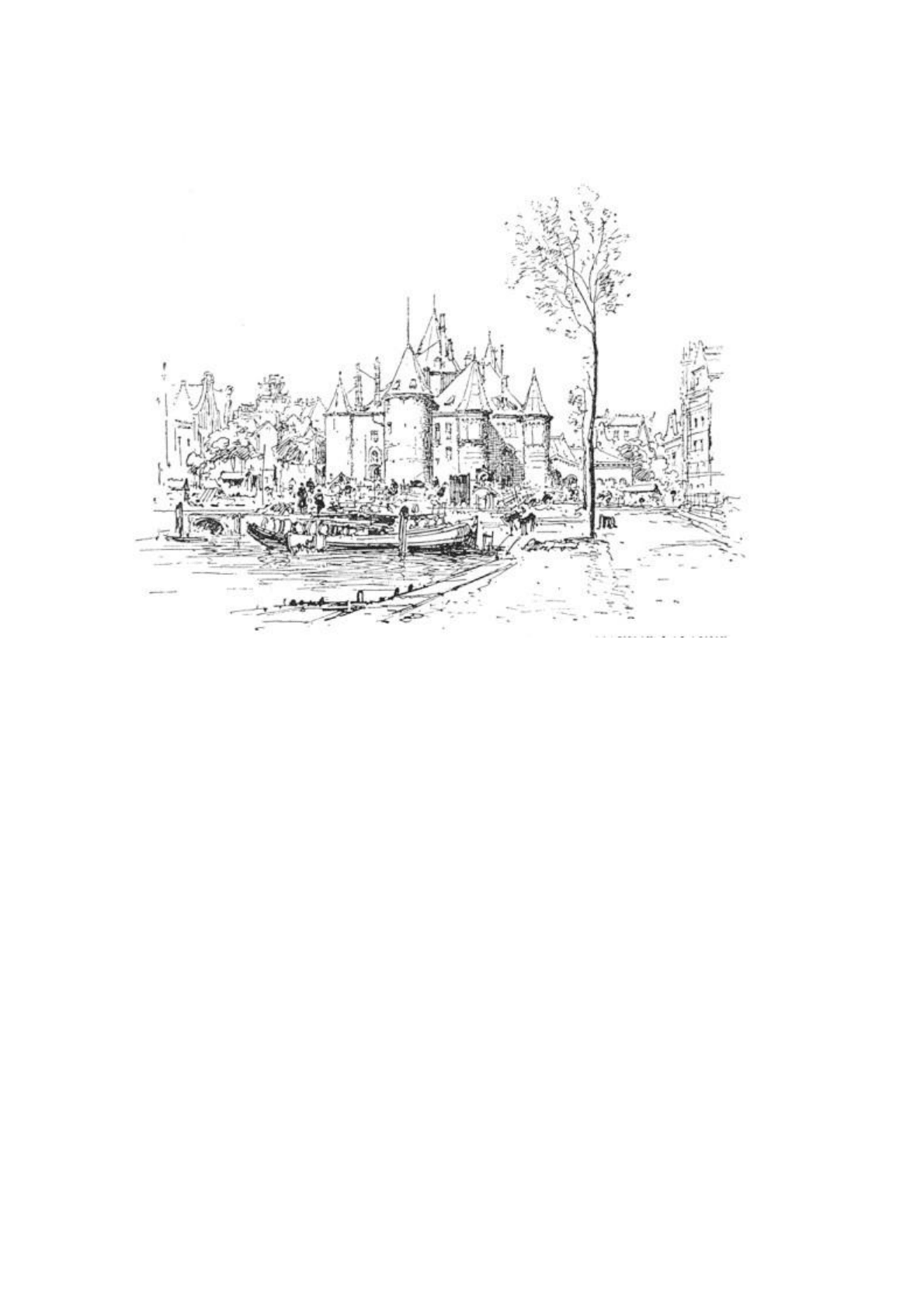
intensified the whites and lighted up the picture. Fig. 3, by the same artist, is even more notable
by reason of the masterly breadth which characterizes the treatment of a most complicated
subject. A comparison of these with a drawing of the Restoration House, at Rochester, England,
Fig. 4, is instructive. In the latter the method is almost painfully elaborate; nothing of the effect
is obtained by suggestion. The technique is varied and interesting, but the whole drawing lacks
that individual something which we call Style. In the Lalanne drawings we see foliage
convincingly represented by means of the mere outlines and a few subtle strokes of the pen.
There is no attempt at the literal rendering of natural objects in detail, all is accomplished by
suggestion: and while I do not wish to be understood as insisting upon such a severely simple
style, much less upon the purist theory that the function of the pen is concerned with form alone,
I would impress upon the student that Lalanne's is incomparably the finer manner of the two.
FIG. 3
MAXIME LALANNE
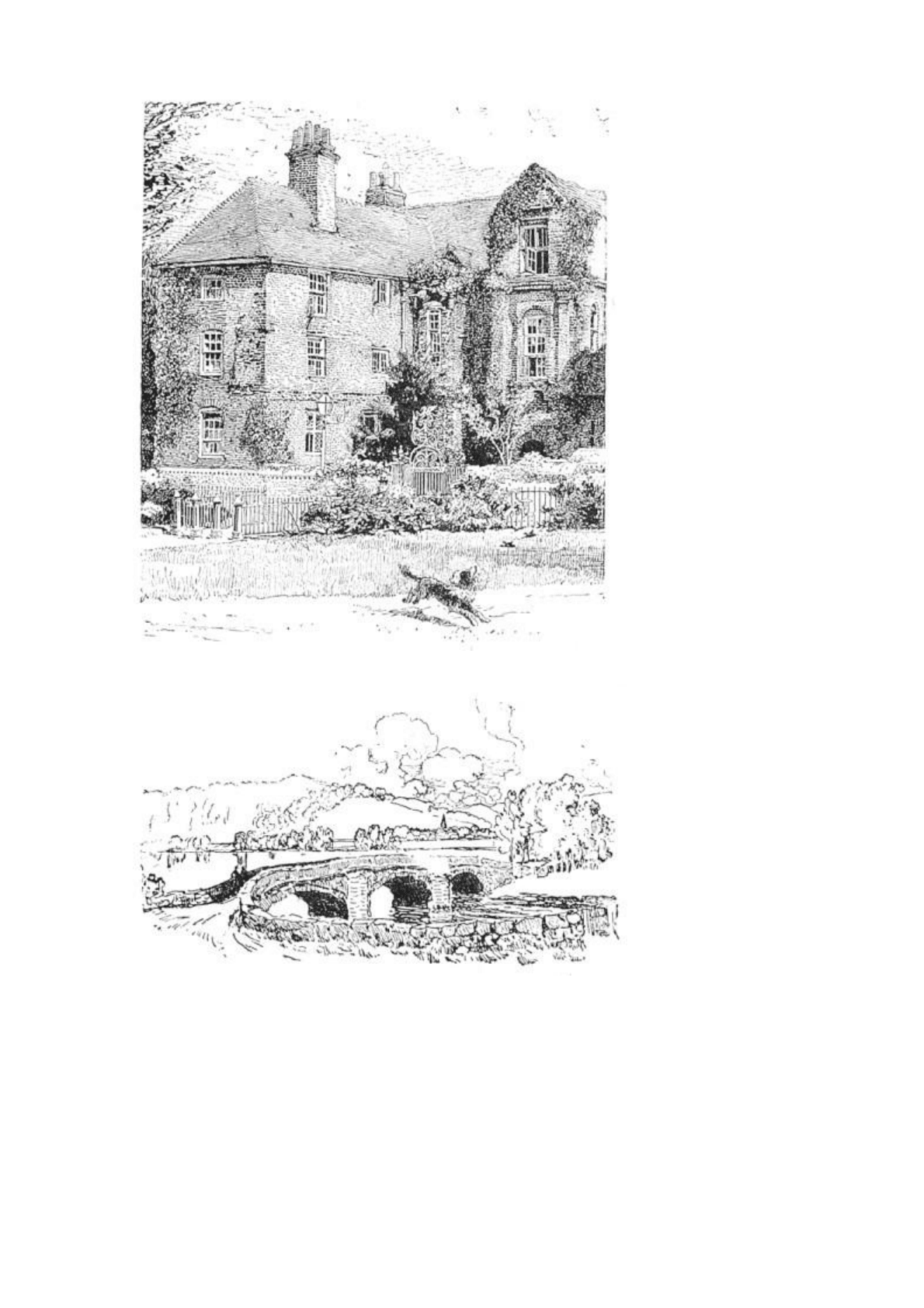
FIG. 4
FROM A PHOTOGRAPH
FIG. 5
JOSEPH PENNELL
A Word of Advice Between these two extremes of method there is a wide latitude for individual
choice. Contrast with the foregoing the accompanying pen drawing by Mr. Pennell, Fig. 5,
which gives a fair idea of the manner of this admirable stylist. Compared with the sketches by
Lalanne it has more richness of color, but there is the same fine restraint, the same nice regard
for the instrument. The student will find it most profitable to study the work of this masterly
penman. By way of warning, however, let me remind him here, that in studying the work of any
accomplished draughtsman he is selecting a style for the study of principles, not that he may
learn to mimic somebody, however excellent the somebody may be; that he must, therefore, do a
little thinking himself; that he has an individuality of his own which he does not confess if his

work looks like some one's else; and, finally, that he has no more right to consciously
appropriate the peculiarities of another's style than he has to appropriate his more tangible
property, and no more reason to do so than he has to walk or talk like him.
CHAPTER II
MATERIALS
Every illustrator has his special predilections in the matter of materials, just as he has in the
matter of methods. The purpose of this chapter is, therefore, rather to assist the choice of the
student by limiting it than to choose for him. It would be advisable for him to become
acquainted with the various materials that I may have occasion to mention (all of them are more
or less employed by the prominent penmen), and a partiality for particular ones will soon
develop itself. He is reminded, however, that it is easily possible to exaggerate the intrinsic
values of pens and papers; in fact the beginner invariably expects too much from them. Of
course, he should not use any but the best,—even Vierge could not make a good drawing with a
bad pen,—but the artistic virtues of a particular instrument are not likely to disclose themselves
in the rude scratchings of the beginner. He has to master it, to "break it in," ere he can discover
of what excellent service it is capable.
Pens The student will find that most of the steel pens made for artists have but a short period
of usefulness. When new they are even more unresponsive than when they are old. At first they
are disposed to give a hard, wiry line, then they grow sympathetic, and, finally, lose their
temper, when they must be immediately thrown away. As a general rule, the more delicate
points are better suited to the smooth surfaces, where they are not likely to get tripped up and
"shaken" by the roughness in the paper.
To begin with the smaller points, the "Gillott Crow-quill" is an excellent instrument. The
normal thickness of its line is extremely small, but so beautifully is the nib made that it will
respond vigorously to a big sweeping stroke. I say a "sweeping stroke," as its capacity is not to
be taxed for uniformly big lines. An equally delicate point, which surpasses the crow-quill in
range, is "Gillott's Mapping-pen." It is astonishing how large a line may be made with this
instrument. It responds most nimbly to the demands made upon it, and in some respects reminds
one of a brush. It has a short life, but it may be a merry one. Mr. Pennell makes mention of a
pen, "Perry's Auto-Stylo," which seems to possess an even more wonderful capacity, but of this I
cannot speak from experience. A coarser, but still a small point, is the "Gillott 192"—a good pen
with a fairly large range; and, for any others than the smooth papers, a pen smaller than this will
probably be found undesirable for general use. A shade bigger than this is the "Gillott 303," a
very good average size. Neither of these two possesses the sensitiveness of those previously
mentioned, but for work demanding more or less uniformity of line they will be found more
satisfactory. The smaller points are liable to lead one into the quagmire of finicalness. When we
get beyond the next in size, the "Gillott 404," there is nothing about the coarse steel points to
especially commend them for artistic use. They are usually stupid, unreliable affairs, whose
really valuable existence is about fifteen working minutes. For decorative drawing the ordinary
commercial "stub" will be found a very satisfactory instrument. Of course one may use several
sizes of pens in the same drawing, and it is often necessary to do so.
Before leaving the steel pens, the "double-line pen" may be mentioned, though it has only a
limited sphere. It is a two-pointed arrangement, practically two pens in one, by means of which
parallel lines may be made with one stroke. Rather interesting effects can be obtained with it, but