
Chen C.J. Physics of Solar Energy
Подождите немного. Документ загружается.


i
i
“ChenSolarEnergy” — 2011/5/17 — 17:56 — page 264 — #291
i
i
i
i
i
i
264 Energy Storage
Anion Negative ion — after gaining electron(s).
Cation Positive ion — after losing electron(s).
Anode Oxidation takes place. During charge, it is the positive electrode (PE). During
discharge, it is the negative electrode (NE).
Cathode Reduction takes place. During charge, it is NE. During discharge, it is PE.
Electrolyte Typically an ionic conducting liquid.
Figure 12.7(a) shows the discharging process. By connecting the cell to an external
load, electrons flow from the negative electrode (NE), the anode, which is oxidized,
through the external load to the positive electrode (PE), the cathode, where the elec-
trons are accepted and the cathode material is reduced. The electric circuit is completed
in the electrolyte by the flow of anions (negative ions) and cations (positive ions) to
the anode and cathode, respectively.
Figure 12.7(b) shows the charging process. An external DC power supply is con-
nected to the battery. The external electrical field forces electrons to flow into the
negative electrode (NE), where reduction takes place. On the other hand, oxidation
takes place at the positive electrode (PE), where the electrons flow out from. As the
anode is, by definition, the electrode at which oxidation occurs and the cathode the
one where reduction takes place, the positive electrode is the anode and the negative
electrode is the cathode.
12.3.2 Lead–Acid Batteries
To date, the most widely used rechargeable battery is the lead–acid battery. Every
automobile should have one with six cells. For a fully charged lead–acid battery, the
positive electrode is made of PbO
2
and the negative electrode is made of pure lead. The
electrolyte is diluted sulfuric acid. After discharging, both the positive electrode and
the negative electrode become PbSO
4
. Sulfuric acid is thus consumed. By measuring
the specific gravity of the electrolyte, and thus the concentration of sulfuric acid, the
state of discharging, thus the energy remaining, can be determined.
The electrochemistry is as follows. During discharging, at the positive electrode,
PbO
2
is reduced,
PbO
2
+H
2
SO
4
+2e
−
−→ PbSO
4
+2OH
−
. (12.18)
At the negative electrode, lead is oxidized,
Pb + H
2
SO
4
−→ PbSO
4
+2H
+
+2e
−
. (12.19)
During charging, at the positive electrode, PbSO
4
is oxidized,
PbSO
4
+2OH
−
−→ PbO
2
+H
2
SO
4
+2e
−
. (12.20)

i
i
“ChenSolarEnergy” — 2011/5/17 — 17:56 — page 265 — #292
i
i
i
i
i
i
12.3 Rechargeable Batteries 265
At the negative electrode, PbSO
4
is reduced,
PbSO
4
+2H
+
+2e
−
−→ Pb + H
2
SO
4
. (12.21)
Lead is a heavy and toxic metal. Sulfuric acid is a dangerous liquid. The lifetime is
short (300 cycles). Therefore, it is not suitable for portable devices and automobiles.
However, since lead is intrinsically an inexpensive metal and can be recycled, the overall
cost is low. It is expected that such batteries will still be extensively used in the
foreseeable future, for example, as energy storage devices in remote areas or in the
basements of residential buildings to store solar electricity.
12.3.3 Nickel Metal Hydride Batteries
In recent decades, nickel metal hydride rechargeable batteries have been widely used in
automobiles and relatively large portable electronic devices. The positive electrode is
nickel hydroxide, and the negative electrode is an intermetallic compound. The most
common metal has the general form AB
5
, where A is a mixture of rare earth elements,
lanthanum, cerium, neodymium, praseodymium and B is nickel, cobalt, manganese,
and aluminum.
The electrochemistry is as follows. During discharging, at the positive electrode,
NiOOH is reduced,
NiOOH + H
2
O+e
−
−→ Ni(OH)
2
+OH
−
. (12.22)
At the negative electrode, metal hyride is oxidized,
MH + OH
−
−→ M+H
2
O+e
−
. (12.23)
During charging, at the positive electrode, Ni(OH)
2
is oxidized,
Ni(OH)
2
+OH
−
−→ NiOOH
+
H
2
O+e
−
. (12.24)
At the negative electrode, metal is reduced,
M+H
2
O+e
−
−→ MH + OH
−
. (12.25)
When overcharged at low rates, the oxygen produced at the positive electrode passes
through the separator and recombines at the surface of the negative. Hydrogen evolu-
tion is suppressed and the charging energy is converted to heat. This process allows
NiMH cells to remain sealed in normal operation and to be maintenance free.
NiMH batteries have been applied extensively in electric automobiles, such as the
General Motors EV1, Honda EV Plus, Ford Ranger EV, and Vectrix Scooter. Hy-
brid vehicles such as the Toyota Prius, Honda Insight, Ford Escape Hybrid, Chevrolet
Malibu Hybrid, and Honda Civic Hybrid also use them. NiMH technology is used
extensively in rechargeable batteries for consumer electronics.

i
i
“ChenSolarEnergy” — 2011/5/17 — 17:56 — page 266 — #293
i
i
i
i
i
i
266 Energy Storage
12.3.4 Lithium-Ion Batteries
Currently the lithium ion battery is the most rapidly developing energy storage device.
Soon after its invention in 1991, the CoO
2
–Li ion battery became the predominant
power source for small portable electronics such as mobile phones, digital cameras,
and laptop computers. It is widely believed to be the best candidate for powering
automobiles because it has the highest specific energy and the longest lifetime; see
Table 12.4.
In some sense, the electrochemistry of Li ion batteries is the simplest. The only ion
involved is the lithium cation, Li
+
. It has the smallest radius and the highest standard
potential, -3.01 eV. The negative electrode is made of graphite, where the small Li ion
intercalates into the space between adjacent sheets of grapheme. The positive electrode
is a transition metal oxide, where the base metal can have different valence states to
allow the lithium atom to join in or leave out.
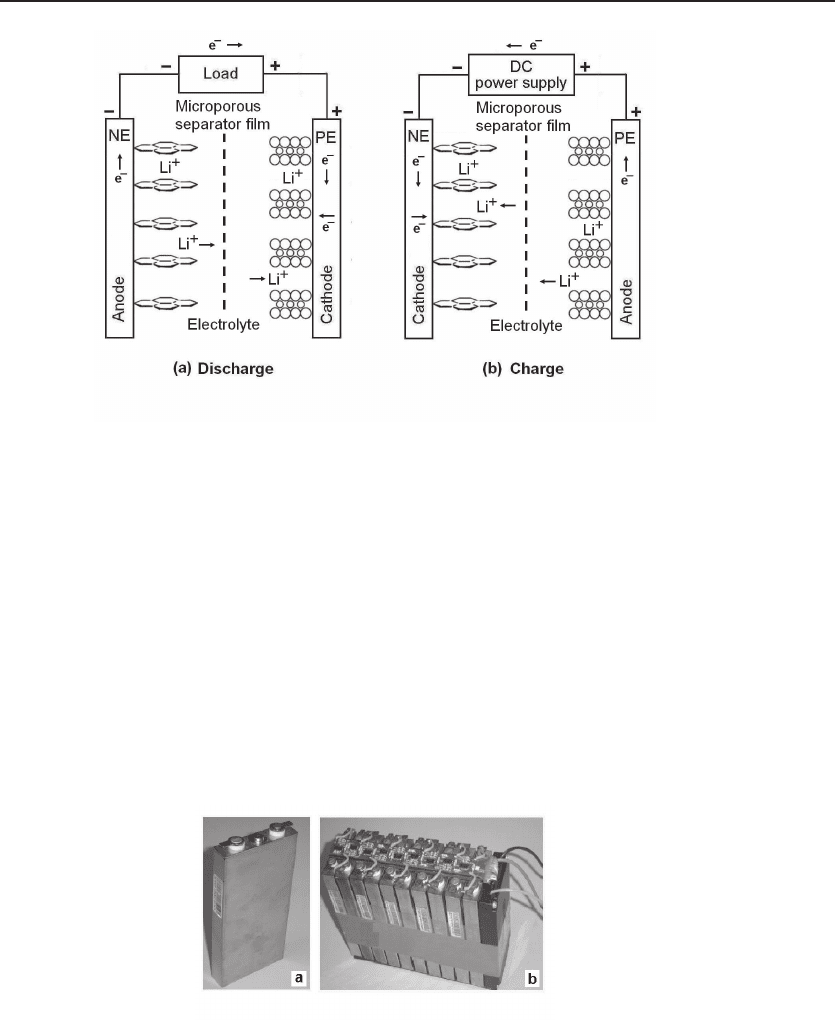
Figure 12.8 shows the electrochemical processes in a Li ion cell. When fully charged,
most of the lithium ions are buried in the planes of graphite. During the discharging
process, as shown in Fig. 12.8(a), the lithium ions leave the negative electrode, drift
through the electrolyte, pass the microporous separation film, and combine with the
metal oxide in the positive electrode. At the end of the discharging process, most of the
lithium ions are combined with the metal oxide in the positive electrode. During the
charging process, as shown in Fig. 12.8(b), the lithium ions are forced by the external
voltage to leave the metal oxide, drift through the electrolyte, pass the microporous
separation film, and are intercalated into graphite.
Most Li ion batteries for small electronic devices, such as cell phones and digital
cameras, use CoO
2
as the basis of the positive electrode. During discharging, at the
positive electrode, the lithium ion is combined with CoO
2
,
Li
1−x
CoO
2
+ x Li
+
+ x e
−
−→ LiCoO
2
. (12.26)
At the negative electrode, lithium ions are extracted,
Li
x
C
6
−→ C
6
+ x Li
+
+ x e
−
. (12.27)
During charging, at the positive electrode, lithium ions are extracted,
LiCoO
2
−→ Li
1−x
CoO
2
+ x Li
+
+ x e
−
. (12.28)
At the negative electrode, lithium ions are intercalated into graphite
C
6
+ x Li
+
+ x e
−
−→ Li
x
C
6
. (12.29)
In the above reactions, 0 ≤ x<1 is the fraction of lithium ion reacted.
The CoO
2
-based Li ion battery has very high specific energy. For applications
where weight is an important factor, it is preferred. However, cobalt is expensive. In
addition, it has been recorded that for large-size CoO
2
-based Li ion batteries, explosion
has occurred. For power applications, Li ion batteries based on manganese oxide and
iron phosphate are more preferred.
i
i
“ChenSolarEnergy” — 2011/5/17 — 17:56 — page 267 — #294
i
i
i
i
i
i
12.3 Rechargeable Batteries 267
Figure 12.8 Electrochemical processes in a Li ion cell. (a) during discharging, lithium ions
leave the negative electro d e, drift through the electrolyte, pass the microporous separation film, and
combine with the metal oxide in the positive electrode. (b) during charging, lithium ions are forced
by the external voltage to leave the metal oxide and intercalated into graphite.
LiFePO
4
was discovered by John Goodenough’s research group at the University of
Texas in 1996 as a material for the positive electrode of Li ion batteries. Because of its
low cost, nontoxicity, high abundance of iron, excellent thermal stability, safety char-
acteristics, good electrochemical performance, and high specific capacity (170 mA·h/g,
or 610 C/g), it gained acceptance in the marketplace.
While LiFePO
4
cells have lower voltage and energy density than LiCoO
2
Li ion cells,
this disadvantage is offset over time by the slower rate of capacity loss (aka greater
calendar life) of LiFePO
4
when compared with other lithium ion battery chemistries.
For example, after one year on the shelf, a LiFePO
4
cell typically has approximately
Figure 12.9 Power Li ion batteries. (a) Single Li ion battery with nominal voltage of 3.7 V. (b)
With 10 Li ion batteries connected in series, the nominal voltage is 37 V. Photo taken by the author.
Courtesy of Phylion Battery Co., S¯uzh¯ou, China.

i
i
“ChenSolarEnergy” — 2011/5/17 — 17:56 — page 268 — #295
i
i
i
i
i
i
268 Energy Storage
the same energy density as a LiCoO
2
Li ion cell. Beyond one year on the shelf, a
LiFePO
4
cell is likely to have higher energy density than a LiCoO
2
Li ion cell due to
the differences in their respective calendar lives.
The basic electrochemistry of the LiFePO
4
battery is as follows. Iron has two
oxidation states, Fe(II) and Fe(III). The Fe(III) compounds are often strong oxidizers.
For example, the standard method of etching copper to make printed circuit boards is
to use FeCl
3
,
2FeCl
3
+Cu−→ 2FeCl
2
+CuCl
2
. (12.30)
Therefore, both FePO
4
and LiFePO
4
are stable compounds. Because the lithium ion
is very small, these two compounds has negligible differences in volume per mole and
share the same crystallographic structure.
The charging and discharging processes are as follows. In a fully charged LiFePO
4
battery, the positive electrode is mostly FePO
4
, and graphite in the negative electrode
is filled with lithium atoms. During discharging, at the positive electrode, the lithium
ions are squeezed into FePO
4
,
FePO
4
+Li
+
+e
−
−→ LiFePO
4
. (12.31)
At the negative electrode, lithium ions are extracted from graphite,
LiC
6
−→ C
6
+Li
+
+e
−
. (12.32)
During charging, at the positive electrode, lithium ions are extracted from iron phos-
phate,
LiFePO
4
−→ FePO
4
+Li
+
+e
−
. (12.33)
At the negative electrode, lithium ions are intercalated into graphite,
C
6
+Li
+
+e
−
−→ LiC
6
. (12.34)
12.3.5 Mineral Resource of Lithium
As Li ion batteries become a major component of automobiles in the future, the problem
of the mineral resource of lithium is currently of interest. First, let us estimate how
much lithium is needed to equip all the automobiles in the world, and then compare it
with the known mineral resources.
The atomic weight of lithium is 6.94 g/mol. Each mol of lithium has 96,490 coulombs
of electrical charge. The working voltage of the Li ion battery is 3.5 V. Therefore, the
specific capacity of lithium is
P =
96490 × 3.5
3600 × 6.94
=13.5 kWh/kg. (12.35)
If each car needs a battery of 30 kWh capacity, then 2.2 kg of lithium is sufficient.
Currently, there are 600 million cars in the world. The total amount of lithium required
is then 1.32 million tons.

i
i
“ChenSolarEnergy” — 2011/5/17 — 17:56 — page 269 — #296
i
i
i
i
i
i
12.4 Solar Energy and Electric Vehicles 269
According to the 2009 U.S. Geological Survey [2], the world’s total verified lithium
reserve base is 11 million tons, which could equip all the cars in the world many times.
Recently, according to New York Times [71], a huge amount of lithium deposition was
found in Afghanistan. According to an internal Pentagon report, Afghanistan could
become the “Saudi Arabia of lithium.” Because currently most of the lithium resource is
from the concentrated brine in high-altitude saline lakes, the discovery in Afghanistan
is not surprising.
12.4 Solar Energy and Electric Vehicles
According to the Energy Information Administration, in the United States, transporta-
tion uses 26.5% of the total energy, or 67.6% of the petroleum. To reduce the use of
fossil energy, the transition to electric cars using rechargeable batteries, especially using
Li ion batteries as storage medium and solar energy as the source, is the best approach.
Electric cars have many desirable features:
• The intrinsic efficiency of electric motors is very high, typically 90%.
• The round-trip efficiency of energy storage in rechargeable batteries, especially
Li ion batteries, is very high, typically around 90%.
• The mechanical structure of electric cars is much simpler than either the Otto
engine cars or the diesel engine cars.
• The regenerative brake can be implemented naturally. Actually, the efficiency
enhancement of hybrid cars, such as the Toyota Prius, is mainly due to the
regenerative brake.
• As battery technology is progressing rapidly, the manufacturing cost of electric
cars will decrease rapidly.
• They can make a natural connection to solar electricity.
Table 12.5: Efficiency of Several Automobiles.
Automobile Miles per Gallon km/kWh kWh/km
BMW hydrogen car 10 0.45 2.24
Rangerover 20 0.89 1.19
Toyota Camry 32 1.43 0.70
Toyota Prius 55 2.46 0.41
Chevy Volt 150 6.67 0.15
Source: Sustainable Energy – without hot air, David J. C. MacKay [56].
i
i
“ChenSolarEnergy” — 2011/5/17 — 17:56 — page 270 — #297
i
i
i
i
i
i
270 Energy Storage
• They are virtually noise free.
Let us first examine some technical data. In the United States, the efficiency of cars
is measured by miles per gallon of gasoline, or mpg. Ine SI units, the most convenient
measure is either kilometers per kilowatt-hours of energy, or the energy in kilowatt-
hours required to drive 1 km. Because the energy content of gasoline is approximately
1.3×10
8
J/gallon and one mile is 1.609 km, a simple calculation gives 1 km/kWh =
22.37 mpg. Table 12.5 gives the measured data for several popular cars.
For several decades, hydrogen and fuel cell has been considered as an alternative
to the Otto engine and the diesel engine for automobiles. Grandiose expressions such
as the hydrogen age, hydrogen economy, and hydrogen era have been used. However,
according to an analysis by Joseph J. Romm [74], a deputy energy secretary during
the Clinton administration in charge of hydrogen projects, based on his hands-on ex-
perience, in the foreseeable future the use of hydrogen will not become a commercially
viable method of energy storage. It is prohibitively expensive and notoriously dan-
gerous. It is especially unsuitable for automobiles, because the density of storage of
the highly compressed hydrogen is only one tenth that of gasoline. Besides, fuel cells
have low efficiency (compared with rechargeable batteries) and low lifetime and use
expensive precious metals.
In the future, solar photovoltaics will become the main source of electricity, a tech-
nology that works well with electric cars. In particular, solar photovoltaics can charge
the batteries in electric cars without going through the grid. This approach has in-
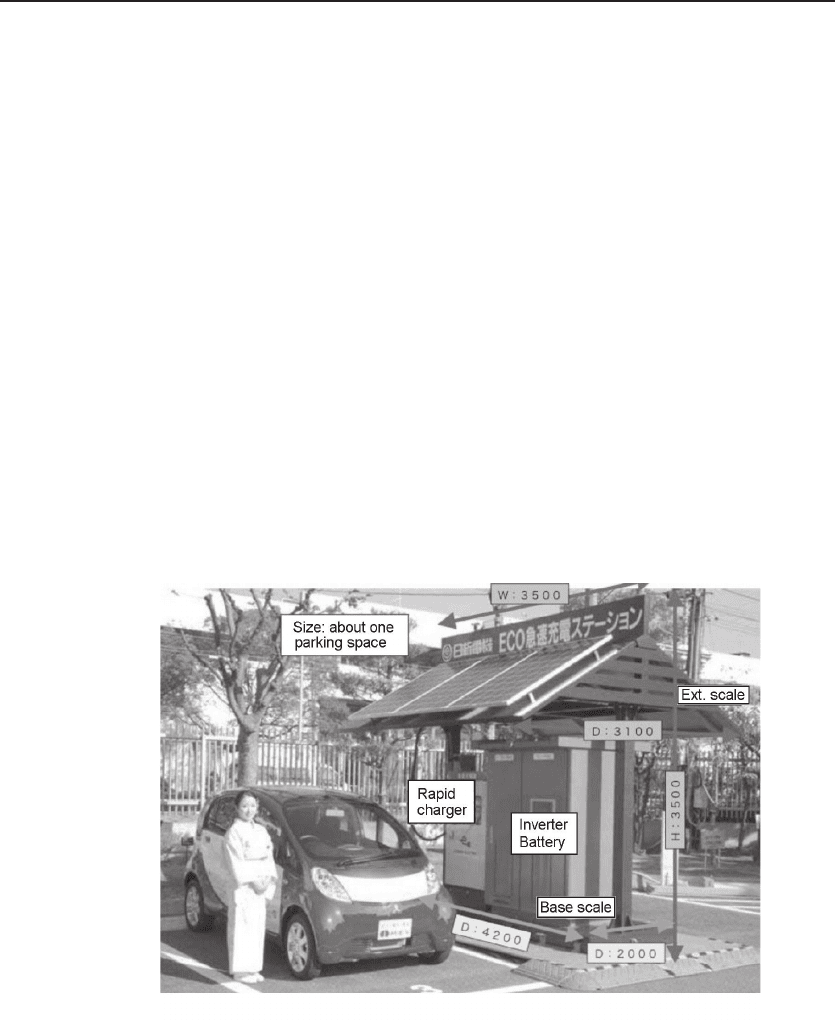
Figure 12.10 Solar-powered electric car charging station in Kyoto. The charging station,
supplied by Nissin Electric Co., has a battery pack, an inverter, and a rapid charging setup. Courtesy
of Kyoto University.

i
i
“ChenSolarEnergy” — 2011/5/17 — 17:56 — page 271 — #298
i
i
i
i
i
i
12.4 Solar Energy and Electric Vehicles 271
Figure 12.11 Solar-powered electric car charging station in Tennessee. In the United States,
taking another step in building its electric vehicle charging infrastructure, Tennessee is now home to
the first of several solar-powered EV-charging stations [10].
herent advantages. It avoids the cost and energy loss due to the DC–AC inverter and
the AC–DC inverter. Furthermore, the intermittency of solar energy is no longer a
disadvantage because to charge batteries a very stable power source is not required.
The advantage of solar-powered battery charger can be further improved by using the
battery-swap procedure: Spare batteries are charged when there is sunlight. A car with
a depleted battery can come to the charging station to swap for a fully charged one
in a few minutes, probably even faster than filling the gas tank. Figure 12.10 shows
a solar-powered electric car charging station in the city of Kyoto supplied by Nissin
Electric Co. It has a battery pack, an inverter, and a rapid charging setup.
In the United States, both General Motor and Nissan will mass-produce electric
cars, Chevy Volt and Nissan Leaf, in the state of Tennessee. Therefore, it makes
sense for people in Tennessee to start laying a plug-in groundwork. That has already
happened in Pulaski, Tennessee. In August 2010, the first solar parking lot opened —
that is, parking spaces with an electric vehicle charger that is powered by solar energy;
see Fig. 12.11. At the opening ceremony, after remarks highlighting American energy
independence and job creation, Congressman Lincoln Davis switched on the array,
sending the sun’s energy into the grid. It was stated that “All the components are
American made. It is an example of how American small business and manufacturing
are growing in the new green economy [10].”
i
i
“ChenSolarEnergy” — 2011/5/17 — 17:56 — page 272 — #299
i
i
i
i
i
i
272 Energy Storage
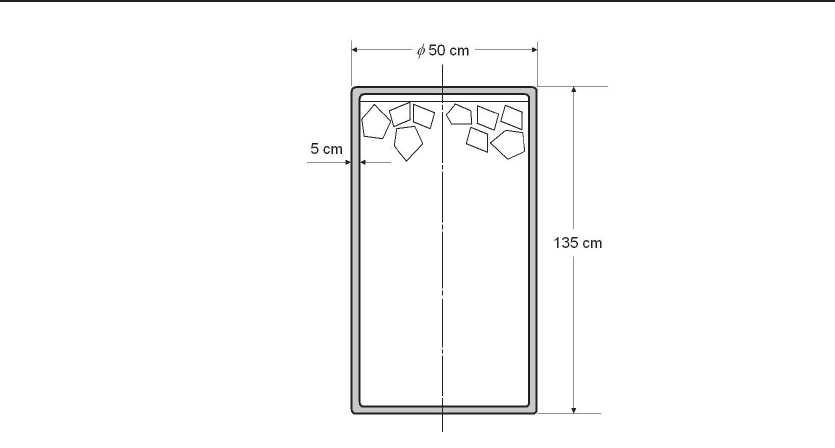
Figure 12.12 A typical domestic hot water tank.
Problems
12.1. A typical domestic hot water tank has a dimension of diameter D =50cmand
height H = 135 cm, with a τ = 5 cm thick insulation made of rigid foam polyimide, see
Figure 1. If the difference of the external and internal temperatures is 45
◦
C, what is the
energy loss of this tank in watts? (The thermal conductivity of rigid foam polyimide
is k = 0.026 W/(m
◦
C).)
12.2. By storing hot water in that tank at 65
◦
C and the environment temperature is
20
◦
C, how long it takes to cool the water temperature down by 1
◦
C?
12.3. By storing ice at 0
◦
C in that insulated tank, with external temperature of 25
◦
C,
how long it takes for all the ice to melt? (The latent heat of ice is 335 kJ/liter.)

i
i
“ChenSolarEnergy” — 2011/5/17 — 17:56 — page 287 — #314
i
i
i
i
i
i
Appendix A
Energy Unit Conversion
Because energy is one of the most important quantities, there are many energy units
which often creates confusion. Throughout this book, we used the SI units for all
physical quantities. The SI unit of energy is joule, defined as the energy capable of
pushing an object with one newton of force by one meter:
J=N· m. (A.1)
The basic SI unit of power, the watt, equals one joule per second,
W=J/s. (A.2)
The most frequently used units of energy and power are listed in Table A.1.
Electrical power is the product of the current in amperes and voltage in volts:
W=A· V. (A.3)
Utility companies often use an energy unit derived from electrical power, the kilowatt-
hour, or kWh:
1 kWh = 3600 kJ = 3.6MJ. (A.4)
Table A.1: Energy and Power Units
Name Symbol Equals
Kilojoule kJ 10
3
J
Megajoule MJ 10
6
J
Gigajoule GJ 10
9
J
Etajoule EJ 10
18
J
Kilowatt kW 10
3
W
Megawatt MW 10
6
W
Gigawatt GW 10
9
W
Terawatt TW 10
12
W
287
Physics of Solar Energy C. Julian Chen
Copyright © 2011 John Wiley & Sons, Inc.