
Chen C.J. Physics of Solar Energy
Подождите немного. Документ загружается.

i
i
“ChenSolarEnergy” — 2011/5/17 — 17:56 — page 243 — #270
i
i
i
i
i
i
11.4 Solar Thermal Power Systems 243
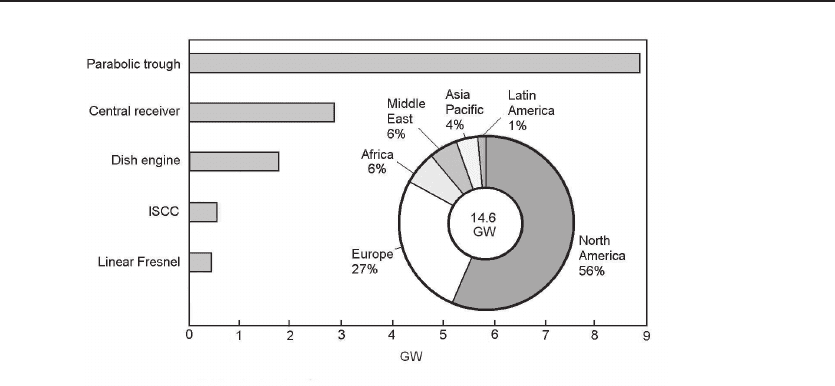
Figure 11.18 Accumulated installation of concentration solar power systems. Installation
of these systems up to 2009, including parabolic trough, central receiver with heliostats, paraboloidal
dish, ISCC, and CLFR systems [88].
where T
L
is the temperature of the cold reservoir and T
H
is the temperature of the
hot source. In order to improve efficiency, the temperature of the hot source should be
as high as possible. Since T
L
cannot be lower than the atmospheric temperature, on
average 300 K, in order to achieve an efficiency of 50%, T
H
should at least be 600 K,
or 327
◦
C. Without concentration, the temperature can hardly reach 150
◦
C.
To achieve such a high temperature, concentration of solar radiation is a necessity.
Three commonly used configurations for stand-alone solar thermal power systems were
developed in the 1970s: the parabolic trough concentration system, a system of a central
receiver with heliostats, and the paraboloidal dish concentration system. Recently, the
Integrated Solar Combined Cycle (ISCC) system has attracted much attention. The
Compact Linear Fresnel Reflector (CLFR) system, suitable for the ISCC system, has
observed a rapid development. Figure 11.18 shows the accumulated installation of those
systems up to 2009 [88].
11.4.1 Parabolic Trough Concentrator
As shown in Fig. 11.18, to date, about two-thirds of electricity generated by concen-
trated solar thermal power plants is from parabolic trough systems. The structure of
the system is shown in Plate 11. Parabolic mirrors are mounted on an axis to track
the Sun. At the focal line of the parabolic mirrors is a linear collector, typically a
high-temperature evacuated tube. See Plate 11.
To date, the largest solar power plants are the Solar Energy Generating Systems
(SEGS) in the California Mojave Desert. The nine SEGS power plants built between
1984 and 1990 have a total capacity of 354 MW. The total area of the 232,500 parabolic
mirrors is 6.5 km
2
, with a total length of 370 km. The sunlight bounces off the mirrors
i
i
“ChenSolarEnergy” — 2011/5/17 — 17:56 — page 244 — #271
i
i
i
i
i
i
244 Solar Thermal Energy
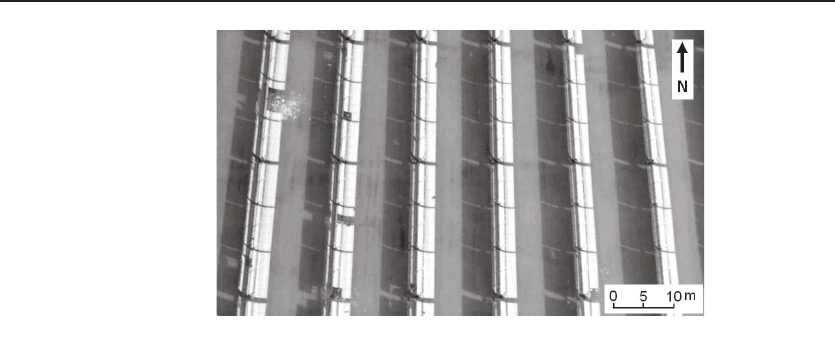
Figure 11.19 Aerial photo of SEGS system. The axes of the parabolic mirrors are north–
south, which turn from east to west every day. About 3000 mirrors are replaced each year because of
wind damage. Several damaged mirrors are shown in this photo. To avoid shadows from neighboring
mirrors, the distance between adjacent mirrors is about twice the width of the mirrors.
and is directed to a central tube filled with synthetic oil which heats to over 400
◦
C.
The reflected light focused at the central tube is 71 – 80 times more intense than
ordinary sunlight. The synthetic oil transfers its heat to water, which boils and drives
the Rankine cycle steam turbine, thereby generating electricity. Synthetic oil is used to
carry the heat (instead of water) to keep the pressure within manageable parameters.
See Plate 12.
Figure 11.19 is an aerial photo of the SEGS. The axis of the parabolic mirrors
is north–south, which turns from east to west every day. The most expensive parts
are the curved mirrors. Wind damage occurs frequently, and about 3000 mirrors are
replaced each year. The mirrors are periodically cleaned by a special machine. To
avoid shadows from neighboring mirrors, the distance between mirrors is about twice
the width of the mirrors. The cost of electricity from the SEGS is still not competitive
with coal-burning power plants.
11.4.2 Central Receiver with Heliostats
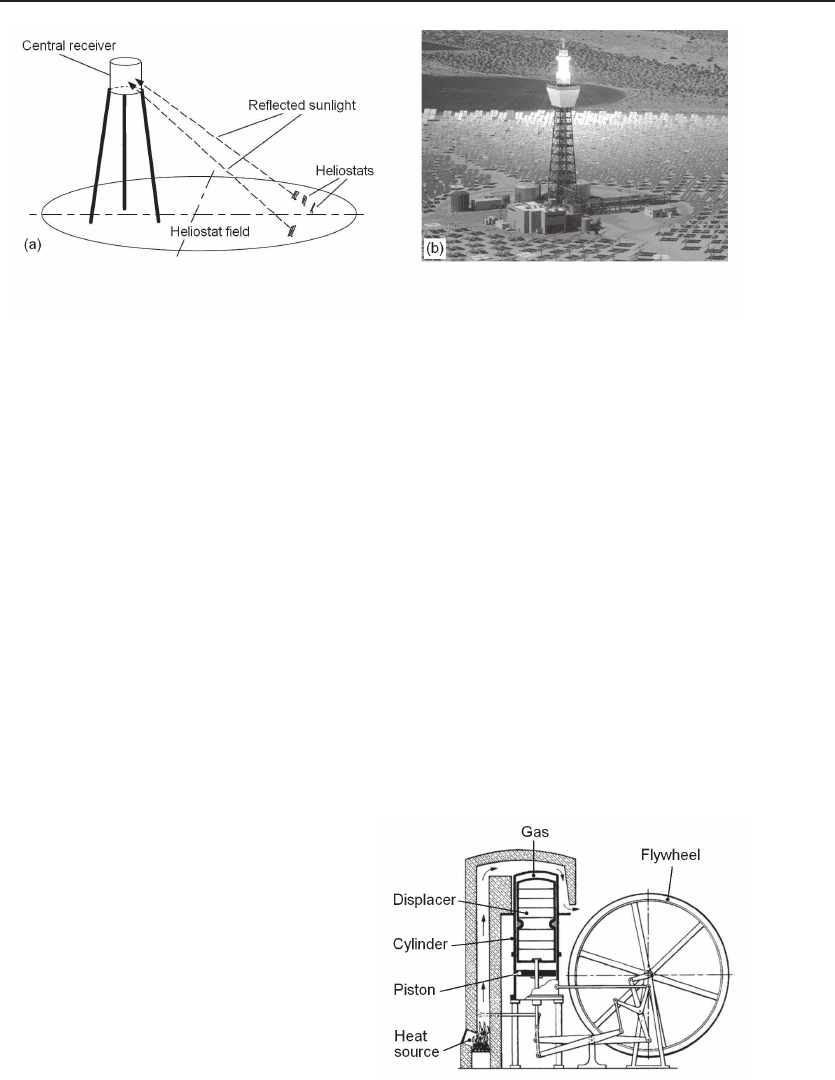
To achieve high power at a centralized receiver, hundreds or thousands of heliostats,
mirrors mounted on a two-dimensional shaft to track the position of the Sun by a
centralized computer distributed on a typically circular or oval field; see Fig. 11.20.
Because very high temperatures can be reached (e.g. 565
◦
C), superheated steam or
molten salt (e.g. 60% NaNO
3
+ 40% KNO
3
) is usually used as the working material.
Finally, it drives a standard Rankine cycle steam turbine to generate electrical power
[73].
The first pilot project, Solar One, in the Mojave Desert, was completed in 1981,
and was operational from 1982 to 1986. It has 1818 mirrors, each 40 m
2
. Oil or water
was used as the working fluid. An efficiency of 6% was demonstrated. A photo of Solar
i
i
“ChenSolarEnergy” — 2011/5/17 — 17:56 — page 245 — #272
i
i
i
i
i
i
11.4 Solar Thermal Power Systems 245
Figure 11.20 Solar power plant with central receiver. To achieve high power at a centralized
receiver, hundreds of heliostats are used, that is, mirrors mounted on a two-dimensional shaft to follow
the position of the Sun by a centralized computer. The temperature of the central receiver can reach
500
◦
Cormore.
One is shown in Fig. 11.19(b). In 1995, Solar One was upgraded to Solar Two. Molten
salt, 60% sodium nitride and 40% potassium nitride were used as the working material.
Ten megawatts of power is demonstrated, and its efficiency was improved to 16%. On
November 25, 2009, the Solar Two tower was demolished.
To be used as a stand-alone power plant, an energy storage system is required.
Latent heat of molten salt is used for energy storage. However, the cost per kilowatt-
hour is increased from $0.08 – $0.15 to $0.15 – $0.20 by adding the energy storage unit
[73].
11.4.3 Paraboloidal Dish Concentrator with Stirling Engine
The third type of concentration solar power plant is the paraboloidal dish concentrator
with Stirling engine, as shown in Plate 10. According to a report released by Sandia
National Laboratory in February 2008, the Stirling engine system has shown a solar-
Figure 11.21 Stirling engine. In-
vented in 1816 by Robert Stirling,
the engine without a valve is the sim-
plest heat engine. A fixed amount of
gas, typically hydrogen, is used as the
working medium. It can be driven
by a single heat source, with an effi-
ciency close to the Carnot limit. It is
the ideal heat engine driven by con-
centrated sunlight.
i
i
“ChenSolarEnergy” — 2011/5/17 — 17:56 — page 246 — #273
i
i
i
i
i
i
246 Solar Thermal Energy
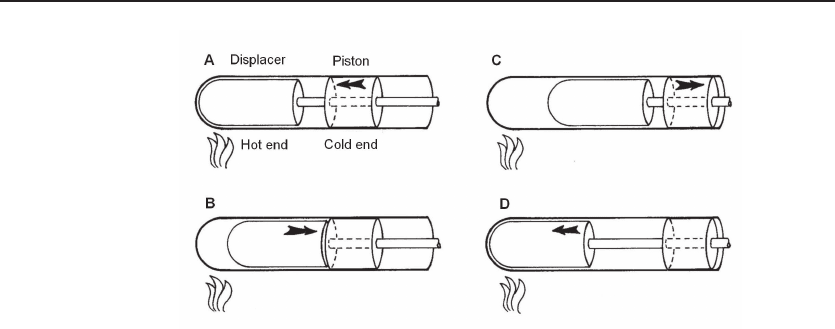
Figure 11.22 Working principle of Stirling engine. (A) The gas is cold, the displacer is in the
innermost position, and the piston pushes into the cylinder. (B) The hot source heats up the gas.
(C) The expanding hot gas pushes the piston outwards. (D) The displacer returns to the innermost
position and the gas is cooled by the surrounding.
to-grid energy conversion efficiency of 31.25%, the highest of any solar-to-electricity
conversions, recorded on a perfectly clear and cold New Mexico winter day [48].
The Stirling engine was invented in 1816 by Robert Stirling, a priest studying me-
chanical engineering as a hobby who built the first such engine in his home machine
shop. A schematic diagram of the Stirling engine is shown in Fig. 11.21. This engine
is different from the two popular heat engines, the steam engine and the internal com-
bustion engine. Similar to the steam engine, it uses an external heat source. However,
instead of constantly evaporating water into steam and then discarding it, the Stirling
engine uses a fixed body of gas in a closed cylinder. It is the simplest heat engine:
There are no valves. It can approach the Carnot efficiency. It can be operated by any
type of single heat source; thus concentrated sunlight is perfect. In Fig. 11.21, the
heat is provided by burning wood or coal. A piston is tightly fit in a cylinder which
drives a flywheel through a crankshaft. A gas displacer, loosely fit in the cylinder, is
driven by the crankshaft with a phase shift in the motion of the piston. The working
media, the gas, is always contained in the cylinder. The details of its working cycles are
shown in Fig. 11.22. During step (A), the gas is cold, the displacer is in the innermost
position, and the piston pushes into the cylinder. Then the hot source heats up the
gas in step (B). During step (C), the expanding hot gas pushes the piston outward.
Finally, step (D), the displacer returns to the innermost position, and the gas is cooled
by the surrounding.
In order to achieve effective operation, the gas must have high thermal conductivity.
The most frequently used gas is hydrogen. However, the diffusion coefficient of hydrogen
in steel is very high. Therefore, either a special material with low diffusion coefficient for
hydrogen is used to construct the cylinder or the hydrogen is periodically supplemented.
The Stirling engine is not suitable for vehicle applications because of its large volume
and the requirement of an effective cooling mechanism.
i
i
“ChenSolarEnergy” — 2011/5/17 — 17:56 — page 247 — #274
i
i
i
i
i
i
11.4 Solar Thermal Power Systems 247
11.4.4 Integrated Solar Combined Cycle
In previous sections, solar thermal power systems designed for stand-alone power sta-
tions were described. Because of the intermittent nature of solar energy, extensive
energy storage facilities are required, such as using sensible heat and latent heat dur-
ing phase transition as well as batteries. However, large-scale energy storage is very
expensive. Moreover, pure solar power plants often require special equipment, such as
the Stirling engine, DC–AC converters, or molten-salt heat transfer facilities.
A recent trend in the exploration of solar energy is not to compete with traditional
power stations, such as fossil-fuel-based boilers or nuclear-powered boilers, but to sup-
plement them. It is called Integrated Solar Combined Cycle ISCC. In this model, the
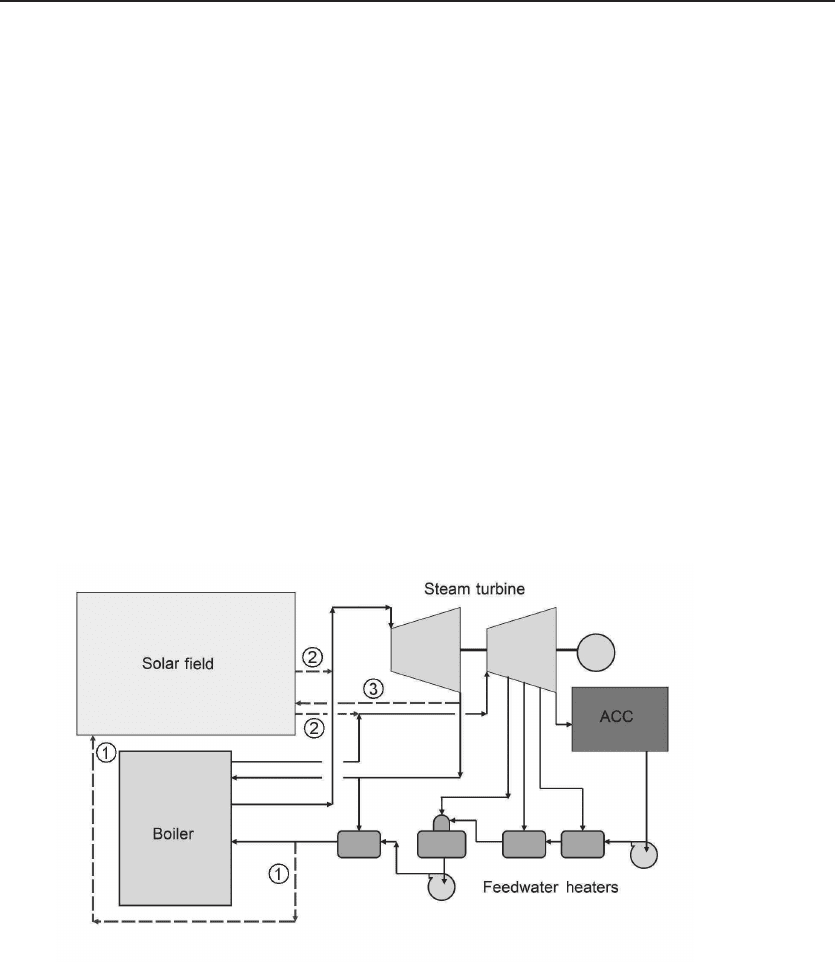
solar field is an addition to a traditional power plant, as shown in Fig. 11.23. The
solar field can take water as the input, heat it to generate superheated steam, then
supply the steam either at the maximum-temperature point (high-temperature opera-
tion), or a point with less than maximum temperature (medium- or low- temperature
operation); see Fig. 11.23.
A significant advantage of the ISCC is that the solar energy component is built
using a traditional, well-developed power generation technology with limited additional
investment while taking full advantage of the inclusion of solar energy. It is even
possible to retrofit an existing fossil fuel power plant by adding a solar component
without interrupting the operation of the power plant. Thus, the ISCC is a winning
Figure 11.23 Schematics of integrated solar combined cycle. By adding a solar field to a
traditional steam-turbine-based power station, a low-cost utilization of solar energy is created. In
a high-temperature ISCC implementation, the sunlight is utilized to generate superheated steam,
indicated by dashed lines in the Figure. (1) By feeding water to the solar field, superheated steam is
supplied to the turbines either at a high temperature, through path (2), or at a lower than maximum
tamperature, through path (3). After a report from Bechtel [84].
i
i
“ChenSolarEnergy” — 2011/5/17 — 17:56 — page 248 — #275
i
i
i
i
i
i
248 Solar Thermal Energy
combination for both traditional and solar plants in terms of reduced capital cost and
continuous power supply. Another advantage of the ISCC is that it produces energy
when most needed during peak times of the day and the year where air conditioners
are run at full capacity. Therefore, by adding a solar field, the nominal capacity of the
power plant can be substantially reduced for the same service in a given area. Since
2008, eight such power stations have been constructed, notably in northern Africa. The
percentage of solar power ranges from 5 to 20%.
11.4.5 Linear Fresnel Reflector (LFR)
The parabolic trough concentrator uses large, individually designed mirrors to form a
huge mechanical system. The cost of the mechanical system is high, and it is vulnerable
to wind damage. Cleaning and repair are also costly. A solution to this problem is
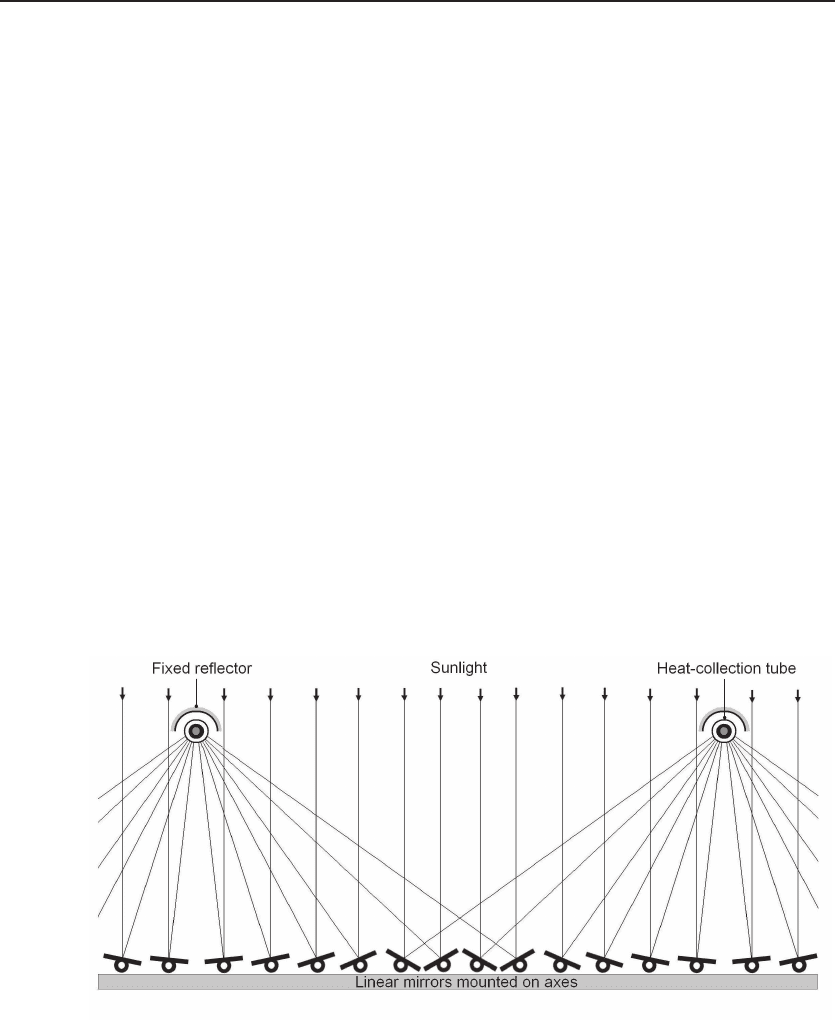
the linear Fresnel concentrator (LFR), see Fig. 11.24. Instead of using large, custom-
designed mirrors, long and narrow flat mirrors are used. These mirrors are mounted
on a one-dimensional axis, and turn individually to reflect the sunlight onto the small
linear concave mirror and then concentrated it onto the evacuated-tube absorber. The
heat transfer fluid is usually water, to generate superheated steam up to about 365
◦
C
directly to run the turbine. In such an arrangement, the mirrors can be placed very
close to the ground. There are several advantages. First, there are many linear receivers
in the system. If they are close enough, then individual reflectors have the option of
directing reflected solar radiation to at least two receivers. This additional variable in
reflector orientation allows much more densely packed arrays and lower absorber tower
heights, because patterns of alternating reflector orientation can be set up such that
Figure 11.24 Linear Fresnel reflector system. An array of linear (narrow and long) mirrors
mounted on an axis which can be rotated to align to the sunlight individually. The sunlight is further
concentrated by a small linear concave mirror to the evacuated-tube absorber.
i
i
“ChenSolarEnergy” — 2011/5/17 — 17:56 — page 249 — #276
i
i
i
i
i
i
11.4 Solar Thermal Power Systems 249
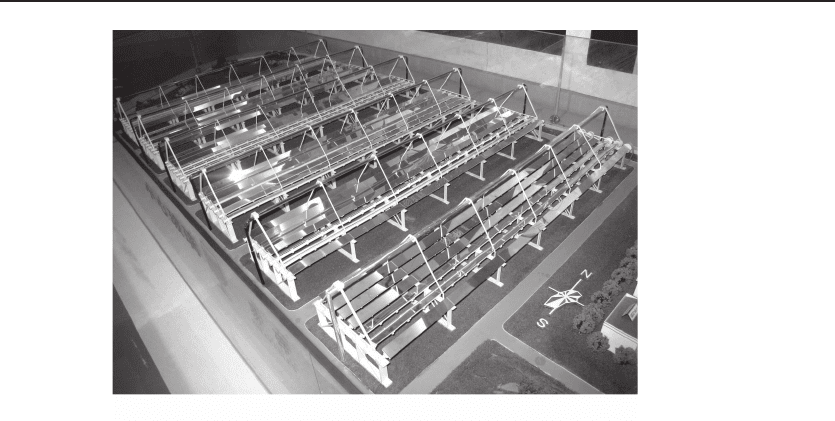
Figure 11.25 Linear Fresnel reflector system: a model. A model at the Himin Solar Energy
Museum, D´ezh¯ou, China. Photo taken by the author. Courtesy of Himin Solar Energy Group.
closely packed reflectors can be positioned without mutual blocking. The shadow effect
can be reduced, as shown in Fig. 11.24, and the efficiency of land usage is improved.
The mechanical structures are close to the ground, and the cost is substantially reduced.
Furthermore, cleaning and repair become much simpler than for the parabolic trough
system. Figure 11.25 is a model of a LFR system in Himin Solar Energy Museum,
D´ezh¯ou, China.
i
i
“ChenSolarEnergy” — 2011/5/17 — 17:56 — page 250 — #277
i
i
i
i
i
i
250 Solar Thermal Energy
Problems
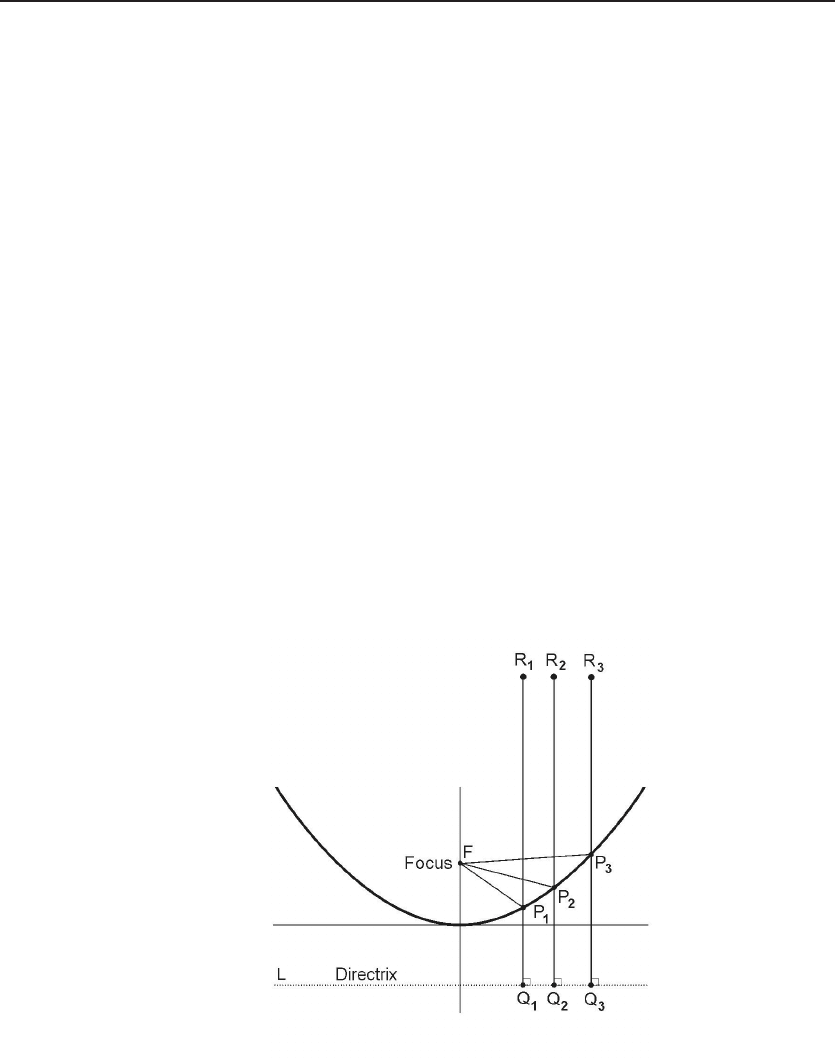
11.1. Based on the algebraic definition of a parabola, y = x
2
/4f, prove that a parabola
is the locus of equal distance from a focus to a directrix. See Fig. 11.26.
11.2. Using the geometric definition in Problem 11.1, prove that all light rays parallel
to the y-axis would be reflected by a parabolic surface to the focus. See Fig. 11.26.
11.3. A vacuum solar heat collector has an internal diameter of 45 mm and a length
of 1800 mm and is filled with water of 20
◦
C. The axis of the tube is perpendicular to
the sunlight. Assuming the efficiency is 90%, with full sunlight, how long does it take
to boil the water inside the tube?
11.4. A solar hot water system consists of 24 vacuum tubes of outer diameter 58 mm
and inner diameter of 47 mm, and length 1800 mm. It is connected to an insulated
tank containing 200 liters of water. In a sunny day, with the sunlight perpendicular to
the plane of vacuum tubes, and the efficiency is 90%, how long it takes to heat up the
water by 20
◦
C? (See Figure 1.32, Figure 11.11, and Figure 11.17).
Figure 11.26 Focusing property of a parabola.
i
i
“ChenSolarEnergy” — 2011/5/17 — 17:56 — page 251 — #278
i
i
i
i
i
i
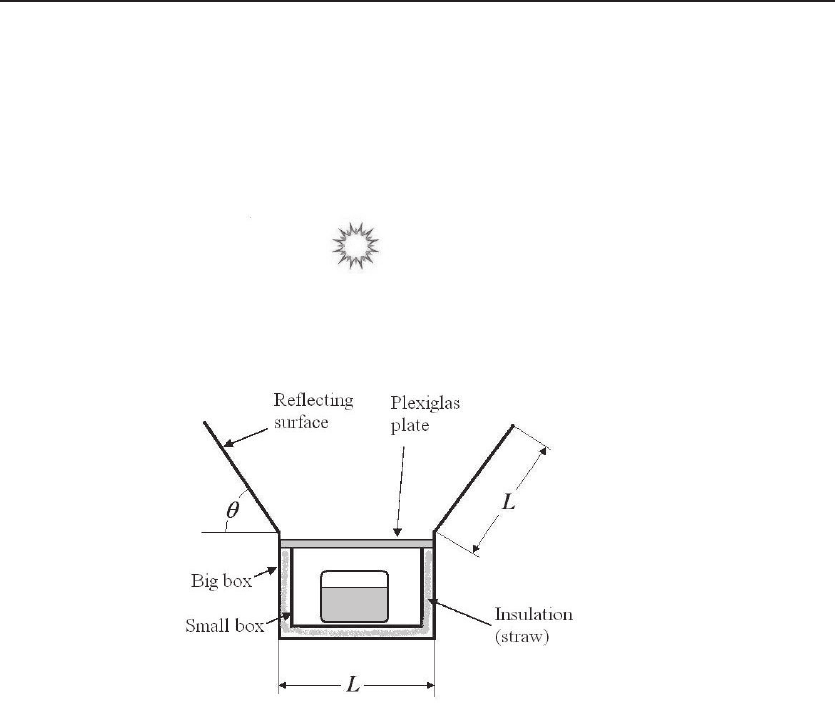
11.5. Kyoto box is a simple solar oven used extensively in Africa; see Fig. 11.27.
Assuming a square box with four reflectors of L = 75 cm, on a sunny day with direct
sunlight from the zenith, what is the optimum angle θ? What is the total solar power
received by the box? If the efficiency is 70%, how long it will take to heat 1 gallon
(3.785 liters) of water from 25
◦
C to the boiling point?
Figure 11.27 Kyoto box. A simple solar oven used extensively in Africa.
Problems 251
i
i
“ChenSolarEnergy” — 2011/5/17 — 17:56 — page 253 — #280
i
i
i
i
i
i
Chapter 12
Energy Storage
Because solar energy is intermittent, if it is the main supply, energy storage is a ne-
cessity. In general, there are two types of energy storage: utility-scale massive energy
storage and the application-related, distributed energy storage. For utility-scale en-
ergy storage, the most effective method is using a reversible hydroelectric plant, which
stores mechanical energy as potential energy of water in a high-level reservoir. We
have discussed this in Section 1.3.1. The two most promising methods of distributed
energy storage are thermal energy storage and rechargeable batteries. Especially for
transportation (automobiles and small vessels) the rechargeable batteries will become
the dominating energy storage device. Compressed air and flywheels are also important
but will not be as widespread as thermal and rechargeable batteries. In this chapter,
we will focus on thermal energy storage and rechargeable batteries.
12.1 Sensible Heat Energy Storage
Storage of energy as heat content of matter is inexpensive and easy to implement. It
can be applied to space heating and cooling as well as for power generation. Two
types of thermal energy are used: sensible thermal energy, essentially proportional to
temperature difference, and phase transition thermal energy, such as the latent heat
during freezing and melting, which could maintain a fixed temperature with energy
content much greater than sensible thermal energy. Phase-change materials (PCM)
are well suited for the storage of solar energy.
Sensible heat energy storage utilizes the heat capacity and the change in tempera-
ture of the material during the process of charging or discharging — the temperature
of the storage material rises when energy is absorbed and drops when energy is with-
drawn. One of the most attractive features of sensible heat storage systems is that
charging and discharging operations can be expected to be completely reversible for an
unlimited number of cycles, that is, over the lifespan of the storage.
In sensible heat energy storage, the thermodynamic process of the material is almost
always isobaric, or under constant pressure, typically atmospheric pressure. A solid or
liquid is usually used. The specific heat of gas is too low and not practical for thermal
energy storage. The heat Q delivered by the material from initial temperature T
1
to
253
Physics of Solar Energy C. Julian Chen
Copyright © 2011 John Wiley & Sons, Inc.