
Chen C.J. Physics of Solar Energy
Подождите немного. Документ загружается.

i
i
“Chen˙Gallery” — 2011/4/19 — 20:28 — page 8 — #8
i
i
i
i
i
i
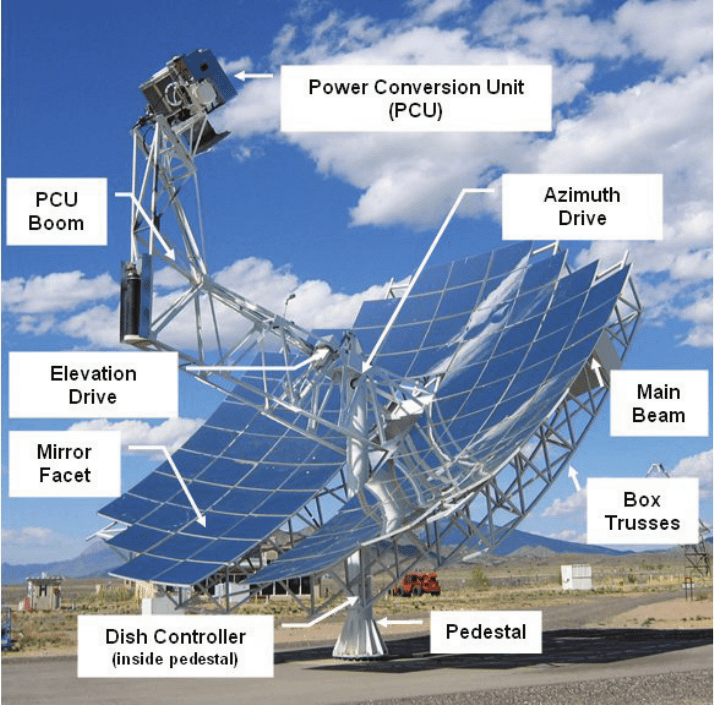
Plate 9. Solar dish Stirling energy system. The Stirling solar energy system de-
veloped by Sandia National Laboratories and Stirling Energy Systems (SES) in Febru-
ary 2008 has set a record of the highest solar-to-grid conversion efficiency of 31.25%.
The solar dish generates electricity by focusing the radiation from the Sun to a receiver,
which transmits the heat energy to a Stirling engine filled with hydrogen. The Stirling
engine works best in a cold but sunny weather. See Section 11.4. Photo courtesy of
Sandia National Laboratories.
i
i
“Chen˙Gallery” — 2011/4/19 — 20:28 — page 9 — #9
i
i
i
i
i
i
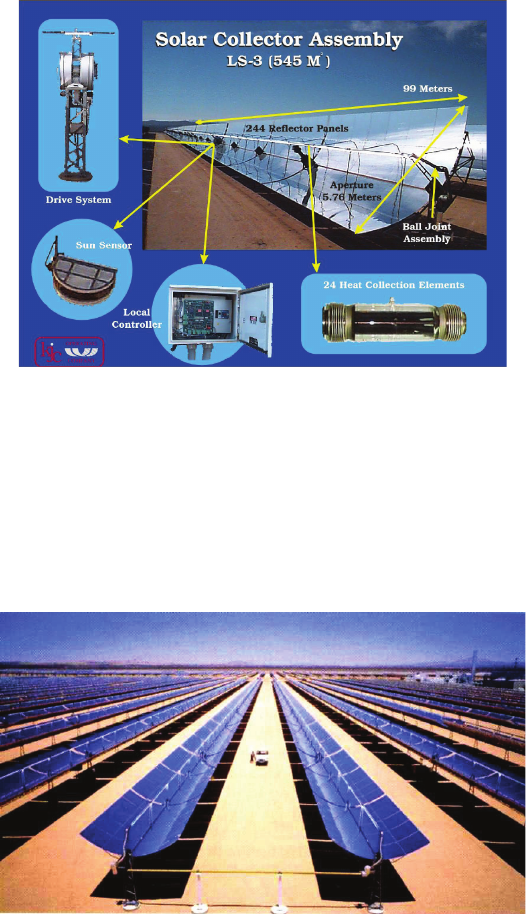
Plate 10. Solar collector assembly of a trough system. The axis of the parabolic
troughs are aligned South-North. A tracking mechanism turns the troughs every day
from East to West. The solar radiation is focused on the vacuum-tube heat collectors.
The collectors heat synthetic oil to 400
◦
C, then generates superheated steam to drive
steam turbines. The highest efficiency on record was 20%. See Section 11.4.
Plate 11. Parabolic trough concentrators at Kramer Junction, CA. The
system, called the Solar Electricity Generating System (SEGS) installed at Kramer
Junction in Mojave desert, California, starting from 1984. The SEGS system is the
largest solar electricity generator set on the world. The total capacity is 354 MW. See
Section 11.4.
i
i
“Chen˙Gallery” — 2011/4/19 — 20:28 — page 10 — #10
i
i
i
i
i
i
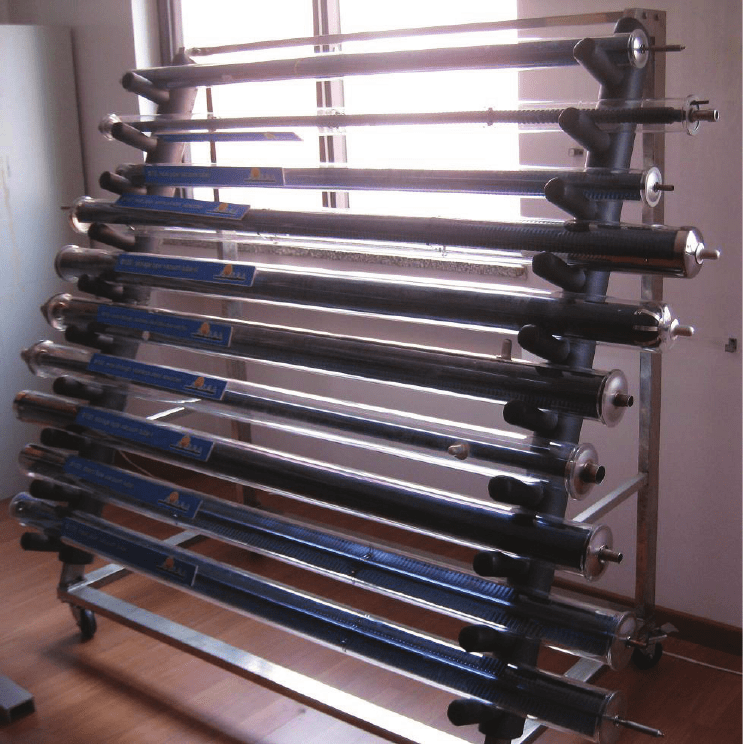
Plate 12. Various types of vacuum tube solar heat collectors. Currently,
vacuum tube solar heat collectors are the most used solar heat collectors. They use
selective coating to achieve maximum absorption of solar radiation, with minimum
loss of heat by radiation. The vacuum between the outer tube and the heated element
provides almost perfect thermal insulation. Depending on the ways of transferring heat,
there are several types: The direct-flow vacuum tube heat collector allows water to flow
by convection into the tubes. The heat siphon collector uses an ingenious phase-change
mechanism to transfer heat with very high efficiency and prevents heat from flowing
back to the tube (the thermal diode effect). See Section 11.2. Photo taken by the
author. Courtesy of Beijing Solar Energy Research Institute.
i
i
“Chen˙Gallery” — 2011/4/19 — 20:28 — page 11 — #11
i
i
i
i
i
i
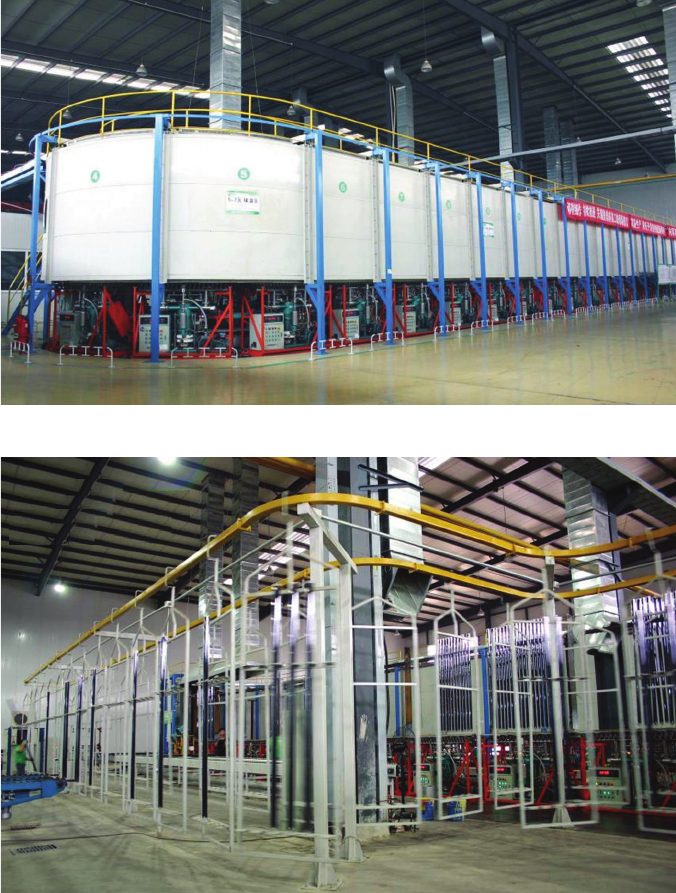
Plate 13. Fully automatic facility for manufacturing of evacuated tubes.
Top: Automatic evacuating machine. Bottom: Automatic conveying line. This facility
produces 20 million evacuated tubes each year. Courtesy of Himin Solar Energy Group,
Dezhou, China.
i
i
“Chen˙Gallery” — 2011/4/19 — 20:28 — page 12 — #12
i
i
i
i
i
i
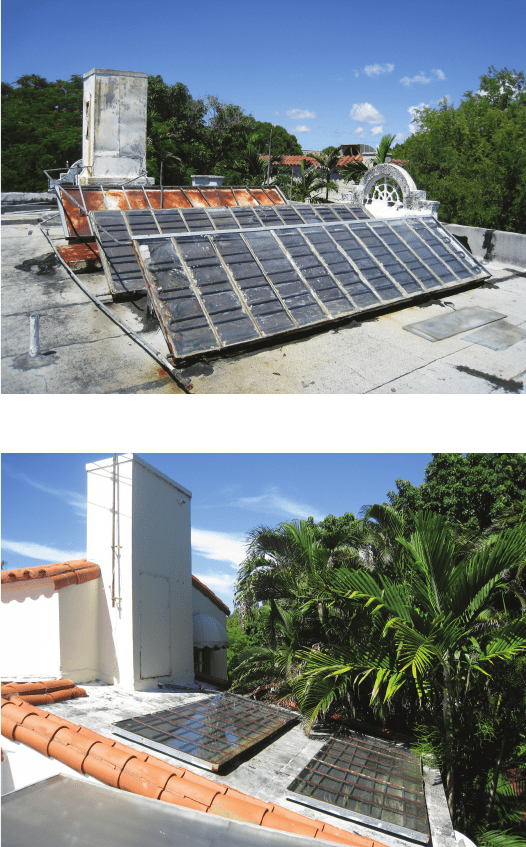
Plate 14. Day-and-Night solar water heaters manufactured and installed in
1920s in Maimi. Solar water heaters (see Sections 1.5.1, 11.2, and 11.3) can be very
durable. In the 1920s, about 40,000 Day-and-Night solar water heaters were installed
in Florida. After 80 years of operation in violent weather conditions, thousands of them
are still working properly today. The secret is its simplicity and complete absence of
moving parts. Photos taken by the author, August 2010, Miami.
i
i
“Chen˙Gallery” — 2011/4/19 — 20:28 — page 13 — #13
i
i
i
i
i
i
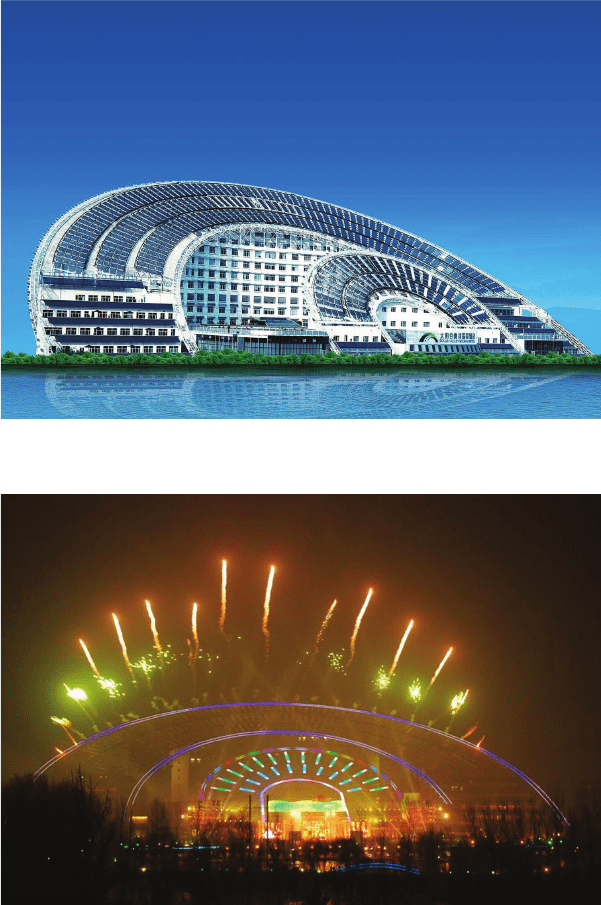
Plate 15. A solar building. As the venue of the 2010 International Solar City
Congress, Himin Solar Energy Group designed and built this 75,000-m
2
(800,000-ft.
2
)
building in D´ezh¯ou, Sh¯and¯ong province, China, with more than 60% of energy supplied
by solar devices. Courtesy of Himin Solar Energy Group, Dezhou, China.

i
i
“Chen˙Gallery” — 2011/4/19 — 20:28 — page 14 — #14
i
i
i
i
i
i
Plate 16. An experimental solar house. As Steven Chu repeatedly advocated,
using better building design to take advantage of solar energy, with a small incremental
investment, tremendous energy savings can be achieved. Shown here is an experimental
single-family house designed by the author. It is a medium-size central-hall colonial
house very common in the United States. Nevertheless, the layout, roof design, and
window placement are optimized for solar energy utilization. On a sunny winter day,
the sunlight through the large south-facing windows warm all the often-occupied rooms
such that the thermostat for gas heating is always turned off. In the Summer, the solar
panels on the roof drive two central air-conditioning systems to keep the entire house
cool. A solar-powered attic fan (on top of the roof, not shown here) further reduces the
cooling load. The walls are well insulated and all windows are double pane, air tight,
and filled with argon. See Section 13.3. Photo taken by the author.

i
i
“Chen˙Gallery” — 2011/4/19 — 20:28 — page 15 — #15
i
i
i
i
i
i
Plate 17: Deepwater Horizon Explosion. As land-based oil fields in the United
States are being essentially depleted, petroleum exploration is moving offshore, to
deeper and deeper seas. The cost of drilling is increasing dramatically, and the environ-
ment cost is becoming even graver. One example of the engineering and environmental
costs is the recent Gulf of Mexico oil spill. On April 20, 2010, the Deepwater Horizon
drilling rig, situated about 40 miles (60 km) southeast of the Louisiana coast in the Ma-
condo Prospect oil field, exploded. It killed 11 workers and injured 17 others. It caused
the Deepwater Horizon to burn and sink. An estimated 4.9 million barrels (780,000
m
3
) of crude oil was released into the water of the Gulf of Mexico. It is now considered
the largest environmental disaster in U.S. history. The oil spill severely damaged the
environment of the Gulf of Mexico and significantly affected the fishing and tourism
businesses of the Gulf states. It cost BP more than $32 billion for the clean-up. To
ensure the safety of deep-sea petroleum exploration, the engineering cost will become
very high. Photo courtesy of U.S. Coast Guard.
i
i
“Chen˙Gallery” — 2011/4/19 — 20:28 — page 16 — #16
i
i
i
i
i
i
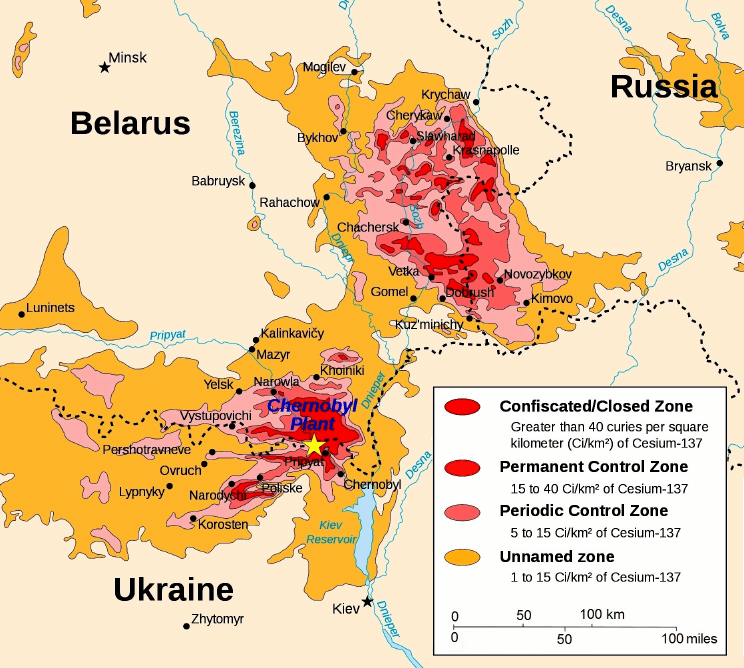
Plate 18: Chernobyl: A quarter century later. On April 26, 1986, as a combined
result of design deficiencies and human error, reactor number four of the Chernobyl
Nuclear Power Plant near the town of Pripyat, Ukraine, former Soviet Union, exploded.
Radioactive material scattered over a wide area in Europe. In the vicinity of the
Chernobyl Plant, the radiation level was so high that a 2,800-km
2
area in Belarus,
Ukraine, and Russia, including three cities and more than one hundred villages, must
be permanently abandoned. The accident crippled the economy of the former Soviet
Union. Up to recently, the Chernobyl accident was the only one rated level 7 (a major
accident) on the International Nuclear Event Scale (INES). On March 11, 2011, a
tsunami damaged several nuclear reactors at the Fukushima Daiichi Nuclear Power
Plant in Japan. Large quantity of radioactive materials was leaked. On April 11, 2011,
the Japanese authorities raised the event level of the Fukushima accident to level 7,
and predicted that the total radiation fallout will be comparable or even higher than
that of Chernobyl. To prevent future nuclear accidents, a higher safety standards will
drive up the cost of nuclear power. Source of the map: CIA Factbook.
i
i
“ChenSolarEnergy” — 2011/5/17 — 17:56 — page 1 — #28
i
i
i
i
i
i
Chapter 1
Introduction
1.1 Solar Energy
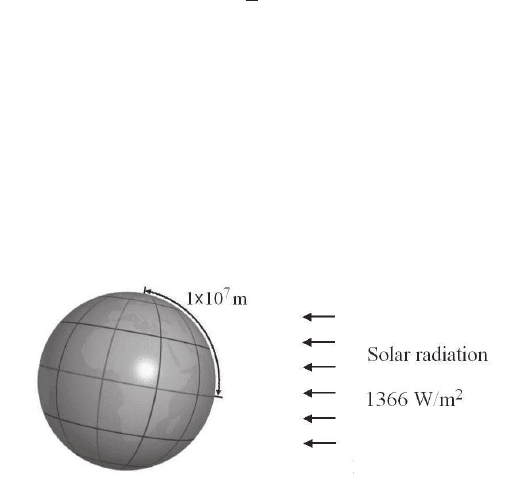
According to well-established measurements, the average power density of solar radi-
ation just outside the atmosphere of the Earth is 1366 W/m
2
, widely known as the
solar constant. The definition of the meter is one over 10,000,000 of Earth’s meridian,
from the North Pole to the equator, see Fig. 1.1. This definition is still pretty accurate
according to modern measurements. Therefore, the radius of Earth is (2/π) × 10
7
m.
The total power of solar radiation reaching Earth is then
Solar power = 1366 ×
4
π
× 10
14
∼
=
1.73 × 10
17
W. (1.1)
Each day has 86,400 s, and on average, each year has 365.2422 days. The total energy
of solar radiation reaching Earth per year is
Annual solar energy = 1.73 ×10
17
× 86400 ×365.2422
∼
=
5.46 × 10
24
J. (1.2)
Or 5,460,000 EJ/year. To have an idea of how much energy that is, let us compare
it with annual global energy consumption; see Fig. 1.2. In the years 2005–2010, the
annual energy consumption of the entire world was about 500 EJ. A mere 0.01% of the
annual solar energy reaching Earth can satisfy the energy need of the entire world.
Figure 1.1 Annual solar energy arriving at surface of Earth. The average solar power on the
Earth is 1366 W/m
2
. The length of the meridian of Earth, according to the definition of the meter, is
10,000,000 m. The total solar energy that arrives at the surface of Earth per year is 5,460,000 EJ.
1
Physics of Solar Energy C. Julian Chen
Copyright © 2011 John Wiley & Sons, Inc.