
Chen C.J. Physics of Solar Energy
Подождите немного. Документ загружается.

i
i
“ChenSolarEnergy” — 2011/5/17 — 17:56 — page 22 — #49
i
i
i
i
i
i
22 Introduction
1.4 Solar Photovoltaics Primer
It is clear that in the first half of the twenty-first century, fossil fuel will be depleted
to an extent that it cannot support the energy demand of human society. There are
various types of renewable energy resources. Many of them have limitations, including
hydropower, wind energy, and geothermal energy. Solar thermal applications such
as solar water heaters can fill only a small part of the total energy demand. Solar
photovoltaics is the single most promising substitute for fossil energy. In this section,
we will present an elementary conceptual overview of photovoltaics. Details will be
presented in Chapters 2–4 and 7–10.
1.4.1 Birth of Modern Solar Cells
In 1953, Bell Labs set up a research project for devices to provide energy source to re-
mote parts of the world where no grid power was available. The leading scientist, Darryl
Chapin, suggested using solar cells, and his proposal was approved by his supervisors.
At that time, the photovoltaic effect in selenium, discovered in the 1870s, was al-
ready commercialized as a device for the measurement of light intensity in photography.
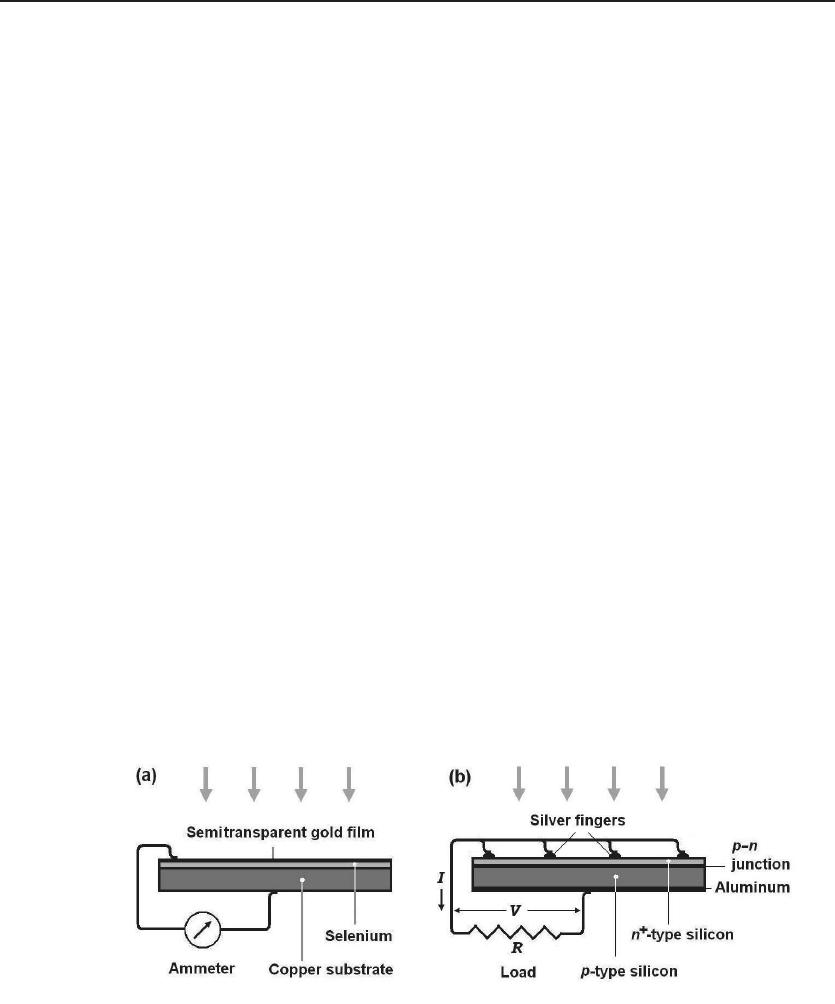
Figure 1.22(a) is a schematic. A layer of Se is applied on a copper substrate, then cov-
ered by a semitransparent film of gold. When the device is illuminated by visible light,
a voltage is generated, which in turn generates a current. The intensity of electric
current depends on the intensity of light. It has been a standard instrument in the
first half of the twentieth century for photographers to measure light conditions. This
device is much more rugged and convenient than photoresistors because there are no
moving parts and no battery is required.
Chapin started his experiment with selenium photocells. He found that the effi-
ciency, 0.5%, is too low to generate sufficient power for telephony applications. Then, a
stroke of unbelievable luck, two Bell Lab scientists involved in the pioneering effort to
develop silicon transistors, Calvin Fuller and Gerald Pearson, joined Chapin in using
Figure 1.22 Selenium solar cell and silicon solar cell. (a) The selenium photovoltaic cell
was discovered in the middle of the nineteenth century and was used for measuring light intensity in
photography. (b) The silicon photovoltaic cell was invented at Bell Labs in 1954 using the technology
for silicon transistors.
i
i
“ChenSolarEnergy” — 2011/5/17 — 17:56 — page 23 — #50
i
i
i
i
i
i
1.4 Solar Photovoltaics Primer 23
Figure 1.23 Inventors of silicon so-
lar cells. Left to right: Gerald Pearson
(1905–1987), Darryl Chapin (1906–1995),
and Calvin Fuller (1902–1994). In 1953
Bell Labs set up a research project to pro-
vide energy sources for remote parts of
the world where no grid power was avail-
able. Utilizing the nascent technology to
make silicon transistors, in 1954, they de-
signed and demonstrated the first silicon
solar cells. The efficiency achieved, 5.7%,
makes the solar cell a useful power source.
Courtesy of AT&T Bell Labs.
the nascent silicon technology for solar cells; see Fig 1.23. In 1954, a solar cell with
5.7% efficiency was demonstrated [67]. A schematic is shown in Fig. 1.22(b).
The silicon solar cell was made from a single crystal of silicon. By judicially con-
trolling the doping profile, a p–n junction is formed. The n-side of the junction is
very thin and highly doped to allow light to come to the p–n junction with very little
attenuation, but the lateral electric conduction is high enough to collect the current
to the front contact through an array of silver fingers. The back side of the silicon is
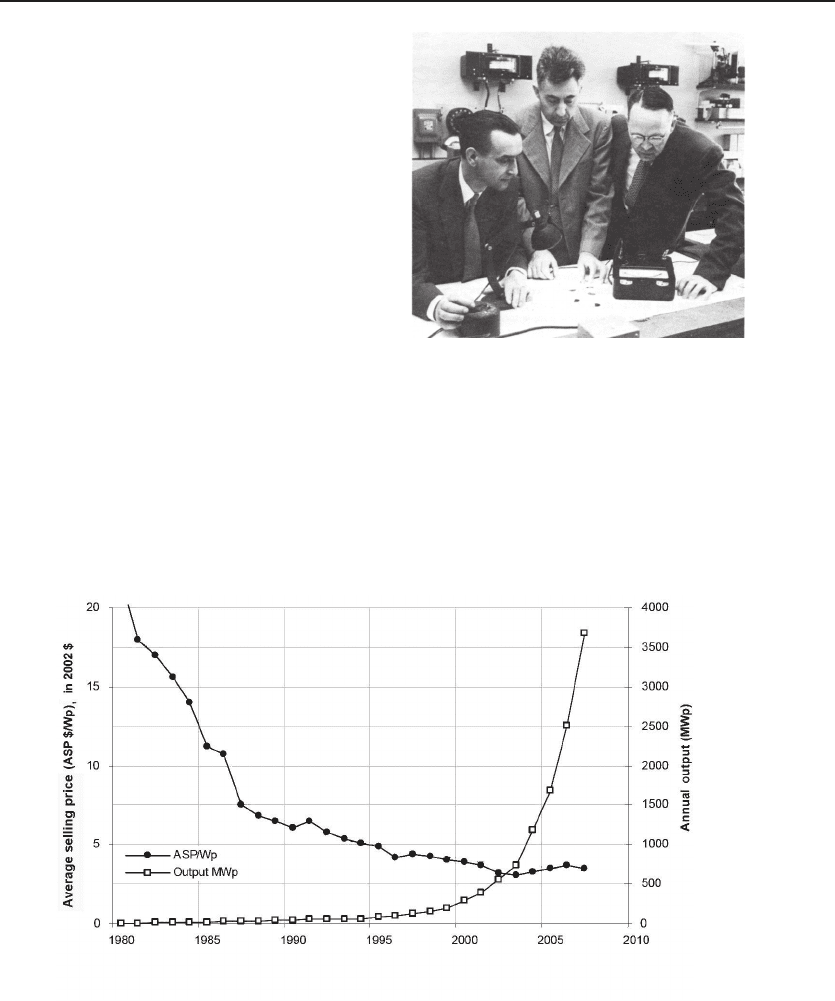
Figure 1.24 Average price and installation of solar cells: 1980–2007. The average price
of solar cells dropped threefold from more than $20 per peak watt in 1980 to $6.5 per peak watt in
1990. The installation of solar cells steadily increased during that period. Source: Solar Photovoltaic
Industry, 2008 Global Outlook, Deutsch Bank.

i
i
“ChenSolarEnergy” — 2011/5/17 — 17:56 — page 24 — #51
i
i
i
i
i
i
24 Introduction
covered with a metal film, typically aluminum. The basic structure of the silicon solar
cell has remained almost unchanged until now.
The initial demonstration of the solar cell to the public in New York City was a
fanfare. And the cost of building such solar cells was very high. From the mid 1950s to
the early 1970s, photovoltaics research and development were directed primarily toward
space applications and satellite power. In 1976, the U.S. Department of Energy (DOE)
was established. A Photovoltaics Program was created. The DOE, as well as many
other international organizations, began funding research in photovoltaics at apprecia-
ble levels. A terrestrial solar cell industry was quickly established. Economies of scale
and progress in technology reduced the price of solar cells dramatically. Figure 1.24
shows the evolution of price and annual PV installation from 1980 to 2007.
1.4.2 Some Concepts on Solar Cells
Following are a list of key terms and concepts regarding solar cells.
Standard Illumination Conditions
The efficiency and power output of a solar module (or a solar cell) are tested under the
following standard conditions: 1000 W/m
2
intensity, 25
◦
C ambient temperature, and
a spectrum that relates to sunlight that has passed through the atmosphere when the
sun is at 42
◦
elevation from the horizon [defined as air mass (AM) 1.5, see Plate 1].
Fill Factor
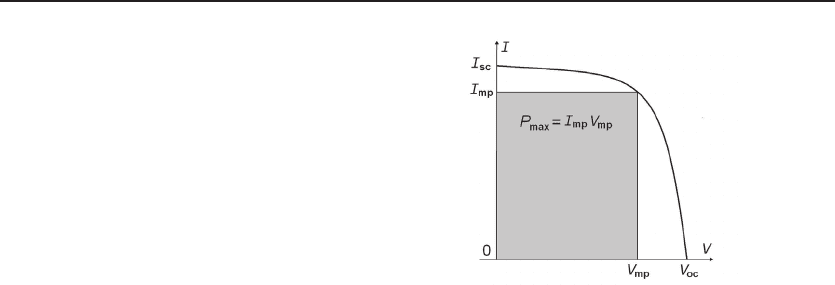
The open-circuit voltage V
op
is the voltage between the terminals of a solar cell under
standard illumination conditions when the load has infinite resistance that is open. In
this situation, the current is zero. The short-circuit current I
sc
is the current of a solar
cell under standard illumination conditions when the load has zero resistance. In this
case, the voltage is zero. By using a resistive load R, the voltage V will be smaller than
V
op
, and the current I is smaller than I
sc
.ThepowerP = IV . The maximum power
output is determined by the condition
dP = d(IV )=IdV + VdI =0. (1.27)
Figure 1.25 shows the relation among these quantities. Denoting the point of maximum
power by I
mp
and V
mp
,wehaveP
max
= I
mp
V
mp
.
The fill factor of a solar cell FF is defined as
FF =
P
max
I
sc
V
oc
=
I
mp
V
mp
I
sc
V
oc
. (1.28)
The typical value of the fill factor is between 0.8 and 0.9.
Efficiency
The efficiency of a solar cell is defined as the ratio of the output electric power over the
input solar radiation power under standard illumination conditions at the maximum
power point. Efficiencies for various solar cells are shown in Plate 5.
i
i
“ChenSolarEnergy” — 2011/5/17 — 17:56 — page 25 — #52
i
i
i
i
i
i
1.4 Solar Photovoltaics Primer 25
Figure 1.25 Maximum power and fill
factor. By connecting a load resistor to the
two terminals of a solar cell, the solar cell sup-
plies power to the load. The maximum power
point occurs when P = IV reaches maximum.
At that point, P
max
= I
mp
V
mp
. Obviously,
there is always I
mp
<I
sc
and V
mp
<V
oc
.
Thefillfactorofasolarcellisdefinedas
FF = P
max
/I
sc
V
oc
= I
mp
V
mp
/I
sc
V
oc
.
Peak Watt
The “peak watt” (Wp) rating of a solar module is the power (in watts) produced by
the solar module under standard illumination conditions at the maximum power point.
The actual power output of a solar cell obviously depends on the actual illumination
conditions. For a discussion of solar illumination, see Chapter 4.
1.4.3 Types of Solar Cells
The crystalline silicon solar cell was the first practical solar cell invented in 1954. The
efficiency of such solar cells as mass produced is 14–20%, which is still the highest in
single-junction solar cells. It also has a long life and a readiness for mass production. To
date, it still accounts for more than 80% of the solar cell market. There are two versions
of the crystalline silicon solar cell: monocrystalline and polycrystalline. Amorphous
silicon thin-film silicon solar cells are much less expensive than the crystalline ones. But
the efficiency is only 6–10%. In between are CIGS (copper indium gallium selenide) and
CdTe–CdS thin film solar cells, with a typical efficiency of around 10% and account for
about 15% of the market. Because of the very high absorption coefficient, the amount
of materials required is small, and the production process is simpler; thus the unit price
per peak watt is lower than crystalline silicon solar cells. To date, organic solar cells
still have low efficiency and a short lifetime, and the market share is insignificant, see
Plate 5. Table 1.6 summarizes several significant types of solar cells.
1.4.4 Energy Balance
It takes energy to produce solar cells. Therefore, a study of the EROI is important.
Here we discuss the energy balance for the most expensive case, crystalline silicon solar
cells. The energy investment includes that for producing silicon feedstock, ingot and
wafers, cell production, module assembly, and installation. A standard benchmark
number to evaluate the energy balance of photovoltaics is payback time. By setting the
solar cells in a given solar illumination condition, the solar cells will generate energy in
the form of electricity. Payback time is the number of years it takes for the electricity
i
i
“ChenSolarEnergy” — 2011/5/17 — 17:56 — page 26 — #53
i
i
i
i
i
i
26 Introduction
Table 1.6: Types of Solar Cells
Type Efficiency (%) Cost ($/Wp) Market share (%)
Monocrystalline Si 17–20 3.0 30
Polycrystalline Si 15–18 2.0 40
Amouphous Si 5–10 1.0 5
CIGS 11–13 1.5 5
CdTe-CdS 9–11 1.5 10
generated by the solar cell to compensate for the energy invested in the production and
installation process.
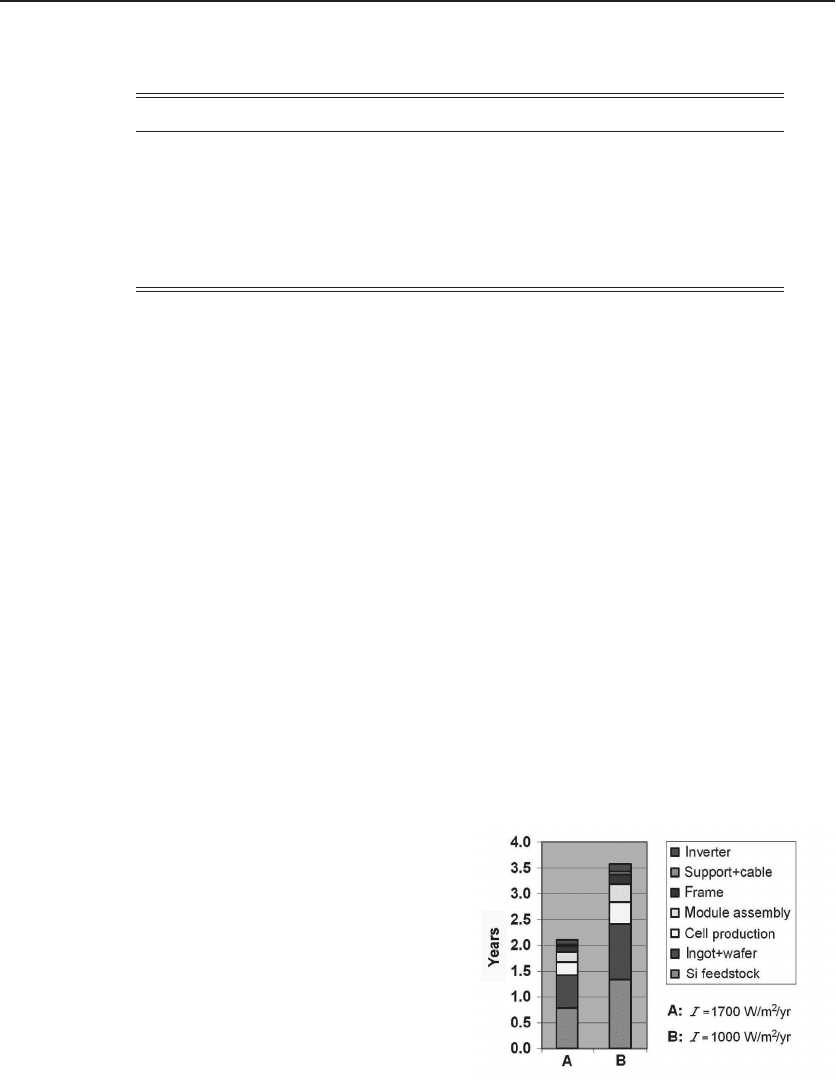
Figure 1.26 represents a conservative estimate of payback time for crystalline silicon
solar cells based on European insolation conditions [4]. For Central Europe, with annual
insolation of 1000 W/m
2
, the payback time is 3.6 years. Its lifetime is typically 25
years, which results in an EROI of 7. In Southern Europe and most places in the
United States, the EROI is above 10. The EROI for thin-film solar cells is even better.
However, because of lower efficiency, these require more space to generate the same
power.
1.5 Above Physics
Good physics does not always lead to successful industrial implementation and to con-
ferring a great benefit to mankind. Solar energy is no exception. Economics and
politics play a significant role. In this section, we will review some important historical
lessons and analyze the economical and political context for which the utilization of
solar energy can become a success and thus benefit mankind.
Figure 1.26 Payback time for crys-
talline silicon solar cells. The energy
invested for a solar cell includes the en-
ergy for producing silicon feedstock, in-
got and wafers, cell production, and in-
stallation. Even under unfavorable in-
solation conditions, such as central Eu-
rope, the payback time is less than 15%
of its lifetime, which results in an EROI
of 7 (see Ref. [4]).
i
i
“ChenSolarEnergy” — 2011/5/17 — 17:56 — page 27 — #54
i
i
i
i
i
i
1.5 Above Physics 27
1.5.1 Economics of Solar Energy
The early history of solar water heaters in the United States vividly illustrates the
interplay of physics, engineering and economics [17]. In the nineteenth century, before
the invention of modern hot-water systems, making hot water for a bath was expensive
and difficult. Water had to be heated in a large pot over fire, then scooped into the
bathtub. It was especially expensive in California, where fuel such as coal had to be
imported and wood was precious. Artificial gas and electricity were very expensive.
However, sunlight is plenty there, and the weather is mild.
In 1891, Clarence Kemp patented an effective and usable solar water heater, named
Climax (U.S. Patent 451,384). First marketed in Maryland, Kemp’s business was not
very successful. Then he sold the exclusive right to two Pasadena businessmen and
made a great commercial success in California. By 1900, 600 units were sold in southern
California alone. However, the Climax water heater had a drawback in that it took
a few hours of sunlight to heat up the water and after sunset the water temperature
would drop quickly. Therefore, it could only be used in the afternoon of a sunny day.
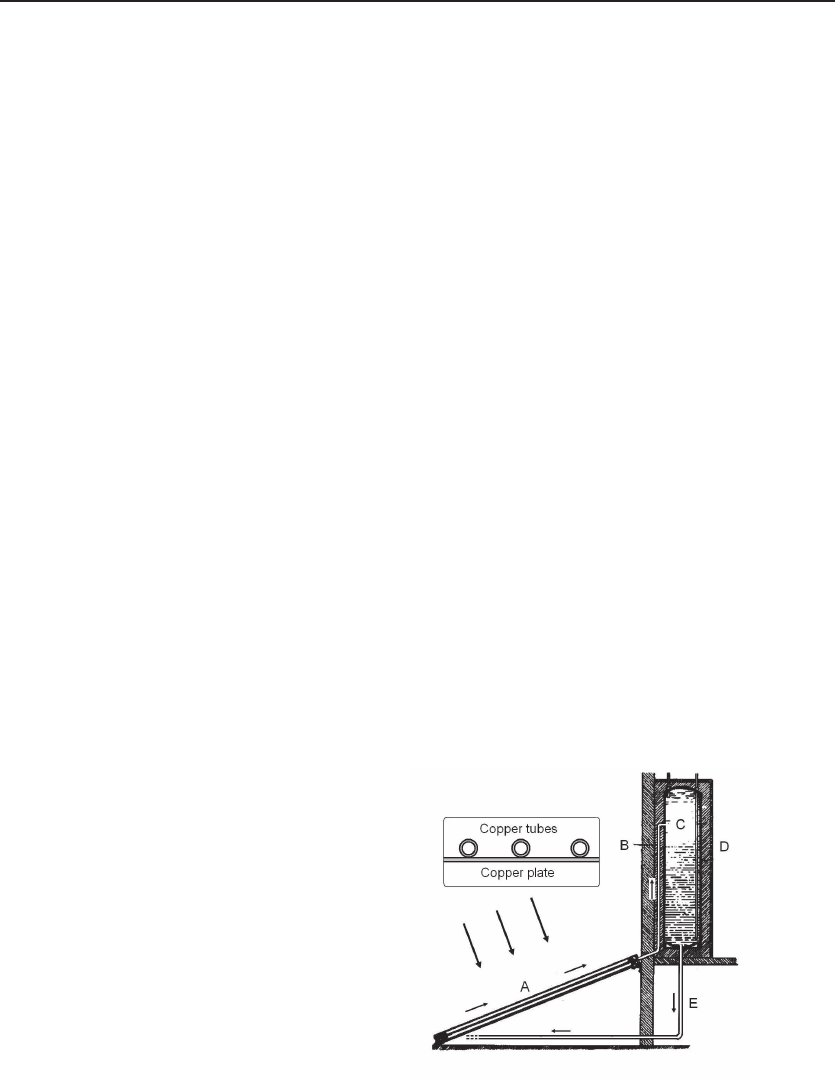
In 1910, William J. Bailey invented and patented the Day-and-Night solar water
heater (U.S. Patent 966,070), which resolved the major problems and became the pro-
totype of later solar water heaters; see Fig. 1.27. First, the heat collector A is made of
a parallel grid of copper pipes welded on a flat piece of copper plate. Second, it uses a
water tank C placed above the heat collector, heavily insulated by cork, D. Such an ar-
rangement enables water circulation by natural convection and effective energy storage.
When water is heated by sunlight, the specific gravity decreases. It flows automatically
upward through pipe B into water tank C. The colder water then flows automatically
downwards through pipe E back into the heat collector A. If the insulation is sufficient,
the water can stay hot overnight. Therefore, it works in the day as well as in the night.
Although the Day-and-Night system cost about $180 at that time, much higher than a
Climax system, it quickly conquered the consumers. Climax was forced out of business.
By the end of World War I, more than 4000 Day-and-Night solar water heaters were
Figure 1.27 Day-and-Night
solar water heater. The inset
shows the copper tubes and cop-
per plate of the solar heat col-
lector A. The system works un-
der natural convection: the water
heated by sunlight in collector A
rises to the insulated tank C. The
cold water flows down from tank
C through pipe E back to the so-
lar heat collector A. Source:U.S.
Patent 966,070, 1911.
i
i
“ChenSolarEnergy” — 2011/5/17 — 17:56 — page 28 — #55
i
i
i
i
i
i
28 Introduction
sold.
In the early 1920s, abundant natural gas was discovered in the Los Angeles Basin.
The price of natural gas in 1927 was only a quarter of that in 1900 for town gas. The
gas-operated water heater, much cheaper in initial investment than the solar heater
and more convenient to use, gradually replaced the once popular solar water heaters.
Bailey’s company, being quite experienced in water heater systems, quickly adapted
into a gas heater business. Still keeping Day-and-Night as the company name, it soon
became one of the largest producers of gas water heaters in the nation.
The downfall of the solar water heater business in California was not the end of it.
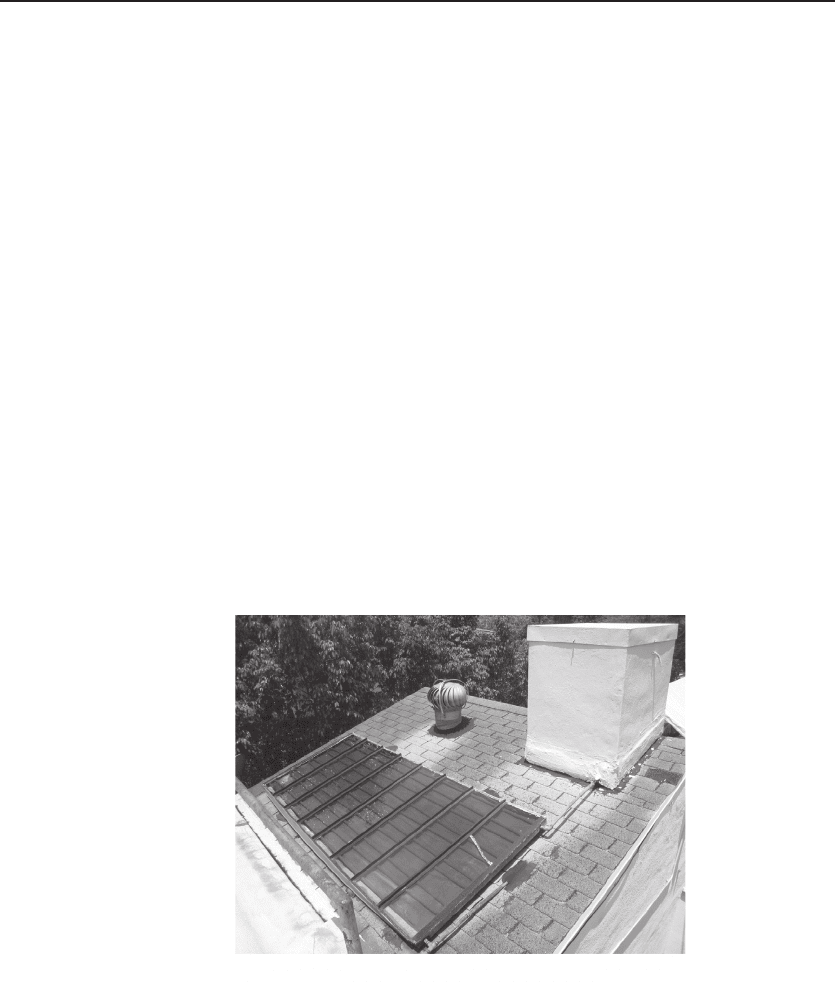
Florida, with a real estate boom in the 1920s through the 1940s and no natural gas
available, became the sweet spot of solar water heaters; see Fig. 1.28. It is estimated
that from 25,000 to 60,000 solar water heaters were installed in Miami during 1920–
1941. During World War II, price of copper skyrocketed. After the war, the price of
electricity plummeted. The result was the gradual replacement of solar water heaters
by electric water heaters. In the United States, the solar water heater had lost its glory.
However, after World War II, elsewhere in the world, solar water heaters gained
momentum, especially in Israel. A desert area without energy resources similar to Cal-
ifornia in the late nineteenth century, solar water heaters could bring sizeable economic
benefit. A significant advance in solar thermal technology, selective absorption coating,
was invented in Israel in the 1950s, which greatly improved the efficiency of solar water
heaters. Later, Israel became the first country to require that all new buildings must
have solar water heaters.
Figure 1.28 A Day-and-Night solar water heater in Florida. From 1920 to 1941, more than
25,000 solar water heaters were manufactured and installed in Florida. After 80 years, thousands of
them are still working. The photo, taken by the author in Miami in August 2010, is a solar water
heater installed in 1937. The insulated water tank is disguised as a chimney. Even with a broken pane,
it is still working properly.
i
i
“ChenSolarEnergy” — 2011/5/17 — 17:56 — page 29 — #56
i
i
i
i
i
i
1.5 Above Physics 29
1.5.2 Moral Equivalence of War
Government policies on energy have a major effect on renewable energy development.
In the United States, the new energy policies during the Carter administration in the
1970s created a golden period for renewable energy research and development.
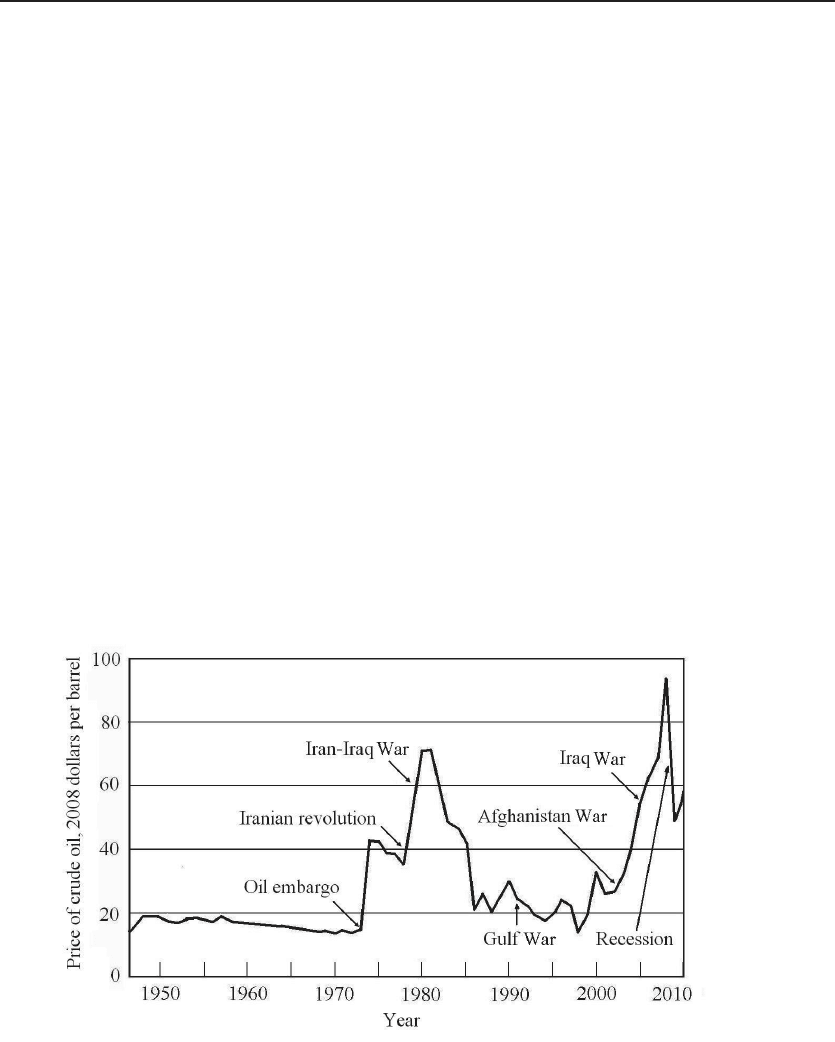
After World War II, the United States enjoyed cheap crude oil, staying below $20
per barrel (inflation adjusted in January 2008 dollars) for three decades. In 1973, an oil
embargo triggered the first energy crisis. The price of crude oil jumped dramatically;
see Fig. 1.29.
Coincidentally, the timing of the energy crisis matched the prediction of M. King
Hubbert in 1956 that shortly after 1970 the production of crude oil in the United States
would peak and start to decline; see Section 1.2. The coincidence is not accidental.
As crude oil production in the United States started to decline, consumption was still
growing. In 1971, the United States paid $3.7 billion for importing crude oil; in 1977,
it increased 10-fold to $37 billion (in 1977 dollars). Obviously, excessive dependence
on foreign oil poses severe economic and security threats.
On April 18, 1977, then President Jimmy Carter delivered a televised speech about
his new energy policy. He called the struggle for greater energy independence the moral
equivalence of war — one that “will test the character of the American people.” He
said:
Tonight I want to have an unpleasant talk with you about a problem
unprecedented in our history. With the exception of preventing war, this is
the greatest challenge our country will face during our lifetimes. The energy
Figure 1.29 History of crude oil price, 2008 dollars. Source: U.S. Energy Information
Administration.

i
i
“ChenSolarEnergy” — 2011/5/17 — 17:56 — page 30 — #57
i
i
i
i
i
i
30 Introduction
crisis has not yet overwhelmed us, but it will if we do not act quickly.
It is a problem we will not solve in the next few years, and it is likely to
get progressively worse through the rest of this century.
We must not be selfish or timid if we hope to have a decent world for
our children and grandchildren.
We simply must balance our demand for energy with our rapidly shrink-
ing resources. By acting now, we can control our future instead of letting
the future control us.
The major points of Carter’s energy policy included energy conservation, increasing
domestic traditional energy exploration, and developing renewable energy resources. In
his words, “we must start now to develop the new, unconventional sources of energy we
will rely on in the next century.” A few days later President Carter signed the Depart-
ment of Energy Organization Act and on August 4, 1997, formed the U.S. Department
of Energy. Then, the National Energy Act (NEA) was established in 1978 with tax
incentives for renewable energy projects, especially solar energy. This legislation ini-
tiated a significant boost to the research, development, and installation of solar water
heaters, solar cells, and solar-operated buildings.
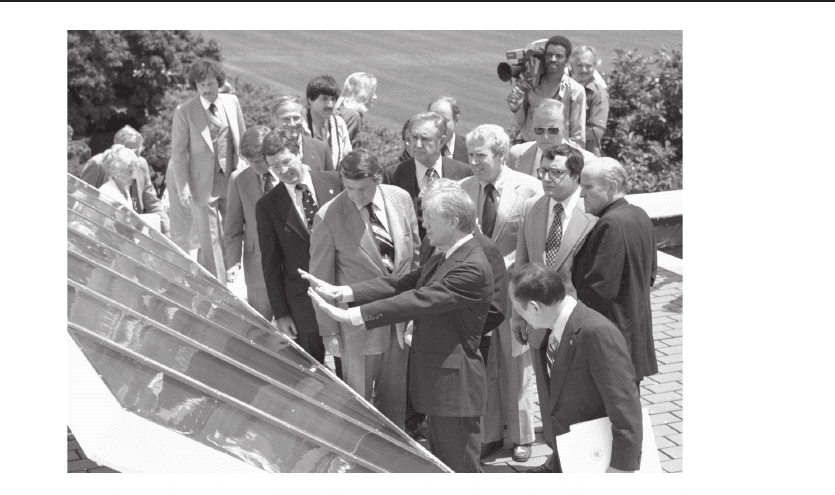
To lead the public by example, on June 20, 1979, Carter installed a solar water
heater with 32 panels on the roof of the White House; see Fig. 1.30. At the ceremony,
Carter reflected upon his own idealism:
A generation from now, this solar heater can either be a curiosity, a
museum piece, an example of a road not taken, or it can be a small part
of one of the greatest and most exciting adventures ever undertaken by the
American people . . . to harness the power of the sun to enrich our lives
as we move away from our crippling dependence on foreign oil.
In 1978, the Carter administration enacted the first National Energy Act (NEA) to
promote fuel efficiency and renewable energy. The research and development funding
for renewable energy is greatly increased. Part of the 1978 NEA is an Energy Tax Act
that gave an income tax credit to private residents who use solar, wind, or geothermal
sources of energy. The 1978 Energy Tax Act was expired in 1986. However, many other
countries followed the example of the United States and provided government financial
support for renewable energy utilization.
As anticipated by Jimmy Carter, during the rest of the twentieth century, several
factors made the energy problem “progressively worse”: Due to a steady decline and
an increasing consumption, crude oil import into the United States increased from 1.8
billion barrels in 1980 to 5.0 billion barrels in 2000s. The price of crude oil (in 2008
dollars) increased from about $20 to more than $100 a barrel in late 2000s; see Fig. 1.29.
The petroleum crisis in the 1970s reappeared, but with an even more gruesome context:
According to Hubbert, in the early 2000s, the world’s crude oil production peaked and
started to decline; see Section 1.2. The world’s two most populous countries, India
and China, are experiencing rapid economic development, which consume a growing
i
i
“ChenSolarEnergy” — 2011/5/17 — 17:56 — page 31 — #58
i
i
i
i
i
i
1.5 Above Physics 31
Figure 1.30 Jimmy Carter dedicates solar water heater on top of the White House,
June 20, 1979. He hoped that this would be “a small part of one of the greatest and most exciting
adventures ever undertaken by the American people, ... to harness the power of the sun to enrich
our lives as we move away from our crippling dependence on foreign oil”. Courtesy of Jimmy Carter
Library, Atlanta, GA.
proportion of the dwindling production of the world’s crude oil. Both India and China
have very limited crude oil resource and therefore have an even more severe energy
problem.
1.5.3 Solar Water Heaters over the World
As we have presented, the solar water heater was invented in the United States and
it was quite popular in the first half of the twentieth century. However, despite the
energy crisis and strong government incentive in the 1970s, the installation volume in
the United States is still very low. Nevertheless, in recent decades, the solar water
heater has enjoyed an explosive growth globally, especially in China. As shown in
Fig. 1.31, in 2007, China installed 80% of the new solar water heaters with 16 GW
capacity; the total installation capacity of solar water heaters is 84 GW, accounting for
two-thirds of the world’s total.
A Huge Virgin Market
The market for water heaters in China is quite similar to that in California in the late
nineteenth century. Up to the 1980s, nearly one billion people in China had no running