
Chen C.J. Physics of Solar Energy
Подождите немного. Документ загружается.

i
i
“ChenSolarEnergy” — 2011/5/17 — 17:56 — page 2 — #29
i
i
i
i
i
i
2 Introduction
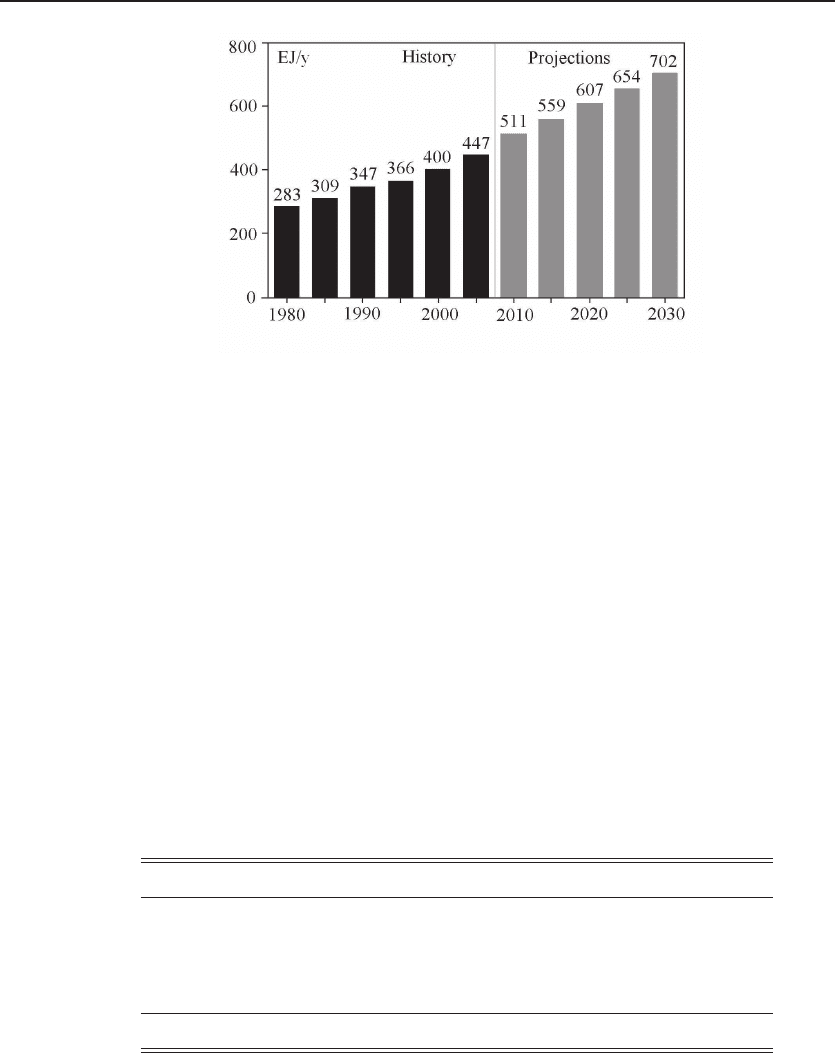
Figure 1.2 World marketed energy consumption, 1980–2030. Source: Energy Information
Administration (EIA), official energy statistics from U.S. government. History: International En-
ergy Annual 2004 (May–July 2006), website www.eia.doe.gov/iea. Projections: EIA, International
Information Outlook 2007.
Not all solar radiation falls on Earth’s atmosphere reaches the ground. About 30%
of solar radiation is reflected into space. About 20% of solar radiation is absorbed by
clouds and molecules in the air; see Chapter 5. About three quarters of the surface of
Earth is water. However, even if only 10% of total solar radiation is utilizable, 0.1% of
it can power the entire world.
It is interesting to compare the annual solar energy that reaches Earth with the
proved total reserve of various fossil fuels; see Table 1.1. The numbers show that the
total proved reserves of fossil fuel is approximately 1.4% of the solar energy that reaches
the surface of Earth each year. Fossil fuels are solar energy stored as concentrated
biomass over many millions of years. Actually, only a small percentage of solar energy
was able to be preserved for mankind to explore. The current annual consumption of
fossil fuel energy is approximately 300 EJ. If the current level of consumption of fossil
Table 1.1: Proved Resources of Various Fossil Fuels
Item Quantity Unit Energy Energy (EJ)
Crude oil 1.65 ×10
11
tons 4.2 × 10
10
J/ton 6,930
Natural gas 1.81 ×10
14
m
3
3.6 × 10
7
J/m
3
6,500
High-quality coal 4.9 × 10
11
tons 3.1 × 10
10
J/ton 15,000
Low-quality coal 4.3 × 10
11
tons 1.9 × 10
10
J/ton 8,200
Total 36,600
Source: BP Statistical Review of World Energy, June 2007, British Petroleum.
i
i
“ChenSolarEnergy” — 2011/5/17 — 17:56 — page 3 — #30
i
i
i
i
i
i
1.1 Solar Energy 3
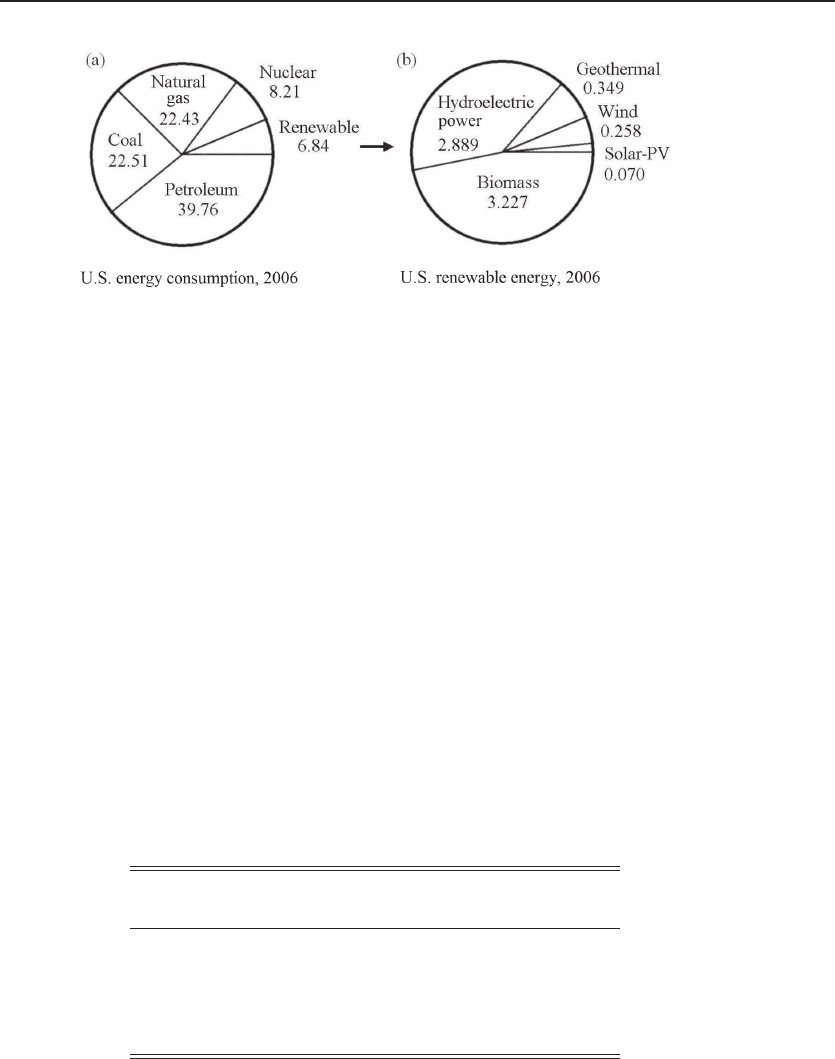
Figure 1.3 U.S. energy consumption, 2006. Source: Annual Energy Review 2006,Energy
Information Administration (EIA). The unit of energy in the original report is quad, approximately
10
18
J, or EJ. See Appendix A. In 2006, total U.S. energy consumption was 99.87 quad, almost exactly
100 EJ. Therefore, the energy value in exajoules is almost exactly its percentage. Solar photovoltaic
(PV) energy only accounts for 0.07% of total energy consumption in 2006.
fuel continues, the entire fossil energy reserve will be depleted in about 100 years.
Currently, the utilization of renewable energy is still a small percentage of total
energy consumption; see Table 1.2. Figure 1.3 shows the percentage of different types
of energy in the United States in 2006. The utilization of solar energy through photo-
voltaic (PV) technology only accounts for 0.07% of total energy consumption. However,
globally, solar photovoltaic energy is the fastest growing energy resource. As we will
analyze in Section 1.5.4, solar photovoltaics will someday become the dominant source
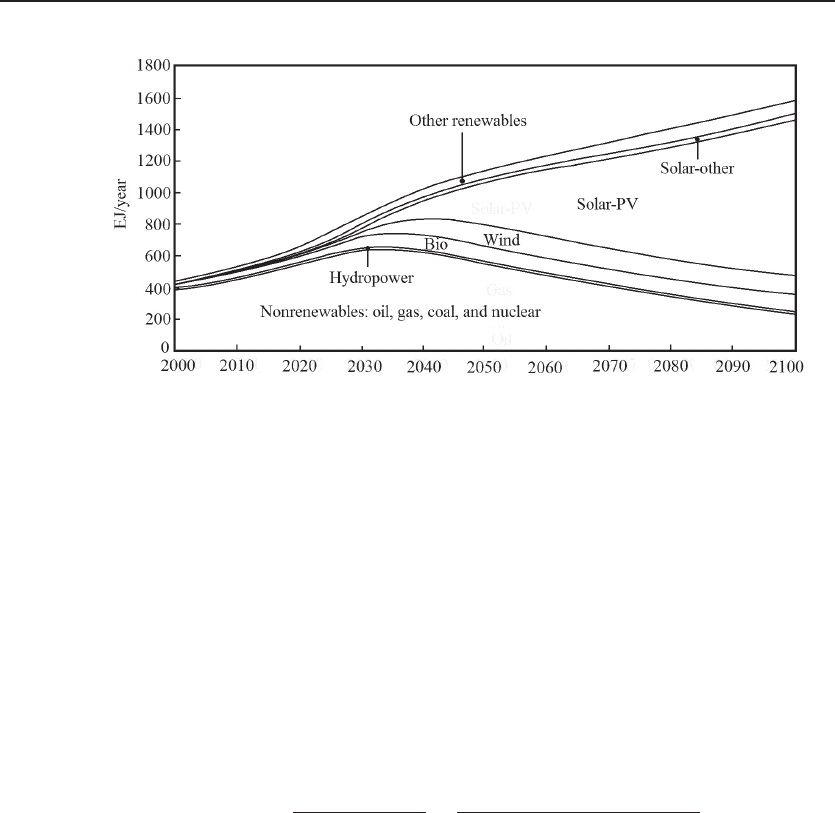
of energy. Figure 1.4 is a prediction by the German Solar Industry Association.
The inevitability that fossil fuel will eventually be replaced by solar energy is sim-
ply a geological fact: The total recoverable reserve of crude oil is finite. For example,
the United States used to be the largest oil producer in the world. By 1971, about
one-half of the recoverable crude oil reserve in the continental United States (the lower
48 states) was depleted. Since then, crude oil production in this area started to decline.
Table 1.2: Renewable Energy Resources
Type Resource Implemented Percentage
(EJ/year) (EJ/year) Explored
Solar 2,730,000 0.31 0.0012%
Wind 2,500 4.0 0.16%
Geothermal 1,000 1.2 0.10%
Hydro 52 9.3 18%
i
i
“ChenSolarEnergy” — 2011/5/17 — 17:56 — page 4 — #31
i
i
i
i
i
i
4 Introduction
Figure 1.4 Energy industry trend in the twenty-first century. Source of information: German
Solar Industry Association, 2007; see www.solarwirtschaft.de. The driving force of twenty-first century
energy revolution is economy. Because natural resources of fossil fuels and nuclear materials are finite,
the cost of production will increase with time. Solar radiation energy and the raw material to make
solar cells, silicon, are inexhaustible. Mass production of solar cells will bring the cost down. At
some time, the cost of solar electricity will be lower than that of conventional electricity, to reach grid
parity. In 2007, it was estimated that grid parity would be reached between 2020 and 2030. After
that, an explosive expansion of solar electricity would take place. Recent development indicates that
grid parity will be reached around 2015. The rapid implementation of solar electricity will take place
sooner than that 2007 prediction. See Section 1.5.4.
Therefore, crude oil production from more difficult geological and environmental con-
ditions must be explored. Not only has the cost of oil drilling increased, but also the
energy consumed to generate the crude oil has also increased. To evaluate the merit of
an energy production process, the energy return on energy invested (EROI), also called
energy balance, is often used: The definition is
EROI =
energy return
energy invested
=
energy in a volume of fuel
energy required to produce it
. (1.3)
In the 1930’s, the EROI value to produce crude oil was around 100. In 1970, it was 25.
For deep-sea oil drilling, typical value is around 10. Shale oil, shale gas, and tar sands
also have low EROI values. If the EROI of an energy production process is decreased
to nearly 1, there is no value in pursuing in the process.
On the other hand, although currently the cost of solar electricity is higher than that
from fossil fuels, its technology is constantly being improved and the cost is constantly
being reduced. As shown in Section 1.5.4, around 2015, the cost of of solar electricity
will be lower than conventional electricity, to reach grid parity. After that, a rapid
growth of solar electrcity will take place; see Fig. 1.4.

i
i
“ChenSolarEnergy” — 2011/5/17 — 17:56 — page 5 — #32
i
i
i
i
i
i
1.2 Go beyond Petroleum 5
1.2 Go beyond Petroleum
Fossil energy resources, especially petroleum, are finite, and depletion will happen
sooner or later. The transition to renewable energy is inevitable. This fact was first
recognized and quantified by a highly regarded expert in the petroleum industry, Mar-
ion King Hubbert (1903–1989). His view is not unique in the oil industry. In 2000,
recognizing the eventual depletion of petroleum, former British Petroleum changed its
name to “bp beyond petroleum.”
In 1956, M. King Hubbert, Chief Consultant of Shell Development Company, pre-
sented a widely cited report [40] based on the data available at that time, and predicted
that crude oil production in the United States would peak around 1970, then start to
decline. His bold and original predictions were scoffed but since then have been proven
to be remarkably accurate and overwhelmingly recognized.
1
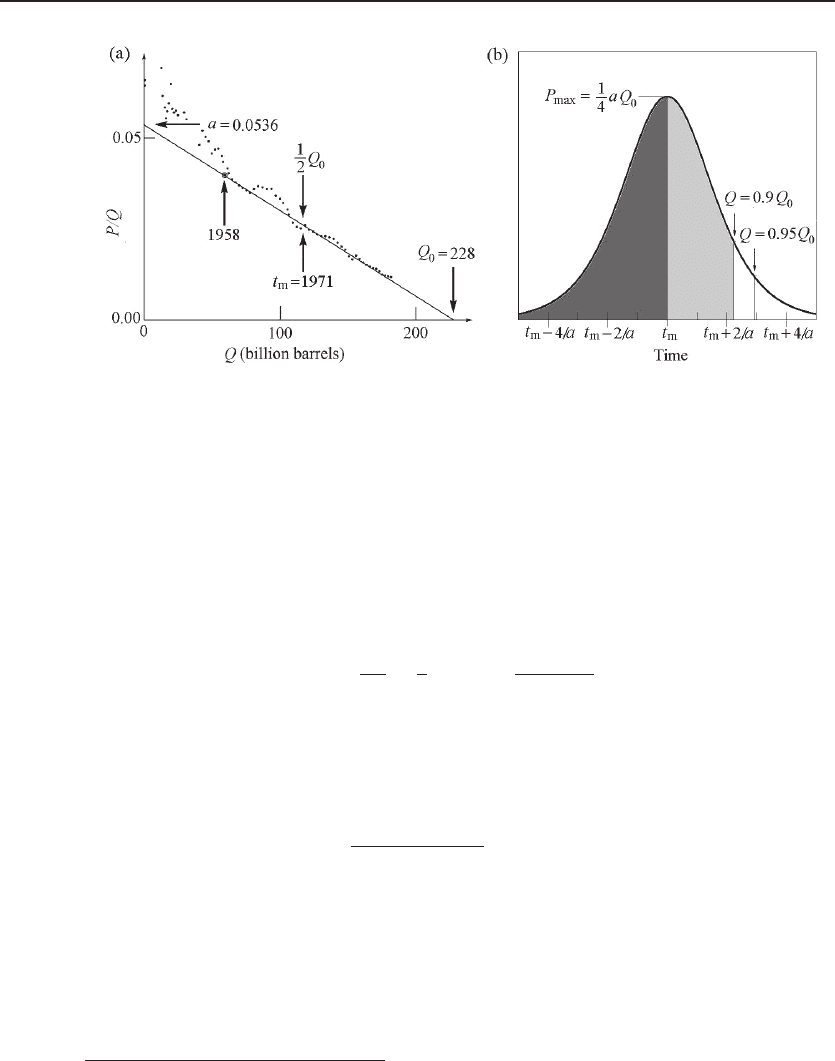
His theory started with the discovery that the plots of x, the cumulative production
of crude oil Q, versus y, the ratio of production rate P over Q, in the United States
follows a straight line; see Fig. 1.5.
The two intersections of the straight line with the coordinate axes are defined as
follows. The intersection with the x-axis, Q
0
, is the total recoverable crude oil reserve.
The value found from Fig. 1.5 is Q
0
= 228 billion barrels. The intersection with the y-
axis, a, has a dimension of inversed time. The inverse of a is a measure of the duration
of crude oil depletion; see below. The value in Fig. 1.5 is a = 0.0536/year. The straight
line can be represented by the equation
P
Q
= a
1 −
Q
Q
0
. (1.4)
By definition, the relation between P and Q is
P =
dQ
dt
, (1.5)
where t is time, usually expressed in years. Using Eq. 1.5, Eq. 1.4 becomes an ordinary
differential equation
Q
0
dQ
Q(Q
0
− Q)
= adt. (1.6)
Equation 1.6 can be easily integrated to
Q
0
dQ
Q(Q
0
− Q)
= −ln
Q
0
Q
− 1
= a(t − t
m
), (1.7)
where t
m
is a constant of integration to be determined. From Eq. 1.7,
Q =
Q
0
1+e
−a(t−t
m
)
. (1.8)
1
The mathematics of Hubbert’s theory is similar to the equations created by Pierre Fran¸cois Ver-
hurst in 1838 to quantify Malthus’s theory on population growth [85].
i
i
“ChenSolarEnergy” — 2011/5/17 — 17:56 — page 6 — #33
i
i
i
i
i
i
6 Introduction
Figure 1.5 Hubbert’s curve. (a) In 1956, Merion King Hubbert of Shell Oil studied the data of
the cumulative production of crude oil, Q, and the rate of production, P , in the United States. He
discovered a linear dependence between P/Q and Q. After Ref. [21]. (b) A curve of Q versus time can
be derived from the linear relation, Hubbert’s curve (Eq. 1.9). The peak of production occurs at time
t
m
when one-half of the crude oil is depleted. At time t
m
+2.197/a, 90% of the recoverable crude oil
is depleted. At time t
m
+2.944/a, 95% of the recoverable crude oil is depleted.
The initial and final conditions, Q =0att = −∞ and Q = Q
0
at t =+∞, are satisfied.
The time at which one half of the crude oil is depleted, Q = Q
0
/2att = t
m
,canbe
determined from historical data.
The rate of production P can be obtained using Eqs. 1.5 and 1.8,
P =
dQ
dt
=
1
4
aQ
0
sech
2
a(t − t
m
)
2
. (1.9)
Equation 1.9 represents a bell-shaped curve
2
symmetric with respect to t at t = t
m
,
see Fig. 1.5(b). Therefore, t = t
m
is also the time (year) of maximum production rate,
P
0
= aQ
0
/4. The quantity a is a measure of the rate of oil field depletion. Actually,
the time when 90% of crude oil is depleted can be determined by Eq. 1.8,
Q
0
1+e
−a(t
0.9
−t
m
)
=0.9 Q
0
, (1.10)
which yields t
0.9
= t
m
+2.197/a. Defining depletion time as the time when 95% of
crude oil is depleted yields t
0.95
= t
m
+2.944/a.
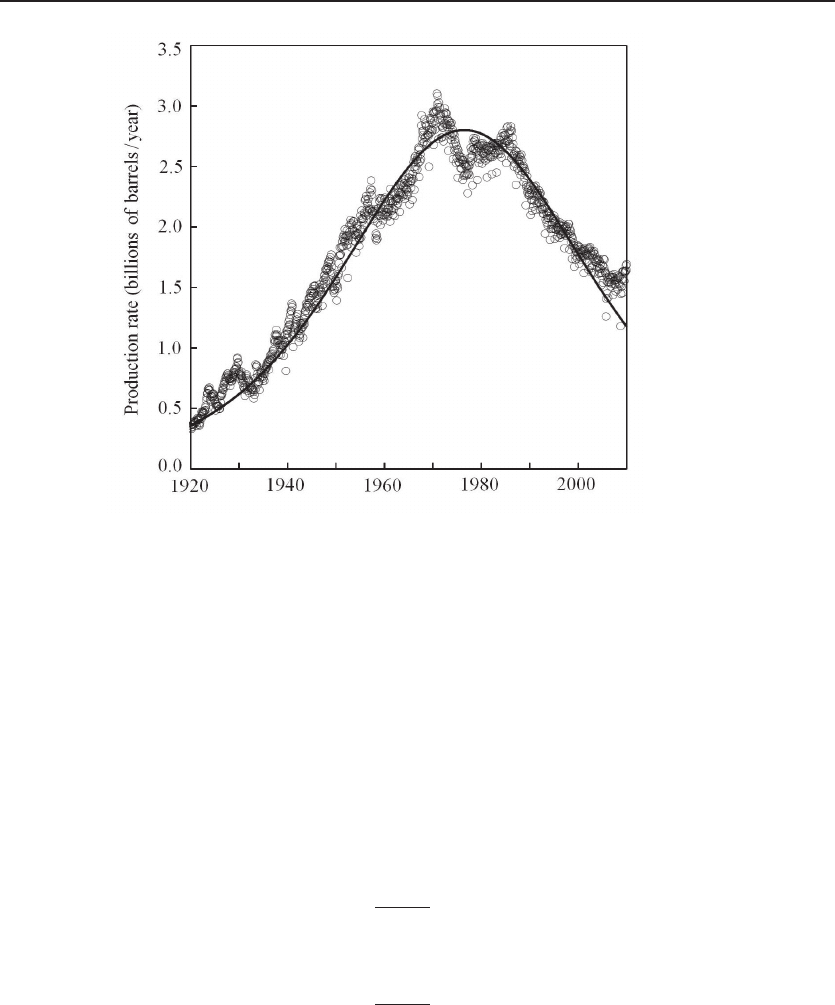
Figure 1.6 shows the crude oil production rate in the United States from 1920 to
2010. The solid curve is a least-squares fitting with a Hubbert curve; Eq. 1.9. The peak
reached in 1971 represents the crude oil production of the lower 48 states (excluding
Alaska and Hawaii). There is another peak at around 1989. In 1977, the U.S. Congress
passed a law to start drilling for crude oil in Alaska. Because Alaska did not produce
2
By definition, sech x = 1/cosh x =2/(e
x
+ e
−x
).
i
i
“ChenSolarEnergy” — 2011/5/17 — 17:56 — page 7 — #34
i
i
i
i
i
i
1.2 Go beyond Petroleum 7
Figure 1.6 Rate of U.S. production of crude oil. Circles: actual U.S. production rate of crude
oil. Source: EIA (U.S. Energy Information Administration). Solid curve: Hubbert function, using a
least-squares fit to actual data. The sudden increase of production in 1977 and the second peak in
1989 are due to oil production in Alaska; see Fig. 1.7.
any crude oil before the 1970s, according to the theory of Hubbert, it should be treated
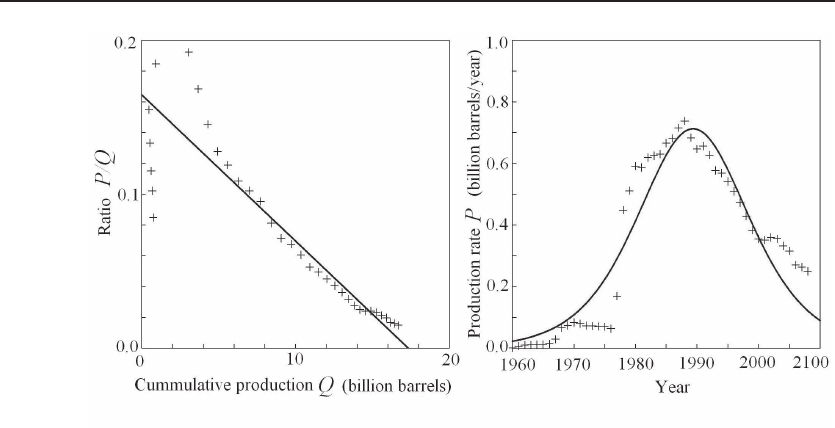
as a stand-alone case independent of the lower 48 states. Plotting the data of crude
oil production in Alaska published by the EIA, except for the earlier years, the ratio
P/Q shows a rather accurate linear dependence on the accumulative production Q; see
Fig. 1.7. From the plot Q
0
=17.3 billion barrels, a = 0.1646, and t
m
= 1989.38, at about
May 1989. Using those parameters, a Hubbert curve is constructed; see Fig 1.7(b). As
shown, except in the early years, the production data follow the Hubbert curve rather
accurately.
The date of depletion can be estimated from the parameters. For the entire United
States, a = 0.0536. The date of 95% depletion is
t
0.95
= 1971 +
2.944
0.0536
≈ 2026. (1.11)
For Alaska, the date of 95% depletion is
t
0.95
= 1989 +
2.944
0.1646
≈ 2007. (1.12)
The depletion date of Alaska crude oil is sooner than the depletion date for the entire
United States. Although crude oil in Alaska started to produce much later than the
i
i
“ChenSolarEnergy” — 2011/5/17 — 17:56 — page 8 — #35
i
i
i
i
i
i
8 Introduction
Figure 1.7 Production of crude oil in Alaska. (a) The ratio of P/Q versus Q for Alaska. Source:
EIA. (b) A Hubbert curve constructed accordingly. As shown, except in the early years, the production
data follows the Hubbert curve rather accurately.
lower 48 states, it is extracted much more aggressively there than in the other U.S.
states.
Because different countries started crude oil production at different times, a better
way of applying the Hubbert theory is to look at each country individually. Hubbert
made an estimate based on the data available in the 1950s for the entire world and
predicted a peak of crude oil production in the 2000s. Estimates based on more recent
data came up with similar results. Recent data show that this peak actually already oc-
curred. The process of discovery and depletion of other nonrenewable energy resources,
such as natural gas and coal, follows a similar pattern. As resources are dwindling, the
engineering and environmental costs of fossil fuel exploration are increasing rapidly.
The Deepwater Horizon oil spill was a wakeup call that in the twenty-first century
we must find and utilize renewable energy resources to gradually replace fossil energy
resources.
1.3 Other Renewable Energy Resources
Because of the limited reserve of fossil fuel and the cost, from the beginning of the
industrial age, renewable energy resources have been explored. Although solar energy
is by far the largest resource of renewable energy, other renewable energy resources,
including hydropower, wind power, and shallow and deep geothermal energy, have been
extensively utilized. Except for deep geothermal energy, all of them are derived from
solar energy.
i
i
“ChenSolarEnergy” — 2011/5/17 — 17:56 — page 9 — #36
i
i
i
i
i
i
1.3 Other Renewable Energy Resources 9
1.3.1 Hydroelectric Power
Hydroelectric power is a well-established technology. Since the late nineteenth century,
it has been producing substantial amounts of energy at competitive prices. Currently,
it produces about one sixth of the world’s electric output, which is over 90% of all
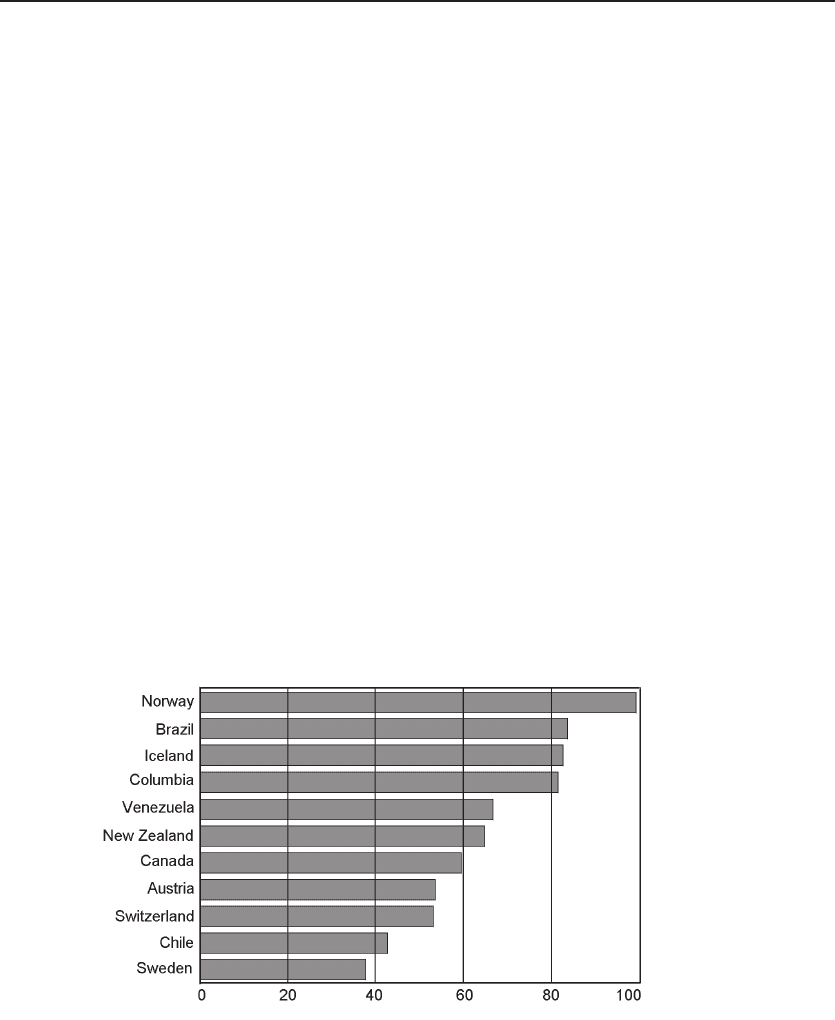
renewable energy. As shown in Fig. 1.8, for many countries, hydropower accounts for
a large percentage of total electricity. For example, Norway generates more than 98%
of all its electricity from hydropower; in Brazil, Iceland, and Colombia, more than 80%
of electricity is generated by hydropower. Table 1.3 lists the utilization of hydropower
in various regions on the world.
The physics of hydropower is straightforward. A hydropower system is characterized
by the effective head,theheightH of the water fall, in meters; and the flow rate,the
rate of water flowing through the turbine, Q, in cubic meters per second. The power
carried by the water mass is given as
P (kW) = g × Q ×H, (1.13)
where g,9.81m/s
2
, is the gravitational acceleration. Because a 2% error is insignificant,
in the engineering community, it always takes g ≈ 10 m/s
2
. Thus, in terms of kilowatts,
P (kW) = 10 × Q ×H. (1.14)
The standard equipment is the Francis turbine, invented by American engineer
James B. Francis in 1848. With this machine, the efficiency η of converting water power
to mechanical power is very high. Under optimum conditions, the overall efficiency of
converting water power into electricity is greater than 90%, which makes it one of the
most efficient machines. The electric power generated by the hydroelectric system is
Figure 1.8 Percentage of electricity generation from hydropower in various countries.
Norway generates virtually all its electricity from hydropower; in Brazil, Iceland, and Colombia, more
than 80% of electricity is generated by hydropower. .

i
i
“ChenSolarEnergy” — 2011/5/17 — 17:56 — page 10 — #37
i
i
i
i
i
i
10 Introduction
Table 1.3: Regional Hydropotential and Output
Region Output Resource Percentage
(EJ/year) (EJ/year) Explored
Europe 2.62 9.74 27%
North America 2.39 6.02 40%
Asia 2.06 18.35 11%
Africa 0.29 6.80 4.2%
South America 1.83 10.05 18%
Oceania 0.14 0.84 17%
World 9.33 51.76 18%
Source: Ref. [14], Chapter 5.
P (kW) = 10 ηQH. (1.15)
A significant advantage over other renewable energy resources is that hydropower
provides an energy storage mechanism of very high round-trip efficiency. The energy
loss in the storage process is negligible. Therefore, the hydropower station together with
the reservoir makes a highly efficient and economic energy storage system. Figure 1.9 is
a photo of one of the world’s largest hydropower station, the Itaipu hydropower station,
which supplies about 20% of Brazil’s electricity.
Figure 1.9 Itaipu hydropower station at border of Brazil and Paraguay. With a capacity
of 14.0 GW, the Itaipu hydropower station is one of the world’s largest and generates about 20% of
Brazil’s electricity.

i
i
“ChenSolarEnergy” — 2011/5/17 — 17:56 — page 11 — #38
i
i
i
i
i
i
1.3 Other Renewable Energy Resources 11
1.3.2 Wind Power
The kinetic energy in a volume of air with mass m and velocity v is
Kinetic energy =
1
2
mv
2
. (1.16)
If the density of air is ρ, the mass of air passing through a surface of area A perpen-
dicular to the velocity of wind per unit time is
m = ρvA. (1.17)
The wind power P
0
, or the kinetic energy of air moving through an area A per unit
time, is then
P
0
= ρvA ×
1
2
v
2
=
1
2
ρv
3
A. (1.18)
Under standard conditions (1 atm pressure and 18
◦
C), the density of air is 1.225 kg/m
3
.
If the wind speed is 10 m/s, the wind power density is
P
0
≈ 610 W/m
2
. (1.19)
It is of the same order of magnitude as the solar power density.
However, the efficiency of a wind turbine is not as high as that of hydropower.
Because the air velocity before the rotor, v
1
, and the air velocity after the rotor, v
2
,
are different, see Figure 1.10, the air mass flowing through area A per unit time is
determined by the average wind speed at the rotor,
m = ρA
v
1
+ v
2
2
. (1.20)
Thus, the kinetic energy picked up by the rotor is
Kinetic energy difference =
1
2
mv
2
1
−
1
2
mv
2
2
. (1.21)
Figure 1.10 Derivation of Betz theorem of wind turbine. Wind velocity before the turbine
rotor is v
1
, and wind velocity after the turbine rotor is v
2
. The velocity at the rotor is the average
velocity, and the power generated by the rotor is related to the difference in kinetic energy.