
Claverie J-M., Notredame C. Bioinformatics for Dummies
Подождите немного. Документ загружается.

6. Click the Load Sequence button.
A new Input form appears.
7. Leave the Input form as is and click the Start Task button.
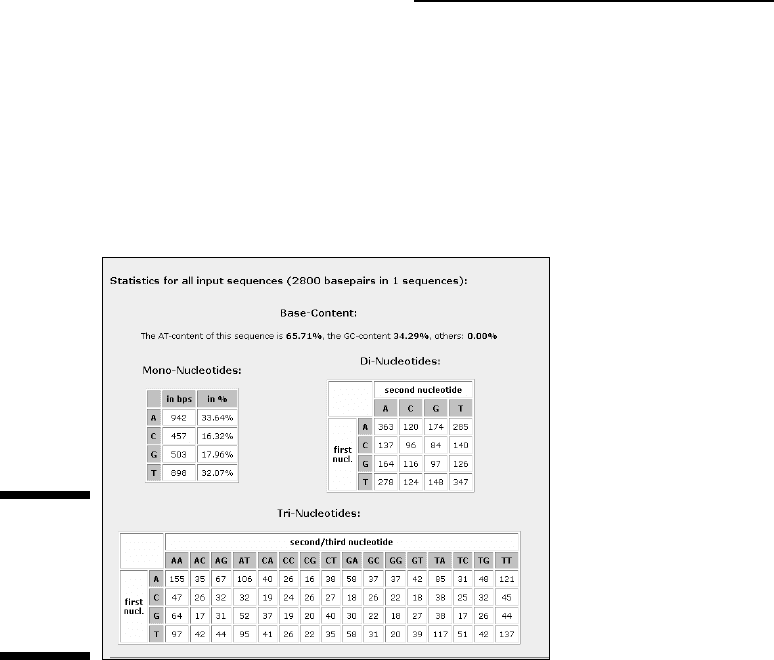
The preset options compute the AT percent and GC percent, as well as
the nucleotides, dinucleotides, and trinucleotides frequencies and pre-
sents the results, as shown in Figure 5-4.
Counting long words in DNA sequences
When analyzing DNA, it can be interesting to count words that are longer
than three nucleotides, although it is rare to use words with sizes above six
or eight. When their size is larger than 3, words are often referred to as
k-tuples (6-letter words = hexamers = 6-tuple). There are 64 different 3-tuples,
256 4-tuples, 1,024 5-tuples, and 4,096 6-tuples. It makes no sense to compute
the hexamer statistics on a short sequence where most hexamers occur, at
most, only once. On the other hand, identifying hexamers (6-tuples) with
unexpected high frequencies in a set of sequences (such as promoter regions)
is often the starting point for discovering regulatory sequence motifs.
The EMBOSS server at the Pasteur Institute, based in Paris, offers an online
version of the program wordcount that allows you to compute the word fre-
quency in your DNA sequence for any size (we tested it up to 20 letters).
Here’s how you get it to work for you:
Figure 5-4:
Typical
composi-
tional
analysis
result.
140
Part II: A Survival Guide to Bioinformatics
10_089857 ch05.qxp 11/6/06 3:56 PM Page 140

1. Point your browser to bioweb.pasteur.fr.
Click the English/American flag (top right) for the English version.
2. Click the EMBOSS link at the bottom-left of the page.
The list of EMBOSS modules appears.
3. Click the wordcount link.
The wordcount page appears in all its glory.
4. Enter your e-mail address and paste your sequence (raw format is
okay) in the appropriate fields. Be sure to enter the word size you’re
interested in as well.
5. Click the Run wordcount button at the top-left of the page.
After a few seconds, a result page appears.
6. Click the wor
dcount.out
link to get your results as a simple list.
141
Chapter 5: Working with a Single DNA Sequence
Triplet counting versus codon frequency
We introduce the concept of counting trinu-
cleotides (triplets or 3-tuples) in this chapter.
These computations are always done by reading
the DNA sequence on one strand, in an over-
lapping manner. This should not be confused
with the computation of codon usage. (Remember
that a
codon
is a triplet of nucleotides used in
the context of the genetic code, when translating
a DNA sequence into a protein; see Chapter 1.)
The concept of codon usage thus only applies
to DNA sequences corresponding to protein
coding regions (for example, open reading
frames or ORFs). It consists in computing the
frequency of trinucleotides in a non-overlapping
manner, mimicking the protein translation
process. Hence, for a DNA sequence such as
ATGTTTAGTGATGGACGCCCAGCATGC
GAC....
The codon frequency is computed using the fol-
lowing parsing:
ATG, TTT, AGT, GAT, GGA, CGC,
CCA, GCA, TGC, GAC, ...
The resulting table of codon usage tells you
which codons are preferentially used to code
for a given amino acid — and, more importantly,
to determine which ones are rare. Codon usage
varies among species. For instance, the codon
usage in human genes is quite different from the
one used by
E. coli.
For this reason, some
human genes don’t work well in these bacteria.
Take a virtual trip to Japan at
www.kazusa.or.jp/codon/
countcodon.html
to test a simple codon usage program on your
DNA sequence.
10_089857 ch05.qxp 11/6/06 3:56 PM Page 141

Experimenting with other DNA
composition analyses
While you’re at the Pasteur Institute site, use the opportunity to further
explore the list of available EMBOSS modules, such as
chips (for codon usage
statistics), or the CpG rich region finder
cpgreport.
Finding internal repeats in your sequence
Another useful type of composition analysis involves locating segments that
occur more than once within your sequence. Such segments are called
repeats.
There is no real difference between long words (6-tuple, 8-tuple, and larger)
and repeats. Here’s a common-sense rule:
A repeat is a word long enough so
that it’s unlikely to occur very often by chance, given a random sequence.
For
instance, a GTC triplet found 4 times within a 500-nucleotide long sequence
doesn’t qualify as a repeat.
Another difference between word-counting and repeat analysis is that repeats
can be imperfect. Unlike words, similar repeats don’t need to be identical.
Finally, biologists like to distinguish
tandem repeats (similar subsequences
along the same DNA strand) from
inverted repeats (similar sequences occur-
ring on the direct and reverse strands). Biologists are interested in repeats
because they are often involved in genome rearrangements or regulatory
mechanisms of gene expression.
There are many different algorithms for finding repeats within a DNA (or pro-
tein) sequence. They all try to identify segments more similar to each other
than would be expected by mere chance alone. The tricky part is in the scor-
ing and ranking of the similar subsequence segments. Is the exact matching
of five consecutive nucleotides good enough to be considered a repeat? And
is it better than 9 out of 10, or 123 over 160? Which one do you want reported
first? How far down the list of possible repeats do you want to go?
Finding repeats is a tricky business
Because there are no universal answers to the questions surrounding the pre-
cise nature of repeats, repeat-finding programs ask you to fix thresholds related
to their scoring algorithms, repeat size, copy number, periodicity (distance
between repeats), and other things you don’t always understand. This makes
them difficult to use. The default settings they provide may or may not work
for your particular sequence.
In that respect, our quick survey of Web-based repeat finders — using a
repeat-containing sequence we made just for this purpose — was amazingly
142
Part II: A Survival Guide to Bioinformatics
10_089857 ch05.qxp 11/6/06 3:56 PM Page 142
unsuccessful on all the available servers. But that doesn’t mean these servers
are bad — only that the problem is truly complicated.
Never believe a negative output from a repeat finder!
Fortunately, there is one simple universal (DNA/protein) approach that avoids
all these difficulties. It is the
dot-plot approach, which we show you in the fol-
lowing steps list. (For more on dot plots, see Chapter 8.)
For long nucleic acid sequences, you can use the dot-plot program provided
by the Molecular Toolkit Web service at Colorado State University. Just do
the following:
1. Point your browser to arbl.cvmbs.colostate.edu/molkit/.
The Molecular Toolkit is a group of programs for analysis and manipula-
tion of nucleic acid and protein sequence data. The programs are writ-
ten in Java (1.0), and require that your browser support this language.
This site is very useful if you need to perform some simple DNA
sequence manipulation, such as reverse complementation (changing
strands), protein translation, or if you want to display a restriction map.
For now, continue through these steps.
2. Click the Dot Plots link at the top of the list.
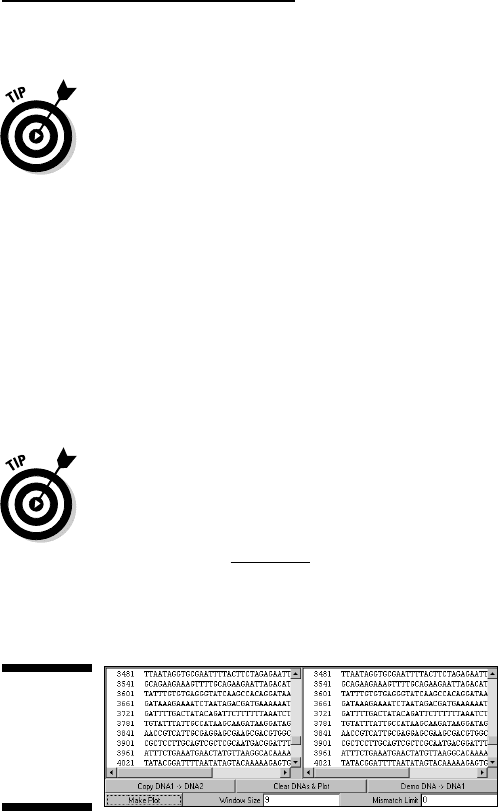
You obtain a straightforward input form, with two side-by-side boxes
titled DNA Number 1 and DNA Number 2, as shown in Figure 5-5.
3. Copy your sequence from a .txt file or a Word document, by using
Ctrl+C or the Copy button on the Word toolbar.
4. Paste your sequence in the DNA Number 1 window by using Ctrl+V or
Word’s Paste button.
The program is happy with the raw sequence format (nucleotide only).
5. Copy your sequence into the DNA Number 2 window as well.
For this, you can use the special Copy DNA1 -> DNA2 button provided
below the DNA Number 1 window.
Figure 5-5:
Input form
of the DNA
dot-plot
program.
143
Chapter 5: Working with a Single DNA Sequence
10_089857 ch05.qxp 11/6/06 3:56 PM Page 143
6. Click the Make Plot button, located below the DNA sequence boxes.
Your dot plot magically appears. That’s all there is to it!
Limit yourself to a sequence under 10,000 bp if you aren’t prepared to
wait for several minutes.
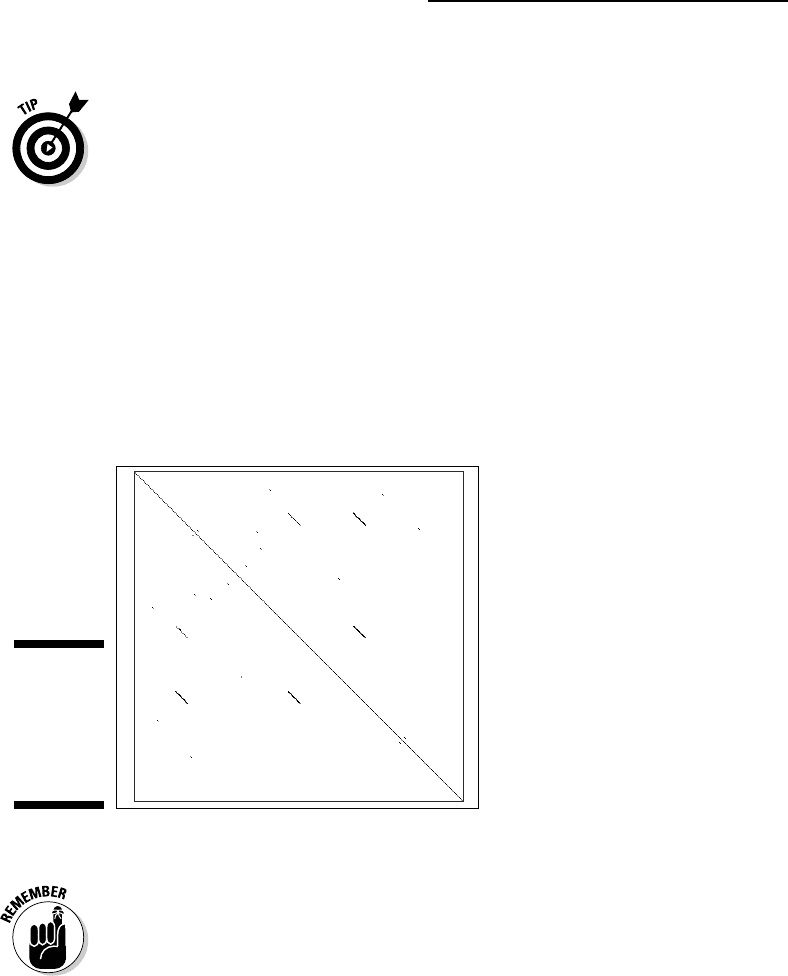
In this case, you can get the dot plot quickly — in real time. It appears in the
square below the input windows. For the example in Figure 5-6, we made up a
sequence in which a large segment is imperfectly repeated three times. These
repeats show up as three lines both in the upper and lower diagonal parts of
the plot. The locations of the repeated sequence segments are found by pro-
jecting them onto the main diagonal (see Figure 5-6). The long repeats stand
out in comparison to non-significant, shorter, random repeats of length 9 to
15 (which show up as mere dots). Using your own sequence, you can experi-
ment with the Window Size parameters (minimal size of the repeat) as well as
the Mismatch Limit parameters (number of non-identical nucleotides) to see
how they influence the graph appearance.
Using dot plots to identify inverted repeats
It’s important to remember that you can also use a dot-plot program to search
for inverted repeats — local similarities between the
direct and reverse strand
of a DNA sequence. To do this, you simply have to use the sequence along
the X-axis (DNA Number 1), and its
reverse-complement along the Y-axis (DNA
Number 2). Use the Manipulate Sequences option at
arbl.cvmbs.colostate.
edu/molkit/
to generate a sequence’s reverse-complement. The only differ-
ence with the previous protocol is that the main diagonal disappears. Inverted
repeats will show up again as off-diagonal segments.
Figure 5-6:
Dot plot
showing a
segment
repeated
three times.
144
Part II: A Survival Guide to Bioinformatics
10_089857 ch05.qxp 11/6/06 3:56 PM Page 144
Identifying genome-specific
repeats in your sequence
Do not confuse the discovery of a new repeat in your sequence with the iden-
tification of a repeat from a pre-established list of repeats, like the Alu repeat
family in the human genome. Discovering a new repeat has to do with the
internal structure of your sequence; identifying an established one is simply a
matter of recognizing some local similarities between your sequence and a
predefined reference database of repeats.
Repeated elements mostly occur in multicellular organisms. Vertebrate
genomes are particularly rich in many families of repeated elements of various
sizes. You can get a fairly complete picture of this topic by visiting the Repbase
Web site of the Genetic Information Research Institute at
www.girinst.org.
This site gives you access to the CENSOR software tool, which screens query
sequences against a reference collection of repeats, “censors” (that is, masks)
matching portions with special symbols, and also generates a report on
found repeats.
A similar service is offered at
www.repeatmasker.org on a server based at
the Institute for Systems Biology. Note that the program will mask, on aver-
age, a whopping 50% of the human genome sequence!
Finding Protein-Coding Regions
Get ready — this is where the fun starts! We’ve checked our DNA sequence
for contamination, verified its restriction maps, computed various composi-
tion statistics, and identified its repeats. It’s time to move to the really excit-
ing stuff! We can search to find whether and where a protein is encoded in
that obscure ATGCTACG gobbledygook.
To understand what is known as
protein discovery, you must remember that
protein-coding genes have vastly different structures in microbes and multi-
cellular organisms. In microbes, each protein is encoded by a simple DNA
segment — from start to end — called an open reading frame (ORF). In ani-
mals and plant genes (vertebrates are the worst), proteins are encoded in
several pieces called
exons, separated by non-coding DNA segments called
introns. That explains why the methods and programs used for finding pro-
teins in microbes and higher eukaryotes are rather different.
This section starts with a simple strategy called
ORFing, which shows you
how to find protein-coding regions in microbial DNA sequences or eukaryotic
mRNA sequences.
145
Chapter 5: Working with a Single DNA Sequence
10_089857 ch05.qxp 11/6/06 3:56 PM Page 145
ORFing your DNA sequence
To code for a protein, a DNA sequence must contain a translation Start codon
(usually ATG) and not exhibit any of the Stop codons (usually TAA, TAG,
TGA) in phase with the ATG for quite some length. This is the precise defini-
tion of an open reading frame. Given that proteins have an average length of
about 350 residues (and that very few of them are smaller than 100 residues),
you can use an additional criterion — minimal size — for example, requesting
that at least 300 nucleotides separate the Start from the Stop. This is what
ORFing is all about. You can get some practice by using ORF Finder at NCBI
(the National Center for Biotechnology Information), as we describe in the
following steps list:
1. Point your browser to www.ncbi.nlm.nih.gov/gorf/gorf.html.
The Input form is made up of a simple box, where you must paste your
sequence (raw format), and a pull-down menu of genetic code choices.
(We’re ready to bet good money that you never knew there were 16
genetic code choices. So much for the universal code!) For now, let’s
stick with the standard genetic code (the default option).
2. Copy your sequence from a .txt file or a Word document.
We used the first 5,000 bp of GenBank entry AE008569 (Rickettsia conorii
genome). Alternatively, you can enter this accession number in the rele-
vant input box, and indicate from 1 to 5,000 below the sequence input
box. Then directly go to Step 4.
3. Paste your sequence in the input box.
The program is happy with the raw sequence format (nucleotide only).
4. Click the OrfFind button.
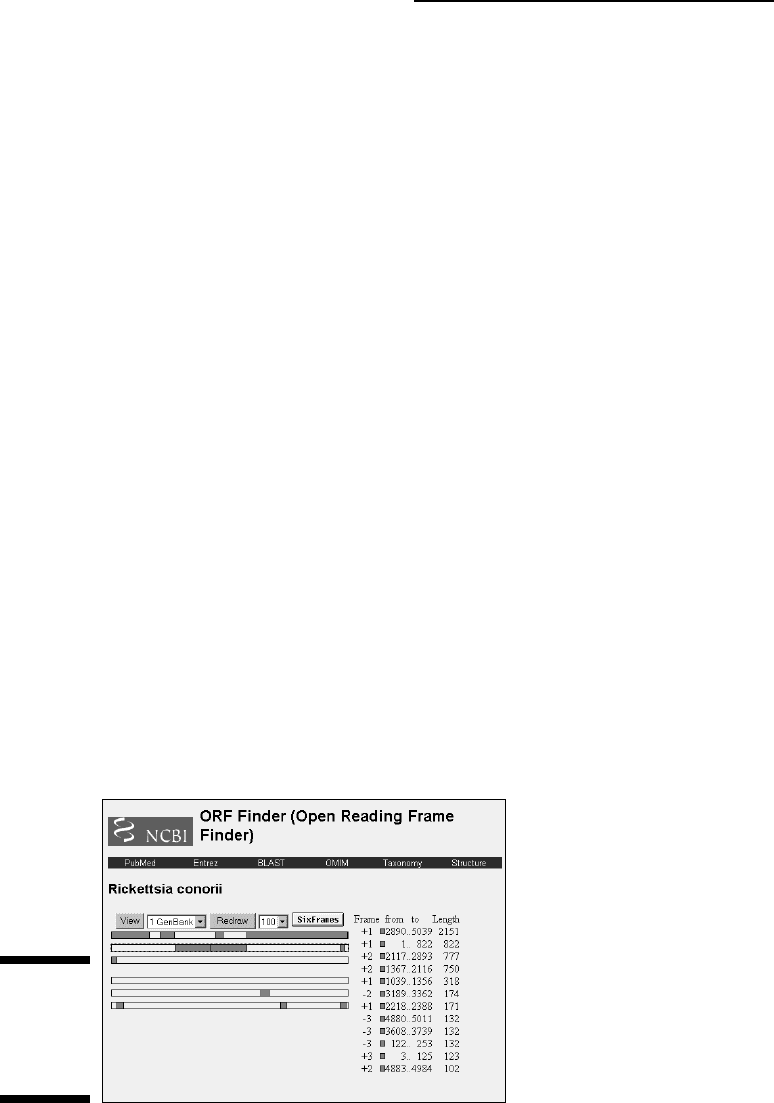
Figure 5-7 shows a typical output.
Figure 5-7:
Typical
output of the
ORF Finder
program.
146
Part II: A Survival Guide to Bioinformatics
10_089857 ch05.qxp 11/6/06 3:56 PM Page 146
Your DNA sequence is displayed as six parallel horizontal bars, with each one
corresponding to one of the six possible translation frames: +1, +2, +3 and on
the reverse strand: –1, –2, and –3. The ORFs verifying the default size thresh-
old (100 nucleotides) appear as small green rectangles on each bar. In addi-
tion to the graphical representation, the ORFs are also listed according to
size. At this point, you’re free to modify the size threshold (50, 100, 300).
Always click the Redraw button to refresh the output.
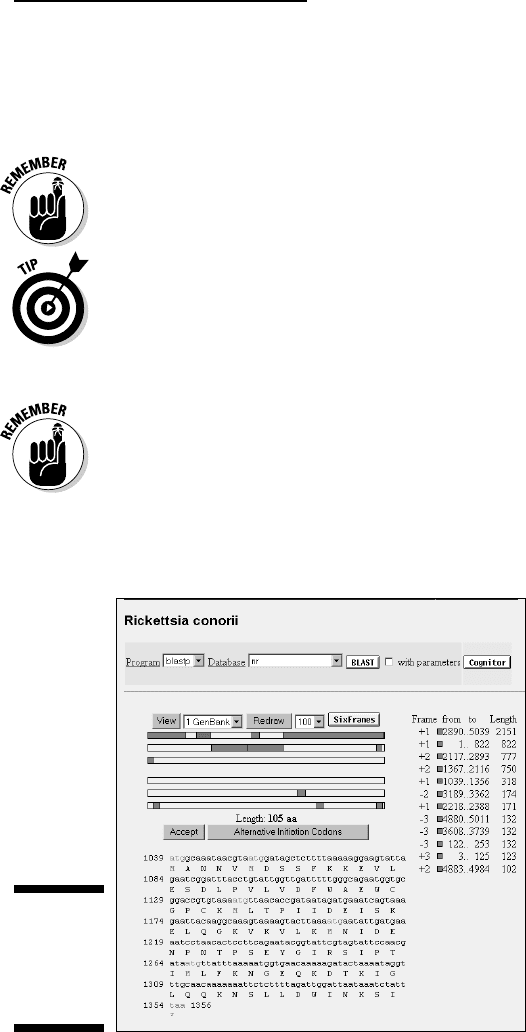
To examine each of the ORFs more closely, click the corresponding rectangle
in the graphical display or in the list to the side. This expands the output to
include the predicted amino-acid sequence and some supplementary but-
tons, as shown in Figure 5-8. These buttons let you screen some of the NCBI
databases for sequences similar to this ORF,
right on the spot! This is a great,
simple tool for ORFing your sequence.
Before getting into more complicated programs, we want to remind you that
this simple ORFing program is also good for finding protein-coding regions
for higher organisms
if your sequence is a cDNA. cDNAs (the image of mRNAs)
don’t include introns — and they have a simple, microbe-like ORF structure.
So you don’t need to use another, more sophisticated program if you only
want to delineate the protein-coding region within a human cDNA/mRNA
sequence.
Figure 5-8:
Secondary
output of the
NCBI ORF
Finder.
147
Chapter 5: Working with a Single DNA Sequence
10_089857 ch05.qxp 11/6/06 3:56 PM Page 147
Analyzing your DNA sequence
with GeneMark
The simplest ORFing protocols can probably correctly identify 85 percent of
the protein-coding regions you may be interested in. However, there are a
variety of situations that frequently occur where you may need to use a more
sophisticated approach — the approach taken by GeneMark, for example.
Such situations include
Finding very short proteins
Resolving ambiguous cases where overlapping ORFs are predicted in dif-
ferent reading frames — on the direct and reverse strand, for instance
Wanting to pinpoint the exact Start codon (the most distal ATG isn’t
always the correct one)
GeneMark searches for coding regions using a criterion that’s a bit more
sophisticated than “it has to be an uninterrupted reading frame longer than a
certain length.” This program also takes into account the statistical proper-
ties (very similar to word/codon usage) of your sequence and associates
some sort of a probabilistic quality index to each candidate’s ORFs. In the
process, some small ORFs may get promoted, and the precise Start location
may be redefined. The quality index measures the similarity between the can-
didate ORFs and an ideal gene model. This gene model is often implemented
as a Markov model, a mathematical concept beyond the scope of this book.
The good news for you here is that these programs are easier to use than to
understand. This is what we show you in the upcoming steps. Here goes:
1. Point your browser to exon.gatech.edu/GeneMark/.
This is the main GeneMark home page, coming to us from Georgia Tech
in Atlanta. It offers different specialized versions of the program (each
corresponds to a different gene model) for working on prokaryotic
(microbes), eukaryotic (animals), cDNA (the DNA version of mRNA), or
virus sequences. (For the purpose of the example, let’s say you want to
analyze a sequence from a microbe that is little known.)
2. In the Bacteria/Archaea section, click the Heuristic models link.
This selects the program version corresponding to the analysis of
sequences from a new organism. It brings you to a simple form with the
usual sequence input box.
3. Copy your sequence from a .txt file or a Word document.
We recommend using a microbial sequence about 5,000 bp in length.
4. Paste the sequence in the input box.
The program is happy with the raw sequence format (nucleotides only)
as well as many others.
148
Part II: A Survival Guide to Bioinformatics
10_089857 ch05.qxp 11/6/06 3:56 PM Page 148
5. Click the Start GeneMark.hmm button to run the search.
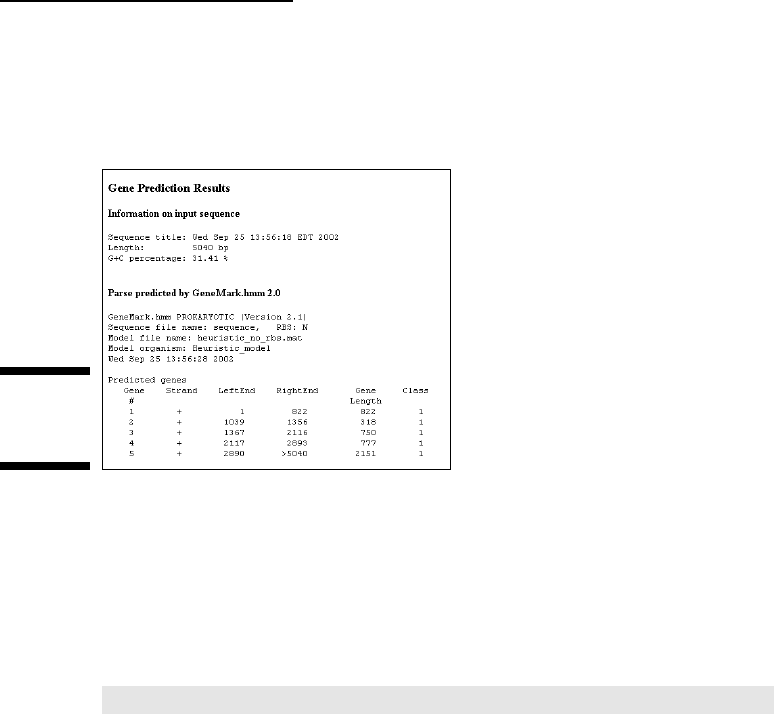
After a while, the program outputs a list of predicted genes — with their
locations — in a very simple format, as shown in Figure 5-9.
If you’re wondering what difference it makes to use a Markov model rather
than a simple ORFing, the answer is in the differences between Figure 5-8 and
Figure 5-9 — both of which relate to the same query sequence. GeneMark
only retained the top five genes of the ORF Finder list!
Note that you can also run GeneMark (in the known model version) from its
site at the European Bioinformatics Institute. The URL is
www.ebi.ac.uk/genemark/
Finding internal exons in vertebrate
genomic sequences
When it comes to predicting proteins from DNA, the most challenging prob-
lem around is analyzing a piece of human genomic DNA sequence. We already
mentioned that vertebrate genes have a mosaic structure, where small bits of
the protein are encoded by exons separated by non-coding introns. If you’re
looking at a human genomic sequence, your first question should be:
Do I
have a protein-coding exon somewhere in there?
According to what molecular biologists have worked out, a protein coding
exon is an ORF flanked by two specific signals known as
splice sites. Several
programs exist that are meant to recognize these exons. They all work on the
same principle: On a first pass, they identify candidate ORFs with good com-
positional properties (such as word frequency and codon usage). This is
Figure 5-9:
Output of
GeneMark.
149
Chapter 5: Working with a Single DNA Sequence
10_089857 ch05.qxp 11/6/06 3:56 PM Page 149