
Claverie J-M., Notredame C. Bioinformatics for Dummies
Подождите немного. Документ загружается.

basically what GeneMark does. On a second pass, they retain only those that
are exactly flanked by good splice-site sequences.
Vertebrate exons are small (150-bp long on average), and the sequences of
their splice sites are variable. For this reason, finding exons is a more challeng-
ing problem than ORFing microbe DNA — so don’t expect an exon-detection
program to work nearly as well as something like ORF Finder or GeneMark.
(After all, those programs have much larger targets to shoot at.) Still, we’d
like to show you what an exon detection program can do. Check out the fol-
lowing steps, where we use Michael Zhang’s program MZEF:
1. Point your browser to rulai.cshl.edu/.
This is the Zhang Laboratory home page at Cold Spring Harbor
Laboratory, on beautiful Long Island.
2. On the next page, click the Gene-Finding link in the Software Tools
section.
3. In the next Gene Finder page, select Human.
This selects the program version calibrated for human coding-region
statistics. A simple input form is then displayed.
4. Copy your sequence from a .txt file or a Word document.
If you don’t have a sequence handy, you can fetch the sequence AF018429
from GenBank at NCBI (
www.ncbi.nlm.nih.gov). This entry contains
the exons 1 and 2 of the dUTPase gene.
Make sure you get the sequence in FASTA format.
5. Paste the sequence you copied into the input box.
6. Click the Submit button (below the sequence-input box) to start your
analysis.
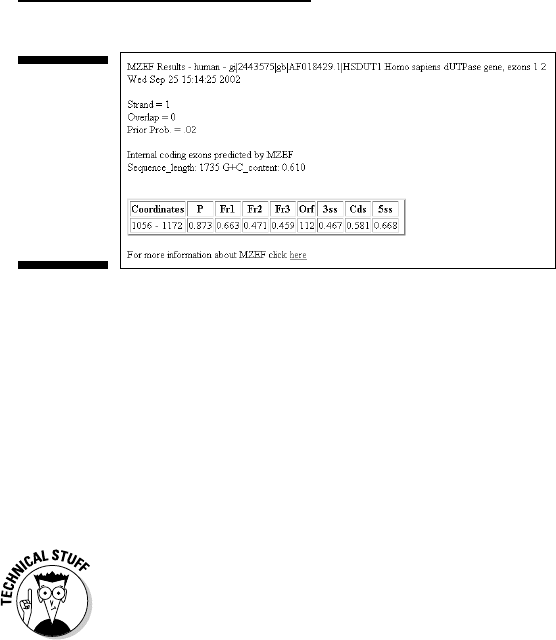
The program quickly returns a minimally formatted output, as shown
in Figure 5-10. MZEF correctly identified one exon between positions
1056–1172. The rest of the line consists of various quality values associ-
ated with the overall prediction, the various reading frames (FR1, FR2,
FR3), the splice site, and the coding potential. The prediction is half
correct because it missed one exon. Furthermore, the predicted exon
actually starts at position 1018. Such a success rate — about half the
attempts, which isn’t entirely perfect — isn’t so unusual for exon-finding
programs.
An exon predictor that combines MZEF with other approaches (which
enhances its performances) is available at this Michigan Tech site:
genome.cs.mtu.edu/aat/aat.html
150
Part II: A Survival Guide to Bioinformatics
10_089857 ch05.qxp 11/6/06 3:56 PM Page 150
Complete gene parsing for
eukaryotic genomes
If you ever get into serious genome sequencing, you’ll need the highest level
of sophistication in computer-assisted annotation: genome-parsing software.
These programs are designed to take large (100,000 to several million bp)
pieces of a genomic sequence at once and predict the detailed exon/intron
structure of entire genes.
Like the MZEF program, these programs have a modular structure, where
each module has been designed to recognize a given gene component: coding
exons, first/last exons, promoter regions, poly-adenylation sites, and so on.
The results of these independent modules are then combined into coherent
gene-structure predictions (limiting exon splicing to compatible reading
frames, for instance) — and these are finally scored according to their simi-
larity with an ideal gene model. Markov models and dynamic programming
optimization are what make these programs so effective.
The most recent genome parsers, such as GenomeScan, also take into
account information on protein-sequence similarity.
Despite their increasing algorithmic complexity, these programs remain easy
to use; all you really have to do is paste your sequence into an input window,
click a button, and voilà — you have parsed genes!
Analyzing your sequence
with GenomeScan
To show you how simple it is, we’re going to show you how to use the
GenomeScan parsing software program. To get things ready, prepare your
Figure 5-10:
MZEF
output
on the
GenBank
AF018429
sequence
entry.
151
Chapter 5: Working with a Single DNA Sequence
10_089857 ch05.qxp 11/6/06 3:56 PM Page 151

own vertebrate genome sequence in FASTA format. It has to be long enough
(100,000 bp) to contain at least one complete gene. Alternatively, you can use
the demonstration sequence available on the GenomeScan site.
You also need protein sequences (also in FASTA format) that you know have
some significant similarity with potential coding regions in your DNA sequence.
You can find such proteins by doing a blastx comparison of your sequence to
all known proteins. (For more on blastx, see Chapter 7.) Alternatively, you
can use the demonstration set available on the GenomeScan site.
1. Point your browser to genes.mit.edu/genomescan/.
The GenomeScan home page at the Massachusetts Institute of Technology
duly appears. GenomeScan is the successor to Chris Burge’s GenScan. The
main difference is the use of protein homology information.
2. Click the GenomeScan Webserver link to call up the page with the
input form.
3. Choose Vertebrate from the Organism pull-down menu.
This selects the program version calibrated for human coding regions
statistics.
4. Copy your DNA sequence from a .txt file or a Word document.
Don’t forget the FASTA header.
5. Paste the DNA sequence you copied into the DNA Sequence input
box — the upper of the two larger input boxes.
Alternatively, you may click the DNA testfile link at the top of the page to
use the demo sequence.
6. Copy your homologous protein sequence set from a .txt file or a
Word document.
Alternatively you may click the pr
otein file
link at the top of the page to
use the demo protein sequences.
Each sequence must have a FASTA header. The set may contain multiple
proteins so long as each is separated by a header on its own line. Files
should contain less than 1 million bases.
7. Paste your protein sequence into the Protein Sequence input box —
the lower of the two larger input boxes.
8. Click the Run GenomeScan button at the bottom of the form to start
the analysis.
The output is a very long table listing all the components of the various pre-
dicted genes, with their coordinates and associated quality indices. This output
is meant to be read by computer programs in the context of large-scale
152
Part II: A Survival Guide to Bioinformatics
10_089857 ch05.qxp 11/6/06 3:56 PM Page 152
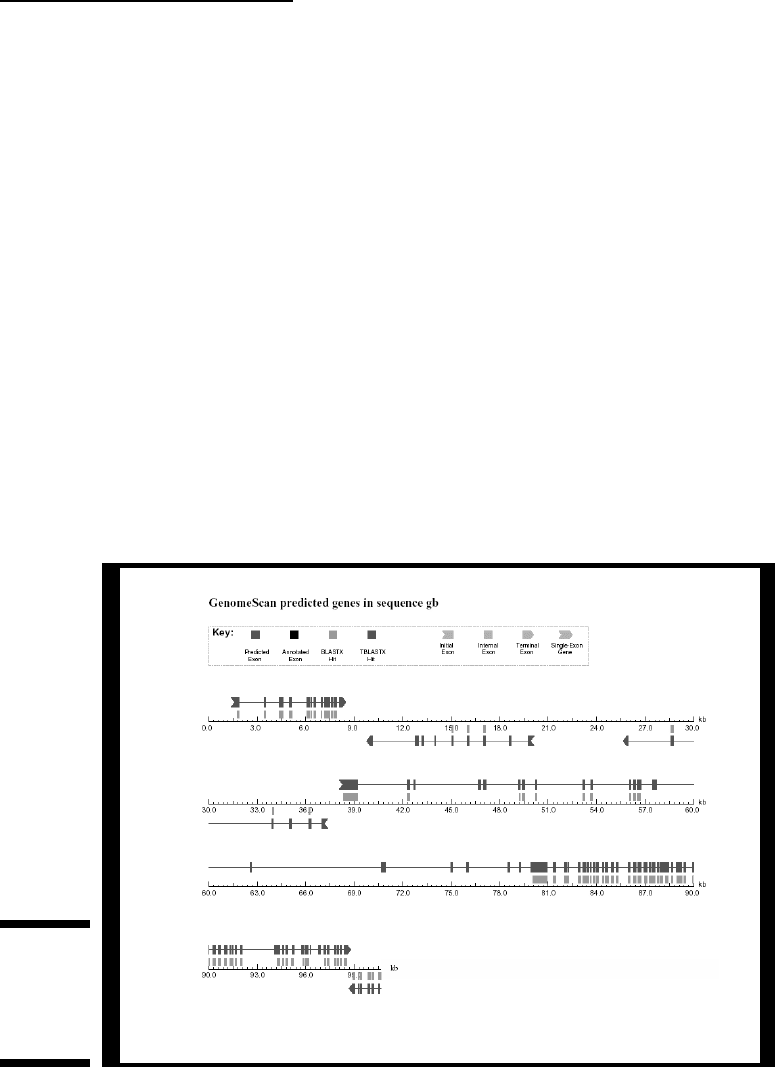
sequencing projects and automated annotation. Fortunately, GenomeScan
also provides a nice graphical output both as PDF and PostScript images.
Figure 5-11 shows an example of the graphical output generated from the
demo DNA and protein sequences (sorry, you’ll have to use your imagination
to provide the colors on this black-and-white page). Predicted genes (red
arrows) and their predicted exons (red rectangles) are clearly indicated,
together with their supportive evidence from blastx similarity (green rectan-
gle below). A total of 5 genes are predicted along this 100,000-bp long verte-
brate genomic sequence.
Assembling Sequence Fragments
Depending on their technology, current sequencing machines can only produce
sequences at lengths of 500 to a 1,000 nucleotides at a time. Thus, if your DNA
sequence is longer than this, it has been obtained by assembling shorter,
overlapping fragments. Research into the various assembly algorithms — as
well as research devoted to the development of better assembly software —
is vital to bioinformatics.
Figure 5-11:
Example of
GenomeScan
graphical
output.
153
Chapter 5: Working with a Single DNA Sequence
10_089857 ch05.qxp 11/6/06 3:56 PM Page 153

Managing large sequencing projects
with public software
Taking what we would label the shotgun approach, most researchers stitch
together a typical microbial genome sequence (4MB) using over 50,000 indi-
vidual fragments known as
reads. The programs used for such genome
sequencing — or for bigger projects involving plant or animal genomes —
take their input directly from the sequencing machine’s
chromatograms or
traces. These traces are complex fluorescent profiles with peaks and valleys
revealing the order and nature (A, T, G, C) of each nucleotide in the reads.
Such programs include a base-calling system that associates a quality score
to each nucleotide at each position of each read. They also include a data-
management system, as well as interactive editing and display tools. Because
of their complexity, these complete genome-sequencing software packages
are not interactively available on Web sites; you have to install them locally
on a dedicated powerful machine. Using them efficiently also requires some
serious study. The most popular genome-sequencing packages that are pub-
licly available (for academics) are these:
The Staden Package: staden.sourceforge.net/
Phred/Phrap/Consed: www.phrap.org/
The Acembly engine included in the popular AceDB suite:
www.acedb.org/
The Assembler from The Institute for Genome Research (TIGR):
www.tigr.org/software/
Commercial genome-sequencing software packages are also available from
several companies:
Sequencher (from Gene Codes): www.genecodes.com/
Lasergene (from DNASTAR): www.dnastar.com/
We believe that showing you how to manage a large genome-sequencing pro-
ject is beyond the scope of this introductory book. However, you may still
encounter the need to assemble a handful of sequences in your everyday
research life. For instance, you might be working on a cDNA that’s just a
few thousand bp in length, represented by a dozen PCR fragments. You may
have generated a number of
expression sequence tags (ESTs — that is, pass-
sequenced partial cDNAs) and want to see whether you can deduce a com-
plete cDNA from the tags. Alternatively, you may want to assemble ESTs you
extracted from a database. In the latter case, you may not have the corre-
sponding traces and base-call quality scores.
154
Part II: A Survival Guide to Bioinformatics
10_089857 ch05.qxp 11/6/06 3:56 PM Page 154

What you’re looking for is a simple program able to recognize significant
overlaps between your fragments and assemble them into a single sequence,
known as a
contig. Of course, the fragment sequences might have been
obtained from different DNA strands, making the visual recognition of over-
lapping segments quite difficult. The following section shows you how to do
this with the CAP3 sequence assembly program (go to
genome.cs.mtu.
edu/
for credits and more information on this freely available code). We’ll
use CAP3 as implemented on a public server based in Lyon, France.
Assembling your sequences with CAP3
Prepare the set of sequences that you want to assemble in FASTA format as a
.txt file or a Word document. Each individual sequence must be in FASTA
format and have its own header. For the sake of simplicity, we’re going to use
the small demo dataset provided with the CAP3 documentation at genome.
cs.mtu.edu/cap/data/
. Simply open the seq file and copy the six FASTA-
formatted sequences (R1 to R6) using the Select All/ Copy options from your
browser. We are now ready to assemble them with CAP3 on the Lyon bioinfor-
matics platform.
1. Point your browser to pbil.univ-lyon1.fr/cap3.php.
The simplest possible form appears, made of one input sequence
window above a Submit button and a Clear button. The Lyon server
allows a total of 50 kb of nucleotide sequences to be processed, which is
usually plenty for the purpose of assembling a cDNA.
2. Paste the set of sequence into the Sequence input box.
We used the CAP3 demo sequences R1 to R6.
Don’t forget the FASTA headers! (This is the only way for the program to
distinguish a fragment sequence from the next.)
It doesn’t matter whether you provide a mixture of sequences in different
orientations. The program tries them in both orientations automatically.
3. Click the SUBMIT button to run the assembly.
The server runs CAP3 with the default setting. A full implementation
would allow you to play with the length threshold and level of similarity
of the overlaps requested to assemble fragments, and to associate a file
of sequence quality to the sequence data. (See the CAP3 documentation
for details.)
If you provided the demo sequences, the program response will be almost
immediate, and the output will look like Figure 5-12, displaying four links:
155
Chapter 5: Working with a Single DNA Sequence
10_089857 ch05.qxp 11/6/06 3:56 PM Page 155
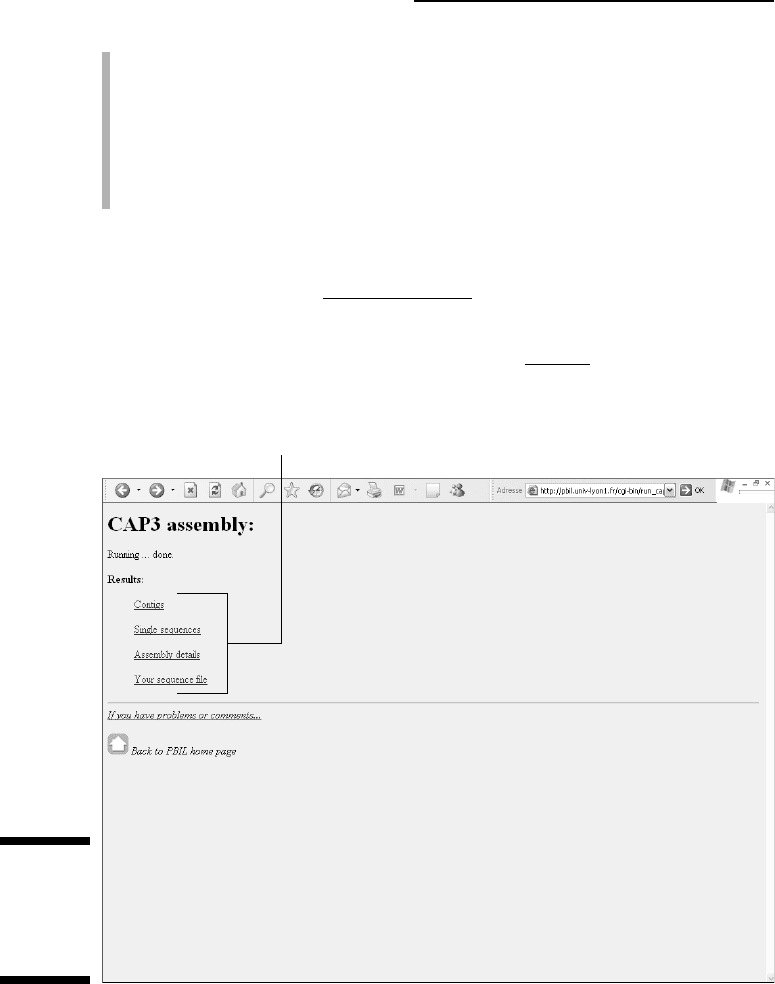
Contigs: Contains the final assembled sequence(s)
Single Sequences: Contains the input sequence fragment not incorpo-
rated in the assembly.
Assembly Details: The precise relationship between the fragments
within the contigs.
Your Sequence File: A summary of the input sequence fragments
Click each of these links in turn to see their content.
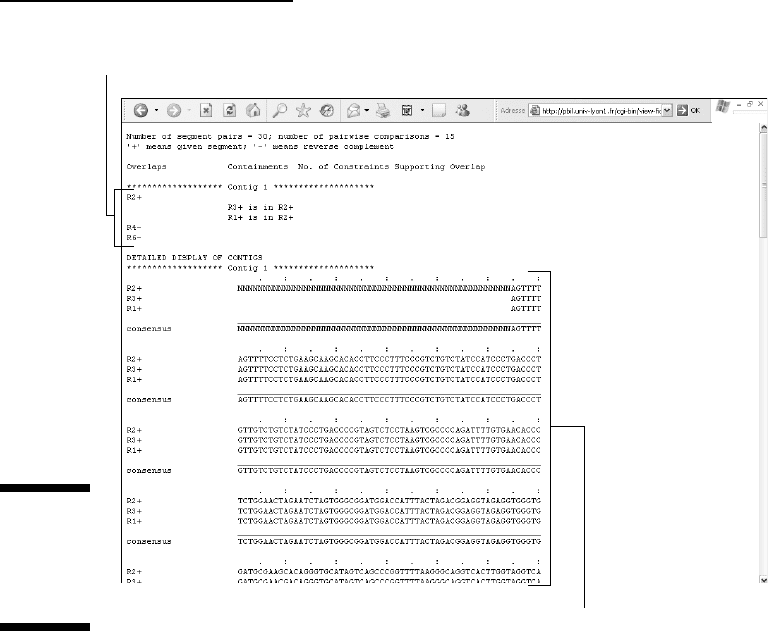
For instance, clicking the Assembly Details
link displays the overlaps and
contig structure. (See Figure 5-13.) One can see that R5 is not part of the
assembly. It is in fact found in the Single Sequences file. The resulting contig
consensus sequence is displayed by clicking the Contigs
link. (Refer to
Figure 5-12.)
Click on these links to display your results.
Figure 5-12:
Output files
of the CAP3
assembly
program.
156
Part II: A Survival Guide to Bioinformatics
10_089857 ch05.qxp 11/6/06 3:56 PM Page 156
Beyond This Chapter
This chapter provides you with a good background on the various kinds of
analyses people usually want to perform on their newly determined DNA
sequences. There are, of course, many other things you can do and look for
when you’re working within a more specialized context. The most important
area that isn’t covered here concerns the search for biologically significant
signals in the non-coding part of DNA sequences. This includes very hot
topics — such as the prediction of promoter regions, regulatory elements,
and/or protein binding sites.
Our main excuse for not presenting this area in more detail is that the success
rate for these analyses is still quite low. Also, the best programs and relevant
databases aren’t always in the public domain or aren’t available as Web servers.
Table 5-1 provides you with some entry points you can explore for yourself.
List of assembled fragments in contig1
Contig building details and consensus sequence
Figure 5-13:
CAP3
Assembly
details
(partial).
157
Chapter 5: Working with a Single DNA Sequence
10_089857 ch05.qxp 11/6/06 3:56 PM Page 157
Table 5-1 Free Web Sites for Searching
Signals in DNA Sequences
Institution; Program URL Description
Zhang Lab, Cold rulai.cshl.edu/ Search for promoters
Spring Harbor, USA and various conserved
elements
Center for Information
bimas.dcrt.nih. Search for transcrip-
Technology, NIH, USA;
gov/molbio/ tional elements
WWW Signal Scan signal/
Center for Information bimas.dcrt.nih. Predict eukaryotic
Technology, NIH, USA;
gov/molbio/ promoter regions
WWW Promoter Scan proscan/
Munich Bioinformatics mips.gsf.de/
Cis
-Regulatory Element
Center, GER, CREDO
services/ Detection
analysis
San Diego Supercomputer meme.sdsc.edu/ Discover motifs in groups
Center, USA; MEME
meme/intro.html of related DNA or protein
& MAST sequences
Université Libre de
rsat.ulb.ac.be/ Analyze regulatory
Bruxelles, Belgium rsat/ sequences
158
Part II: A Survival Guide to Bioinformatics
10_089857 ch05.qxp 11/6/06 3:56 PM Page 158
Chapter 6
Working with a Single
Protein Sequence
In This Chapter
Knowing what you must about domains, HMMs, profiles, and the Pfam
domain collection
Visiting the three most popular sites for finding domains in your protein
Predicting simple physical properties of your sequences
Predicting protease digestion patterns
Predicting coiled-coil domains
Predicting post-translational modifications
Once you eliminate the impossible, whatever remains, no matter how
improbable, must be the truth.
— Sherlock Holmes, as told to Sir Arthur Conan Doyle (1859–1930)
W
hen you’re studying a protein, you turn yourself into an investigator.
Basically, you want to find out everything you can before designing a
new experiment in the lab. For instance, in order to make sure that the pro-
tein you have in your test tube really is what you think it is, you must carry
out a simple physical analysis. Many online tools exist that help you predict
the results of these analyses (and make sure you’re on the right track). In this
chapter, we show you where you can find these tools and how to use them.
Among other things, we show you how to predict molecular weights, mea-
sure isoelectric points, count residues, or predict the outcome of a protease
digestion.
Of course, there’s more to a protein than its weight or its charge. While these
properties do help you get a sense of what’s what with your particular pro-
tein, uncovering a nice biological story takes more than that. An important
question to ask yourself is what your protein looks like when it’s active. Does
it need to be modified after being translated, does it contain coiled-coil
11_089857 ch06.qxp 11/6/06 3:56 PM Page 159