
Claverie J-M., Notredame C. Bioinformatics for Dummies
Подождите немного. Документ загружается.


two major advantages: They’re simple and don’t require any biological hypoth-
esis. Result: It’s hard to make a mistake when making a dot plot. If you aren’t
sure what a dot plot really is, a quick glance at the matrix shown in the side-
bar “A DIY guide to dot plots” may give you an idea.
The interpretation of a dot plot relies on the most sophisticated detection
device available to you: your eyes. When it comes to identifying patterns
such as diagonals, nothing beats the human eye, even when the signal is
noisy. This is so true that any time you see a good signal on a dot plot, you
can bet your life something interesting is going on — even if the statistics are
too “smart” to see anything!
Choosing the right dot-plot flavor
In this section, we introduce a very powerful tool named Dotlet. Dotlet is very
convenient because it’s easy to use, free of charge, doesn’t need any installa-
tion, and runs on (almost) any computer that has access to the Internet.
Dotlet is ideal for sequences with lengths of less than 10,000 amino acids or
nucleotides. Thus it can be helpful for most proteins but is restricted to small
DNA sequences. If you want to look at longer sequences online, you will have
to use Dnadot (Table 8-2), a tool designed for fast dot-plotting between long
sequences.
If your sequences are longer than 100,000 characters, no adequate tool is
available online — you need to install a more powerful version of Dotlet on
your computer. At least two such packages are available for free: Dotter and
Dottup. You can find their respective specifications (and URLs) in Table 8-2.
Table 8-2 Various Flavors of Dot-Plot Programs
Name Used For Range URL Platforms
Dotlet Proteins, DNA 10,000 www.ch.embnet. All (Java)
org
Dnadot Proteins, DNA 100,000 arbl.cvmbs. All (Java)
colostate.edu/
molkit/dnadot/
Dotter Proteins, DNA 100,000 www.cgr.ki.se/ Unix, Linux,
cgr/groups/ Windows
sonnhammer/
Dotter.html
Dottup Complete ge- >100,000 www.emboss.org Unix, Linux
nomes, DNA
240
Part III: Becoming a Pro in Sequence Analysis
14_089857 ch08.qxp 11/6/06 3:59 PM Page 240
Using Dotlet over the Internet
Dotlet is one of the most user-friendly dot-plot programs available over the
Internet. It is a Java applet that you can access on the EMBnet server. An
applet is a little program that loads automatically in your Internet browser
and then runs on your own machine. The nice thing about it is that you don’t
need to install anything, as long as you have Java running (which most
Internet browsers do by default these days).
Dotlet isn’t a complicated program, but it contains many features. If you don’t
use these features properly, you may pass very close to the result you need
but miss it. The general rule when using Dotlet is that you want to find a clear
signal — and that you should keep playing with the parameters until you get one.
In the upcoming steps list, we show you some examples of what we mean by
the term
clear signal and give some tips on how best to obtain one.
Downloading Dotlet
You can download Dotlet with one click of a mouse, simply by pointing your
browser to
www.isrec.isb-sib.ch/java/dotlet/Dotlet.html. When
you open this page, your browser also downloads the Dotlet program. This
may take a few minutes if you’re on a slow connection.
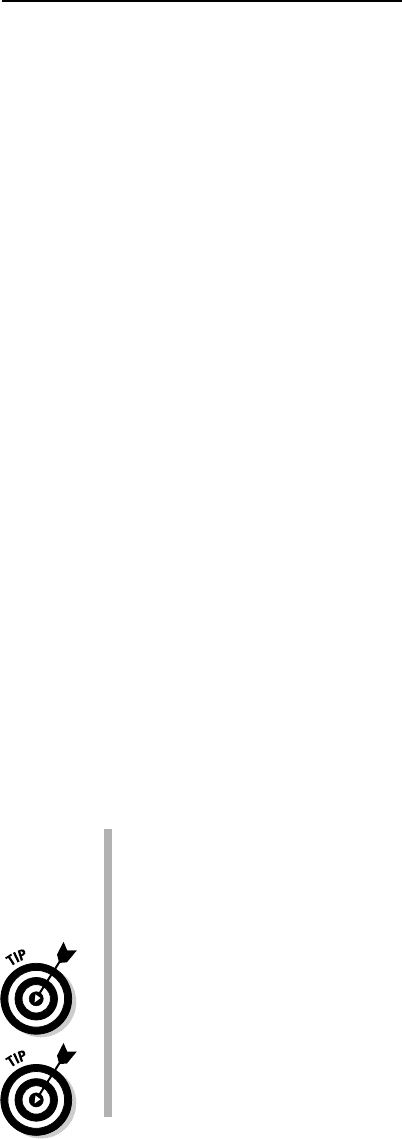
When the download is finished, your browser displays a page like the one
shown in Figure 8-1.
If your browser does not display this page properly, it means that it can’t run
Java; you may need to update to the latest version of Internet Explorer or
Netscape in order to get Java running on your computer.
Dotlet is not a server but a Java applet. Everything Dotlet does, it does on
your own computer — not on the EMBnet server. For you, this has three con-
sequences:
You can use Dotlet offline after you download it once. This is useful if
you work on a laptop that isn’t always connected.
The speed of the program depends on your own computer. The faster
your computer, the faster Dotlet runs. Differences become apparent with
sequences longer than 1,000 residues.
When you use Dotlet, you are not sending your sequences anywhere! Each
sequence you compare with Dotlet stays on your computer and isn’t sent
to the EMBnet server. If you work in a company that’s at all interested in
protecting proprietary information, you know this is a VERY GOOD thing!
To make sure Dotlet isn’t communicating with any server when you use
it, choose File
➪Work Offline from your browser menu after you’ve down-
loaded Dotlet.
241
Chapter 8: Comparing Two Sequences
14_089857 ch08.qxp 11/6/06 3:59 PM Page 241
Entering your sequence in Dotlet
In the following steps list, we compare two sequences that contain a kinase
domain. We’re going to assume that you’ve already got Dotlet up and running
in your browser (if not, the address is
www.isrec.isb-sib.ch/java/
dotlet/Dotlet.html
):
1. Open a new browser window by pressing Ctrl+N on your keyboard.
You need access to two browser windows, which is why we start with
this step.
2. Type the address www.expasy.ch/cgi-bin/get-sprot-fasta?P0
5049
into the new window you opened in Step 1 and then press Enter
or Return.
Type in the exact URL; do not omit the ?. This URL gives you a direct
access to Swiss-Prot if you know the ID number of your sequence. For
our example, the ID number is P05049.
After a bit of a wait, a new window appears, displaying the sequence
associated with the ID number you just entered.
Figure 8-1:
The Dotlet
page.
242
Part III: Becoming a Pro in Sequence Analysis
14_089857 ch08.qxp 11/6/06 3:59 PM Page 242
3. Copy the sequence displayed in your browser using Ctrl-C.
4. Return to your first browser window (the Dotlet window shown in
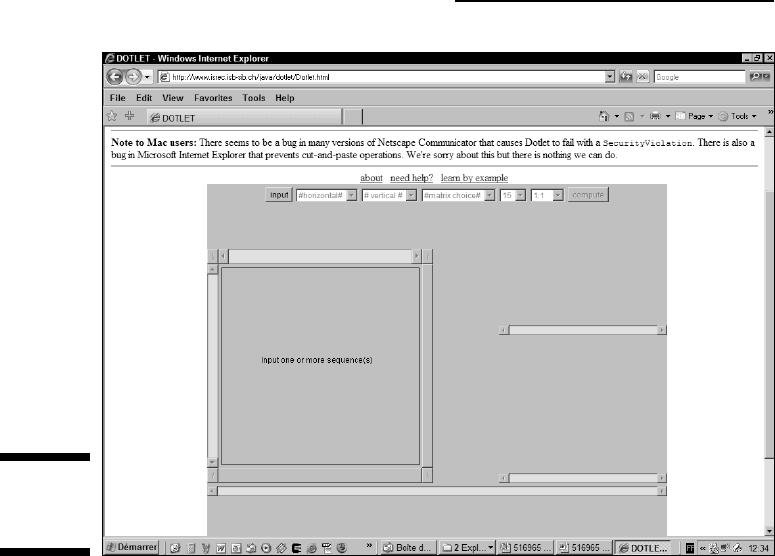
Figure 8-1) and click the Input button at the top left.
A pop-up window like the one in Figure 8-2 appears.
5. Use Ctrl+V to paste your sequence into the pop-up window and then
enter a title.
You must enter your sequence in raw format (only the sequence) as
shown in Figure 8-2.
The Name box is where you can enter the title of your sequence on the
dot plot if you so desire.
6. Press the OK button in the Sequence Window.
When you press the OK button, the window disappears; this means your
sequence is now loaded in Dotlet.
If you want to compare a sequence only with itself, go directly to Step 13.
7. Type the address www.expasy.ch/cgi-bin/get-sprot-fasta?P0
8246
into the new window you opened in Step 1, and press Enter or
Return.
This is the second sequence you want to load into Dotlet.
8. Copy the sequence displayed in your browser.
9. In the Dotlet window (refer to Figure 8-2), click the Input button.
10. Paste your sequence using Ctrl-V in the pop-up window that appears
and enter a title.
Figure 8-2:
The
sequence
window in
Dotlet.
243
Chapter 8: Comparing Two Sequences
14_089857 ch08.qxp 11/6/06 3:59 PM Page 243
11. Click the OK button in the pop-up Window.
When you click the OK button, the window disappears; this only means
that your sequence is now loaded in Dotlet — it hasn’t disappeared for
good!
12. Back in your original browser window — the Dotlet window — choose
the two sequences you want to compare from the two drop-down win-
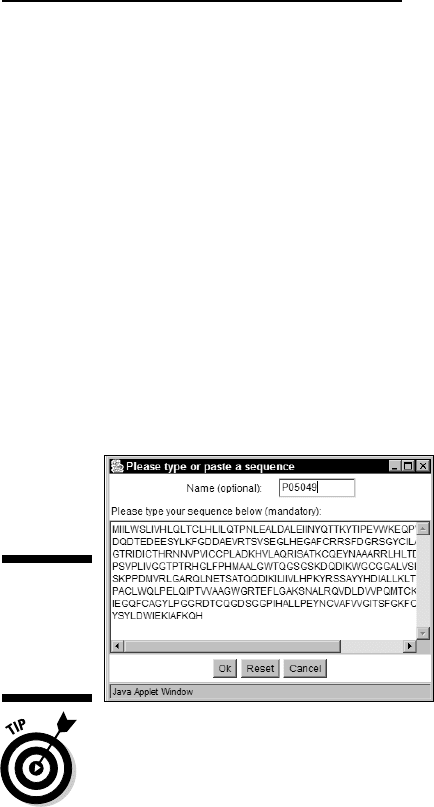
dows nearest to the Input button, as shown in Figure 8-3.
Figure 8-3 shows you how to use the pull-down menus to choose the
sequences you want to compare. The names in the menus are those you
provided in the Title box in Steps 5 and 10.
• The sequence you choose in the first pull-down menu is the hori-
zontal sequence (top of the dot plot, left to right).
• The sequence you choose in the second menu is the vertical
sequence (left side of the dot plot, top to bottom).
13. In the Dotlet window, click the Compute button at the far right.
Dotlet never takes action automatically (except when you change the
threshold). Any time you change one of its parameters, you must inform
Dotlet by clicking the Compute button.
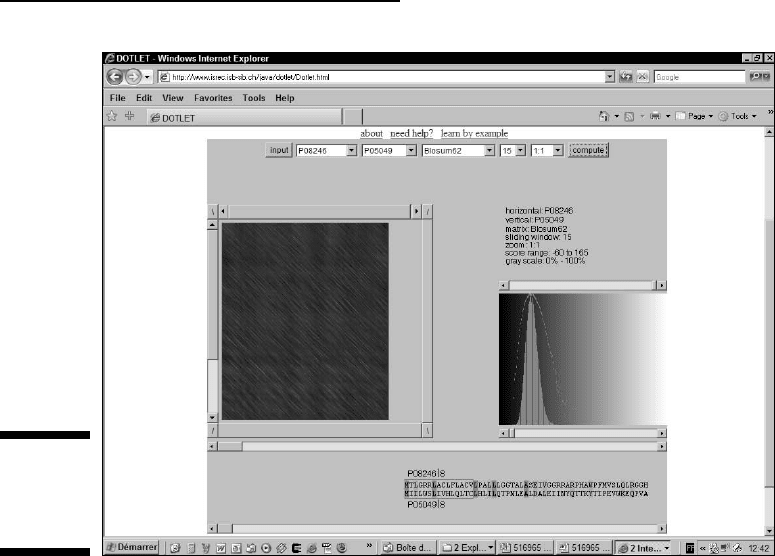
The output looks like what’s shown in Figure 8-4. This figure shows
Dotlet’s three windows:
•
The dot-plot window: The large window on the left contains your
dot plot.
•
The threshold window: This small window on the right is the one
you must use to tune the sensitivity of your dot plot.
•
The alignment window: This is the long narrow window below
that shows which pair of residues from the two sequences corre-
sponds to each dot in the dot-plot window.
The default output of Dotlet is usually difficult to interpret. To make it talk
some sense, you have to refine it — which we show you how to do in the next
section.
Figure 8-3:
The
sequence
pull-down
menus in
Dotlet.
244
Part III: Becoming a Pro in Sequence Analysis
14_089857 ch08.qxp 11/6/06 3:59 PM Page 244
Fine-tuning your Dotlet
The sequence of instructions we show here isn’t necessarily optimal, but it fol-
lows a top-down approach. We start with settings that you can roughly adjust,
and finish with settings that you must fine-tune to yield an informative dot plot.
1. Set the zoom factor.
By default, Dotlet has a zoom factor of 1:1 — which means that 1 pixel
corresponds to 1 residue.
If your sequences are long, you may not see the entire dot plot. This is
exactly what happens in Figure 8-4. You can tell this is so because the
scroll bar down the left side is
active — you’d need to use the rectangu-
lar box in the scroll bar to scroll down to see the rest of the display. To
see the entire dot plot, do the following:
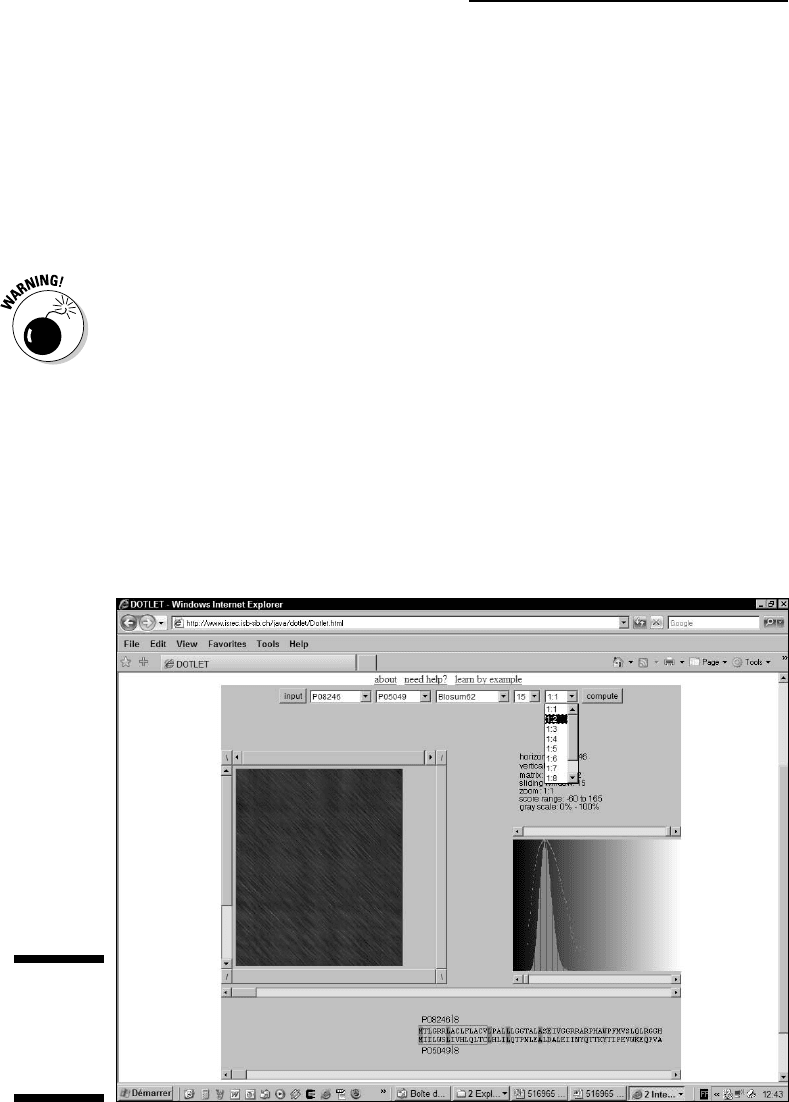
a. In the Zoom selector — the pull-down menu to the left of the
Compute button — choose 1:2, as shown in Figure 8-5.
b. Click the Compute button.
Dotlet now displays a complete dot plot of your two sequences.
Seeing the overall picture is useful, even if it looks a bit small. After you
get a feeling for the regions that are interesting in your dot plot, you can
always zoom back.
Figure 8-4:
Default
output of
Dotlet.
245
Chapter 8: Comparing Two Sequences
14_089857 ch08.qxp 11/6/06 3:59 PM Page 245
2. Choose the window size.
When Dotlet compares two amino acids — or nucleotides — it also com-
pares the amino acids — or nucleotides — in the immediate vicinity. The
window size controls the size of this neighborhood (for some helpful
hints, see the “Getting the right window size” sidebar). To use our exam-
ple, you have to change the default value as follows:
a. Choose 51 from the Window pull-down menu (the menu to the
left of the Zoom selector).
b. Click the Compute button.
After changing the window size, you MUST also tune the threshold (see
Step 3). There is little point in changing the window size if you don’t
adjust the threshold accordingly.
3. Adjust the threshold.
The threshold is a value that defines the color of each dot in the dot-plot
window. Dots with a score above the threshold are white; those with a
score below the threshold are black. The threshold is by far the most
powerful and the most delicate parameter when you’re making a dot
plot. Fortunately, Dotlet lets you adjust the threshold dynamically and
see the effect in real time. (You don’t even have to click the Compute
button!)
Figure 8-5:
Choosing
the right
zoom factor
in Dotlet.
246
Part III: Becoming a Pro in Sequence Analysis
14_089857 ch08.qxp 11/6/06 3:59 PM Page 246
On the top of the threshold window — the window on the right side for
the Dotlet display in Figure 8-4 — there is a little horizontal scroll bar
with a cursor. This is the
top cursor. On the bottom of this same window,
there is another small horizontal scroll bar with another small cursor.
This is the bottom cursor.
The horizontal axis in the threshold window represents the score. Low
scores are to the left, high scores to the right. The big peak on the curve
shows you the most common score for two residues chosen randomly.
You can imagine the threshold as two vertical lines going through the
top and the bottom cursor. Its position controls the appearance of the
dot-plot window (the large window on the left in Figure 8-4). In this dot-
plot window
• Dots with a score below the bottom cursor threshold are black.
• Dots with a score above the top cursor threshold are white.
• Dots with a score between the two cursors’ thresholds are gray.
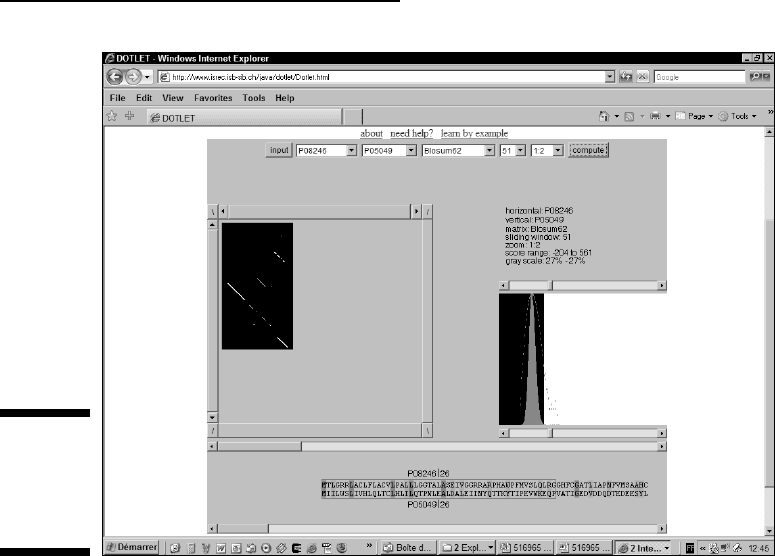
The game is all about setting the threshold so interesting residues
appear as white dots on a black background in the dot-plot window on
the left. You can use the following procedure to achieve this effect:
a. Drag the bottom cursor in the threshold window entirely to
the right.
This makes the dot plot on the left entirely black.
247
Chapter 8: Comparing Two Sequences
Getting the right window size
Here are some handy rules for making your
window the right size:
Long windows make clean dot plots. They
make sure that two similar amino acids (or
nucleotides) only yield a dot if the amino
acids (or nucleotides) around them are also
similar. Gurus say that long windows make
the dot plot more
stringent.
Of course, being
too stringent is just as bad as not being
stringent enough. In order to achieve the
right equilibrium, you can use the following
simple guidelines:
The size of a window should be within the
same range as the size of the elements
you’re looking for. For instance, if you’re
looking for conserved domains in pro-
teins, a size of 50 amino acids or higher is
appropriate.
Shorter windows are more sensitive but
bring some noise with them. They may help
if you’re looking at protein domains that are
very distantly related.
It’s convenient to start with a large window
and narrow it a little until the signal you’re
looking for appears.
14_089857 ch08.qxp 11/6/06 3:59 PM Page 247
b. Grab the right side of the Threshold Window by the middle, and
slowly drag it to the left, while holding your right mouse button
pressed down.
While you drag, keep an eye on the dot plot to see a conserved
segment appear, as shown in Figure 8-6.
When the top cursor and the bottom cursor are on the top of each other,
dots in the dot-plot window are either black or white. If you shift one of
the cursors to the left or to the right, the dots whose scores are between
these two thresholds appear in gray. This can help smooth the plot and
make it look nicer for publication.
If you want to see black dots on a white background, shift the top cursor
slightly to the right of the bottom cursor. This inverts the color chart.
4. Save your dot plot.
Saving your results is the most delicate part of using Dotlet. Not all
browsers can print these results — and we didn’t find one that could
save the display as a file. As far as we know, there are only two ways to
keep a record of your display:
Print the browser content into a PDF file. To do so, you must have a PDF
printer installed on your computer.
Use the ol’ screen-capture technique. You can use it with any graphic dis-
play that gives you trouble when trying to save. Follow this procedure to
do a screen capture.
a. Press the PrntScrn button on your keyboard (usually top right).
b. Start a Power Point presentation.
c. Press Ctrl+V to cut and paste your screen-capture into the
presentation.
You can now print your dot plot or include it in any type of
document.
Interpreting your results
P05049 and P08246, the two proteins we chose for the previous steps list (in
the section “Entering your sequence in Dotlet”), are very distantly related. If
you use BLAST to find one with the other, you get a match with an E-value of
10-
4
. If you have been through Chapter 7 — which introduces you to the intri-
cacies of BLAST — you already know that getting really excited over such a
match isn’t a good idea. It could even be a false positive.
Knowing that P05049 is a serine protease, it would be interesting to check the
protease activity of P08246 in the wet lab. The problem is that when you
launch a costly experiment on the basis of such a weak BLAST match, you’re
definitely taking a chance. If you fail, the probabilities are high that your boss
will ask the lethal question, “What in the world where you thinking?!”
248
Part III: Becoming a Pro in Sequence Analysis
14_089857 ch08.qxp 11/6/06 3:59 PM Page 248
This is the reason why — before doing this experiment — it would be reas-
suring to make sure that P05049 and P08246 are genuinely homologous in the
serine protease region.
Making a dot plot is a good way to answer this question. A dot plot like the one
we produced in the previous steps list is very much to the point. Figure 8-6
makes a good case for the existence of a conserved domain between the two
proteins. You can make sure of this by looking at their Swiss-Prot annotation
(accessible at
www.expasy.ch). Swiss-Prot says that P05049 and P08246 both
contain a serine protease domain in the region that the dot plot indicates.
Of course, in real life you may not have a Swiss-Prot annotation for the two pro-
teins. In fact, in the real world, you may not have any annotation at all! That
should not deter you from making a dot plot. Even if you don’t know its func-
tion, the identification of a conserved domain between two protein sequences
is a good way to locate the specific region responsible for a function.
Doing biological analysis with a dot plot
The preceding example shows you how to spot a distantly related domain
shared by two proteins. Dot plots give very characteristic representations of
Figure 8-6:
Dotlet with
a proper
parameter
setting.
249
Chapter 8: Comparing Two Sequences
14_089857 ch08.qxp 11/6/06 3:59 PM Page 249