
Claverie J-M., Notredame C. Bioinformatics for Dummies
Подождите немного. Документ загружается.


Whatever your choice or motivation, always bear in mind that the reason you
can use multiple alignments for so many things is that they can give you an
instant picture of the forces that shape evolution! When you look at proteins
or DNA sequences, the rules are ruthless:
Important amino acids (or nucleotides) are not allowed to mutate. For
instance, active sites of enzymes are much conserved.
Less-important residues change more easily — sometimes randomly —
and sometimes in order to adapt a function.
For you, this has a very simple consequence: When you look at a multiple align-
ment, you can make the hypothesis that
conserved positions (columns where all
the sequences contain the same amino acid or nucleotide) are more important
for the function than non conserved positions (columns where the sequences
contain different amino acids or nucleotides). Of course, you could tell all this
from the alignment of just two sequences — but using more sequences makes it
easier to discriminate between important and less-important positions.
And one more thing: A multiple sequence alignment is a terrific way to present
your results. It lets you put lots of information into a single model and makes it
incredibly easy to spot inconsistencies or potential problems. If you want to get
an important point across — in a paper or in front of an audience — a good,
hand-crafted, well-colored multiple alignment says more than 3 billion
nucleotides in bulk.
All this being said, multiple alignments do NOT cure asthma, arthritis, lum-
bago, or baldness. They won’t make you stronger or increase any of your
potentials (except maybe your research potential). But at this point, if you
need more arguments to convince you of the genius of multiple alignments,
chances are you don’t really need to make this kind of alignment.
Choosing the Right Sequences
Anyone who ever worked in a lab knows that molecular biology is very much
like cooking: It’s all about selecting the right ingredients and putting them
into the pot at the right time and in the right order.
Building a multiple alignment obeys the same rule. Before you build your
alignment, you must carefully select the sequences you want to align. These
sequences are members of the same protein family, and they all share a
common ancestor. The family is usually too large to be entirely included
in your multiple alignment, and picking the right sequences is an art. If you
want to be good at this game, you need to know what you want to show with
your alignment — and you need to know how the multiple alignment pro-
grams work.
270
Part III: Becoming a Pro in Sequence Analysis
15_089857 ch09.qxp 11/6/06 4:00 PM Page 270

Of course, to understand these programs well, you need to see them in
action — and for that, you need to have a few sequences! This is a typical
chicken/egg problem for which no simple solution exists. We suggest that
you go through the next section once, and come back again after you start
playing with the multiple sequence alignments that we describe in the other
parts of the chapter. After one or two rounds, things should click into place.
The kinds of sequences you’re looking for
Let’s assume that you start this procedure with your favorite sequence. You
want to thoroughly study this sequence and you know that in order to do this
you have to build a multiple alignment. Table 9-3 summarizes most of the
things you must take into account when selecting these extra sequences.
Table 9-3 A Few Guidelines for Selecting Sequences
Problem Diagnostic
Proteins or DNA Use proteins whenever possible. You can turn them back
into DNA
after
doing the multiple alignment.
Many sequences Start with 10–15 sequences; avoid aligning more than 50
sequences.
Very different Sequences that are less than 30 percent identical to
sequences more than half the other sequences in the set often
cause troubles.
Identical They never help. Unless you have a
very
good reason to
sequences do so, avoid incorporating into your multiple alignment
any sequence that’s more than 90 percent identical to
another sequence in the set.
Partial Multiple-sequence-alignment programs prefer sequences
sequences that are roughly the same length. Programs often have dif-
ficulties comparing items in a mixture of complete
sequences and shorter fragments.
Repeated Sequences with repeated domains cause trouble for most
domains multiple-alignment programs — especially if the number
of domains is different. When this happens, you may be
better off extracting the domains yourself with Dotlet or
Lalign (see Chapter 8) and making a multiple alignment of
those segments.
271
Chapter 9: Building a Multiple Sequence Alignment
15_089857 ch09.qxp 11/6/06 4:00 PM Page 271

Using DNA or protein sequences
If the sequences you’re interested in are non-coding sequences, you obviously
have no choice — you must use DNA. However, beware that non-coding DNA
sequences can be tricky to align. If you cannot generate a proper alignment
from sequences that you know are related, you could use a local multiple
alignment method, such as the Gibbs sampler, or a pattern extraction motif,
such as Pratt. (See “Comparing Sequences That You Can’t Align,” later in this
chapter, for a description of these two methods.)
Multiple-sequence-alignment methods are at their best when aligning protein
sequences. The reason is that protein sequences are three times shorter than
the corresponding DNA, and they use a more informative alphabet of 20
amino acids.
If you want to persist in carrying out a phylogenetic analysis on a set of
coding DNA sequences, things work better if you do the following:
1. Translate your DNA sequences into proteins.
2. Perform the multiple alignments on the proteins.
3. Thread the DNA back onto the protein multiple sequence alignment
framework using pal2nal (
coot.embl.de/pal2nal) or Protogene if
you do not have the original DNA sequence (
www.tcoffee.org).
If your proteins are difficult to align because they have few similarities, DNA
information does not help. This has to do with the degeneracy of the genetic
code and the fact that there are 20 amino acids and only 4 nucleotides. If
there is little signal at the protein level, you can be sure that there is NO
useful signal at the DNA level.
Choosing the right number of sequences
Of course, there’s no absolute answer to this question, such as 42 or 7. A few
years ago, the answer was easy: Get everything you can and go to the lab if
there aren’t enough sequences in the databases! But that isn’t true anymore.
These days — given the sizes of the databases and new complete genome
sequences flowing in twice a month — you may easily find hundreds or thou-
sands of sequences that would be suitable for inclusion in your multiple
sequence alignment. But that doesn’t mean you have to use them all!
In our opinion, you should start with a relatively small number of sequences —
between 10 and 15 sequences would be suitable for most cases. After you get
something interesting happening with this small set, you can always increase
its size. In any case, it’s hard to see any reason for generating a multiple align-
ment with more than 50 sequences, unless you’re interested in building some
extensive phylogenetic tree.
If you start with hundreds of sequences, you immediately hit troubles. There
are good reasons why:
272
Part III: Becoming a Pro in Sequence Analysis
15_089857 ch09.qxp 11/6/06 4:00 PM Page 272

Computing big alignments is difficult. Public servers do not have infi-
nite resources. Your job may take a very long time to run (if it runs). For
you, this makes it difficult to tune parameters and check alternatives.
Building big alignments is difficult. Multiple alignment programs are
not very good at handling very large sets of sequences.
Displaying big alignments is difficult. You can’t print them, and they
clog your computer when you want to visualize them. If columns are
longer than one page, interpretation becomes impossible.
Using big alignments is difficult. Tree-building and structure-prediction
programs cannot handle them easily.
Making accurate big alignments is difficult. You want your multiple
sequence alignment to be highly reliable so you can be confident that all
the sequences it contains are true members of the family. A major cause
for concern is that multiple-sequence-alignment programs make mis-
takes. The curse is that these mistakes do not add up, they
multiply —
making it easy for a tiny number of bad sequences to ruin an entire align-
ment. Of course, the more sequences you have, the more likely this is to
happen. The best way to avoid such a disaster is to start small — and
gradually increase the size of your multiple sequence alignment until it
contains all the sequences you’re interested in.
Now that you know how many sequences you need, the last question you
face is deciding how related these sequences must be. Should you choose
sequences that are very similar or very different?
Making the right compromise between similarity and new information
If you think that very similar sequences give very good alignments, you’re
right! However, a multiple sequence alignment that’s correct isn’t enough; it
must also be useful.
For instance, an alignment that only contains very similar sequences brings
little information. You can use it to extrapolate annotations, but you can’t do
phylogeny, structure prediction, or any of the other useful applications that
we list in Table 9-2. These other tasks require being able to observe mutation
patterns in every column — which isn’t possible if you have an alignment in
which most columns are entirely conserved.
Grabbing the most distantly related sequences you can find doesn’t work,
either. Multiple-sequence-alignment programs can’t use sequences that are
too different — even if these sequences are homologous. In fact, two things
multiple-sequence-alignment programs
really don’t like are
Sequences that are very different from every other sequence in the group
Sequences that need long insertions/deletions to be properly aligned
273
Chapter 9: Building a Multiple Sequence Alignment
15_089857 ch09.qxp 11/6/06 4:00 PM Page 273

Selecting your sequences for a multiple alignment is a team-building exercise:
You want everyone to be a bit special, but you don’t want your team mem-
bers to be so different that they can’t communicate. Teams of divas rarely go
very far — and neither do gangs of sextuplets.
When you select your sequences, the general rule is that you want them to
be as distantly related as possible — without requiring too many gaps in
order to be properly aligned. These two criteria are mutually exclusive, so
finding the right trade-off requires a bit of strategy. The following steps show
you a general approach that you should have in mind when gathering your
sequences:
1. Select a few sequences.
See the section “Gathering your sequences with online BLAST servers,”
later in this chapter.
2. Compute a multiple alignment by using one of the servers we introduce
in this chapter.
See the section “Choosing the Right Method of Multiple Sequence
Alignment,” later in this chapter.
3. Evaluate the quality of your alignment visually.
See the section “Interpreting Your Multiple Sequence Alignment,” later in
this chapter.
4. If your alignment looks good, keep the sequences.
A good alignment contains nicely conserved blocks separated by
regions with insertions and deletions. If you have such an alignment,
your sequence set is probably appropriate — and you can try to extend
it by adding a few new sequences.
5. If your alignment is difficult to interpret,
a. Examine the sequences more closely — try to remove the trouble-
makers that are the most distantly related, or those that cause long
insertions/deletions.
b. Redo the alignment with the smaller set.
c. Keep trimming the set until you get a multiple alignment that’s
easier to interpret.
If you can, make sure that
each sequence is between 30 and 70 percent identical
with more than half of the sequences in the set.
This way, you’re making a rea-
sonable trade-off between new information and alignment quality.
Before adding a sequence to a multiple alignment, you can try to figure out
whether it’s a good choice by making pairwise comparisons with some of
the tools we describe in Chapter 6. (
Pairwise comparisons let you compare
sequences two by two.) However, we don’t recommend that you do so
exhaustively; it’s time-consuming.
274
Part III: Becoming a Pro in Sequence Analysis
15_089857 ch09.qxp 11/6/06 4:00 PM Page 274

Naming your sequences the right way
Naming may sound like a trivial issue, but it’s not. Multiple-sequence-alignment
programs have no standard way of handling the sequence names. If you stick
to the following four rules, however, you will NEVER get into trouble (if you
don’t, you’re on your own):
Never use white spaces in your sequence names.
Do not use special symbols. Stick to plain letters, numbers, and the
underscore ( _
) to replace spaces. Avoid ALL other symbols, especially
those that are the most tempting for special sequences (such as @, #, _,^
and so on).
Never use names longer than 15 characters.
Never give the same name to two different sequences in your set.
Although some programs accept it, others (such as ClustalW) don’t.
If you don’t obey these naming rules, some multiple-sequence-alignment
programs may automatically change the name of your sequences, without
the courtesy of telling you.
Gathering your sequences with online
BLAST servers
There are two types of sequences that you may want to integrate into your
multiple alignment:
Characterized sequences: These are sequences for which you have
good annotations and experimental information. You’d definitely want to
include these sequences in your alignment because they bring biological
information with them — and also allow feature propagation.
Uncharacterized sequences: This category can include your sequence(s)
of interest as well as database sequences. Uncharacterized sequences
must be members of the same family. Your main motivation in including
them in your multiple alignment is to distinguish between the conserved
positions that cannot mutate and the other, less-important columns.
They help in getting some contrast on your sequence of interest.
In this section, we show you how to gather these sequences with the BLAST
database search program. If you want to know all the gory details about BLAST,
check out Chapter 7. Here we give you only the bare minimum to get by.
With BLAST, you can search databases for sequences that are homologous
(similar) to a query. The original query can be any sequence you are inter-
ested in — protein or DNA — and you can use BLAST to search both protein
and DNA databases. The main reason for using BLAST is to identify database
275
Chapter 9: Building a Multiple Sequence Alignment
15_089857 ch09.qxp 11/6/06 4:00 PM Page 275

sequences that are so similar to the query that they probably are
homologous. We commonly refer to such sequences as
hits or matches.
There are many BLAST servers around — as becomes abundantly clear in
Chapter 7 — and you’re free to try any (or all) of them. Nonetheless, they
aren’t all equally convenient for retrieving the sequences you’re interested
in. Table 9-4 lists three BLAST servers that are useful for generating a list
of sequences in FASTA format (the best format for moving your sequences
around, from one program to another) or for sending chosen sequences to
a multiple-alignment server.
Table 9-4 BLAST Servers Integrating Multiple-Alignment Methods
Address What You Can Do There
www.expasy.ch/tools/blast/ Extract entire sequences,
export sequences in FASTA,
submit sequences to ClustalW,
Tcoffee or MAFFT.
Turn the list of Hits into a non-
redundant collection of sequences.
npsa-pbil.ibcp.fr/cgi-bin/ Extract entire sequences,
npsa_automat.pl?page= extract sequences fragments,
npsa_blast.html export sequences in FASTA,
submit sequences to ClustalW.
srs.ebi.ac.uk Submit sequences to ClustalW.
In the following steps list, we show you how to use the ExPASy server. The
SRS server, although sometimes useful, is a bit harder to use than the other
two listed in Table 9-4.
Selecting sequences on the ExPASy server
In the following steps list, we select appropriate sequences to make a multi-
ple sequence alignment of calcium-dependent kinase proteins.
You can use this server only to retrieve
protein sequences. If you’re inter-
ested in gathering
DNA sequences, use the European Bioinformatics SRS
server (
srs.ebi.ac.uk) instead.
The BLAST server of the PBIL site is very similar to ExPASy. If you don’t find
the database you’re interested in on the ExPASy server, try the PBIL.
1. Point your browser to www.expasy.ch/tools/blast/.
The BLAST page of the ExPASy server appears.
276
Part III: Becoming a Pro in Sequence Analysis
15_089857 ch09.qxp 11/6/06 4:00 PM Page 276
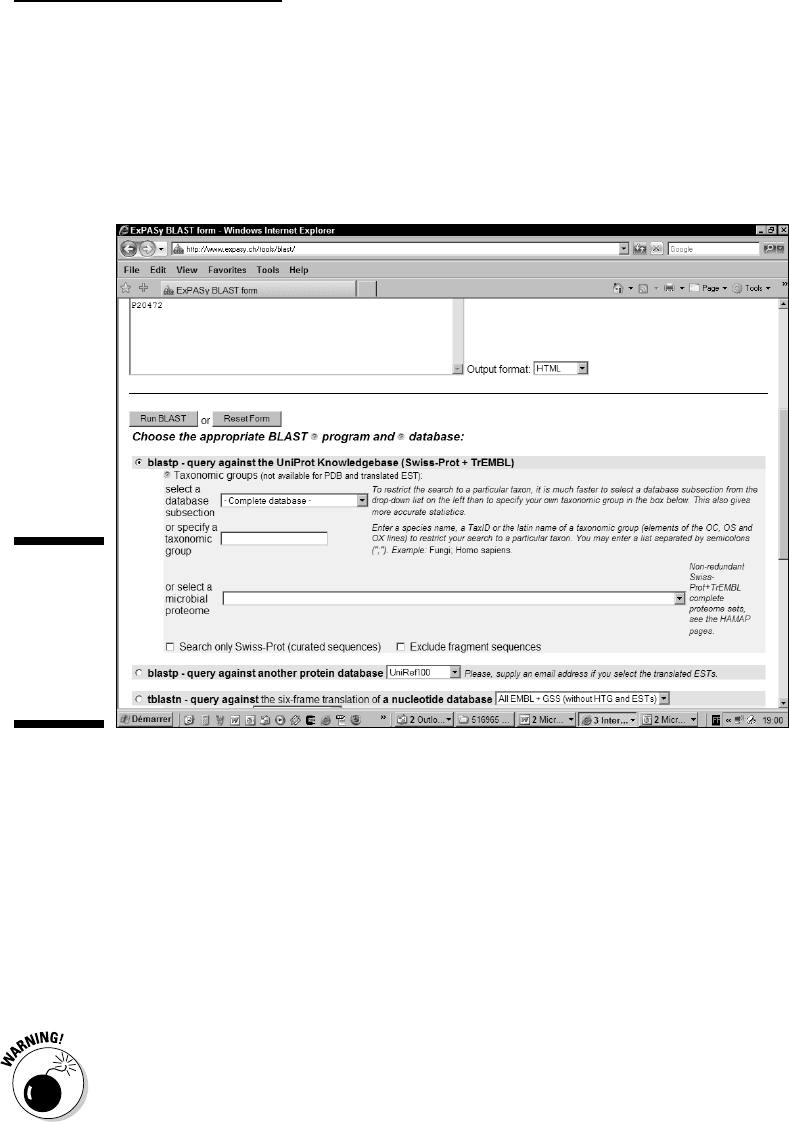
2. Enter the Sequence Accession Number P20472, as shown in Figure 9-2).
This is the accession number of the human parvalbumin.
If you prefer, you can also paste the sequence in raw format (that is, use
the sequence only, without any header). The program ignores spaces
and numbers.
3. Select the BLAST flavor that you’re interested in.
If you gave a protein sequence in Step 2, select blastp.
If you gave a coding DNA sequence in Step 2, select tblastn.
4. Keep the default option — Complete Database — in the pull-down menu.
This amounts to simultaneously searching Swiss-Prot + TrEMBL +
TrEMBL_NEW. If the search reports too many sequences that are very
similar to your sequence of interest, you can decrease the number of
identical hits by selecting a smaller database from the Database pull-
down menu — Swiss-Prot, for example, or the database of only the
microbial proteomes.
For a multiple sequence alignment, do not select Translated ESTs from
the pull-down menu. These sequences are mostly incomplete protein
sequences that may confuse the multiple-alignment procedure.
Figure 9-2:
Using the
BLAST
ExPASy
server to
gather
sequences.
277
Chapter 9: Building a Multiple Sequence Alignment
15_089857 ch09.qxp 11/6/06 4:00 PM Page 277

5. Scroll down to the Options section and set the Number of Best Scoring
Sequences to Show option to 1000.
Doing this makes it more likely that you’ll find appropriate sequences in
the BLAST result for your multiple alignment.
6. In the same Options section, set the Number of Best Alignments to
Show option to 1000.
This choice makes it possible to judge the quality of the alignment
before selecting a sequence.
7. Click the Run BLAST button.
After a brief pause, a Results page appears.
8. Scroll down the page to select the sequences you want.
You select a sequence by checking the box to its left.
This is the most delicate part of the process. There is no absolute rule to
selecting your sequences, but you can use the following guidelines:
•
Select the top sequence. This top sequence is usually your
sequence of interest. If your sequence of interest is not at the
top, you may have to add it to the list later on.
•
For a first analysis, you want to select ten sequences or fewer.
Ideally, the ten sequences to select should be evenly spaced
between the very good E-values (10-
40
) and less-good E-values (10-
5
).
Figure 9-3 gives you an idea of what such a selection looks like.
For the purpose of this steps list, choose (from top to bottom):
P20472, P80079, P02626, P02619, P43305, P32930, Q91482, P02620,
P02622, P02627.
•
Before selecting a sequence, check to make sure it’s similar to
the query sequence — along its entire length.
The alignment section is at the bottom of the BLAST output. You
must be especially careful with hits that have E-values higher than
10-
10
. They are equally likely to correspond to a good partial match,
a global overall match, or a match between a protein fragment and
your sequence. Inspecting the alignment is the only way to distin-
guish between these situations.
9. Choose the method you want to use to export your sequences from
the Send Selected Sequences pull-down menu, as shown in Figure 9-4.
There are several ways to export your sequences:
•
FASTA: Generates a file that contains your sequences in FASTA
format. You can save this file with the File
➪Save As option of your
browser. When you need to, you can reopen this file with your
browser, in order to cut and paste its content into another server
form (MUSCLE for instance, at
www.drive5.com/muscle/).
278
Part III: Becoming a Pro in Sequence Analysis
15_089857 ch09.qxp 11/6/06 4:00 PM Page 278
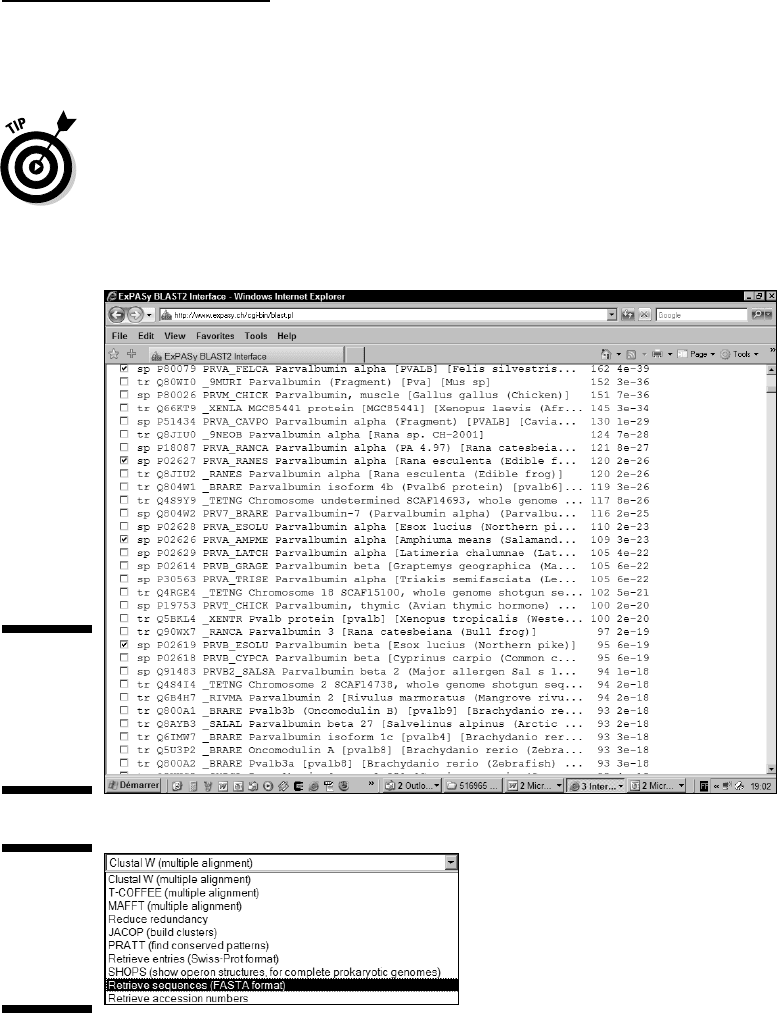
• ClustalW, Tcoffee, and MAFFT: These are multiple-sequence-
alignment packages running on the EMBnet server. Select any
of these to align the selected sequences.
•
Reduce Redundancy: This option will extract the most meaningful
sequences from your dataset. Ideal if you have too many
sequences and you don’t know how to choose.
•
Pratt: Will search for conserved motifs in your sequences without
aligning them.
Figure 9-4:
Output
selector on
the ExPASy
BLAST
page.
Figure 9-3:
Selecting
sequences
on the
BLAST
output.
279
Chapter 9: Building a Multiple Sequence Alignment
15_089857 ch09.qxp 11/6/06 4:00 PM Page 279