
Claverie J-M., Notredame C. Bioinformatics for Dummies
Подождите немного. Документ загружается.

If you play with the Lalign parameters, you may find that stronger gap-opening
or gap-extension penalties may split the Dotlet diagonals into two alignments.
Lower gap-opening or gap-extension penalties, on the other hand, can cause
diagonals to fuse. What happens here depends on the length of the gaps that
Lalign needs to insert in the local alignments.
When it comes to judging the quality of your alignment, size definitely matters.
It isn’t uncommon to see short segments with very good scores. This can result
from a variety of reasons — such as low-complexity segments, small-scale regu-
larity in protein sequences, recurrent patterns of hydrophobic/hydrophilic
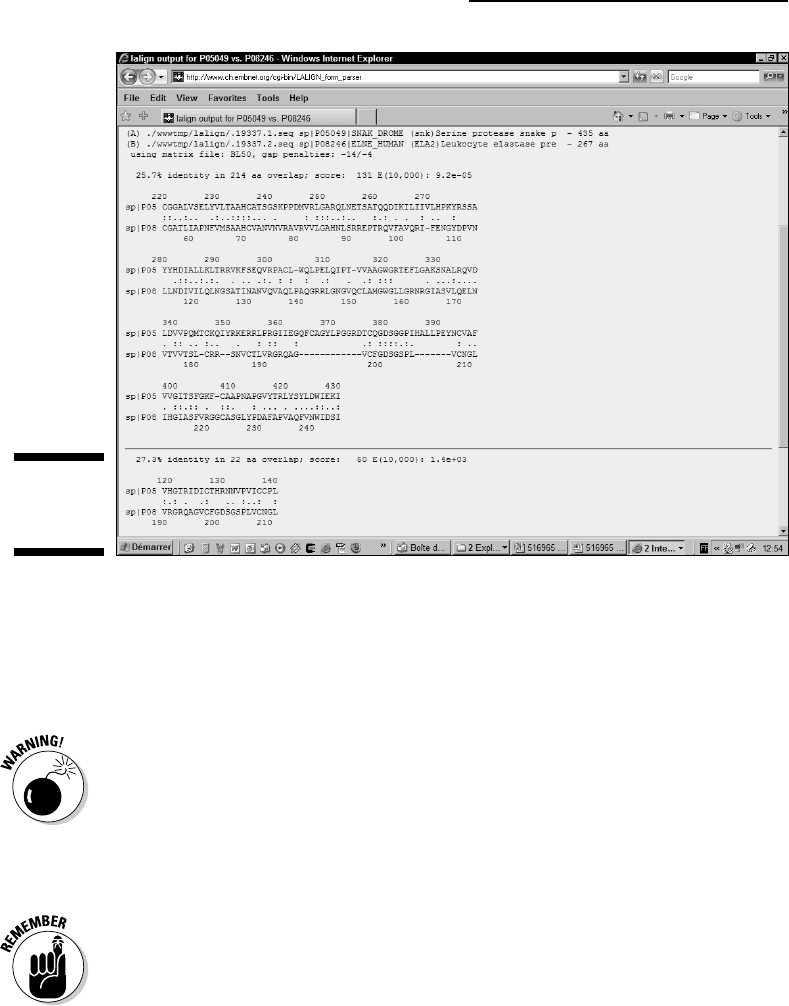
residues, and so on. For instance, in Figure 8-11, the second and the third local
alignments are obviously meaningless because they are too short. However,
their E-values are better than that of the top alignment. This clearly illustrates
that a short alignment can easily get a good score by chance.
Bioinformatics programs aren’t perfect: They can make mistakes and deliver
wrong results. Unfortunately, right and wrong obey the same practical rules
in bioinformatics as they do in life: They are not absolute concepts.
The top alignment that Lalign reports here illustrates this limitation well.
Because of the dot-plot information, we trust this alignment to be correct
Figure 8-11:
Output of
Lalign.
260
Part III: Becoming a Pro in Sequence Analysis
14_089857 ch08.qxp 11/6/06 3:59 PM Page 260

overall. On the other hand, the two sequences are so remotely related — and
have so little similarity — that we must be cautious in our interpretation:
Many amino acids could be incorrectly aligned, which means this alignment
is probably right
and wrong. The only way to really push this analysis further
would be to make a multiple sequence alignment or to use structural informa-
tion. (For more on multiple sequence alignments, see Chapter 9; for more on
structures, see Chapter 11.)
Making Global Alignments
over the Internet
A global alignment is just what the name implies: an alignment of every amino
acid or nucleotide found in your sequences. When you decide to make a global
alignment, you implicitly make the hypothesis that your two sequences are
related over their entire lengths.
Global alignments are very important for making multiple sequence align-
ments. However, when done using only two sequences, they offer little inter-
est for biological analysis. Whenever you have two closely related sequences,
you can generate a much more informative result by gathering a few more
related sequences and making a multiple sequence alignment. (Chapter 9
tells you everything you need to know for this purpose.)
Global alignments aren’t useful at all for discovering similarities between two
sequences because the statistical method for evaluating E-values doesn’t
apply to them. Even so, beginners often prefer global alignments to local
because they’re simpler to understand.
In a global alignment, no amino acid or nucleotide mysteriously disappears:
You find in the output exactly what you put in the box, plus a few extra gaps.
There are three main reasons for making a global alignment:
Checking minor differences between two sequences. This may happen
with data that you’ve manipulated and possibly altered. The global align-
ment is the best way to localize potential problems.
Analyzing polymorphisms (for example, SNPs) between closely
related sequences.
Comparing two sequences that partly overlap. In that case, you want to
make a global pairwise comparison that doesn’t penalize misalignments
at the extremities of the sequences.
261
Chapter 8: Comparing Two Sequences
14_089857 ch08.qxp 11/6/06 3:59 PM Page 261

Using Lalign to Make a
Global Alignment
In terms of algorithms, there is not much difference between a local and a
global alignment. If you were to write the programs for both, you would not
find more than one line of difference between these two algorithms!
You can use Lalign to produce global alignments, but there are other choices —
some of which we’ve listed in Table 8-4, at the end of this chapter.
Using Lalign to produce a global alignment is exactly like using Lalign to pro-
duce a local alignment. The only thing extra you need to do is to is to click
the radio button that says
Global without End-Gap Penalty, near the top of the
Lalign form at
ww.ch.embnet.org/software/LALIGN_form.html
Aligning Proteins and DNA
The alignment tools we describe above are only truly effective when you
want to compare sequences of a similar type — proteins with proteins or
DNA with DNA. Sometimes, however, you need to compare a protein with a
piece of DNA (its original gene, for instance). Doing such an alignment
requires special tools that can insert the long gaps corresponding to the
introns. We know at least two places where you can do this online. One is at
the Pasteur Institute (
bioweb.pasteur.fr/seqanal/interfaces/
protal2dna.html
) and the other is maintained by Dr. Peer Bork and his
group at the European Molecular Biology Laboratory in Heidelberg (
coot.
embl.de/pal2nal
). Both of these servers will require you to have your pro-
tein and the corresponding DNA sequence ready before you can use them.
If you only have the protein, you can either run a blastx against a complete
genome (see Chapter 6) or use a Web server called Protogene (available at
www.tcoffee.org). Protogene automatically fetches the DNA sequence cor-
responding to a given protein.
Free Pairwise Sequence Comparisons
over the Internet
Many existing servers propose pairwise comparisons. Table 8-4 lists a brief
selection of some of the more stable resources.
262
Part III: Becoming a Pro in Sequence Analysis
14_089857 ch08.qxp 11/6/06 3:59 PM Page 262

Table 8-4 Online Pairwise Alignment Programs
Name Address Alignment Type
Lalign www.ch.embnet.org/software/ Global/Local
LALIGN_form.html
Lalign fasta.bioch.virginia.edu/ Global/Local
fasta_www/plalign.htm
USC www-hto.usc.edu/software/ Global/Local/
seqaln/seqaln-query.html
Alion fold.stanford.edu/alion/ Global/Local
Align
genome.cs.mtu.edu/ Global/Local
align.html
Align www.ebi.ac.uk/emboss/align/ Global/Local
xenAliTwo
www.soe.ucsc.edu/~kent/ Local for DNA
xenoAli/xenAliTwo.html
Blast2seqs www.ncbi.nlm.nih.gov/ Local BLAST
blast/bl2seq/wblast2.cgi
Protal2dna bioweb.pasteur.fr/seqanal/ Protein against DNA
interfaces/protal2dna.html
Pal2nal coot.embl.de/pal2nal Protein against DNA
Generating an alignment isn’t always enough. You may also need to visualize
this alignment and to evaluate its statistical significance. Table 8-5 lists a few
sites that enable you to do this online.
Table 8-5 Online Pairwise Alignments Analyses
Name Address Function
lalnview www.expasy.ch/tools/ Visualization
sim-prot.html
prss www.ch.embnet.org/software/ Evaluation
PRSS_form.html
prss Fasta.bioch.virginia.edu/ Evaluation
fasta/prss.htm
graph-align darwin.nmsu.edu/cgi-bin/ Evaluation
graph_align.cgi
263
Chapter 8: Comparing Two Sequences
14_089857 ch08.qxp 11/6/06 3:59 PM Page 263

264
Part III: Becoming a Pro in Sequence Analysis
14_089857 ch08.qxp 11/6/06 3:59 PM Page 264

Chapter 9
Building a Multiple
Sequence Alignment
In This Chapter
Gathering the sequences you need to make a multiple sequence alignment
Making a multiple sequence alignment with ClustalW and MUSCLE
Creating and comparing multiple sequence alignments with Tcoffee
Comparing sequences you cannot align
The man with two watches never knows the time, and the man with one
watch only thinks he knows.
— A man with multiple watches
I
n this chapter, we show you how to compare many protein or nucleotide
sequences simultaneously. This is something you probably want to do if
you have a sequence and you want to elucidate the role of each amino acid
or nucleotide that it contains.
To compare multiple sequences, your first job is to select a few sequences
and then align them all. In this chapter, we show you how to select the most
appropriate sequences and how you can generate such a
multiple sequence
alignment.
We introduce three different multiple-sequence-alignment methods
that should cover most of your needs: ClustalW because everybody uses it,
MUSCLE because it is very fast, Tcoffee because it is very accurate, and can
let you combine sequences and structures. Since it’s too easy to generate bad
alignments that look good, we also show you how to evaluate the quality of
your alignment.
Sometimes your multiple sequence alignment isn’t good enough to be useful.
When this happens, we show you alternatives to sequence alignment — and
that it’s possible to compare your sequences without aligning them. We intro-
duce two of these methods: the Gibbs sampler (for identifying related seg-
ments of the same length) and Pratt, a motif-discovery method for discovering
PROSITE patterns.
15_089857 ch09.qxp 11/6/06 4:00 PM Page 265

A multiple alignment is probably the most useful investigative tool you can
generate in bioinformatics. In many ways, multiple sequence alignments are
to bioinformatics what Swiss knives are to MacGyver; we’re hard-pressed to
think of a situation where they don’t help. If you aren’t sure whether a multi-
ple alignment can help your work — or if you don’t see exactly how you can
fit one of these into your experiments — we suggest that you start reading
the first section of this chapter, “Finding Out if a Multiple Sequence
Alignment Can Help You.”
In any case, remember that multiple alignments are useful for predicting
protein structures (see Chapter 11), central for predicting the function of
proteins, and indispensable for phylogenetic analysis (see Chapter 13). Of
course, the better your multiple sequence alignment, the better use you can
make of it: better structural models, better functional predictions, and better
phylogenetic trees.
Even so, building multiple sequence alignments is far from an exact science.
In fact, it’s more art than science, requiring that you use everything you know
in bioinformatics and in biology. This chapter is here to give you the secrets
of the trade so that you, too, will be able to create the multiple sequence
alignment that best suits your needs — and even find your own recipes.
If you already have an alignment and you only want to modify it or improve
its appearance for publication (highlighting, shading, and so on), go directly
to Chapter 10 — that’s the chapter entirely dedicated to such fine-tuning
techniques.
Finding Out if a Multiple Sequence
Alignment Can Help You
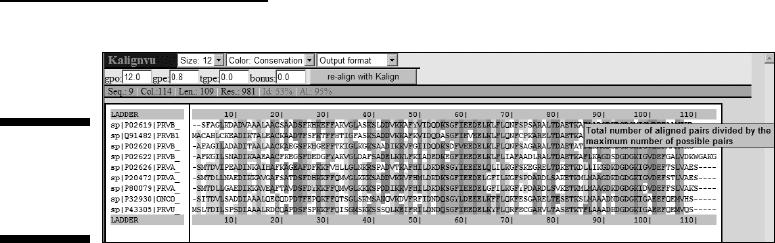
Figure 9-1 shows you what a multiple alignment actually looks like: As you
can see, it’s really only a matter of rewriting your sequences so similar fea-
tures end up in the same columns. That’s it, plain and simple.
This kind of multiple alignment is ideal if you want to study a sequence family
where all sequences share the
same common ancestor. Don’t worry if you
have only one member at this stage of the game; we show you later in this
chapter how to organize a family gathering!
266
Part III: Becoming a Pro in Sequence Analysis
15_089857 ch09.qxp 11/6/06 4:00 PM Page 266
Identifying situations where multiple
alignments do not help
Part of knowing when to use multiple sequence alignments involves knowing
when
not to use them. The multiple-sequence methods we describe in this
chapter don’t work well for assembling the sequence pieces in a sequencing
project. If you have a set of
shotgun sequences — short, partly overlapping
sequences — or if you want to turn an EST cluster into a gene sequence, mul-
tiple sequence alignment doesn’t work well — and dumping your sequences
into ClustalW, MUSCLE, or Tcoffee can produce a very disappointing and
uninformative result.
If you’re facing this particular type of problem, you may want to use special-
ized sequence assembly tools, such as Phred and Phrap (
www.phrap.org)
or cap3 (
www.mainlab.clemson.edu/cgi-bin/gdr/gdr_cap3).
Unfortunately, the intricacies of specialized sequence-assembly tools (which
we briefly overview in Chapter 5) are far beyond the scope of this book.
Another situation that
doesn’t call for multiple sequence alignment is when
the sequence you’re interested in has no homologue in any of the sequence
databases. If this happens, you’re out of luck; there’s no way you can build a
multiple alignment that relates to this sequence. You may try to find a few
sequences by using functional criteria and conducting a pattern search with
Pratt, but don’t count on any miracles.
Helping your research with multiple
sequence alignments
With the appropriate sequences in hand, you can build the proper multiple
sequence alignment. To be honest, you could build this alignment manually,
rather than by using a computer. Manual alignments are like home-cooked
food: When prepared by a good cook, nothing beats them; for regular folks like
us, however, the automatic processing (TV dinner) is generally much better.
Figure 9-1:
A multiple
sequence
alignment.
267
Chapter 9: Building a Multiple Sequence Alignment
15_089857 ch09.qxp 11/6/06 4:00 PM Page 267

The idea behind a multiple alignment like the one in Figure 9-1 is to put amino
acids or nucleotides in the same column because they’re similar according to
some criterion. You can use four major criteria to build a multiple alignment of
sequences that all have different properties, as Table 9-1 conveniently shows.
Table 9-1 Main Criteria for Building a Multiple
Sequence Alignment
Criterion Meaning
Structural similarity Amino acids that play the same role in each structure
are in the same column. Structure-superposition pro-
grams are the only ones that use this criterion.
Evolutionary similarity Amino acids or nucleo tides related to the same amino
acid (or nucleotide) in the common ancestor of all the
sequences are put in the same column. No automatic
program explicitly uses this criterion, but they all try to
deliver an alignment that respects it.
Functional similarity Amino acids or nucleotides with the same function are
in the same column. No automatic program explicitly
uses this criterion, but if the information is available,
you can force some programs to respect it — or you
can edit your alignment manually.
Sequence similarity Amino acids in the same column are those that yield an
alignment with maximum similarity. Most programs use
sequence similarity because it is the easiest criterion.
When the sequences are closely related, their struc-
tural, evolutionary, and functional similarities are equiv-
alent to sequence similarity.
The first three criteria have a clear biological meaning — the fourth one
doesn’t. Yet, when the sequences are similar enough, you can use similarity
to produce a multiple alignment that reflects the evolutionary, the structural,
and the functional relationships that exist between your sequences. Of
course, to do this, you need an alignment that you can trust. Later in this
chapter, we show you how to make sure you’re putting your money on the
right alignment.
Table 9-2 lists the main applications of multiple sequence alignments.
268
Part III: Becoming a Pro in Sequence Analysis
15_089857 ch09.qxp 11/6/06 4:00 PM Page 268

Table 9-2 Main Applications of Multiple Sequence Alignments
Application Procedure
Extrapolation A good multiple alignment can help convince you that an
uncharacterized sequence is really a member of a protein
family. Alignments that include Swiss-Prot sequences are the
most informative. Use the ExPASyBLAST server (at
www.
expasy.ch/tools/blast/) to gather and align them.
Phylogenetic If you carefully choose the sequences you include in your
analysis multiple alignment, you can reconstruct the history of these
proteins. Use the Pasteur Phylip server at
bioweb.
pasteur.fr/seqanal/phylogeny/
phylip-uk.html.
Pattern By discovering very conserved positions, you can identify a
identification region that is characteristic of a function (in proteins or in
nucleic-acid sequences). Use the logo server for that
purpose:
www-lmmb.ncifcrf.gov/~toms/
sequencelogo.html.
Domain It is possible to turn a multiple sequence alignment into a pro-
identification file that describes a protein family or a protein domain
(PSSM). You can use this profile to scan databases for new
members of the family. Use NCBI-BLAST to produce and ana-
lyze PSSMs:
www.ncbi.nlm.nih.gov/blast/
blastcgihelp.shtml#pssm.
DNA You can turn a DNA multiple alignment of a binding site into a
regulatory weight matrix and scan other DNA sequences for potentially
elements similar binding sites. Use the Gibbs sampler to identify these
sites:
bayesweb.wadsworth.org/gibbs/
gibbs.html
Structure A good multiple alignment can give you an almost perfect
prediction prediction of your protein secondary structure for both
proteins and RNA. Sometimes it can also help in the building
of a 3-D model.
nsSNP Various gene alleles often have different amino-acid
analysis sequences. Multiple alignments can help you predict whether
a Non-Synonymous Single-Nucleotide Polymorphism is likely
to be harmful. See the SIFT site for more details:
blocks.
fhcrc.org/sift/SIFT.html.
PCR A good multiple alignment can help you identify the less-
analysis degenerated portions of a protein family, in order to fish out
new members by PCR (polymerase chain reaction). If this is
what you want to do, you can use the following site:
blocks.fhcrc.org/codehop.html.
269
Chapter 9: Building a Multiple Sequence Alignment
15_089857 ch09.qxp 11/6/06 4:00 PM Page 269