
Claverie J-M., Notredame C. Bioinformatics for Dummies
Подождите немного. Документ загружается.


Gathering a known collection of sequences from Swiss-Prot
If you already know the name or accession number of every sequence you
want to include in your multiple alignment and if these sequences are in
Swiss-Prot or in TrEMBL, you can directly access them by using a special
online ExPASy facility.
This can be handy if you’re using a BLAST server that does not have
sequence-extraction facilities. You can simply copy the accession number
of the sequences you are interested in, and extract them here.
This procedure works only if the sequences that you’re interested in belong
to the Swiss-Prot or TrEMBL databases. The following steps list shows you
how to use this server:
1. Point your browser to www.expasy.ch/sprot/sprot-retrieve-
list.html
.
The Swiss-Prot/TrEMBL Retrieve a List of Entries page appears.
2. Leave the File Name field blank so the browser returns the
sequences directly.
3. On the Format line, select the FASTA check box.
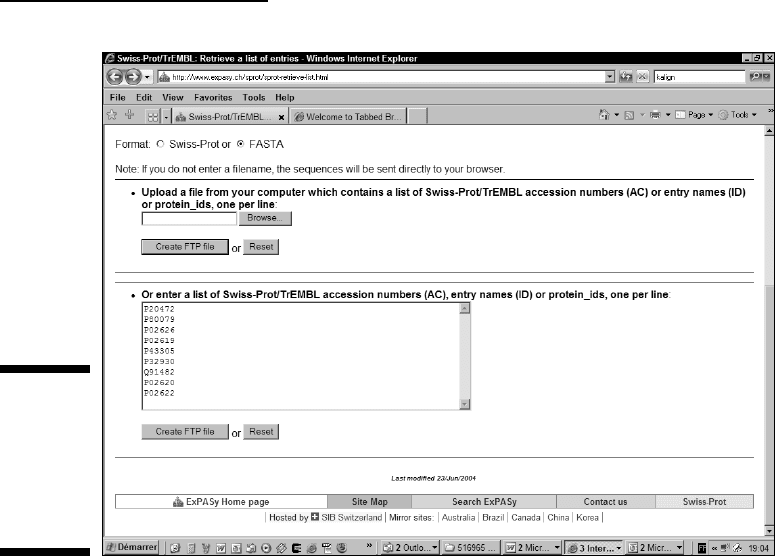
4. Enter the accession numbers of your sequences in the Sequence
window, as shown in Figure 9-5.
Enter one accession number (or sequence name) per line. For our exam-
ple, we entered P20472, P80079, P02626, P02619, P43305, P32930, Q91482,
P02620, P02622.
The Upload a File field is convenient if you have all your accession num-
bers in a file. You can generate this file with Microsoft Word, but it must
be in text form. You can enter the filename in the box or use the Browse
button and choose your file for upload.
5. Underneath the field where you entered your accession numbers,
click the Create FTP File button.
This submits your sequence request to the ExPASy server.
6. Save the results into a text file with the File➪Save As option of
your browser.
This server gives the sequences names that are longer than 15
characters. These can give you trouble on some servers.
280
Part III: Becoming a Pro in Sequence Analysis
15_089857 ch09.qxp 11/6/06 4:00 PM Page 280
Choosing the Right Method of
Multiple Sequence Alignment
Before you start making multiple sequence alignments, you must know that
none of the methods available today is perfect. They all use approximations.
Building a multiple alignment that lets you make a real discovery requires
some practice. The usual strategy requires comparing several alternative
results and looking for robustness and stability.
In this section, we show you how to use ClustalW, the most commonly used
multiple sequence alignment package. It is a simple, no-fuss, no-questions-
asked kind of tool. We also show you how to use Tcoffee, one of the latest
multiple-sequence-alignment packages that you can use. With Tcoffee, you
can combine sequences and structures, evaluate an alignment, or merge
several alternative multiple alignments into a single unified result. Finally, we
also introduce you to MUSCLE, one of the fastest alignment methods around.
Figure 9-5:
Gathering
several
sequences
from the
ExPASy
server.
281
Chapter 9: Building a Multiple Sequence Alignment
15_089857 ch09.qxp 11/6/06 4:00 PM Page 281

Using ClustalW
ClustalW is by far the most commonly used program for making multiple
sequence alignments. If you see a multiple alignment in a scientific publica-
tion, you can safely bet that the authors used ClustalW to generate it.
ClustalW uses a progressive method to build its alignments. Instead of aligning
all the sequences at the same time, it adds them one by one. If you want to get
best results from ClustalW, understanding its underlying principle helps a lot.
Many ClustalW servers are around. They usually run the same version of this
program, but their interfaces give you access to different options. At the end of
this chapter, we give you a list of servers that run ClustalW. Shopping around to
find a ClustalW server that’s both fast
and reliable is worth your time.
Running the EBI ClustalW server
ClustalW is a typical example of a program that can produce a reasonable
output with its default settings. You should probably worry about the set-
tings only when you want to change the output format of the program.
282
Part III: Becoming a Pro in Sequence Analysis
ClustalW behind the scenes
ClustalW is the latest of the Clustal software
series. Clustal was the first multiple sequence
alignment program that could run on almost
any platform. Legend has it that Des Higgins
made the original design for Clustal on the back
of an envelope, in a smoky Dublin pub, in the
early 1990s. A few years later, when Des moved
to the European Molecular Biology Laboratory
in Heidelberg, he took Clustal along — and
kept it alive, turning it into one of the most
successful series of bioinformatics programs:
ClustalV, ClustalW, and ClustalX, an X-window
implementation.
Des Higgins did not truly invent the Clustal algo-
rithm; Paula Hogeweg had already described
it in the early 1980s. What Des did was to
put together all the right ingredients so his
program could be used by anybody on almost
any computer. He also packaged and arranged
everything so it would be very easy to use.
These are some of the reasons why Clustal
became an instant hit. These days, with more
than 35,000 citations, ClustalW is one of the
most widely cited scientific publications in the
history of biology.
ClustalW uses a progressive algorithm. This
means that it builds the alignment progressively,
adding sequences little by little until the com-
plete multiple sequence alignment is finished.
The reason for doing this is that state-of-the art
sequence-alignment programs find it hard to
align more than two sequences at a time. Since
these pairwise-alignment programs are the only
tools we’ve got on hand to produce a multiple
alignment, the only solution is to cheat a little.
This is what the progressive algorithm does.
The trick is simple: You start comparing all your
sequences two by two, so you can cluster them
by similarity (Clustal does this for you). The clus-
tering looks like a phylogenetic tree. (It is the file
with a
.dnd extension that ClustalW outputs.)
15_089857 ch09.qxp 11/6/06 4:00 PM Page 282

283
Chapter 9: Building a Multiple Sequence Alignment
This clustering is named a
dendrogram.
If we
were to align four sequences A, B, C, and D, the
dendrogram might look like this:
|------A
|------|
| |------B
|
Root ----------|
|
| |------C
|------|
|------D
The topology of this dendrogram tells us a
simple story: It says that A and B are more sim-
ilar to each other than they are to C and D. Thus
if we align A with B, we are less likely to make
a mistake than if we align A with C or D.
To make the progressive alignment, ClustalW fol-
lows the dendrogram topology: It starts aligning A
with B. After this it aligns C with D. When this is
done, Clustal has two small multiple alignments
(AB and CD). This is where Clustal pulls out its
main trick: It aligns the two alignments as if each
of them was a single sequence! It is not as com-
plicated as it seems and there are many ways to
do this. For instance, you could replace each
alignment with a single consensus sequence.
Clustal uses a slightly more sophisticated method,
but the idea is essentially the same: It treats mul-
tiple alignments like single sequences and aligns
them two by two.
Now you may ask, where do we cheat then?
The answer is simple: we make a multiple align-
ment with ALL the sequences in our set, but we
do not use ALL the information they contain. For
instance, when Clustal aligns A and B, it does
not use C and D. This could be a problem. If A
and B are very different, we will produce an
incorrect pairwise alignment — which would
be a waste if the two other sequences con-
tained some useful information we did not use.
Imagine, for instance, that A, B, C, and D all con-
tain a certain very short (but important) motif.
This motif does not look so important when you
compare only A and B, and it only shows up
when you look at all the sequences simultane-
ously. Unfortunately, with a progressive strat-
egy, C and D will come too late to rescue the
incorrect alignment of A and B.
The reason not to use all the information is that
it’s too expensive in terms of computation. So we
cheat a little and use the progressive alignment.
This shouldn’t worry you too much, though. Even
if it is a little greedy and approximate, Clustal
often delivers pretty good alignments.
When you ask yourself which type of sequences
are best suited for ClustalW, imagine that your
sequences are like big stones spread across a
shallow river. Making a multiple alignment is like
crossing this river by jumping from stone to
stone: It doesn’t matter how wide the river is, as
long as you always find a stone to jump to.
Similarly, it doesn’t matter how many sequences
you have, and how far apart they are from each
other, as long as a chain of correct alignments
exists that can take you across the entire set.
(Of course, if a sequence or a small group of
sequences is very different from the rest, you
fall in the rapids!)
Sometimes your sequence set may contain
many identical or similar sequences — usually
a problem because sequences that belong to
minority subgroups become harder to align
properly. If you can, you want to avoid this situ-
ation by removing the sequences yourself, but
if you have no choice, it can be reassuring to
know that ClustalW is equipped to deal with
redundancy.
In case you were wondering, the
W
in
ClustalW
does not stand for Dubya, the U.S. President; it
stands for
W
eights. ClustalW uses a sophisti-
cated scheme so that very similar sequences do
not end up dominating the multiple sequence
alignment. In fact, every sequence is supposed
to receive a weight proportional to the amount
of new information it contributes.
15_089857 ch09.qxp 11/6/06 4:00 PM Page 283

Before you head off to a ClustalW server, you must do a little spadework
ahead of time. Specifically, you need to gather together all the sequences
you want to work with. (If you’re not quite sure how to do this, check out
the section “Gathering a known collection of sequences from Swiss-Prot,”
earlier in this chapter.)
The most convenient way to use ClustalW is to feed it sequences in FASTA
format. However, you can also give to ClustalW a variety of formats, including
Swiss-Prot and PIR (the Protein Information Resource format), as well as
sequences in the most common multiple-alignment formats.
If you want to use ClustalW effectively, you’ll need to observe a couple of
caveats:
If you give ClustalW a set of sequences already aligned, it does not
remove the existing gaps.
This means that the alignment you input
influences the alignment ClustalW will produce.
The order in which you give sequences to ClustalW sometimes influ-
ences the alignment.
If you change this order, even with the same
sequences, the alignment may change.
With your sequences in hand, it’s now time to fire up the ClustalW server:
1. Point your browser to the EBI ClustalW server page at
www.ebi.ac.uk/clustalw.
The ClustalW page dutifully appears.
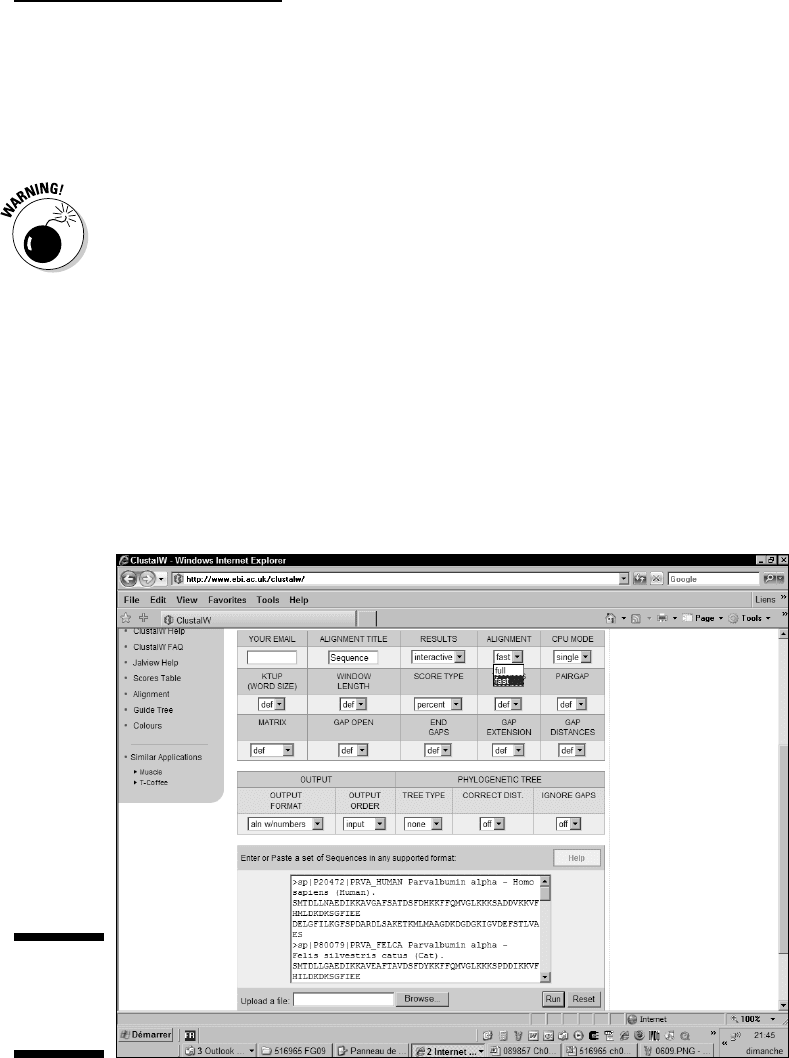
2. Paste the sequences you collected in the Sequence window.
3. Choose Fast from the Alignment pull-down menu (Figure 9-6).
4. Use the Output Format pull-down menu to set the selection of
your choice.
Output formats have various pros and cons. (See Chapter 10 for a dis-
cussion on this.) It is safe to use Aln Without Numbers, the default
ClustalW format.
It is never too late to change a format. If you didn’t generate your
multiple alignment in the format that suits you best, DON’T recompute
it! You can easily reformat alignments by using an online reformat utility
(such as Fmtseq) at
www.bimcore.emory.edu/Pise/. (For more on
reformatting, see Chapter 10.)
5. Choose Input from the Output Order pull-down menu. (Refer to
Figure 9-6.)
Here are a few things to remember about setting output:
284
Part III: Becoming a Pro in Sequence Analysis
15_089857 ch09.qxp 11/6/06 4:00 PM Page 284
• When you set the output order to Input, ClustalW outputs your
sequences in their original order.
• If you set the output order to Aligned, the sequences appear in the
order they were aligned. This order depends on the guide tree, and
it puts closely related sequences next to each other.
• Although the Aligned output is more informative than Input,
Aligned output makes it difficult to compare alignments generated
with different methods or different parameters. Usually it’s better
to prearrange your sequences in the most informative way and
then select the Input option.
6. Do not select a tree type.
No need to select a tree type here. Any tree computed would be esti-
mated from the unaligned sequences. If you want to compute a tree,
compute the alignment first and then turn that alignment into a phyloge-
netic tree. (See Chapter 13 for more on phylogenetic trees.)
7. Click the Run button at the bottom of the page.
An intermediate page appears. Wait until your browser displays the
Results page.
Figure 9-6:
The EBI
ClustalW
server.
285
Chapter 9: Building a Multiple Sequence Alignment
15_089857 ch09.qxp 11/6/06 4:00 PM Page 285

8. Save your results.
Your results come in three sections:
•
Pairwise scores: This is the default output of ClustalW. You can safely
ignore the content of this section. It has mostly to do with the pair-
wise comparisons that ClustalW makes to figure out the guide tree.
•
The multiple alignment: This section is in the middle of the
output. It contains your alignment. You can display this alignment
and save it as a text file if you click the hyperlink that comes just
before the alignment.
Most ClustalW Web servers (including the EBI) output the ClustalW
guide tree (a
.dnd file). The guide tree is NOT a phylogenetic tree.
To obtain a phylogenetic tree from a ClustalW server, you must cut
and paste an actual multiple sequence alignment — not a set of
unaligned sequences. (We explain how to do this in Chapter 13.)
Changing ClustalW parameters
There are three parameters in ClustalW that can change your alignment: sub-
stitution matrices, gap-opening penalties, and gap-extension penalties. (Refer
to Figure 9-6 to see the pull-down menus associated with these parameters.)
Table 9-5 lists these three types of parameters along with potential conse-
quences when you change them.
Table 9-5 Controlling the Effect of Parameter Tuning in ClustalW
Parameter Effect
Substitution Substitution matrices control the cost of mutations in sequence
matrix alignments. (For more on cost, see Chapter 8.) If you select a
category of matrices like PAM or BLOSUM, ClustalW automati-
cally chooses the most adapted index. Predicting the effect of
changing matrices is difficult, and there is no such thing as an
ideal matrix. If your sequences are closely related, such a
change has no effect. If your alignment is difficult to interpret, it
may be worth changing from BLOSUM to PAM.
Gap-opening Gap-opening penalties (GOP) control the cost of opening gaps
penalty in your alignment. The higher the value, the more difficult it is
to insert a gap in your alignment. The gap-opening penalty is
applied once for the opening of each gap. Tuning has little
effect because ClustalW readjusts these values automatically.
Gap-extension Gap-extension penalties control the size of the gaps. It’s impos-
penalty sible to predict the optimal couple GOP/GEP, but it’s clear that an
optimal value exists for almost every protein family — and that
the only way to find this value is empirically.
286
Part III: Becoming a Pro in Sequence Analysis
15_089857 ch09.qxp 11/6/06 4:00 PM Page 286

Never change parameters in order to force ClustalW to produce an alignment
that you know is right. If you know the correct alignment, edit the ClustalW
alignment with one of the editors we show you in Chapter 10. The only good
justification for changing the parameters is to see whether slight changes can
improve the overall appearance of your alignment in terms of blocks and
weakly conserved positions.
Aligning sequences and structures
with Tcoffee
Tcoffee is a recent method developed for conducting multiple sequence
alignments. It uses a principle that’s a bit similar to ClustalW, but it yields
more accurate alignments at the cost of a slightly longer running time.
Tcoffee builds a progressive alignment like ClustalW, but it compares segments
across the entire sequence set. Table 9-6 lists the main applications of Tcoffee.
Aside from its accuracy, the main specificity of Tcoffee is its ability to align
sequences and structures (EXPRESSO), the possibility of evaluating the accu-
racy of an alignment (CORE) and the possibility of combining many alterna-
tive multiple sequence alignments into one (Mcoffee).
Table 9-6 Available Tools on www.tcoffee.org
Usage Description
TCOFFEE Produce a multiple sequence alignment with Tcoffee.
CORE Evaluate the reliability of an existing multiple alignment.
MCOFFEE Run any requested Multiple Sequence Alignment package and
combine all the output into one final alignment.
EXPRESSO Incorporate all the available structural information in your align-
ment. Will produce the best sequence alignments if the structures
are available.
Making a multiple alignment with Tcoffee
Making a Multiple sequence alignment with the regular Tcoffee server is only a
matter of cutting and pasting your sequences into the right window. (If you’re
not quite sure how to get the sequences, check out the section “Gathering a
known collection of sequences from Swiss-Prot,” earlier in this chapter.)
287
Chapter 9: Building a Multiple Sequence Alignment
15_089857 ch09.qxp 11/6/06 4:00 PM Page 287
With your sequences in hand, it’s Coffee Time!
1. Point your browser to the Tcoffee server home page at
www.tcoffee.org.
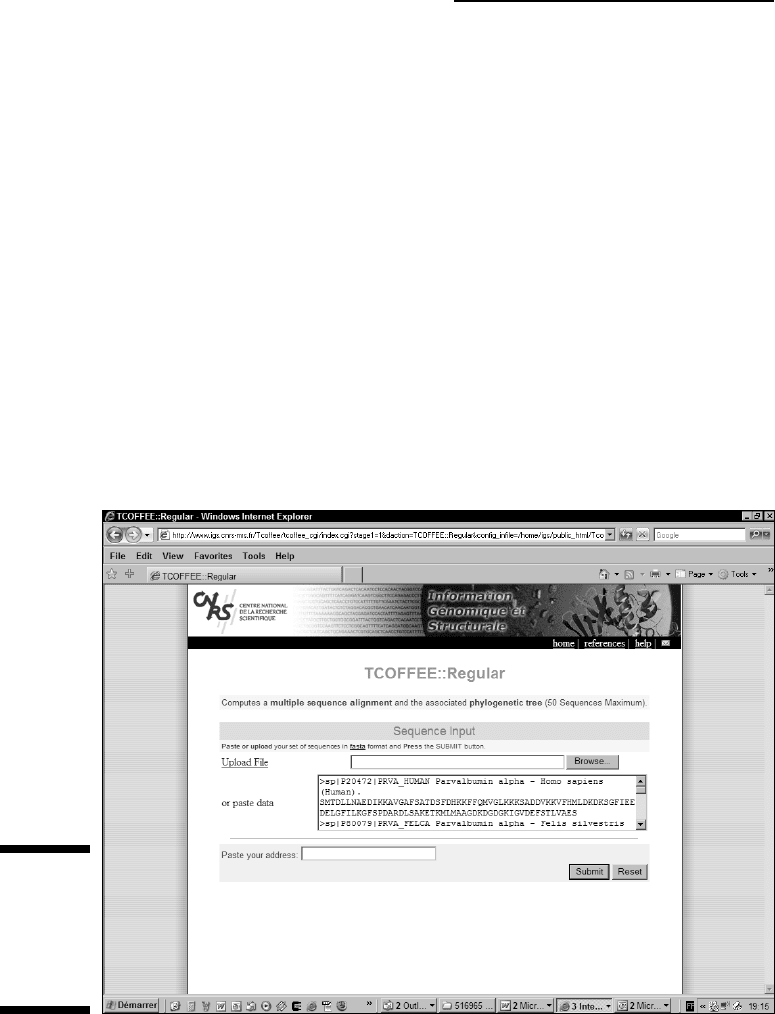
2. Click the Regular button on the TCOFFEE line (first line).
The Build a Multiple Alignment page appears (Figure 9-7).
3. Paste your sequences into the large window.
You can use most formats. If your sequences are in a text file, you can
upload this file by using the Browse button.
4. Click the Submit button at the top or the bottom of the page.
Tcoffee can be slow at times. If you’d prefer to be notified when your
computation is done, enter your e-mail address in the Web form.
5. Examine your results.
Tcoffee returns a table that contains hyperlinks to your results, as
shown in Figure 9-8.
Figure 9-7:
The Tcoffee
Build a
Multiple
Alignment
page.
288
Part III: Becoming a Pro in Sequence Analysis
15_089857 ch09.qxp 11/6/06 4:00 PM Page 288
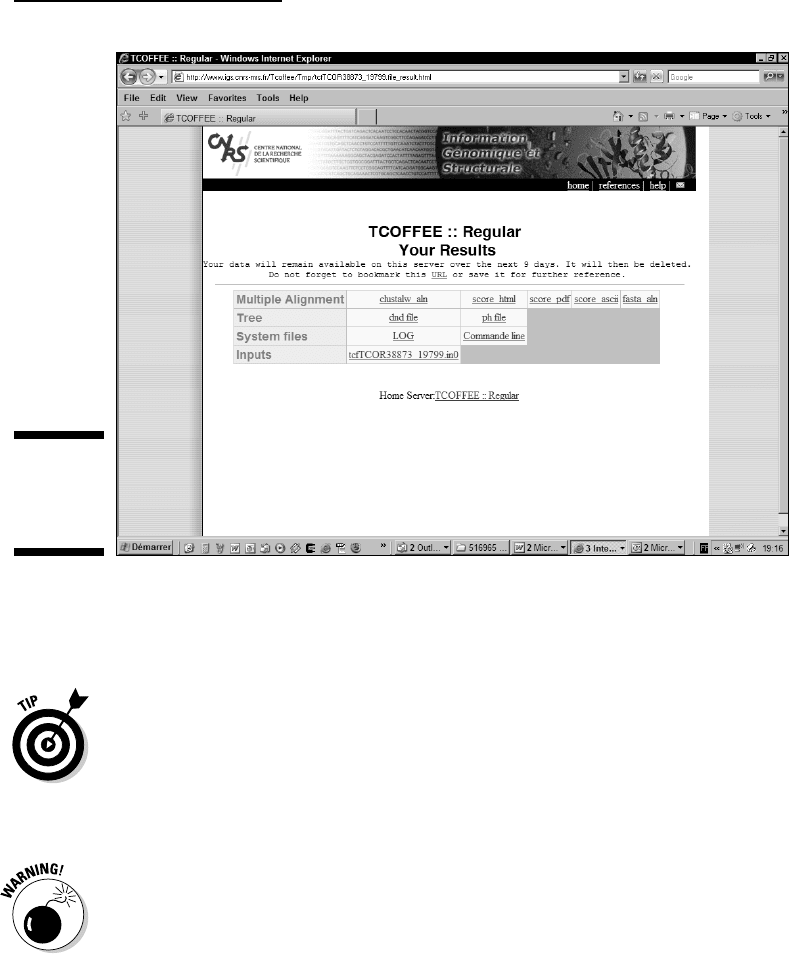
The first row of the table is dedicated to multiple sequence alignments
and includes
•
msf_aln, clustalw_aln, fasta_aln: Text files containing your align-
ment in various formats.
Keep these files if you want to use your alignment as input for
another program.
•
score_html, score_ascii: A colorized alignment where every
residue appears on a background that indicates the quality of this
alignment. Red indicates high-quality segments; blue indicates
regions of your alignment that you have no reason to trust. The
score_ascii is a text version of the .html file.
These two last files are meant only for display; you can’t use them
as an input for other sequence-analysis programs.
The second row is dedicated to phylogenetic trees:
•
dnd: The guide tree or dendrogram generated by Tcoffee in Newick
format (see Chapter 13). You should not use it in place of the true
phylogenetic tree.
Figure 9-8:
The Tcoffee
default
output.
289
Chapter 9: Building a Multiple Sequence Alignment
15_089857 ch09.qxp 11/6/06 4:00 PM Page 289