
Claverie J-M., Notredame C. Bioinformatics for Dummies
Подождите немного. Документ загружается.

Str
ucture Analysis
Help
Follow the first link (Download Files) to get your own copy of the coordi-
nates. Feel free to explore the other links, in particular by clicking on the vari-
ous tags at the top of the form. For instance, the Sequence Details
link gives
you a nice graphical picture of the actual secondary structure along with the
sequence. You can compare it to the prediction that we made earlier in this
chapter.
Guessing the 3-D structure of your protein
The previous section shows how to retrieve and quickly display a known 3-
D–structure recorded in the PDB. This is definitely useful but falls short of
addressing the questions we listed at the beginning of this chapter. Basically,
we still do not know what the interesting bits of our own sequence look like
in their 3-D context.
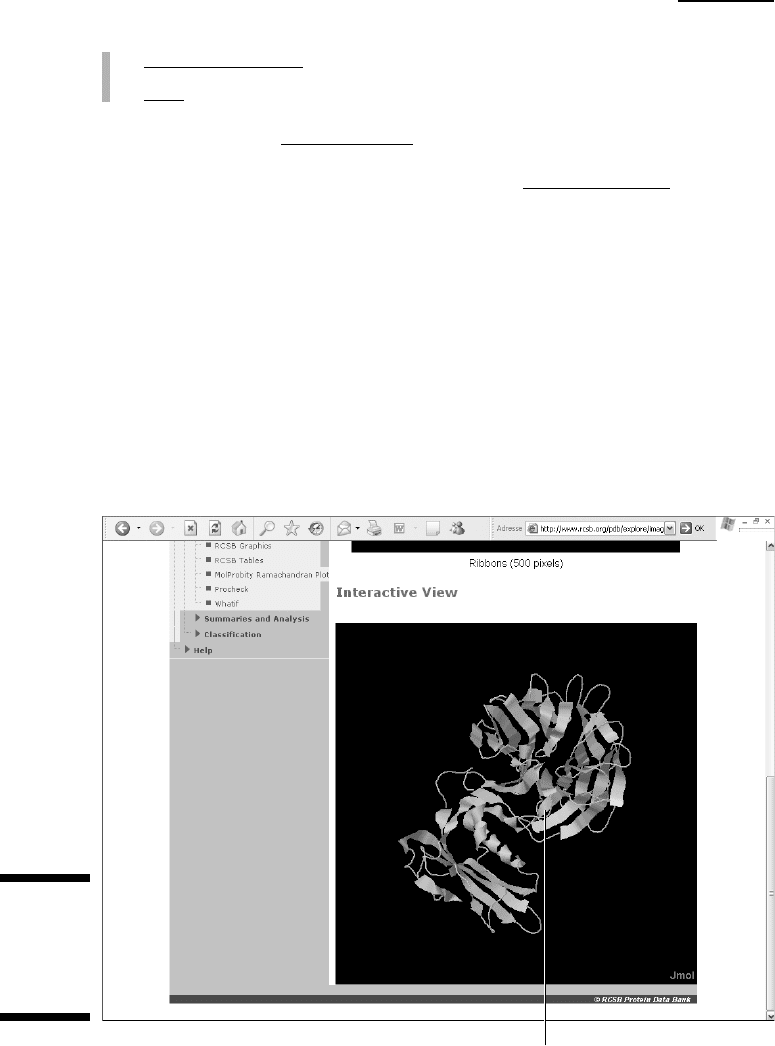
Click here to drag and rotate the molecule.
Figure 11-4:
Interactive
view of the
1CRZ PDB
entry.
340
Part IV: Becoming a Specialist: Advanced Bioinformatics Techniques
18_089857 ch11.qxp 11/6/06 4:02 PM Page 340

In the remaining sections of this chapter, we follow a realistic scenario to show
you how you can sometimes get a fairly good idea of the 3-D structure of your
protein
from its sequence alone by doing a handful of simple operations.
We assume that you have determined the sequence and the secondary struc-
ture of your protein and that you are now asking this basic question:
How does
it fold?
A simple way to answer this question is to look for a homologous pro-
tein with a known 3-D structure in the PDB. The next steps list shows you how.
Imagine, if you will, that we’ve just determined the sequence of the TolB gene
of the bacteria
Rickettsia conorii and we are curious about its structure. To
satisfy our curiosity, we do the following:
1. Fetch the protein sequence from NCBI:
a. Open a window in your browser and go to www.ncbi.nlm.nih.gov.
b. Choose Protein from the Search drop-down menu.
c. Type the identifier
NP_360043 in the query window and then
click Go.
d. When the answer comes back, change the Display format to FASTA.
The
Rickettsia conorii TolB protein sequence is now ready for use.
2. Open a new browser window and point it to the NCBI BLAST server at
www.ncbi.nlm.nih.gov/BLAST/.
3. Click the
Standard Protein-Protein BLAST [blastp] link.
It is the first choice in the upper-right corner. The blastp input page
appears.
4. Select pdb from the Choose database drop-down menu.
5. Copy the
Rickettsia conorii TolB sequence from the other browser
window and paste it into the blastp query window.
6. Deselect the Do CD-search box (to simplify your output).
7. Click the BLAST! button.
An intermediate page appears, telling you that your request has been
successfully submitted and put into the Blast Queue.
8. Click the Format! button on the intermediate page and wait for the
Blastp search to finish.
Figure 11-5 shows an example of the kinds of results you can expect. There are
two strong matches with E-values much lower than 1. They are identified as
341
Chapter 11: Working with Protein 3-D Structures
18_089857 ch11.qxp 11/6/06 4:02 PM Page 341
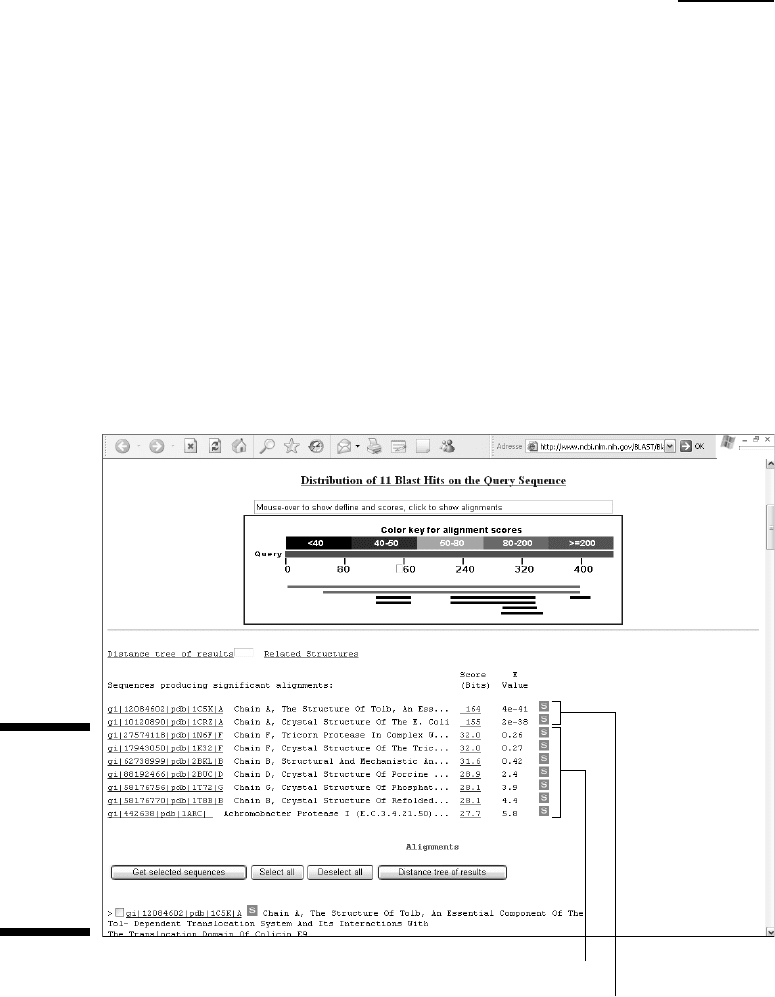
PDB entries 1C5K and 1CRZ. This is good news. If you click these matches, their
identifiers reveal that they both correspond to the TolB protein from
E. coli —
the structure of which has been determined by two different laboratories.
This result is very interesting for two important reasons:
1. The homologous PDB sequences have 29 percent identical residues with
our query.
2. The homology region covers the entire sequences.
By experience, we know that, given such a percentage of identical residues,
the 3-D structure of our query protein (the
Rickettsia TolB) is probably quasi-
identical to the 3-D structure of its
E. coli homologue. And so, we have a
nearly perfect 3-D model to work with. The next section shows you how to
use this model to further interpret the TolB protein sequence.
Non-significant matches
Two very good matches in PDB
Figure 11-5:
Blastp
output of the
Rickettsia
conorii TolB
sequence
against
PDB.
342
Part IV: Becoming a Specialist: Advanced Bioinformatics Techniques
18_089857 ch11.qxp 11/6/06 4:02 PM Page 342

Looking at sequence features in 3-D
On its own, a protein sequence is an important piece of information, but it
becomes more revealing and valuable when you compare it with others from
a variety of different species. Chapter 9 insists on the role of multiple align-
ments to identify the most significant regions of a sequence: Conserved
residues (or, alternatively, highly variable ones) are often key to predicting
or understanding a protein function. Going further, by precisely locating
these conserved residues in space, it’s possible to come up with additional
clues as to their biological roles: Such residues, for example, can delineate a
cavity at the active site of an enzyme — or, if they are found at the surface,
one can assume they are good candidates for interactivity with other mole-
cules, and so on.
We can use the example of the TolB protein family (of relatively unknown
function) to illustrate the interplay between multiple alignments and struc-
tural analysis. Here’s how it’s done:
1. First fetch several TolB homologue sequences from various bacterial
species from NCBI:
a. Open a window in your browser and go to www.ncbi.nlm.
nih.gov
.
b. Choose Protein from the drop-down Search menu.
c. In the query window, type in the following identifiers:
NP_360043
(
R. conorii), NP_415268 (E. coli), NP_404737 (Y. pestis), NP_249663
(
P. aeruginosa), and NP_438543 (H. influenzae); then click Go.
d. When the answer is returned, change the Display format to FASTA.
e. Finally, use Send to Text to get rid of any parasitic characters.
Five TolB protein sequences are now ready for use. Now we can build a
multiple alignment out of these sequences.
2. Open a new browser window and go to www.igs.cnrs-mrs.fr/
Tcoffee/
.
3. Click on Regular in the very top TCOFFEE option line.
4. Copy the five TolB sequences from the other browser window and
paste them into the Tcoffee input window.
Be sure to include their FASTA headers.
5. Click Submit (at the bottom of the form).
The Tcoffee Results form automatically appears after an intermediary
waiting page.
343
Chapter 11: Working with Protein 3-D Structures
18_089857 ch11.qxp 11/6/06 4:02 PM Page 343
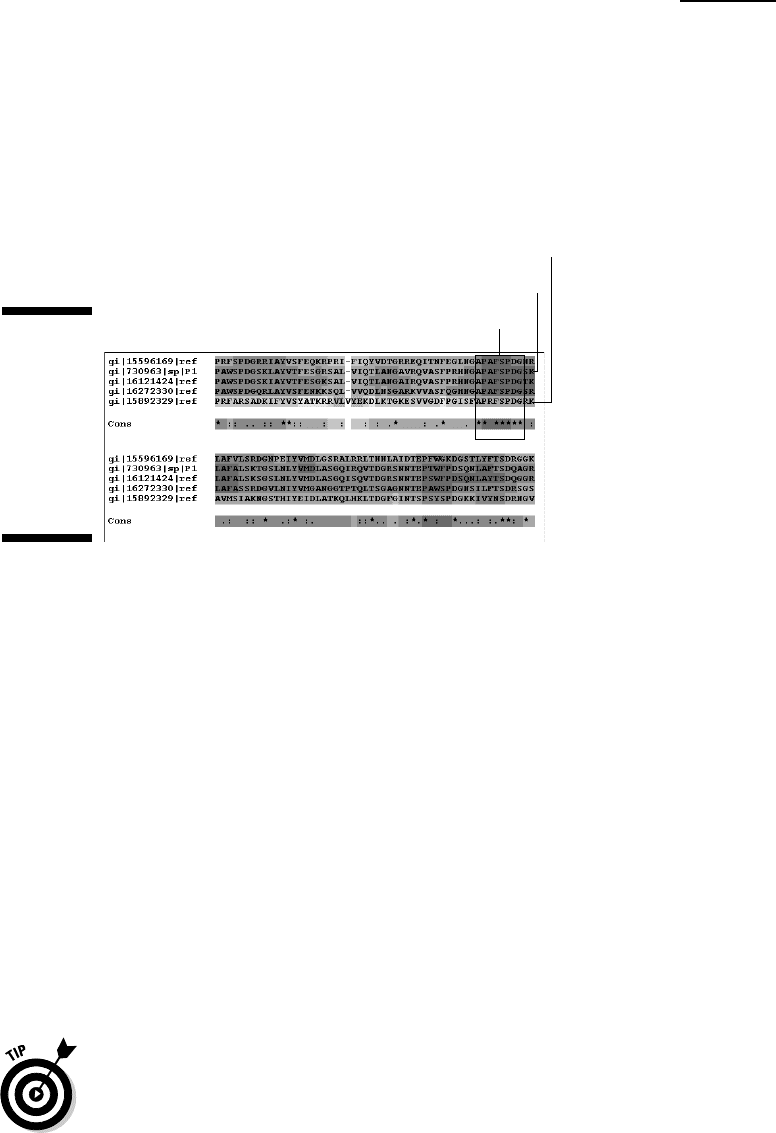
6. Choose score_html from the Multiple Alignment Output menu.
This displays the multiple alignment in color with the most reliable
regions in red. This part of the alignment is shown in Figure 11-6. It clearly
reveals a segment of strictly conserved (invariant) residues shared by all
these TolB proteins. Our challenge in the remaining pages of this chapter
is to figure out where in the TolB structure these residues are located.
Exploring the sequence/PDB structure relationship the interactive way
To interpret the significance of an invariant segment in our TolB proteins, we
must be able to display its 3-D structure and
turn this structure around interac-
tively
so we can look at it from any angle. Simultaneously, we must be able to
refer to the protein sequence, and to
highlight the residues we find interesting.
In short, we need a protein model that we can rotate around and analyze in
parallel with its sequence. Not long ago, this kind of business was still the
privilege of protein crystallographers working on expensive computers. Not
anymore! If you can bear with us until the end of this chapter, you’ll be doing
it on your own PC in just a few minutes. Just follow our instructions:
1. Point your browser to www.ncbi.nlm.nih.gov/Structure/.
The structure server of the NCBI appears.
2. In the Search Entrez Structure/MMDB window at the top of the page,
enter the PDB code of your relevant model. (MMDB stands for
“
Molecular Modeling DataBase.”)
For our example, we’ll use 1CRZ.
If you have the choice of several structures, a simple rule is to choose
the one with the best resolution; for our example, the best resolution is
1CRZ (that is, 1.95 Angstroms). You’ll find the Angstrom value in the ID
card of each PDB entry (refer to Figure 11-3).
Highly conserved region?
E. coli
R. conorii
Figure 11-6:
An
intriguing
segment of
strictly
conserved
residues in
the TolB
proteins.
344
Part IV: Becoming a Specialist: Advanced Bioinformatics Techniques
18_089857 ch11.qxp 11/6/06 4:02 PM Page 344
3. Click the Go button.
Wait for a new page to appear.
4. Click the 1CRZ link.
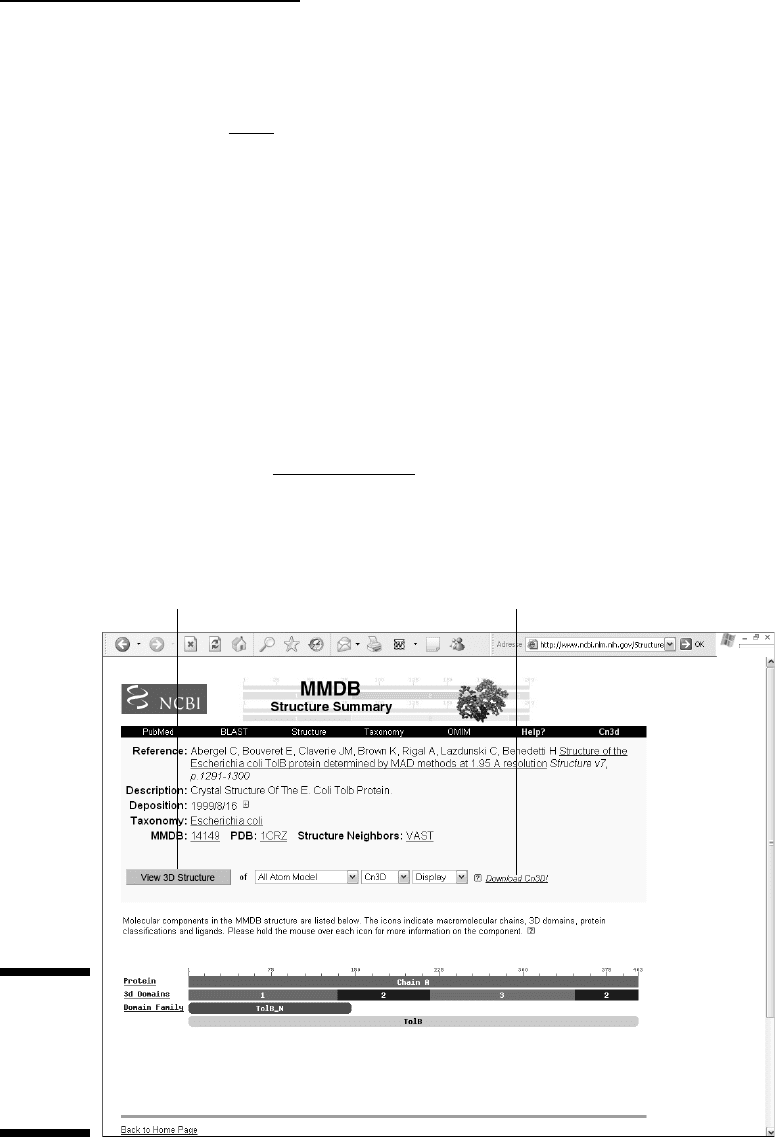
At this point, you should be looking at the MMDB structure card, as
shown in Figure 11-7.
This MMDB form exhibits a prominent View 3-D Structure button. What will
happen next depends on the software already installed on your computer.
5. Click the View 3-D Structure button.
Doing so downloads a file with the atomic coordinates of the 1CRZ pro-
tein structure. This file is formatted for the 3-D structure viewer Cn3D
program. If nobody ever used your computer to display a protein struc-
ture in 3-D, a dialog box will pop up, asking you what to do with this file.
It’s telling you that your system doesn’t contain the Cn3D program
required to display the structure. In order to continue, you have to
install the program. Here’s how:
a. Click the Download
Cn3D!
link.
This takes you to the Cn3D home page, as shown in Figure 11-8.
From here you can access a complete tutorial and/or continue the
installation process.
Click here to view. Click here to install Cn3D.
Figure 11-7:
MMDB
structure
card for
PDB entry
1CRZ.
345
Chapter 11: Working with Protein 3-D Structures
18_089857 ch11.qxp 11/6/06 4:02 PM Page 345
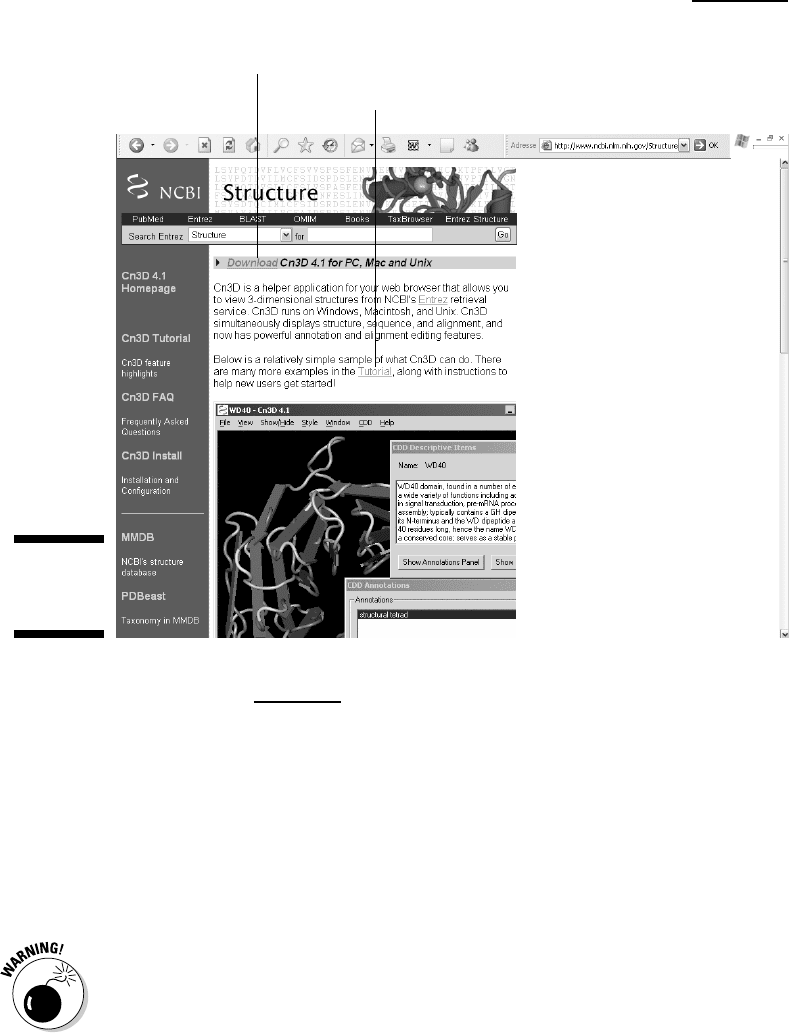
b. Click Download Cn3D for PC, Mac, or Unix link.
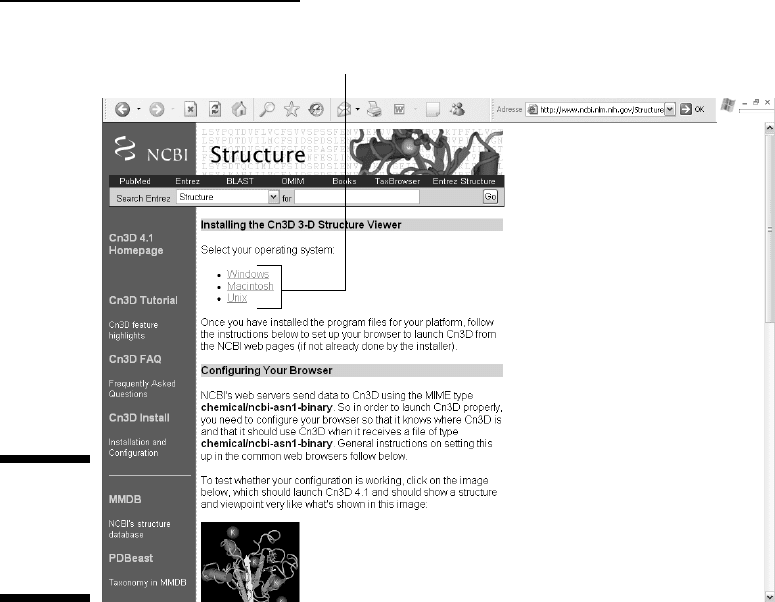
c. In the window that appears (see Figure 11-9), select the version
suitable for your computer: PC, Mac, or Unix.
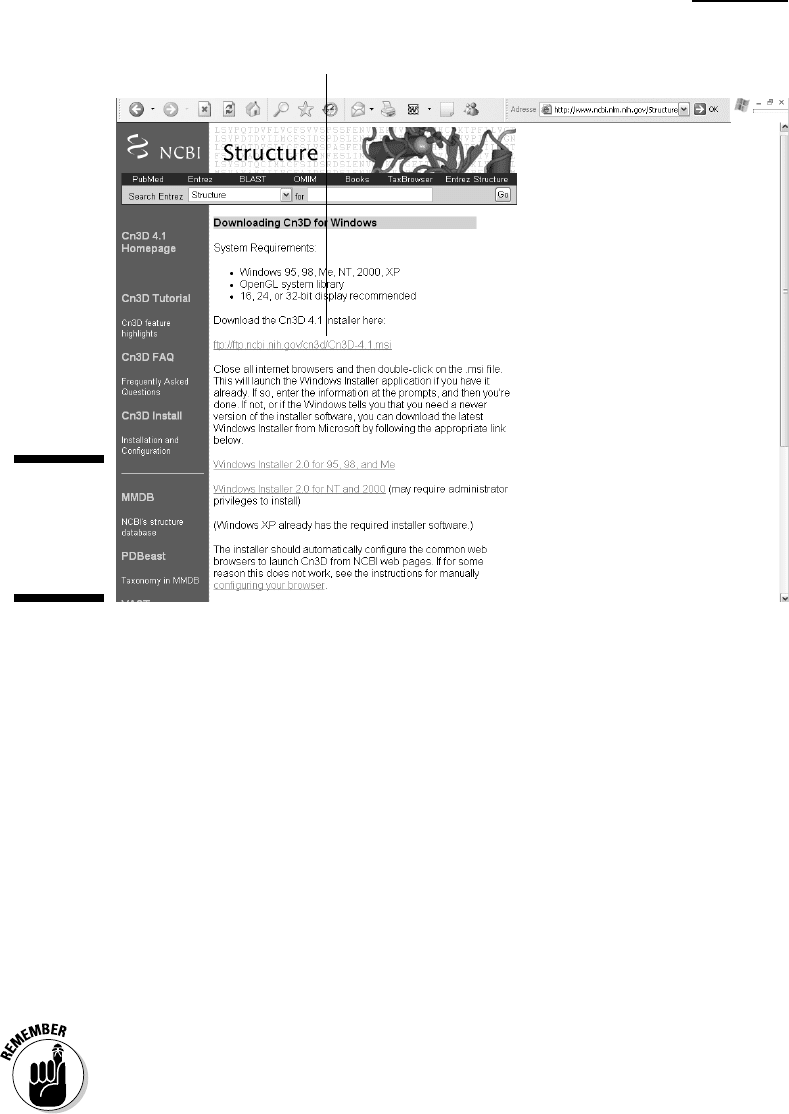
Whatever platform you select, a new page appears with an FTP
address, similar to the Windows page shown in Figure 11-10.
d. Click the FTP address link.
For our Windows system, the link is
ftp://ftp.ncbi.nih.gov/cn3d/Cn3D-4.1.msi
This downloads the CnD3 installer, which takes just a few seconds.
The system may also require you to install a newer version of the
Windows Installer. Just follow the instructions. This also only takes
a few extra seconds.
Click here to install Cn3D.
Learn how to use Cn3D.
Figure 11-8:
The Cn3D
home page.
346
Part IV: Becoming a Specialist: Advanced Bioinformatics Techniques
18_089857 ch11.qxp 11/6/06 4:02 PM Page 346
e. After everything is done, locate the Cn3D-4.1.msi icon on your
desktop and click it twice.
The Cn3D installation wizard welcomes you.
f. Follow its instructions and fill out the forms.
You have to provide a name, an organization, and select a destina-
tion folder (default is fine). After the last step, the wizard confirms
the successful installation.
Now that Cn3D is in your system, go back to NCBI and redo the
sequence of steps that we describe in the previous section.
6. Click the View 3D Structure button again.
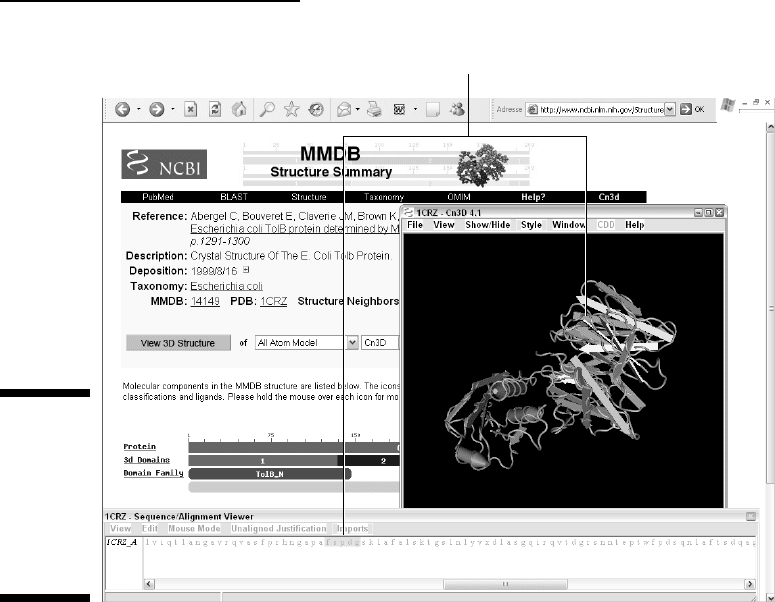
Now that Cn3d is installed, the miracle occurs, and your screen should
look like Figure 11-11. At the top of the MMDB page, the 3-D protein
structure that corresponds to the 1CRZ PDB entry is displayed in a live
window.
Select your system.
Figure 11-9:
Installing
Cn3D:
System
selection.
347
Chapter 11: Working with Protein 3-D Structures
18_089857 ch11.qxp 11/6/06 4:02 PM Page 347
7. Spin your protein around.
You can turn your protein around simply by moving your mouse; in fact,
you can spin that protein around like a partner when you’re dancing
salsa! This is impressive, fun, and tremendously useful!
8. Prepare your protein for taking a picture.
Zoom in and out with the drop-down menus on the top bar of the
window.
Change the appearance of the model (wire, tube, ball and stick, or even
solid space filling).
9. Save a picture by choosing File➪Export PNG from the main menu in
the Cn3D window.
This allows you to save a picture of the protein structure after choosing
its appearance and orientation according to your personal preferences.
This spectacular show runs locally on your computer, independently of your
Internet connection. Terminate your browser, and the live molecule stays on
your screen! Neat! It also means that your data doesn’t travel over the
Internet. (This is important if you work for a paranoid boss.)
Download the Cn3D installer.
Figure 11-10:
Installing
Cn3D:
Installing
the installer.
348
Part IV: Becoming a Specialist: Advanced Bioinformatics Techniques
18_089857 ch11.qxp 11/6/06 4:02 PM Page 348
Analyzing the relationship between sequence
and structure interactively
Last but not least, you probably noticed another window displayed below the
live molecule. (Refer to Figure 11-11.) This is the sequence viewer. By default,
this window displays the protein sequence associated with the PDB entry.
Here we have the sequence of the
E. coli TolB molecule.
The time has come to find out where in the structure that curious region of
invariant residues that read “FSPDG” is located. With Cn3D, it could not be
easier.
1. In the sequence viewer top bar, click the View button.
2. From the pop-up menu that appears, choose the Find Pattern option.
3. In the pattern input box that pops up, type
FSPDG.
The corresponding segment is immediately highlighted in bright yellow in the
sequence AND in the structure. To locate it in the sequence, scroll along the
sequence by using the bottom cursor. To locate it in the structure, turn the
molecule around.
“fspdg” motif
Figure 11-11:
Interactive
3-D display
of the E. coli
TolB protein
sequence
and
structure.
349
Chapter 11: Working with Protein 3-D Structures
18_089857 ch11.qxp 11/6/06 4:02 PM Page 349