
Coker A.K. Fortran Programs for Chemical Process Design, Analysis, and Simulation
Подождите немного. Документ загружается.

900
180
ELSE
ENDIF
CONTINUE
WRITE (i, 180)
FORMAT (78(IH-))
FORM FEED THE PRINTING PAPER TO TOP OF THE NEXT PAGE.
WRITE (i, *) CHAR(12)
CLOSE (UNIT = i)
STOP
END
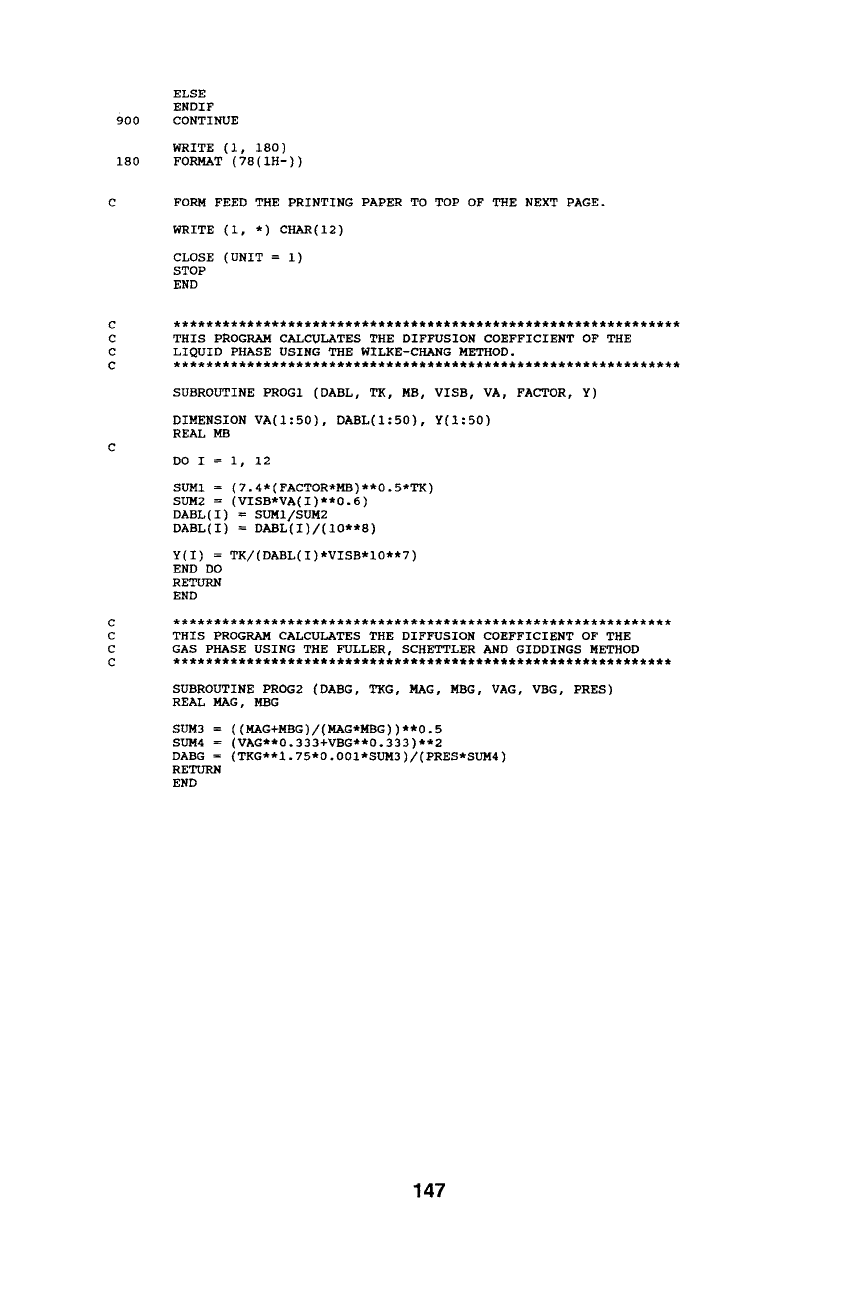
THIS PROGRAM CALCULATES THE DIFFUSION COEFFICIENT OF THE
LIQUID PHASE USING THE WILKE-CHANG METHOD.
**************************************************************
SUBROUTINE PROGI (DABL, TK, MB, VISB, VA, FACTOR, Y)
DIMENSION VA(I:50), DABL(I:50), u
REAL MB
DO I = i, 12
SUM1 = (7.4*(FACTOR*MB)**0.5*TK)
SUM2 = (VISB*VA(I)**0.6)
DABL(I) = SUMI/SUM2
DABL(I) = DABL(I)/(10**8)
Y(I) = TK/(DABL(I)*VISB*I0**7)
END DO
RETURN
END
*************************************************************
THIS PROGRAM CALCULATES THE DIFFUSION COEFFICIENT OF THE
GAS PHASE USING THE FULLER, SCHETTLER AND GIDDINGS METHOD
*************************************************************
SUBROUTINE PROG2 (DABG, TKG, MAG, MBG, VAG, VBG, PRES)
REAL MAG, MBG
SUM3 = ((MAG+MBG)/(MAG*MBG))**0.5
SUM4 = (VAG**0.333+VBG**0.333)**2
DABG = (TKG**I.75*0.001*SUM3)/(PRES*SUM4)
RETURN
END
147
9
i00
105
ii0
120
i0
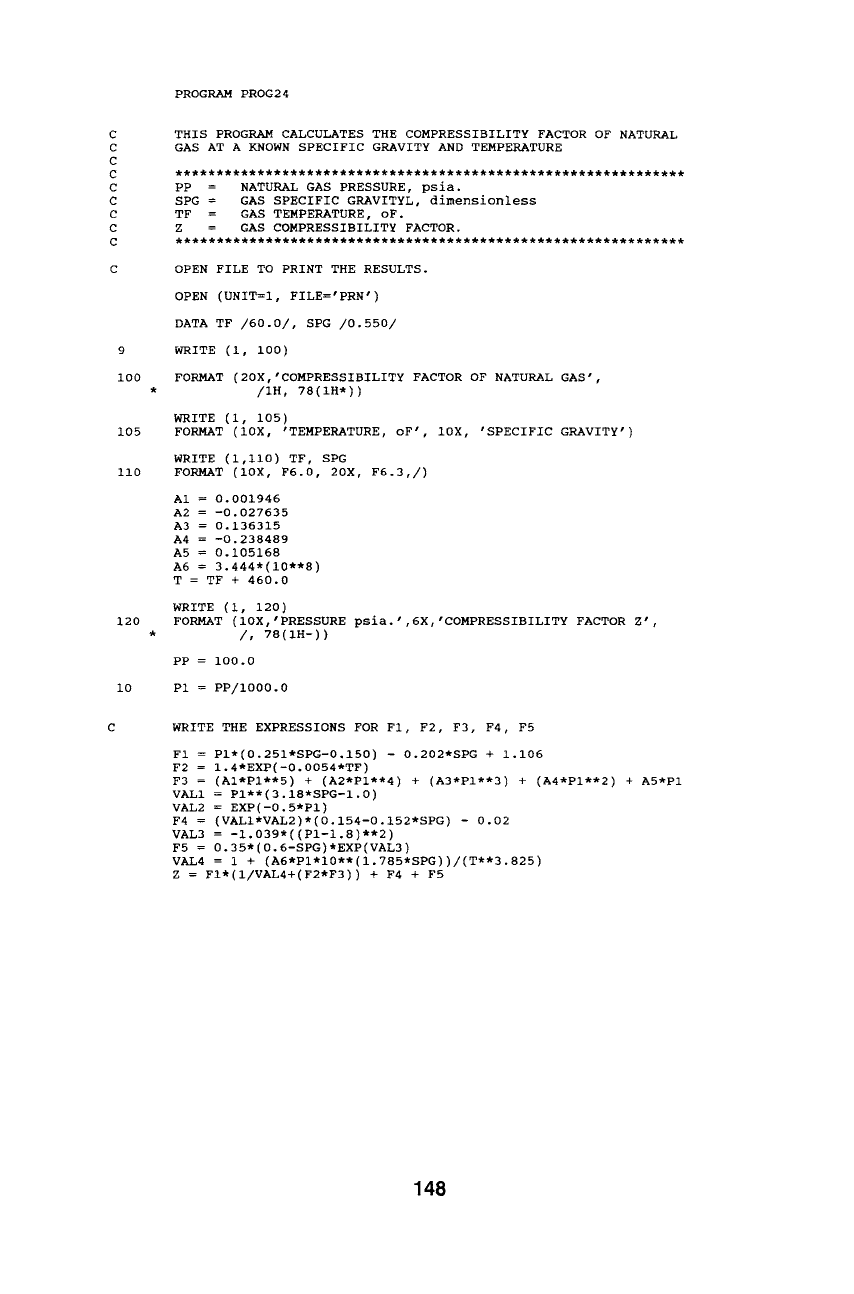
PROGRAM PROG24
THIS PROGRAM CALCULATES THE COMPRESSIBILITY FACTOR OF NATURAL
GAS AT A KNOWN SPECIFIC GRAVITY AND TEMPERATURE
**************************************************************
PP = NATURAL GAS PRESSURE, psia.
SPG = GAS SPECIFIC GRAVITYL, dimensionless
TF = GAS TEMPERATURE, oF.
Z = GAS COMPRESSIBILITY FACTOR.
**************************************************************
OPEN FILE TO PRINT THE RESULTS.
OPEN (UNIT=I, FILE='PRN')
DATA TF /60.0/, SPG /0.550/
WRITE (i, i00)
FORMAT (20X,'COMPRESSIBILITY FACTOR OF NATURAL GAS',
* /IH, 78(IH*))
WRITE (i, 105)
FORMAT (10X, 'TEMPERATURE, oF', 10X, 'SPECIFIC GRAVITY')
WRITE (i,ii0) TF, SPG
FORMAT (10X, F6.0, 20X, F6.3,/)
A1 = 0.001946
A2 = -0.027635
A3 = 0.136315
A4 = -0.238489
A5 = 0.105168
A6 = 3.444"(10"'8)
T = TF + 460.0
WRITE (i, 120)
FORMAT (10X,'PRESSURE psia.',6X,'COMPRESSIBILITY FACTOR Z',
* /, 78(IH-))
PP = I00.0
PI = PP/1000.0
WRITE THE EXPRESSIONS FOR FI, F2, F3, F4, F5
F1 = PI*(0.251*SPG-0.150) - 0.202*SPG + 1.106
F2 = 1.4*EXP(-0.0054*TF)
F3 = (AI*PI**5) + (A2*PI**4) + (A3*PI**3) + (A4*PI**2) + A5*PI
VALI = PI**(3.18*SPG-I.0)
VAL2 = EXP(-0.5*PI)
F4 = (VALI*VAL2)*(0.154-0.152*SPG) - 0.02
VAL3 = -i.039"((Pi-1.8)*'2)
F5 = 0.35*(0.6-SPG)*EXP(VAL3)
VAL4 = 1 + (A6*PI*I0**(I.785*SPG))/(T**3.825)
Z = FI*(I/VAL4+(F2*F3)) + F4 + F5
148
130
C
60
140
150
12
70
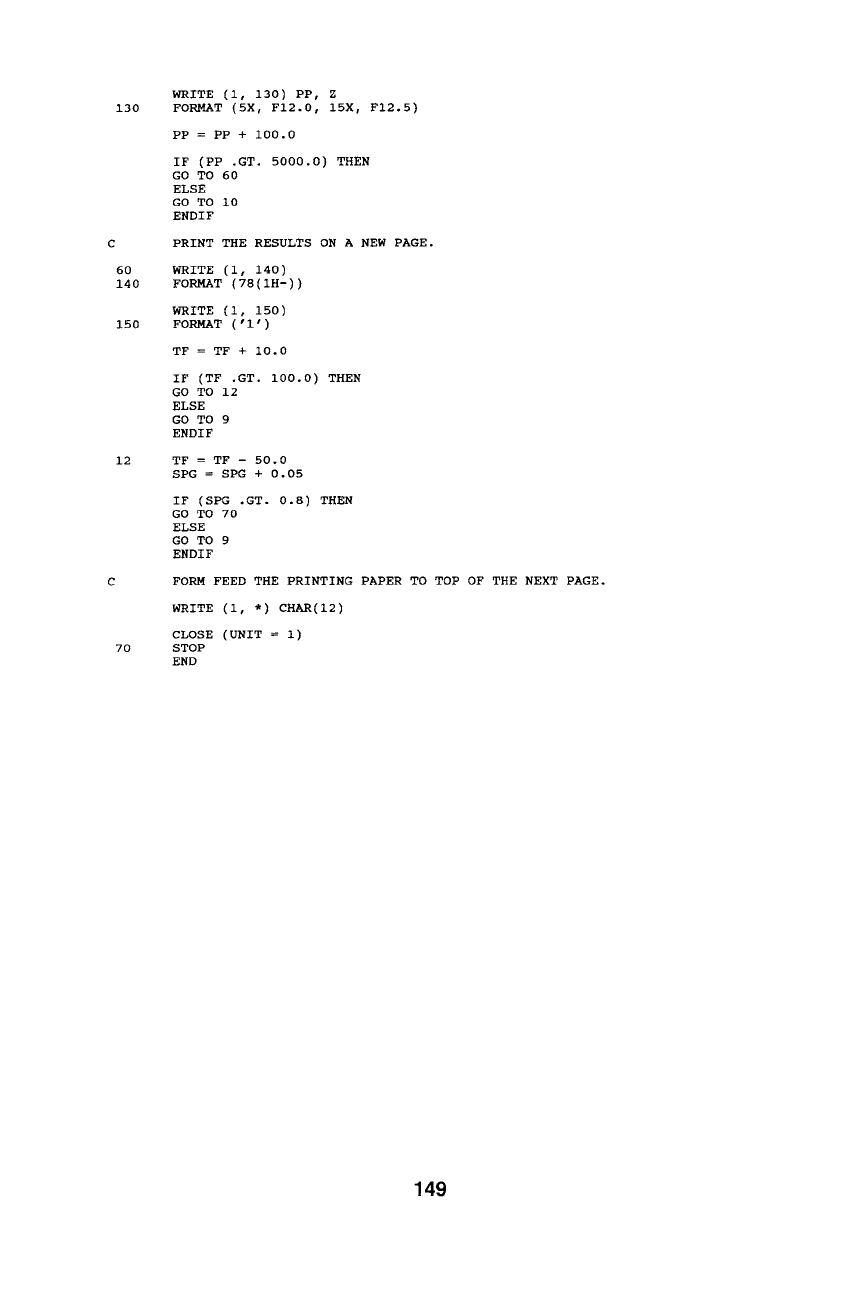
WRITE (i, 130) PP, Z
FORMAT (5X, FI2.0, 15X, F12.5)
PP = PP + i00.0
IF (PP .GT. 5000.0) THEN
GO TO 60
ELSE
GO TO i0
ENDIF
PRINT THE RESULTS ON A NEW PAGE.
WRITE (i, 140)
FORMAT (78(IH-))
WRITE (i, 150)
FORMAT ('I')
TF = TF + i0.0
IF (TF .GT. I00.0) THEN
GO TO 12
ELSE
GO TO 9
ENDIF
TF
= TF -
50.0
SPG = SPG + 0.05
IF (SPG .GT. 0.8) THEN
GO TO 70
ELSE
GO TO 9
ENDIF
FORM FEED THE PRINTING PAPER TO TOP OF THE NEXT PAGE.
WRITE (i, *) CHAR(12)
CLOSE (UNIT = i)
STOP
END
149
CHAPTER 3
Fluid Flow
INTRODUCTION
Transportation of fluids is important in the design of chemical pro-
cess plants. In the chemical process industries (CPI), pipework and its
accessories such as fittings, makeup 20% to 30% of the total design
costs and 10% to 20% of the total plant investment. Maintenance
requirements and energy usage in the shape of pressure drop (AP) in the
fluids being pumped add to the cost. Also, these items escalate each
year in line with inflation. As a result, sound pipe sizing practices can
have a substantial influence on overall plant economics. It is the
designer's responsibility to optimize the pressure drops in piping and
equipment and to assess the most economical conditions of operations.
Figures 3-1A and 3-1B illustrate piping layouts in a chemical plant.
The characteristics and complexity of flow pattern are such that most
flows are described by a set of empirical or semi-empirical equations.
These relate the pressure drop in the flow system as a function of flow
rate, pipe geometry, and physical properties of the fluids. The aim in the
design of fluid flow is to choose a line size and piping arrangement that
achieve minimum capital and pumping costs. In addition, constraints
on pressure drop and maximum allowable velocity in the process pipe
should be maintained. These objectives require many trial and error
computations, which can be performed well by a computer.
Flow of Fluids in Pipes
Pressure drop or head loss in a piping system is caused by fluid rising
in elevation, friction, shaftwork (e.g., from a turbine) and turbulence
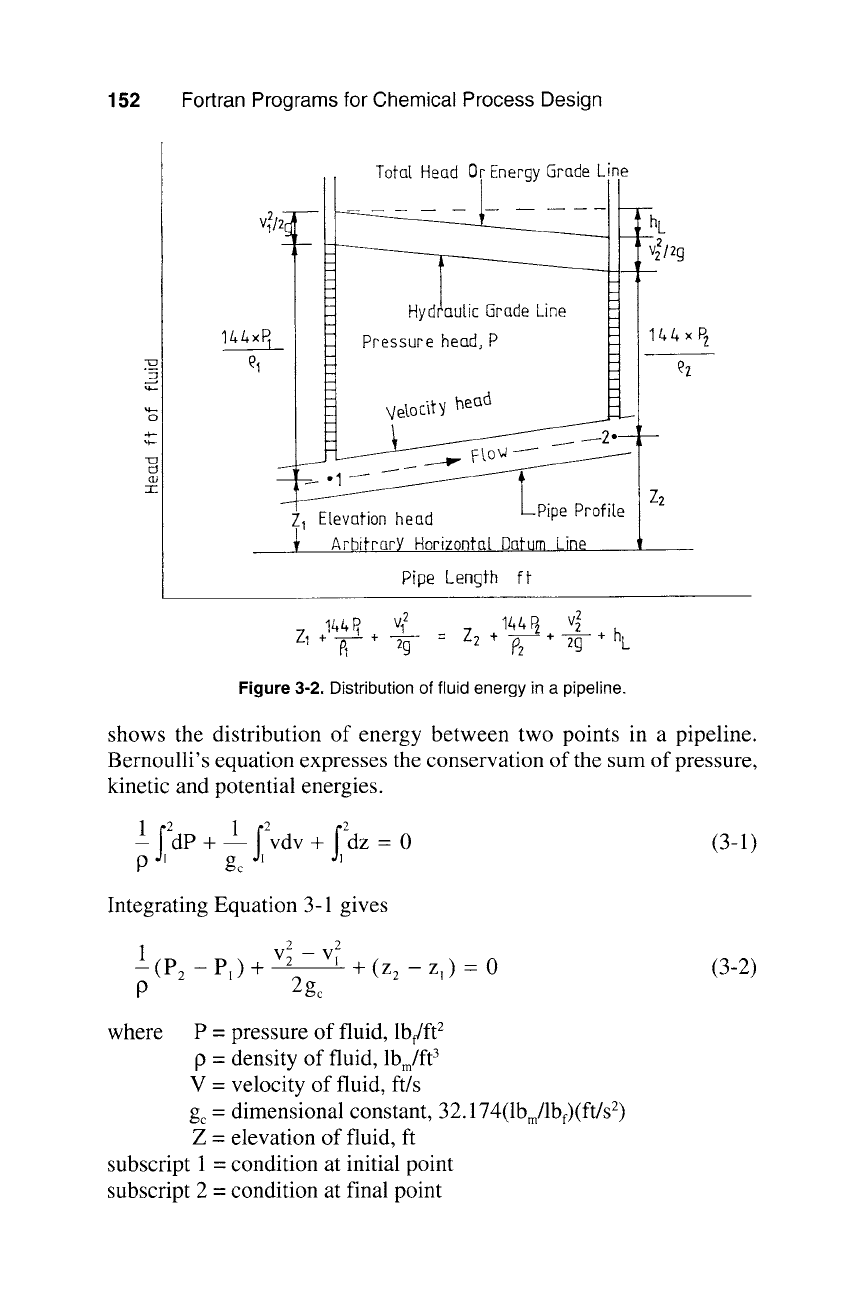
due to sudden changes in direction or cross-sectional area. Figure 3-2
150
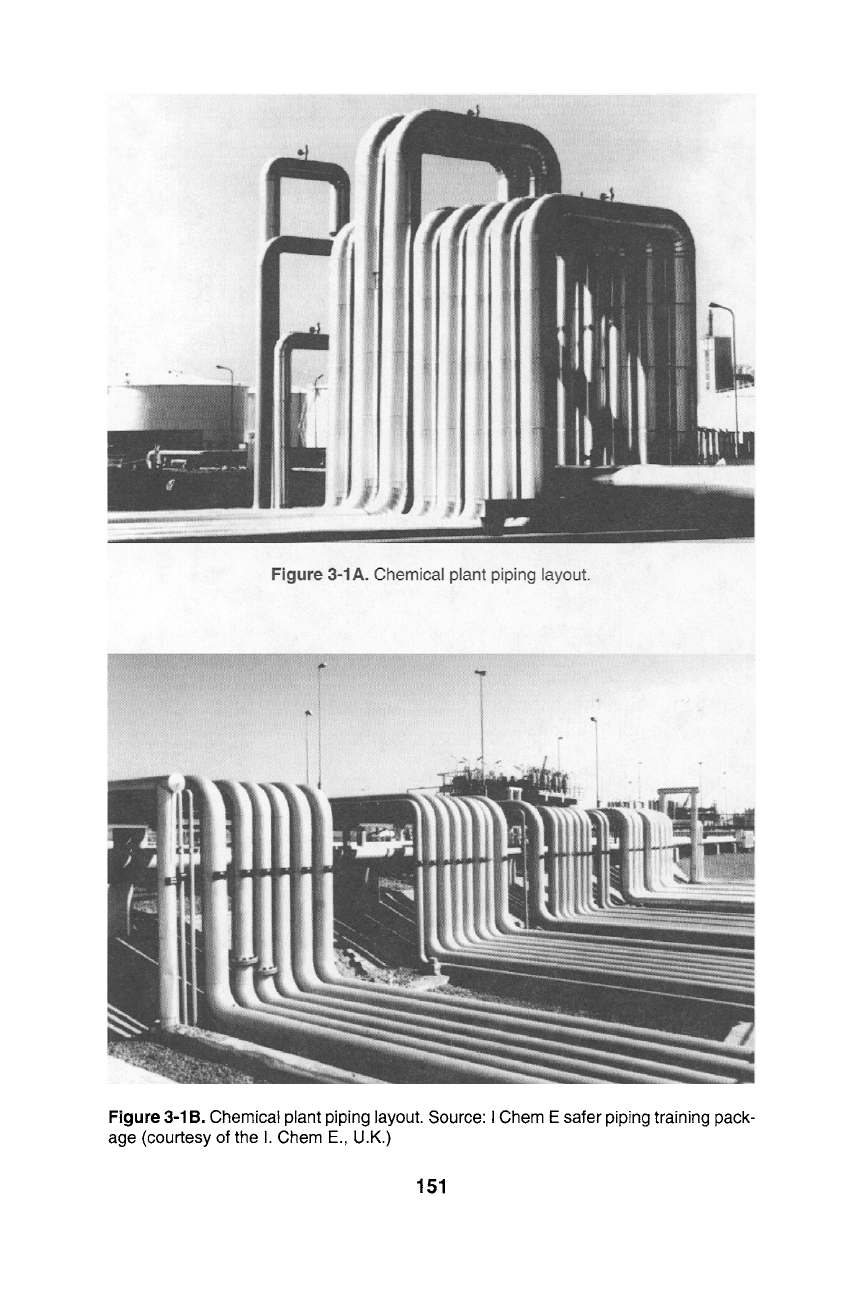
Figure 3-1B. Chemical plant piping layout. Source: I Chem E safer piping training pack-
age (courtesy of the I. Chem E., U.K.)
151
152
Fortran Programs for Chemical Process Design
'4--
0
-4-"
I.I--
"I::I
1:3
dJ
--i-
144xP 1
Tofctt Head Or Energy 5rade Line
/
_
Hyd~e Line
_- Pressure heed, P
_
_
_- ,q e~.o ci~ ~J beo.d
- ~-~ .---2 o~
=_.-. 9 1 ~
..=--- . .
ZI
Etevafion head
/
~r ArbifrQrY Horizonfc~t Datum Line
Pipe Lengfh ff
h L
v#12g
1/-+4 x P z
~z
Z2
144P, #
Zl + p~-- + -2g:-
144P2
v~
- Z 2 + ~-~--+-~-g +h L
Figure 3-2. Distribution of fluid energy in a pipeline.
shows the distribution of energy between two points in a pipeline.
Bernoulli's equation expresses the conservation of the sum of pressure,
kinetic and potential energies.
L
, f v v+
+ _
P
g~
(3-1)
Integrating Equation 3-1 gives
2 2
l(p2 P~) + vz-v~ +(z 2 z~)-0 (3-2)
P 2gc
where
P = pressure of fluid, lb/ft 2
p = density of fluid, lbm/ft 3
V - velocity of fluid, ft/s
gc - dimensional constant, 32.174(lbm/lbf)(ft/s 2)
Z = elevation of fluid, ft
subscript 1 -condition at initial point
subscript 2 -condition at final point
Fluid Flow 153
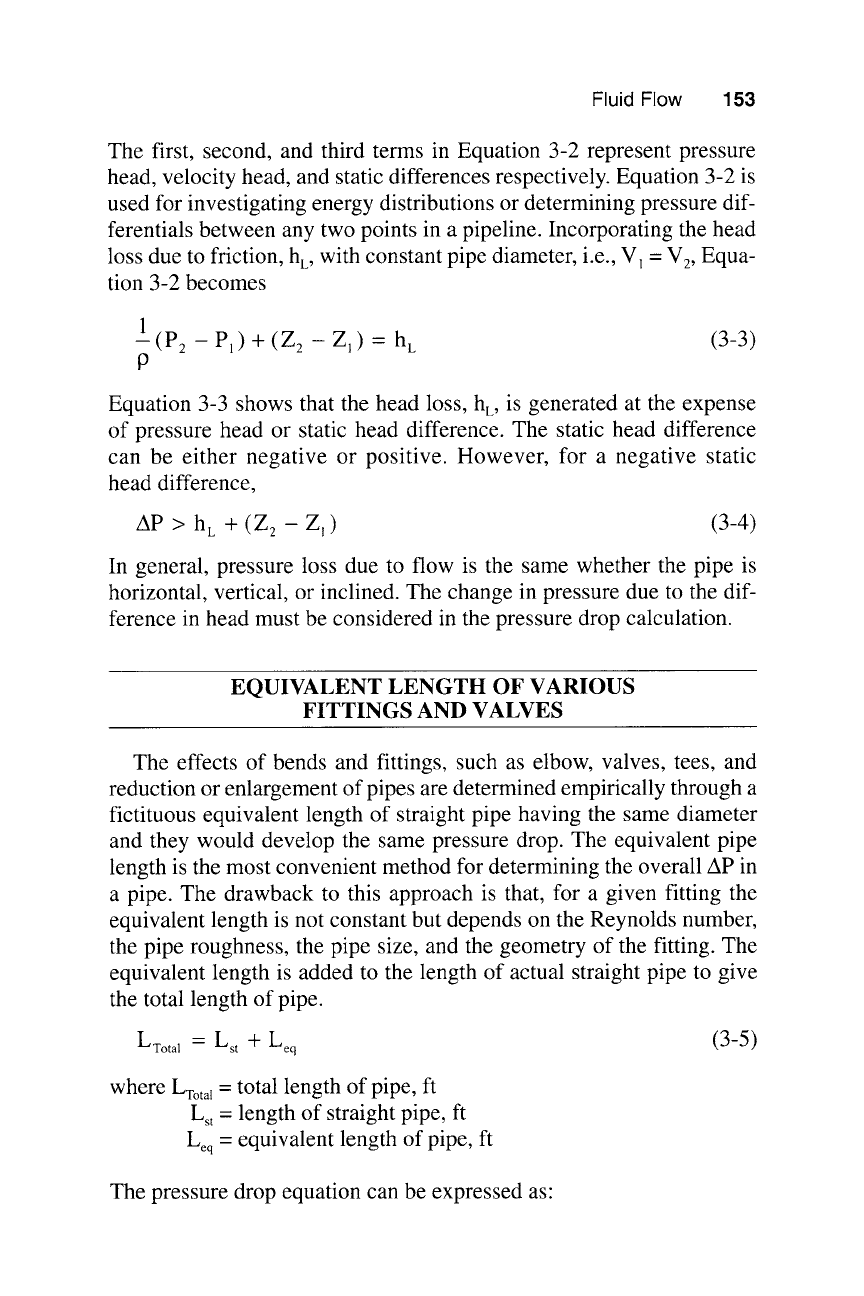
The first, second, and third terms in Equation 3-2 represent pressure
head, velocity head, and static differences respectively. Equation 3-2 is
used for investigating energy distributions or determining pressure dif-
ferentials between any two points in a pipeline. Incorporating the head
loss due to friction, h L, with constant pipe diameter, i.e., V~ = V 2, Equa-
tion 3-2 becomes
1 (P2 - P, ) + (Z2 - Z~ ) - h L (3-3)
P
Equation 3-3 shows that the head loss, h L, is generated at the expense
of pressure head or static head difference. The static head difference
can be either negative or positive. However, for a negative static
head difference,
AP > h L + (Z 2 - Z l)
(3-4)
In general, pressure loss due to flow is the same whether the pipe is
horizontal, vertical, or inclined. The change in pressure due to the dif-
ference in head must be considered in the pressure drop calculation.
EQUIVALENT LENGTH OF VARIOUS
FITTINGS AND VALVES
The effects of bends and fittings, such as elbow, valves, tees, and
reduction or enlargement of pipes are determined empirically through a
fictituous equivalent length of straight pipe having the same diameter
and they would develop the same pressure drop. The equivalent pipe
length is the most convenient method for determining the overall AP in
a pipe. The drawback to this approach is that, for a given fitting the
equivalent length is not constant but depends on the Reynolds number,
the pipe roughness, the pipe size, and the geometry of the fitting. The
equivalent length is added to the length of actual straight pipe to give
the total length of pipe.
L Total
--
L ~, + L
eq (3-
5)
where
LTota !
L~t
Leq
= total length of pipe, ft
= length of straight pipe, ft
- equivalent length of pipe, ft
The pressure drop equation can be expressed as:
154
Fortran Programs for Chemical Process Design
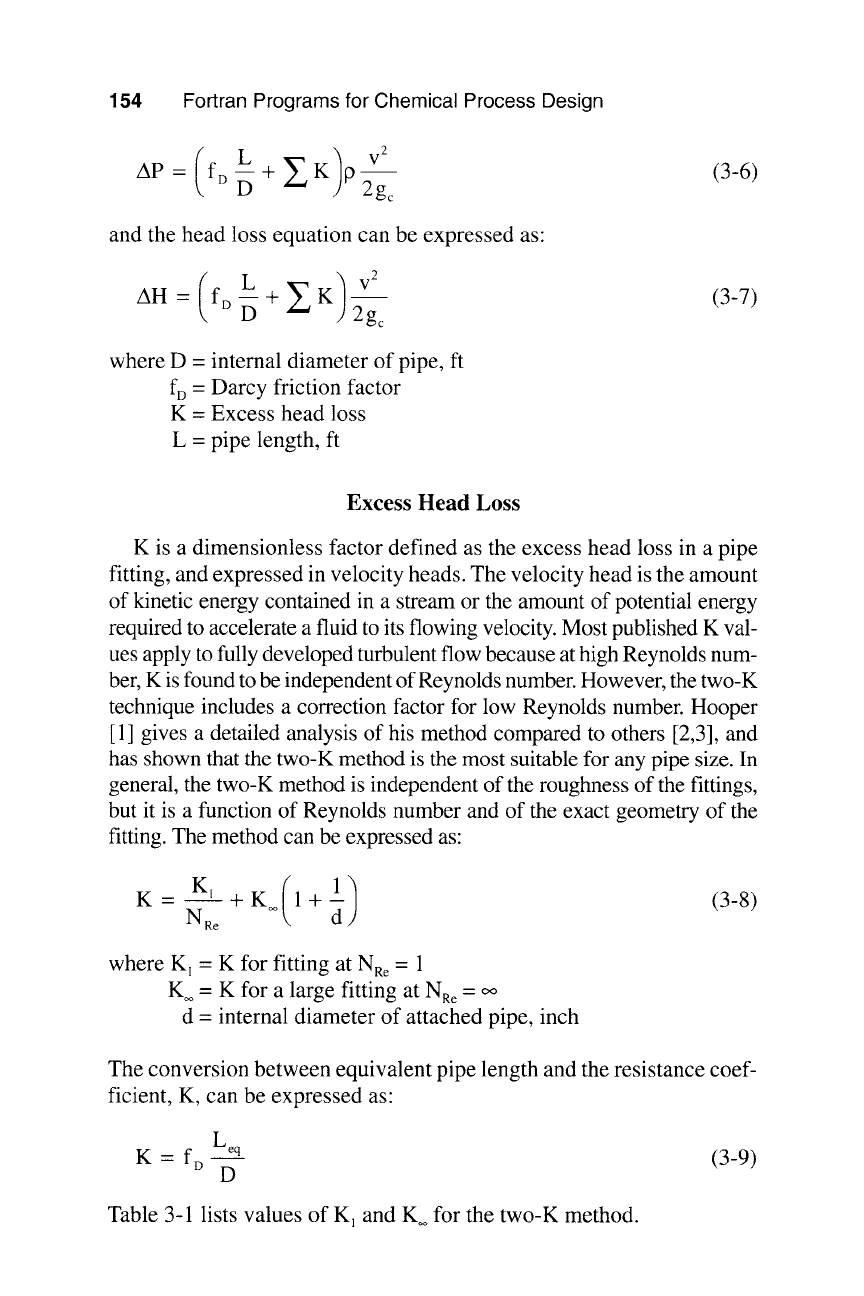
( ) v_i
AP- fD~+~K 928 ~
and the head loss equation can be expressed as"
L ) v 2
AH- fD~+ZK 2gc
where D - internal diameter of pipe, ft
fD- Darcy friction factor
K- Excess head loss
L- pipe length, ft
(3-6)
(3-7)
Excess Head Loss
K is a dimensionless factor defined as the excess head loss in a pipe
fitting, and expressed in velocity heads. The velocity head is the amount
of kinetic energy contained in a stream or the amount of potential energy
required to accelerate a fluid to its flowing velocity. Most published K val-
ues apply to fully developed turbulent flow because at high Reynolds num-
ber, K is found to be independent of Reynolds number. However, the two-K
technique includes a correction factor for low Reynolds number. Hooper
[1] gives a detailed analysis of his method compared to others [2,3], and
has shown that the two-K method is the most suitable for any pipe size. In
general, the two-K method is independent of the roughness of the fittings,
but it is a function of Reynolds number and of the exact geometry of the
fitting. The method can be expressed as:
( '/
K- K~ +Koo 1+~ (3-8)
NRe
where K~ - K for fitting
at NRe -
1
K - K for a large fitting
at NRe - oo
d - internal diameter of attached pipe, inch
The conversion between equivalent pipe length and the resistance coef-
ficient, K, can be expressed as ....
L
K- fD eq (3-9)
D
Table 3-1 lists values of K~ and Ko~ for the two-K method.
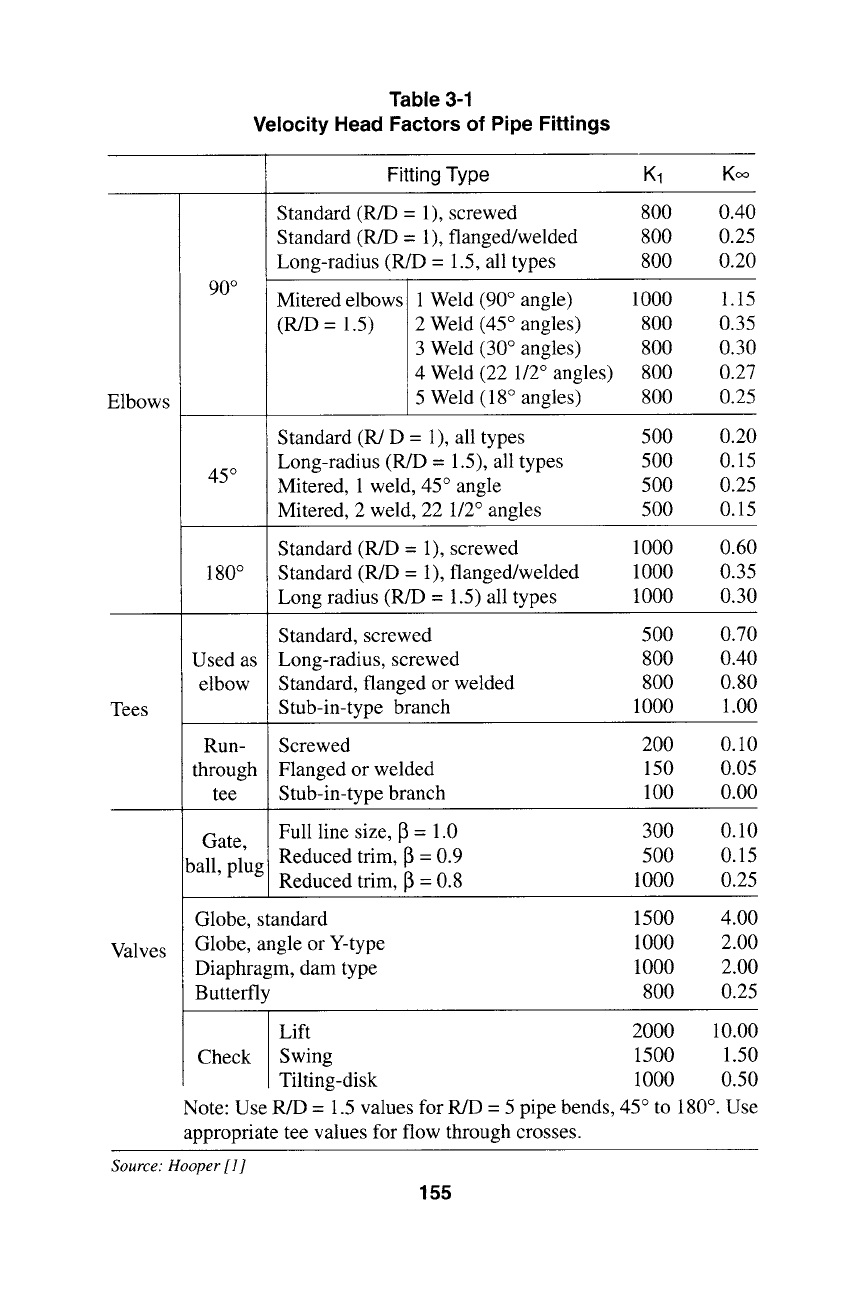
Table 3-1
Velocity Head Factors of Pipe Fittings
Elbows
Tees
Valves
Fitting Type
Standard (R/D - 1), screwed
Standard (R/D - 1), flanged/welded
Long-radius (R/D- 1.5, all types
90 ~
Mitered elbows
(R/D- 1.5)
45 ~
180 ~
Used as
elbow
Run-
through
tee
Gate,
ball, plug
1 Weld (90 ~ angle)
2 Weld (45 ~ angles)
3 Weld (30 ~ angles)
4 Weld (22 1/2 ~ angles)
5 Weld (18 ~ angles)
Standard (R/D = 1), all types
Long-radius (R/D = 1.5), all types
Mitered, 1 weld, 45 ~ angle
Mitered, 2 weld, 22 1/2 ~ angles
Standard (R/D- 1), screwed
Standard (R/D - 1), flanged/welded
Long radius (R/D - 1.5) all types
Standard, screwed
Long-radius, screwed
Standard, flanged or welded
Stub-in-type branch
Screwed
Flanged or welded
Stub-in-type branch
Full line size, 13- 1.0
Reduced trim, 13- 0.9
Reduced trim, 13 - 0.8
K1
800
800
800
1000
800
800
800
800
500
500
500
500
1000
1000
1000
500
800
800
1000
Kcx~
0.40
0.25
0.20
1.15
0.35
0.30
0.27
0.25
0.20
0.15
0.25
0.15
0.60
0.35
0.30
0.70
0.40
0.80
1.00
200 0.10
150 0.05
100 0.00
300 0.10
500 0.15
1000 0.25
Globe, standard 1500 4.00
Globe, angle or Y-type 1000 2.00
Diaphragm, dam type 1000 2.00
Butterfly 800 0.25
Lift 2000 10.00
Check Swing 1500 1.50
Tilting-disk 1000 0.50
Note: Use R/D = 1.5 values for R/D = 5 pipe bends, 45 ~ to 180 ~ Use
appropriate tee values for flow through crosses.
Source: Hooper [1]
155
156
Fortran Programs for Chemical Process Design
Pipe Reduction and Enlargement
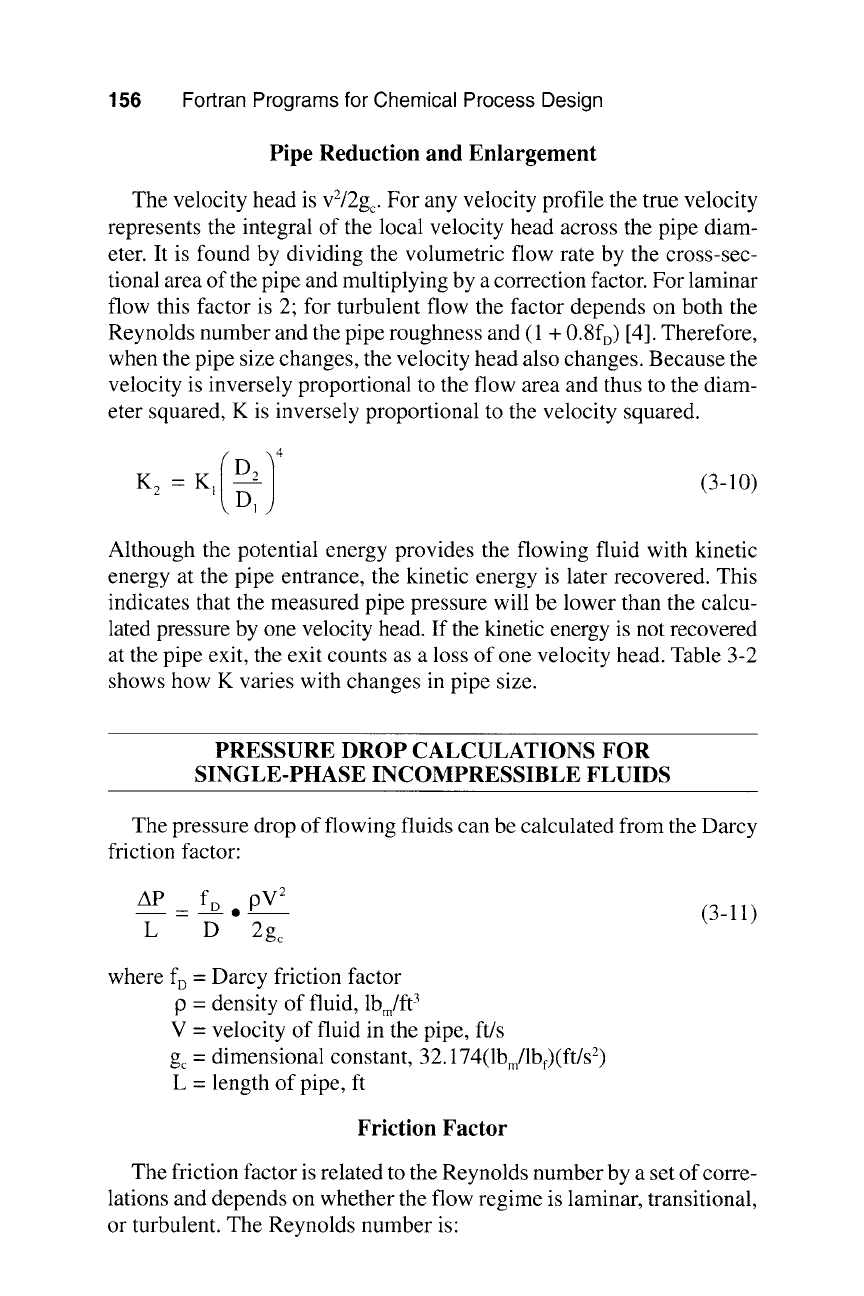
The velocity head is v2/2gc . For any velocity profile the true velocity
represents the integral of the local velocity head across the pipe diam-
eter. It is found by dividing the volumetric flow rate by the cross-sec-
tional area of the pipe and multiplying by a correction factor. For laminar
flow this factor is 2; for turbulent flow the factor depends on both the
Reynolds number and the pipe roughness and (1 + 0.8fD) [4]. Therefore,
when the pipe size changes, the velocity head also changes. Because the
velocity is inversely proportional to the flow area and thus to the diam-
eter squared, K is inversely proportional to the velocity squared.
/ / 4
D 2
K 2 - K l -~,
(3-10)
Although the potential energy provides the flowing fluid with kinetic
energy at the pipe entrance, the kinetic energy is later recovered. This
indicates that the measured pipe pressure will be lower than the calcu-
lated pressure by one velocity head. If the kinetic energy is not recovered
at the pipe exit, the exit counts as a loss of one velocity head. Table 3-2
shows how K varies with changes in pipe size.
PRESSURE DROP CALCULATIONS FOR
SINGLE-PHASE INCOMPRESSIBLE FLUIDS
The pressure drop of flowing fluids can be calculated from the Darcy
friction factor:
AP _ fD
9
9 V2
- (3-11)
L D 2g c
where fD = Darcy friction factor
9 = density of fluid,
lbm/ft 3
V - velocity of fluid in the pipe, ft/s
gc = dimensional constant, 32.174(lbm/lbf)(ft/s 2)
L - length of pipe, ft
Friction Factor
The friction factor is related to the Reynolds number by a set of corre-
lations and depends on whether the flow regime is laminar, transitional,
or turbulent. The Reynolds number is: