
Coker A.K. Fortran Programs for Chemical Process Design, Analysis, and Simulation
Подождите немного. Документ загружается.

Fluid Flow 177
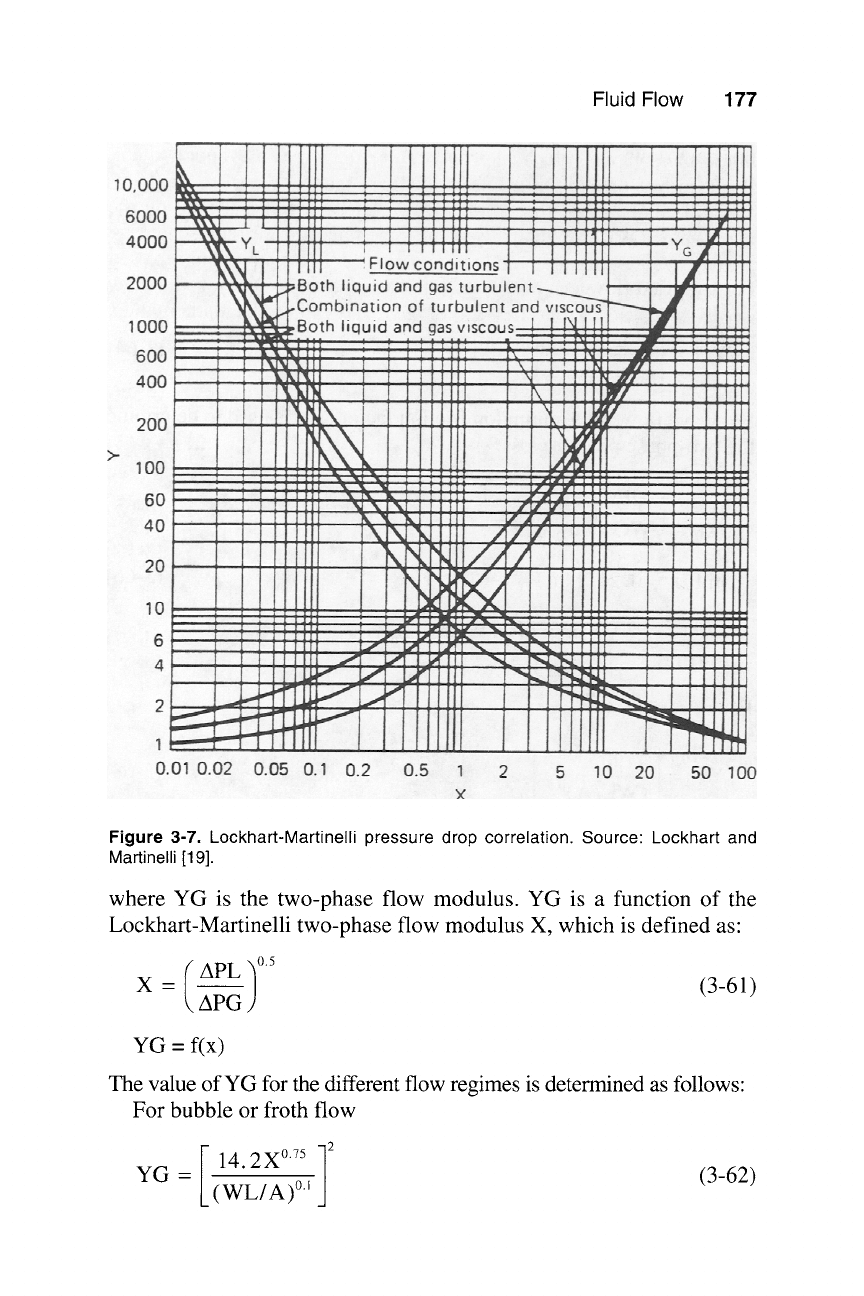
Figure
3-7. Lockhart-Martinelli pressure drop correlation. Source: Lockhart and
Martinelli [19].
where YG is the two-phase flow modulus. YG is a function of the
Lockhart-Martinelli two-phase flow modulus X, which is defined as:
X (APL) ~
- (3-61)
APG
YG = f(x)
The value of YG for the different flow regimes is determined as follows:
For bubble or froth flow
yG [14 2x07512
(WL/A) ~
(3-62)
178
Fortran Programs for Chemical Process Design
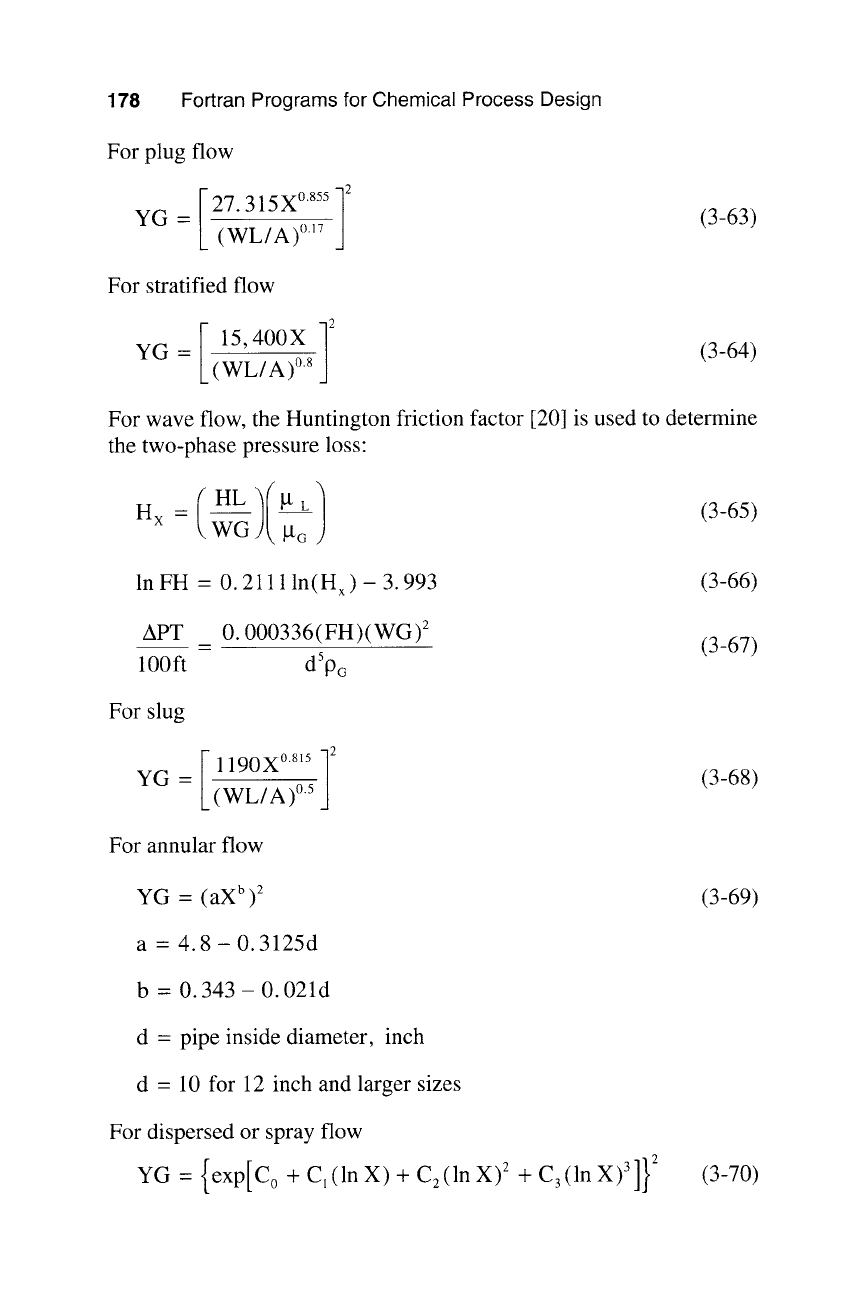
For plug flow
yG _ [27.315X~ 12
(WL/A) ~
(3-63)
For stratified flow
E ] 2
YG - 15,400 X
(3-64)
For wave flow, the Huntington friction factor [20] is used to determine
the two-phase pressure loss:
(3-65)
In FH - 0.2111 In (H x ) - 3.993
(3-66)
APT 0.000336(FH)(WG)2
lOOft dSPG
(3-67)
For slug
YG
-
12
I
1190X ~
(3-68)
For annular flow
YG
- (aXb) 2
(3-69)
a - 4.8- 0.3125d
b - 0.343 - 0.021d
d - pipe inside diameter, inch
d - l0 for 12 inch and larger sizes
For dispersed or spray flow
YO - {exp[~0 + ~l ~,n • + ~ ~,n • + ~ ~ln
• 1}~
(3-70)
Fluid Flow 179
C o - 1. 4659
C 1 - 0. 49138
C 2 - 0.04887
C 3 - -0.000349
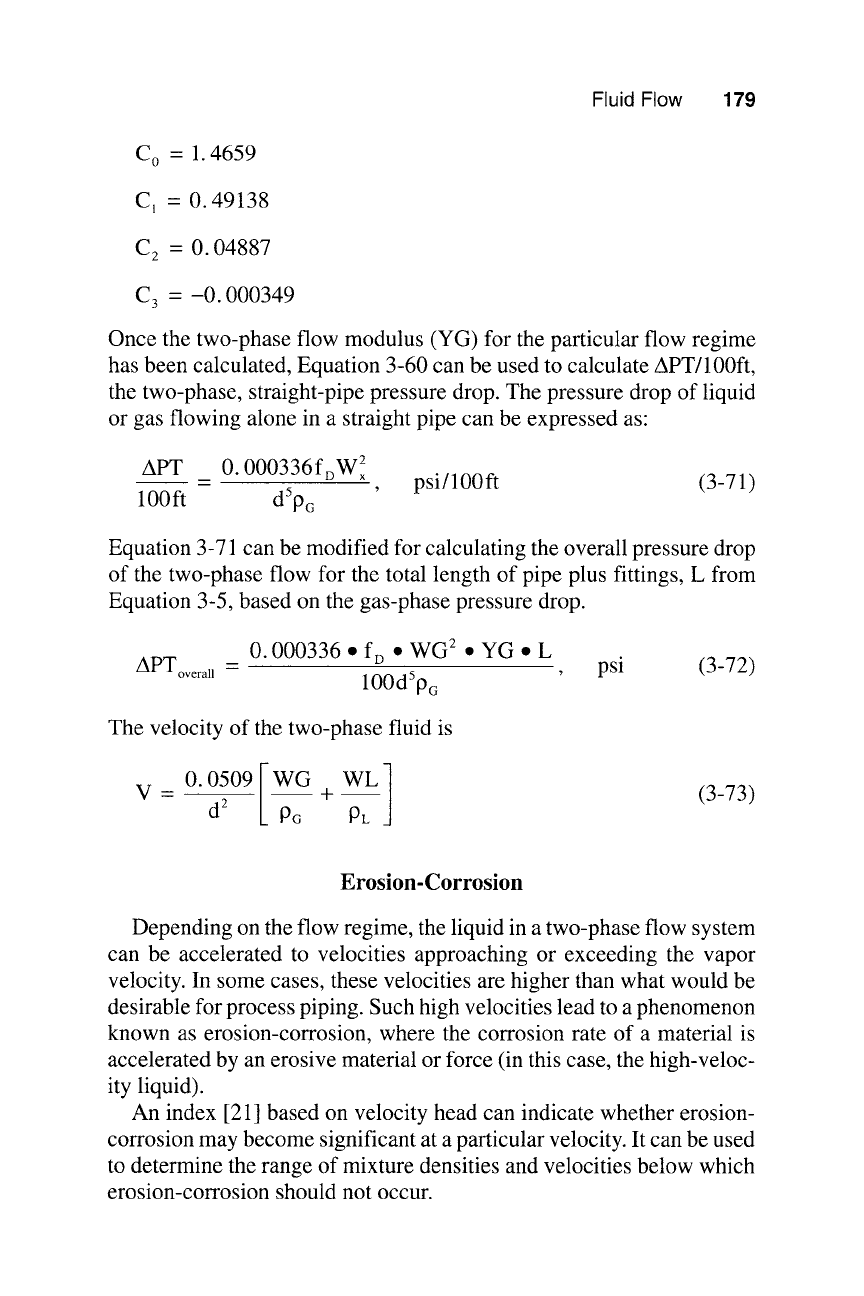
Once the two-phase flow modulus (YG) for the particular flow regime
has been calculated, Equation 3-60 can be used to calculate APT/100ft,
the two-phase, straight-pipe pressure drop. The pressure drop of liquid
or gas flowing alone in a straight pipe can be expressed as"
APT 0. 000336 f D W 2x
lOOft
dSPG
psi/100ft (3-71)
Equation 3-71 can be modified for calculating the overall pressure drop
of the two-phase flow for the total length of pipe plus fittings, L from
Equation 3-5, based on the gas-phase pressure drop.
0.000336
9
fD
9
WG2 9 YG 9 L
APToverall
"- ,
psi (3-72)
100dSPG
The velocity of the two-phase fluid is
F 7
V - 0.0509 | WG WL /
- ~ + ~ (3-73)
d2
L
PG PL
/
Erosion-Corrosion
Depending on the flow regime, the liquid in a two-phase flow system
can be accelerated to velocities approaching or exceeding the vapor
velocity. In some cases, these velocities are higher than what would be
desirable for process piping. Such high velocities lead to a phenomenon
known as erosion-corrosion, where the corrosion rate of a material is
accelerated by an erosive material or force (in this case, the high-veloc-
ity liquid).
An index [21 ] based on velocity head can indicate whether erosion-
corrosion may become significant at a particular velocity. It can be used
to determine the range of mixture densities and velocities below which
erosion-corrosion should not occur.
180
Fortran Programs for Chemical Process Design
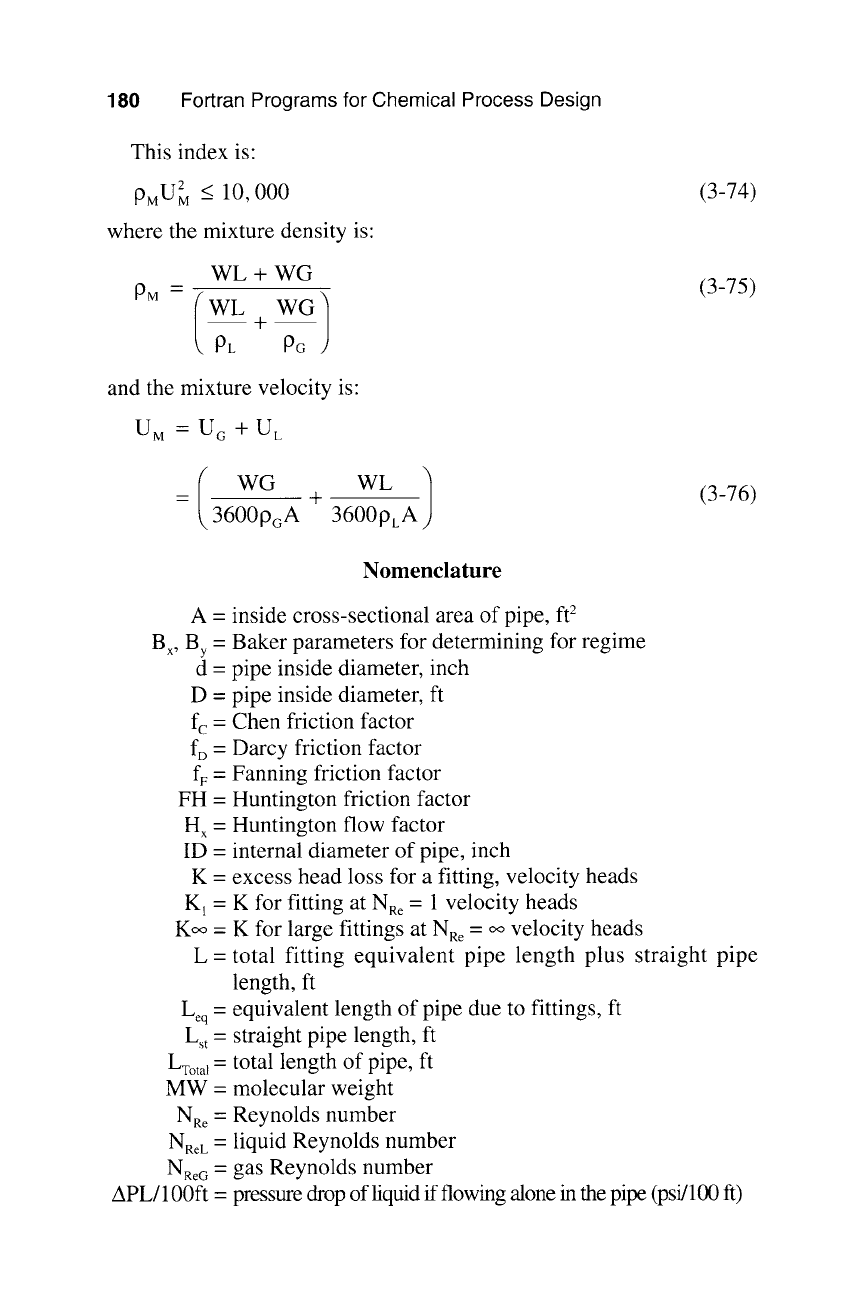
This index is:
IOM U2
_<
10,000
where the mixture density is:
WL + WG
and the mixture velocity is:
UM -- UG --[-U L
(3-74)
(3-75)
WG WL /
- +
3600pGA 3600pLA
(3-76)
Nomenclature
A = inside cross-sectional area of pipe,
ft 2
B x, By - Baker parameters for determining for regime
d = pipe inside diameter, inch
D = pipe inside diameter, ft
fc =Chen friction factor
fD = Darcy friction factor
fF = Fanning friction factor
FH = Huntington friction factor
H~ = Huntington flow factor
ID = internal diameter of pipe, inch
K = excess head loss for a fitting, velocity heads
K 1 = K for fitting at NRe = 1 velocity heads
K~ = K for large fittings at NRe = ~ velocity heads
L = total fitting equivalent pipe length plus straight pipe
length, ft
Leq- equivalent length of pipe due to fittings, ft
L~t = straight pipe length, ft
LTota 1 =
total length of pipe, ft
MW = molecular weight
NRe = Reynolds number
NRe L = liquid Reynolds number
NRe G = gas Reynolds number
APL/100ft = pressure drop of liquid if flowing alone in the pipe (psi/100 ft)
Fluid Flow 181
APG/100ft =pressure drop of gas if flowing alone in the pipe (psi/100 fi)
APT/100ft = pressure drop of the two-phase mixture in straight pipe
(psi/100 ft)
APToveral 1 = overall pressure drop of the two-phase mixture for the total
length plus fittings, psi
UL = liquid velocity, ft/s
U G = gas velocity, ft/s
UM = velocity of the two-phase mixture, ft/s
V = velocity of fluid in a pipe, ft/s
WL = liquid flow rate, lb/h
WG = gas flow rate, lb/h
W~ = flow rate of either liquid or gas, lb/h
X = Lockhart-Martinelli two-phase flow modulus (APL/APG) ~
YG = two-phase flow modulus
= absolute roughness of pipe wall, ft (0.00015 ft for carbon
steel)
PL = liquid density, lb/ft 3
PG = gas density, lb/ft 3
PM = density of liquid-gas mixture, lb/ft 3
la x = viscosity of liquid or gas, cP
gL = liquid viscosity, cP
gG = gas viscosity, cP
(YL = surface tension of liquid (dyne/cm)
VAPOR-LIQUID TWO-PHASE VERTICAL DOWNFLOW
An understanding of two-phase flow is necessary for sound piping
design because almost all chemical process plants encounter two-phase
flow conditions. Two-phase vertical downflow presents its own problems
in horizontal flow. In a vertical flow, large vapor bubbles, known as slug
flow, are formed in the liquid stream. This flow regime is associated with
pipe vibration and pressure pulsation. With bubbles greater than 1 inch in
diameter and the liquid viscosity less than 100 cR slug flow region can be
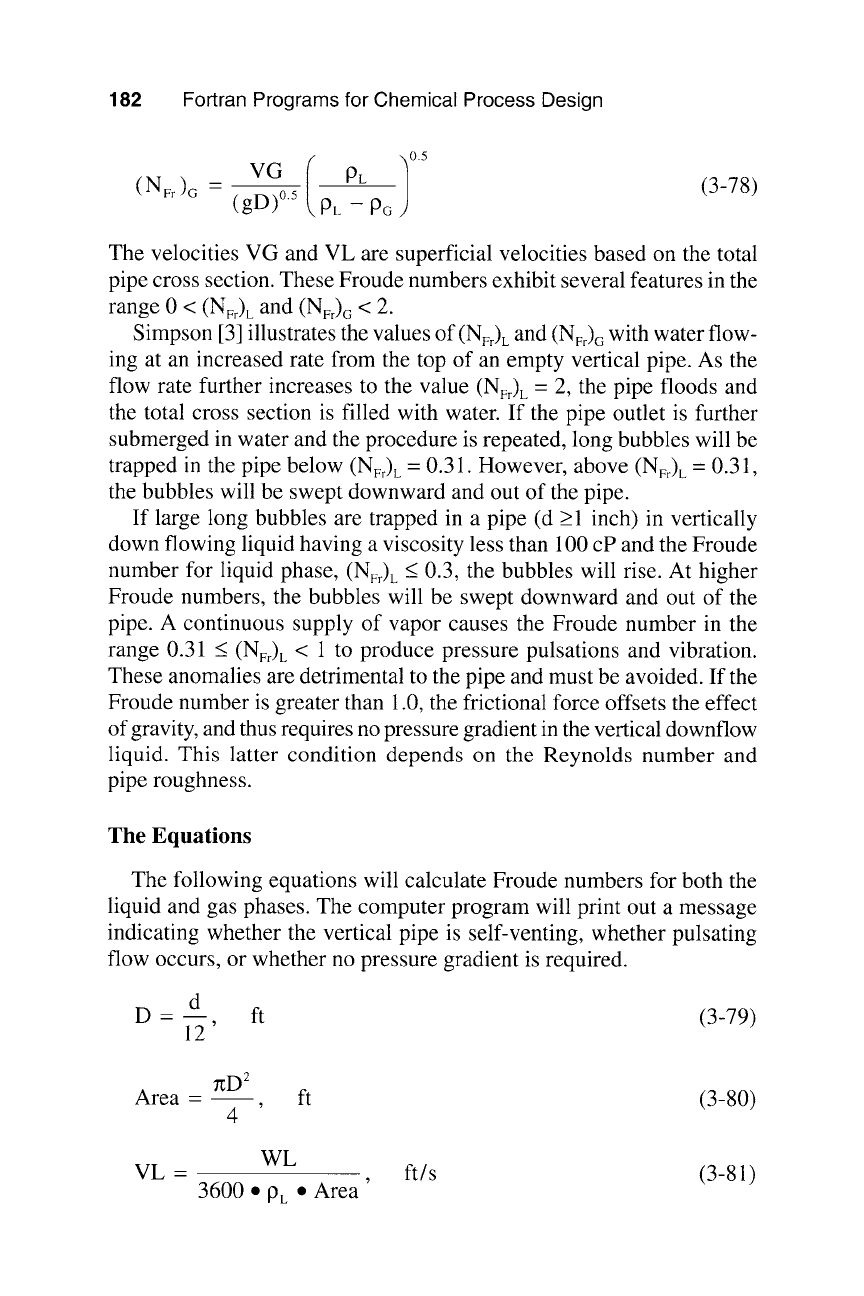
represented by dimensionless numbers for liquid and vapor phases respec-
tively (Froude numbers (NFr) L and
(NFr)C).
These are related by the ratio of
inertial to gravitational force and are expressed as:
/0.5
_ VL PL (3-77)
(NFr)L
(gD) ~
PL--PG
182
Fortran Programs for Chemical Process Design
/0.5
_ VG 9L (3-78)
(NFr)G --
(gD)~ 9L - PG
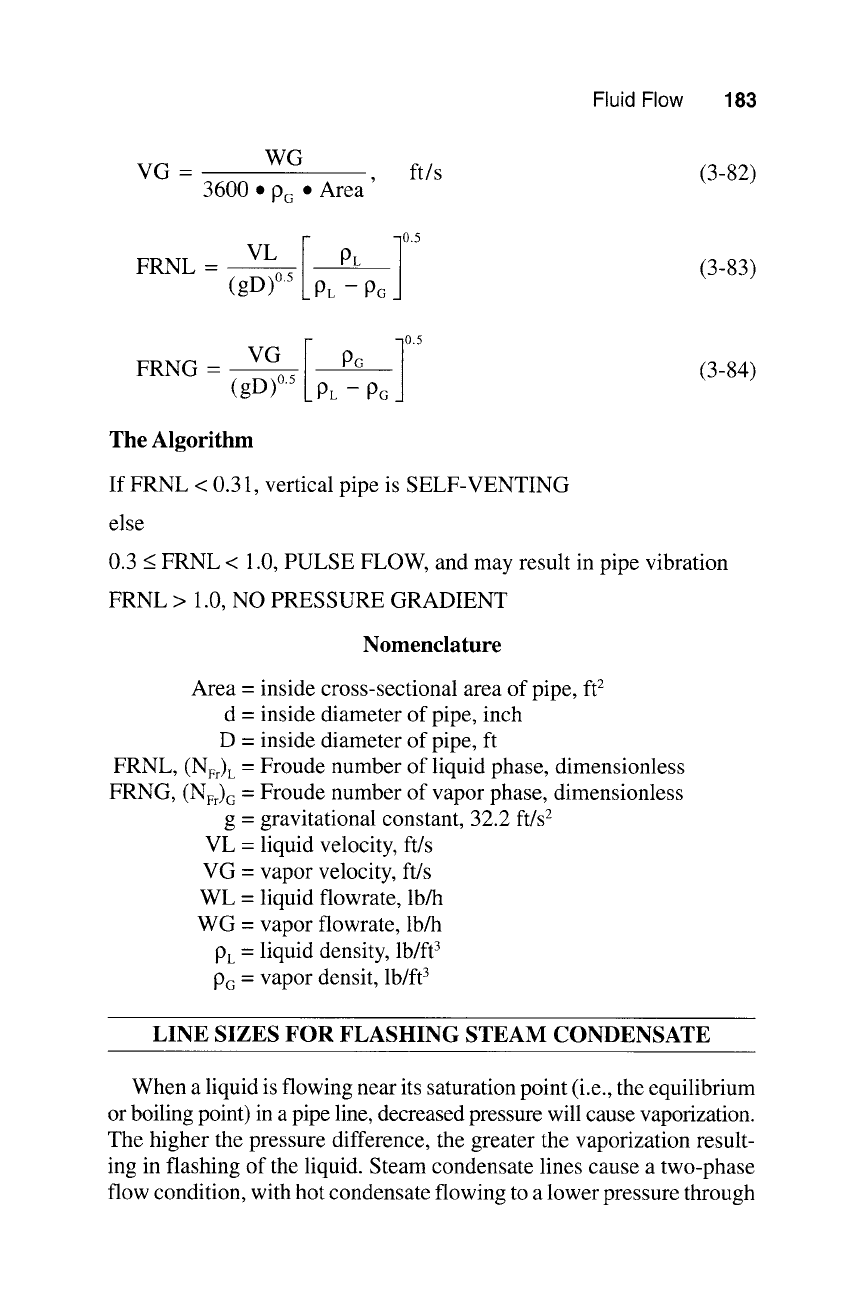
The velocities VG and VL are superficial velocities based on the total
pipe cross section. These Froude numbers exhibit several features in the
range 0 < (NFr) L and (NFr) G < 2.
Simpson [3] illustrates the values of (NFr) L and
(NFr)C
with water flow-
ing at an increased rate from the top of an empty vertical pipe. As the
flow rate further increases to the value (NFr) L = 2, the pipe floods and
the total cross section is filled with water. If the pipe outlet is further
submerged in water and the procedure is repeated, long bubbles will be
trapped in the pipe below
(NFr)L =
0.31. However, above
(NFr)L =
0.31,
the bubbles will be swept downward and out of the pipe.
If large long bubbles are trapped in a pipe (d >1 inch) in vertically
down flowing liquid having a viscosity less than 100 cP and the Froude
number for liquid phase, (NFr)L < 0.3, the bubbles will rise. At higher
Froude numbers, the bubbles will be swept downward and out of the
pipe. A continuous supply of vapor causes the Froude number in the
range 0.31 < (NFr) L < 1 tO produce pressure pulsations and vibration.
These anomalies are detrimental to the pipe and must be avoided. If the
Froude number is greater than 1.0, the frictional force offsets the effect
of gravity, and thus requires no pressure gradient in the vertical downflow
liquid. This latter condition depends on the Reynolds number and
pipe roughness.
The Equations
The following equations will calculate Froude numbers for both the
liquid and gas phases. The computer program will print out a message
indicating whether the vertical pipe is self-venting, whether pulsating
flow occurs, or whether no pressure gradient is required.
d
D = ~, ft (3-79)
12
gD 2
Area = --, ft (3-80)
4
WL
VL = , ft/s (3-81)
3600 ,, 9L " Area
Fluid Flow 183
WG
VG = , ft/s (3-82)
3600 9 9G 9 Area
I
10.5
FRNL - VL PL (3-83)
(gD) ~ PL -- 9G
I
10.5
FRNG - VG PG (3-84)
(gD) ~ PL - PG
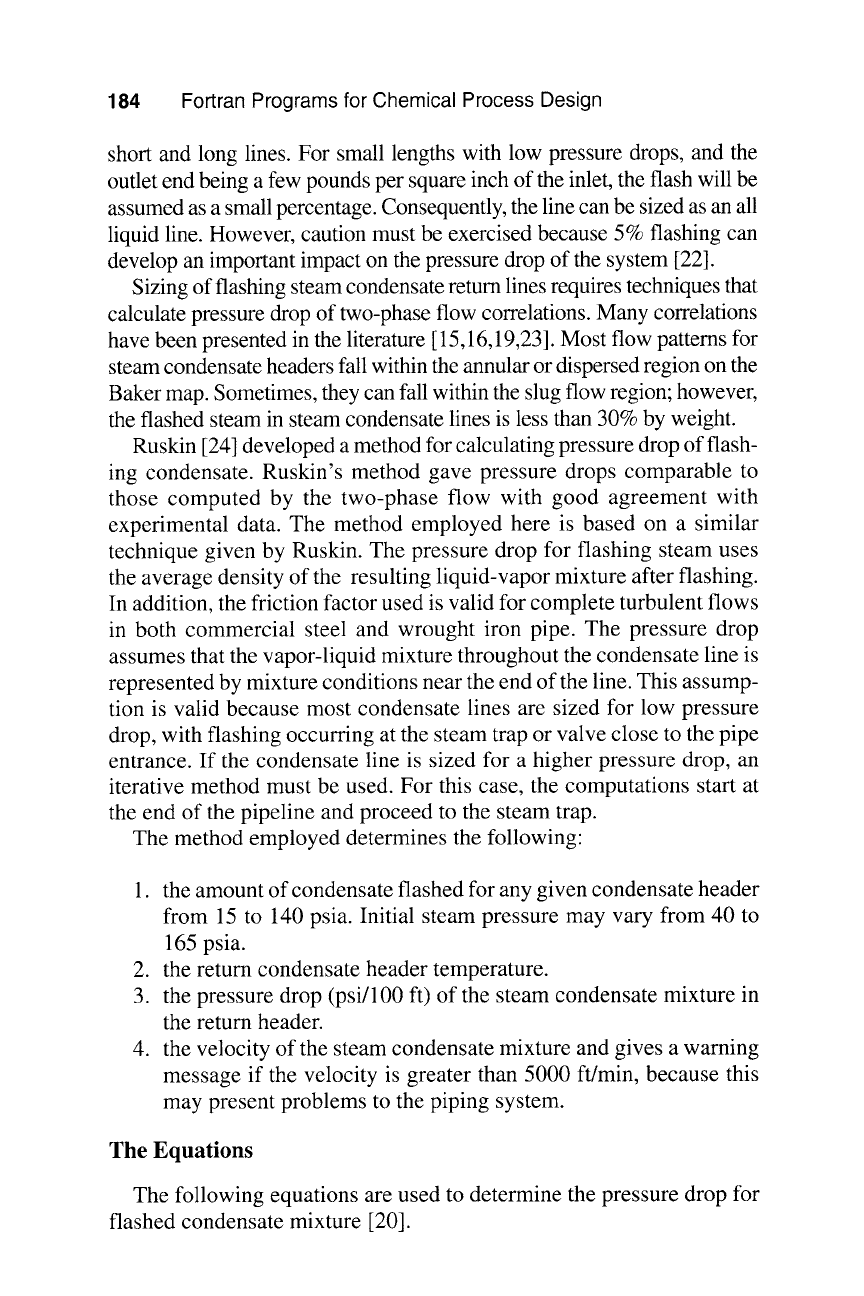
The Algorithm
If FRNL < 0.31, vertical pipe is SELF-VENTING
else
0.3 < FRNL < 1.0, PULSE FLOW, and may result in pipe vibration
FRNL > 1.0, NO PRESSURE GRADIENT
Nomenclature
Area = inside cross-sectional area of pipe,
ft 2
d = inside diameter of pipe, inch
D = inside diameter of pipe, ft
FRNL,
(NFr)L =
Froude number of liquid phase, dimensionless
FRNG,
(NFr)C -
Froude number of vapor phase, dimensionless
g = gravitational constant, 32.2 ft/s 2
VL- liquid velocity, ft/s
VG = vapor velocity, ft/s
WL = liquid flowrate, lb/h
WG = vapor flowrate, lb/h
9L = liquid density, lb/ft 3
9G = vapor densit, lb/ft 3
LINE SIZES FOR FLASHING STEAM CONDENSATE
When a liquid is flowing near its saturation point (i.e., the equilibrium
or boiling point) in a pipe line, decreased pressure will cause vaporization.
The higher the pressure difference, the greater the vaporization result-
ing in flashing of the liquid. Steam condensate lines cause a two-phase
flow condition, with hot condensate flowing to a lower pressure through
184
Fortran Programs for Chemical Process Design
short and long lines. For small lengths with low pressure drops, and the
outlet end being a few pounds per square inch of the inlet, the flash will be
assumed as a small percentage. Consequently, the line can be sized as an all
liquid line. However, caution must be exercised because 5% flashing can
develop an important impact on the pressure drop of the system [22].
Sizing of flashing steam condensate return lines requires techniques that
calculate pressure drop of two-phase flow correlations. Many correlations
have been presented in the literature [ 15,16,19,23]. Most flow patterns for
steam condensate headers fall within the annular or dispersed region on the
Baker map. Sometimes, they can fall within the slug flow region; however,
the flashed steam in steam condensate lines is less than 30% by weight.
Ruskin [24] developed a method for calculating pressure drop of flash-
ing condensate. Ruskin's method gave pressure drops comparable to
those computed by the two-phase flow with good agreement with
experimental data. The method employed here is based on a similar
technique given by Ruskin. The pressure drop for flashing steam uses
the average density of the resulting liquid-vapor mixture after flashing.
In addition, the friction factor used is valid for complete turbulent flows
in both commercial steel and wrought iron pipe. The pressure drop
assumes that the vapor-liquid mixture throughout the condensate line is
represented by mixture conditions near the end of the line. This assump-
tion is valid because most condensate lines are sized for low pressure
drop, with flashing occurring at the steam trap or valve close to the pipe
entrance. If the condensate line is sized for a higher pressure drop, an
iterative method must be used. For this case, the computations start at
the end of the pipeline and proceed to the steam trap.
The method employed determines the following:
1. the amount of condensate flashed for any given condensate header
from 15 to 140 psia. Initial steam pressure may vary from 40 to
165 psia.
2. the return condensate header temperature.
3. the pressure drop (psi/100 ft) of the steam condensate mixture in
the return header.
4. the velocity of the steam condensate mixture and gives a warning
message if the velocity is greater than 5000 ft/min, because this
may present problems to the piping system.
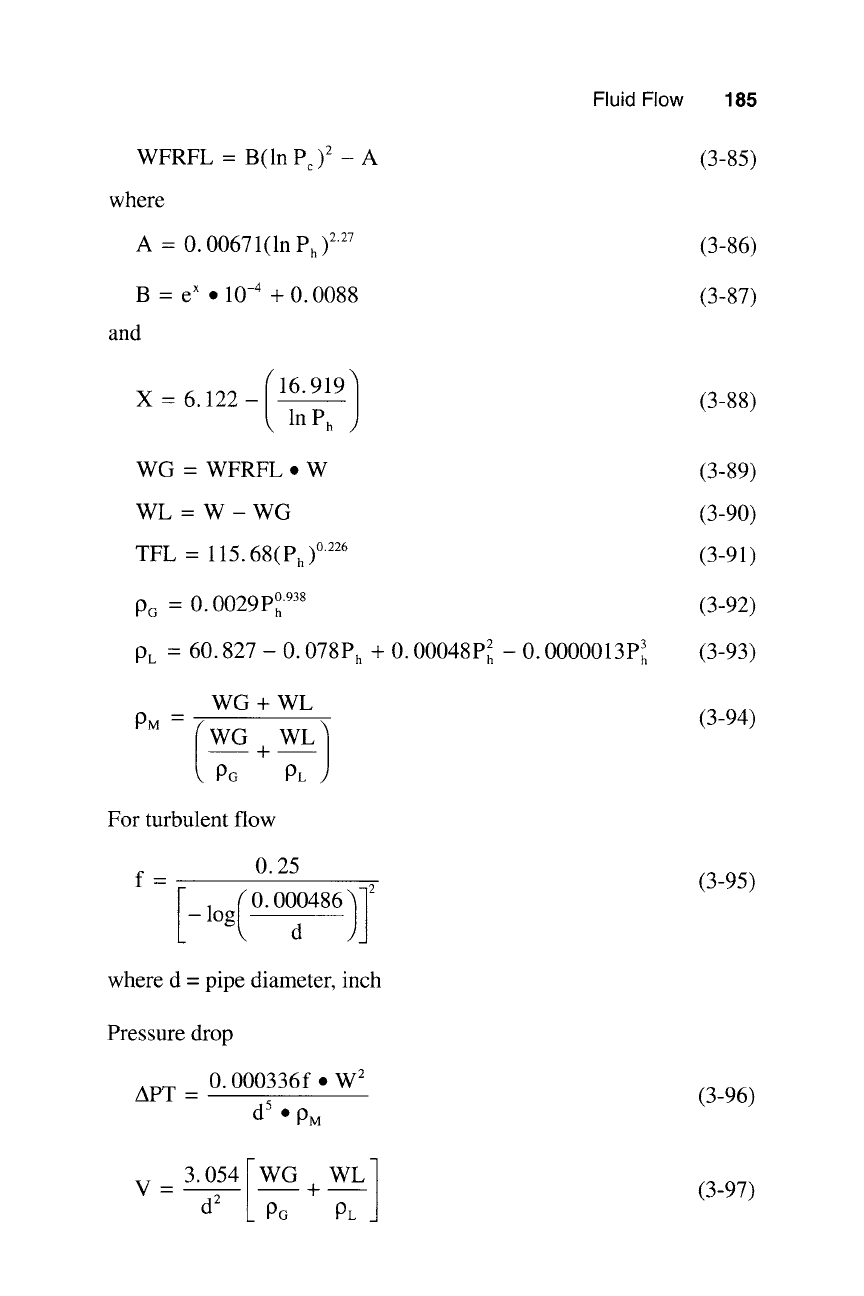
The Equations
The following equations are used to determine the pressure drop for
flashed condensate mixture [20].
Fluid Flow 185
WFRFL - B (In Pc )2
__
A
where
A - 0. 00671 (In
Ph )2.27
B -
e x
9 10 -4
+0.0088
and
X-6" 122 - (16"919/In
Ph
W G - WFRFL 9 W
WL - W- WG
TFL - 115.68(P h
)0.226
OG --
0.
0029P~
PL --
60.827 - 0.078Ph
-I-
0.00048p2 h - 0.0000013p3 h
WG + WL
/ + WL/ :
For turbulent flow
f m
0.25
[- l~ 000486)12 d
where d- pipe diameter, inch
Pressure drop
APT -
0. 000336f
9 W 2
d5 9 PM
W
3.054[WG +~WL 1
d2 PG PL
(3-85)
(3-86)
(3-87)
(3-88)
(3-89)
(3-90)
(3-91)
(3-92)
(3-93)
(3-94)
(3-95)
(3-96)
(3-97)
186
Fortran Programs for Chemical Process Design
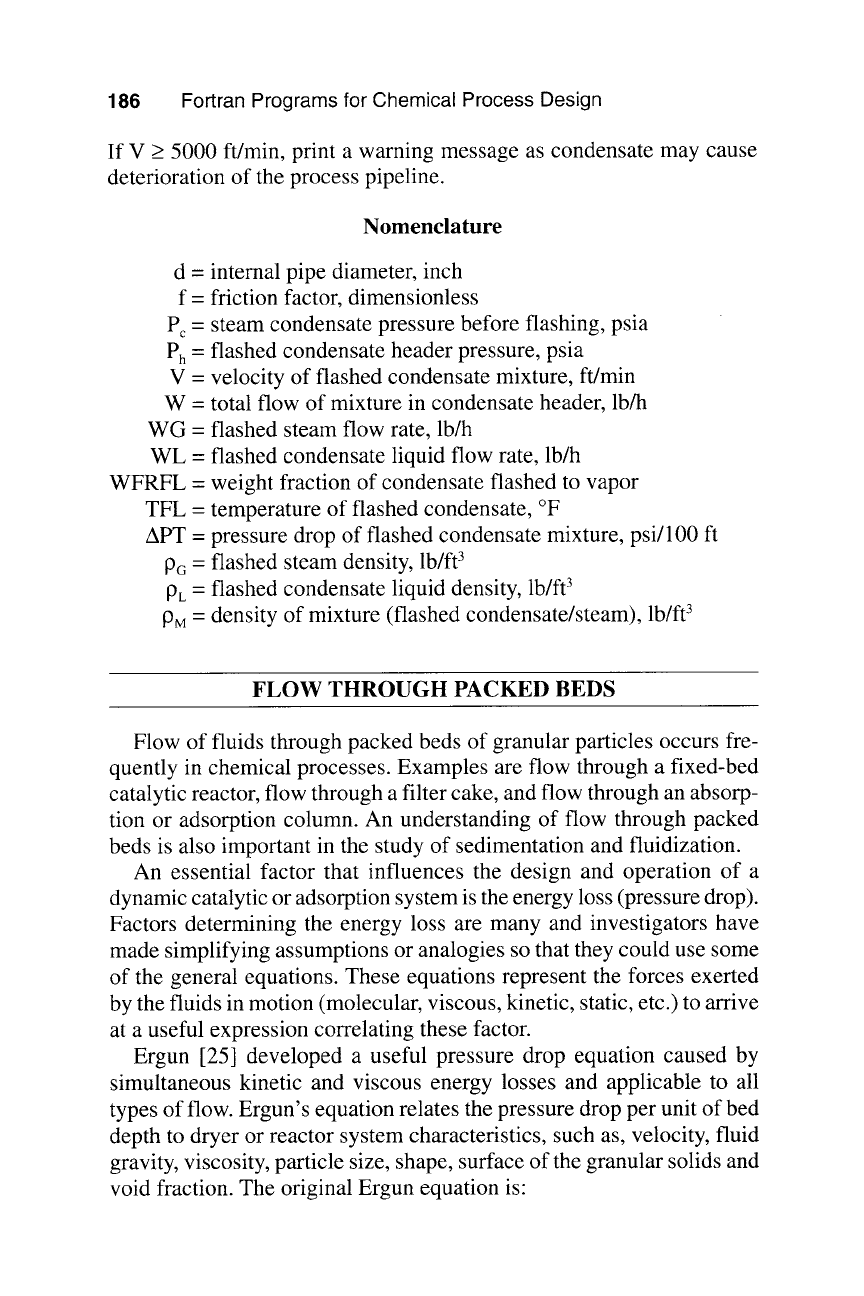
If V > 5000 ft/min, print a warning message as condensate may cause
deterioration of the process pipeline.
Nomenclature
d = internal pipe diameter, inch
f = friction factor, dimensionless
Pc = steam condensate pressure before flashing, psia
Ph = flashed condensate header pressure, psia
V = velocity of flashed condensate mixture, ft/min
W = total flow of mixture in condensate header, lb/h
WG = flashed steam flow rate, lb/h
WL = flashed condensate liquid flow rate, lb/h
WFRFL = weight fraction of condensate flashed to vapor
TFL = temperature of flashed condensate, ~
APT = pressure drop of flashed condensate mixture, psi/100 ft
PG = flashed steam density, lb/ft 3
PL = flashed condensate liquid density, lb/ft 3
9M = density of mixture (flashed condensate/steam), lb/ft 3
FLOW THROUGH PACKED BEDS
Flow of fluids through packed beds of granular particles occurs fre-
quently in chemical processes. Examples are flow through a fixed-bed
catalytic reactor, flow through a filter cake, and flow through an absorp-
tion or adsorption column. An understanding of flow through packed
beds is also important in the study of sedimentation and fluidization.
An essential factor that influences the design and operation of a
dynamic catalytic or adsorption system is the energy loss (pressure drop).
Factors determining the energy loss are many and investigators have
made simplifying assumptions or analogies so that they could use some
of the general equations. These equations represent the forces exerted
by the fluids in motion (molecular, viscous, kinetic, static, etc.) to arrive
at a useful expression correlating these factor.
Ergun [25] developed a useful pressure drop equation caused by
simultaneous kinetic and viscous energy losses and applicable to all
types of flow. Ergun's equation relates the pressure drop per unit of bed
depth to dryer or reactor system characteristics, such as, velocity, fluid
gravity, viscosity, particle size, shape, surface of the granular solids and
void fraction. The original Ergun equation is: