
Coker A.K. Fortran Programs for Chemical Process Design, Analysis, and Simulation
Подождите немного. Документ загружается.

Fluid Flow 167
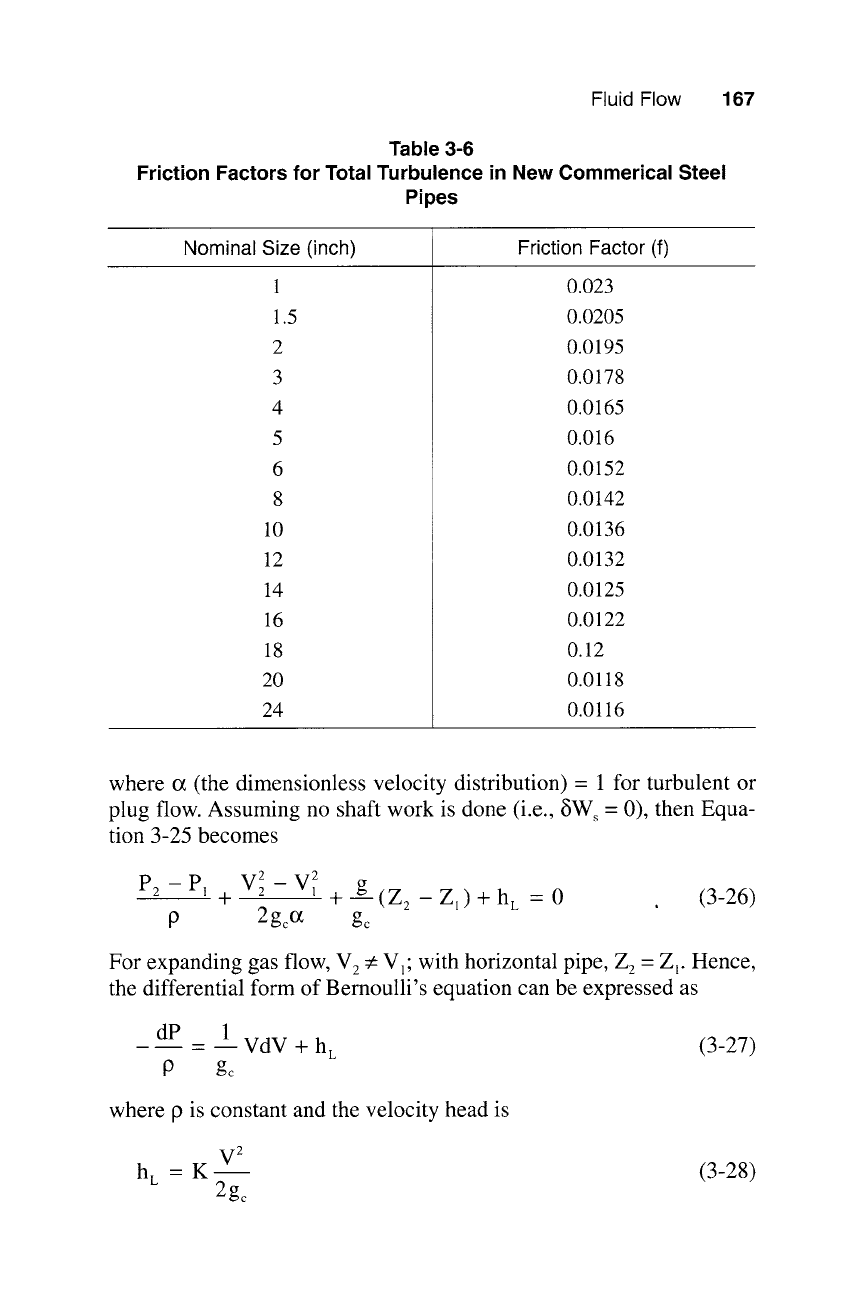
Table 3-6
Friction Factors for Total Turbulence in New Commerical Steel
Pipes
Nominal Size (inch)
1
1.5
2
3
4
5
6
8
10
12
14
16
18
20
24
Friction Factor (f)
0.023
0.0205
0.0195
0.0178
0.0165
0.016
0.0152
0.0142
0.0136
0.0132
0.0125
0.0122
0.12
0.0118
0.0116
where ~ (the dimensionless velocity distribution) - 1 for turbulent or
plug flow. Assuming no shaft work is done (i.e., 8W~ - 0), then Equa-
tion 3-25 becomes
P2 - P~ V22
-- v2
--F" 1 -I- g (Z 2 - Z 1 ) -}-
h c - 0 . (3-26)
P 2gctX gc
For expanding gas flow,
V 2 zt: V l;
with horizontal pipe,
2 2 -- Zl.
Hence,
the differential form of Bernoulli's equation can be expressed as
dP 1
= ~ VdV + h E (3-27)
P gc
where p is constant and the velocity head is
g 2
h e - K~ (3-28)
2g~
168 Fortran Programs for Chemical Process Design
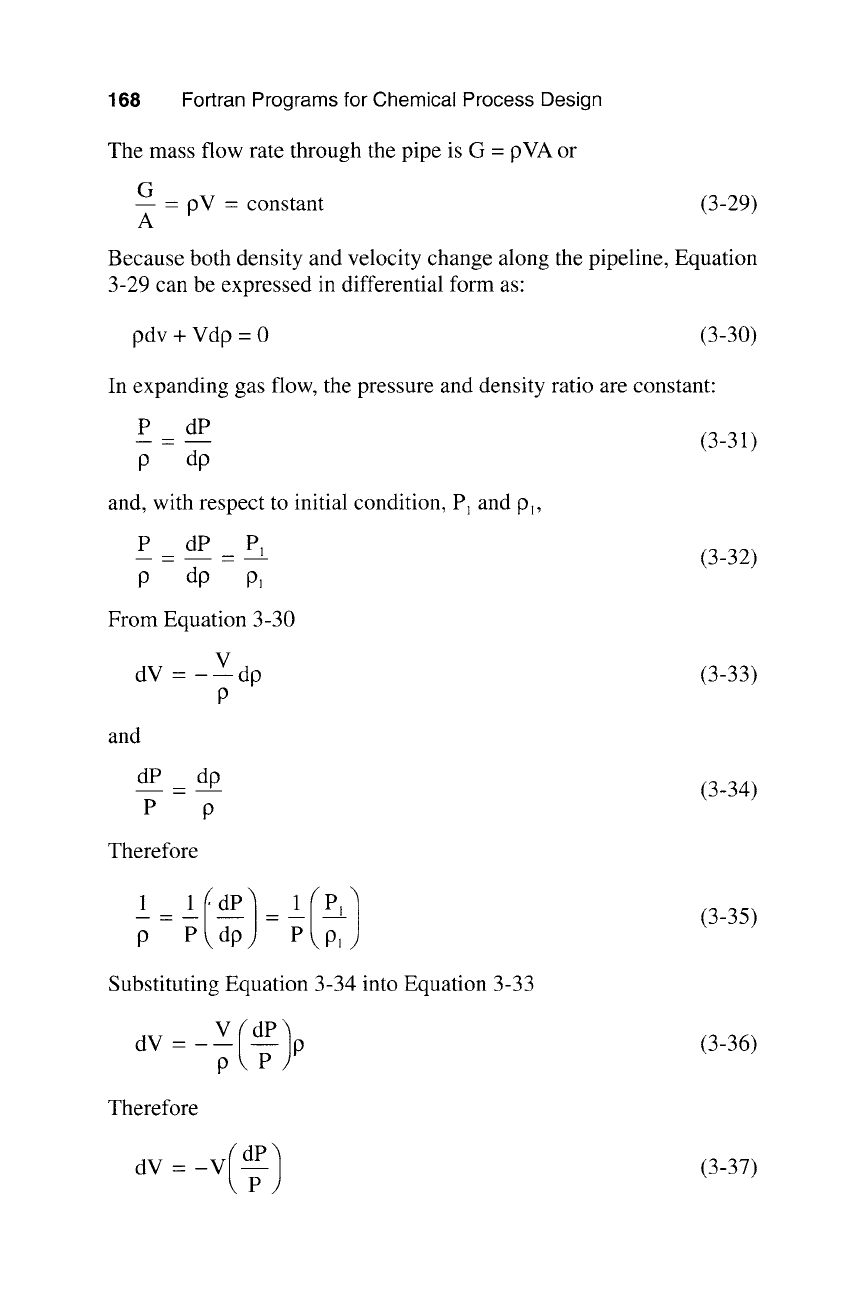
The mass flow rate through the pipe is G - pVA or
G
= pV - constant (3-29)
A
Because both density and velocity change along the pipeline, Equation
3-29 can be expressed in differential form as:
pdv + Vd 9 -0 (3-30)
In expanding gas flow, the pressure and density ratio are constant:
P dP
p dp
(3-31)
and, with respect to initial condition, P~ and P~,
P dP P1
p dp Pl
(3-32)
From Equation 3-30
V
dV = dp (3-33)
and
dP
P
dp
z
P
(3-34)
Therefore
1
P
(3-35)
Substituting Equation 3-34 into Equation 3-33
dV=
V(dP/
p -p-
(3-36)
Therefore
dV
- -v(dP
(3-37)
Fluid Flow 169
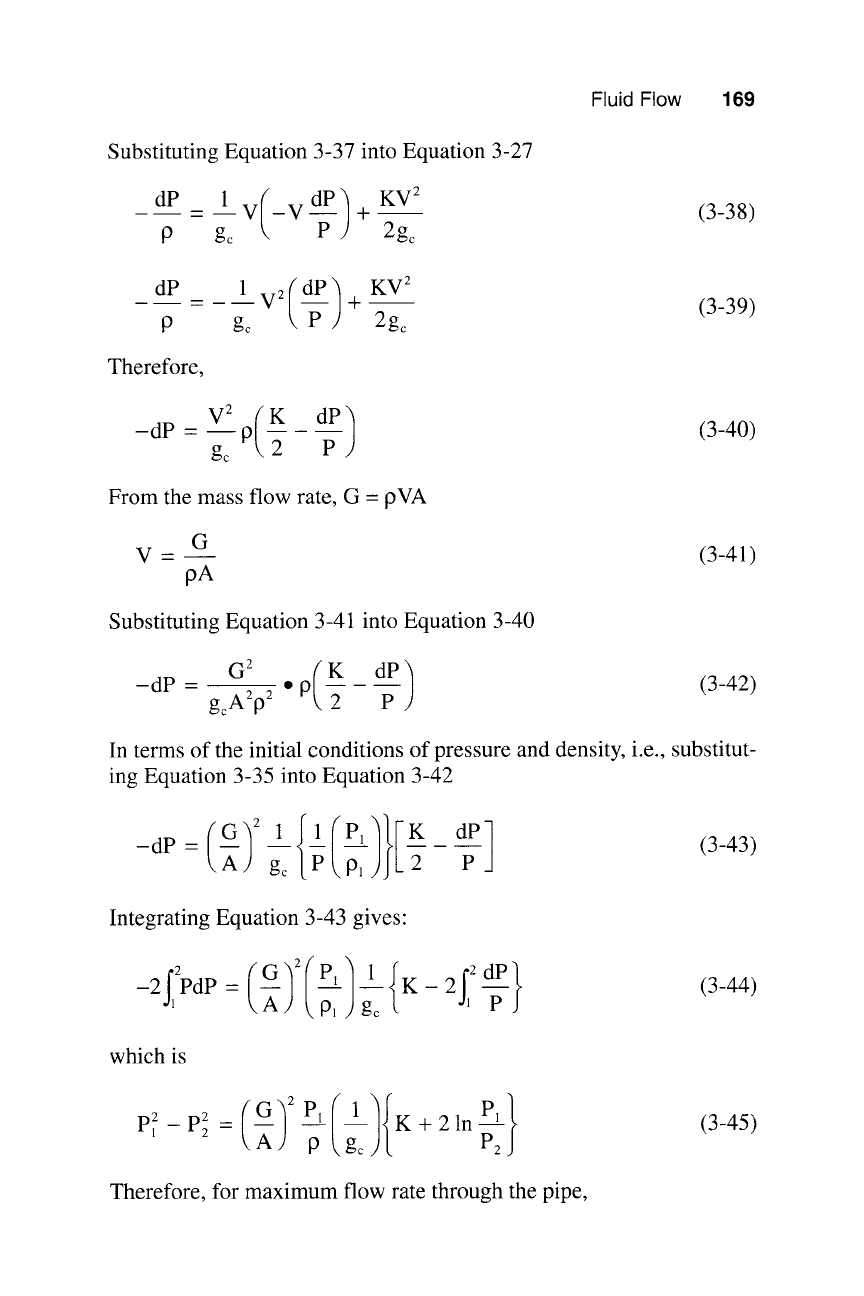
Substituting Equation 3-37 into Equation 3-27
dP 1 V(-V dP)
KV 2
= + (3-38)
9 gc P 2gc
dP
1
V2 (dP) KV 2
gc -~ -+-~2g c (3-39)
Therefore,
v2/K dp /
-dP - -- 9 (3-40)
gc 2 P
From the mass flow rate, G- 9VA
G
V = (3-41)
pA
Substituting Equation 3-41 into Equation 3-40
dp O 2 (K dP /
- 9 (3-42)
gcAZp2 P
2 P
In terms of the initial conditions of pressure and density, i.e., substitut-
ing Equation 3-35 into Equation 3-42
-dP- ~ 77 -~l 2 P
(3-43)
Integrating Equation 3-43 gives:
G 2(p,/1 2dp
-2~2pdP-(~ -~-1 7{K-2I -p-}
(3-44)
which is
/G/2 pl l,/{ pl}
p~
_ p2
2 -- A 7 7 K --}- 2 In
P2
(3-45)
Therefore, for maximum flow rate through the pipe,
170 Fortran Programs for Chemical Process Design
0.5
G- A2plgc / p2-p2 )
l 2 (3-46)
KTOTA c + 2 In p~ P~
P2
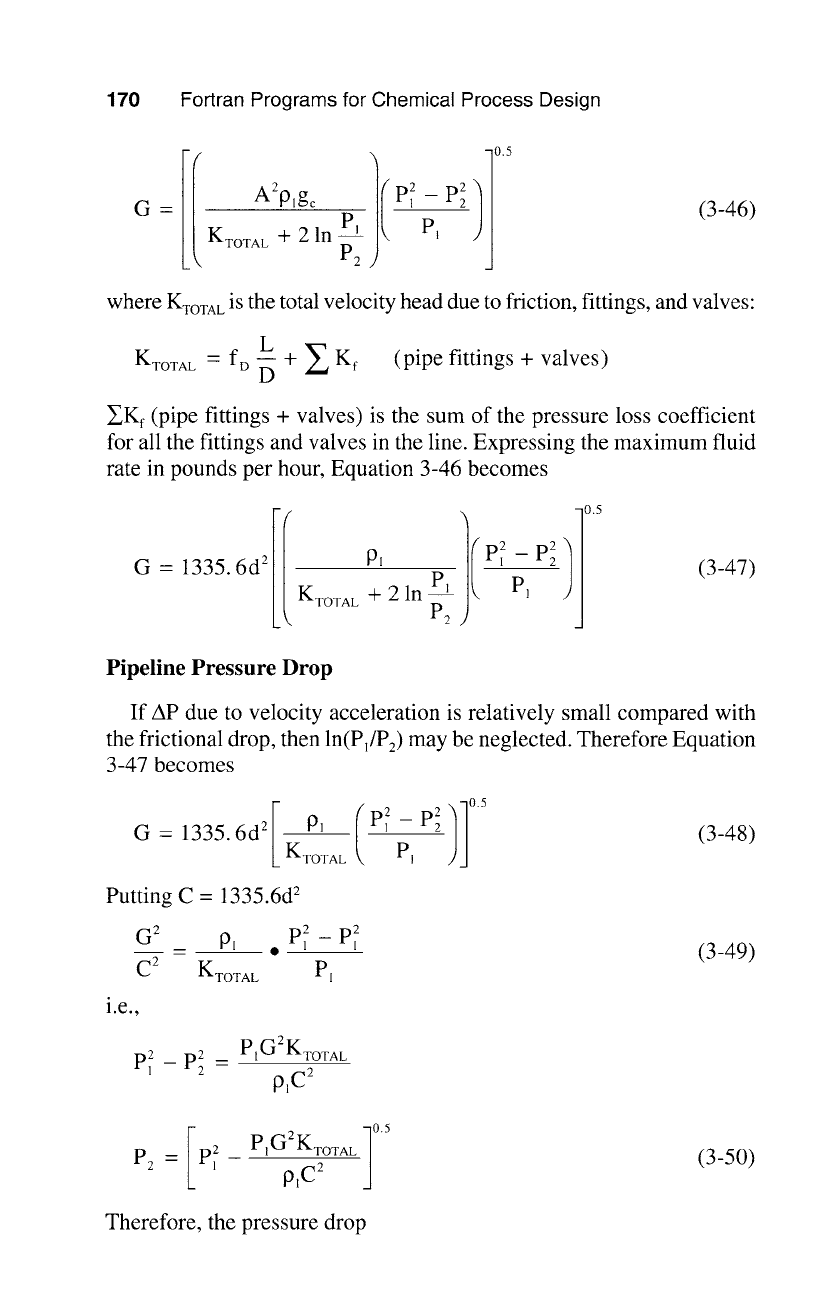
where
KTOTA L
is the total velocity head due to friction, fittings, and valves:
L
KTOTAL -- fD O + EKf
(pipe fittings + valves)
~Kf (pipe fittings + valves) is the sum of the pressure loss coefficient
for all the fittings and valves in the line. Expressing the maximum fluid
rate in pounds per hour, Equation 3-46 becomes
0.5
G n 1335.6d 2 Pl /P~ m P~/ (3-47)
KTOTA L +
2 In P~ P~
P2
Pipeline Pressure Drop
If AP due to velocity acceleration is relatively small compared with
the frictional drop, then ln(PJP2) may be neglected. Therefore Equation
3-47 becomes
[ / 2/]0"5
G - 1335.6d
2 f)l
P~
- P2
KTOTAL Pl
Putting C = 1335.6d 2
G 2 = P, . P~ - P~
C2 KTOTAL
Pl
i.e.,
(3-48)
(3-49)
P~ - p22 -
P1G2KToTAL
D1 C2
P2 - Ie~
-
P1GZK~ OTALpl C 10.5
(3-50)
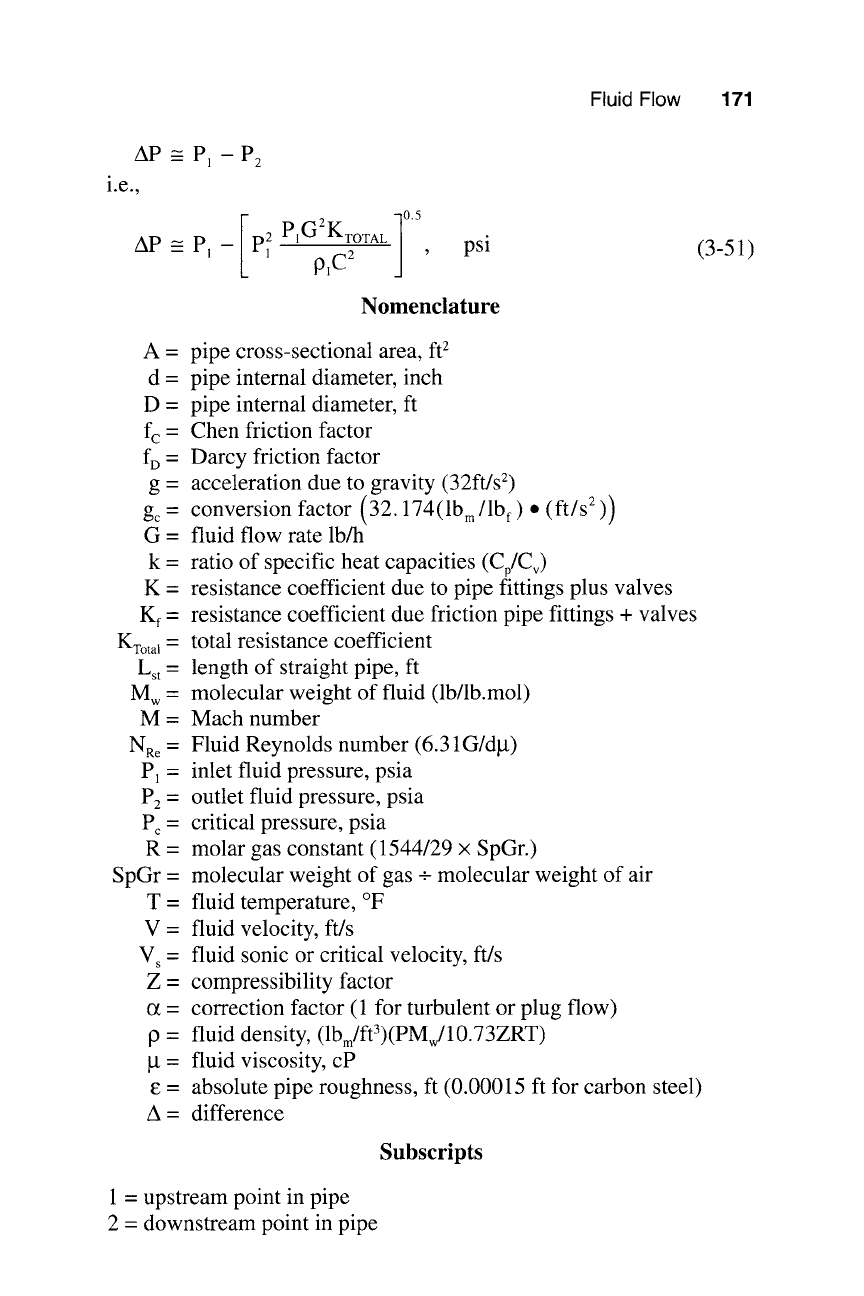
Therefore, the pressure drop
Fluid Flow 171
AP =_ P~-
P2
i.e.,
E 1
AP'~ el- P~ p--~{
psi
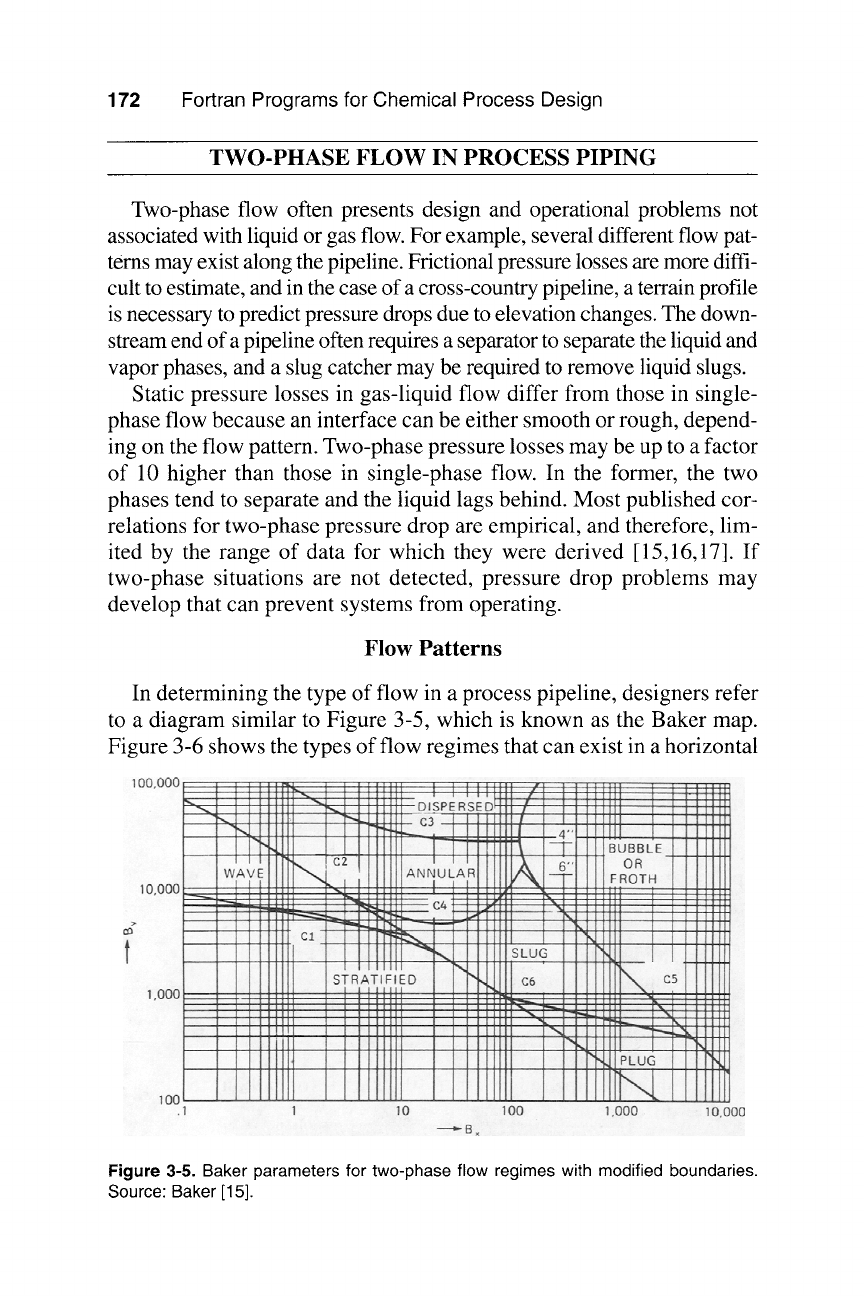
Nomenclature
(3-51)
A = pipe cross-sectional area,
ft 2
d = pipe internal diameter, inch
D- pipe internal diameter, ft
fc = Chen friction factor
fD = Darcy friction factor
g = acceleration due to gravity (32ft/s 2)
gc - conversion factor (32.174(lbm/lb f) ,, (ft/s 2))
G = fluid flow rate lb/h
k - ratio of specific heat capacities (Cp/Cv)
K- resistance coefficient due to pipe fittings plus valves
Kf = resistance coefficient due friction pipe fittings + valves
KTota I =
total resistance coefficient
Lst--
length of straight pipe, ft
M w = molecular weight of fluid (lb/lb.mol)
M = Mach number
NRe = Fluid Reynolds number (6.31G/dbt)
P~ = inlet fluid pressure, psia
P2 :
outlet fluid pressure, psia
Pc = critical pressure, psia
R = molar gas constant (1544/29 x SpGr.)
SpGr = molecular weight of gas + molecular weight of air
T- fluid temperature, ~
V- fluid velocity, ft/s
V~- fluid sonic or critical velocity, ft/s
Z = compressibility factor
o~ = correction factor (1 for turbulent or plug flow)
P = fluid density, (lbm/ft3)(PMw/10.73ZRT)
la = fluid viscosity, cP
= absolute pipe roughness, ft (0.00015 ft for carbon steel)
A- difference
Subscripts
1 = upstream point in pipe
2 = downstream point in pipe
172
Fortran Programs for Chemical Process Design
TWO-PHASE FLOW IN PROCESS PIPING
Two-phase flow often presents design and operational problems not
associated with liquid or gas flow. For example, several different flow pat-
terns may exist along the pipeline. Frictional pressure losses are more diffi-
cult to estimate, and in the case of a cross-country pipeline, a terrain profile
is necessary to predict pressure drops due to elevation changes. The down-
stream end of a pipeline often requires a separator to separate the liquid and
vapor phases, and a slug catcher may be required to remove liquid slugs.
Static pressure losses in gas-liquid flow differ from those in single-
phase flow because an interface can be either smooth or rough, depend-
ing on the flow pattern. Two-phase pressure losses may be up to a factor
of 10 higher than those in single-phase flow. In the former, the two
phases tend to separate and the liquid lags behind. Most published cor-
relations for two-phase pressure drop are empirical, and therefore, lim-
ited by the range of data for which they were derived [15,16,17]. If
two-phase situations are not detected, pressure drop problems may
develop that can prevent systems from operating.
Flow Patterns
In determining the type of flow in a process pipeline, designers refer
to a diagram similar to Figure 3-5, which is known as the Baker map.
Figure 3-6 shows the types of flow regimes that can exist in a horizontal
Figure 3-5. Baker parameters for two-phase flow regimes with modified boundaries.
Source: Baker [15].
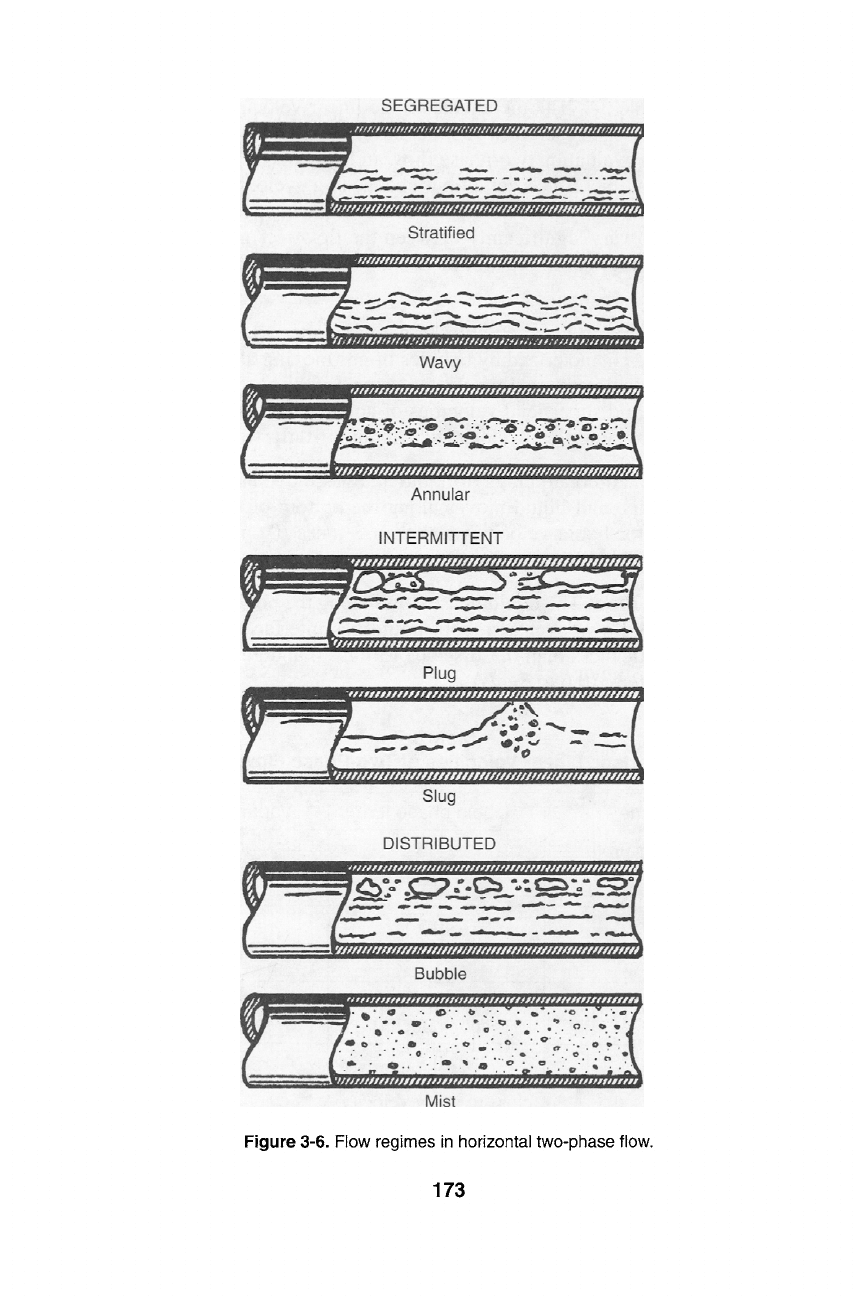
Figure 3-6. Flow regimes in horizontal two-phase flow.
173
174
Fortran Programs for Chemical Process Design
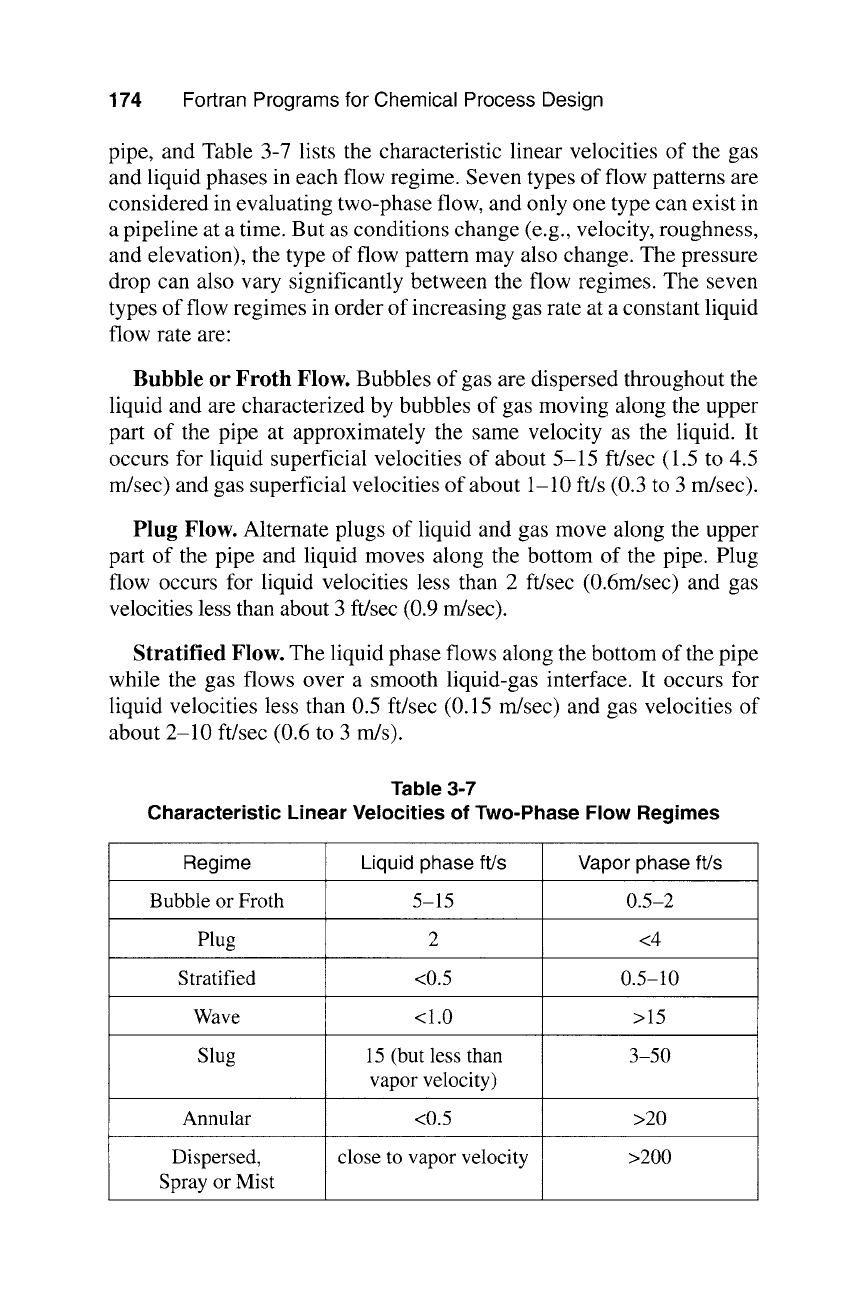
pipe, and Table 3-7 lists the characteristic linear velocities of the gas
and liquid phases in each flow regime. Seven types of flow patterns are
considered in evaluating two-phase flow, and only one type can exist in
a pipeline at a time. But as conditions change (e.g., velocity, roughness,
and elevation), the type of flow pattern may also change. The pressure
drop can also vary significantly between the flow regimes. The seven
types of flow regimes in order of increasing gas rate at a constant liquid
flow rate are:
Bubble or Froth Flow. Bubbles of gas are dispersed throughout the
liquid and are characterized by bubbles of gas moving along the upper
part of the pipe at approximately the same velocity as the liquid. It
occurs for liquid superficial velocities of about 5-15 ft/sec (1.5 to 4.5
m/sec) and gas superficial velocities of about 1-10 ft/s (0.3 to 3 m/sec).
Plug Flow. Alternate plugs of liquid and gas move along the upper
part of the pipe and liquid moves along the bottom of the pipe. Plug
flow occurs for liquid velocities less than 2 ft/sec (0.6m/sec) and gas
velocities less than about 3 ft/sec (0.9 m/sec).
Stratified
Flow. The liquid phase flows along the bottom of the pipe
while the gas flows over a smooth liquid-gas interface. It occurs for
liquid velocities less than 0.5 ft/sec (0.15 m/sec) and gas velocities of
about 2-10 ft/sec (0.6 to 3 m/s).
Table 3-7
Characteristic Linear Velocities of Two-Phase Flow Regimes
Regime
Bubble or Froth
Plug
Stratified
Wave
Slug
Annular
Dispersed,
Spray or Mist
Liquid phase ft/s
5-15
<0.5
<1.0
15 (but less than
vapor velocity)
<0.5
close to vapor velocity
Vapor phase ft/s
0.5-2
<4
0.5-10
>15
3-50
>20
>200
Fluid Flow 175
Wave Flow. Wave flow is similar to stratified flow except that the
gas is moving at a higher velocity and the gas-liquid interface is distrib-
uted by waves moving in the direction of flow. It occurs for liquid
velocities less than 1 ft/sec (0.3 m/sec) and gas velocities from about
15 ft/sec. (4.5 m/sec).
Slug Flow. This pattern occurs when waves are picked up periodi-
cally by the more rapidly moving gas. These form frothy slugs that move
along the pipeline at a much higher velocity than the average liquid
velocity. This type of flow causes severe and, in most cases, dangerous
vibrations in equipment because of the high velocity slugs against fittings.
Annular
Flow. In annular flow, liquid forms around the inside wall
of the pipe and gas flows at a high velocity through the central core. It
occurs for gas velocities greater than 20 ft/sec (6 m/sec).
Dispersed, Spray, or Mist Flow.
Here, all of the liquid is entrained
as fine droplets by the gas phase. Dispersed flow occurs for gas veloci-
ties greater than 200 ft/sec (60 m/sec).
Flow Regimes
Establishing the flow regime involves determining the Baker param-
eters B x and By from the two-phase system's characteristics and physi-
cal properties. The Baker parameters can be expressed as:
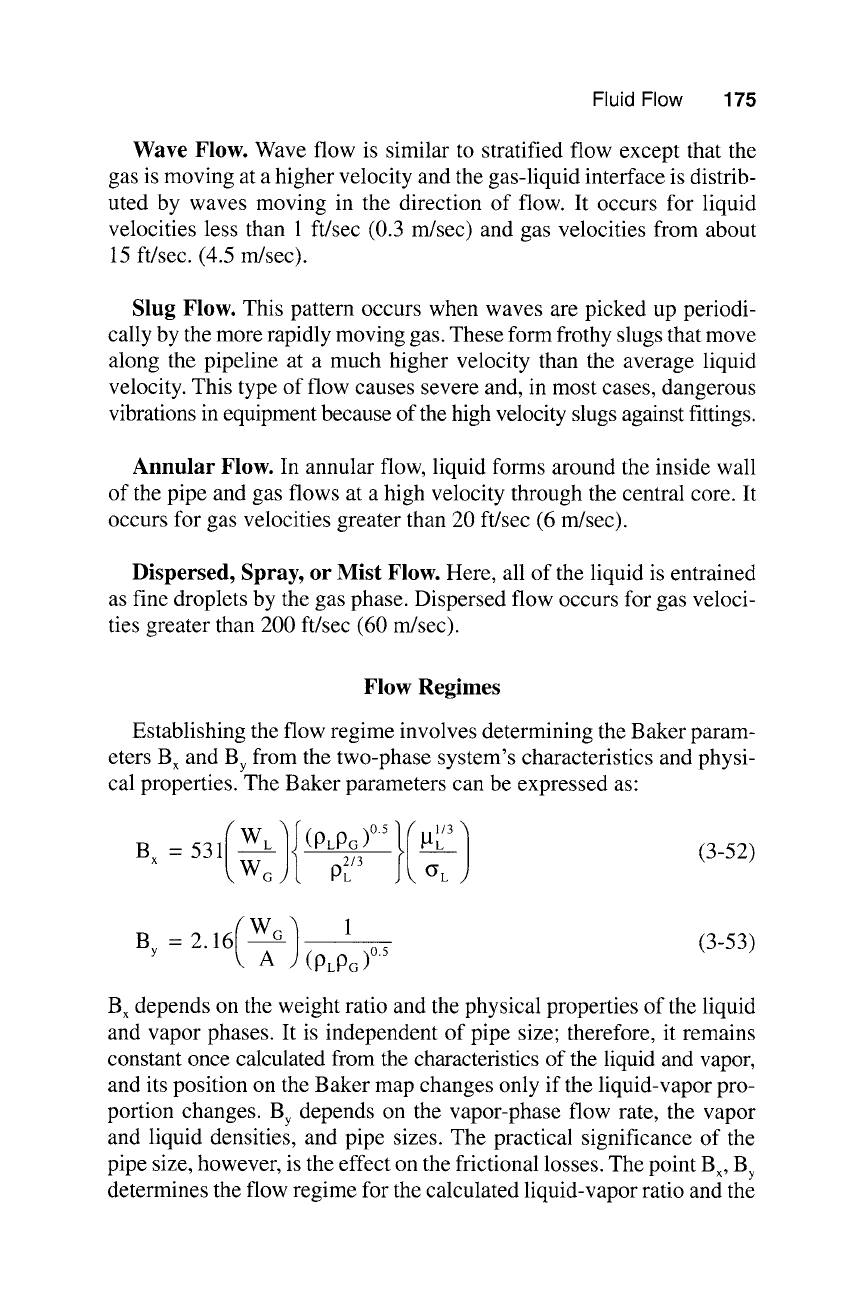
/wL/t 5 /
B~-531 ~ pT 3- GL
(3-52)
WG) 1
By - 2.16
--~--
(9LQG)0.5 (3-53)
B~ depends on the weight ratio and the physical properties of the liquid
and vapor phases. It is independent of pipe size; therefore, it remains
constant once calculated from the characteristics of the liquid and vapor,
and its position on the Baker map changes only if the liquid-vapor pro-
portion changes. By depends on the vapor-phase flow rate, the vapor
and liquid densities, and pipe sizes. The practical significance of the
pipe size, however, is the effect on the frictional losses. The point B x, By
determines the flow regime for the calculated liquid-vapor ratio and the
176
Fortran Programs for Chemical Process Design
liquid's and vapor's physical properties. With increasing vapor content,
B~, By moves up and to the left on the map.
The boundaries of the various flow pattern regions depend on the
mass velocity of the gas phase. These boundaries are represented by
analytical equations developed by Coker [ 18]. These equations are used
as the basis for determining the prevailing regime for any given flow
rates and physical properties of the liquid and vapor. The mathematical
models representing the boundaries of the flow regimes are:
C~" In
By -
9.774459 - 0.6548(ln Bx)
(3-54)
C 2"
In By - 8.67694 - 0.1901 (ln Bx)
(3-55)
C 3"
In By -
11.3976- 0.6084(ln B~) + 0.0779(ln
Bx) 2
(3-56)
C 4"
In By -
10.7448- 1.6265(ln Bx) + 0.2839(ln
Bx) 2
(3-57)
C 5"
In By -
14.569802 - 1.0173(ln Bx)
(3-58)
C 6"
In By - 7.8206 - 0.2189(ln Bx)
(3-59)
Pressure Drop
Various studies have been conducted in predicting the two-phase fric-
tional pressure losses in pipes. The Lockhart-Martinelli correlations [19]
shown in Figure 3-7 are employed. The basis of the correlations is that
the two-phase pressure drop is equal to the single-phase pressure drop
of either phase multiplied by a factor that is derived from the single-
phase pressure drops of the two-phases. The total pressure drop is based
on the vapor-phase pressure drop. The pressure drop computation is
based on the following assumptions:
1. The two-phase flow is isothermal and turbulent in both liquid and
vapor phases.
2. The pressure loss is less than 10% of the absolute upstream pressure.
The two-phase pressure drop can be expressed as:
APT APG
= 9 YG (3-60)
lOOft lOOft