
Coker A.K. Fortran Programs for Chemical Process Design, Analysis, and Simulation
Подождите немного. Документ загружается.

Numerical Computation 17
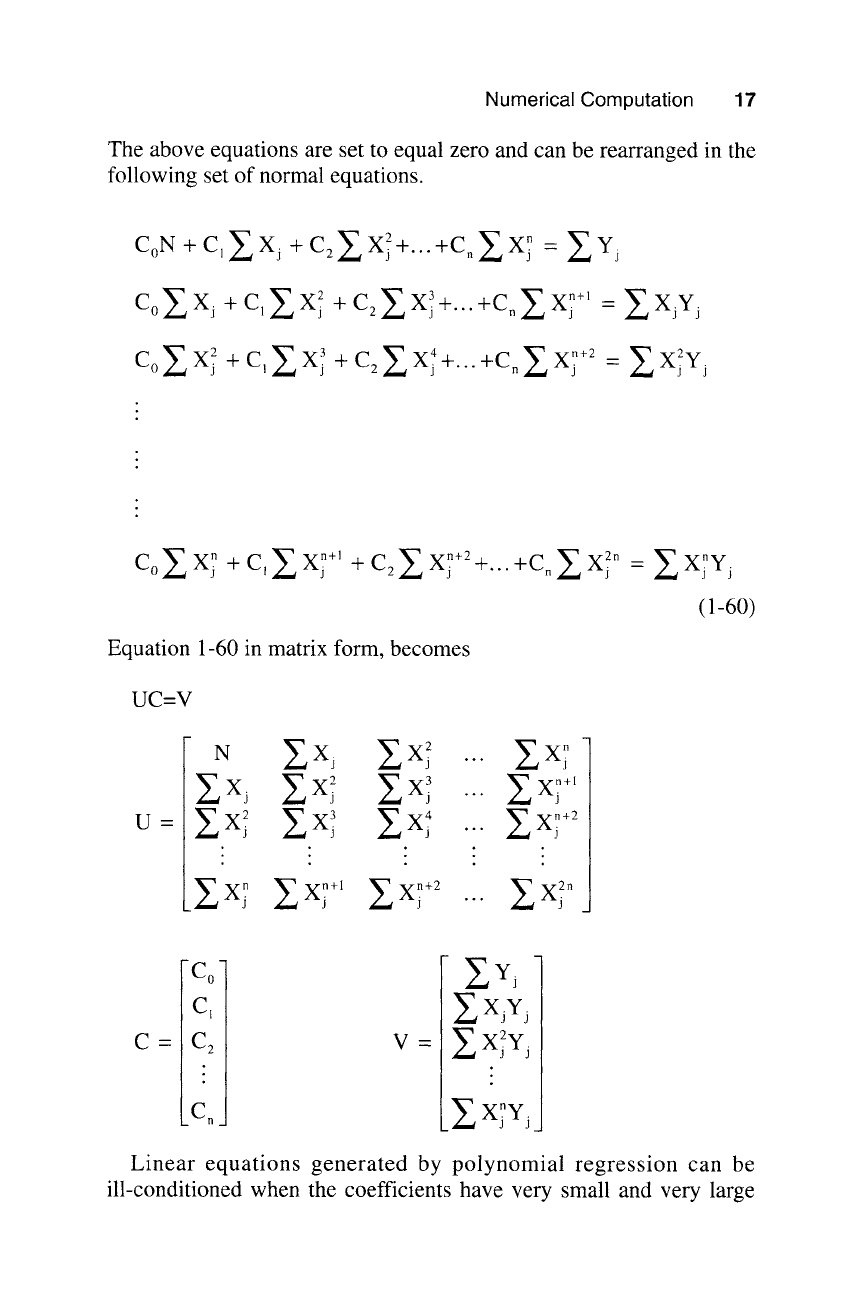
The above equations are set to equal zero and can be rearranged in the
following set of normal equations.
CoN --F CIEXj -F c2Ex~-F...-.i-CnEX; - EYJ
2 3 n+l
CoEXj +Cl~z_~Xj +c~Zx,+...+CnEXj - EXjYj
CoZX~+C, EX~+C:EX~+ +CnZX~ E
~
2 3 4 ... n+2 __ Xj j
n n+l n+2 2n
CoZXj+C, ZXj +c~Ex j +...+CnEXj
Equation 1-60 in matrix form, becomes
- E XjYj
(1-60)
UC=V
U m
N
~xj
2
}~xj
~
Zx~ Zx~ ... Ex;
Zx~ Zx~ ... Zx; +'
Zx~ Ex; ... Zx~ +~
EX~ +1 EX~ +2 ... EX~ n
C m
-Co7
C, I
I
C2 i
:l
I
Cn I
g ~
~Yj
E
xjYj
Ex~Y~
_E X;Yj
Linear equations generated by polynomial regression can be
ill-conditioned when the coefficients have very small and very large
18
Fortran Programs for Chemical Process Design
numbers. This results in smooth curves that fit poorly. Ill-conditioning
often happens if the degree of the polynomial is large and if the Y val-
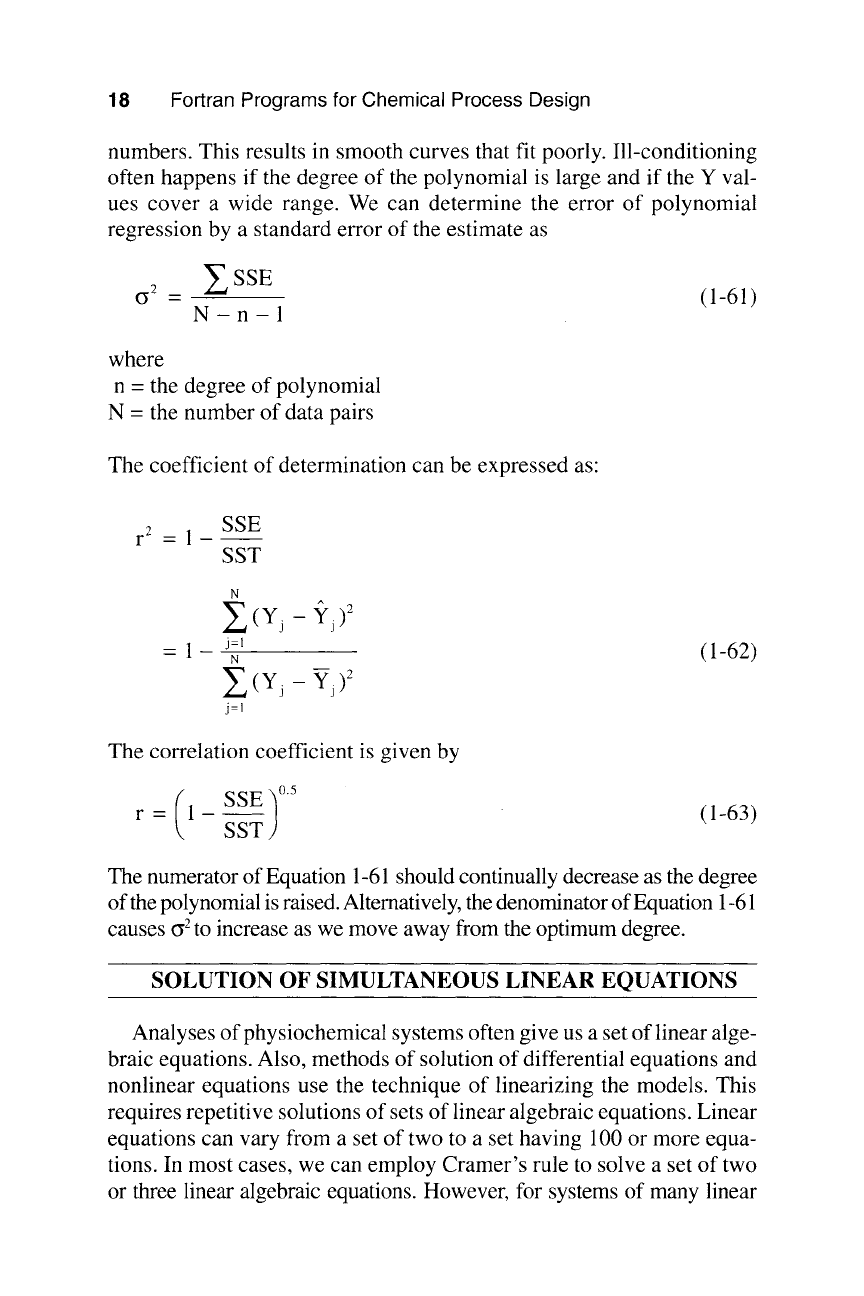
ues cover a wide range. We can determine the error of polynomial
regression by a standard error of the estimate as
02
= ZSSE
N- n- 1 (1-61)
where
n = the degree of polynomial
N = the number of data pairs
The coefficient of determination can be expressed as:
r2=l
SSE
SST
E(Yj
=1 J :l
N
-
9j3
Z(Yj -Yj)Z
j=l
(1-62)
The correlation coefficient is given by
r-(1 SSE) ~
SST (1-63)
The numerator of Equation 1-61 should continually decrease as the degree
of the polynomial is raised. Alternatively, the denominator of Equation 1-61
causes o 2 to increase as we move away from the optimum degree.
SOLUTION OF SIMULTANEOUS LINEAR EQUATIONS
Analyses of physiochemical systems often give us a set of linear alge-
braic equations. Also, methods of solution of differential equations and
nonlinear equations use the technique of linearizing the models. This
requires repetitive solutions of sets of linear algebraic equations. Linear
equations can vary from a set of two to a set having 100 or more equa-
tions. In most cases, we can employ Cramer's rule to solve a set of two
or three linear algebraic equations. However, for systems of many linear
Numerical Computation 19
equations, the algebraic computation becomes too complex and may
require other methods of analysis.
We will analyze two methods of solving a set of linear algebraic equa-
tions, namely Gauss elimination and Gauss-Seidel iteration methods.
Gauss elimination is most widely used to solve a set of linear algebraic
equations. Other methods of solving linear equations are Gauss-Jordan
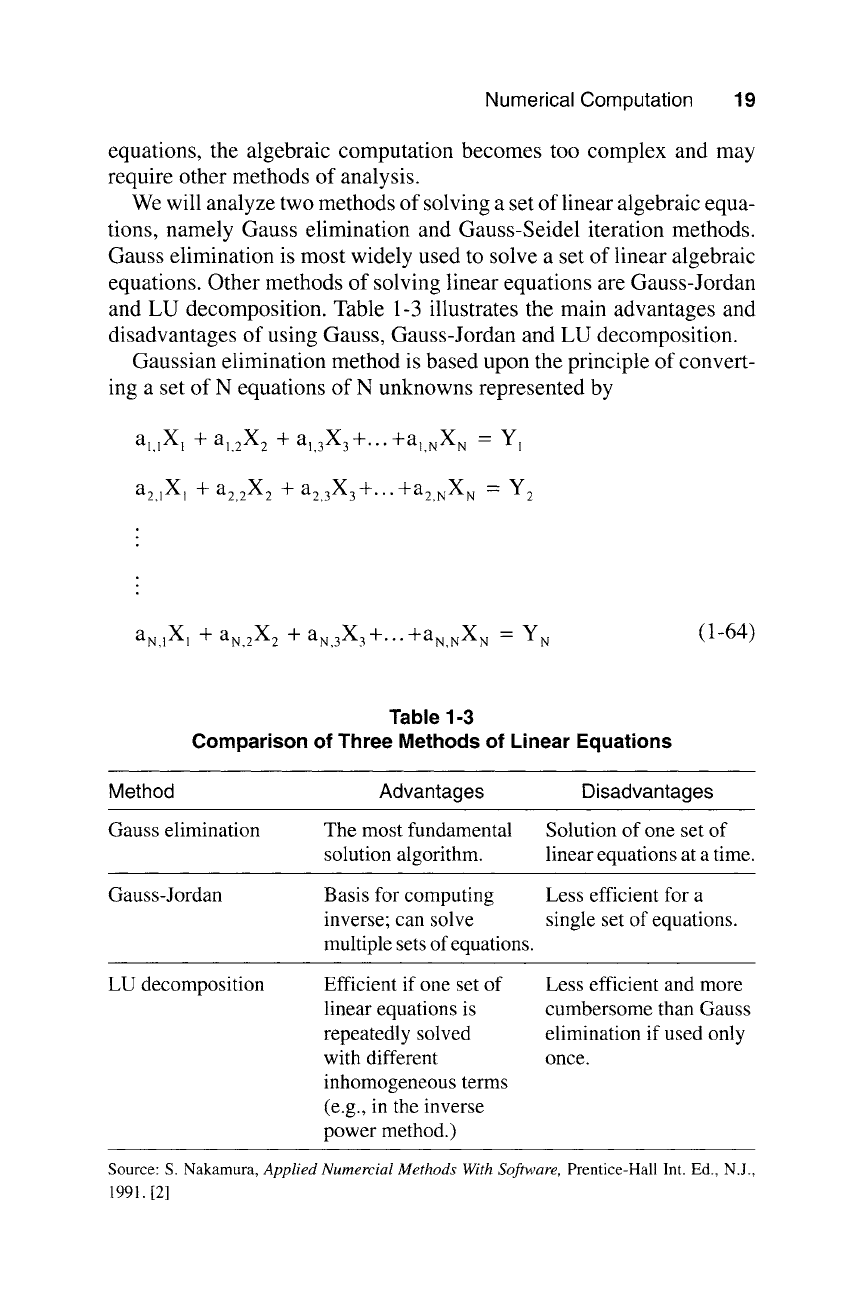
and LU decomposition. Table 1-3 illustrates the main advantages and
disadvantages of using Gauss, Gauss-Jordan and LU decomposition.
Gaussian elimination method is based upon the principle of convert-
ing a set of N equations of N unknowns represented by
a~,~X~
+ al,2X 2 + al,3X3+...
+al,NX N =
Y~
az,lXl + az,zX2 + az,3X3 +..-+a2,NXN = Y2
aN,1Xl + aN,2X2 + aN,3X3 +--" +aN,NXN ---- YN
(1-64)
Table 1-3
Comparison of Three Methods of Linear Equations
Method Advantages Disadvantages
Gauss elimination The most fundamental
solution algorithm.
Solution of one set of
linear equations at a time.
Gauss-Jordan Basis for computing
inverse; can solve
multiple sets of equations.
Less efficient for a
single set of equations.
LU decomposition
Efficient if one set of
linear equations is
repeatedly solved
with different
inhomogeneous terms
(e.g., in the inverse
power method.)
Less efficient and more
cumbersome than Gauss
elimination if used only
once.
Source: S. Nakamura,
Applied Numercial Methods With Software,
Prentice-Hall Int. Ed., N.J.,
1991. [2]
20 Fortran Programs for Chemical Process Design
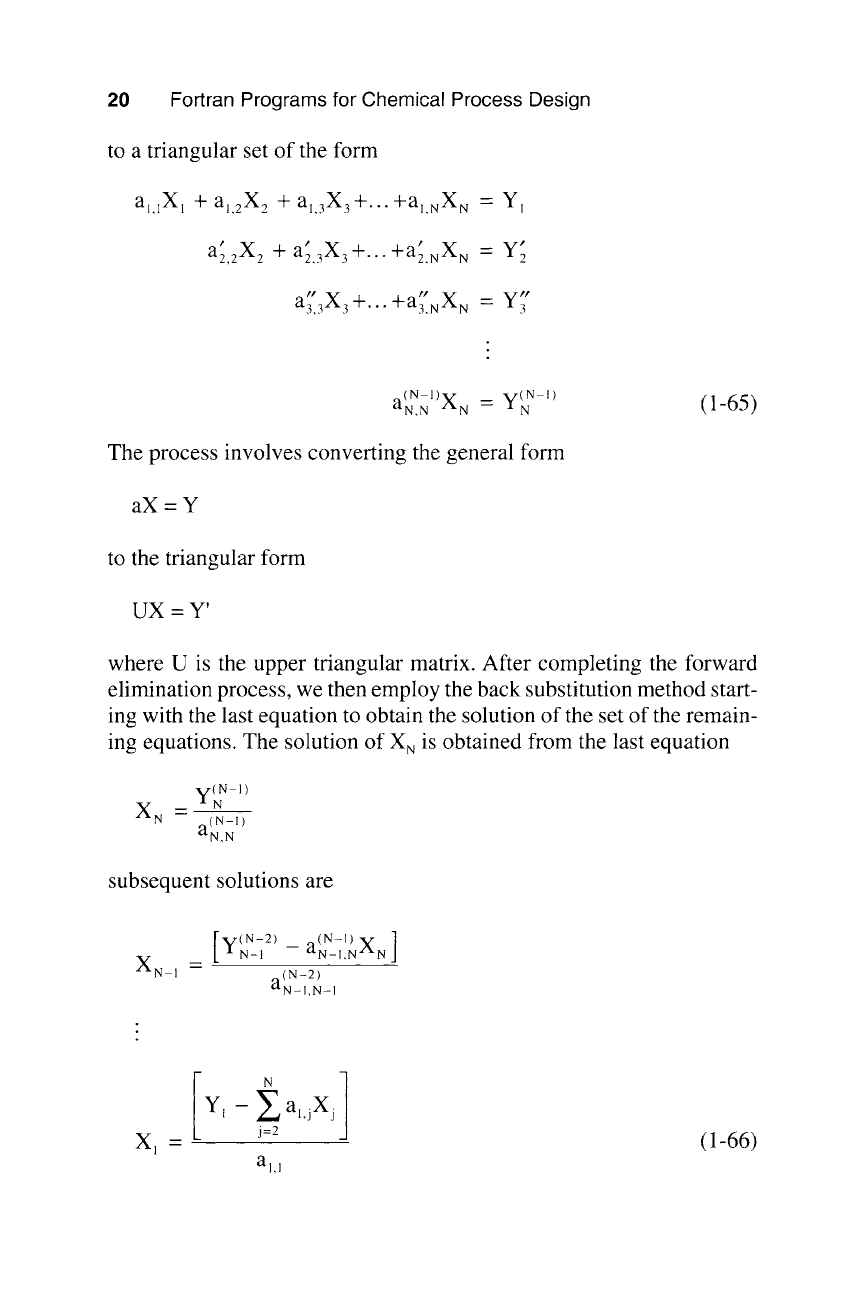
to a triangular set of the form
a~,~X~
+ al,2X 2 + al,3X 3 +... +al,NX N --
Y~
y p p t
a2,2X2 + a2,3X3+... +a2,NXN -- Y2
" X + . " - Y"
a3,3 3 .. +a3,NXN 3
(N-I) x (N-I)
aN,h N -- YN (1-65)
The process involves converting the general form
aX - Y
to the triangular form
UX- Y'
where U is the upper triangular matrix. After completing the forward
elimination process, we then employ the back substitution method start-
ing with the last equation to obtain the solution of the set of the remain-
ing equations. The solution of X N is obtained from the last equation
XN --~
yr N-l)
a(N-J)
N,N
subsequent solutions are
(N-2) ,~(N-I) X ]
_ YN-I
- aN-I,N
N
aN_ 1
a(N-2)
N-I,N-I
Xl __ j=2
a~,l
(1-66)
Numerical Computation 21
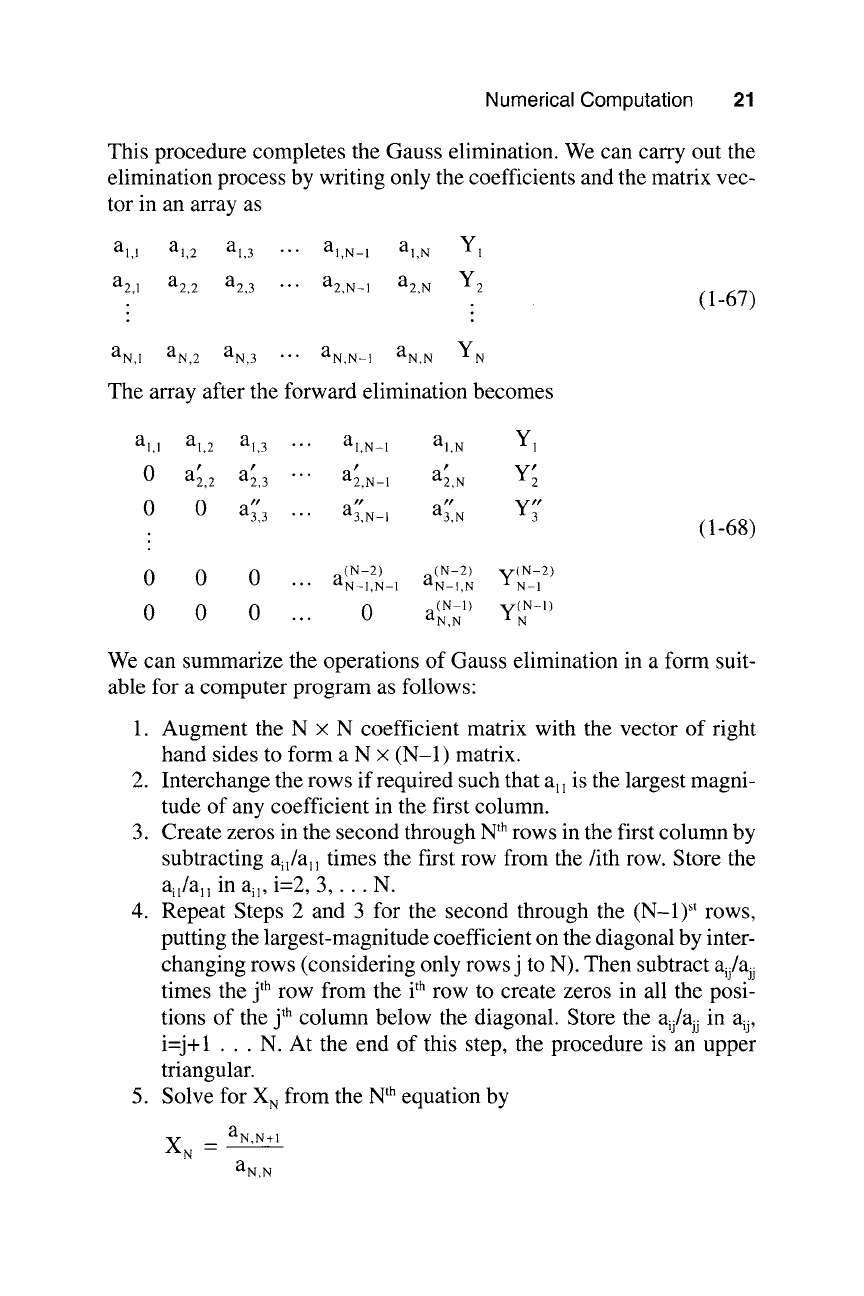
This procedure completes the Gauss elimination. We can carry out the
elimination process by writing only the coefficients and the matrix vec-
tor in an array as
al,1 a~,2 a~,3 ... a~,N_ ~ al,N
Y~
a2,1 a2,2 a2,3 ... aZ,N-1 a2,m Y2
9 .
9 .
(1-67)
aN,1 aN,2 aN,3 "'" aN,N-1 aN,N YN
The array after the forward elimination becomes
al,1 al,2 al,3 ... al,N-1 al,N Y1
P P P a p p
0 a2,2 a2,3 "'" a2,N-1 2,N Y2
,, ,, ,, y ,,
0 0 a3,3 ... a3,N-I a3,N 3
0 0 0 ,.. (N-2) ,_. (N-2) (N-2)
9 " " dN-1,N-1 i::tN-I,N YN-I
0 0 0 0 ,, (N-I) y(N-l)
9 9 9 iZIN,N N
(1-68)
We can summarize the operations of Gauss elimination in a form suit-
able for a computer program as follows:
1. Augment the N • N coefficient matrix with the vector of right
hand sides to form a N x (N-l) matrix.
2. Interchange the rows if required such that a~ is the largest magni-
tude of any coefficient in the first column.
3. Create zeros in the second through
N th rows
in the first column by
subtracting ai~/a~ times the first row from the/ith row. Store the
ai~/a~ in ai~, i=2, 3,... N.
4. Repeat Steps 2 and 3 for the second through the (N-l) ~ rows,
putting the largest-magnitude coefficient on the diagonal by inter-
changing rows (considering only rows j to N). Then subtract aij/ajj
times the
jth rOW from the i th row to
create zeros in all the posi-
tions of the
jth
column below the diagonal. Store the aij/ajj in aij,
i=j+l . . . N. At the end of this step, the procedure is an upper
triangular.
5. Solve for X N from the
N th
equation by
a
XN _-- N,N+I
aN,N
22
Fortran Programs for Chemical Process Design
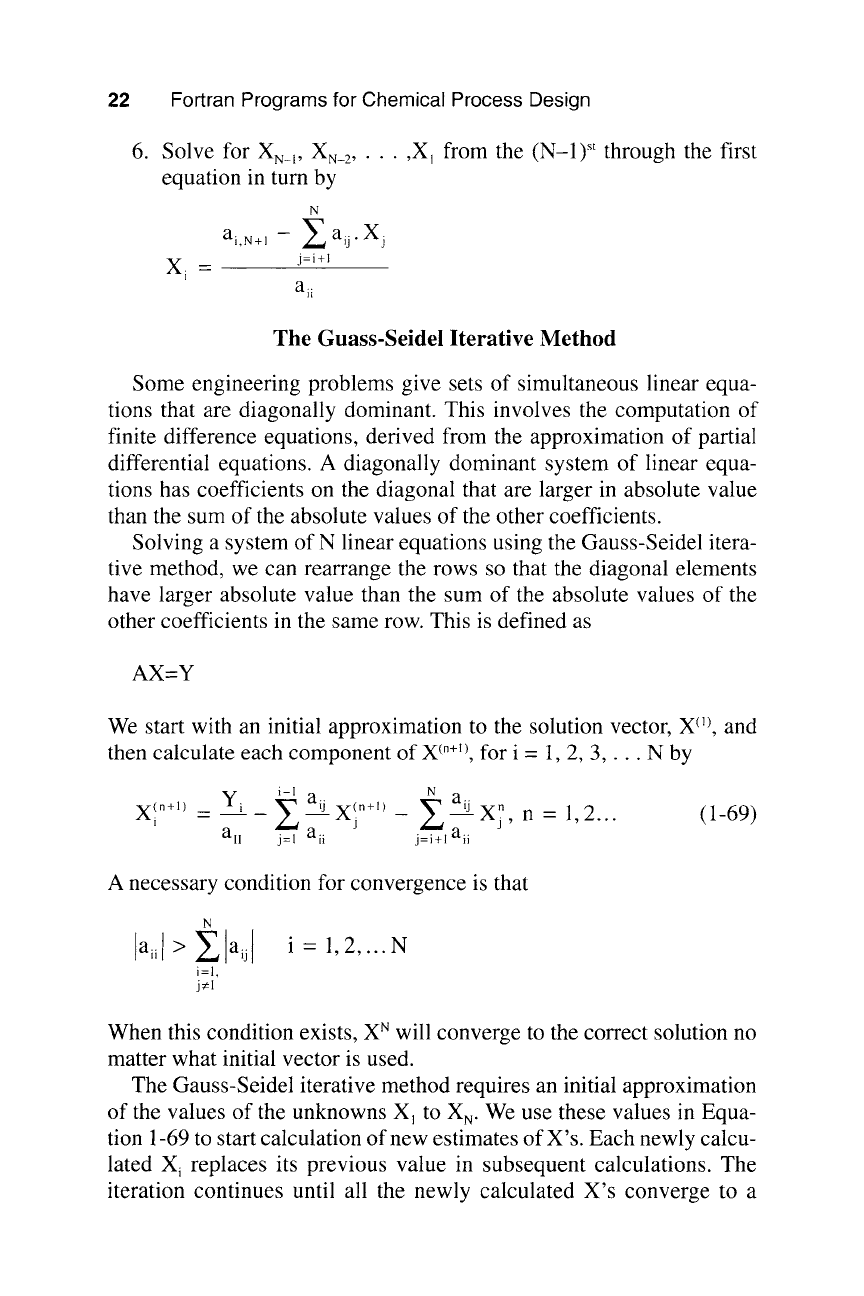
6. Solve for XN_ ~, XN_2,... ,X~ from the (N-l) ~ through the first
equation in turn by
X i =
i,N+l
N
~aij. Xj
j=i+l
aii
The Guass-Seidel Iterative Method
Some engineering problems give sets of simultaneous linear equa-
tions that are diagonally dominant. This involves the computation of
finite difference equations, derived from the approximation of partial
differential equations. A diagonally dominant system of linear equa-
tions has coefficients on the diagonal that are larger in absolute value
than the sum of the absolute values of the other coefficients.
Solving a system of N linear equations using the Gauss-Seidel itera-
tive method, we can rearrange the rows so that the diagonal elements
have larger absolute value than the sum of the absolute values of the
other coefficients in the same row. This is defined as
AX=Y
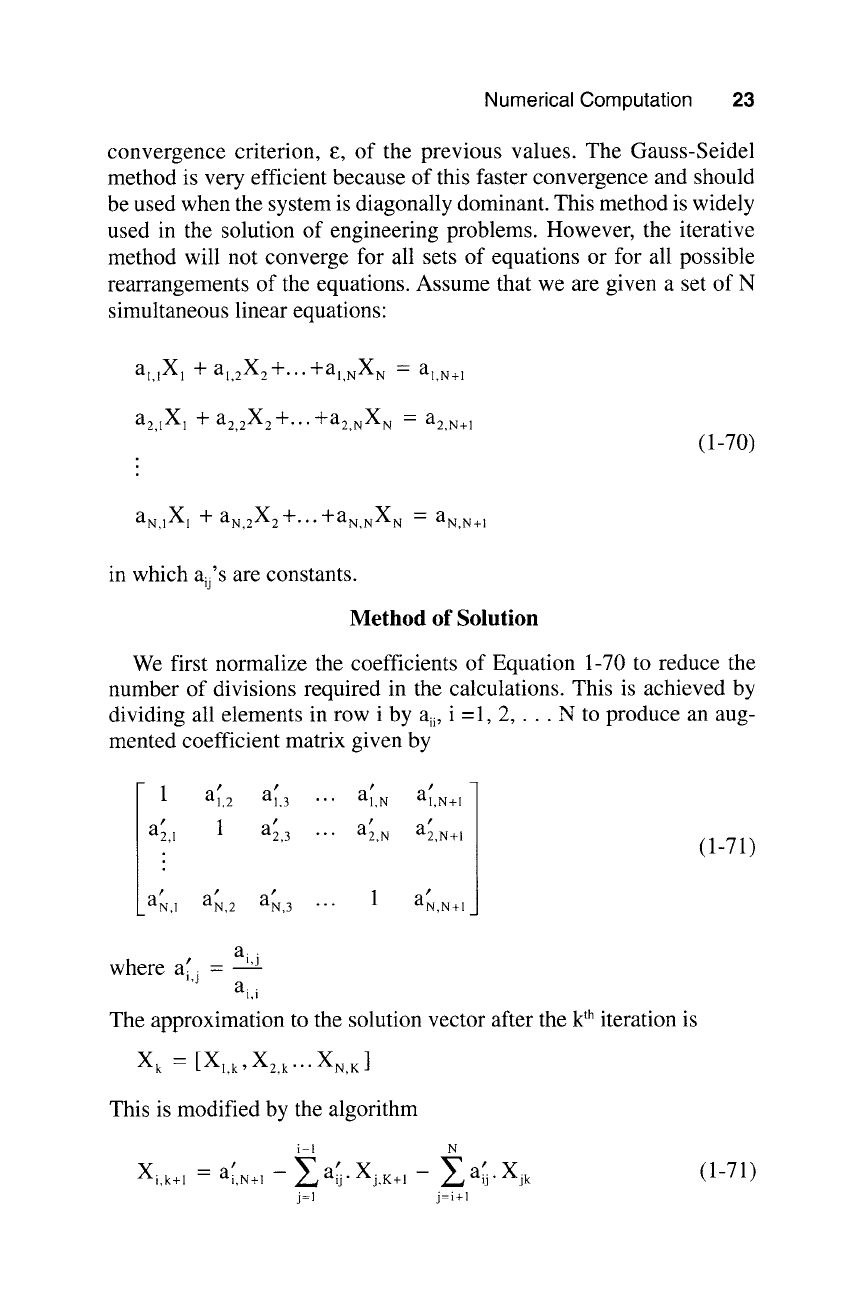
We start with an initial approximation to the solution vector, X ~), and
then calculate each component of X ~"+~), for i = 1, 2, 3,... N by
= -- - X 3 , n - 1, 2... (1-69)
ali j=l aii j=i+l aii
A necessary condition for convergence is that
N
laiif > Elai l
i=l,
j4:l
i- 1,2 .... N
When this condition exists, X N will converge to the correct solution no
matter what initial vector is used.
The Gauss-Seidel iterative method requires an initial approximation
of the values of the unknowns X~ to X N. We use these values in Equa-
tion 1-69 to start calculation of new estimates of X's. Each newly calcu-
lated X i replaces its previous value in subsequent calculations. The
iteration continues until all the newly calculated X's converge to a
Numerical Computation 23
convergence criterion, ~, of the previous values. The Gauss-Seidel
method is very efficient because of this faster convergence and should
be used when the system is diagonally dominant. This method is widely
used in the solution of engineering problems. However, the iterative
method will not converge for all sets of equations or for all possible
rearrangements of the equations. Assume that we are given a set of N
simultaneous linear equations:
a~,~X~
+ al,2X2 +... +al,NXN -- al,N+ 1
a2,1Xl
+ a2,2X2 +... +a2,NXN -- a2,N+ 1
(1-70)
aN,lXl -[- aN,2X2-1-...+aN,NXN -- aN,N+ l
in which %'s are constants.
Method of Solution
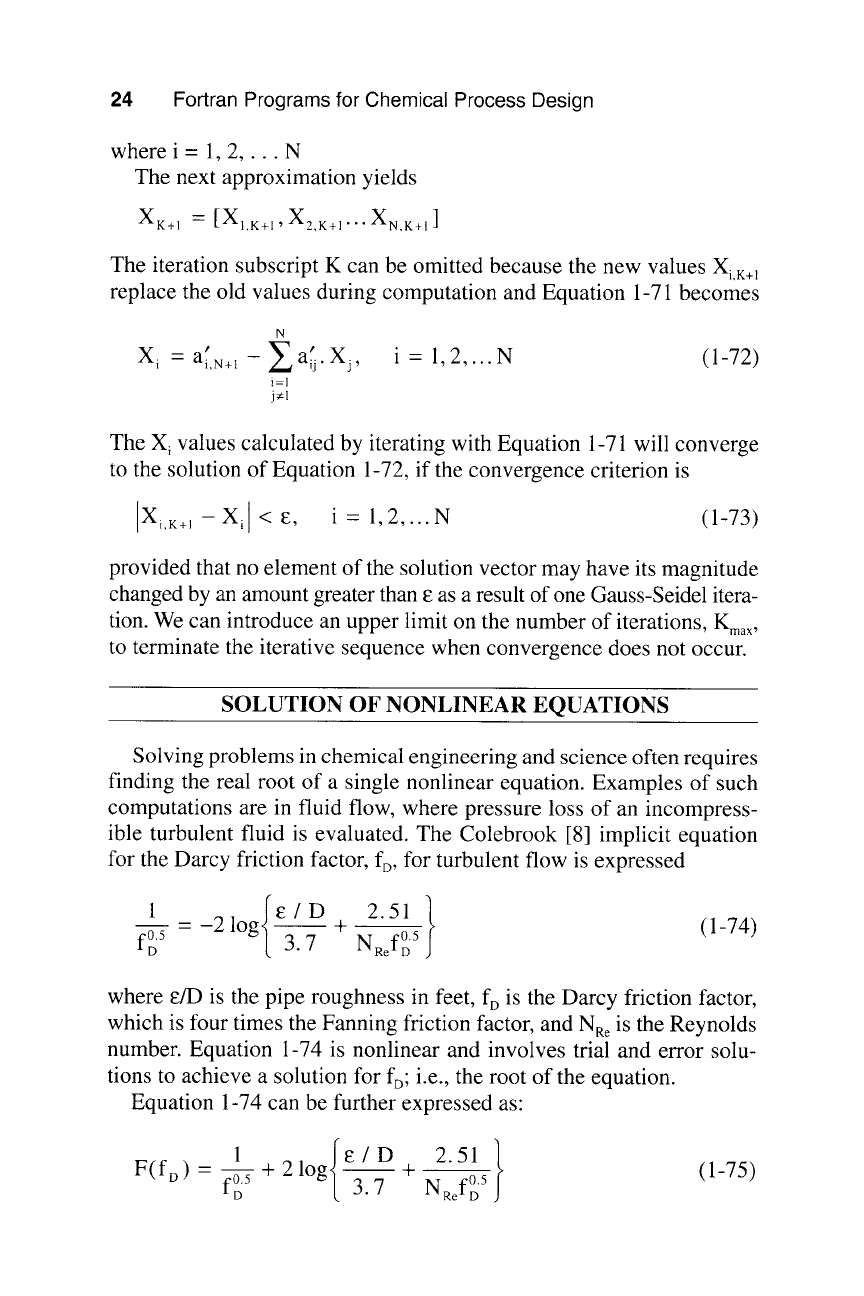
We first normalize the coefficients of Equation 1-70 to reduce the
number of divisions required in the calculations. This is achieved by
dividing all elements in row i by a,, i =1, 2,... N to produce an aug-
mented coefficient matrix given by
I I y I
al,2 al,3 ... al, N
a2,1
l a'
2,3 "" a2,N
k ' ' ' 1
aN,1 aN,2 aN,3 ...
a I
1,N+I
p
a2,N+l
P
aN,N+I
(1-71)
a..
where a' - l,j
l,j
ai,i
The approximation to the solution vector after the k th iteration is
Xk -- [Xl,k, X2,k... XN,K]
This is modified by the algorithm
i-1
Xi,k+ 1 -- ai,N+ 1 --
aij.
Xj,K+I
j=l
N
j=i+l
(1-71)
24
Fortran Programs for Chemical Process Design
where i- 1, 2,... N
The next approximation yields
XK+ 1 -- [X1,K+I, X2,K+I.-. XN,K+I]
The iteration subscript K can be omitted because the new values Xi,K+ ~
replace the old values during computation and Equation 1-71 becomes
-aP -E P"
Xi i,N+l
aij X 3, i - 1, 2,... N (1-72)
i=l
j~l
The X i values calculated by iterating with Equation 1-71 will converge
to the solution of Equation 1-72, if the convergence criterion is
Ix, - x,[ < c,
i - 1, 2 .... N (1-73)
provided that no element of the solution vector may have its magnitude
changed by an amount greater than e as a result of one Gauss-Seidel itera-
tion. We can introduce an upper limit on the number of iterations,
Kmax,
to terminate the iterative sequence when convergence does not occur.
SOLUTION OF NONLINEAR EQUATIONS
Solving problems in chemical engineering and science often requires
finding the real root of a single nonlinear equation. Examples of such
computations are in fluid flow, where pressure loss of an incompress-
ible turbulent fluid is evaluated. The Colebrook [8] implicit equation
for the Darcy friction factor, fD, for turbulent flow is expressed
1 {e/D 2.51 t
= + .... if5 (1-74)
f~5 -21og 317 NRef D
where e/D is the pipe roughness in feet, fD is the Darcy friction factor,
which is four times the Fanning friction factor, and NRe is the Reynolds
number. Equation 1-74 is nonlinear and involves trial and error solu-
tions to achieve a solution for fD; i.e., the root of the equation.
Equation 1-74 can be further expressed as:
1 {e/D 2.51}
F(fD ) - o.----5- + 2 log + -- -~.5 (1-75)
fD 317 NRef D
Numerical Computation
25
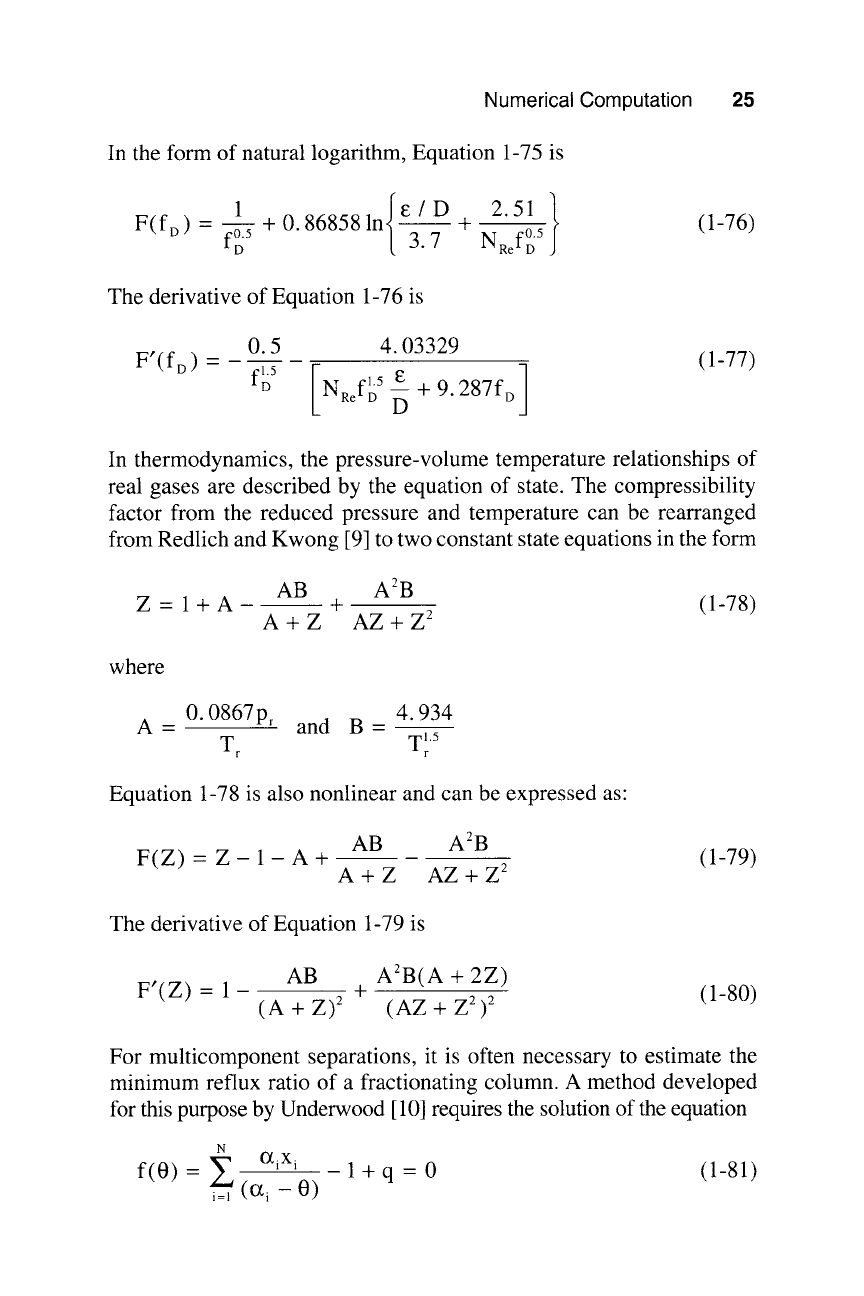
In the form of natural logarithm, Equation 1-75 is
1 {E/D
F(f D ) - ~ + 0.
86858 In
fD 317
2.51 }
+ -- -~5 (1-76)
NRefD
The derivative of Equation 1-76 is
O.5 4. O3329
- (1-77)
1.5[
e +9 287fD ]
F'(f~ ) fD NRef{~ 5 -~ .
In thermodynamics, the pressure-volume temperature relationships of
real gases are described by the equation of state. The compressibility
factor from the reduced pressure and temperature can be rearranged
from Redlich and Kwong [9] to two constant state equations in the form
AB
A2B
Z = 1 + A- + (1-78)
A+Z
AZ+Z 2
where
A - 0.0867Pr and B - 4.934
T r Tlr "5
Equation 1-78 is also nonlinear and can be expressed as:
F(Z)=Z-1-A+
AB
A2B
A+Z
AZ+Z 2
(1-79)
The derivative of Equation 1-79 is
AB A2B(A + 2Z)
F'(Z) -
1 - + Z (1-80)
(A + Z) 2 (AZ +
For multicomponent separations, it is often necessary to estimate the
minimum reflux ratio of a fractionating column. A method developed
for this purpose by Underwood [10] requires the solution of the equation
N
i~l ~iXi
--
1 + q - 0 (1-81)
f(0) -
.= (l~i _
0)
26
Fortran Programs for Chemical Process Design
where i- 1, 2,... N
and
N = the number of components in the feed
x i = the mole fraction of component i
~ = the relative volatility of component i
q = the thermal condition of the feed
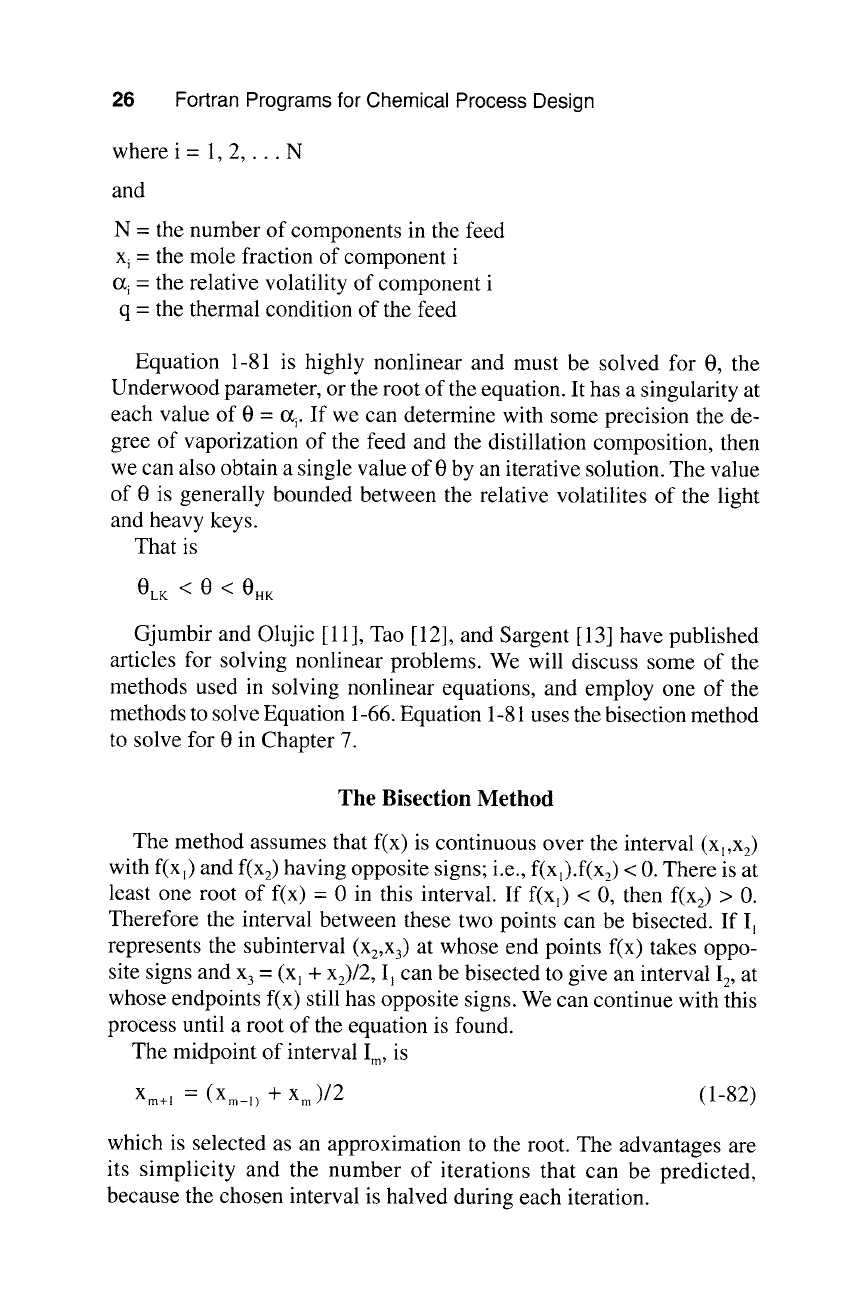
Equation 1-81 is highly nonlinear and must be solved for 0, the
Underwood parameter, or the root of the equation. It has a singularity at
each value of 0 = c~ i. If we can determine with some precision the de-
gree of vaporization of the feed and the distillation composition, then
we can also obtain a single value of 0 by an iterative solution. The value
of 0 is generally bounded between the relative volatilites of the light
and heavy keys.
That is
OLK < 0 < OHK
Gjumbir and Olujic [11], Tao [12], and Sargent [13] have published
articles for solving nonlinear problems. We will discuss some of the
methods used in solving nonlinear equations, and employ one of the
methods to solve Equation 1-66. Equation 1-81 uses the bisection method
to solve for 0 in Chapter 7.
The Bisection Method
The method assumes that f(x) is continuous over the interval
(XI,X2)
with f(xl) and f(x2) having opposite signs; i.e., f(x~).f(x2) < 0. There is at
least one root of f(x) = 0 in this interval. If f(x~) < 0, then f(x2) > 0.
Therefore the interval between these two points can be bisected. If I~
represents the subinterval (Xz,X3) at whose end points f(x) takes oppo-
site signs and x 3 - (x~
+ x2)/2 ,
I~ can be bisected to give an interval
I2, at
whose endpoints f(x) still has opposite signs. We can continue with this
process until a root of the equation is found.
The midpoint of interval
Im,
is
Xm+ 1 -- (Xm_l) "1-
Xm)/2
(1-82)
which is selected as an approximation to the root. The advantages are
its simplicity and the number of iterations that can be predicted,
because the chosen interval is halved during each iteration.