
Coker A.K. Fortran Programs for Chemical Process Design, Analysis, and Simulation
Подождите немного. Документ загружается.

Numerical Computation 37
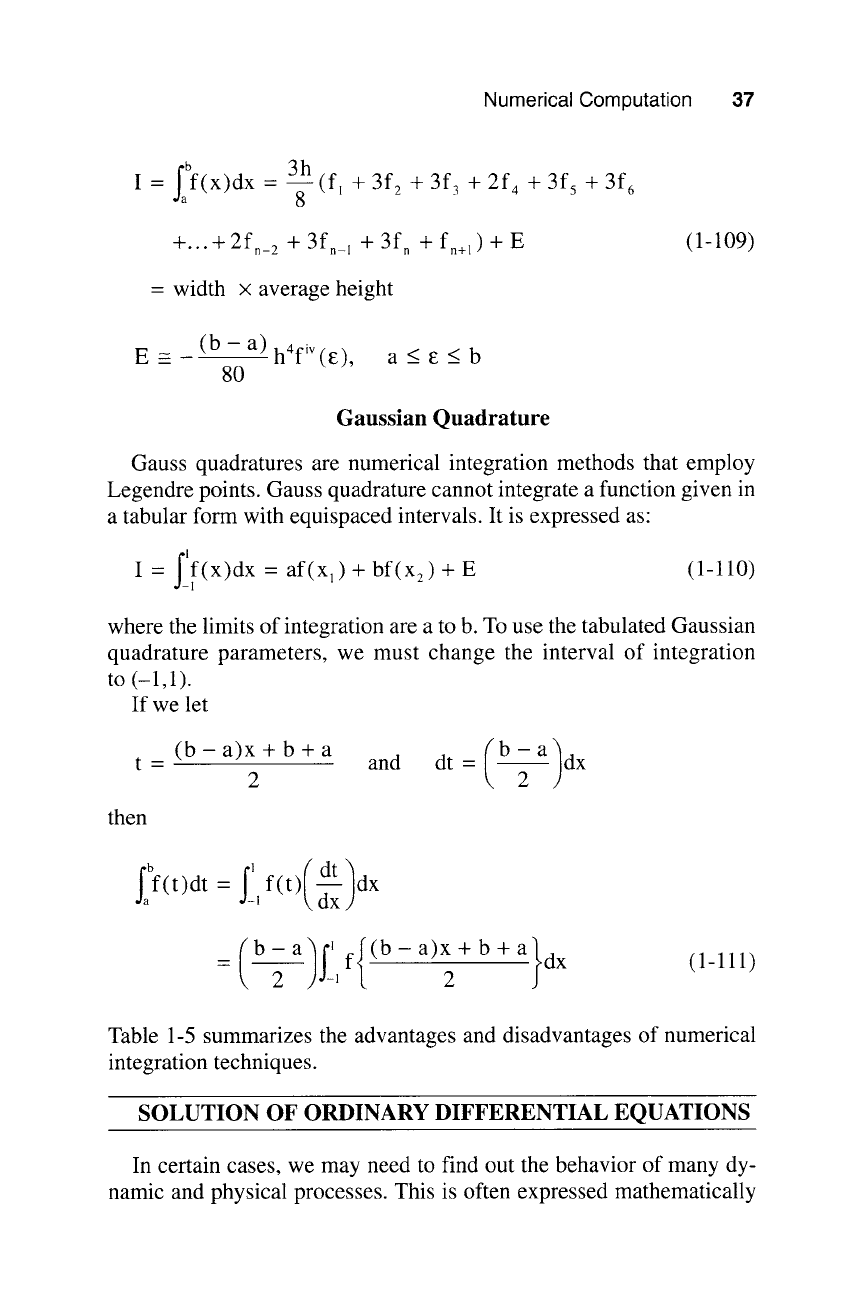
_ ['bf(x)dx _ 3h
I
Ja"
8
(fl + 3f2 + 3f3 + 2f4 + 3f5 + 3f6
+'" + 2fn-2 + 3fn-1 + 3fn + fn+l ) + E
(1-109)
= width x average height
E =- - (b - a)
h4fi v (E),
8O
a<e<b
Gaussian Quadrature
Gauss quadratures are numerical integration methods that employ
Legendre points. Gauss quadrature cannot integrate a function given in
a tabular form with equispaced intervals. It is expressed as"
I - IJf(x)dx - af(x 1)+ bf(x 2)+ E
(1-110)
where the limits of integration are a to b. To use the tabulated Gaussian
quadrature parameters, we must change the interval of integration
to (-1,1).
If we let
t- (b-a)x+b+a and
dt-(b-a) dx2
then
(t)dt- I_ f(t) -d-xx dx
2 1 2
(1-111)
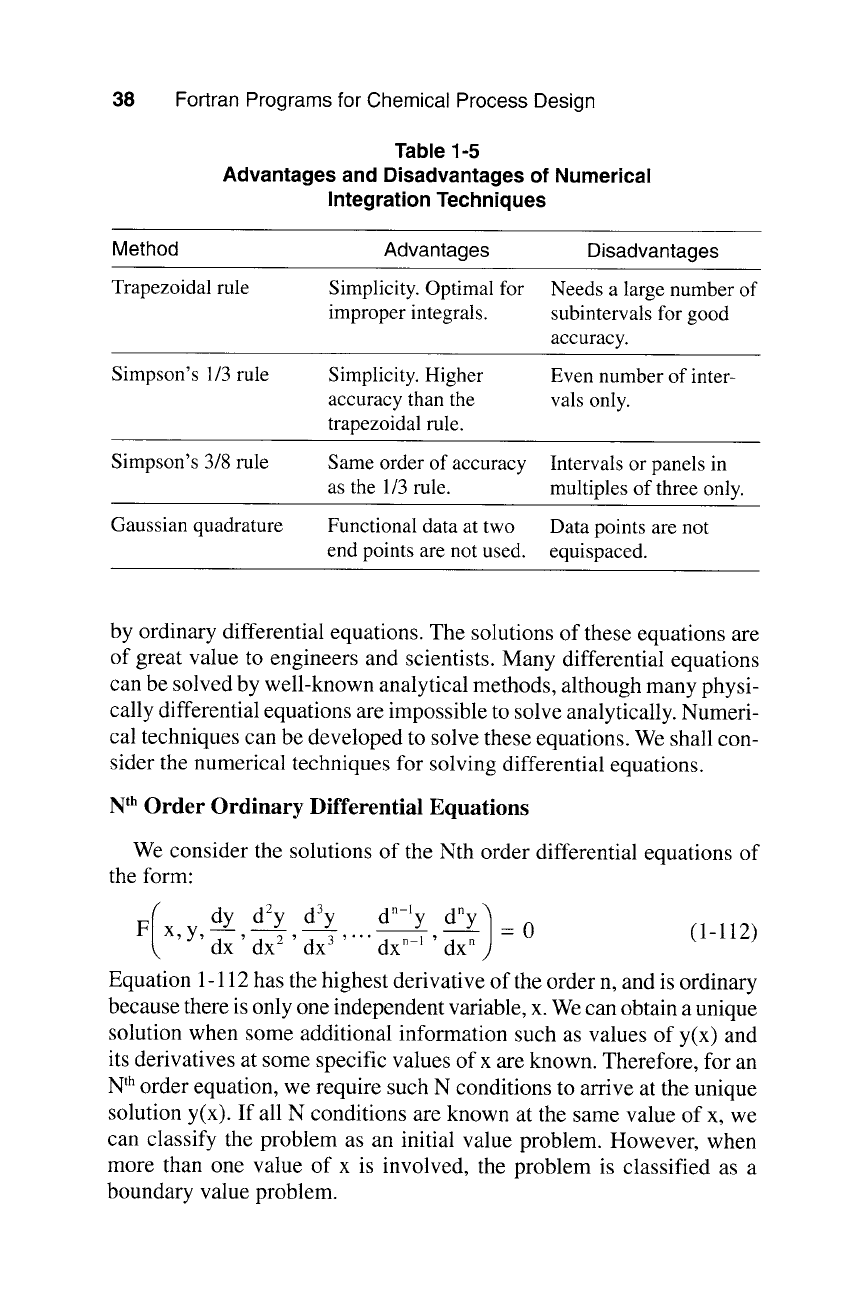
Table 1-5 summarizes the advantages and disadvantages of numerical
integration techniques.
SOLUTION OF ORDINARY DIFFERENTIAL EQUATIONS
In certain cases, we may need to find out the behavior of many dy-
namic and physical processes. This is often expressed mathematically
38
Fortran Programs for Chemical Process Design
Table 1-5
Advantages and Disadvantages of Numerical
Integration Techniques
Method
Advantages
Disadvantages
Trapezoidal rule
Simplicity. Optimal for
improper integrals.
Needs a large number of
subintervals for good
accuracy.
Simpson's 1/3 rule
Simplicity. Higher
accuracy than the
trapezoidal rule.
Even number of inter-
vals only.
Simpson's 3/8 rule
Same order of accuracy
as the 1/3 rule.
Intervals or panels in
multiples of three only.
Gaussian quadrature
Functional data at two
end points are not used.
Data points are not
equispaced.
by ordinary differential equations. The solutions of these equations are
of great value to engineers and scientists. Many differential equations
can be solved by well-known analytical methods, although many physi-
cally differential equations are impossible to solve analytically. Numeri-
cal techniques can be developed to solve these equations. We shall con-
sider the numerical techniques for solving differential equations.
N th
Order Ordinary Differential Equations
We consider the solutions of the Nth order differential equations of
the form:
( dy d2y d3y dn-'y any)
~,~ ..
- 0 (1-112)
F x,y, dx
dx 2 'dx 3 '" dxn-I 'dxn
Equation 1-112 has the highest derivative of the order n, and is ordinary
because there is only one independent variable, x. We can obtain a unique
solution when some additional information such as values of y(x) and
its derivatives at some specific values of x are known. Therefore, for an
N th
order equation, we require such N conditions to arrive at the unique
solution y(x). If all N conditions are known at the same value of x, we
can classify the problem as an initial value problem. However, when
more than one value of x is involved, the problem is classified as a
boundary value problem.
Numerical Computation 39
Solution of First Order Ordinary Differential Equations
We express a first order equation as:
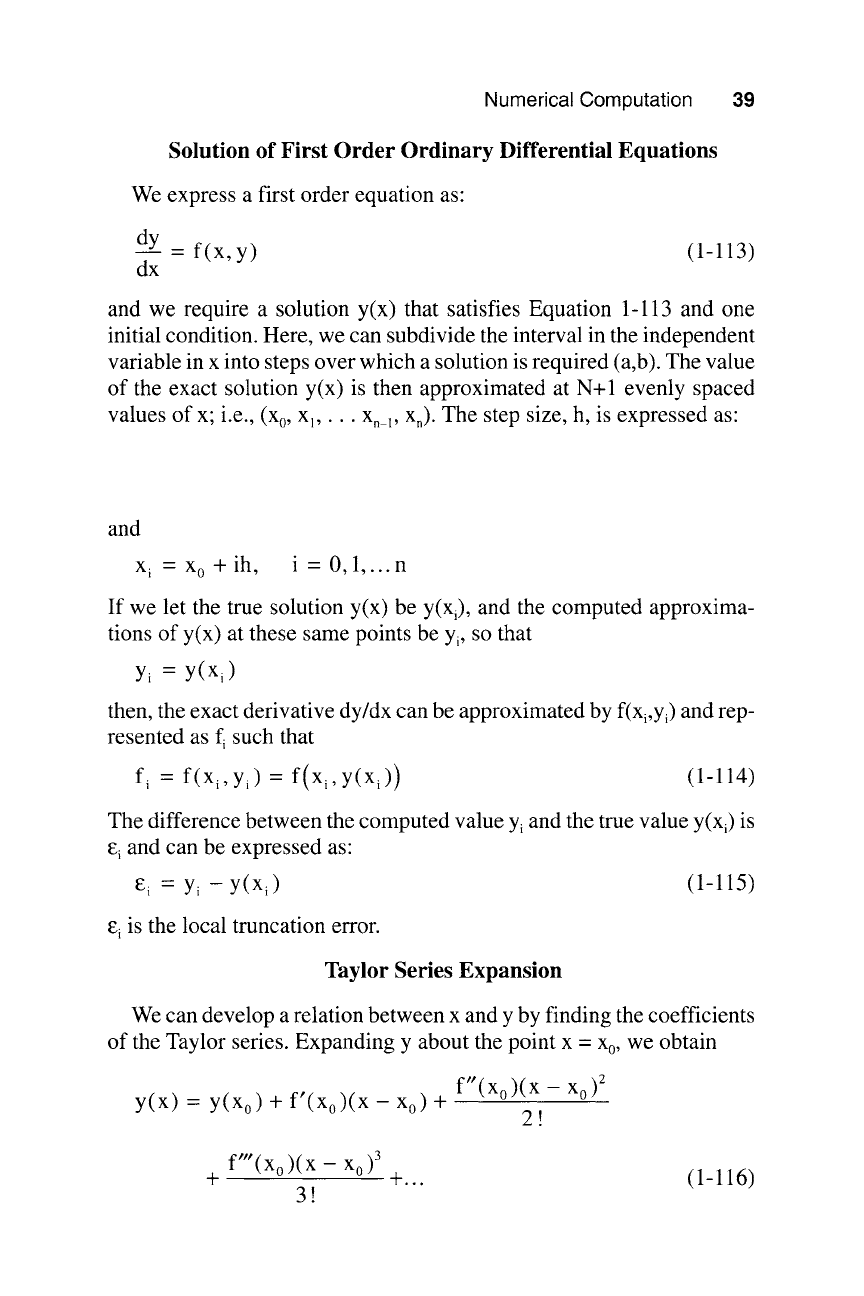
dy = f(x, y) (1-113)
dx
and we require a solution y(x) that satisfies Equation 1-113 and one
initial condition. Here, we can subdivide the interval in the independent
variable in x into steps over which a solution is required (a,b). The value
of the exact solution y(x) is then approximated at N+I evenly spaced
values of x; i.e., (x 0, Xl,... X,_l, Xn). The step size, h, is expressed as:
and
x i =x 0+ih, i=0,1 .... n
If we let the true solution y(x) be y(xi), and the computed approxima-
tions of y(x) at these same points be Yi, so that
Yi = y(xi)
then, the exact derivative dy/dx can be approximated by f(xi,Yi) and rep-
resented as fi such that
fi -- f(xi,
Y~)
- f(xi, Y(Xi))
(1-114)
The difference between the computed value Yi and the true value
Y(Xi)
is
~i
and can be expressed as:
~i =
Yi - Y(Xi) (1-115)
ei is the local truncation error.
Taylor Series Expansion
We can develop a relation between x and y by finding the coefficients
of the Taylor series. Expanding y about the point x - x 0, we obtain
y(x) = y(x 0) + f'(Xo)(X - x0) +
f"(x o )(x - x o )2
2!
f"(x0)(x - x0)3
+ +... (1-116)
3!
40
Fortran Programs for Chemical Process Design
d
where f'(x) represents f (x)
dx
If we let x- x 0 - h
We can express the series as"
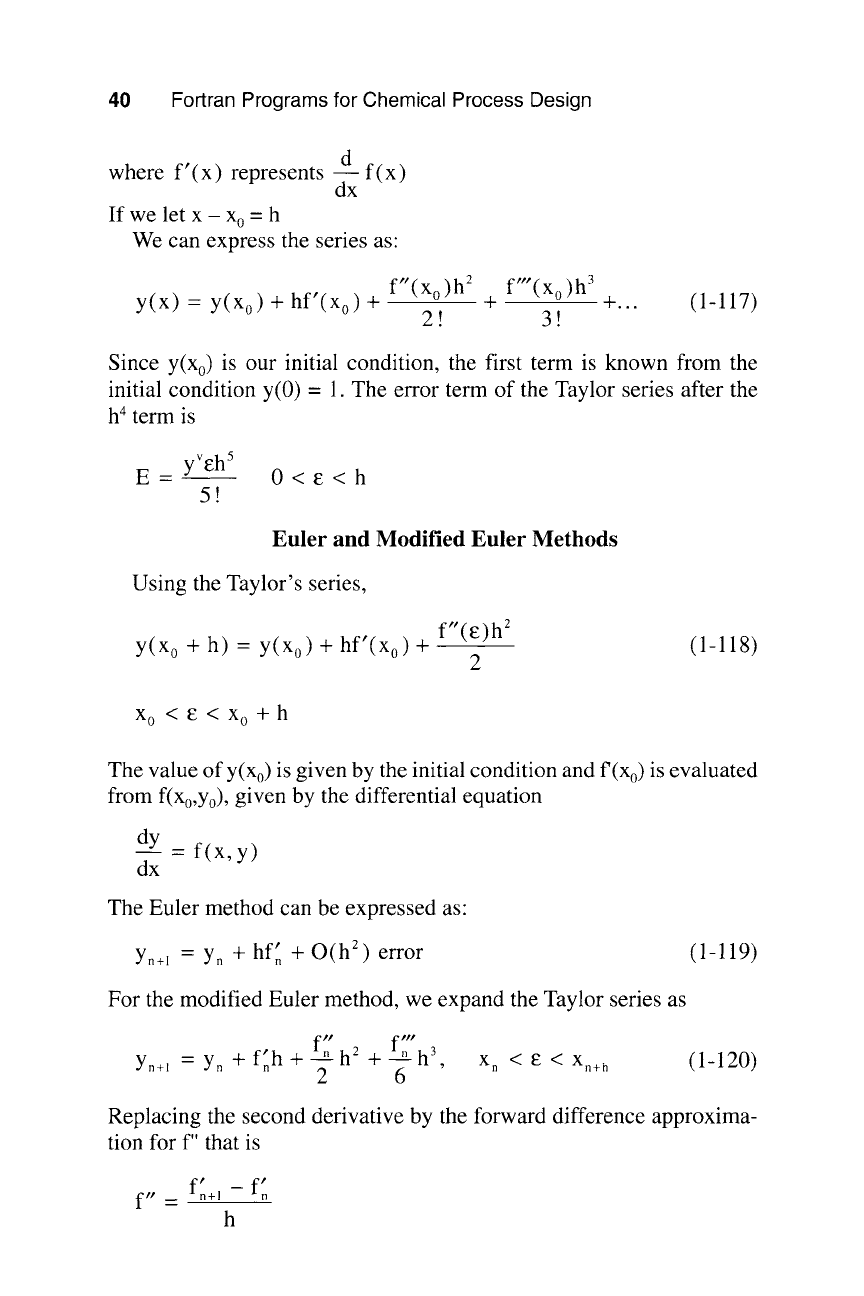
y(x) - Y(Xo) + hf'(Xo) +
f"(xo)h 2 f'(xo)h 3
+ +... (1-117)
2! 3!
Since y(x0) is our initial condition, the first term is known from the
initial condition y(0) - 1. The error term of the Taylor series after the
h 4 term is
E- YVl~h5
5~
0<~;<h
Euler and Modified Euler Methods
Using the Taylor's series,
y(x o + h) - Y(Xo) + hf'(Xo) +
f"(g)h 2
(1-118)
x o < e < x o + h
The value of y(Xo) is given by the initial condition and r(Xo) is evaluated
from f(xo,Yo), given by the differential equation
dy = f(x, y)
dx
The Euler method can be expressed as:
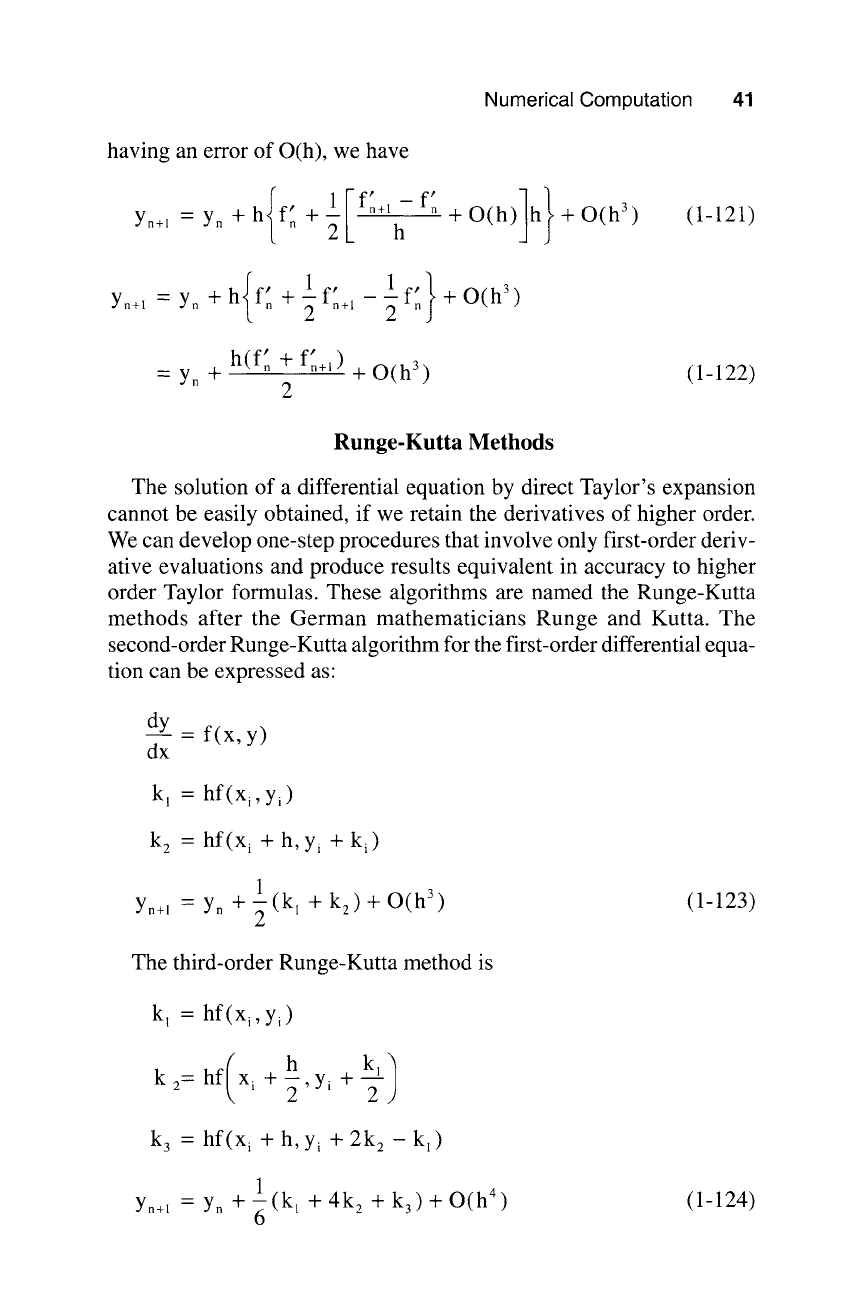
Yn+l
--
Y n + hf~ + O (h2) error
(1-119)
For the modified Euler method, we expand the Taylor series as
Yn+l -- Yn
+ f;h + ~ f"
h 2 + ~f'n"h3,
X n
< e < Xn+ h (1-120)
2 6
Replacing the second derivative by the forward difference approxima-
tion for f" that is
f PP
fp p
n+l ~
fn
Numerical Computation 41
having an error of O(h), we have
1 [ f' - f'
n+l n
Yn+l -- Yn
+ h f'n + ~ h
+ O h lh) +
1
Yn+l --
Y + h f'n + ~ f'
n n+l
1 } h 3
2 f" +O( )
(1-121)
h(f' n + f'+.) h 3
: Yn + +
O( ) (1-122)
2
Runge-Kutta Methods
The solution of a differential equation by direct Taylor's expansion
cannot be easily obtained, if we retain the derivatives of higher order.
We can develop one-step procedures that involve only first-order deriv-
ative evaluations and produce results equivalent in accuracy to higher
order Taylor formulas. These algorithms are named the Runge-Kutta
methods after the German mathematicians Runge and Kutta. The
second-order Runge-Kutta algorithm for the first-order differential equa-
tion can be expressed as:
dy = f(x, y)
dx
kl = hf(xi, Yi)
k 2
= hf(x i +
h,
Yi + ki)
1
h3
Yn+l -- Yn + ~
(k~
+ k 2) + O( )
The third-order Runge-Kutta method is
(1-123)
kl
= hf(xi, Yi)
h
kl)
k2=hf x i+-~,yi+-~-
k 3 = hf(x i +
h, Yi
+ 2k2 - kl )
1
Yn+l --
Y. + ~
(kl +
4k2
+ k3) + O(h4)
(1-124)
42
Fortran Programs for Chemical Process Design
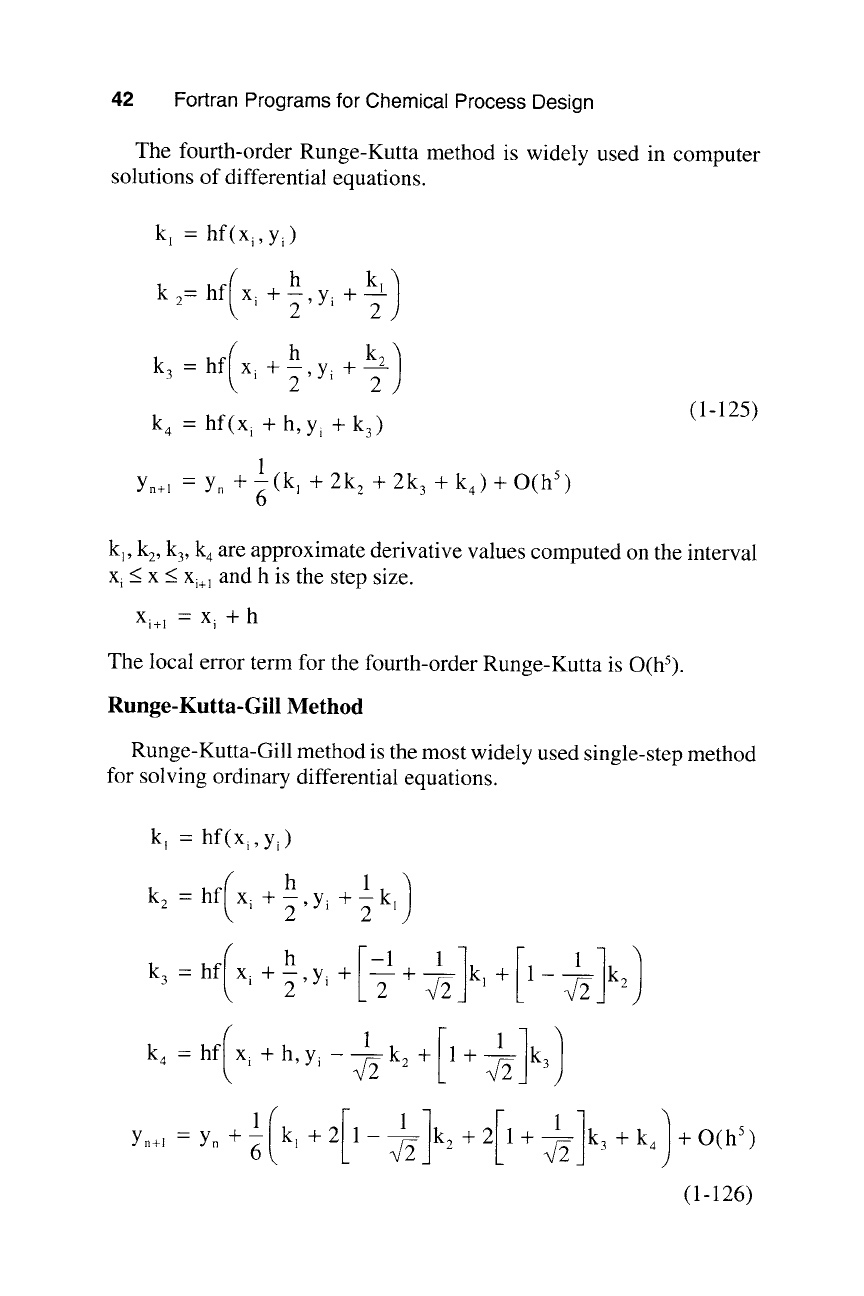
The fourth-order Runge-Kutta method is widely used in computer
solutions of differential equations.
kl
= hf(xi, Yi)
/ h k /
k z=hf x i +-~-,Yi +-~
( h _k~)
k 3 -hf x i +~-,yi +
(1-125)
k 4 =
hf(x~ + h, y~
+ k3)
1
Yn+l -
Yn + ~(k~ + 2k 2 + 2k 3
+ k4) --I-- O(h 5 )
k l, k 2, k 3,
k 4 are approximate derivative values computed on the interval
x i _< x _< xi+ ~ and h is the step size.
xi+ ~ = x i + h
The local error term for the fourth-order Runge-Kutta is O(hS).
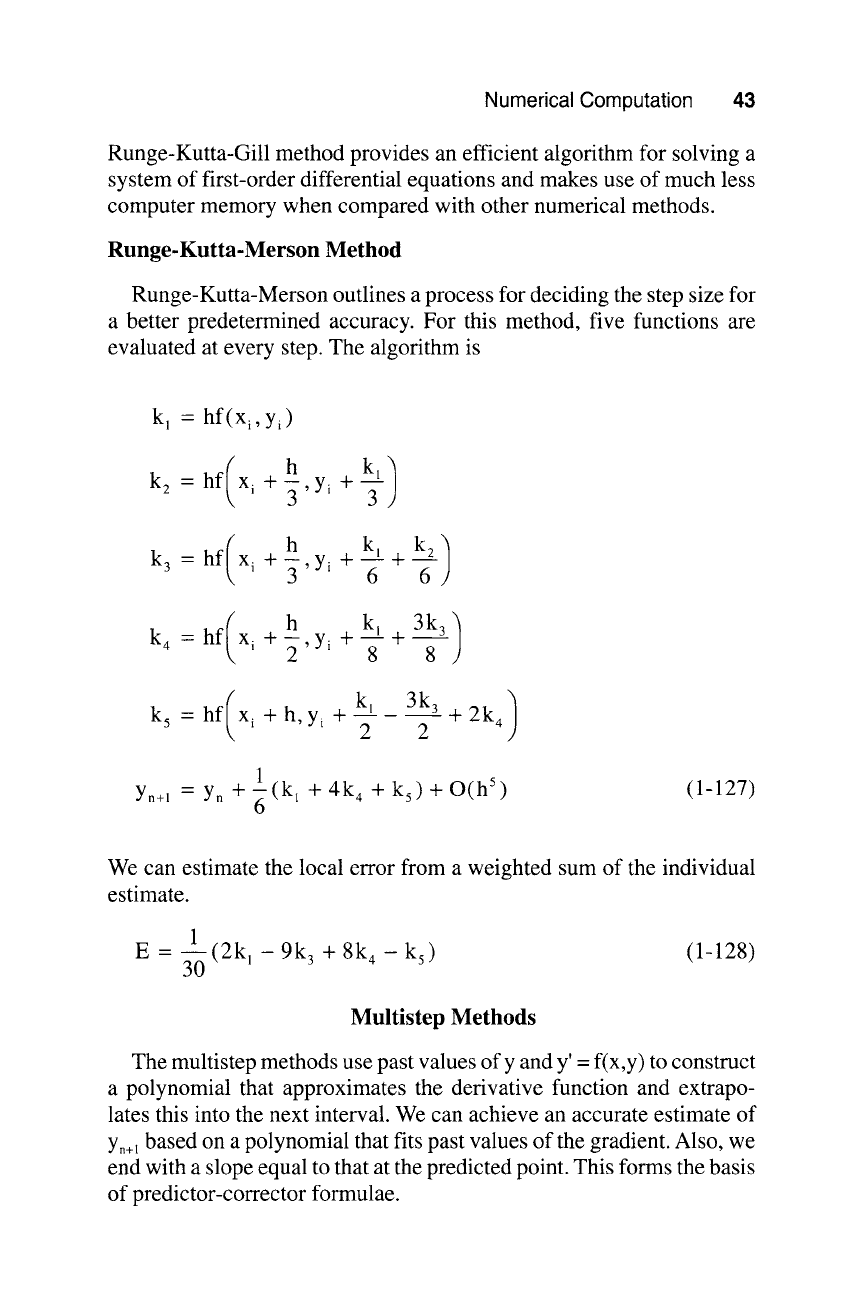
Runge-Kutta-Gill Method
Runge-Kutta-Gill method is the most widely used single-step method
for solving ordinary differential equations.
kl = hf(xi, Yi)
/ h 1 /
k 2 - hf x i +~,yi +~-kl
(
+ ~, yih I~ +~-1] I 1 ] )
k 3 -hf X i + kl + 1---~- k 2
k 4 -
hf x i + h, Yi ~/~ k2 + 1
+ 3
Yn+l
--
Yn +~
k~ + 2 1- k 2 + 2 1 +
k 3
+k 4
+O(h
(1-126)
Numerical Computation 43
Runge-Kutta-Gill method provides an efficient algorithm for solving a
system of first-order differential equations and makes use of much less
computer memory when compared with other numerical methods.
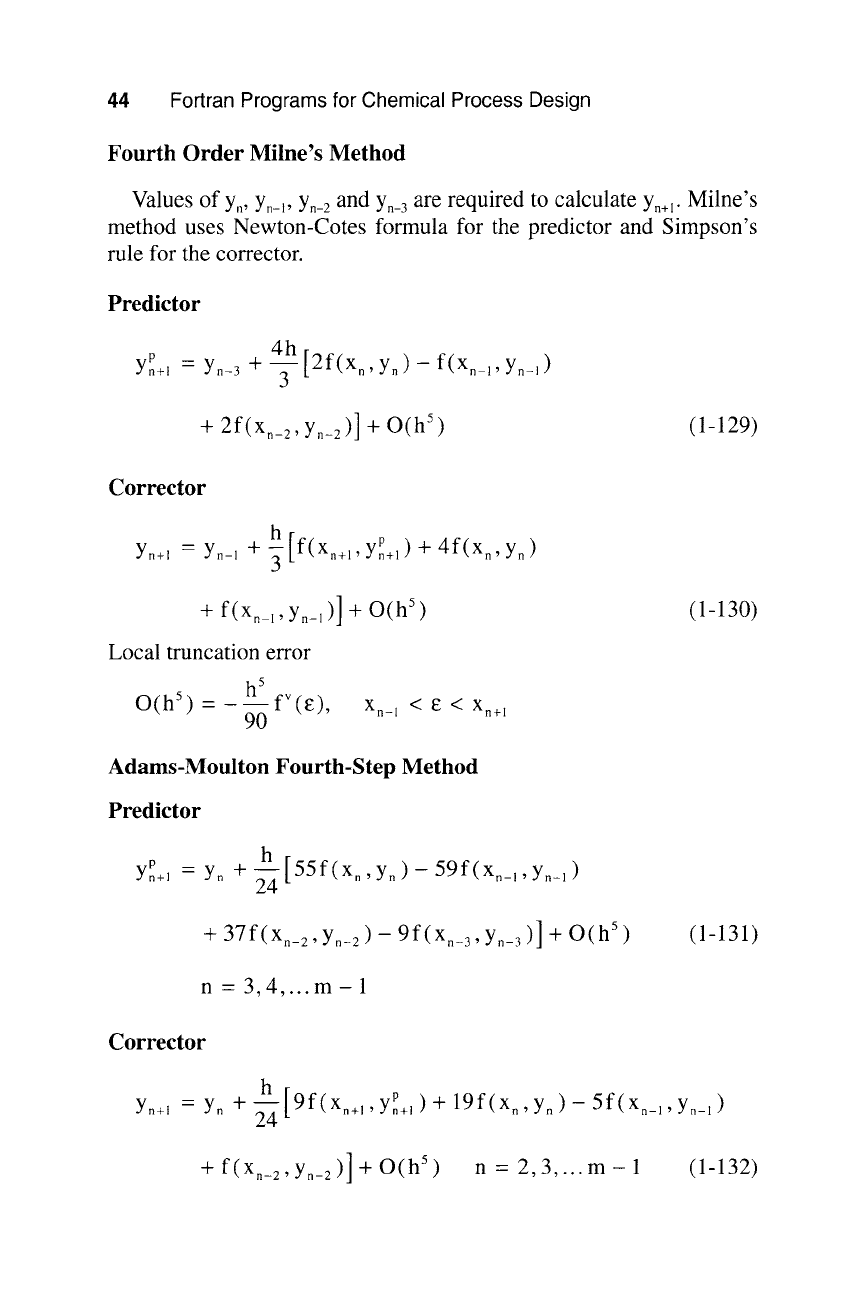
Runge-Kutta-Merson Method
Runge-Kutta-Merson outlines a process for deciding the step size for
a better predetermined accuracy. For this method, five functions are
evaluated at every step. The algorithm is
kl = hf(xi, Yi)
h
kl)
k 2 -hf x i+~-,yi +-~
k 3 -
hf(
h k 1 k 2 "~
Xi
+~,Yi +~+~6
6
)
h k I 3k3)
k 4 -
hf
X i +
-2-, Yi -I- ~ +
2
8 8
k 3k 3 )
k 5 - hf
X i "l"
h Yi 4 1 F 2k 4
' 2 2
1
Yn+l -- Yn + ~(kl + 4k4 +
ks) + O(hS)
(1-127)
We can estimate the local error from a weighted sum of the individual
estimate.
E- 1
30 (2k, - 9k 3
+ 8k 4 - k5)
(1-128)
Multistep Methods
The multistep methods use past values of y and y'= f(x,y) to construct
a polynomial that approximates the derivative function and extrapo-
lates this into the next interval. We can achieve an accurate estimate of
Yn+~ based on a polynomial that fits past values of the gradient. Also, we
end with a slope equal to that at the predicted point. This forms the basis
of predictor-corrector formulae.
44
Fortran Programs for Chemical Process Design
Fourth Order Milne's Method
Values of Yn, Yn-l, Yn-2 and
Yn-3
are required to calculate Yn+l" Milne's
method uses Newton-Cotes formula for the predictor and Simpson's
rule for the corrector.
Predictor
4h
P __ _1_
[2f(x n ) -- f(Xn_ , )
Y.+l Yn-3
-7- ,Y. 'Yn-I
3
+ 2f(Xn-2' Yn-2 )] +
O(hS)
(1-129)
Corrector
h[ P
)+4f(x
Yn)
Yn+, -- Yn-, + ~- f(Xn+l' Yn+, n'
+ f(Xn-l, Yn-l)] + O(hS)
Local truncation error
h 5
O(h 5) _ __ fv (e), Xn_ , < I~ <
Xn+ 1
9O
(1-130)
Adams-Moulton Fourth-Step Method
Predictor
p h
Yn+l --
Yn
+
-2-7 [55f(Xn, Yn ) - 59f(x._,, Yn-1 )
Z4 ~
+ 37f(x,_:, Yn-2 ) -- 9f(Xn-3'
Yn-3 )] + O( h5 )
(1-131)
n=3,4 .... m-1
Corrector
h
Y.+, - Yn + ~- [9 f(Xn+, ' YPn+,
) + 19f(Xn ,
Yn
) -
5f(Xn-1, Yn-, )
+ f(x._:,
Yn-2 )] -!-
O(h 5 )
n = 2,3 .... m- 1 (1-132)
Numerical Computation 45
Local truncation error
19
O(h 5 ) - hSf v (e), Xn_ 2 < e < X,+ 1
720
The predictor calls for four previous values in Adams-Moulton and
Milne's algorithms. We obtain these by the fourth-order Runge-Kutta
method. Also, we can reduce the step size to improve the accuracy of
these methods. Milne's method is unstable in certain cases because the
errors do not approach zero as we reduce the step size, h. Because of
this instability, the method of Adams-Moulton is more widely used.
The primary advantage of the single-step methods is that they are
self starting. We can also vary the step sizes. In contrast, the multistep
methods require a single-step formula to start the calculations. Step size
variation is difficult. However, the efficiency of both the Milne's and
Adams-Moulton methods is about twice that of the single-steps meth-
ods. We need two function evaluations per step in the former while four
or five are required with the single step.
PROBLEMS AND SOLUTIONS
Problem
1-1
An experimental result in a liquid mixing experiment for the power cor-
relation using a pitched-blade turbine shows that in the viscous regime, the
power number is related to the Reynolds number by the following data:
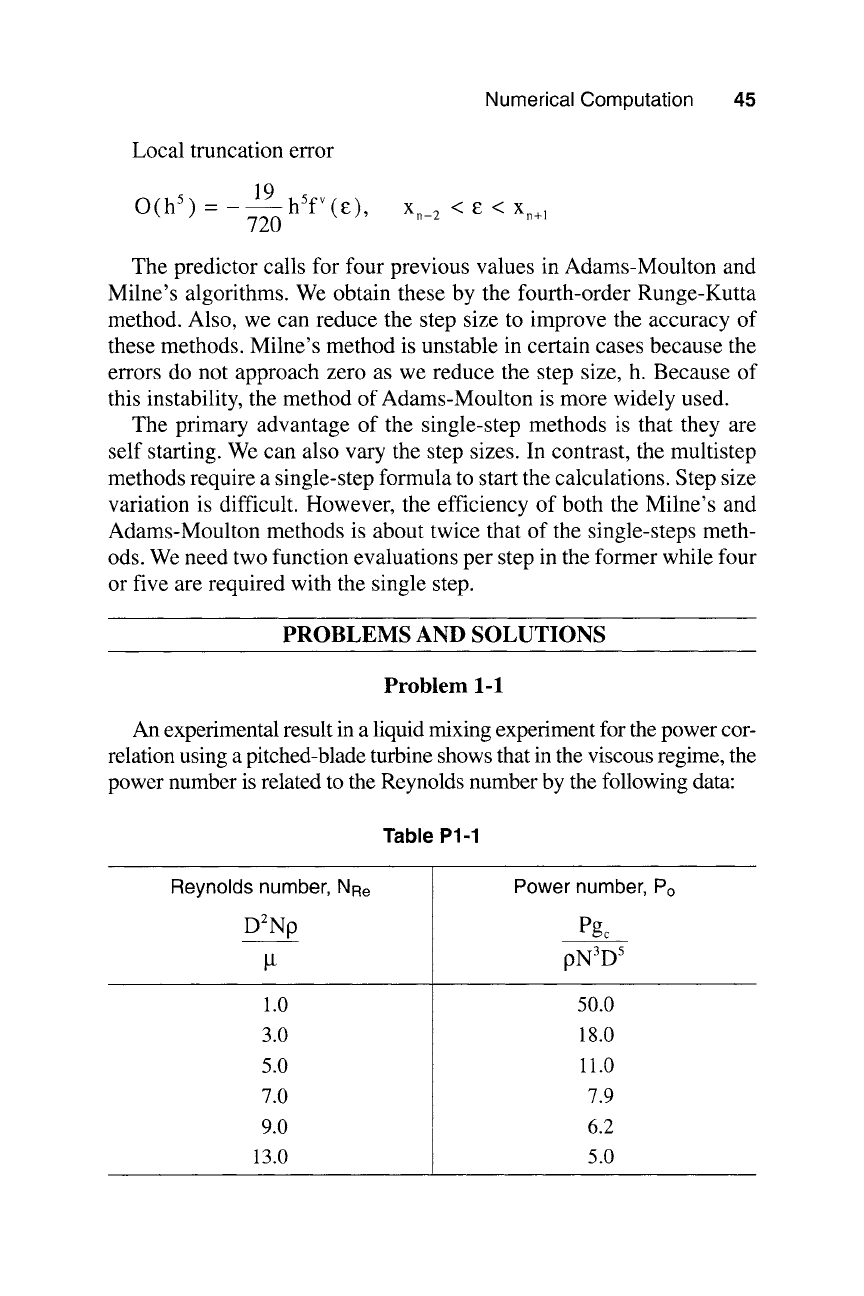
Table P1-1
Reynolds number, NRe
D2Np
g
1.0
3.0
5.0
7.0
9.0
13.0
Power number, Po
Pgc
pN3D 5
50.0
18.0
11.0
7.9
6.2
5.0
46
Fortran Programs for Chemical Process Design
Use the regression analysis to determine the best fit for the data.
Solution
Program PROG 11 .FOR determines the slope, intercept, and correla-
tion coefficient for the above experimental data. The results show that
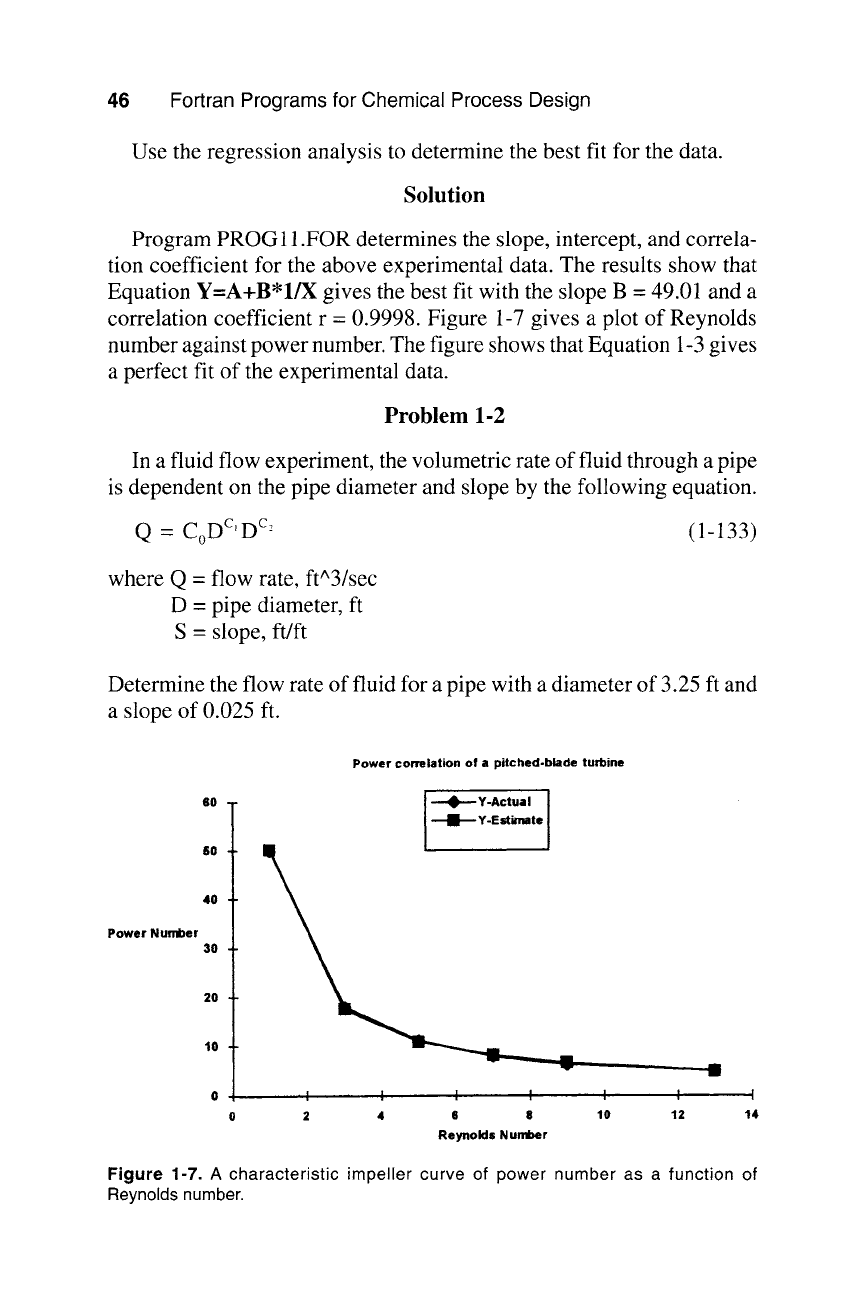
Equation Y=A+B*I/X gives the best fit with the slope B - 49.01 and a
correlation coefficient r = 0.9998. Figure 1-7 gives a plot of Reynolds
number against power number. The figure shows that Equation 1-3 gives
a perfect fit of the experimental data.
Problem 1-2
In a fluid flow experiment, the volumetric rate of fluid through a pipe
is dependent on the pipe diameter and slope by the following equation.
Q - CoDC'D c~ (1-133)
where Q- flow rate, ft^3/sec
D - pipe diameter, ft
S - slope, ft/ft
Determine the flow rate of fluid for a pipe with a diameter of 3.25 ft and
a slope of 0.025 ft.
Power correlation
of a
pitched.blade turbine
Power
Number
60
50
40
3O
20
10
Y-Actual
~ Y-Estimate
0 2 4 6 8 10 12 14
Reynolds Number
Figure 1-7. A characteristic impeller curve of power number as a function of
Reynolds number.