
Coker A.K. Fortran Programs for Chemical Process Design, Analysis, and Simulation
Подождите немного. Документ загружается.

Numerical Computation 27
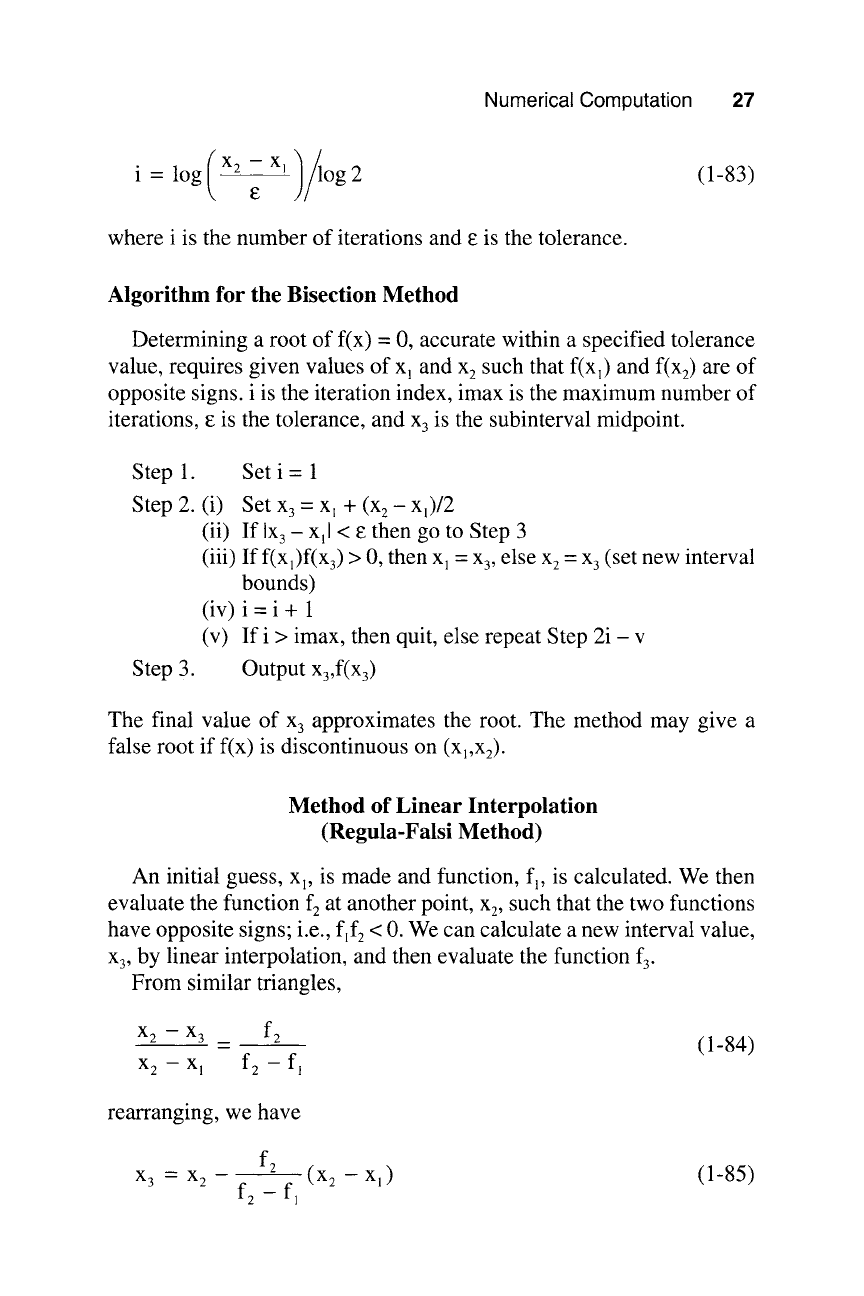
i
where i is the number of iterations and e is the tolerance.
Algorithm for the Bisection Method
Determining a root of f(x) = 0, accurate within a specified tolerance
value, requires given values of x 1 and x 2 such that f(x~) and f(x 2) are of
opposite signs, i is the iteration index, imax is the maximum number of
iterations, e is the tolerance, and x 3 is the subinterval midpoint.
Step 1.
Step 2. (i)
Set i = 1
Set x 3 = x~ + (x 2 - x~)/2
(ii) If
Ix 3 -
xll <
E
then go to Step 3
(iii) If f(xl)f(x3) > O, then x 1 = x 3, else x 2 = x 3 (set new interval
bounds)
(iv) i-i + 1
(v) If i > imax, then quit, else repeat Step 2i - v
Step 3.
Output x3,ffx3)
The final value of x 3 approximates the root. The method may give a
false root if fix) is discontinuous on (x~,x2).
Method of Linear Interpolation
(Regula-Falsi Method)
An initial guess, x l, is made and function, fl, is calculated. We then
evaluate the function f2 at another point, x 2, such that the two functions
have opposite signs; i.e., flf2 < 0. We can calculate a new interval value,
x 3, by linear interpolation, and then evaluate the function f3.
From similar triangles,
X2 -- X3 _
f2
m
X2 -- Xl
f2 -- f~
(1-84)
rearranging, we have
f2
x3 - x2 - ~ (x2 - Xl) (1-85)
f2 - fl
28 Fortran Programs for Chemical Process Design
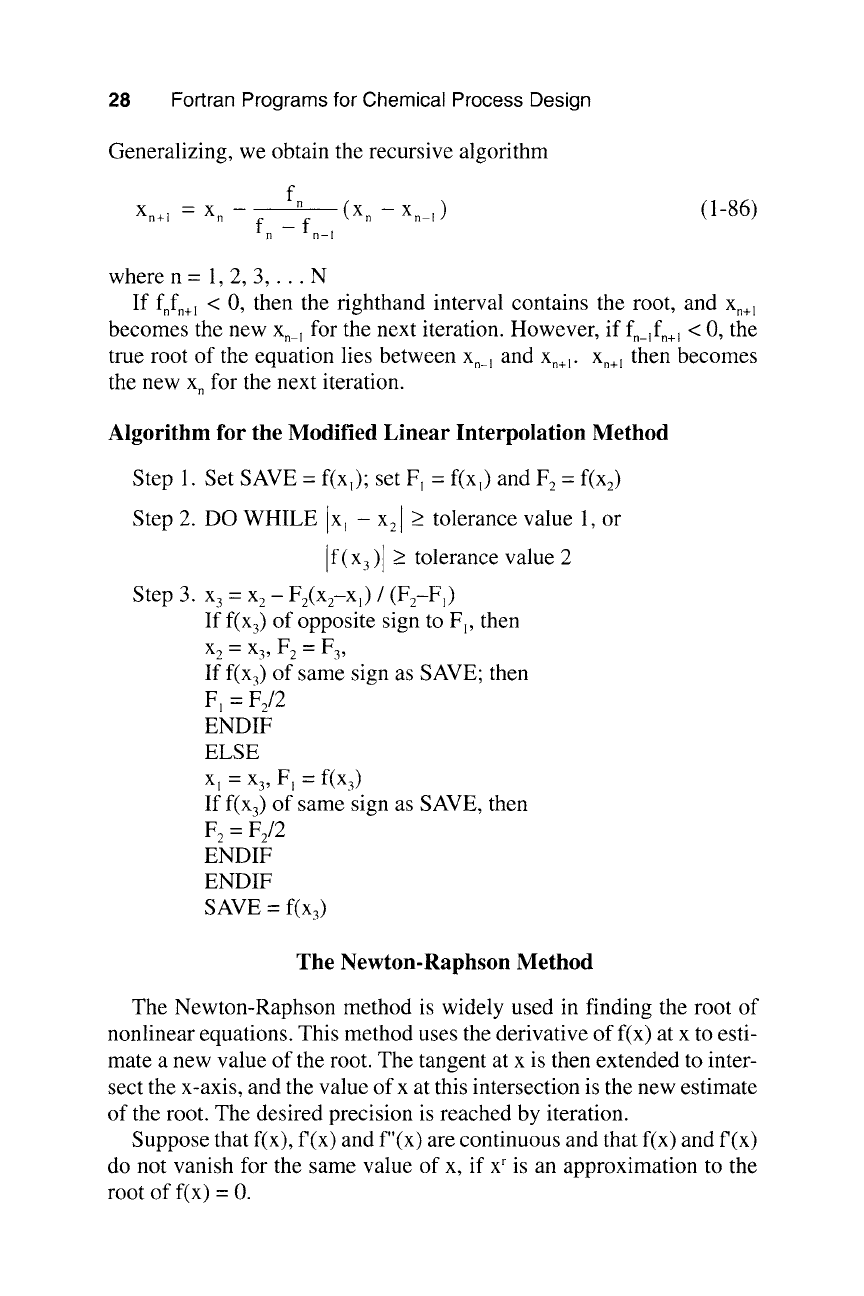
Generalizing, we obtain the recursive algorithm
f
Xn+l __ Xn __ n (X n -- Xn_l) (1-86)
f. - f.-i
where n = 1, 2, 3,... N
If fnf,+~ < 0, then the righthand interval contains the root, and x,+~
becomes the new Xn_ ~ for the next iteration. However, if fn_~f,+~ < 0, the
true root of the equation lies between x._~ and Xn+ ~. Xn+ ~ then becomes
the new x n for the next iteration.
Algorithm for the Modified Linear Interpolation Method
Step 1. Set SAVE = f(x~); set F~ = f(x~) and F 2 = f(x2)
Step 2. DO WHILE Ix~ - x21 > tolerance value 1, or
If(x 3)[ > tolerance value 2
Step 3. x 3 = x 2 - Fz(xz-X ~) / (F2-F ~)
If f(x3) of opposite sign to F~, then
x 2 = x 3, F2 = F 3,
If f(x3) of same sign as SAVE; then
F l = F2/2
ENDIF
ELSE
X, =X 3,F 1 =f(x3)
If f(x3) of same sign as SAVE, then
F 2 = F2/2
ENDIF
ENDIF
SAVE = f(x3)
The Newton-Raphson Method
The Newton-Raphson method is widely used in finding the root of
nonlinear equations. This method uses the derivative of f(x) at x to esti-
mate a new value of the root. The tangent at x is then extended to inter-
sect the x-axis, and the value of x at this intersection is the new estimate
of the root. The desired precision is reached by iteration.
Suppose that f(x), f(x) and r'(x) are continuous and that f(x) and r(x)
do not vanish for the same value of x, if x r is an approximation to the
root of f(x) = 0.
Numerical Computation 29
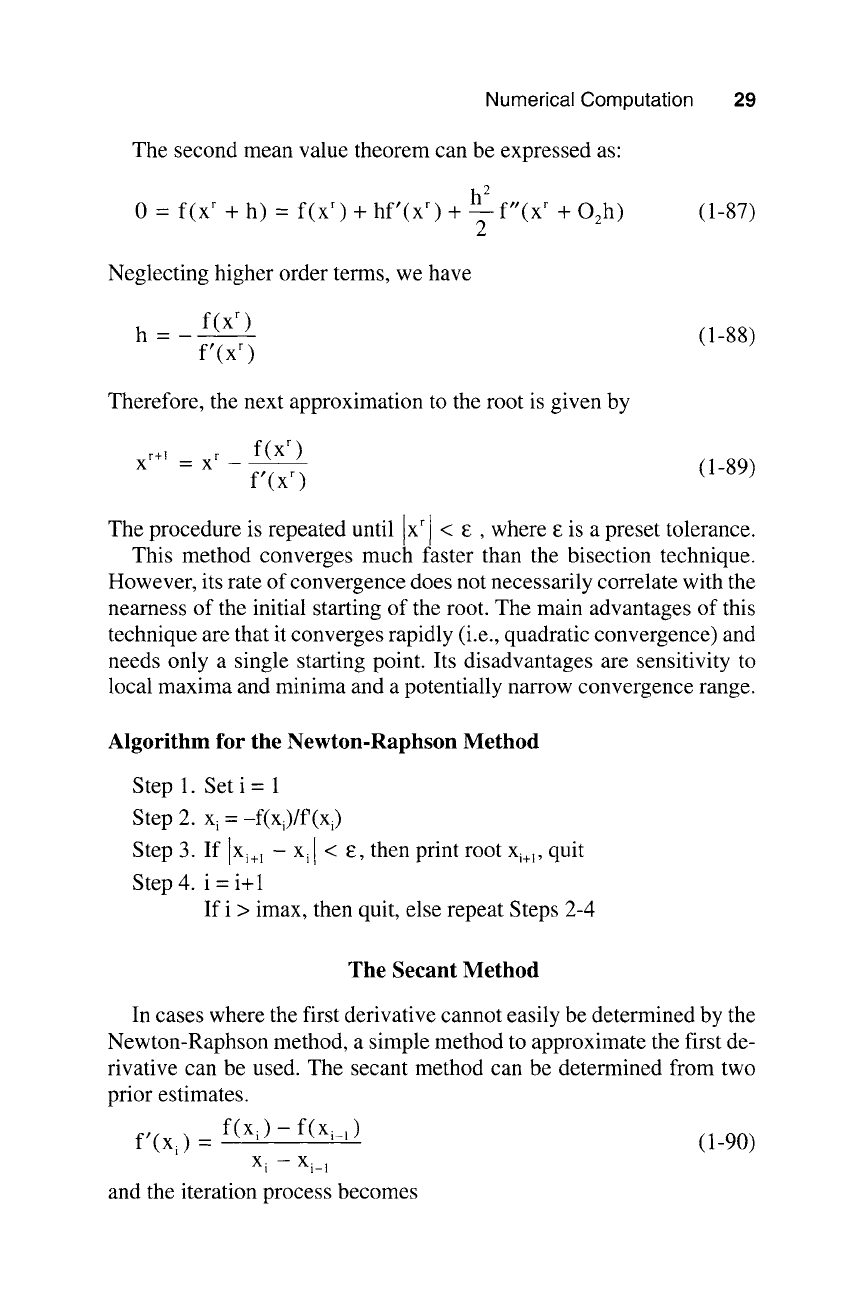
The second mean value theorem can be expressed as"
h 2 f,, x r
0 - f(x r +
h) - f(x ~)
+ hf'(x r) + ~ ( + Ozh )
2
(1-87)
Neglecting higher order terms, we have
f(x r )
h - (1-88)
f'(x r )
Therefore, the next approximation to the root is given by
X TM ~ X r
f(x r )
f'(x r )
(1-89)
The procedure is repeated
until [x rl < ~ ,
where ~ is a preset tolerance.
This method converges much faster than the bisection technique.
However, its rate of convergence does not necessarily correlate with the
nearness of the initial starting of the root. The main advantages of this
technique are that it converges rapidly (i.e., quadratic convergence) and
needs only a single starting point. Its disadvantages are sensitivity to
local maxima and minima and a potentially narrow convergence range.
Algorithm for the Newton-Raphson Method
Step 1. Set i= 1
Step 2.
X i :-f(x~)/f'(x
i)
Step 3. If ]xi+ ~ - xi[ < e, then print root x~+~, quit
Step 4. i = i+ 1
If i > imax, then quit, else repeat Steps 2-4
The Secant Method
In cases where the first derivative cannot easily be determined by the
Newton-Raphson method, a simple method to approximate the first de-
rivative can be used. The secant method can be determined from two
prior estimates.
f'(x i ) -- f(xi ) -- f(xi-' ) (1-90)
X i -- Xi_ l
and the iteration process becomes
30
Fortran Programs for Chemical Process Design
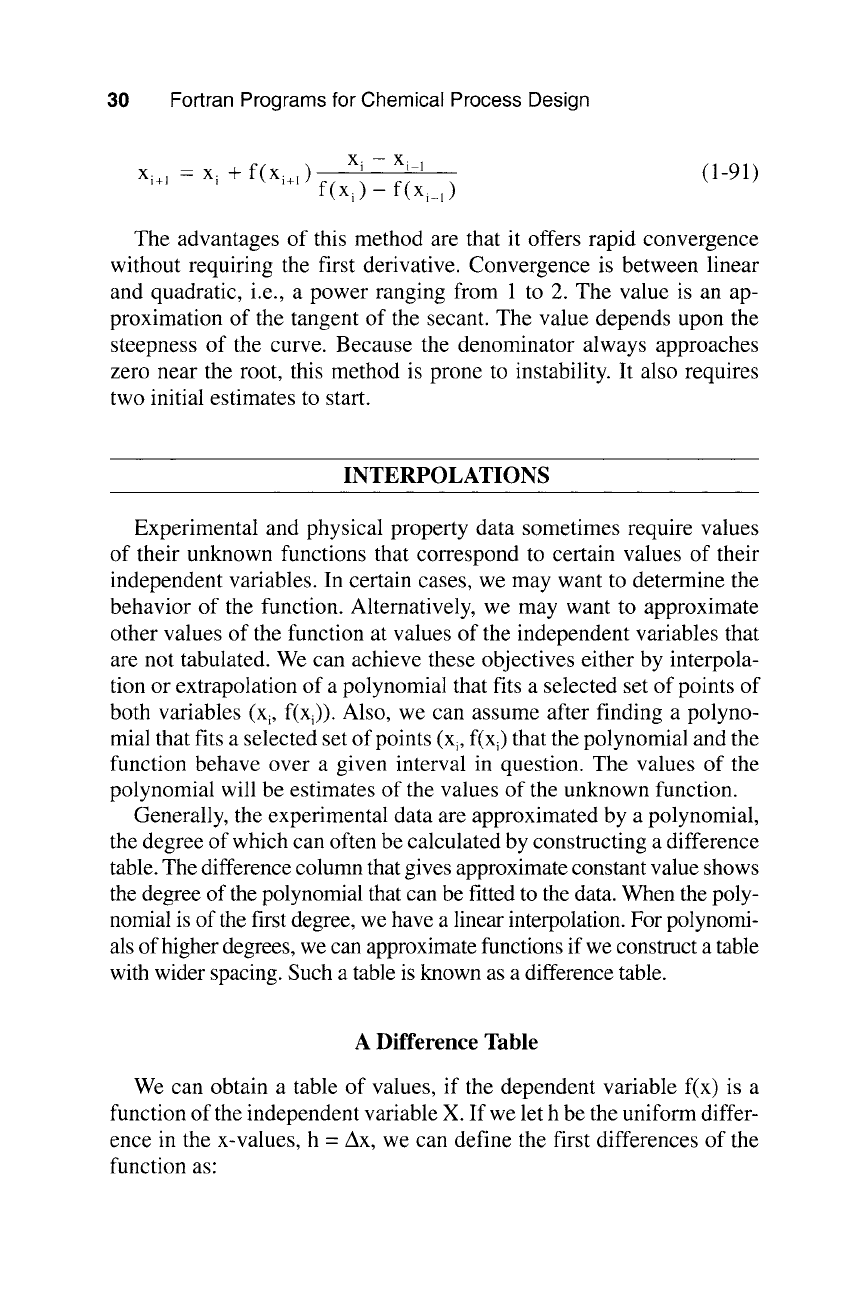
Xi+ 1 : X i --]-
f(xi+ l)
X i -- Xi_ 1
f(x,) - f(x,_,)
(1-91)
The advantages of this method are that it offers rapid convergence
without requiring the first derivative. Convergence is between linear
and quadratic, i.e., a power ranging from 1 to 2. The value is an ap-
proximation of the tangent of the secant. The value depends upon the
steepness of the curve. Because the denominator always approaches
zero near the root, this method is prone to instability. It also requires
two initial estimates to start.
INTERPOLATIONS
Experimental and physical property data sometimes require values
of their unknown functions that correspond to certain values of their
independent variables. In certain cases, we may want to determine the
behavior of the function. Alternatively, we may want to approximate
other values of the function at values of the independent variables that
are not tabulated. We can achieve these objectives either by interpola-
tion or extrapolation of a polynomial that fits a selected set of points of
both variables (xi, f(xi)). Also, we can assume after finding a polyno-
mial that fits a selected set of points (xi, f(xi) that the polynomial and the
function behave over a given interval in question. The values of the
polynomial will be estimates of the values of the unknown function.
Generally, the experimental data are approximated by a polynomial,
the degree of which can often be calculated by constructing a difference
table. The difference column that gives approximate constant value shows
the degree of the polynomial that can be fitted to the data. When the poly-
nomial is of the first degree, we have a linear interpolation. For polynomi-
als of higher degrees, we can approximate functions if we construct a table
with wider spacing. Such a table is known as a difference table.
A Difference Table
We can obtain a table of values, if the dependent variable f(x) is a
function of the independent variable X. If we let h be the uniform differ-
ence in the x-values, h - Ax, we can define the first differences of the
function as:
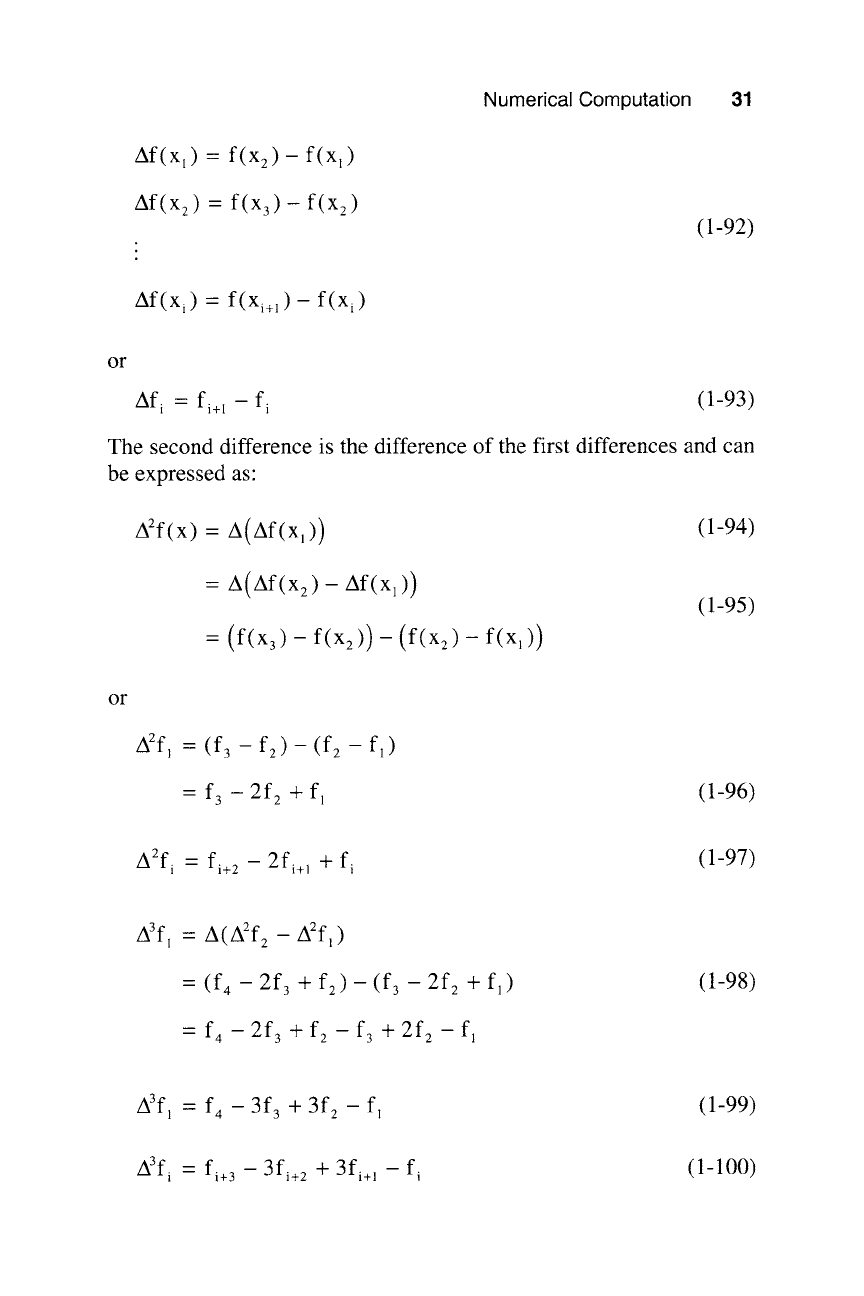
Numerical Computation 31
Af(x 1 ) - f(x 2 ) -
f(x,
)
Af(x2 ) - f(x 3)
- f(x 2
)
(1-92)
kf(x, )
- f(xi+ 1 ) - f(x i )
or
Afi - fi+l - fi
(1-93)
The second difference is the difference of the first differences and can
be expressed as"
A2f(x) - k(kf(x,))
(1-94)
= A(Af(x 2) -- Af(x 1))
= (f(x3) -- f(x 2 )) -- (f(x 2 ) --
f(x,
))
(1-95)
or
A2f,
- (f3 - f2 ) - (f2 -
f,
)
= f3 - 2f2 §
fl (1-96)
A2fi - fi+2 - 2fi+l + fi (1-97)
A3f,
- A(A2f2 -
A2f,)
-- (f4 --
2f3 + f2)-(f3 - 2f2 + fl) (1-98)
= f4 - 2f3 +
f2
- f3 +
2f2 - f~
A3fl
-
f4
--
3
f3 -I-
3f2 - fl (1-99)
A3fi - fi+3 - 3fi+2 +
3fi+l
- fi
(1-100)
32
Fortran Programs for Chemical Process Design
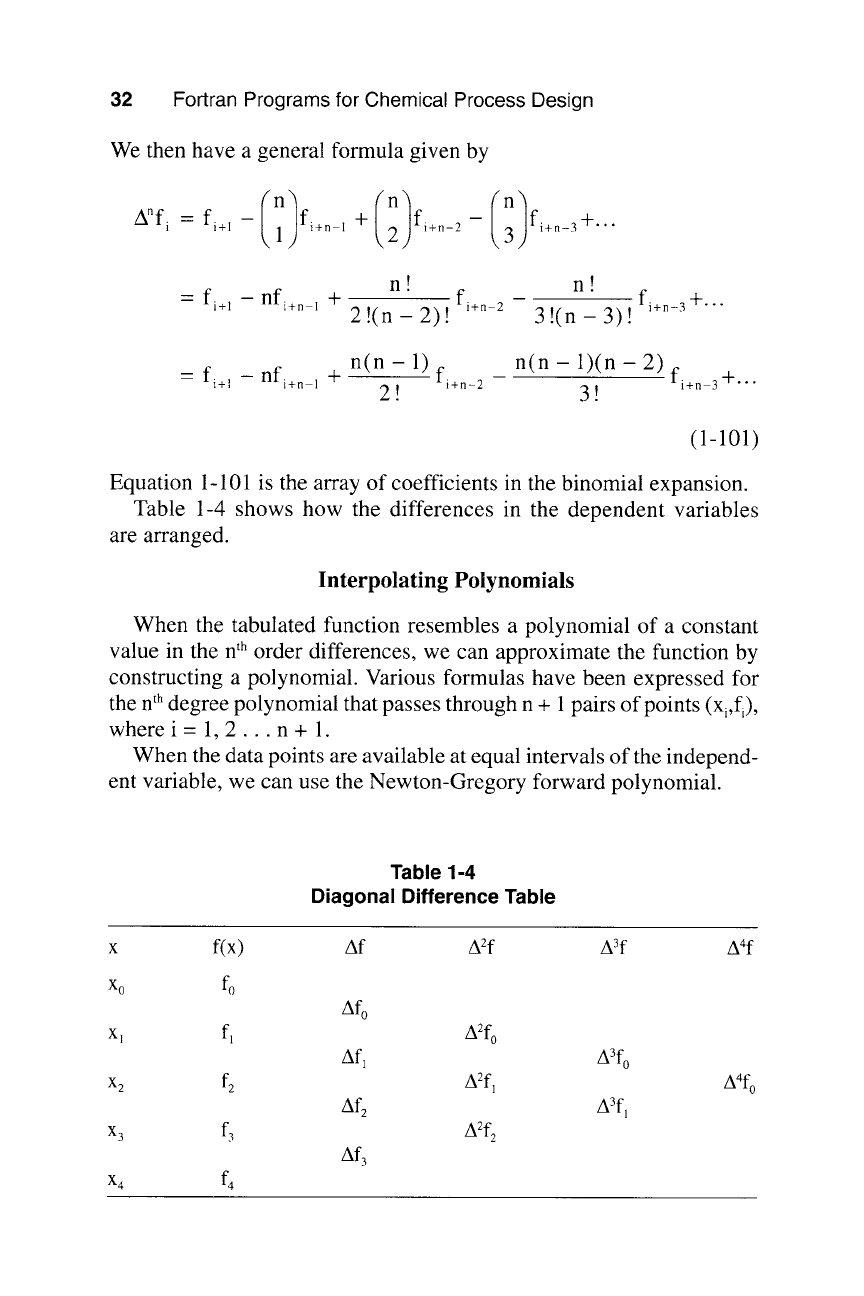
We then have a general formula given by
In/ In/ In/
-- fi+n-l-I-
fi -- f +
Anfi -- fi+l 1 2 +n-2 3 i+n-3 "'"
n! n!
= fi+l -- nfi+n-1 + fi+n-2 -- fi+n-3+""
2!(n- 2)! 3!(n- 3)!
= fi+l -- nfi+n-I +
n(n- 1)(n- 2)
fi+n 3"k-"
n(n- 1)
fi+n-2 -- - ""
2! 3!
(1-101)
Equation 1-101 is the array of coefficients in the binomial expansion.
Table 1-4 shows how the differences in the dependent variables
are arranged.
Interpolating Polynomials
When the tabulated function resembles a polynomial of a constant
value in the n th order differences, we can approximate the function by
constructing a polynomial. Various formulas have been expressed for
the n th degree polynomial that passes through n + 1 pairs of points (xi,fi),
where i = 1, 2... n + 1.
When the data points are available at equal intervals of the independ-
ent variable, we can use the Newton-Gregory forward polynomial.
Table 1-4
Diagonal Difference Table
x f(x)
Xo fo
Af A2f A3f A4f
Afo
xl fl
A2fo
Af 1 A3f 0
X2 f2 AZfl A4fo
Af 2 A3f I
G A:f
x4 f4
Numerical Computation 33
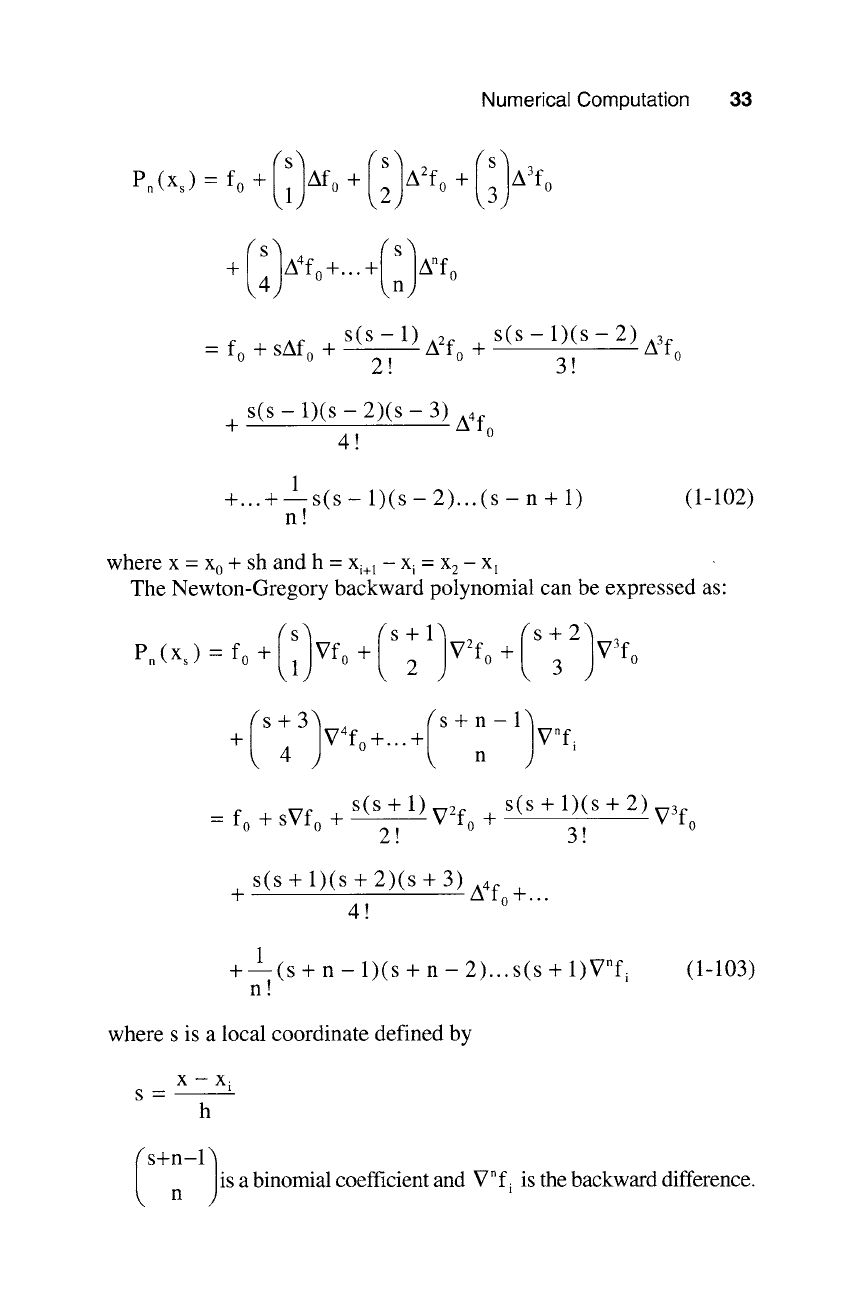
Is/ (s/ (s/
Pn (Xs)-
fo + kfo
+ A2fo + A3fo
1 2 3
+ (s4) 4fo+ +(Sn) nfo
s(s-1)
= fo + SAfo
+ A2fo +
2~
s(s- 1)(s- 2) k3fo
3!
s(s- 1)(s- 2)(s- 3) A4fo
4!
1
+...+--s(s- 1)(s- 2)...(s- n + 1) (1-102)
n!
where x - x o + sh and h - xi+ ~ - x~-
x 2 -
X 1
The Newton-Gregory backward polynomial can be expressed as:
/ s) / s+,) /s+2)v3
P n (Xs)-
fo + Vfo + V2fo + fo
1 2 3
/ ) / s+n-')
s
+
3 V4fo +... + vnfi
+ 4 n
s(s+ 1)
= fo + sVfo
+ VZfo +
2!
s(s + 1)(s + 2)
V3fo
3!
s(s + 1)(s + 2)(s + 3) ,_,,A4fo
+...
4~
1
--(s + n- 1)(s + n- 2)...s(s
+ 1)vnfi
(1-103)
n!
where s is a local coordinate defined by
S --
X--X i
s+n-1 ]is a binomial coefficient and
vnfi
is the backward difference.
n
34
Fortran Programs for Chemical Process Design
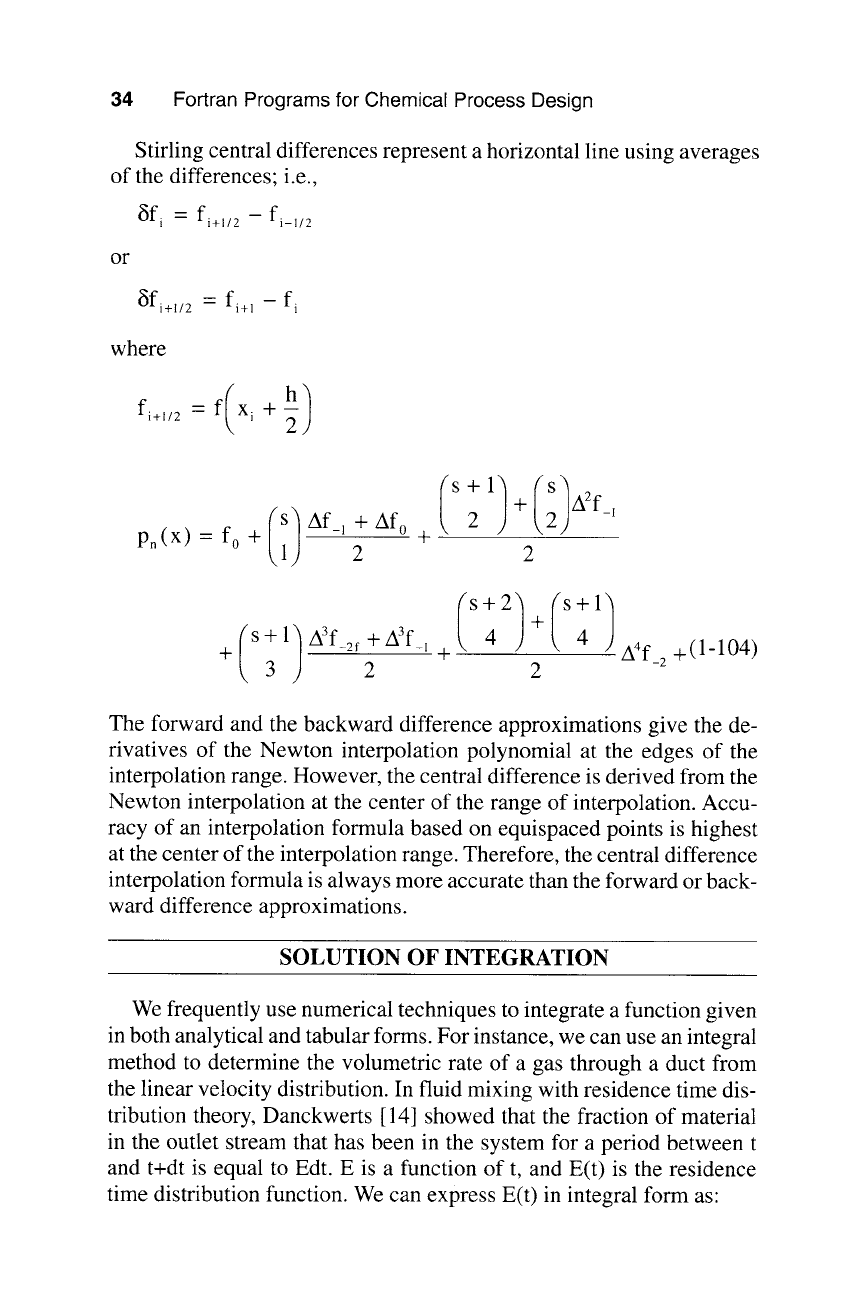
Stirling central differences represent a horizontal line using averages
of the differences; i.e.,
~fi = fi+l/2 - fi-1/2
or
~fi+l/2 = fi+l -- fi
where
( h/
fi+l/2 --
f
Xi -1- 2-
S) Afl+
Af ~
p.(x)- fo +
1 2
(s+1 / (s /
+ A2f,
2 2 -
s + 1 / A3f_zf + A3f
+ - +
3 2
/s+2/4 + (s+1)4
A4f_2 +(1-104)
The forward and the backward difference approximations give the de-
rivatives of the Newton interpolation polynomial at the edges of the
interpolation range. However, the central difference is derived from the
Newton interpolation at the center of the range of interpolation. Accu-
racy of an interpolation formula based on equispaced points is highest
at the center of the interpolation range. Therefore, the central difference
interpolation formula is always more accurate than the forward or back-
ward difference approximations.
SOLUTION OF INTEGRATION
We frequently use numerical techniques to integrate a function given
in both analytical and tabular forms. For instance, we can use an integral
method to determine the volumetric rate of a gas through a duct from
the linear velocity distribution. In fluid mixing with residence time dis-
tribution theory, Danckwerts [ 14] showed that the fraction of material
in the outlet stream that has been in the system for a period between t
and t+dt is equal to Edt. E is a function of t, and E(t) is the residence
time distribution function. We can express E(t) in integral form as:
Numerical Computation 35
foE(t)dt-
1
(1-105)
The average time spent by material flowing at a rate, q, through a vol-
ume, V, equals V/q.
V
The mean residence time, t -
q
We can also express Equation 1-105 in the form of dimensionless time
where 0 - tq/V, and this becomes:
~oE(O)dO-
1
(1-106)
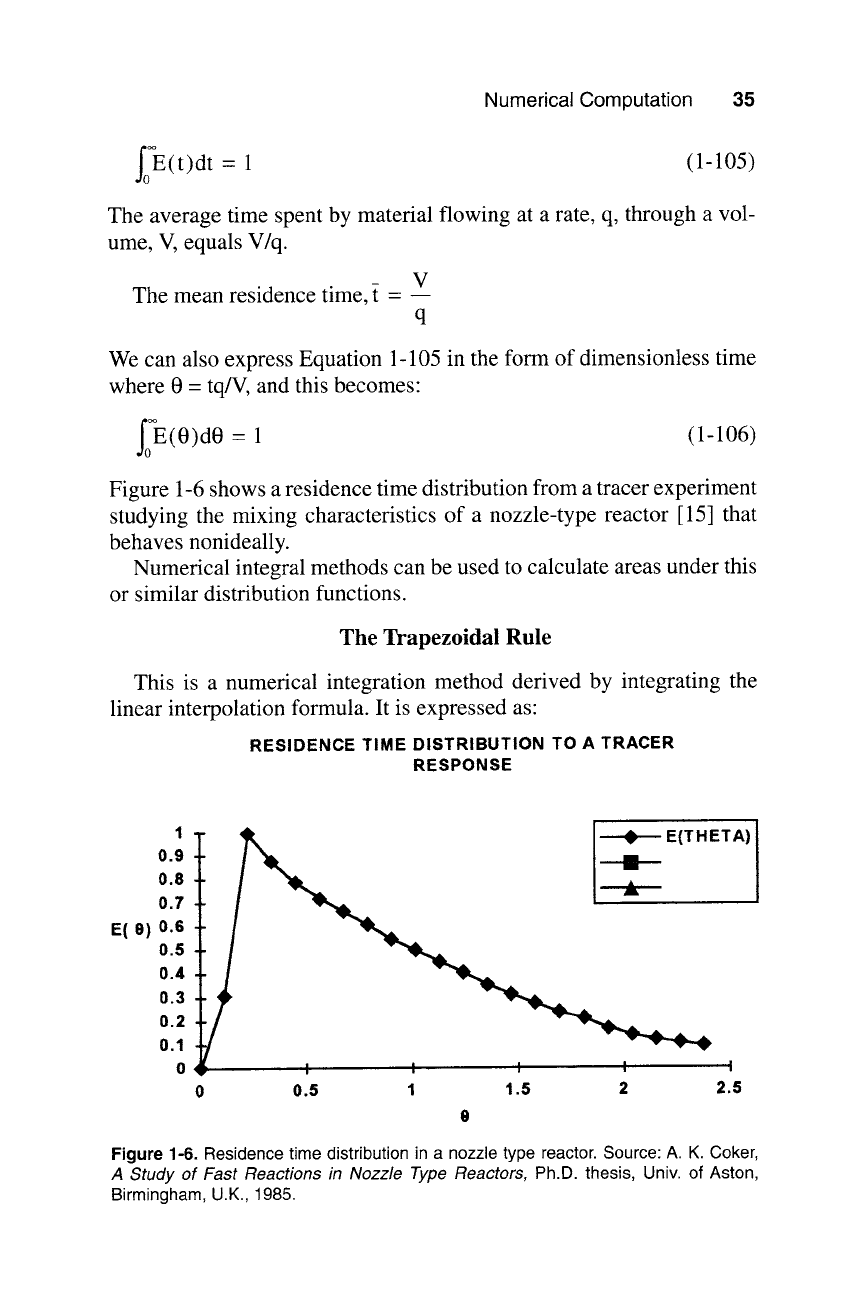
Figure 1-6 shows a residence time distribution from a tracer experiment
studying the mixing characteristics of a nozzle-type reactor [15] that
behaves nonideally.
Numerical integral methods can be used to calculate areas under this
or similar distribution functions.
The Trapezoidal Rule
This is a numerical integration method derived by integrating the
linear interpolation formula. It is expressed as"
RESIDENCE TIME DISTRIBUTION TO A TRACER
RESPONSE
1
0.9
0.8
0.7
E(e) o.6
0.5
0.4
0.3
0.2
0.1
0
#
, I
I
A
E(THETA)
0 0.5 1 1.5 2 2.5
Figure 1-6. Residence time distribution in a nozzle type reactor. Source: A. K. Coker,
A Study of Fast Reactions in Nozzle Type Reactors,
Ph.D. thesis, Univ. of Aston,
Birmingham, U.K., 1985.
36
Fortran Programs for Chemical Process Design
-- Fi+l
f(x)dx
- f(xi ) + f(Xi+l )
I
(Ax)
(1-106)
L
2
_h
-- ~(fi + fi+l)
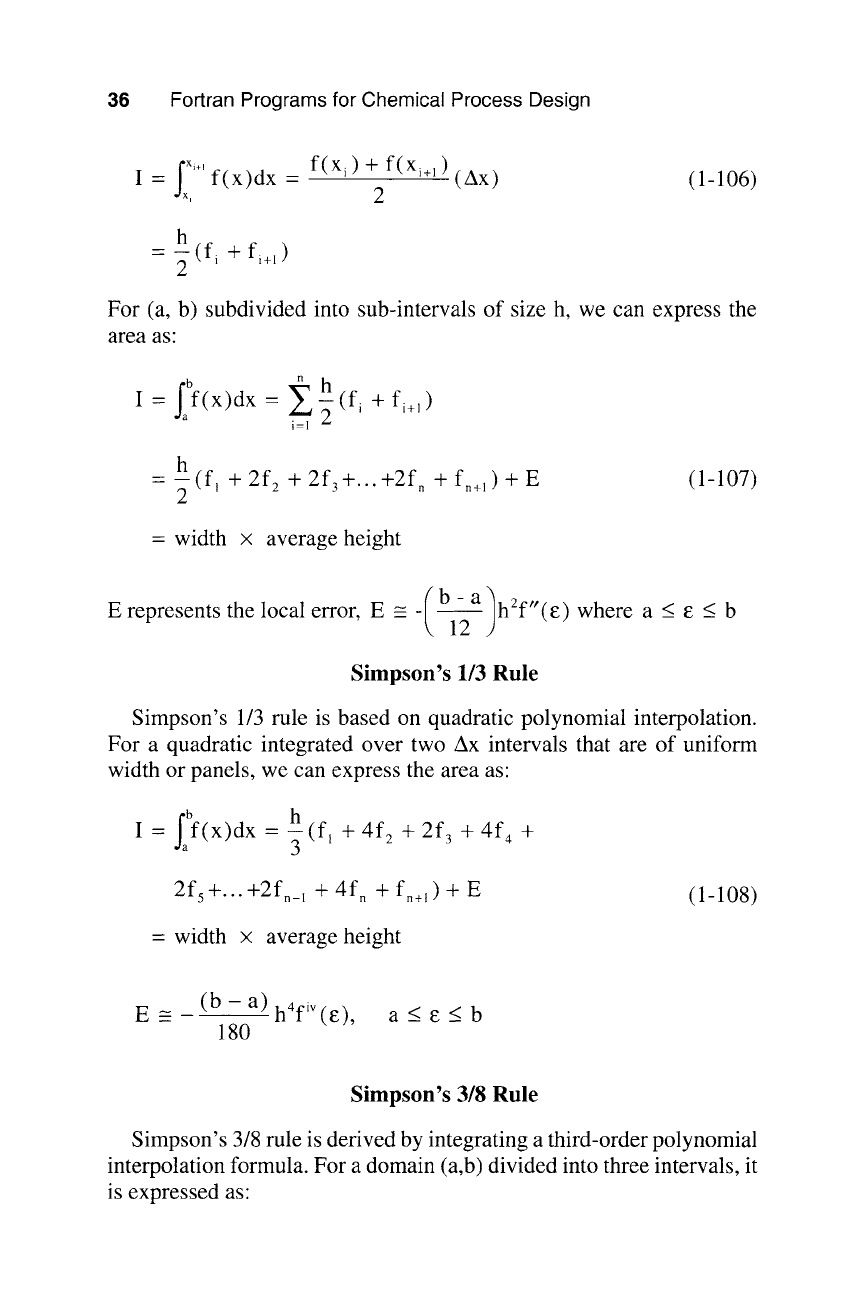
For (a, b) subdivided into sub-intervals of size h, we can express the
area as:
I - f(x)dx - ~ (f,
+ fi+, )
i--l
_--h(f +2f 2 +2f 3+ +2f n +f ~)+E
2 1 ... n+
(1-107)
= width x average height
b - a/h2f,,(
E represents the local error, E "~ - i2 e) where a < ~ < b
Simpson's 1/3 Rule
Simpson's 1/3 rule is based on quadratic polynomial interpolation.
For a quadratic integrated over two Ax intervals that are of uniform
width or panels, we can express the area as"
If
' h
I - f(x)dx - ~ (f~ + 4f 2 + 2f 3 + 4f 4 +
2 fs +.-. +2 fn_l
+
4 fn
"1-
fn+l
) -~-
E
(1-108)
= width x average height
E _= -(b- a) h4fiv (E),
180
a<e<b
Simpson's 3/8 Rule
Simpson's 3/8 rule is derived by integrating a third-order polynomial
interpolation formula. For a domain (a,b) divided into three intervals, it
is expressed as: