
Coker A.K. Fortran Programs for Chemical Process Design, Analysis, and Simulation
Подождите немного. Документ загружается.

Numerical Computation 47
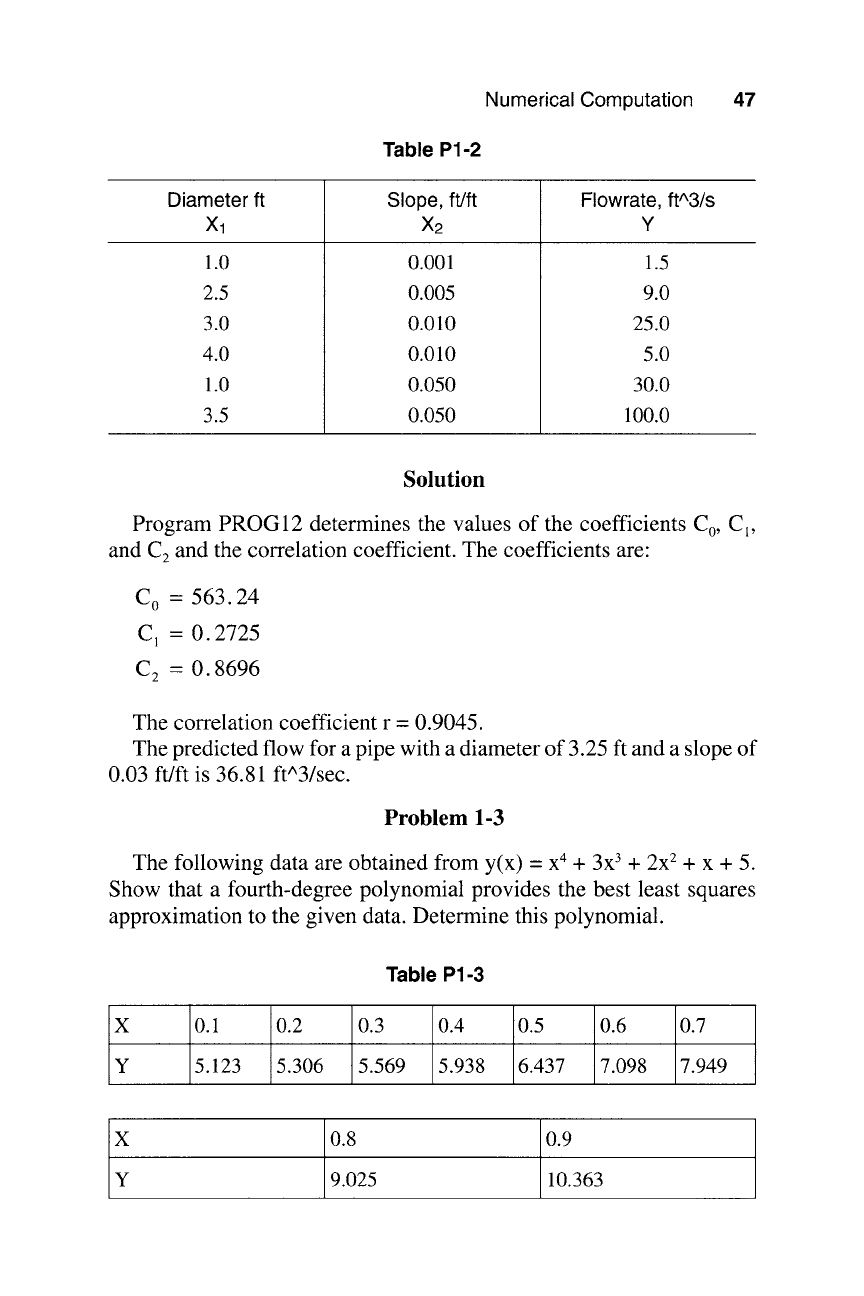
Table P1-2
Diameter ft
Xl
1.0
2.5
3.0
4.0
1.0
3.5
Slope, ft/ft
X2
0.001
0.005
0.010
0.010
0.050
0.050
Flowrate, ft^3/s
Y
1.5
9.0
25.0
5.0
30.0
100.0
Solution
Program PROG12 determines the values of the coefficients C 0, C~,
and C 2 and the correlation coefficient. The coefficients are"
C O - 563.24
C 1 - 0. 2725
C 2 - 0. 8696
The correlation coefficient r - 0.9045.
The predicted flow for a pipe with a diameter of 3.25 ft and a slope of
0.03 ft/ft is 36.81 ft^3/sec.
Problem 1-3
The following data are obtained from y(x) - x 4 + 3x 3 +
2X 2 + X +
5.
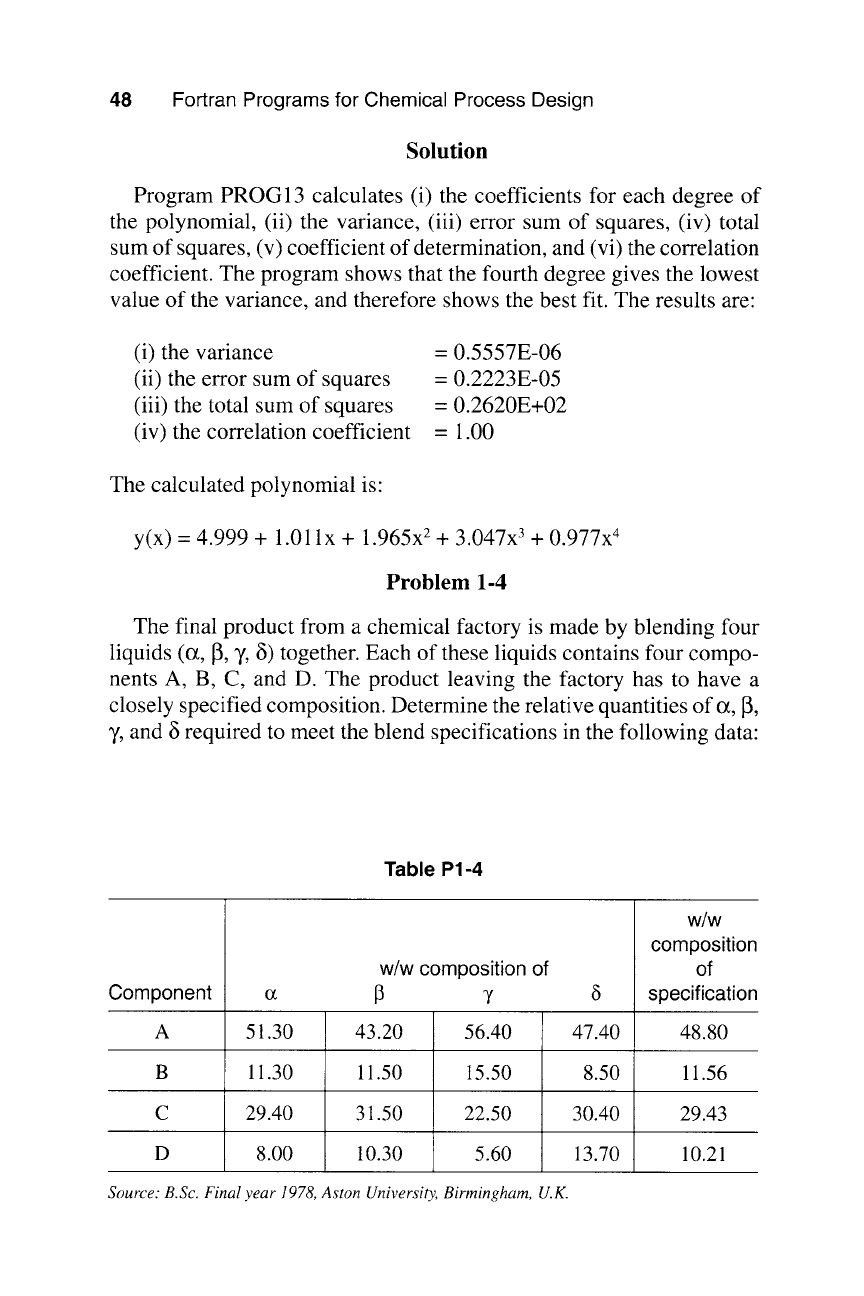
Show that a fourth-degree polynomial provides the best least squares
approximation to the given data. Determine this polynomial.
Table P1-3
X
Y
0.1
5.123
0.2 0.3 0.4 0.5
5.306 5.569 5.938 6.437
0.6 0.7
7.098 7.949
X
Y
0.8
9.025
0.9
10.363
48
Fortran Programs for Chemical Process Design
Solution
Program PROG13 calculates (i) the coefficients for each degree of
the polynomial, (ii) the variance, (iii) error sum of squares, (iv) total
sum of squares, (v) coefficient of determination, and (vi) the correlation
coefficient. The program shows that the fourth degree gives the lowest
value of the variance, and therefore shows the best fit. The results are:
(i) the variance
(ii) the error sum of squares
(iii) the total sum of squares
(iv) the correlation coefficient
= 0.5557E-06
- 0.2223E-05
- 0.2620E+02
-
1.00
The calculated polynomial is:
y(x) - 4.999 + 1.01 l x + 1.965x e + 3.047x 3 + 0.977x 4
Problem 1-4
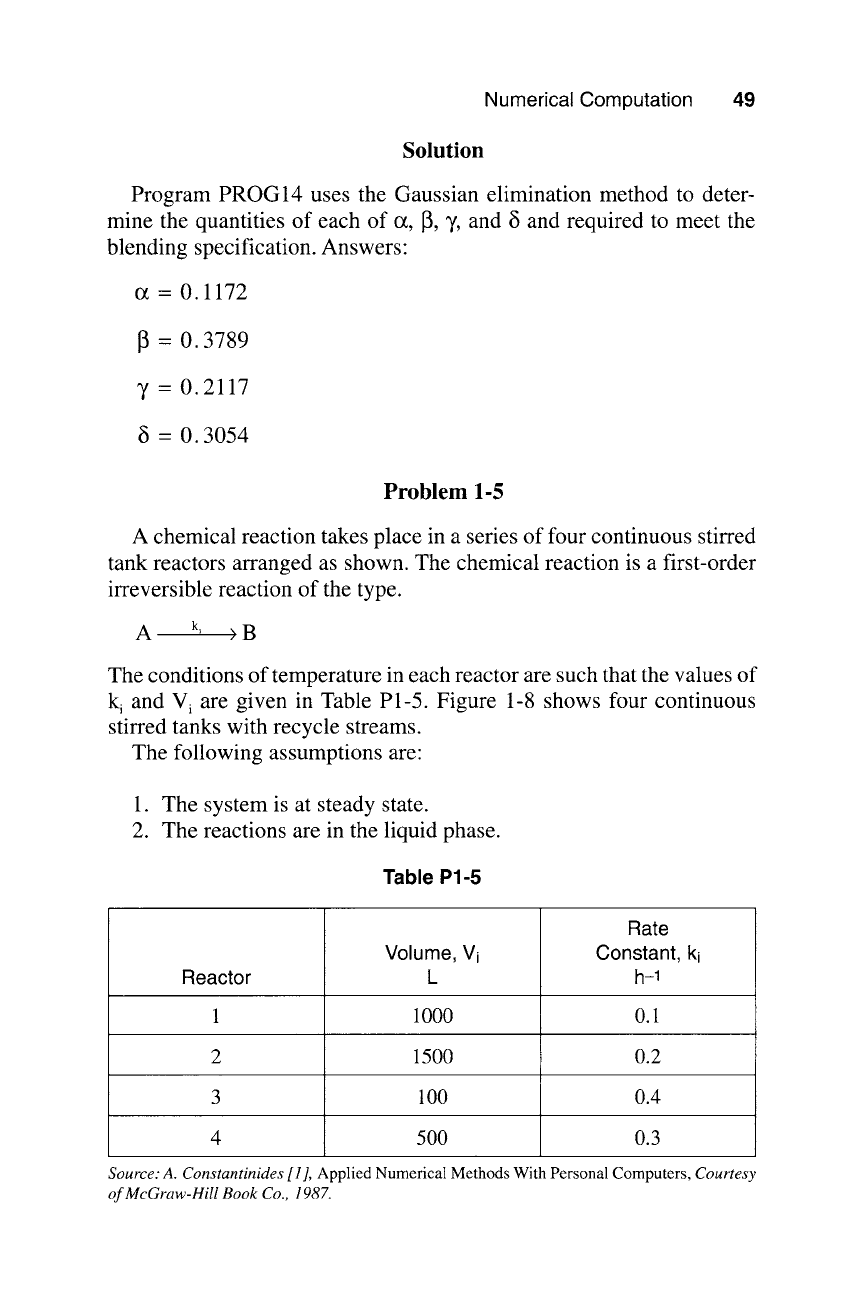
The final product from a chemical factory is made by blending four
liquids ((~, 13, y, 8) together. Each of these liquids contains four compo-
nents A, B, C, and D. The product leaving the factory has to have a
closely specified composition. Determine the relative quantities of o~, [3,
y, and 8 required to meet the blend specifications in the following data:
Table P1-4
Component
A
C
D
w/w composition of
o~ 13 ~, 8
51.30
11.30
29.40
8.00
43.20
11.50
31.50
10.30
56.40
15.50
22.50
5.60
47.40
8.50
30.40
13.70
w/w
composition
of
specification
48.80
11.56
29.43
10.21
Source: B.Sc. Final year 1978, Aston University, Birmingham, U.K.
Numerical Computation 49
Solution
Program PROG14 uses the Gaussian elimination method to deter-
mine the quantities of each of o~, 13, 7, and ~5 and required to meet the
blending specification. Answers:
o~ - 0.1172
13 - O. 3789
7
-
0.2117
~i - 0. 3054
Problem 1-5
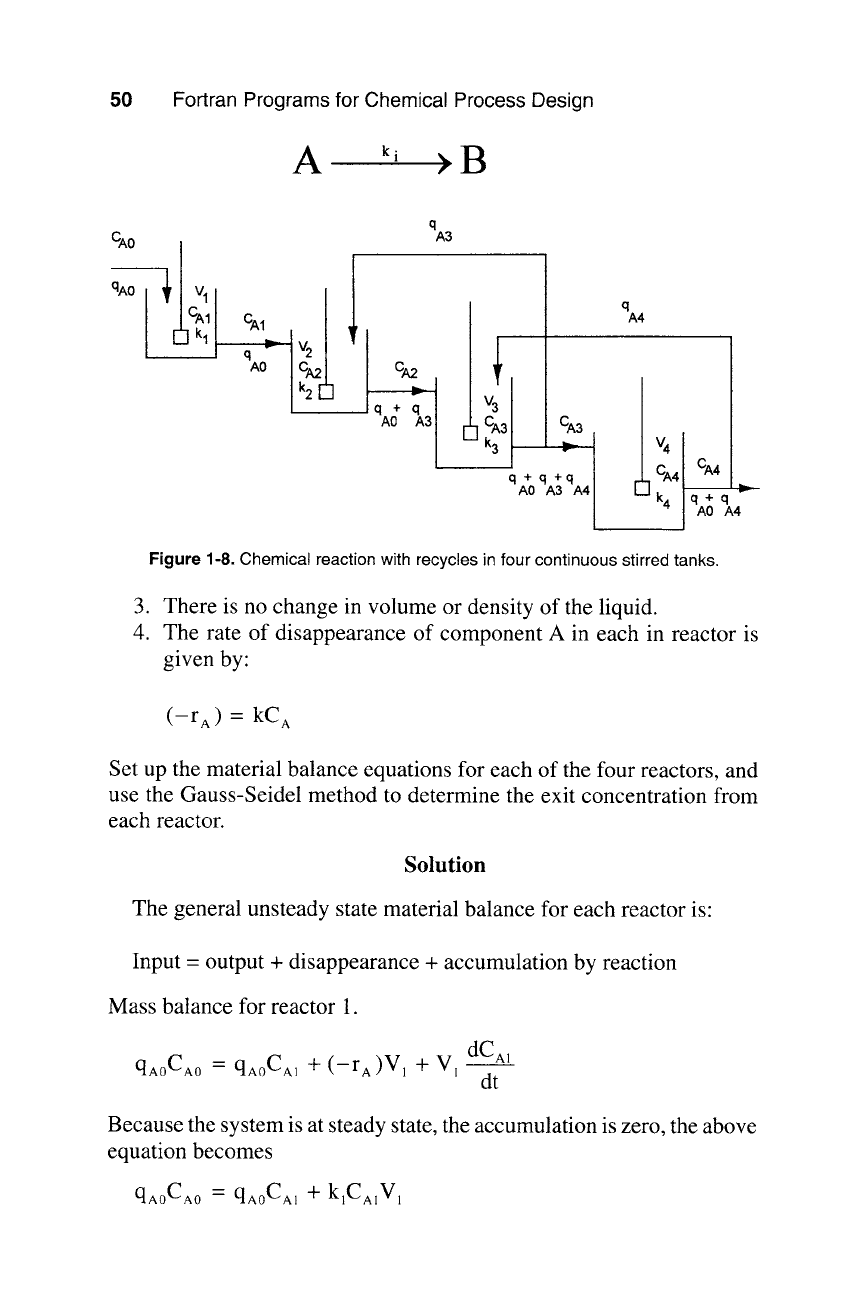
A chemical reaction takes place in a series of four continuous stirred
tank reactors arranged as shown. The chemical reaction is a first-order
irreversible reaction of the type.
A
k,
>B
The conditions of temperature in each reactor are such that the values of
k i and V i are given in Table P1-5. Figure 1-8 shows four continuous
stirred tanks with recycle streams.
The following assumptions are:
1. The system is at steady state.
2. The reactions are in the liquid phase.
Table P1-5
Reactor
Volume, Vi
L
1000
1500
100
500
Rate
Constant, k~
h-1
0.1
0.2
0.4
0.3
Source: A. Constantinides [1],
Applied Numerical Methods With Personal Computers,
Courtesy
of McGraw-Hill Book Co., 1987.
50
Fortran Programs for Chemical Process Design
A
>B
%
qA0
1
r~ kl
v 2
%o %
k 2
q
A3
q
A4
I r v4
q+q+q CA4
A0 A3 A4
k 4
CA4
v
q+q
A0 A4
Figure
1-8. Chemical reaction with recycles in four continuous stirred tanks.
3. There is no change in volume or density of the liquid.
4. The rate of disappearance of component A in each in reactor is
given by"
(--rA)
- kC A
Set up the material balance equations for each of the four reactors, and
use the Gauss-Seidel method to determine the exit concentration from
each reactor.
Solution
The general unsteady state material balance for each reactor is"
Input - output + disappearance + accumulation by reaction
Mass balance for reactor 1.
qAoCA0 --qAoCA1 + (--rA)V 1 + V 1
dCA1
dt
Because the system is at steady state, the accumulation is zero, the above
equation becomes
qAoCA0 -- qAoCAI -k- klCAIV 1
Numerical Computation 51
Mass balance for reactor 2.
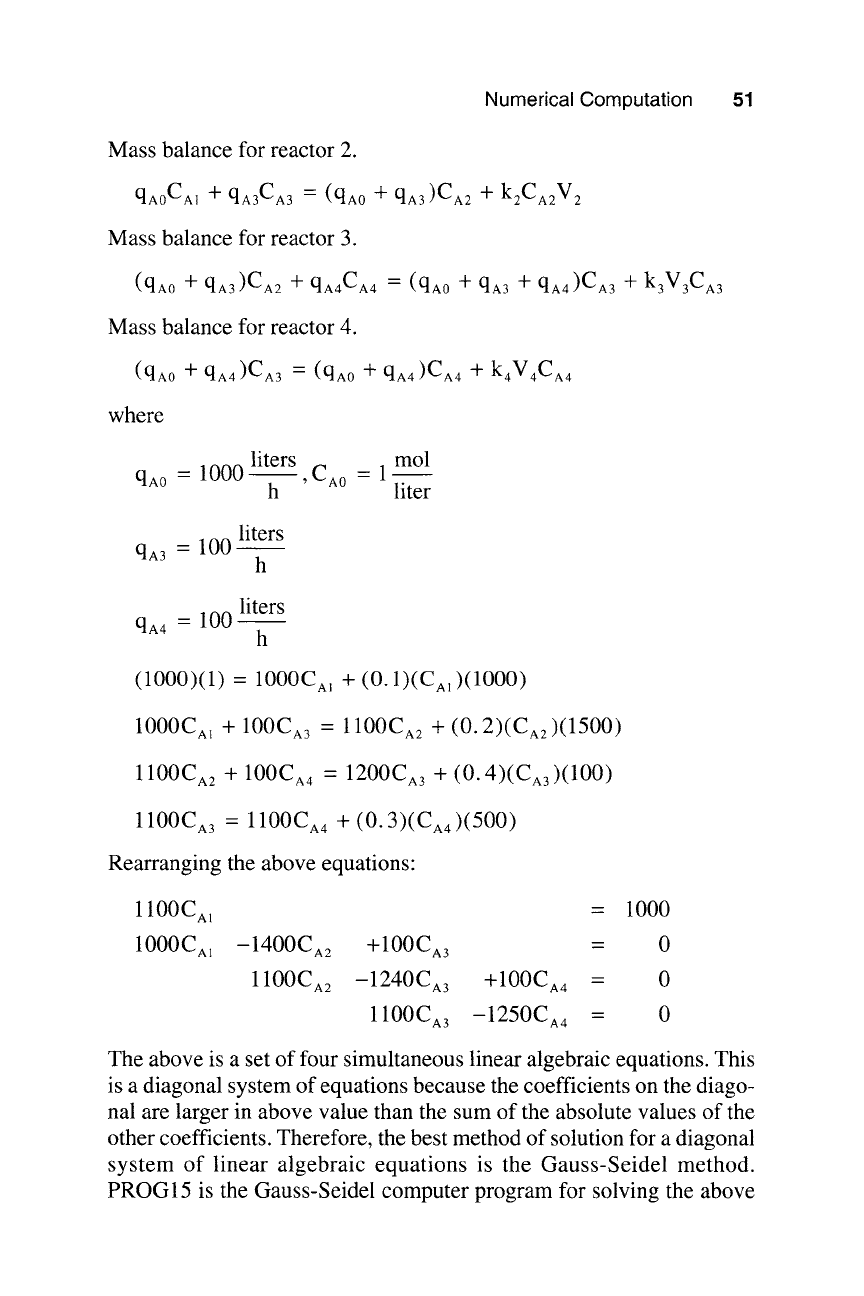
qAoCA1 + qA3CA3 -- (qA0 + qA3)CA2 + k2CA2V2
Mass balance for reactor 3.
(qA0 + qA3)CA2 + qA4CA4 -- (qA0 + qA3 + qA4)CA3 -t- k3V3eA3
Mass balance for reactor 4.
(qA0 -I- qA4)CA3 -- (qA0 + qA4)CA4 -I- k4V4CA4
where
liters mol
qA0 -- 1000 ,
CA0 - 1~
h liter
qA3 -- 100
liters
qA4 -- 100~
liters
(1000)(1) - 1000CA, + (0.1)(CA,)(1000)
1000CAI + 100CA3 -- 1100CA2 + (0.2)(CA2)(1500)
llOOCg2 + IOOCA4 - 1200CA3 + (0.4)(Cg3)(lO0)
1100CA3 -- 1100CA4 + (0.3)(CA4)(500)
Rearranging the above equations"
1100CA1
1000CA1 --1400CA2
1100CA2
=
1000
+100CA3 = 0
-1240CA3 +100CA4 -- 0
ll00CA3 --1250CA4 = 0
The above is a set of four simultaneous linear algebraic equations. This
is a diagonal system of equations because the coefficients on the diago-
nal are larger in above value than the sum of the absolute values of the
other coefficients. Therefore, the best method of solution for a diagonal
system of linear algebraic equations is the Gauss-Seidel method.
PROG15 is the Gauss-Seidel computer program for solving the above
52
Fortran Programs for Chemical Process Design
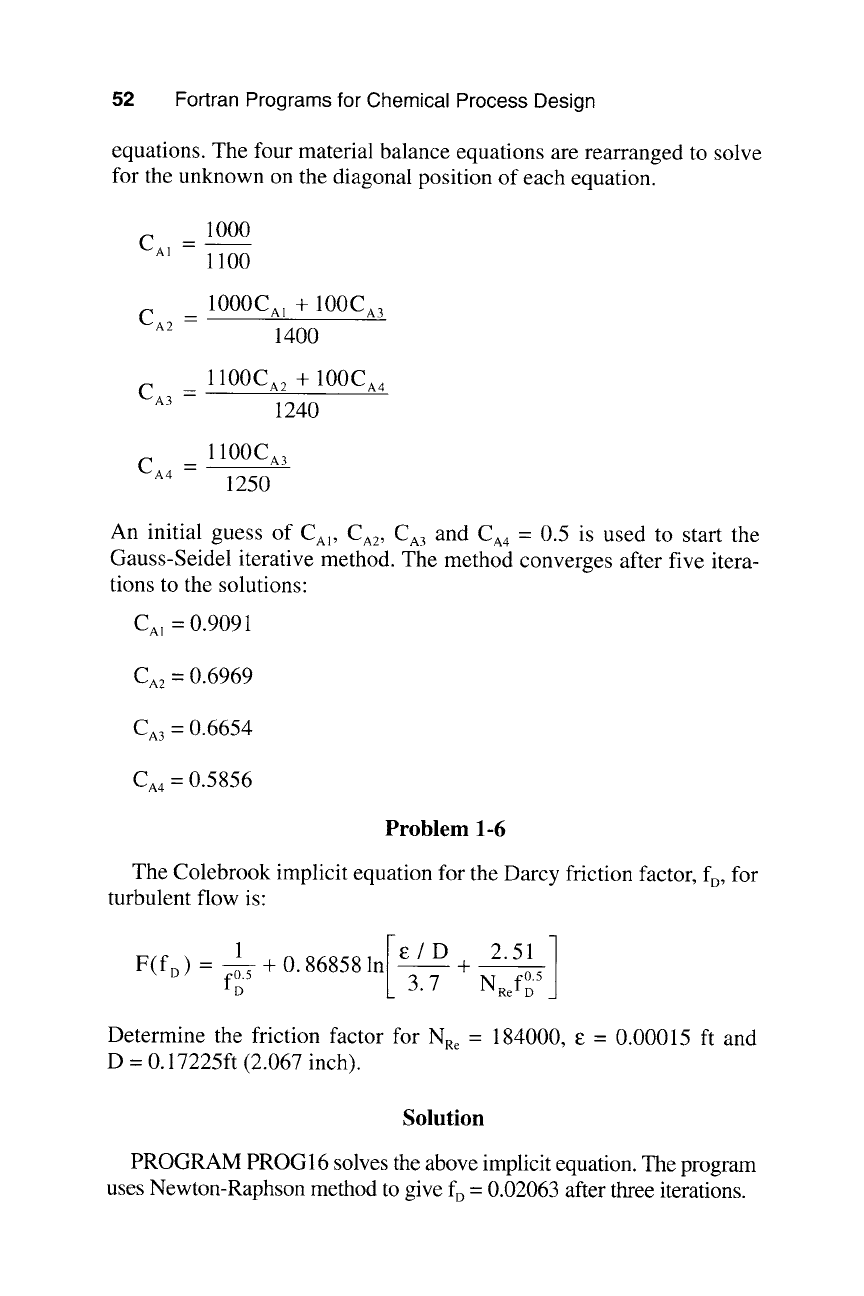
equations. The four material balance equations are rearranged to solve
for the unknown on the diagonal position of each equation.
CA 1 -
1000
1100
CA2 ----
1000CAI "k- 100CA3
1400
CA 3 -
1100CA2 q- 100CA4
1240
CA4 =
1100CA3
1250
An initial guess of
CAI , CA2 , CA3
and
CA4 -- 0.5
is used to start the
Gauss-Seidel iterative method. The method converges after five itera-
tions to the solutions:
CAI --0.9091
CA2 -- 0.6969
CA3 --0.6654
CA4 -- 0.5856
Problem 1-6
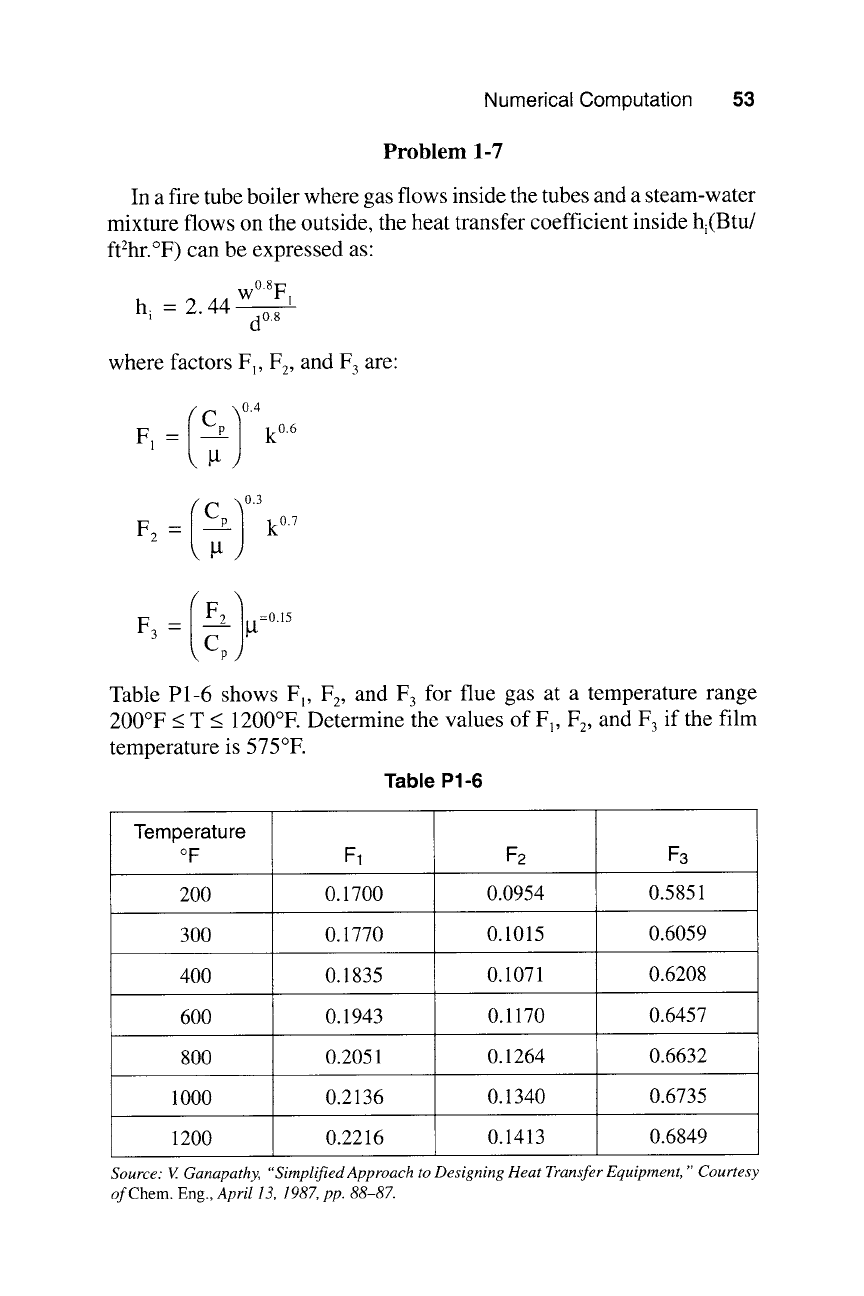
The Colebrook implicit equation for the Darcy friction factor, fD, for
turbulent flow is"
1 [E/D
F(fD ) - ~ + 0.86858 In
fo 3.7
2.51 1
.... (~.5
NRefD
Determine the friction factor for
NRe
--
184000, e -
0.00015 ft and
D - 0.17225ft (2.067 inch).
Solution
PROGRAM PROG 16 solves the above implicit equation. The program
uses Newton-Raphson method to give fD -- 0.02063 after three iterations.
Numerical Computation 53
Problem 1-7
In a fire tube boiler where gas flows inside the tubes and a steam-water
mixture flows on the outside, the heat transfer coefficient inside hi(Btu/
ftZhr.~ can be expressed as"
w~
h i - 2.44
dO.--- ~
where factors F~,
F2,
and F 3 are"
_ Cp / 0.4
F, (-6-
k0.6
C .~0.3
F2/ j k07
F 2
0 5
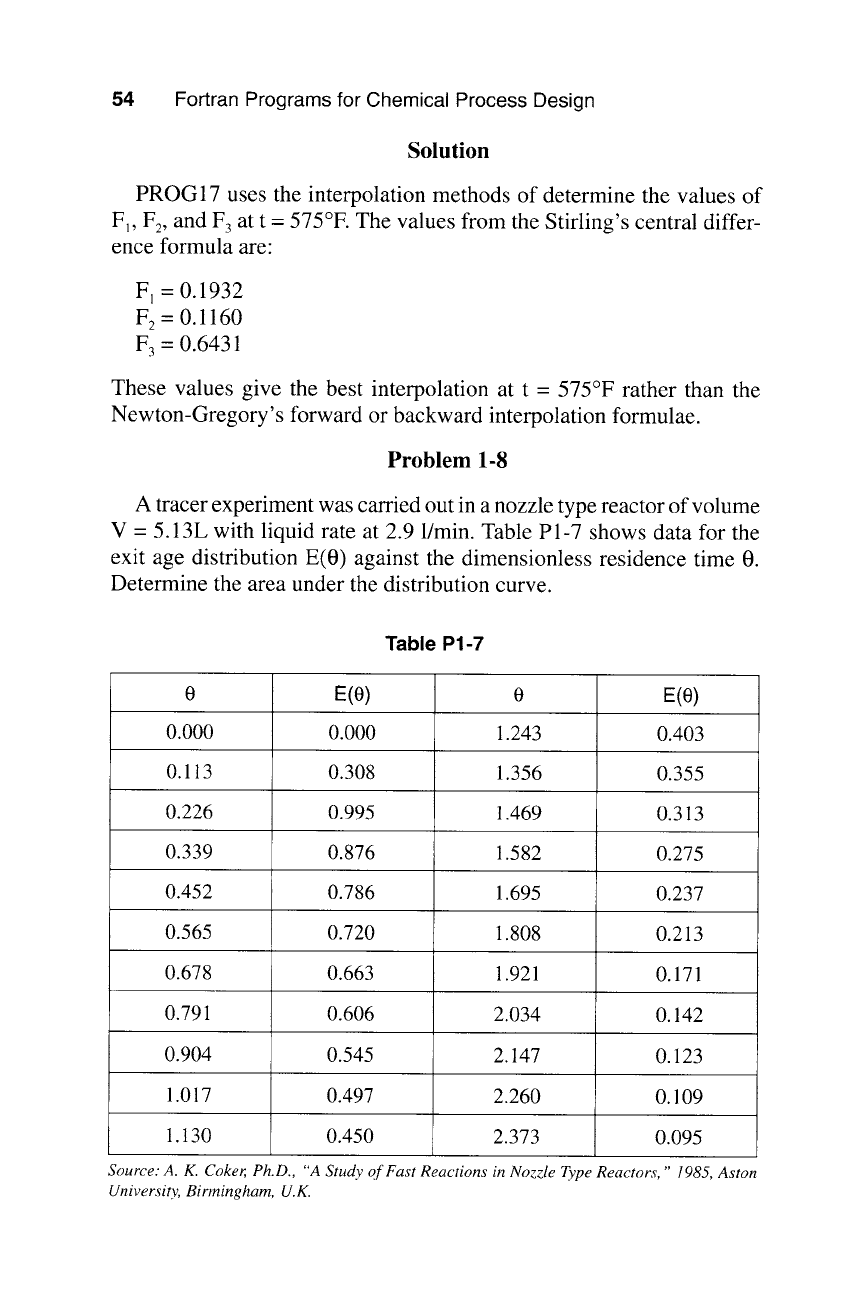
Table P1-6 shows F~,
F2,
and F 3 for flue gas at a temperature range
200~ < T < 1200~ Determine the values of F~,
F2,
and F 3 if the film
temperature is 575~
Table P1-6
Temperature
o F
200
300
400
600
800
1000
1200
F1
0.1700
0.1770
0.1835
0.1943
0.2051
0.2136
0.2216
F2
0.0954
0.1015
0.1071
0.1170
0.1264
0.1340
0.1413
F3
0.5851
0.6059
0.6208
0.6457
0.6632
0.6735
0.6849
Source: V. Ganapathy, "Simplified Approach to Designing Heat Transfer Equipment," Courtesy
of
Chem. Eng.,
April 13, 1987, pp. 88-87.
54
Fortran Programs for Chemical Process Design
Solution
PROG17 uses the interpolation methods of determine the values of
F1, F2,
and F 3 at t - 575~ The values from the Stirling's central differ-
ence formula are:
F l -0.1932
F 2 - 0.1160
F 3 - 0.6431
These values give the best interpolation at t - 575~ rather than the
Newton-Gregory's forward or backward interpolation formulae.
Problem 1-8
A tracer experiment was carried out in a nozzle type reactor of volume
V- 5.13L with liquid rate at 2.9 1/min. Table P1-7 shows data for the
exit age distribution E(0) against the dimensionless residence time 0.
Determine the area under the distribution curve.
Table P1-7
0.000
0.113
0.226
0.339
0.452
0.565
0.678
0.791
0.904
1.017
1.130
E(0)
0.000
0.308
0.995
0.876
0.786
0.720
0.663
0.606
0.545
0.497
0.450
1.243
1.356
1.469
1.582
1.695
1.808
1.921
2.034
2.147
2.260
2.373
E(O)
0.403
0.355
0.313
0.275
0.237
0.213
0.171
0.142
0.123
0.109
0.095
Source." A. K. Coker, Ph.D., "A Study of Fast Reactions in Nozzle Type Reactors," 1985, Aston
Universi~, Birmingham, U.K.
Numerical Computation 55
Solution
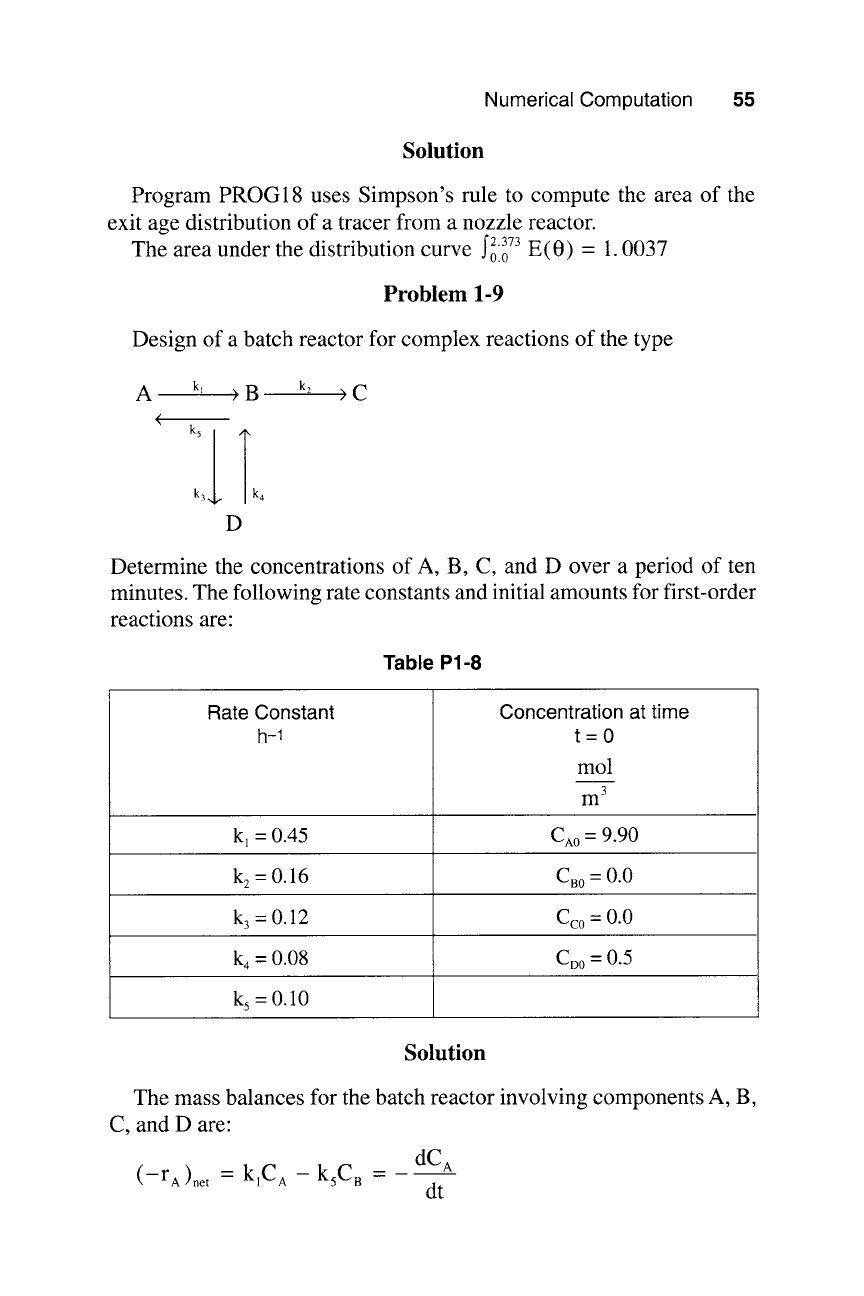
Program PROG18 uses S impson's rule to compute the area of the
exit age distribution of a tracer from a nozzle reactor.
The area under the distribution
curve I 2"373
E(0) - 1 0037
0.0
Problem 1-9
Design of a batch reactor for complex reactions of the type
A
k,
> B
k2 ) C
131 lk4
D
Determine the concentrations of A, B, C, and D over a period of ten
minutes. The following rate constants and initial amounts for first-order
reactions are:
Table P1-8
Rate Constant
h-1
k I = 0.45
k 2 = 0.16
k 3 =0.12
k 4 = 0.08
k 5 = 0.10
Concentration at time
t=O
mol
m 3
CA0 = 9.90
CBo = 0.0
Cc0 = 0.0
CDo = 0.5
Solution
The mass balances for the batch reactor involving components A, B,
C, and D are:
(--rA)net
--
klCA -
ksCB
= dCA
dt
56
Fortran Programs for Chemical Process Design
(--rB)ne t --
(k 2 + k 3 + ks)C B
- kiC A - k4C D =
dCB
dt
(rc)net
--
k2C. -
dC c
dt
(--rD)net -- R4CD -
k3CB
=
dC D
dt
Rearranging the above equations
dCA = ksC B - klC A
dt
dCB = klC A 4- k4C D -(k 2 + k 3 + k5)C B
dt
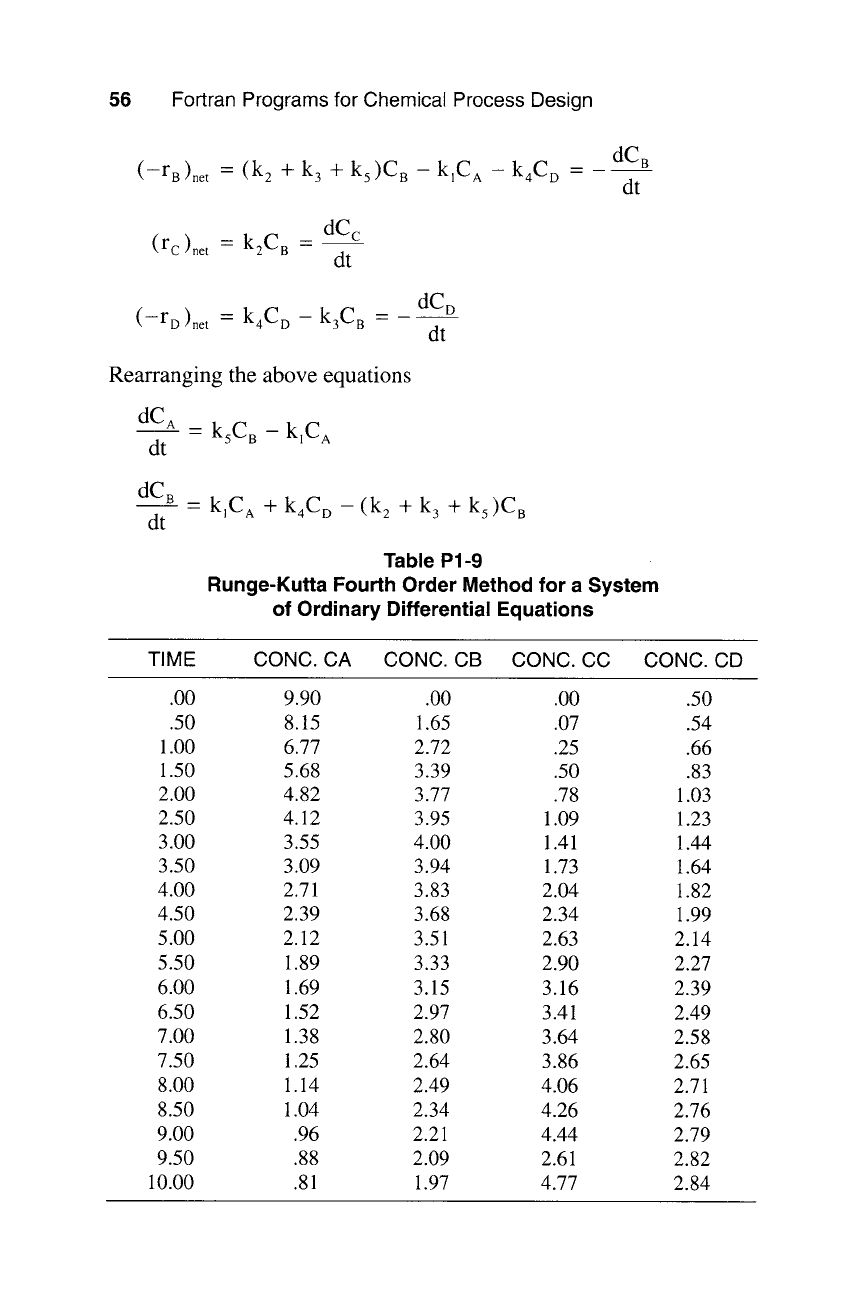
Table P1-9
Runge-Kutta Fourth Order Method for a System
of Ordinary Differential Equations
TIME CONC. CA CONG. CB CONC. CC CONC. CD
.00 9.90 .00 .00 .50
.50 8.15 1.65 .07 .54
1.00 6.77 2.72 .25 .66
1.50 5.68 3.39 .50 .83
2.00 4.82 3.77 .78 1.03
2.50 4.12 3.95 1.09 1.23
3.00 3.55 4.00 1.41 1.44
3.50 3.09 3.94 1.73 1.64
4.00 2.71 3.83 2.04 1.82
4.50 2.39 3.68 2.34 1.99
5.00 2.12 3.51 2.63 2.14
5.50 1.89 3.33 2.90 2.27
6.00 1.69 3.15 3.16 2.39
6.50 1.52 2.97 3.41 2.49
7.00 1.38 2.80 3.64 2.58
7.50 1,25 2.64 3.86 2.65
8.00 1.14 2.49 4.06 2.71
8.50 1.04 2.34 4.26 2.76
9.00 .96 2.21 4.44 2.79
9.50 .88 2.09 2.61 2.82
10.00 .81 1.97 4.77 2.84