
Coker A.K. Fortran Programs for Chemical Process Design, Analysis, and Simulation
Подождите немного. Документ загружается.

Instrument Sizing 337
The orifice sizing applies to corner, flange, vena-contracta and 1/2-
diameter taps.
Nomenclature
C D - coefficient of discharge
d = orifice diameter for full scale AP, inch
D = internal pipe diameter, inch
F a = area thermal-expansion factor. Takes into account the expansion
of the orifice with temperature changes
h w = full-scale orifice pressure differential, in.
H20 at
68~
k- specific heat ratio (constant pressure to constant volume Cp/Cv)
P = upstream pressure, psia
AP = full-scale orifice pressure-differential, psi
Q = full-scale flow rate at upstream conditions, ft3/min
Wtrue = true full-scale flow rate, lb/s
Y = expansion factor
]3 = d/D, ratio of orifice diameter to pipe I.D.
9 = upstream fluid density, lb/ft 3
CONTROL VALVE SIZING
Introduction
Valves and piping represent about 25 percent of the total capital expen-
diture for materials and equipment in the chemical process industries
(CPI). These industries employ valves in a wide range of flowing media
from granula solids to industrial wastes. The most important character-
istics in the selection of valves are viscosity, corrosiveness, and
abrasiveness. In addition, a designer must consider the process param-
eters. These may be predictable short-term upset conditions, handling
more than one fluid with the same valve, or potentially high pressures
resulting from a fluid being entrapped in a valve body that then vapor-
izes due to heat gain. Selecting the right control valve for an application
involves four basic styles of throttling: cage-style globe valves, ball
valves, eccentric-disk valves, and butterfly valves. Globe valves are the
standards of the control valves. These may be hand operated or power
actuated types for automatic control. The common feature of these valves
is their internal construction, which consists of a disc or plug recipro-
cating within the valve body. Figure 5-2A shows a typical globe valve,
and Figure 5-2B shows a globe valve with cage-style trim.
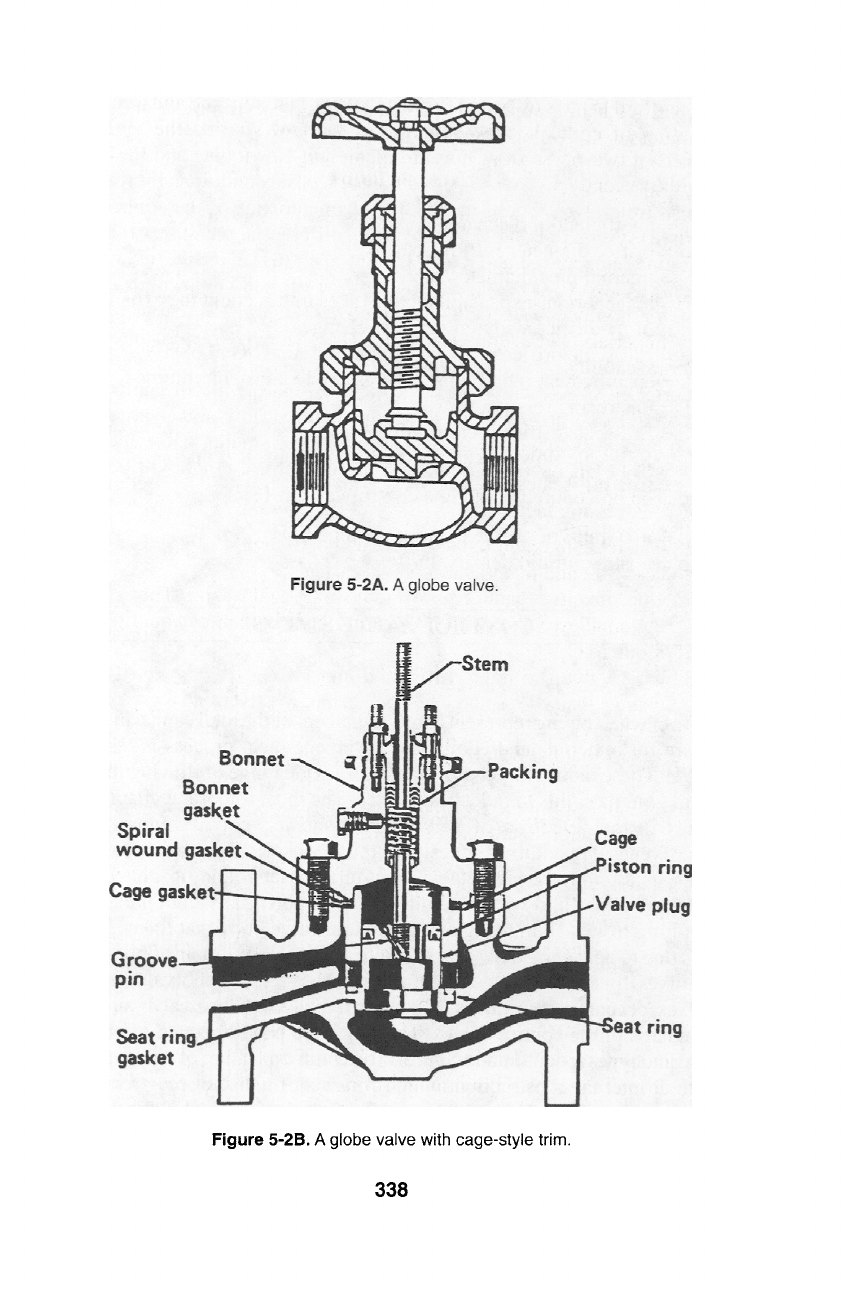
Figure 5-2B. A globe valve with cage-style trim.
338
Instrument Sizing 339
Langford [5] has reviewed the installation, maintenance and trouble-
shooting of control valves, while Driskell [6] studied the various
aspects of two-phase flow, non-turbulent, non-Newtonian and flashing
liquids. Recently, Collins [7] listed the main basic conditions for select-
ing control valves. These include (1) characteristics of the controlled
fluid, (2) system pressures, (3) maximum differential pressure, (4) fluid
operating temperature and range, (5) line size, (6) valve size, (7) valve
type, (8) valve C v, (9) allowable leakage, (10) end connections, (11)
valve environment (outside temperature and range), (12) seat material,
body material, (13) actuation medium, (14) flow characteristics, and
(15) rangeability.
Correctly sized control valves achieve a high quality of control. A
valve that is too small will not allow the required flow, and a valve that
is too large will cost more than a correctly sized smaller valve and the
flow will be uncontrollable because its full control range will not be
used. The procedure for sizing a control valve is [8]:
1. Calculate the required valve sizing coefficient, Cv, based on pro-
cess data and manufacturers' valve data.
2. Consult valve manufacturers' table of C v against size. Then select
the smallest valve with a C~ rating greater than or equal to the
required C v.
3. Check that the reducers required installing the valve will not
change the valve selection. Choose a new valve with a greater C v
if necessary.
4. Check that the flow through the valve is not choked.
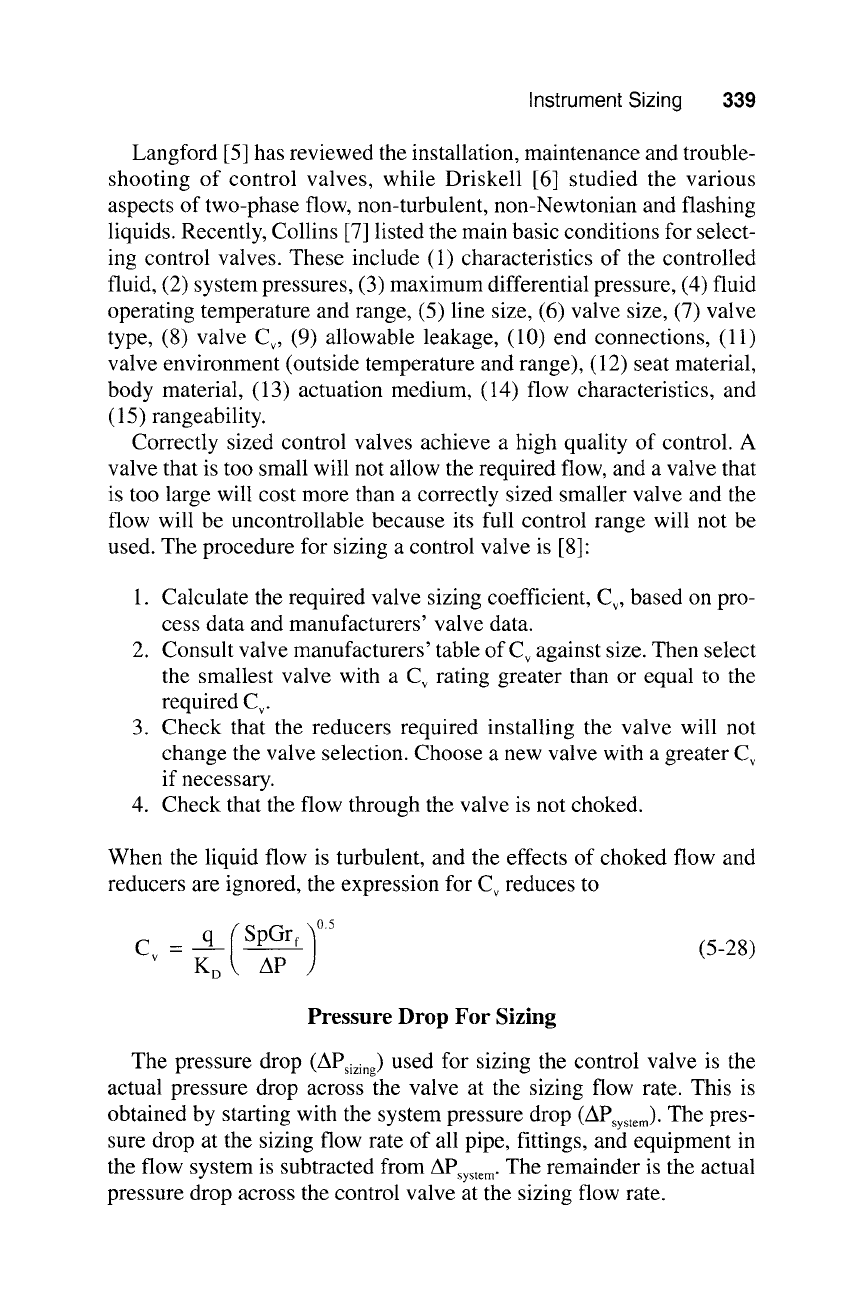
When the liquid flow is turbulent, and the effects of choked flow and
reducers are ignored, the expression for C~ reduces to
)0.5
C = q SpGrf (5-28)
v KD AP
Pressure Drop For Sizing
The pressure drop
(APsizing)
used for sizing the control valve is the
actual pressure drop across the valve at the sizing flow rate. This is
obtained by starting with the system pressure drop
(APsystem).
The pres-
sure drop at the sizing flow rate of all pipe, fittings, and equipment in
the flow system is subtracted from
APsystem.
The remainder is the actual
pressure drop across the control valve at the sizing flow rate.
340
Fortran Programs for Chemical Process Design
Choked Flow
As the flow of liquid passes the point of greatest restriction inside the
control valve, its velocity reaches a maximum and its pressure falls to a
minimum. If the pressure falls below the vapor pressure of the liquid,
vapor bubbles form within the valve. Increasing
APsizing across
the valve
beyond the point where vapor bubbles form would not alter the flow.
This suggests choked flow. The AP at which choked flow begins is called
the terminal, AP T . AP T is used instead for sizing the control valve when
APsizing across the valve is greater than AP T.
Flashing and Cavitation
Choked flow produces either flashing or cavitation. Flashing occurs
when the pressure downstream of the valve is below the vapor pressure
of the liquid, AP v. Pipe and internal valve erosion often occur because
the velocity of flashing the vapor-liquid stream is higher than the inlet
liquid velocity. A cavitation will occur if the downstream pressure is
above the liquid's vapor pressure. This results in the collapse of the
vapor bubbles as they leave the point of greatest restriction in the valve.
The shock waves and noise caused by the collapsing bubbles cause rapid
and severe damage to the valve or piping.
CONTROL VALVE SIZING FOR LIQUID, GAS,
STEAM,
AND TWO-PHASE FLOW
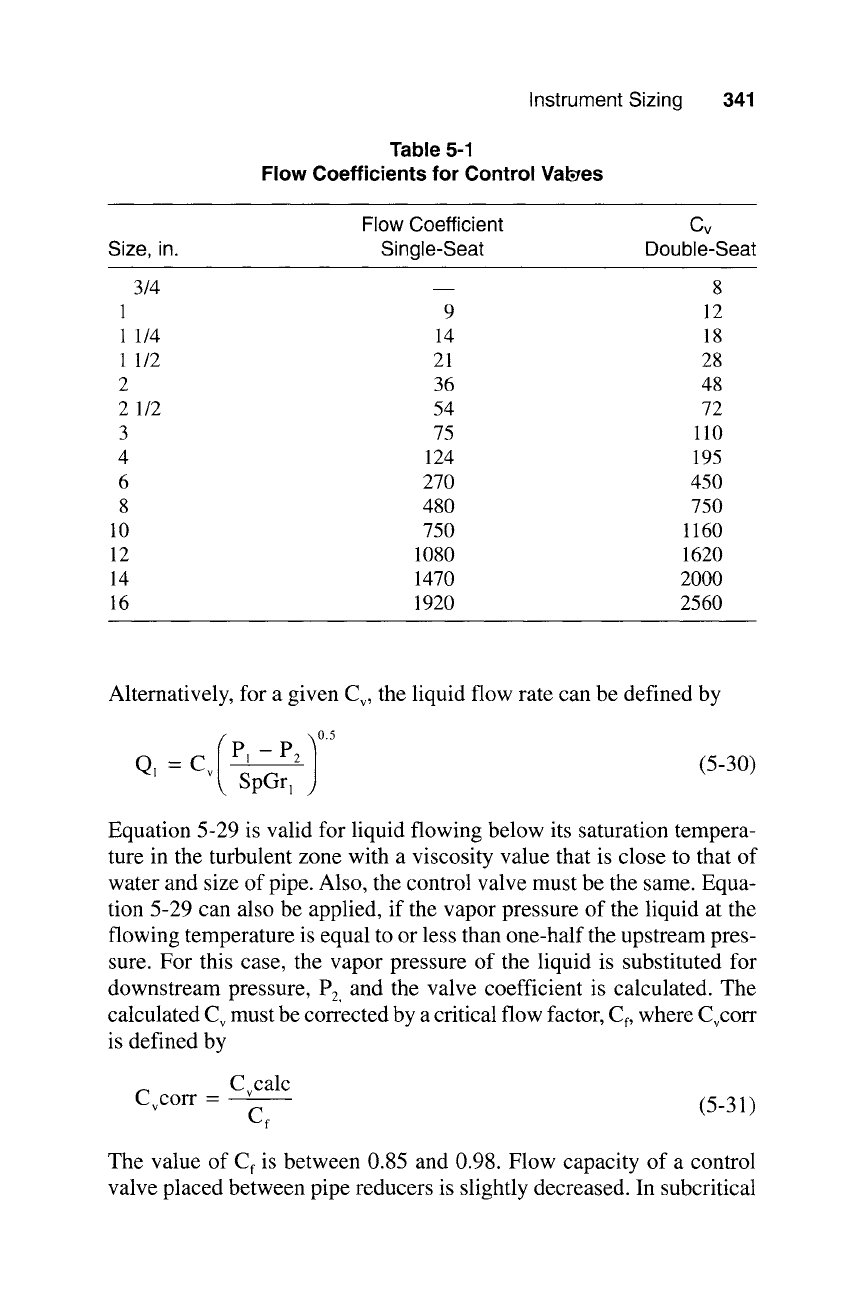
The valve flow coefficients,C v for a given valve depend on the internal
dimensions of the valve and the smoothness of the valve's internal sur-
face. Control valve manufacturers establish the C v for their valves through
a series of tests using water or air at a given pressure differential across
the valve. Manufacturers define C v as the capacity index. This indicates
the flow of water (gpm at 60~ that will pass through a completely
open valve under a pressure differential between the inlet and outlet
flanges. Control valve coefficients for single and double seated valves
are given in Table 5-1 [9].
Liquid Sizing
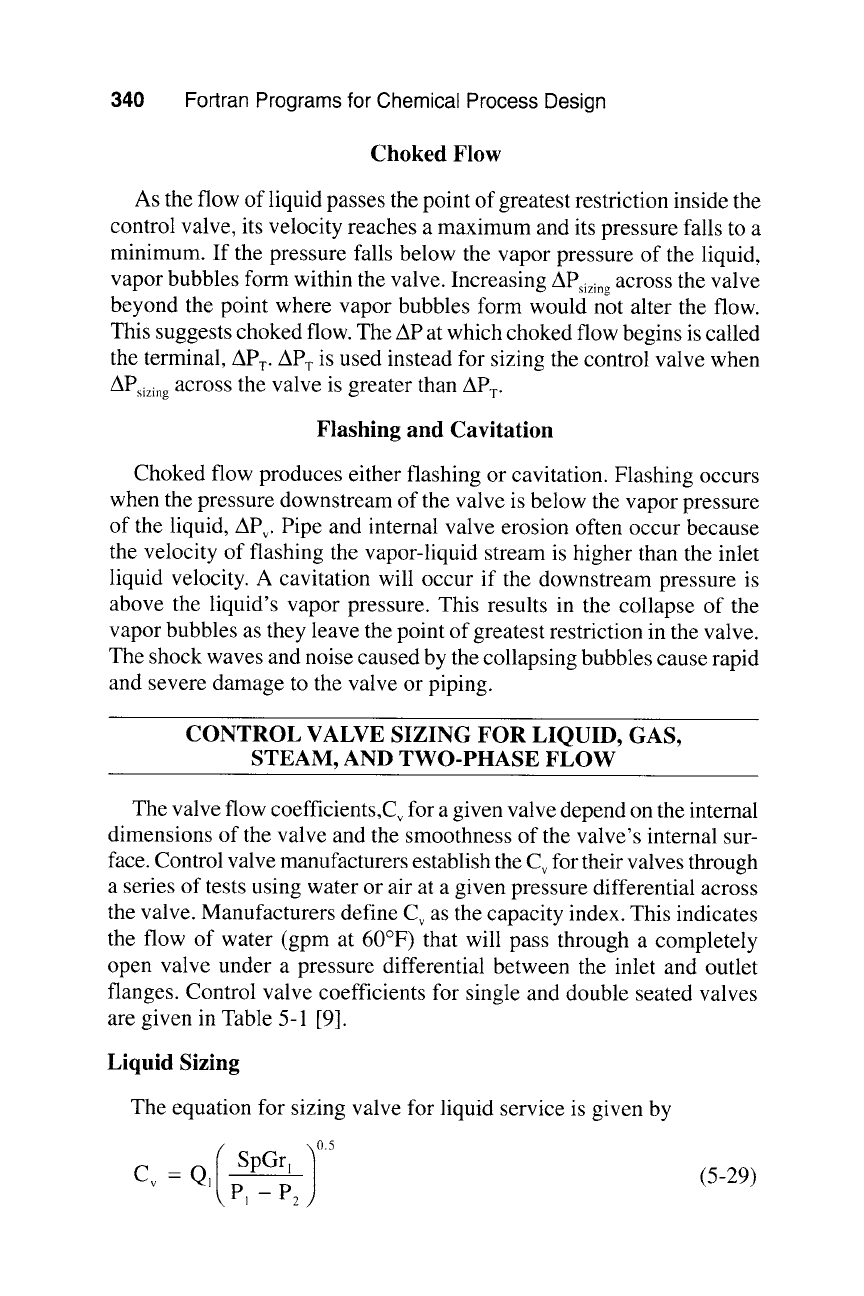
The equation for sizing valve for liquid service is given by
( /
SpGr~
Cv-Q, i~-~- 2
(5-29)
Instrument Sizing
341
Table 5-1
Flow Coefficients for Control Val~es
Flow Coefficient Cv
Size, in. Single-Seat Double-Seat
3/4 8
1 9
12
1 1/4 14 18
1
1/2 21 28
2 36 48
2 1/2 54 72
3 75 110
4 124 195
6 270 450
8 480 750
10 750 1160
12 1080 1620
14 1470 2000
16 1920 2560
Alternatively, for a given C v, the liquid flow rate can be defined by
/ 0.5
Q1 C v ( PIspG~-
P2
(5-3o)
Equation 5-29 is valid for liquid flowing below its saturation tempera-
ture in the turbulent zone with a viscosity value that is close to that of
water and size of pipe. Also, the control valve must be the same. Equa-
tion 5-29 can also be applied, if the vapor pressure of the liquid at the
flowing temperature is equal to or less than one-half the upstream pres-
sure. For this case, the vapor pressure of the liquid is substituted for
downstream pressure,
P2,
and the valve coefficient is calculated. The
calculated Cv must be corrected by a critical flow factor, Cf, where Cvcorr
is defined by
Cvcalc
Cvcorr --
Cf
(5-31)
The value of Cf is between 0.85 and 0.98. Flow capacity of a control
valve placed between pipe reducers is slightly decreased. In subcritical
342 Fortran Programs for Chemical Process Design
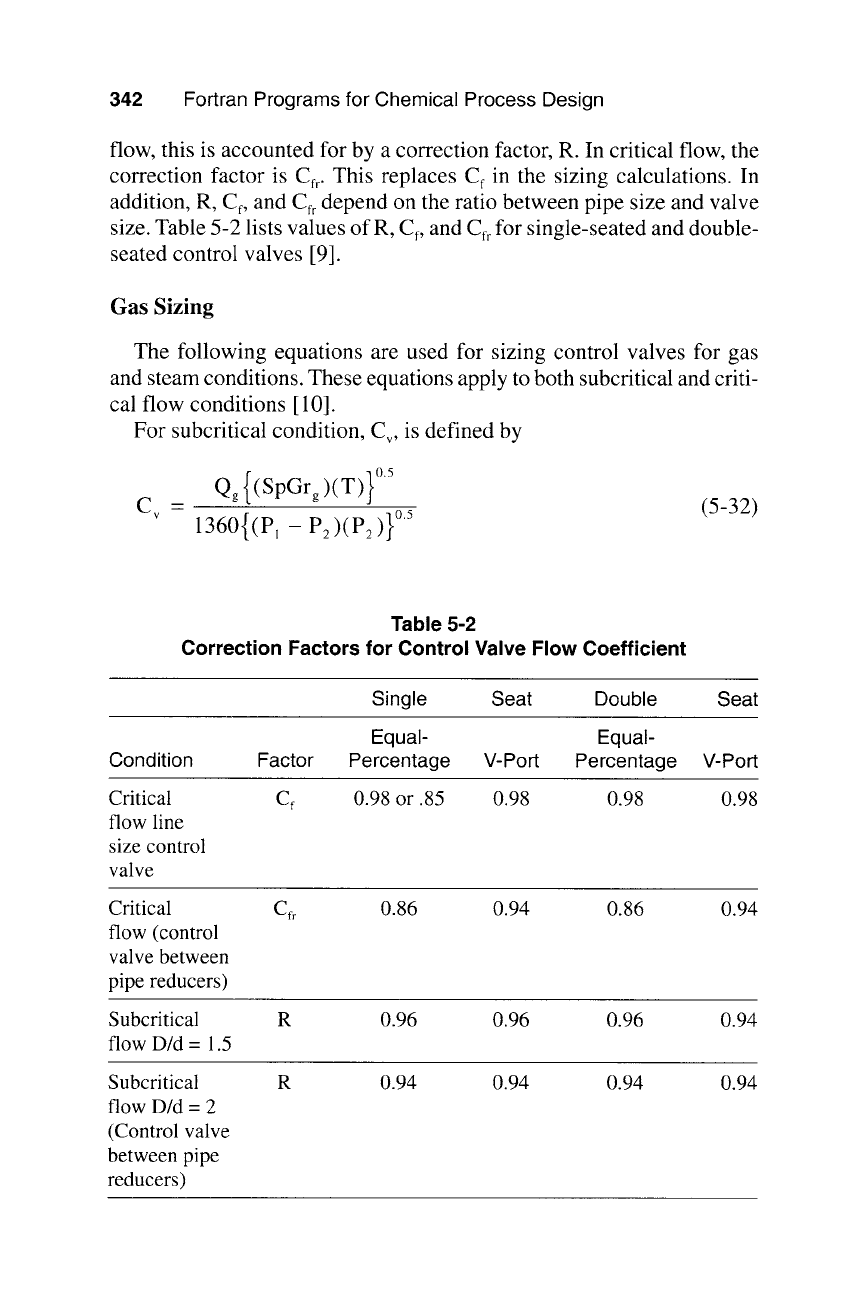
flow, this is accounted for by a correction factor, R. In critical flow, the
correction factor is Cfr. This replaces Cf in the sizing calculations. In
addition, R, Cf, and Cf~ depend on the ratio between pipe size and valve
size. Table 5-2 lists values of R, Cf, and Cfr for single-seated and double-
seated control valves [9].
Gas Sizing
The following equations are used for sizing control valves for gas
and steam conditions. These equations apply to both subcritical and criti-
cal flow conditions [10].
For subcritical condition, C v, is defined by
0.5
C = Qg{(SpGrg)(T) )}0.5 (5-32)
v 1360{(P, - P2)(P2
Table 5-2
Correction Factors for Control Valve Flow Coefficient
Single Seat Double Seat
Condition
Equal- Equal-
Factor Percentage V-Port Percentage V-Port
Critical
flow line
size control
valve
Cf 0.98 or .85 0.98 0.98 0.98
Critical
flow (control
valve between
pipe reducers)
Cfr 0.86 0.94 0.86 0.94
Subcritical
flow D/d = 1.5
R 0.96 0.96 0.96 0.94
Subcritical
flow D/d = 2
(Control valve
between pipe
reducers)
R 0.94 0.94 0.94 0.94
Instrument Sizing 343
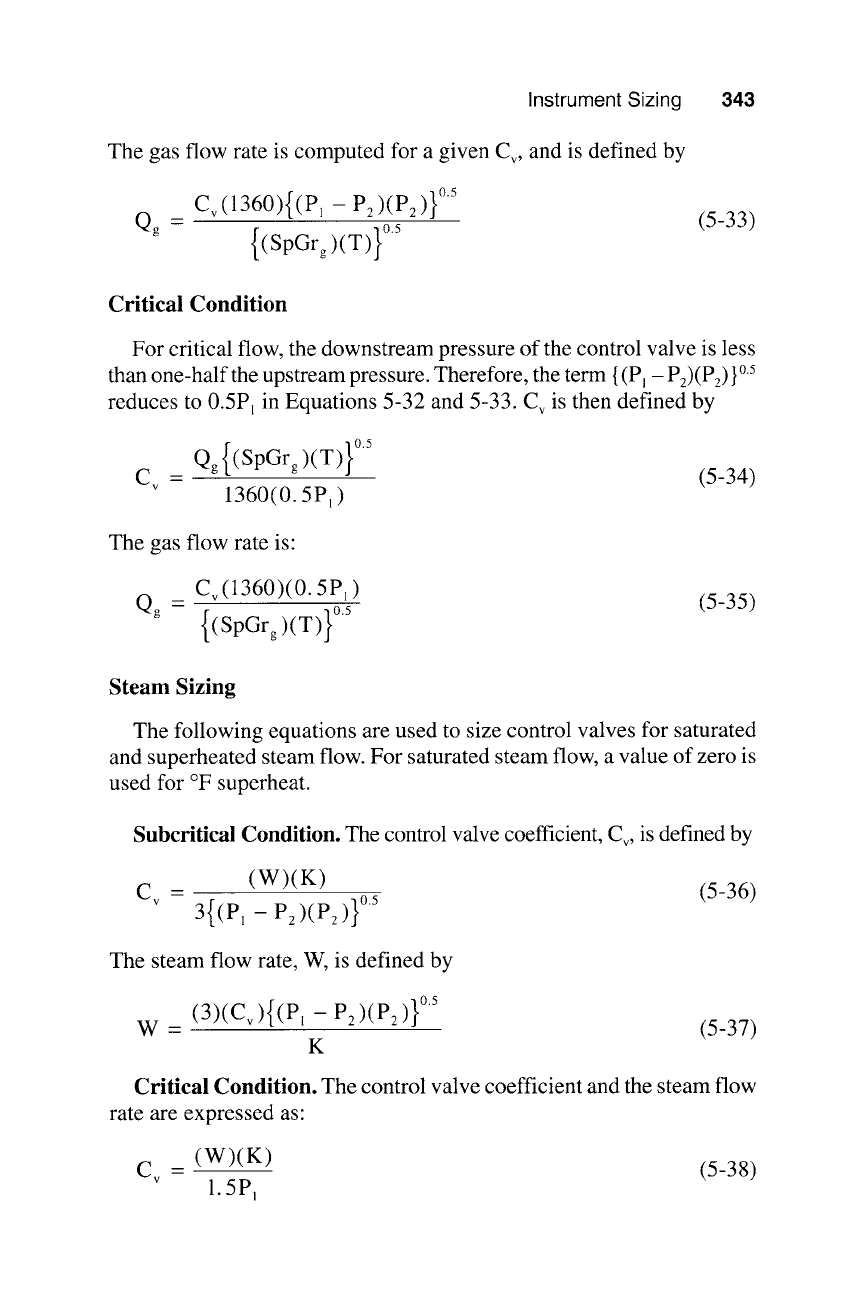
The gas flow rate is computed for a given C v, and is defined by
2
C v (1360){(P, - P })o!P2)}~
Qg - {(Sparg )(T) (5-33)
Critical Condition
For critical flow, the downstream pressure of the control valve is less
than one-half the upstream pressure. Therefore, the term {(P~-
Pz)(P2)}0.5
reduces to 0.5P~ in Equations 5-32 and 5-33. Cv is then defined by
Cv Q {(SpGrg)(T)} ~
= g (5-34)
1360(0.5P~)
The gas flow rate is:
Q : C v(1360)(0.~P~) (5-35)
g {(Sparg)(T)
Steam Sizing
The following equations are used to size control valves for saturated
and superheated steam flow. For saturated steam flow, a value of zero is
used for ~ superheat.
Subcritical Condition. The control valve coefficient, C v, is defined by
Cv = (W)(K)
3{(P1 - P: )(P2 )}0.5 (5-36)
The steam flow rate, W, is defined by
W = (3)(Cv){(P' - Pz)(P2)}05
K
(5-37)
Critical Condition. The control valve coefficient and the steam flow
rate are expressed as:
Cv = (W)(K) (5-38)
1.5P I
344 Fortran Programs for Chemical Process Design
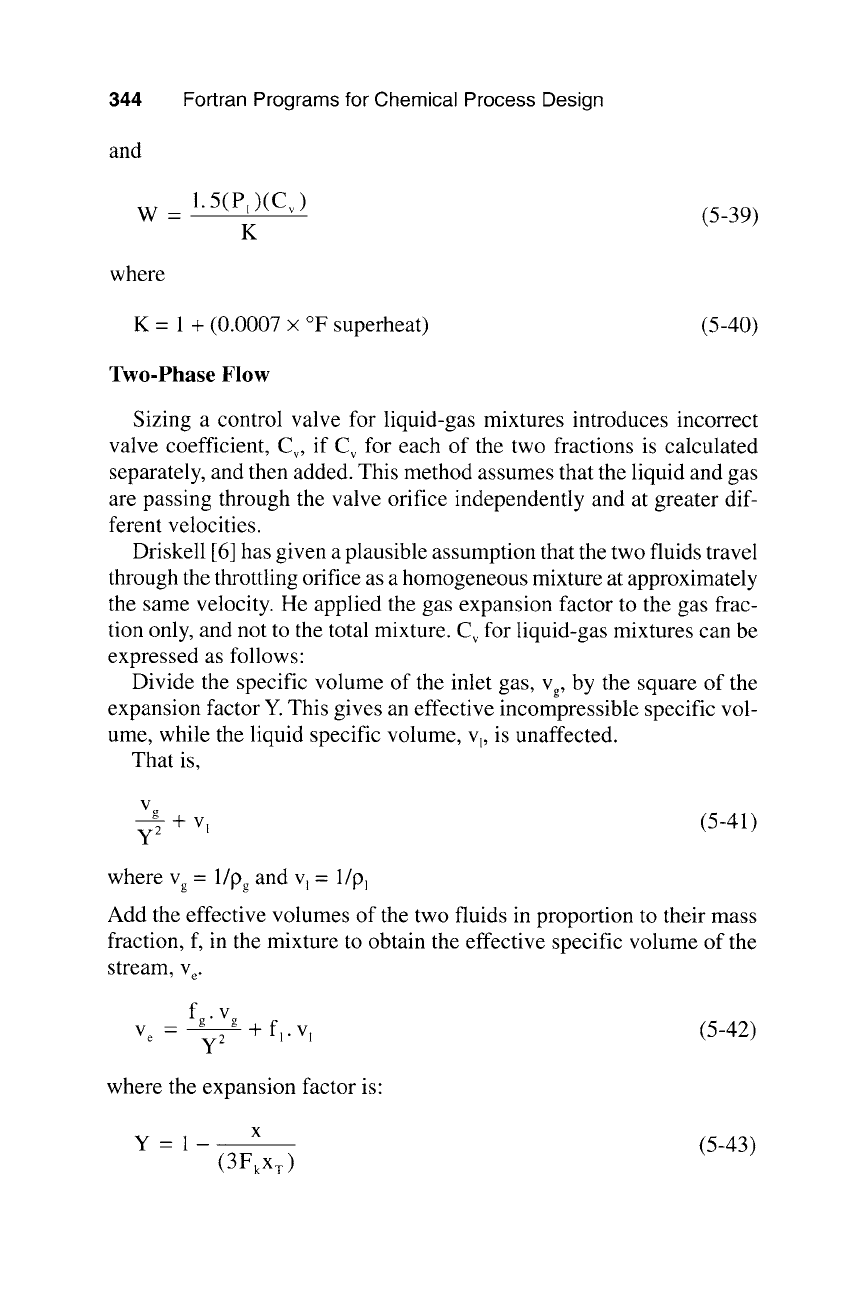
and
W - 1.5(P. )(C v ) (5-39)
K
where
K = 1 + (0.0007 x ~ superheat)
(5-40)
Two-Phase Flow
Sizing a control valve for liquid-gas mixtures introduces incorrect
valve coefficient, C v, if C v for each of the two fractions is calculated
separately, and then added. This method assumes that the liquid and gas
are passing through the valve orifice independently and at greater dif-
ferent velocities.
Driskell [6] has given a plausible assumption that the two fluids travel
through the throttling orifice as a homogeneous mixture at approximately
the same velocity. He applied the gas expansion factor to the gas frac-
tion only, and not to the total mixture. C v for liquid-gas mixtures can be
expressed as follows:
Divide the specific volume of the inlet gas, Vg, by the square of the
expansion factor Y. This gives an effective incompressible specific vol-
ume, while the liquid specific volume, Vl, is unaffected.
That is,
Vg
y2
+ v ! (5-41)
where
Vg =
1/pg and v~ =
1/p~
Add the effective volumes of the two fluids in proportion to their mass
fraction, f, in the mixture to obtain the effective specific volume of the
stream, v e.
fg. Vg
V e = y2 + fl'vl (5-42)
where the expansion factor is:
x
Y = 1- (5-43)
(3FkXT)
Instrument Sizing 345
and
x = AP/P 1
x T = pressure drop ratio factor (from manufacturer)
F k =
ratio of specific heats factor (k/1.40)
k = ratio of specific heats (Cp/Cv)
AP
= P1 - P2,
psi
P~ = inlet pressure, psia
P2 = outlet pressure, psia
The valve coefficient, C v, is:
W
C v = 0.5 (5-44)
63.3( A__p_P)ve
Alternatively, for a given Cv, the flow rate in lb/h is:
/0.5
W - 63.3(C v) AmP
V e
(5-45)
Installation
Control valves form an important equipment item in process plants,
and therefore, a lot of money can be saved by ensuring that the right
valves are installed. Selecting the right control valve for any application
starts with defining the valve's functions. For example, if an on-off inter-
lock valve is to be used, then the primary criteria for selection are reli-
ability and simplicity. If very fast and precise modulation is required,
such as for a compressor antisurge vent, a high quality valve is chosen.
Factors that affect the selection of control valves are:
9 Defining the type of fluid.
This includes the physical properties
(density and viscosity), corrosive properties, and the nominal pres-
sures, temperatures and flow rate. In the case of fluids, it is neces-
sary to know the vapor pressures to check for flashing and cavitation.
Also a high temperature increase can severely damage some types
of gaskets and packings.
9 The valve size.
This can be defined using standard calculation meth-
ods. The operating conditions and calculations may eliminate cer-
346 Fortran Programs for Chemical Process Design
tain valve styles from consideration. Cavitation is more evident
with the high-recovery rotary type valves and sometimes can be
avoided by selecting a globe valve. In addition, a valve that is too
small will not permit the required amount of flow. Alternatively, a
valve that is too large will be expensive and may create trim wear
and control problems.
9 Access for maintenance. This must be provided during the design
phase, retained during construction, and considered during the
revision stage. Maintenance can be both problematic and expen-
sive if a valve is difficult to reach or to work on. A substantial
change in the fluid-momentum (e.g., a flow through an angle valve
or a large fluid-velocity change) causes high reaction forces. This
can cause serious damage to the valves. The valve should be
installed between one and three feet above the grade or platform to
control the process.
9 Excessive stress on a valve body. This can cause leakage and
prevent normal operation of the moving parts resulting in the break-
age of the flange or valve body. Poor pipe alignment is the most prob-
able cause of excess stress. Also, heavy valves require support in order
to reduce the stress and to make removal and reinstallation easier.
Noise
Cavitation refers to the formation and subsequent collapse of vapor
bubbles in the flowing liquid stream at a point of higher pressure. This
causes erosion of the valve parts. It generates extremely high pressure
shock waves that hammer against the valve outlet and piping. Pressures
in these collapsing cavities can be as high as 500,000 psi in magnitude,
and often result in severe and rapid damage to the valve and piping.
Noise from control valves is often caused by pressures, flows, and
temperatures involving compressible flow. Valves control flow by caus-
ing turbulence, thereby converting much of the energy to heat and a
small fraction to sound. The control valve manufacturers have devel-
oped noise reducing valve trims and high-capacity valve configuration.
Langford [5] suggested that noise may be reduced by as much as 20 dB
by installing acoustic insulation at the valve and downstream, or alter-
natively by using heavier wall pipe downstream.
Nomenclature
C v = capacity coefficient for fully open control valve
fg- mass fraction in the gas phase