
Coker A.K. Fortran Programs for Chemical Process Design, Analysis, and Simulation
Подождите немного. Документ загружается.

E
ii, ii
.=
¢i
I I
ii
=,'6
¢i
E
G)
03
.r-
11-
E
O3
o3
E
O3
QI
f
f
i
~2
,---t
X
t¢"~
II
<
o
X
II
<
,~ j ~
N
f "N
x
II
<
~q
II
-- c;~c;~
II II II II II
II II II II II
II II II II II
II II H II II
II II II II II
~dcf
II II II II II
367
368
Fortran Programs for Chemical Process Design
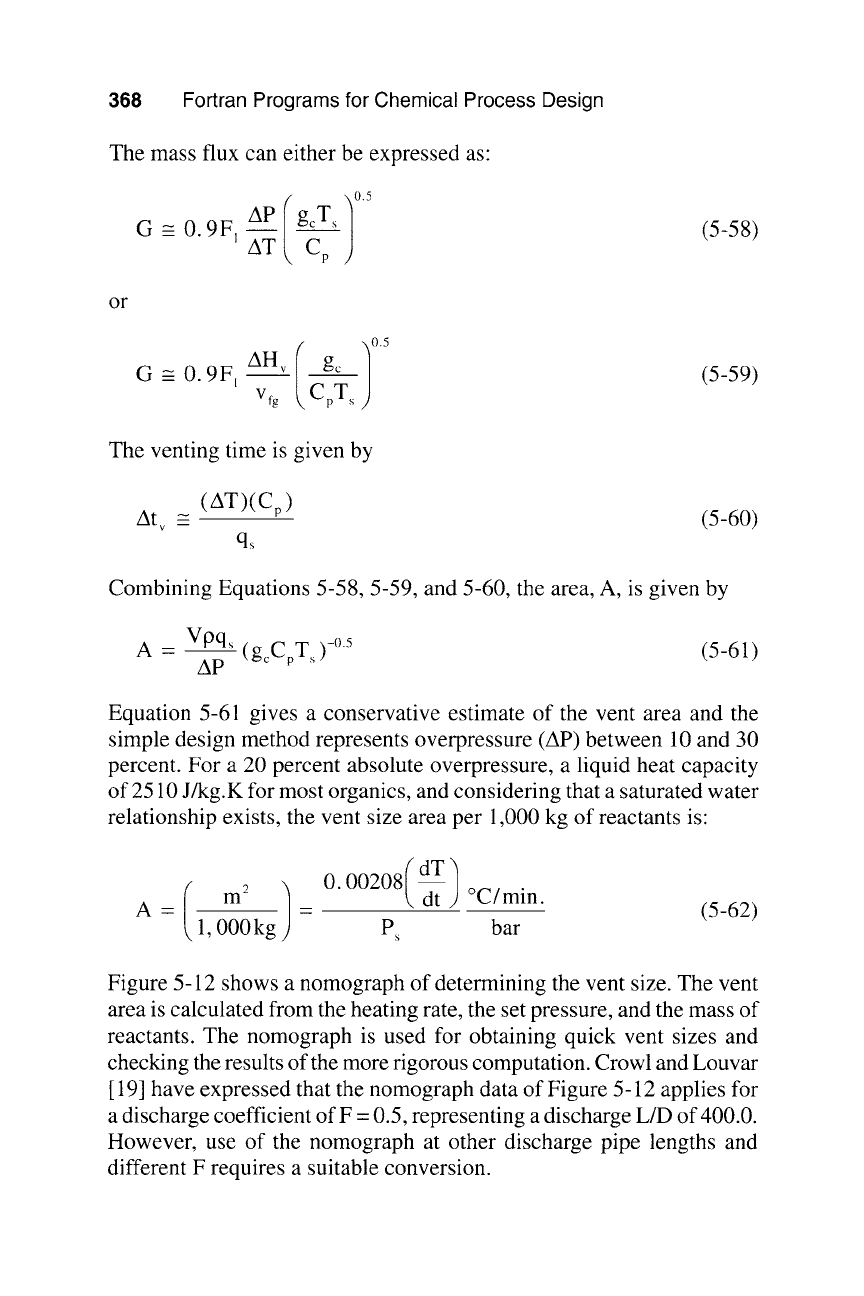
The mass flux can either be expressed as"
/0.5
AP gcT~
G'~0.9F l-~ Cp
(5-58)
or
/0.5
G- 0.9F AHv gc
! Vfg CpT~
(5-59)
The venting time is given by
At v _=_
(AT)(Cp)
qs
(5-60)
Combining Equations 5-58, 5-59, and 5-60, the area, A, is given by
A
-
Vpq~ (gcC Ts) -~ (5-61)
AP P "
Equation 5-61 gives a conservative estimate of the vent area and the
simple design method represents overpressure (AP) between 10 and 30
percent. For a 20 percent absolute overpressure, a liquid heat capacity
of 2510 J/kg.K for most organics, and considering that a saturated water
relationship exists, the vent size area per 1,000 kg of reactants is:
( m2 /
A ~
1,000 kg
(aT)
0.00208 dt ~
P, bar
(5-62)
Figure 5-12 shows a nomograph of determining the vent size. The vent
area is calculated from the heating rate, the set pressure, and the mass of
reactants. The nomograph is used for obtaining quick vent sizes and
checking the results of the more rigorous computation. Crowl and Louvar
[ 19] have expressed that the nomograph data of Figure 5-12 applies for
a discharge coefficient of F = 0.5, representing a discharge L/D of 400.0.
However, use of the nomograph at other discharge pipe lengths and
different F requires a suitable conversion.
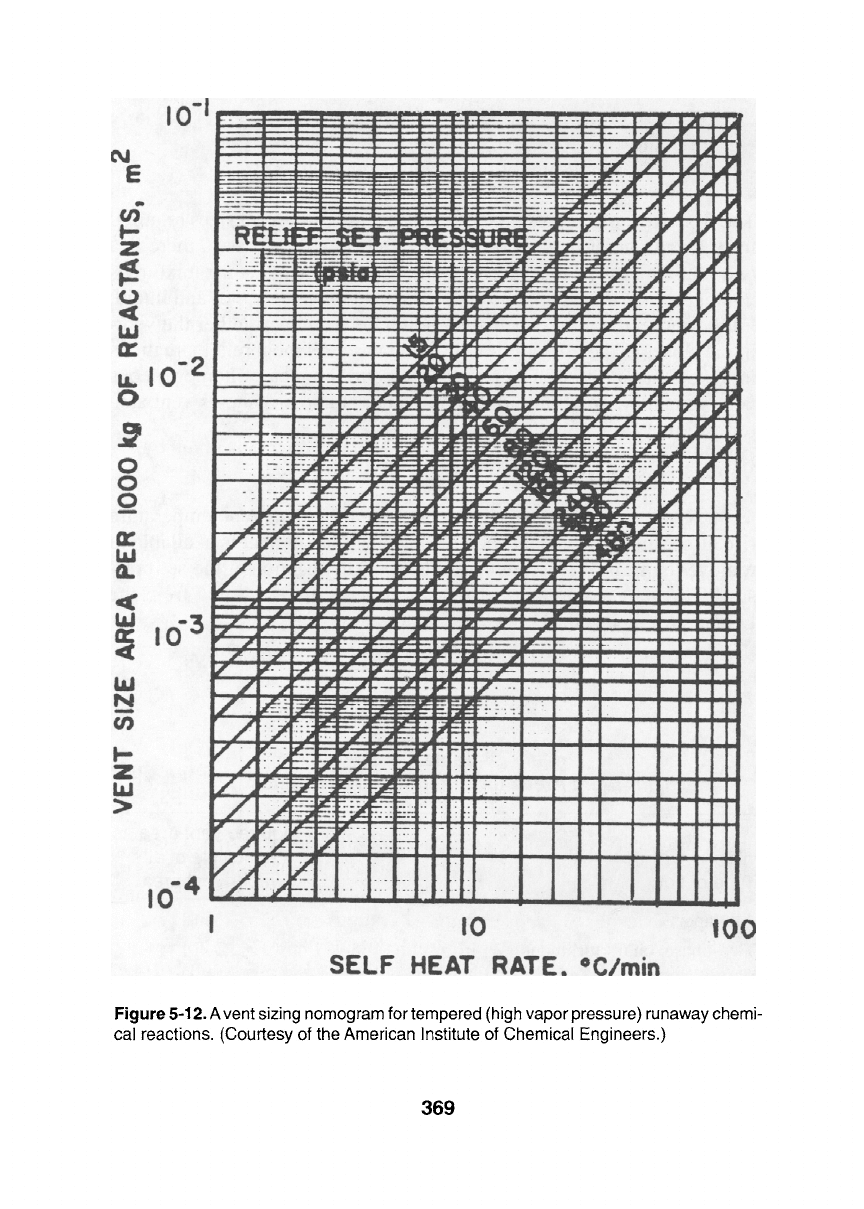
Figure
5-12. A vent sizing nomogram for tempered (high vapor pressure) runaway chemi-
cal reactions. (Courtesy of the American Institute of Chemical Engineers.)
369
370 Fortran Programs for Chemical Process Design
Vent Sizing Methods
Vents are usually sized on the assumption that the vent flow is:
9 all vapor or gas
9 all liquid
9 a two-phase mixture of liquid and vapor or gas
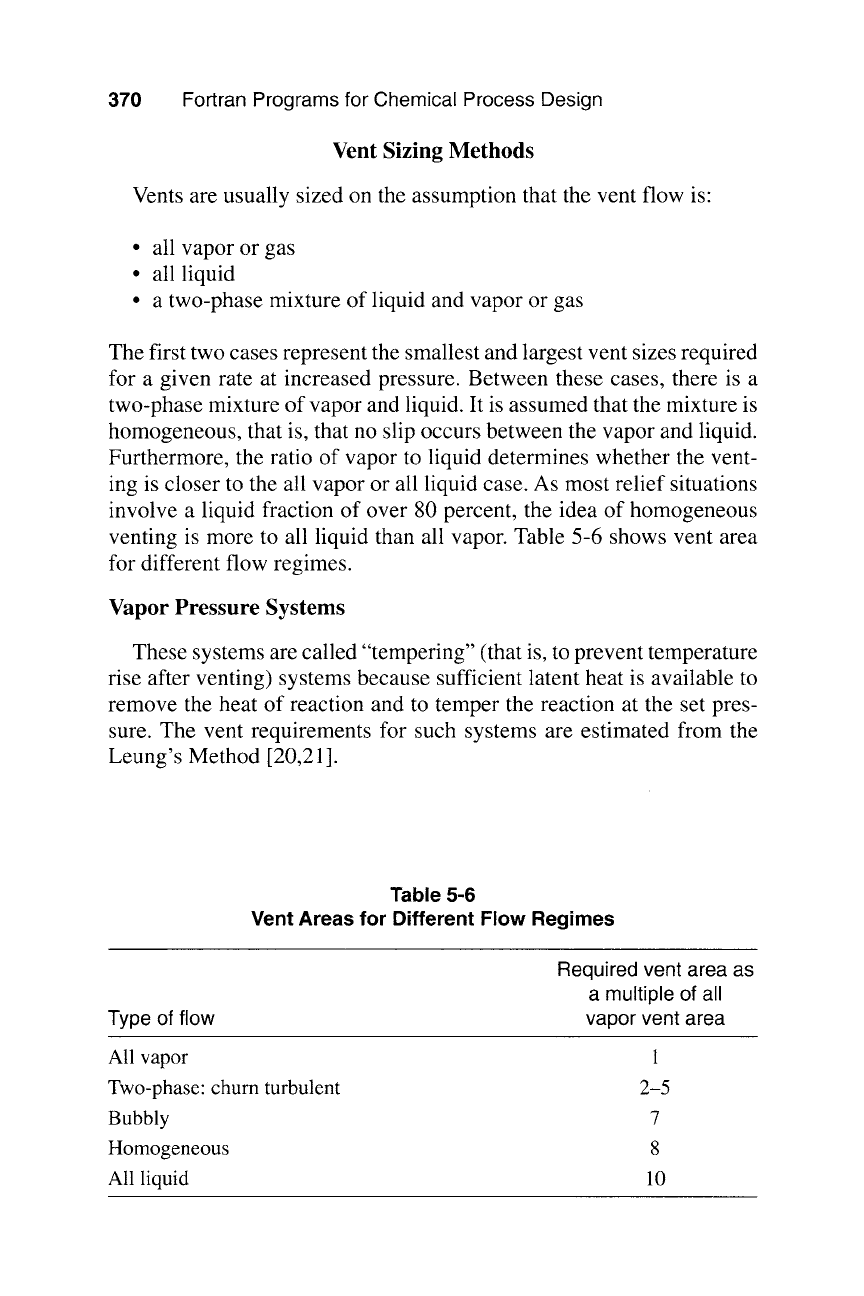
The first two cases represent the smallest and largest vent sizes required
for a given rate at increased pressure. Between these cases, there is a
two-phase mixture of vapor and liquid. It is assumed that the mixture is
homogeneous, that is, that no slip occurs between the vapor and liquid.
Furthermore, the ratio of vapor to liquid determines whether the vent-
ing is closer to the all vapor or all liquid case. As most relief situations
involve a liquid fraction of over 80 percent, the idea of homogeneous
venting is more to all liquid than all vapor. Table 5-6 shows vent area
for different flow regimes.
Vapor Pressure Systems
These systems are called "tempering" (that is, to prevent temperature
rise after venting) systems because sufficient latent heat is available to
remove the heat of reaction and to temper the reaction at the set pres-
sure. The vent requirements for such systems are estimated from the
Leung's Method [20,21 ].
Table 5-6
Vent Areas for Different Flow Regimes
Type of flow
Required vent area as
a multiple of all
vapor vent area
All vapor
Two-phase: churn turbulent
Bubbly
Homogeneous
All liquid
1
2-5
7
8
l0
Instrument Sizing 371
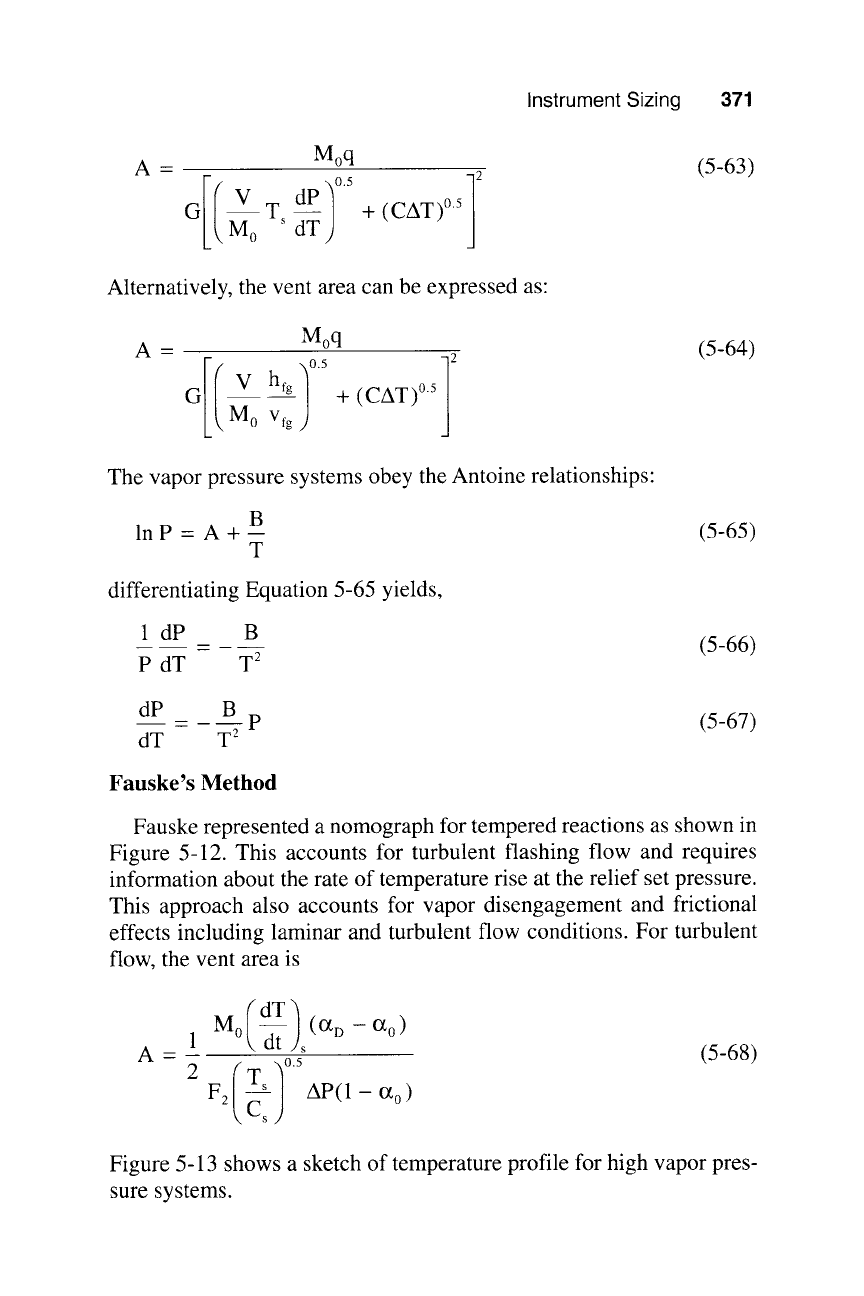
A - M~ (5-63)
V dP )o.5
G ~o-o T~ d-~ +(CAT
Alternatively, the vent area can be expressed as"
A - M~ (5-64)
I( / 1
G V hfg )o.5
+ (CAT
M 0
Vfg
The vapor pressure systems obey the Antoine relationships"
B
In P - A + -- (5-65)
T
differentiating Equation 5-65 yields,
1 dP B
P dT
T 2
(5-66)
dP
B
= p (5-67)
dT
T 2
Fauske's Method
Fauske represented a nomograph for tempered reactions as shown in
Figure 5-12. This accounts for turbulent flashing flow and requires
information about the rate of temperature rise at the relief set pressure.
This approach also accounts for vapor disengagement and frictional
effects including laminar and turbulent flow conditions. For turbulent
flow, the vent area is
(aT)
1 M~ -dt (~D--C~0)
s
A - -
F 2 ~ AP(1 - cx o )
(5-68)
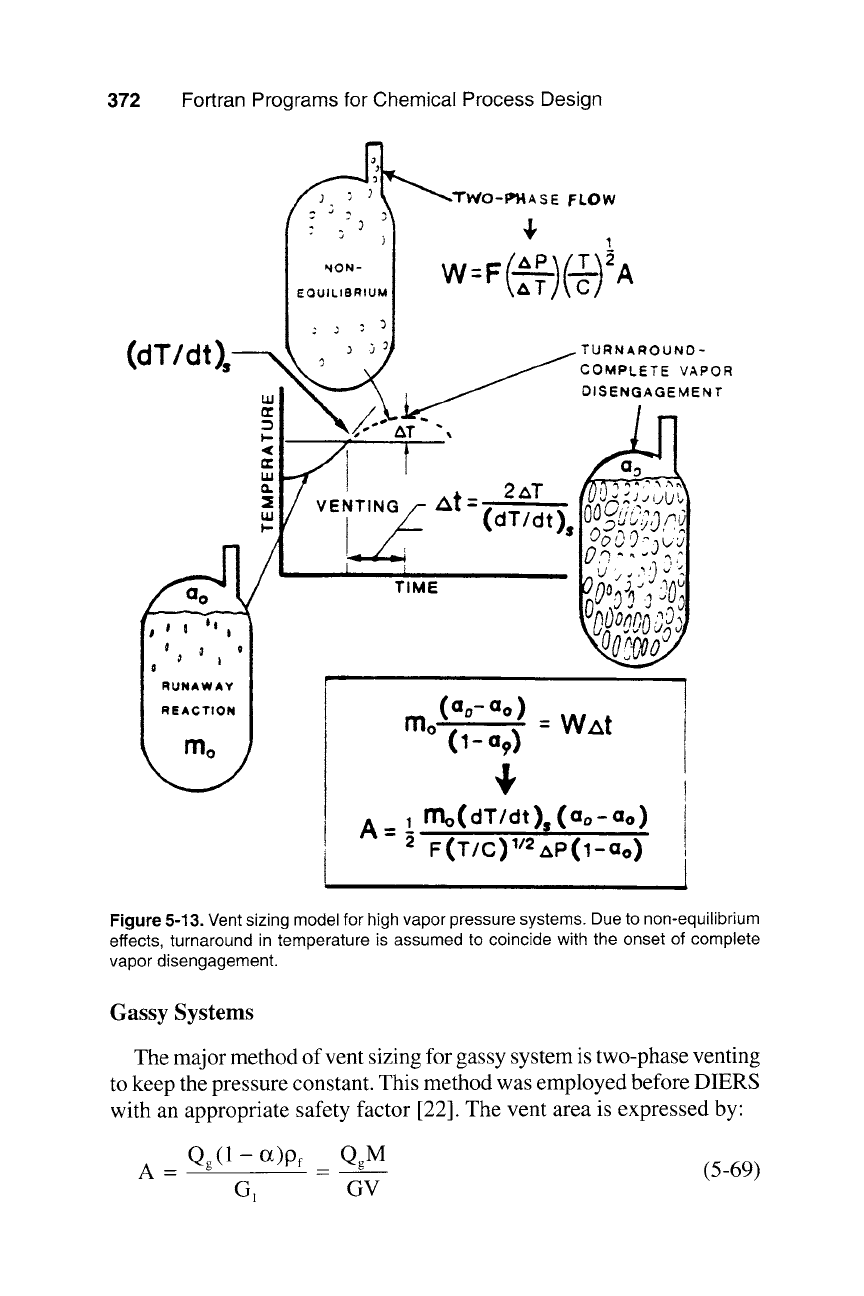
Figure 5-13 shows a sketch of temperature profile for high vapor pres-
sure systems.
372
Fortran Programs for Chemical Process Design
~TV40-P14 A S E
FLOW
NON
~~P
- W-F
,ou::;:,u. .,t(+)
I ; 3
? 3
0 COMPLETE VAPOR
LU DISENGAGEMENT
.- ..~.- ~, -,
/ n
~1/ VENTING/- at=.'dT
.
I i01 3 lifo
r
RUNAWAY
REACTION
m~ (0,,-
a,)
= Wat
(1-.9)
1
4 T
, mo(dT/dt), (ao-ao) i
A =
~ F(T/C),/2Lxp(I_ao) ,
J
Figure
5-13. Vent sizing model for high vapor pressure systems. Due to non-equilibrium
effects, turnaround in temperature is assumed to coincide with the onset of complete
vapor disengagement.
Gassy Systems
The major method of vent sizing for gassy system is two-phase venting
to keep the pressure constant. This method was employed before DIERS
with an appropriate safety factor [22]. The vent area is expressed by:
A - Qg (1 -
DE)Of
_- QgM (5-69)
G l GV
Instrument Sizing 373
Unlike systems with vapor present, gassy systems do not have appre-
ciable latent heat to temper the reaction. The system pressure increases
as the rate of gas generation with temperature increases, until it reaches
the maximum value. The vent area could be underestimated if sizing is
dependent on the rate of gas generated at the set pressure. Therefore, it
is more plausible to size the vent area on the maximum rate of gas gen-
eration. Homogeneous two-phase venting is assumed even if the dis-
charge of liquid during venting could reduce the rate of gas generation
even further. The vent area is defined by
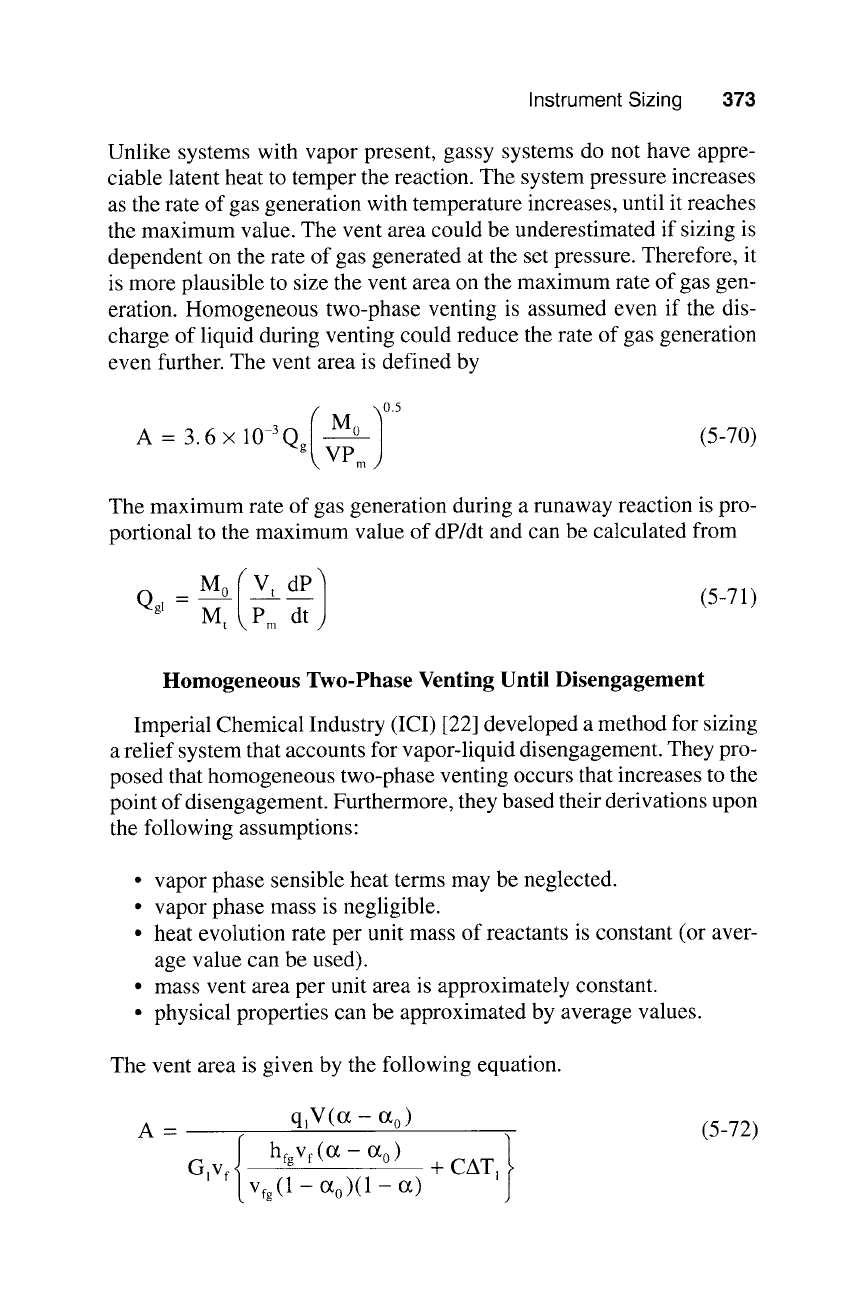
10.5
M0
A-3.6• -3Qg VPm
(5-70)
The maximum rate of gas generation during a runaway reaction is pro-
portional to the maximum value of dP/dt and can be calculated from
M0/vt dP /
Qgl - MI pm d- ~
(5-71)
Homogeneous Two-Phase Venting Until Disengagement
Imperial Chemical Industry (ICI) [22] developed a method for sizing
a relief system that accounts for vapor-liquid disengagement. They pro-
posed that homogeneous two-phase venting occurs that increases to the
point of disengagement. Furthermore, they based their derivations upon
the following assumptions:
9 vapor phase sensible heat terms may be neglected.
9 vapor phase mass is negligible.
9 heat evolution rate per unit mass of reactants is constant (or aver-
age value can be used).
9 mass vent area per unit area is approximately constant.
9 physical properties can be approximated by average values.
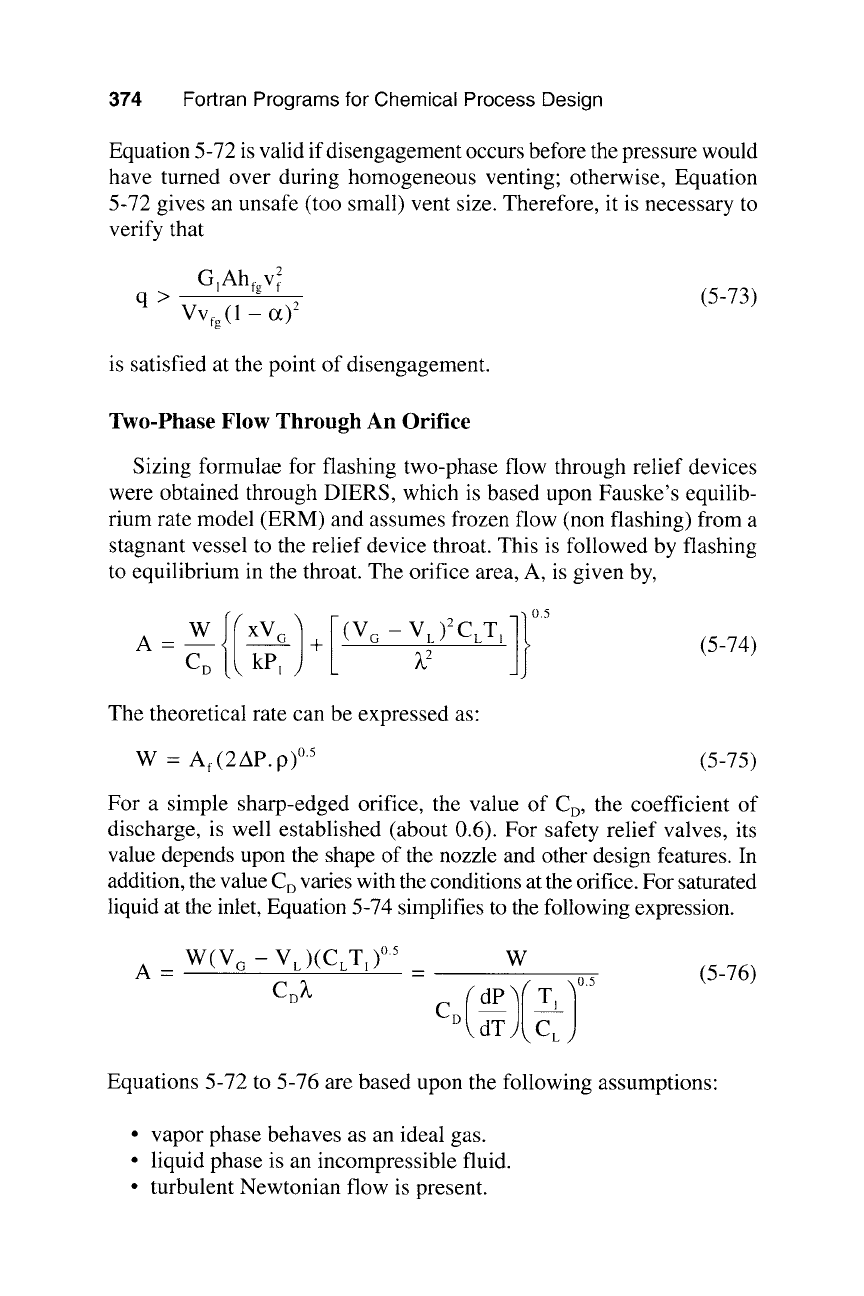
The vent area is given by the following equation.
A - q~V(o~ - o%) (5-72)
{ hfgVf(O~--O~o) }
Glv e + CAT
ve (1 - 0)(1 - cx)
374 Fortran Programs for Chemical Process Design
Equation 5-72 is valid if disengagement occurs before the pressure would
have turned over during homogeneous venting; otherwise, Equation
5-72 gives an unsafe (too small) vent size. Therefore, it is necessary to
verify that
2
GiAhfgve
q > (5-73)
Vvfg (1 _~)2
is satisfied at the point of disengagement.
Two-Phase Flow Through An Orifice
Sizing formulae for flashing two-phase flow through relief devices
were obtained through DIERS, which is based upon Fauske's equilib-
rium rate model (ERM) and assumes frozen flow (non flashing) from a
stagnant vessel to the relief device throat. This is followed by flashing
to equilibrium in the throat. The orifice area, A, is given by,
A W
xV G
(V G _ VL )2 CLT~
- + (5-74)
C D
kPi ~2
The theoretical rate can be expressed as:
W- Af(2AP. p) ~
(5-75)
For a simple sharp-edged orifice, the value of C D, the coefficient of
discharge, is well established (about 0.6). For safety relief valves, its
value depends upon the shape of the nozzle and other design features. In
addition, the value C D varies with the conditions at the orifice. For saturated
liquid at the inlet, Equation 5-74 simplifies to the following expression.
A - W(VG -- VL)(CLT')~ = W (5-76)
< )
Equations 5-72 to 5-76 are based upon the following assumptions:
9 vapor phase behaves as an ideal gas.
9 liquid phase is an incompressible fluid.
9 turbulent Newtonian flow is present.
Instrument Sizing 375
9 critical flow. This is usually the case because the critical pressure
ratios of flashing liquid approach the value of 1.0.
Duxbury and Wilday [22] recommend that a safety factor of at least 2.0
be used. In certain cases, lower safety factors may be employed. How-
ever, the designer should consult the appropriate process safety section
in the engineering department for advice.
Discharge System
Design of the Vent Pipe.
The nature of the discharging fluid is nec-
essary in determining the relief areas. DIERS and ICI techniques can
analyze systems that exhibit "natural" surface active foaming and those
that do not. DIERS further found that small quantities of impurities can
affect the flow regime in the reactor. In addition, a variation in impurity
level could arise by changing the supplier of a particular raw material.
Therefore, care is needed in sizing emergency relief on homogeneous
vessel behavior, that is, two-phase flow.
In certain instances, pressure relief during a runaway reaction can
result in a three-phase discharge if solids are suspended in the reaction
liquors. Solids can also be entrained by turbulence caused by boiling or
gassing in the bulk of the liquid. Caution is required in sizing this type
of relief system, especially where there is a significantly static head of
fluid in the discharge pipe. Another aspect in the design of the relief
system includes the possible blockage in the vent line. This could arise
from the process material being solidified in cooler sections of the reac-
tor. It is important to consider all discharge regimes when designing the
discharge pipe work.
Safe Discharge
Reactors or storage vessels are fitted with overpressure protection vent
directly to roof level. Such devices (e.g., relief valves) protect only against
common process maloperations and not runaway reactions. The quantity
of material ejected and the rate of discharge are low, resulting in good dis-
persion. The rise of bursting disc can result in large quantities of materials
(95% of the reactor contents) being discharged for foaming systems.
The discharge of copious quantities of chemicals directly to atmos-
phere can give rise to secondary hazards, especially if the materials are
toxic and can form flammable atmosphere in air (e.g., vapor or mist). In
such cases, the provision of a knock-out device (scrubber, dump tank)
of adequate size to contain the aerated/foaming fluid will be required.
376 Fortran Programs for Chemical Process Design
Conditions of Use
9 If Fauske's method yields a significantly different vent size, then
the calculation should be reviewed.
9 The answer obtained from the Leung's method should not be sig-
nificantly smaller than that from Fauske's method.
9 ICI recommends a safety factor of 1-2 on flow or area. The safety
factor associated with the inaccuracies of the flow calculation will
depend on the method used, the phase nature of the flow, and the
pipe friction. For two-phase flow, use a safety factor of two to ac-
count for friction and static head.
9 Choose the smaller of the vent size from the two methods.
A systematic evaluation of venting requires information on:
9 the reaction~vapor, gassy, or hybrid.
9 flow regime~foamy or nonfoamy.
9 vent flow~laminar or turbulent.
9 vent sizing parameters, such as dT/dt, AP/AT, AT.
It is important to ensure that all factors (e.g., long vent lines) are
accounted for, independent of the methods used. Designers should
ascertain that a valid method is chosen rather than the most convenient
or the best one. For ease of use, the Leung's method for vapor pressure
systems are rapid and easy. Different methods should give vent sizes
with a factor of two. Nomographs give adequate vent sizes for long
lines to L/D of 400, but sizes are divisible by two for nozzles. Table 5-6A
lists the applicability of both Leung and Fauske's methods.
Nomenclature
A = vent area,
m 2
A~ = relief vent area
A r = flow area, m 2
C = specific heat of the material, J/Kg.K
CD = coefficient of discharge (CD = 0.6)
CL- average liquid specific heat capacity, J/Kg.K
Cp- specific heat at constant pressure, J/Kg.K
d = vent diameter, mm
F = flow reduction factor
F~ = correction factor, and for a length of pipe zero, F~= 1.0. As the
pipe length increases, the value of F~ decreases.