
Cossey L. Introduction to Mathematical Physics
Подождите немного. Документ загружается.

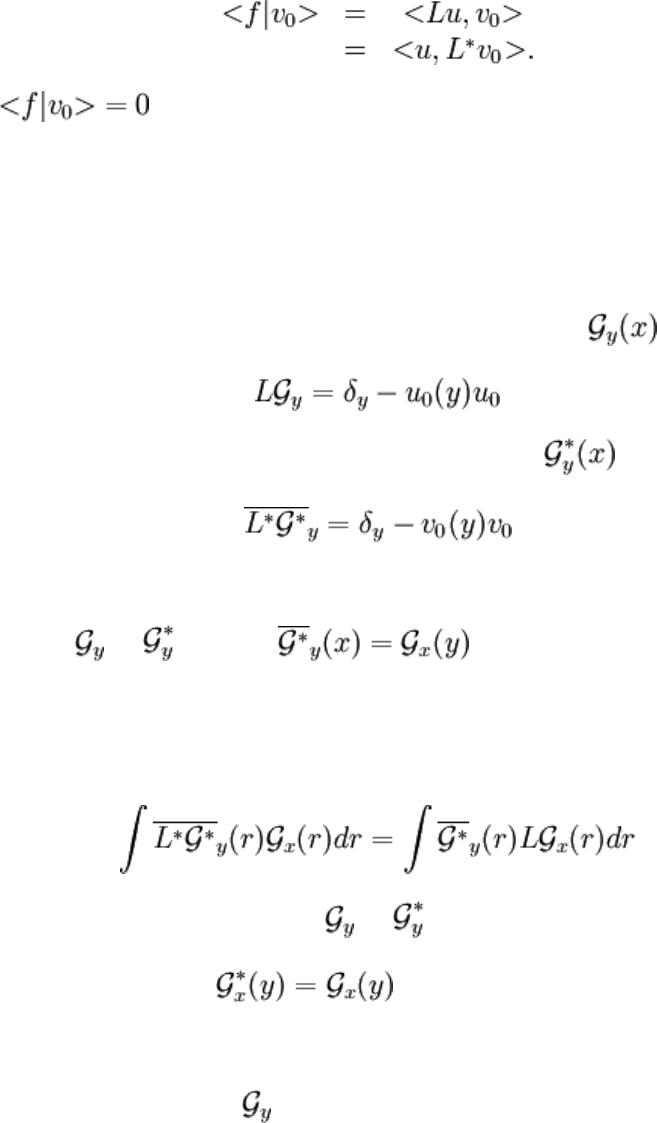
Let u such that Lu = f. Let v
0
be a solution of L v = 0
*
0
({\it i.e} a function of Ker (L )
*
).
Then:
Thus
However, once f is projected onto the orthogonal of Ker (L )
*
, calculations similar to the
previous ones can be made: Let us assume that the kernel of L is spanned by a function u
0
and that the kernel of L
*
is spanned by v
0
.
Definition: The Green solution of problem P(f,0,0) is the function solution of
The Green solution of adjoint problem P(f,0,0) is the function solution of
where horizontal bar represents complex conjugaison.
Theorem: If and exist, then
Proof:
By definition of the adjoint L
*
of an operator L
Using definition relations defgreen2 of and , one obtains the result.
In particular, if L = L
*
then .
Theorem:
There exists a unique function
such that
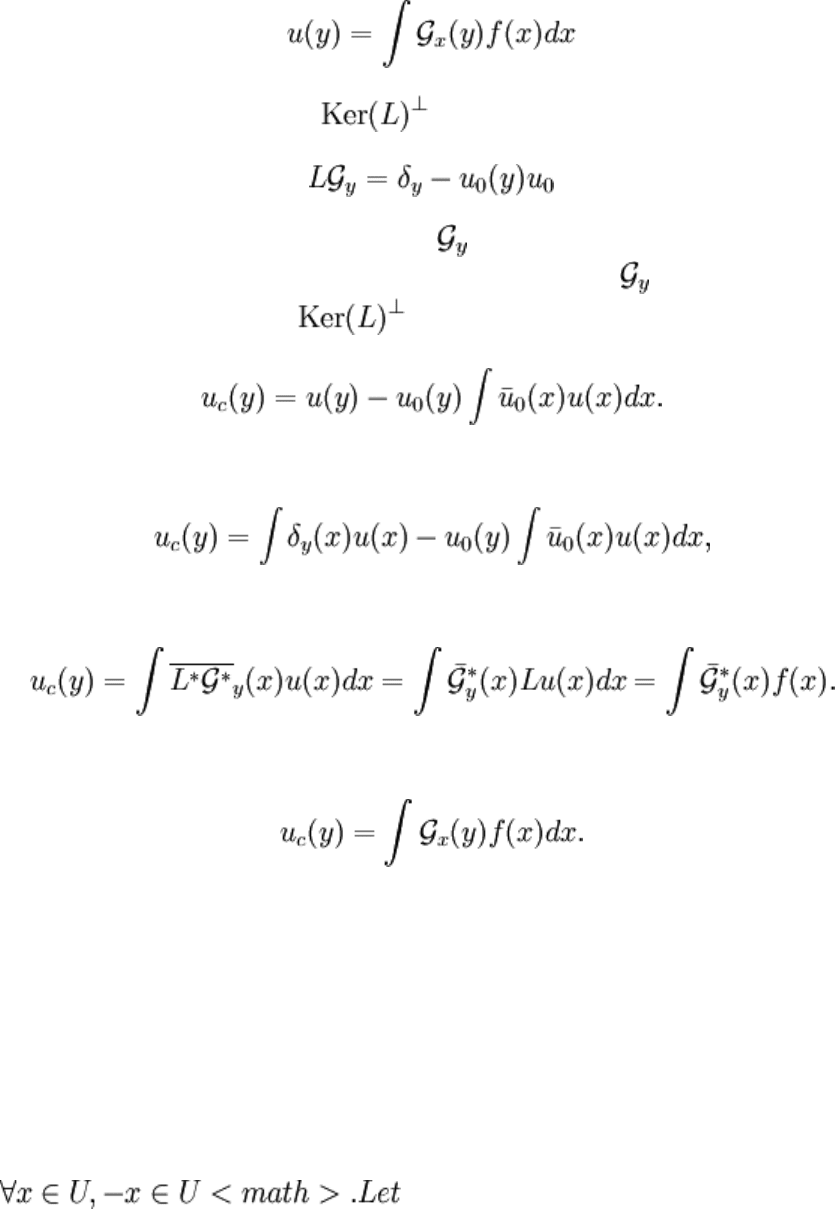
is solution of problem P(f,0,0) in
and
Proof\footnote{In particular, the existence of .} of this theorem is not given here.
However, let us justify solution definition formula. Assume that
exists. Let u
c
be the
projection of a function u onto
.
This can also be written:
or
From theorem theogreen2, we have:
Resolution
Once problem's Green function is found, problem's solution is obtained by simple
integration. Using of symmetries allows to simplify seeking of Green's functions.
Images method
\index{images method}
Let U be a domain having a symmetry plan:
\partial UbetheborderofU</math>. Symmetry
plane shares U into two subdomains: U
1
and U
2
(voir la figure figsymet).
Symet
Domain U is the union of U
1
and U
2
symetrical with respect to plane x = 0.} LABEL
figsymet
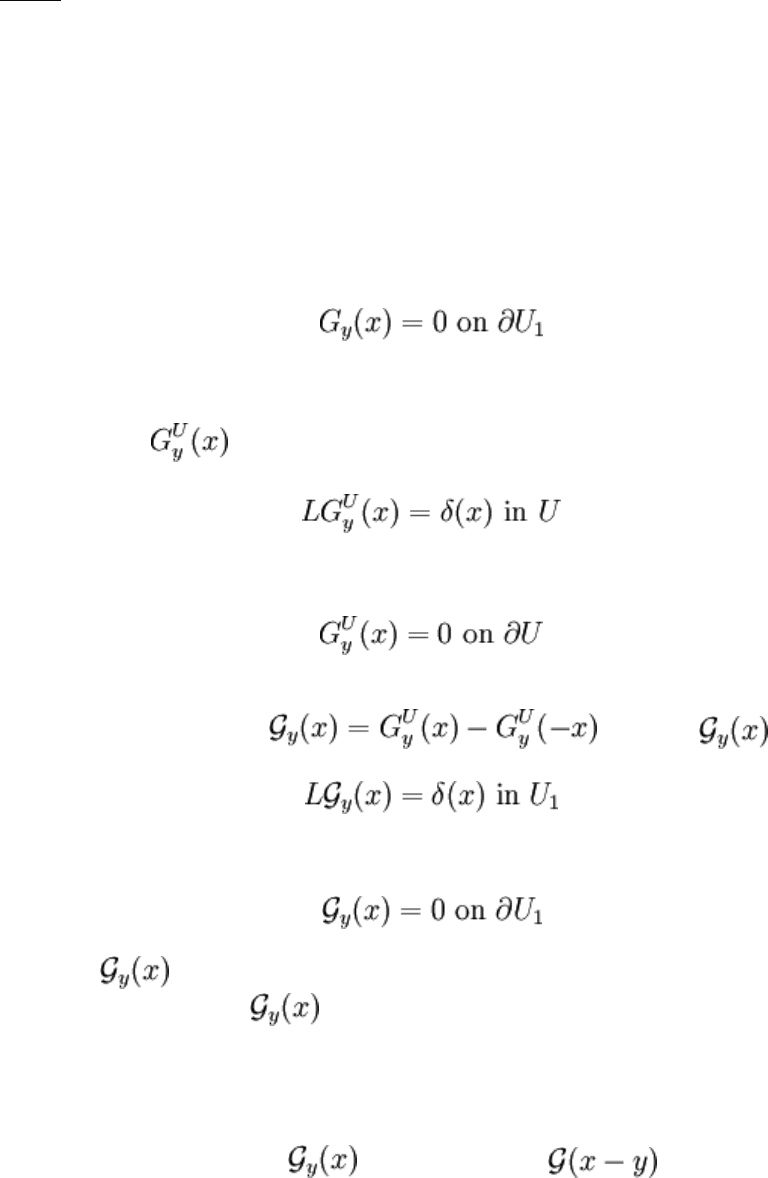
Let us seek the solution of the folowing problem:
Problem: Find G
y
(x) such that:
LG
y
(x) = δ(x) in U
1
and
knowing solution of problem
Problem: Find such that:
and
Method of solving problem p em probconnu is called robori by using solution of probl
images method ). Let us set . Function verifies
and
Functions and G (x) the same equation. Green function
y
verify x) is thus simply
the restriction of function
G
y
(
to U
1
. Problem probori is thus solved.
Invariance by translation
riant b unction's dWhen problem P(f,0,0) is inva y translation, Green f efinition relation can
be simplified. Green function becomes a function that depends only on
difference x - y and its definition relation is:
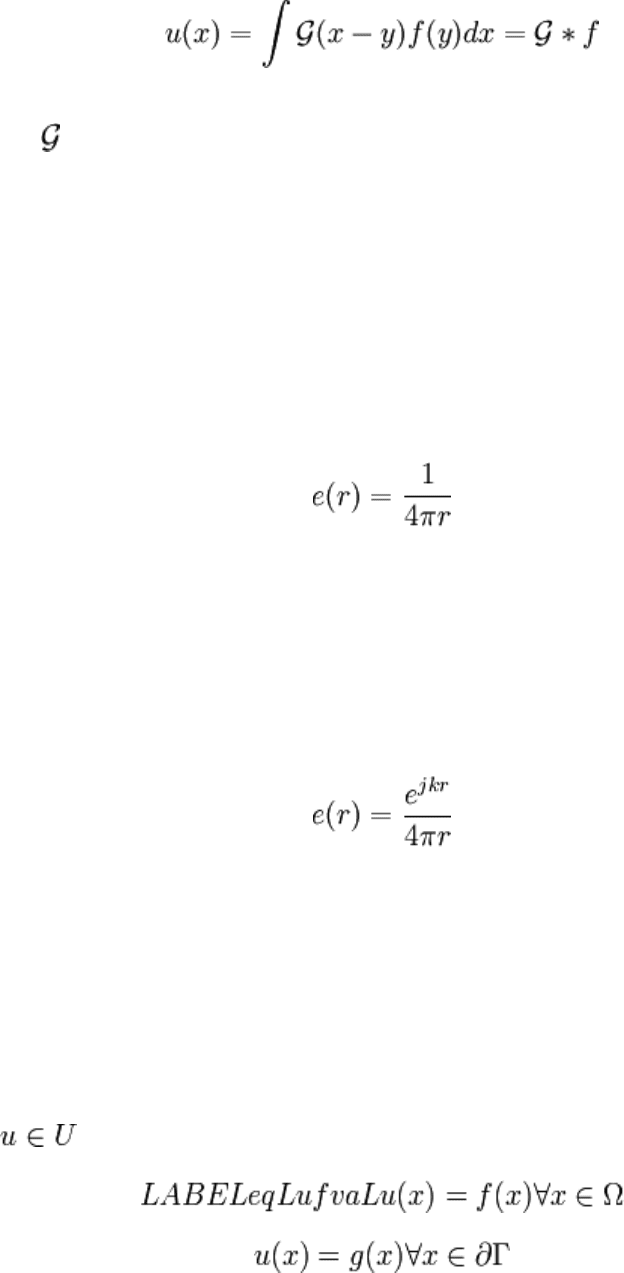
where * is the convolution product appendix{appendconvoldist})\index{convolution}.
Function is in this case called elementary solution and noted e. Case where P(f,0,0) is
translation invariant typically corresponds to infinite boundaries. Here are some examples
of well known elemantary solutions:
Example:
Laplace equation in R
3
. Considered operator is:
L = ∆
Elementary solution is:
Example:
Helmholtz equation in R
3
. Considered operator is:
L = ∆ + k
2
Elementary solution is:
Boundary problems, variational methods
==Variational formulation==LABEL secvafor
Let us consider a boundary problem:
Problem:
Find
such that:
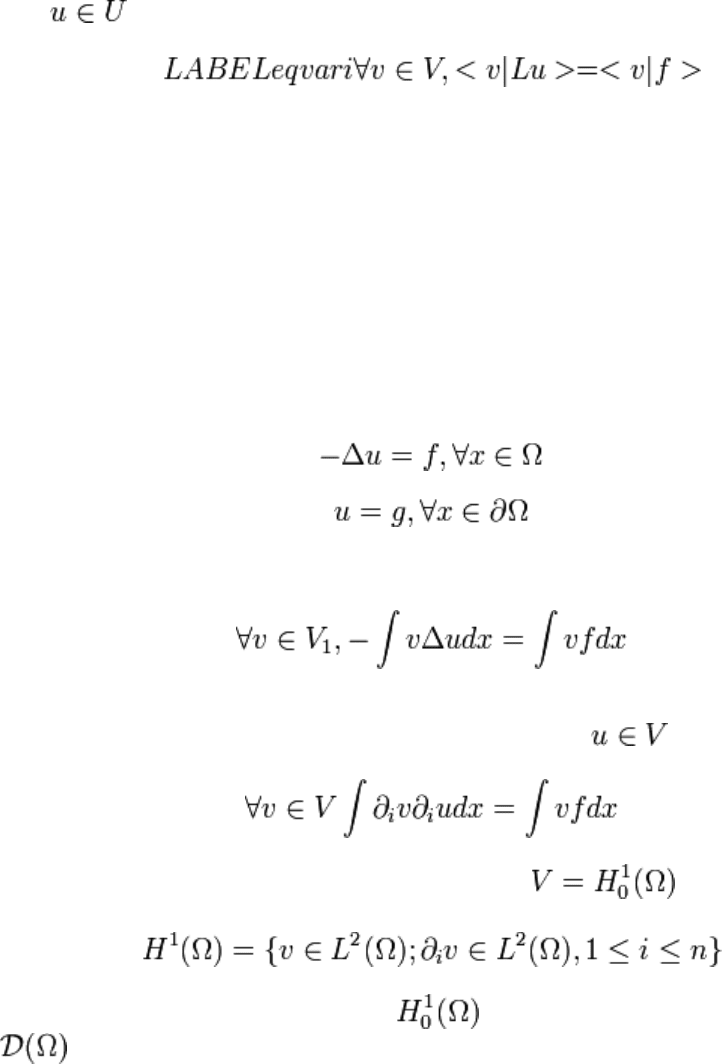
Let us suppose that is a unique solution u of this problem. For a functional space V
sufficiently large the previous problem, may be equivalent to the following:
Problem:
Find such that:
This is the variational form of the boundary problem. To obtain the equality
eqvari, we have just multiplied scalarly by a "test function" < v |
equation eqLufva. A "weak form" of this problem can be found using Green formula type
formulas: the solution space is taken larger and as a counterpart, the test functions space
is taken smaller. let us illustrate those ideas on a simple example:
Example:
Find u in U = C
2
such that:
The variational formulation is: Find u in U = C
2
such that:
Using the Green equality appendix secappendgreeneq)\index{Green formula} and the
boundary conditions we can reformulate the problem in: find , such that:
One can show that this problem as a unique solution in
where
is the Sobolev space of order 1 on Ω and is the adherence of H (Ω)
1
in the space
(space of infinitely differentiable functions on Ω, with compact support in Ω).
It may be that, as for the previous example, the solution function space and the test
function space are the same. This is the case for most of linear operators L encountered in
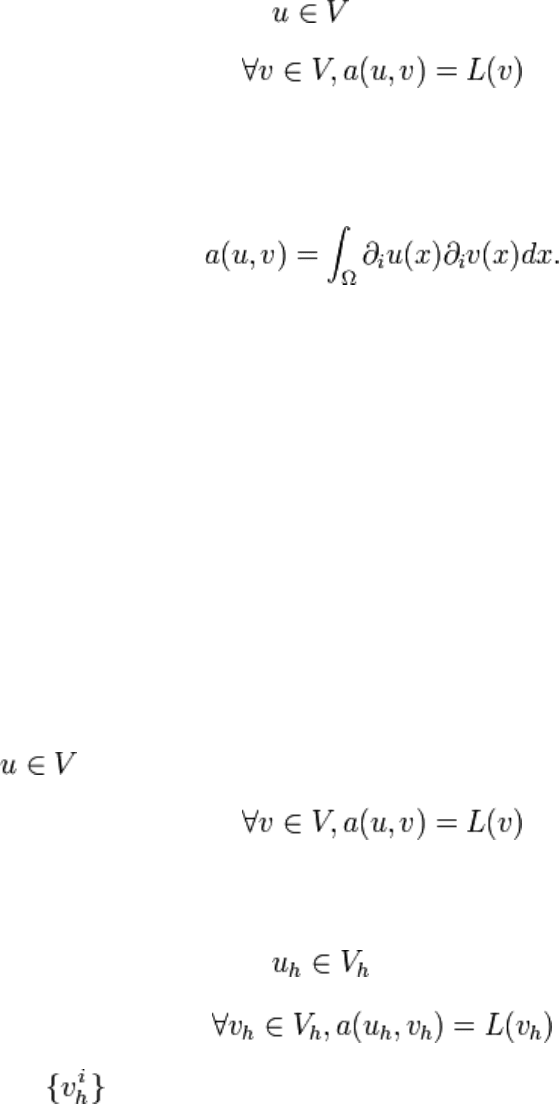
physics. In this case, one can associate to L a bilinear form a. The (weak) variational
problem is thus:
Problem: LABEL provari2 Find
such that
Example:
In this previous example, the bilinear form is:
There exist theorems (Lax-Milgram theorem for instance) that proove the existence and
unicity of the solution of the previous problem
provari2 , under certain
conditions on the bilinear form a(u,v).
==Finite elements approximation==LABEL secvarinum
Let us consider the problem provari2 :
Problem:
Find
such that:
The method of approximation consists in choosing a finite dimension subspace V
h
of V
and the problem to solve becomes:
Problem: LABEL provari3 Find
such that
A base of of V
h
is chosen to satisfy boundary conditions. The problem is reduced to
finding the components of u
h
:
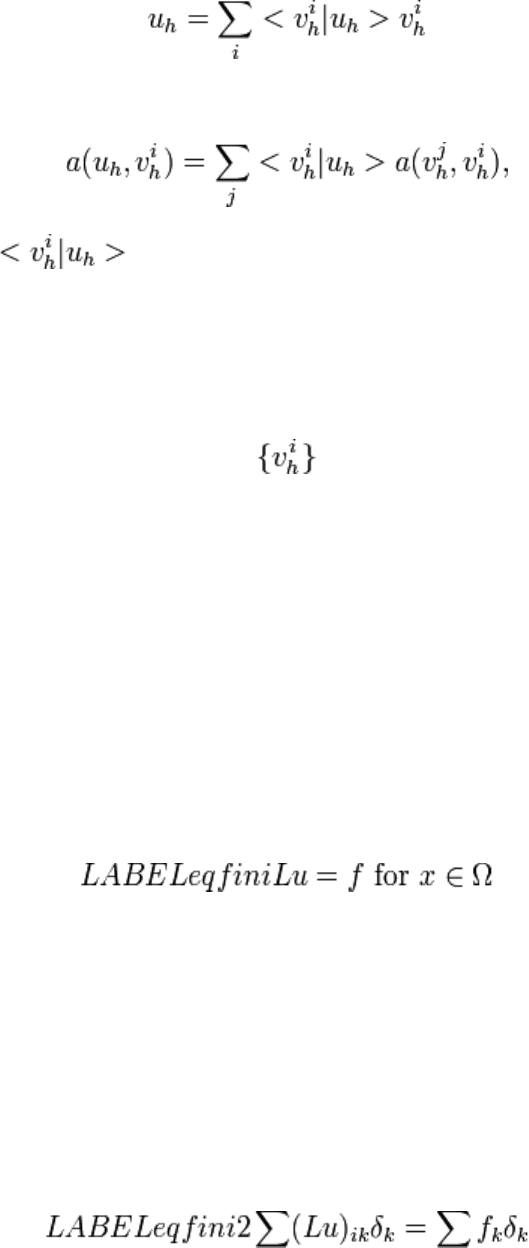
If a is a bilinear form
and to find the 's is equivalent to solve a linear system (often close to a
diagonal system)that can be solved by classical algorithms
which can be direct methods (Gauss,Cholesky) or iterative (Jacobi, Gauss-Seidel,
relaxation). Note that if the vectors of the basis of V
h
are eigenvectors of L, then the
solving of the system is immediate (diagonal system). This is the basis of the spectral
methods for solving evolution problems. If a is not linear, we have to solve a nonlinear
system. Let us give an example of a basis .
Example:
When V = L ([0,1])
2
, an example of V
h
that can be chosen
Finite difference approximation
Finite difference method is one of the most basic method to tackle PDE problems. It is
not strictly speaking a variational approximation. It is rather a sort of variational method
where weight functions w
k
are Dirac functions δ
k
. Indeed, when considering the boundary
problem,
instead of looking for an approximate solution u
h
which can be decomposed on a basis of
weight functions w
k
:
u
h
=
∑
< w
k
| u
h
> w
k
,
k
the action of L on u is directly expressed in terms of Dirac functions, as well as the right
hand term of equation eqfini:
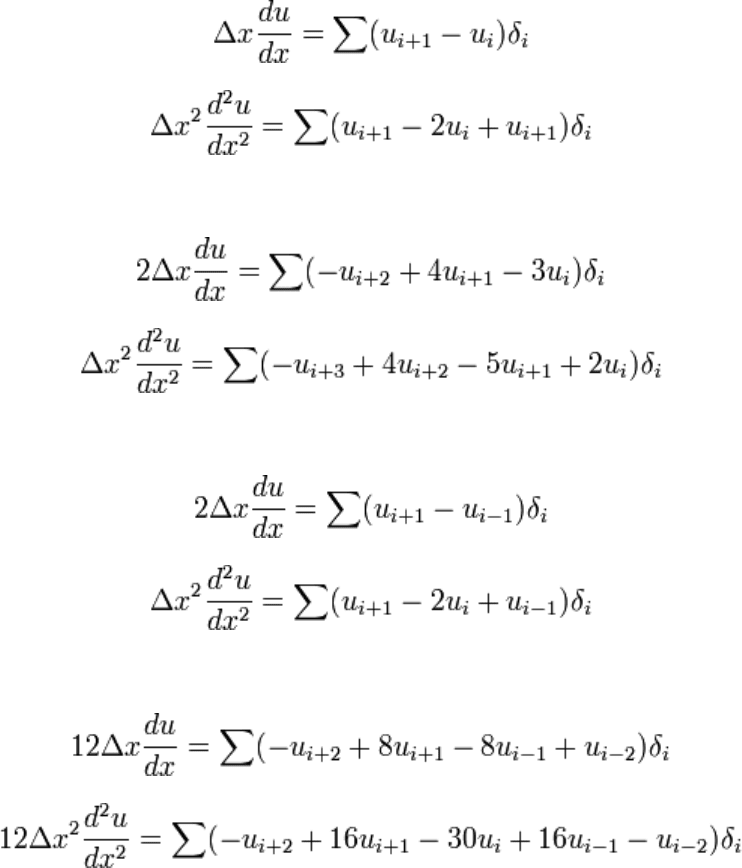
\begin{rem} If L contains derivatives, the following formulas are used : right formula,
order 1:
right formula order 2:
Left formulas can be written in a similar way. Centred formulas, second order are:
Centred formulas, fourth order are:
\end{rem} One can show that the equation eqfini2 is equivalent to the system of
equations:
LABELeqfini3
∑
(Lu)
ik
= f
k
i
One can see immediately that equation eqfini2 implies equation
eqfini3 in choosing "test" functions v
i
of support
[x − 1 / 2,x + 1 / 2]
i i
and such that v(x ) = 1
i i
.
Minimization problems
A minimization problem can be written as follows:
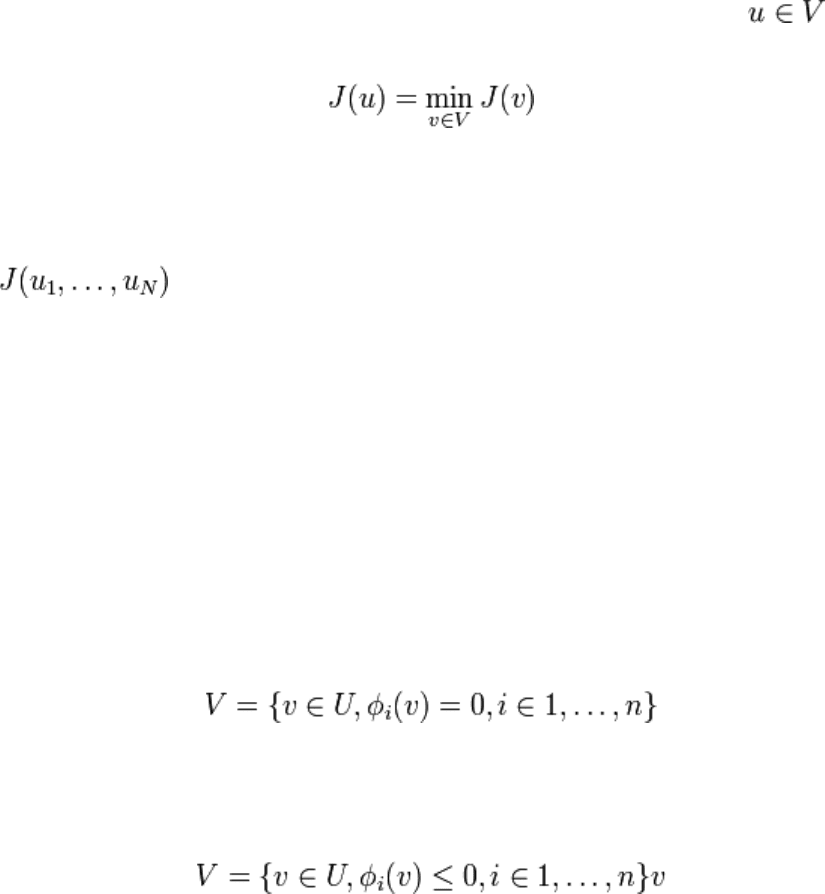
Problem: LABEL promini Let V a functional space, a J(u) a functional. Find ,
such that:
The solving of minimization problems depends first on the nature of the functional J and
on the space V.
As usually, the functional J(u) is often approximated by a function of several variables
where the u
i
's are the coordinate of u in some base E
i
that approximates
V. The methods to solve minimization problems can be classified into two categories:
One can distinguish problems without constraints Fig. figcontraintesans) and problems
with constraints Fig. figcontrainteavec). Minimization problems without constraints can
be tackled theoretically by the study of the zeros of the differential function dF(u) if
exists. Numerically it can be less expensive to use dedicated methods. There are methods
that don't use derivatives of F (downhill simplex method, direction-set method) and
methods that use derivative of F (conjugate gradient method, quasi-Newton methods).
Details are given in
Problems with constraints reduce the functional space U to a set V of functions that
satisfy some additional conditions. Note that those sets V are not vectorial spaces: a linear
combination of vectors of V are not always in V. Let us give some example of constraints:
Let U a functional space. Consider the space
where φ (v)
i
are n functionals. This is a first example of constraints. It can be solved
theoretically by using Lagrange multipliers ),\index{constraint}. A second example of
constraints is given by
where φ (v)
i
are n functionals. The linear programming example exmplinepro) problem is
an example of minimization problem with such constraints (in fact a mixing of equalities
and inequalities constraints).
Example:
Let us consider of a first class of functional J that are important for PDE problems.
Consider again the bilinear form introduced at section secvafor. If this bilinear form
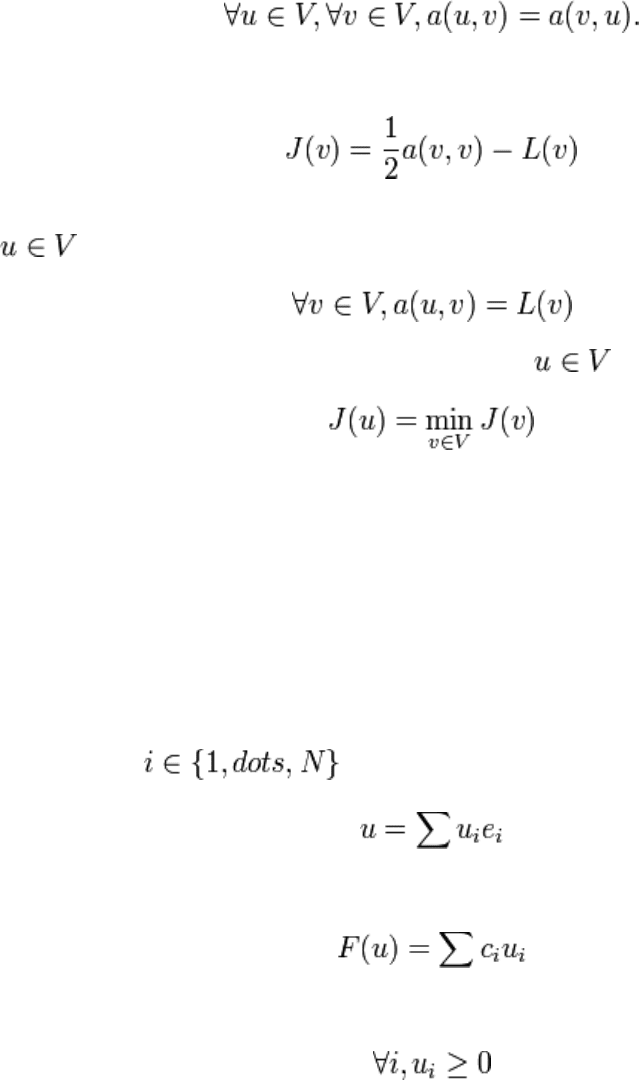
a(u,v) is symmetrical, {\it i.e.}
the problem can be written as a minimization problem by introducing the functional:
One can show that (under certain conditions) solving the variational problem:\\ Find
such that:
is equivalent to solve the minimization problem:\\ Find , such that:
Physical principles have sometimes a natural variational formulation (as natural as a PDE
formulation). We will come back to the variational formulations at the section on least
action principle section secprinmoindreact ) and at the section
secpuisvirtu on the principle of virtual powers.
Example: LABEL exmplinepro Another example of functional is given by the linear
programming problem. Let us consider a function u that can be located by its coordinates
u
i
in a basis e
i
, :
In linear programming, the functional to minimize can be written
and is subject to N primary constraints:
and M = m + m + m
1 2 3
additional constraints: