
Cossey L. Introduction to Mathematical Physics
Подождите немного. Документ загружается.

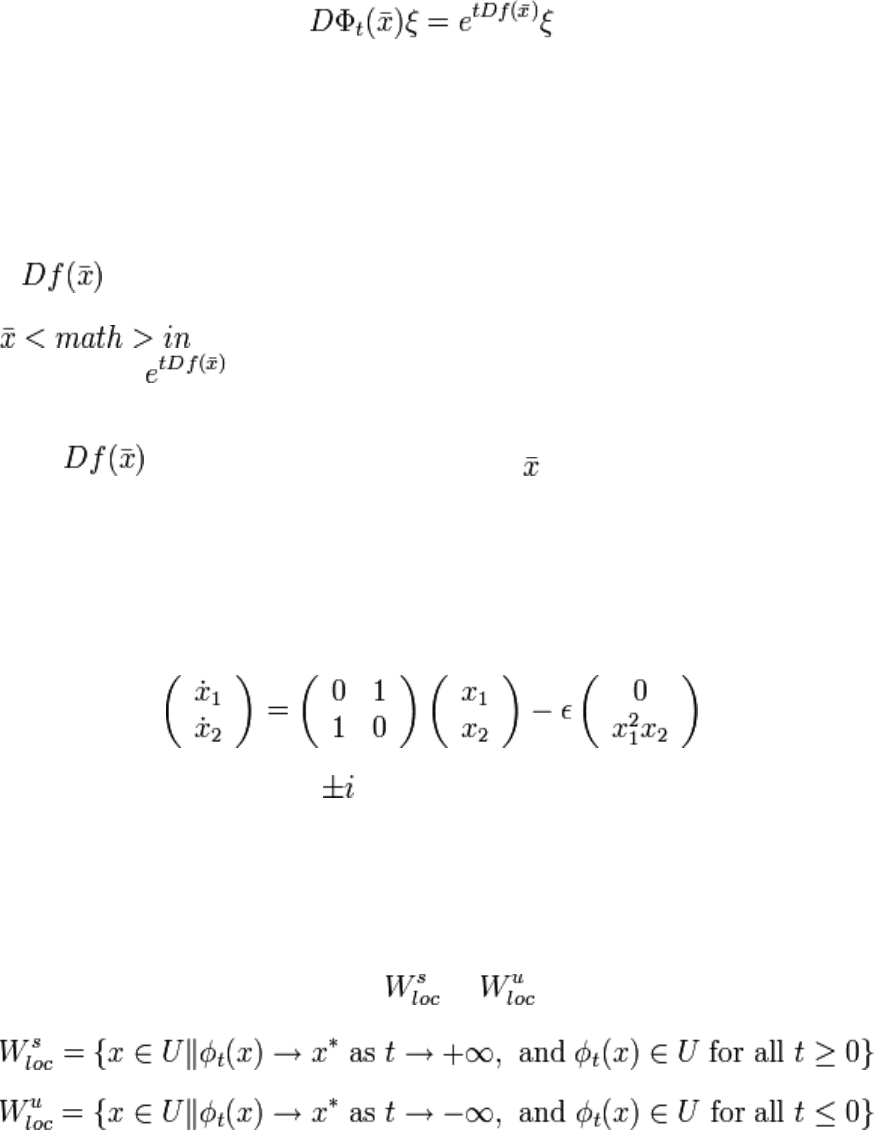
The linearized flow obeys:
It is natural to ask the following question: What can we say about the solutions of eqnl
based on our knowledge of eql?
Theorem:
If
has no zero or purely imaginary eigenvalues, then there is a homeomorphism h
defined on some neighborhood U of
R^nlocallytakingorbitsofthenonlinearflow\phi_t</math> to those of
the linear flow . The homeomorphism preserves the sense of orbits and can be
chosen to preserve parametrization by time.
When has no eigen values with zero real part, is called a hyperbolic or
nondegenerate fixed point and the asymptotic behaviour near it is determined by the
linearization.
In the degenerate case, stability cannot be determined by linearization.
Consider for example:
Eigenvalues of the linear part are . If ε > 0: a spiral sink, if ε < 0: a repelling source, if
ε = 0 a center (hamiltonian system).
Stable and unstable manifolds
Definition:
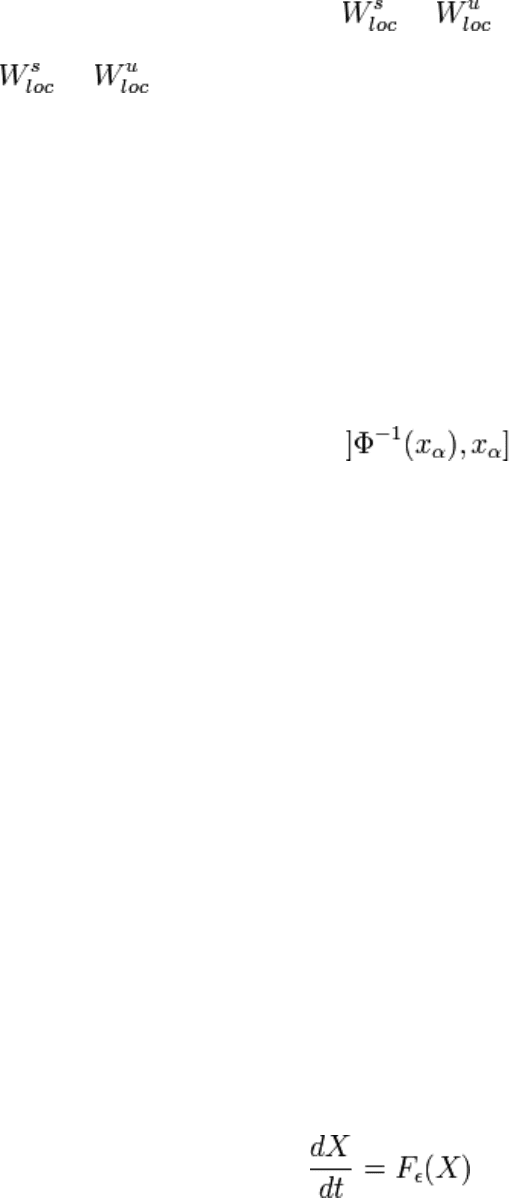
The local stable and unstable manifolds
and of a fixed point x
*
are
where U is a neighborhood of the fixed point X
*
.
Theorem:
(Stable manifold theorem for a fixed point). Let x
*
be a hyperbolic fixed point. There
exist local stable and unstable manifold and of the same dimesnion n
s
and n
u
as those of the eigenspaces E
s
, and E
u
of the linearized system, and tangent to E
u
and E
s
at
x
*
. and are as smooth as the function f.
An algorithm to get unstable and stable manifolds is given in
).
It basically consists in finding an point x
α
sufficiently close to the fixed point x
*
,
belonging to an unstable linear eigenvector space:
LABELeqalphchoosex = x + αe .
α
*
u
For continuous time system, to draw the unstable manifold, one has just to integrate
forward in time from x
α
. For discrete time system, one has to integrate forward in time
the dynamics for points in the segement where Phi is the application.
The number α in equation eqalphchoose has to be small enough for the linear
approximation to be accurate. Typically, to choose α one compares the distant between
the images of x
α
given by the linearized dynamics and the exact dynamics. If it is too
lage, then α is divided by 2. The process is iterated untill an acceptable accuracy is
reached.
Periodic orbits
It is well known ) that there exist periodic (unstable) orbits in a chaotic system. We will
first detect some of them. A periodic orbit in the 3-D phase space corresponds to a fixed
point of the Poincar\'e map.
The method we choosed to locate periodic orbits is "the Poincare map" method ). It uses
the fact that periodic orbits correspond to fixed points of Poincare maps. We chose the
plane U = 0 as one sided Poincare section. (The 'side' of the section is here defined by U
becoming positive)
Let us recall the main steps in locating periodic orbits by using the Poincare map
method : we apply the Newton-Raphson algorithm to the application H(X) = P(X) − X
where P(X) is the Poincare map associated to our system which can be written as :
X(0) = X
0
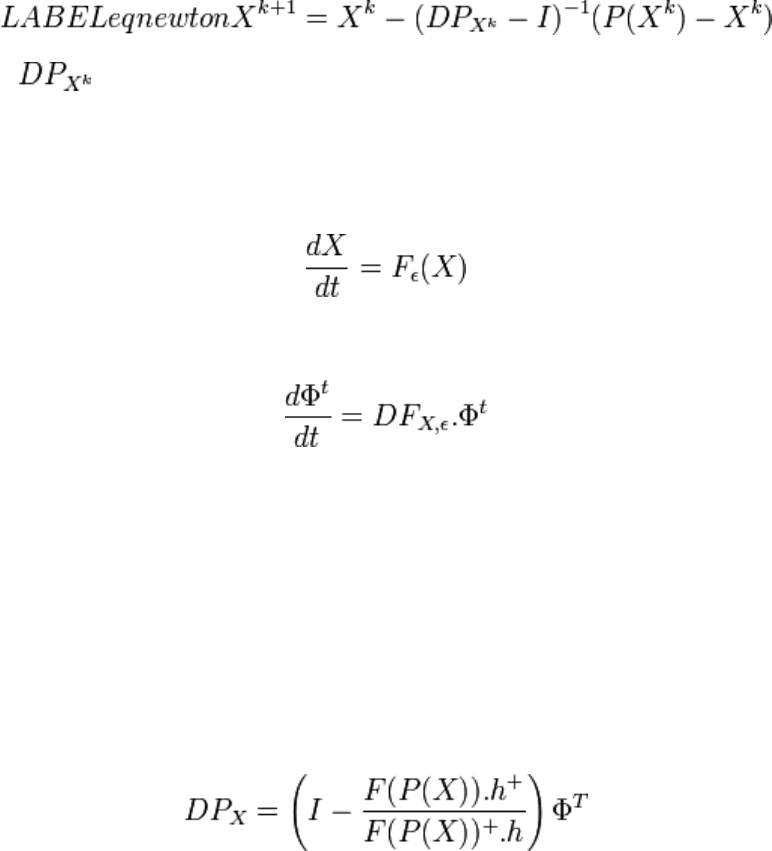
where ε denotes the set of the control parameters. Namely, the Newton-Raphson
algorithm is here :
where is the Jacobian of the Poincare map P(X) evaluated in X
k
.
The jacobian of poincare map DP needed in the scheme of equation eqnewton is
computed via the integration of the dynamical system:
X(0) = X
0
Φ = Id
0
where DF
X,ε
is the Jacobian of F
ε
in X, and X
0
is a Point of the Poincare section. We
chose a Runge--Kutta scheme, fourth order
) for the
time integration of the whole previous system. The time step was 0.003.
We have the relation :
where T is the time needed at which the trajectory crosses le Poincare section again.
Remark:
Note that a good test for the accuracy of the integration is to check that on a periodic
orbit, there is one eigenvalue of Φ
T
which is one.
Use of change of variables
Normal forms
As written in ) it is very powerfull not to solve differential equations but to tranform them
into a simpler differential equation.
)
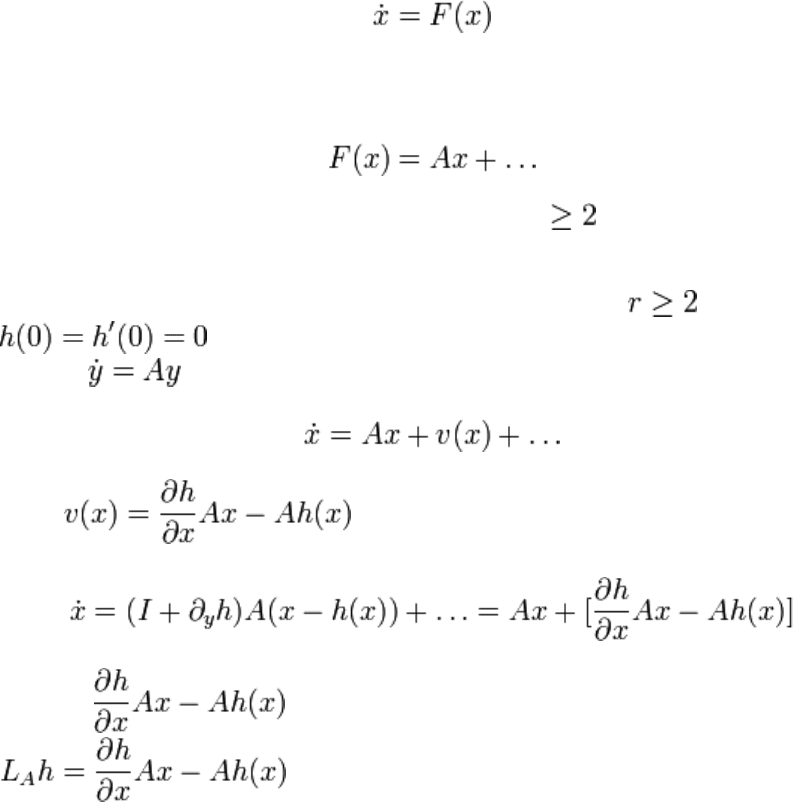
Let the system:
and x
*
a fixed point of the system: F(x ) = 0
*
. Without lack of generality, we can
asssume x = 0
*
. Assume that application F can be develloped around 0:
where the dots represent polynomial terms in x of degree . There exists the following
lema:
Theorem: LABEL lemplo Let h be a vectorial polynom of order and
. The change of variable x = y + h(y) transforms the differential
equation into the equation:
where and where the dots represent terms of order > r.
Note that is the Poisson crochet between Ax and h(x). We note
and we call the following equation:
L h = v
A
the homological equation associated to the linear operator A.
We are now interested in the reverse step of theorem lemplo: We have a nonlinear system
and want to find a change of variable that transforms it into a linear system. For this we
need to solve the homological equation, {\it i.e.} to express h as a function of v associated
to the dynamics.
Let us call e
i
, the basis of eigenvectors of A, λ
i
the associated
eigenvalues, and x
i
the coordinates of the system is this basis. Let us write
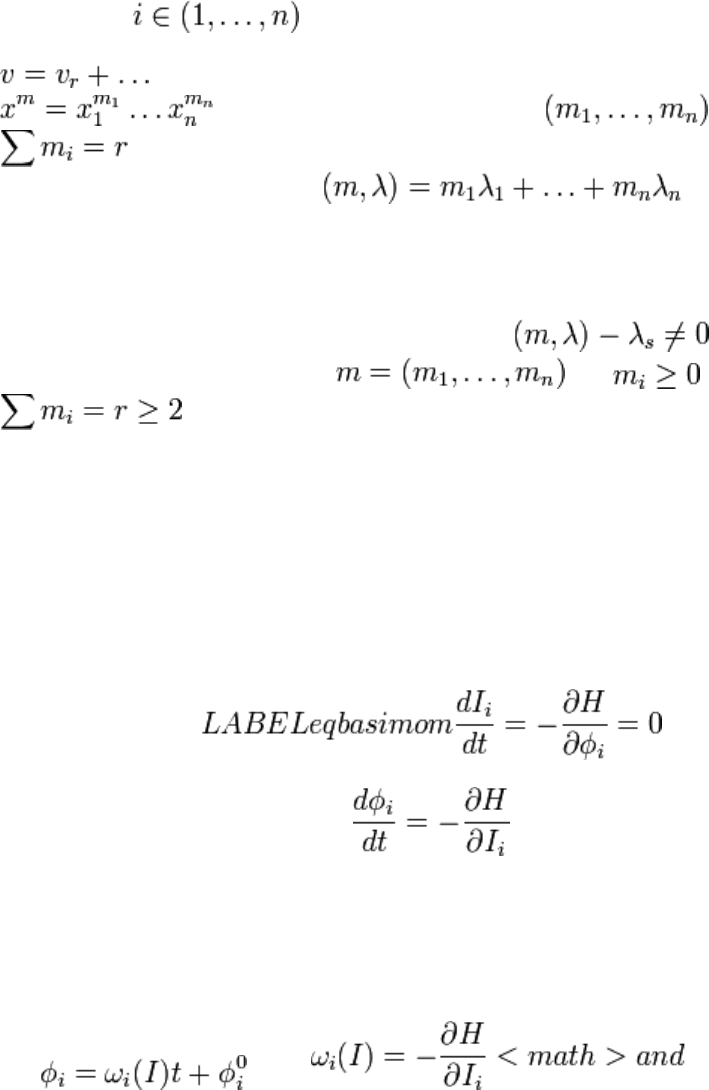
where v
r
contains the monoms of degree r, that is the terms
, m being a set of positive integers such that
. It can be easily checked )) that the monoms x e
m
s
are eigenvectors of L
A
with eigenvalue (m,λ) − λ
s
where :
L x e = [(m,λ) − λ ]x e .
A
m
s s
m
s
One can thus invert the homological equation to get a change of variable h that eliminate
the nonom considered. Note however, that one needs to invert
previous equation. If there exists a with and
such that (m,λ) − λ = 0
s
, then the set of eigenvalues λ is called
resonnant. If the set of eigenvalues is resonant, since there exist such m, then monoms
x e
m
s
can not be eliminated by a change of variable. This leads to the normal form theory
).
KAM theorem
An hamiltonian system is called integrable if there exist coordinates (I,φ) such that the
Hamiltonian doesn't depend on the φ.
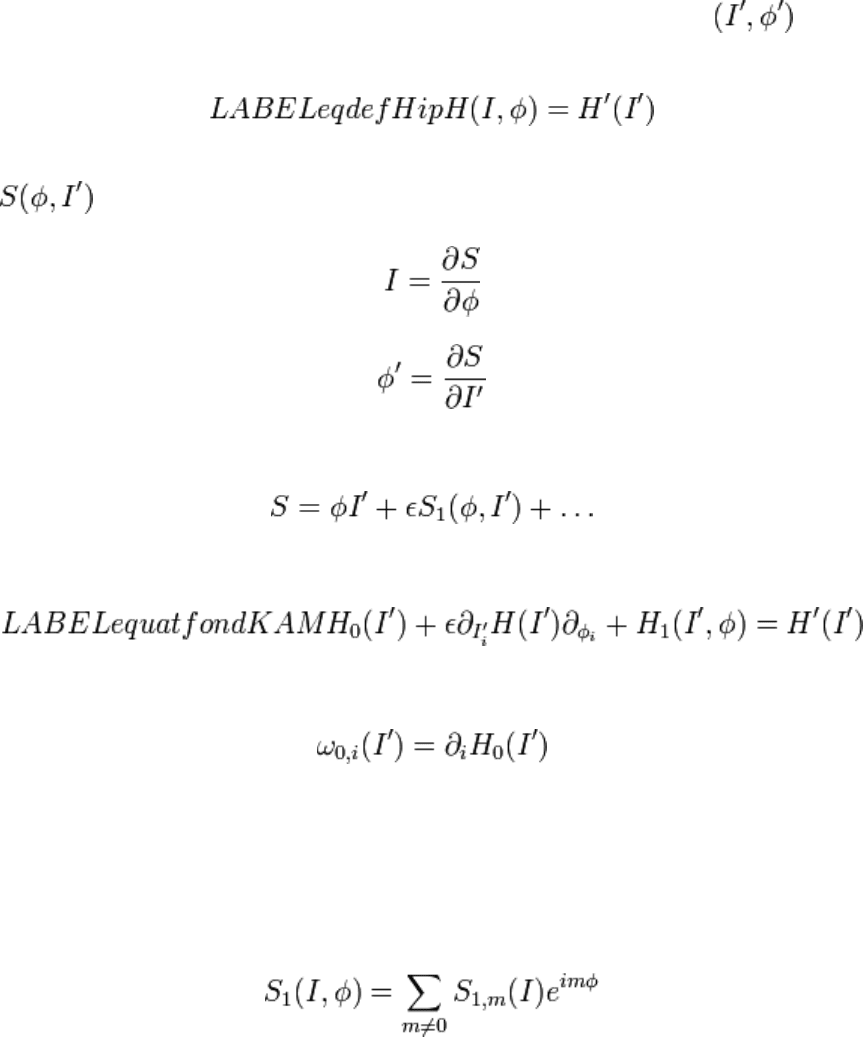
Variables I are called action and variables φ are called angles. Integration of equation
eqbasimom is thus immediate and leads to:
I = I
0
and where \phi_i^0</math>
are the initial conditions.
Let an integrable system described by an Hamiltonian H (I)
0
in the space phase of the
action-angle variables (I,φ). Let us perturb this system with a perturbation εH (I,φ)
1
.
H(I,φ) = H (I) + εH (I,φ)
0 1
where H
1
is periodic in φ.
If tori exist in this new system, there must exist new action-angle variable
such
that:
Change of variables in Hamiltonian system can be characterized ) by a function
called generating function that satisfies:
If S admits an expension in powers of ε it must be:
Equation eqdefHip thus becomes:
Calling ω
0
the frequencies of the unperturbed Hamiltionan H
0
:
Because H
1
and S
1
are periodic in φ, they can be decomposed in Fourier:
H
1
(I,φ) =
∑
H
1,m
(I)e
imφ
m
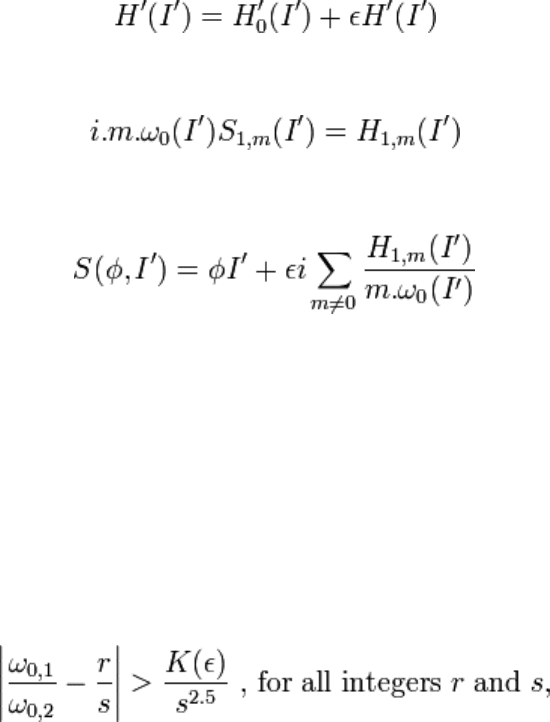
Projecting on the Fourier basis equation equatfondKAM one gets the expression of the
new Hamiltonian:
and the relations:
Inverting formally previous equation leads to the generating function:
The problem of the convergence of the sum and the expansion in ε has been solved by
KAM. Clearly, if the ω
i
are resonnant (or commensurable), the serie diverges and the
torus is destroyed. However for non resonant frequencies, the denominator term can be
very large and the expansion in ε may diverge. This is the {\bf small denominator
problem}.
In fact, the KAM theorem states that tori with ``sufficiently incommensurable
frequencies\footnote{ In the case two dimensional case the KAM theorem proves that the
tori that are not destroyed are those with two frequencies ω (I)
0,1
and ω (I)
0,2
whose ratio
ω (I) / ω (I)
0,1 0,2
is sufficiently irrational for the following relation to hold:
where K is a number that tends to zero with the ε.
} are not destroyed: The serie converges\footnote{ To prove the convergence, KAM use
an accelerated convergence method that, to calculate the torus at order n + 1 uses the
torus calculated at order n instead of the torus at order zero like an classical Taylor
expansion. See
) for a good analogy with the relative speed of the Taylor
expansion and the Newton's method to calculate zeros of functions. }.
Introduction
As noted in the introduction to this book, N body problem is the fundamental problem
that spanned modern physics, sustaining reductionnist approach of Nature. The element
considered depend on the scale chosen to describe the matter. Each field of physics has
its favourite N body problem:
• nuclear physics deals with sets of nucleons.
• atomic physics deals with interactions between nucleus and nucleons.
• molecular chemistry, solid state physics, physics of liquids, gas, plasmas deals
with interactions between atoms.
• classical mechanics and electrodynamics, N body problems can arise (planet
movement for instance).
• en astrophysics one studies interactions between stars, galaxies, and clusters of
galaxies.
Once fundamental elements making matter are identified, the interaction between
systems made of N such fundamental elements should be described. Note that the
interaction between constituents change with the lenght scale considered. Nuclear physics
deals mostly with strong interaction (and weak interaction). Atomic physics and
molecular physics deal mostly with electromagnetic interaction. Astrophysics deals with
gravitation and ther other interactions\footnote{Indeed, in the description of stars for
instance, gravitational pressure implies that fusion reaction are possible and that all atoms
are ionized, thus interacting via electromagnteic interaction}
This chapter is purely descriptive. No equations are presented. The subatom
ic systems
will not be more treated in the next chapters. However, the various forms of matter that
can be considered using, as elementary block, atomic nucleus and its electrons will be
treated in the rest of the book. For each form of matter presented here, numerous
references to other parts of the books are proposed. Especially, chapter
chapproncorps, treats of quantum properties of eigenstates of such
systems (the Schr\"odinger evolution equation is solved by the spectral method). Chapter
chapNcorpsstat treats of their statistical properties.
Origin of matter
The problem of the creation of the Universe is an open problem. Experimental facts
show that Universe is in expansion\footnote{The red-shift phenomenon was summerized
by Hubble in 1929. The Hubble's law states that the shift in the light received from a
galaxy is proportional to the distance from the observer point to the galaxy.} Inverting the
time arrow, this leads to a Universe that has explosive concentration. Gamow, a genial
physicist, proposed in 1948 a model known as, Big Bang model{Big Bang model}, for
the creation of the Universe. When it was proposed the model didn't receive much
attention, but in 1965 two engineers from AT\&T, Penzias and Wilson\footnote{They
received the physics Nobel price in 1978} , trying to improve communication between
earth and a satellite, detected by accident a radiation foreseen by Gamow and his theory:
the 3K cosmic background radiation {cosmic background radiation}. In 1992, the COBE
satellite (COsmic Background Explorer) recorded the fluctuations in the radiation figure
figcobe), which should be at the origin of the galaxy formation as we will see now.
The Big Bang model states that the history of the Universe obeys to the following
chronology\footnote{Time origin corresponds to Universe creation time}:
• During the first period (from t = 0 to t = 10
− 6
s), universe density is huge (much
greater than the nucleons density)\footnote{Describing waht componds Universe
at during this period is a challenge to human imagination.} It's behaviour is like a
black hole. Quarks may exist independantly.
• The hadronic epoch\footnote{Modern particle accelerators reach such energies.
The cosmology, posterior to t = 10
− 4
s is called "standard" and is rather well
trusted. On the contrary, cosmology before the hadronic period is much more
speculative.}, (from t = 10
− 6
, T = 1GeV (or T = 10
13
K) to t = 10
− 4
s, T = 100
MeV), the black hole radiation creates hadrons (particle undergoing strong
interaction like proton, neutrons), leptons (particle that undergo weak interaction
like electrons and neutrinos\footnote{Neutrinos are particles without electric
charge and with a very small mass so that on the contrary to electrons they don't
undergo electrostatic interaction.}) and photons. The temperature is such that
strong interaction can express itself by assembling quarks into hadrons. During
this period no quark can be observe independantly.
• During the leptonic epoch, (from t = 10
− 4
s, T = 100 MeV to t = 10 s, T = 1MeV)
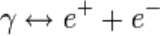
hadrons can no more be created, but leptons can still be created by photons
(reaction
). The temperature is such that strong interaction can
express itself by assembling hadrons into nuclei. Thus indepandant hadrons tend
to disappear, and typically the state is compound by: leptons, photons,
nuclei\footnote{ Note that heavy nuclei are not created during this period, as it
was believed some years at the beginning of the statement of the Big band model.
Indeed, the helium nucleus is very stable and prevents heavier nuclei to appear.
Heavier nuclei will be created in the stellar phase by fusion in the kernel of the
stars.}.
• From t = 10 s, T = 1MeV to t = 400,000 years, T = 1eV (or T = 3,000K), density
and temperature decrease and Universe enter the photonic epoch (or radiative
epoch). At such temperature, leptons (as electrons) can no more be created. They
thus tend to disappear as independant particles, reactionning with nuclei to give
atoms (Hydrogen and helium) and molecules\footnote{ As for the nuclei, not all
the atoms and molecules can be created. Indeed, the only reactive atoms, the
hydrogen atom (the helium atom is not chemically reactive) gives only the H
2
molecule which is very stable.} (H
2
). The interaction involed here is the
electromagnetic interaction (cohesion of electrons and nuclei is purely
electromagnetic). Typically the state is compound by: photons, atoms, molecules
and electrons. The radiative epoch ends by definition when there are no more free
electrons. Light and matter are thus decoupled. This is the origin of the cosmic
background radiation. Universe becomes "transparent" (to photons). Photons does
no more colide with electrons.
• From t = 400,000 years, T = 1eV (or T = 3,000K) untill today (t = 1.510
10
years, T
= 3K), Universe enters the stellar epoch. This is now the kingdom of the
gravitation. Because of (unexplain
ed) fluctuations is the gas density, particles
(atoms and molecules) begin to gather under gravitation to for prostars and stars.
Let us now summerize the stellar evolution and see how heavier atoms can be created
within stars. The stellar{
star} evolution can be summerized as follows:
• Protostar : As the primordial gas cloud starts to collapse under gravity, local
regions begin to form protostars, the precursors to stars. Gravitational energy
which is released in the contraction begins to heat up the centre of the protostar.
• Main sequence star: gravitational energy leads the hydrogen fusion to be possible.
This is a very stable phase. Then two evolutions are possible:
• If the mass of the star is less that 1.4 (the Chandrasekhar\footnote{The Indian
physicist Subrehmanyan Chandrasekhar received the physics Nobel price in 1983
for his theoretical studies of the structure and evolution of stars.}
limit){Chandrasekhar limit} the mass of the sun,
• The main sequence star evolves to a red giant star . {red giant star} The core is
now composed mostly of helium nuclei and electrons, and begins to collapse,
driving up the core temperature, and increasing the rate at which the remaining
hydrogen is consumed. The outer portions of the star expand and cool.
• the helium in the core fuses to form carbon in a violent event know as the helium
flash {helium flash}, lasting as little as only a few seconds. The star gradually
blows away its outer atmosphere into an expanding shell of gas known as a
planetary nebula {planetary nebula}.
• The remnant portion is known as a white dwarf {white dwarf}. Further
contraction is no more possible since the whole star is supported by electron
degeneracy. No more fusion occurs since temperature is not sufficient. This star
progressively cooles and evolves towards a black dwarf star .
• If the mass of the star is greater that 1.4 the mass of the sun,
• When the core of massive star becomes depleted of hydrogen, the gravitational
collapse is capable of generating sufficient energy that the core can begin to fuse
helium nuclei to form carbon. In this stage it has expanded to become a red giant,
but brighter. It is known as a supergiant {supergiant star}. Following depletion of
the helium, the core can successively burn carbon, neon, etc, until it finally has a
core of iron, the last element which can be formed by fusion without the input of
energy.
• Once the silicon has been used the iron core then collapses violently, in a fraction
of a second. Eventually neutron degeneracy prevents the core from ultimate