
Cossey L. Introduction to Mathematical Physics
Подождите немного. Документ загружается.

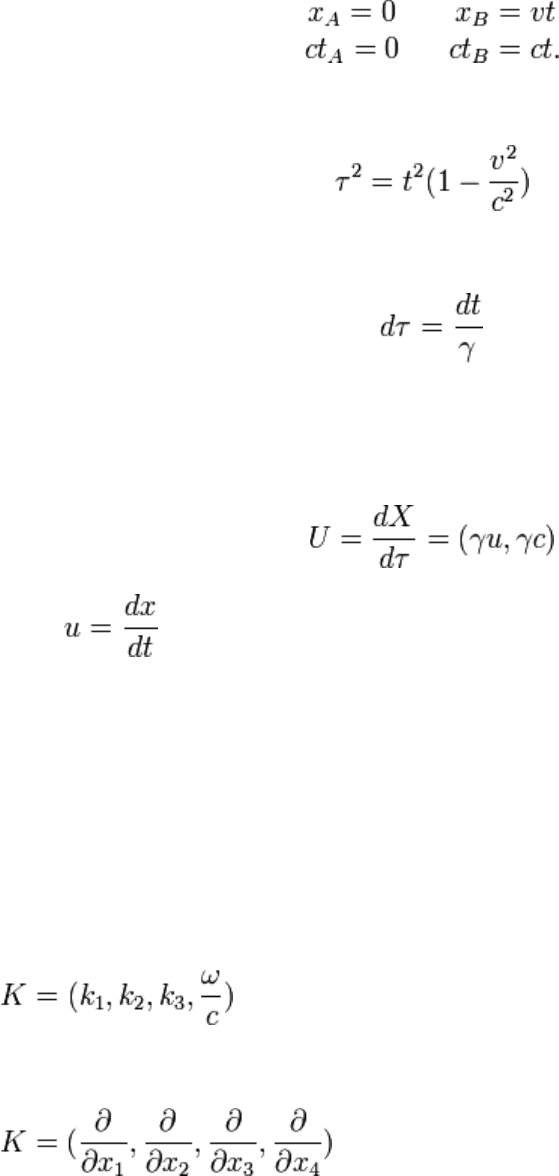
So, one gets the relation verified by τ::
so
Velocity four-vector
Velocity four-vector is defined by:
where is the classical speed.
Other four-vectors
Here are some other four-vectors (expressed using first formalism):
• four-vector position :
X = (x ,x ,x ,ct)
1 2 3
• four-vector wave:
• four-vector nabla:
General relativity
There exists two ways to tackle laws of Nature discovery problem:
1. First method can be called {
"phenomenological"}. A good example of phenomenological theory is quantum
mechanics theory. This method consists in starting from known facts (from experiments)
to infer laws. Observable notion is then a fundamental notion.
1. There exist another me
thod less "anthropocentric" whose advantages had been
underlined at century 17 by philosophers like Descartes.
It is the method called {\it a priori}. It has been used by Einstein to propose his relativity
theory. It consists in starting from principles that are believed to be true and to look for
laws that obey to those principles.
Here are the fundamental postulates of general relativity:
Postulate: Generalized relativity pr
inciple: All the laws of Nature are
covariant{covariance} relatively to any continuous transformation of coordinates system.
\footnote{Special relativity states only covariance with respect to Lorentz transformations
([#References
Postulate: Maximum logical s
implicity principle for laws formulation: All geometrical
properties of space--time can be described by the means of a differential tensor S. This
tensor
1. is expressed in a four dime
nsion Riemannian space whose metrics is defined by a
tensor g
ij
2. is a second order tensor and is noted S
ij
3. is a function of the g
ij
's that doesn't contain any partial derivatives of order greater
than two and that is linear with respect to second order partial derivatives.
Postulate: Divergence of tensor S
ij
is zero.
Postulate: Space curvature is due to matter:
Curvature = Matter
or, using tensors:
S = T
ij ij
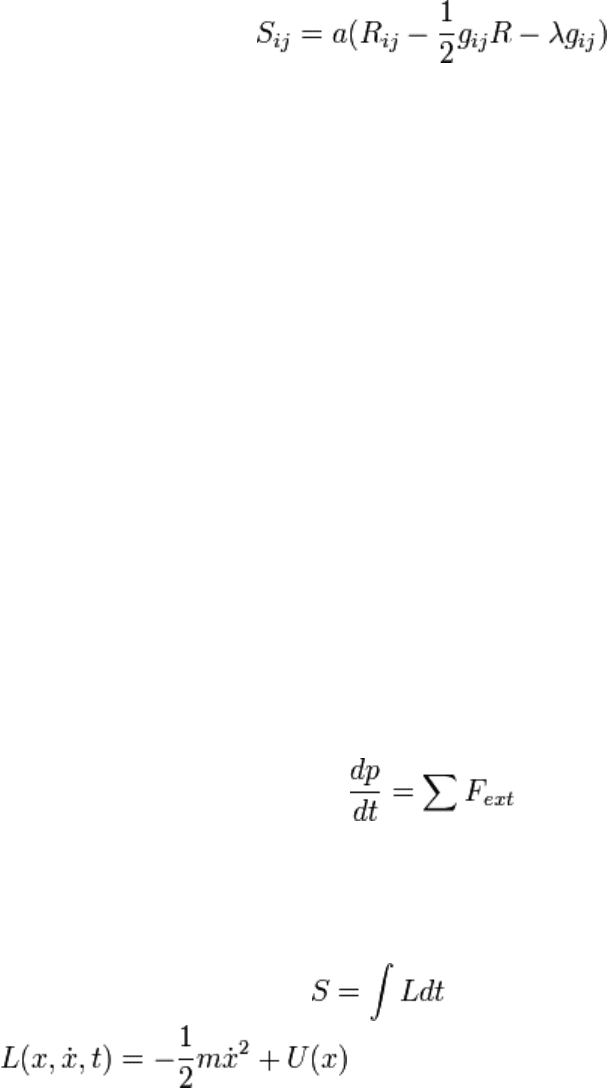
Einstein believes strongly in those postulates. On another hand, he believes that
modelization of gravitational field have to be improved. From this postulates, Einstein
equation can be obtained: One can show that any tensor S
ij
that verifies those postulates:
where a and λ are two constants and R
ij
, the Ricci curvature tensor, and R, the scalar
curvature are defined from g
ij
tensor\footnote{ Reader is invited to refer to specialized
books for the expression of R
ij
and R.} Einstein equation corresponds to a = 1. Constant λ
is called cosmological constant. Matter tensor is not deduced from symmetries implied by
postulates as tensor S
ij
is. Please refer to for indications about how to model matter
tensor. Anyway, there is great difference between S
ij
curvature tensor and matter tensor.
Einstein opposes those two terms saying that curvature term is smooth as gold and matter
term is rough as wood.
Dynamics
Fundamental principle of classical mechanics
Let us state fundamental principle of classical dynamics for material
point\footnote{Formulation adapted to continuous matter will be presented later in the
book.}. A material point is classically described by its mass m, its position r, and its
velocity v. It undergoes external actions modelized by forces F
ext
. Momentum mv of the
particle is noted p.{momentum}
Principle: Dynamics fundamental principle or (Newton's equation of motion) {Newton's
equation of motion} states that the time derivative of momentum is equal to the sum of
all external forces{force}:
Least action principle
Principle: Least action principle: {least action principle} Function x(t) describing the
trajectory of a particle in a potential U(x) in a potential U(x) yields the action stationary,
where the action S is defined by where L is the Lagrangian of the particle:
.
This principle can be taken as the basis of material point classical mechanics. But it can
also be seen as a consequence of fundamental dynamics principle presented previously .
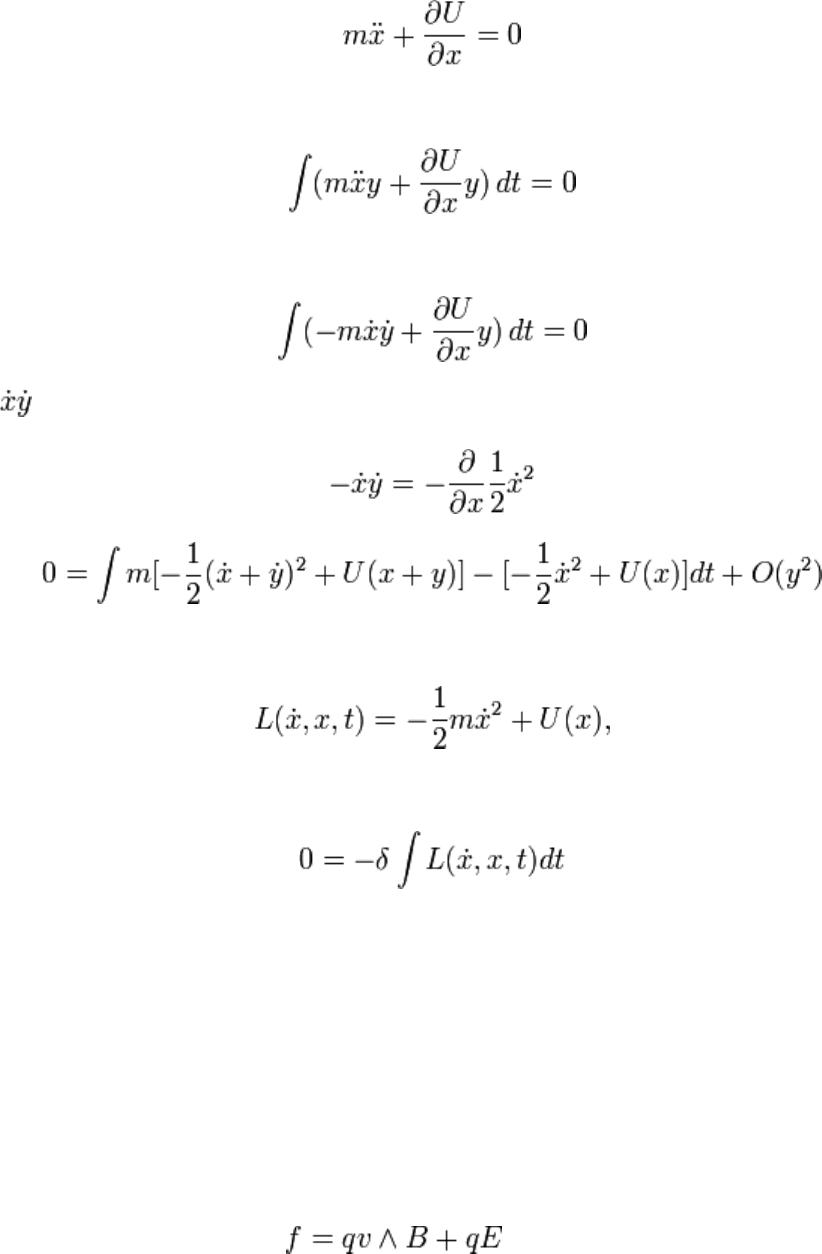
Let us multiply by y(t) and integrate over time:
Using Green theorem (integration by parts):
is a bilinear form.
Defining Lagrangian L by:
previous equation can be written
meaning that action S is stationary.
Description by energies
Laws of motion does not tell anything about how to model forces. The force modelization
is often physicist's job. Here are two examples of forces expressions:
1. weight P = mg. g is a vector describing gravitational field around the material
point of mass m considered.
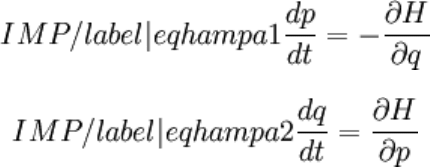
2. electromagnetic force
, where q is particle's charge, E is the
electric field, B the magnetic field and v the particle's velocity.
This two last forces expressions directly come from physical postulates. However, for
other interactions like elastic forces, friction, freedom given to physicist is much greater.
An efficient method to modelize such complex interactions is to use the energy (or
power) concept. At chapter chapelectromag, the duality between forces and energy is
presented in the case of electromagnetic interaction. At chapters chapapproxconti and
chapenermilcon, the concept of energy is developed for the description of continuous
media.
Let us recall here some definitions associated to the description of interactions by forces.
Elementary work of a force f for an elementary displacement is:
δW = f.dr
Instantaneous power emitted by a force f to a material point of velocity v is:
P = f.v
Potential energy gained by the particle during time dt that it needs to move of dr is:
dE = − f.dr = − P.dt
Note that potential energy can be defined only if force field f have conservative
circulation\footnote{That means:
∫
f
.dr = 0
C
for every loop C, or equivalently that
rot f = 0.
}. This is the case for weight, for electric force but not for friction. A system that
undergoes only conservative forces is hamiltonian. The equations that govern its
dynamics are the Hamilton equations:
where function H(q,p,t) is called hamiltonian of the system. For a particle with a potential
energy E
p
, the hamiltonian is:
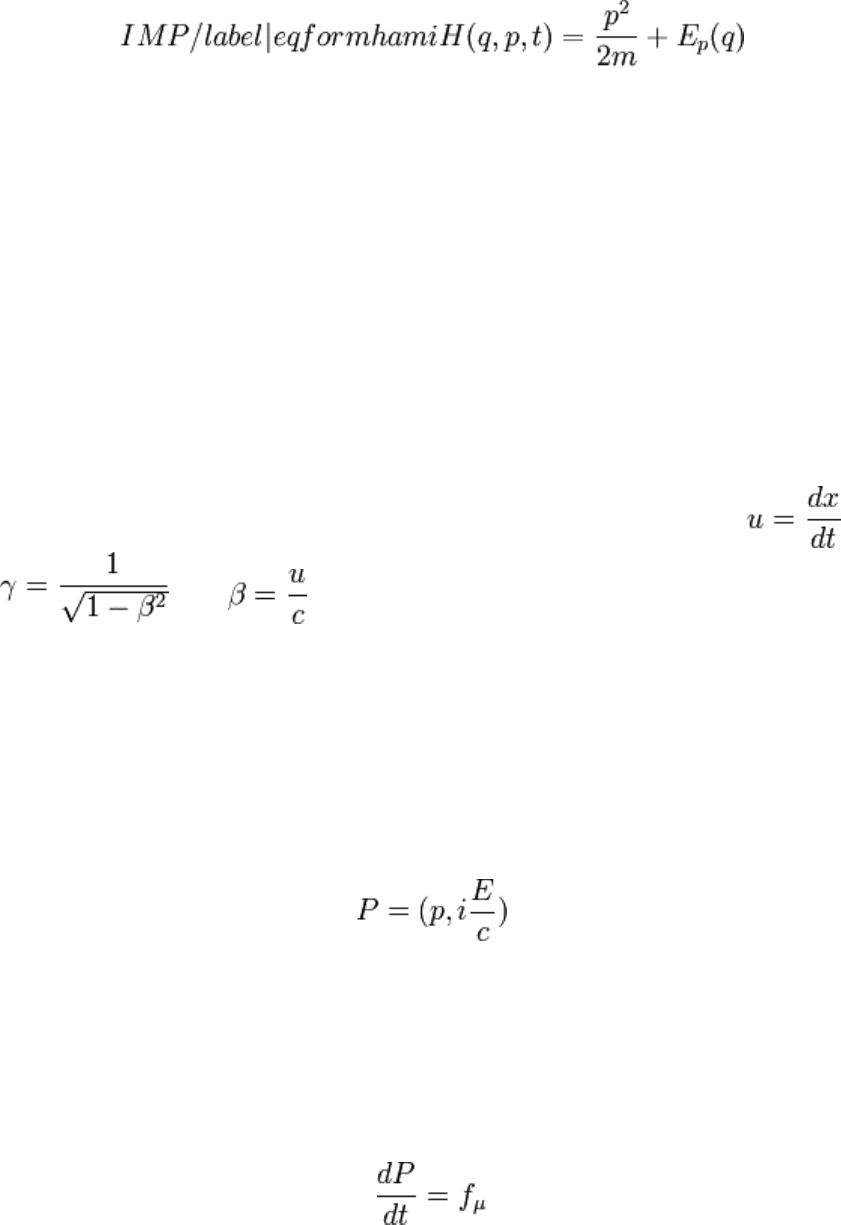
where p is particle's momentum and q its position. By extension, every system whose
dynamics can be described by equations eqhampa1 and eqhampa2 is called hamiltonian
{hamiltonian system} even if H is not of the form given by equation eqformhami.
Dynamics in special relativity
It has been seen that Lorentz transformations acts on time. Classical dynamics laws have
to be modified to take into into account this fact and maintain their invariance under
Lorentz transformations as required by relativity postulates. Price to pay is a modification
of momentum and energy notions. Let us impose a linear dependence between the
impulsion four-vector and velocity four-vector;
P = mU = (mγu,icmγ)
where m is the rest mass of the particle, u is the classical speed of the particle ,
, with . Let us call ``relativistic momentum quantity:
p = mγu
and "relativistic energy" quantity:
E = mγc
2
Four-vector P can thus be written:
Thus, Einstein associates an energy to a mass since at rest:
E = mc
2
This is the matter--energy equivalence . {matter--energy equivalence} Fundamental
dynamics principle is thus written in the special relativity formalism:
where f
µ
is force four-vector.
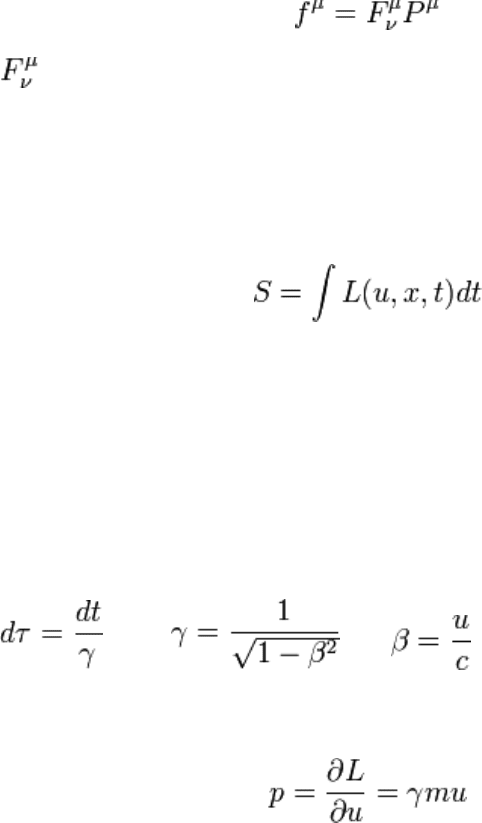
Example: Let us give an example of force four-vector. Lorentz force four-vector is
defined by:
where is the electromagnetic tensor field section seceqmaxcov)
Least action principle in special relativity
Let us present how the fundamental dynamics can be retrieved from a least action
principle. Only the case of a free particle is considered. Action should be written:
where L is invariant by Lorentz transformations, u and x are the classical speed and
position of the particle. The simplest solution consists in stating:
L = γk
where k is a constant. Indeed Ldt becomes here:
Ldt = kdτ
where , (with , and ) is the differential of the eigen
time and is thus invariant under any Lorentz transformation. Let us postulate that k = −
mc
2
. Momentum is then:
Energy is obtained by a Legendre transformation, E = p.u − L so:
E = γmc
2
Dynamics in general relativity
The most natural way to introduce the dynamics of a free particle in general relativity is
to use the least action principle. Let us define the action S by:
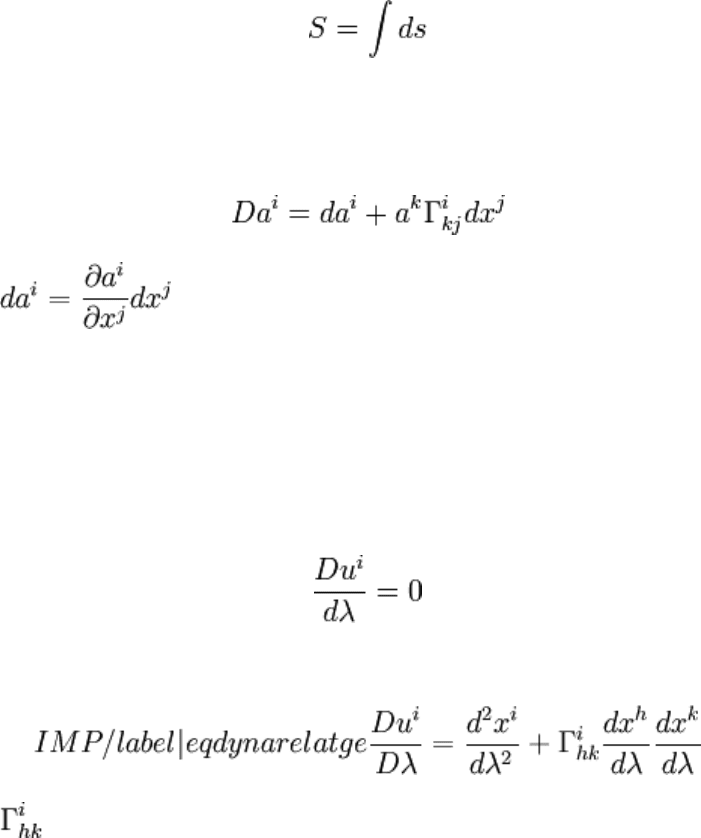
where ds is the elementary distance in the Rieman space--time space. S is obviously
covariant under any frame transformation (because ds does). Consider the fundamental
relation eqcovdiff that defines (covariant) differentials. It yields to:
where . A deplacement can be represented by dx = udλ
i i
where u
i
represents the tangent to the trajectory (the velocity). The shortest path corresponds to a
movement of the particle such the the tangent is transported parallel to itself, that
is\footnote{The actual proof that action S is minimal implies that DU = 0
i
is given in }:
Du = 0.
i
or
This yields to
where is tensor depending on system's metrics for more details). Equation
eqdynarelatge is an evolution equation for a free particle. It is the equation of a geodesic.
Figure figgeo represents the geodesic between two point A and B on a curved space
constituted by a sphere. In this case the geodesic is the arc binding A and B.
Note that here, gravitational interaction is contained in the metrics. So the equation for
the "free" particle above describes the evolution of a particle undergoing the gravitational
interaction. General relativity explain have larges masses can deviate light rays figure
figlightrayd)
Exercises
Exercice:
Show that a rocket of mass m that ejects at speed u (with respect to itself) a part of its
mass dm by time unit dt moves in the sense opposed to u. Give the movement law for a
rocket with speed zero at time t = 0, located in a earth gravitational field considered as
constant.
Exercice:
Doppler effect. Consider a light source S moving at constant speed with respect to
reference frame R. Using wave four-vector (k,ω / c) give the relation between frequencies
measured by an experimentator moving with S and another experimentater attached to R.
What about sound waves?
Exercice:
For a cylindrical coordinates system, metrics g
ij
of the space is:
ds = dr + r dθ + dz
2 2 2 2 2
Calculate the Christoffel symbols defined by:
Exercice:
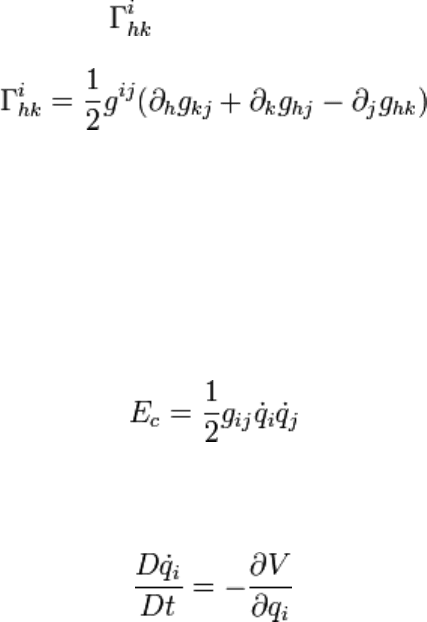
Consider a unit mass in a three dimensional reference frame whose metrics is:
ds = g dqdq
2
ij i j
Show that the kinetic energy of the system is:
Show that the fundamental equation of dynamics is written here (forces are assumed to
derive from a potential V) :
Introduction
At previous chapter, equations that govern dynamics of a particle in a filed of forces
where presented. In this chapter we introduce electromagnetic forces. Electromagnetic
interaction is described by the mean of electromagnetic field, which is solution of so-
called Maxwell equations. But as Maxwell equations take into account positions of
sources (charges and currents), we have typically coupled dynamics--field equations
problem: fields act on charged particles and charge particles act on fields.
A first way to solve this problem is to study the static case. A second way is to assume
that particles able to move have a negligible effect on the electromagnetic field
distribution (assumed to be created by some "big" static sources). The last way is to
tackle directly the coupled equations system (this is the usual way to treat plasma
problems, see exercise exoplasmapert and reference ).
This chapter presents Maxwell equations as well as their applications to optics. Duality
between representation by forces and by powers of electromagnetic interaction is also
shown.
Electromagnetic field
Equations for the fields: Maxwell equations
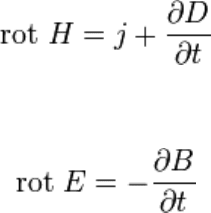
Electromagnetic interaction is described by the means of Electromagnetic fields: E field
called electric field, B field called magnetic field, D field and H field. Those fields are
solution of Maxwell equations, {Maxwell equations}
div D = ρ
div B = 0
where ρ is the charge density and j is the current density. This system of equations has to
be completed by additional relations called constitutive relations that bind D to E and H
to B. In vacuum, those relations are:
D = ε E
0