
Cossey L. Introduction to Mathematical Physics
Подождите немного. Документ загружается.

collapse, and the surface rebounds, blowing out as fast as it collpased down. As
the surface collides with the outer portions of the star an explosion occurs and the
star is destroyed in a bright flash. The material blown out from the star is
dispersed into space as a nebula. The remnants of the core becomes
• If the mass of the star is less than 3 sun's mass, star becomes a neutron star
{neutron star}. The core collapses further, pressing the protons and electrons
together to form neutrons, until neutron degeneracy stablilises it against further
collapse. Neutron stars have been detected because of their strange emission
characteristics. From the Earth, we see then a pulse of light, which gives the
neutron star its other name, a pulsar {pulsar}.
• If the mass of the star is greater than 3 sun's mass, star becomes a black hole
{black hole}. When stars of very large mass explode in a supernova, they leave
behind a core which is so massive (greater than about 3 solar masses) that it
cannot be stabilized against gravitational collapse by an known means, not even
neutron degeneracy. Such a core is detined to collapse indefinitely until it forms a
black hole, and object so dense that nothing can escape its gravitational pull, ot
even light.
Let us now start the listing of matter forms observed at a super nuclear scale (sacle larger
than the nuclear s
cale).
Atoms
Atoms are elementary bricks of matter. {atom} Atoms themselves are
compound by a set of electrons in interaction with a nucleus. This
system can be described by a planetary model fig figatome), but it
should be rigorously described by using the quantum mechanics formalism
section secatomemq). The nucleus is itself a N body problem: it is
compound by nucleons, themselves compound by quarks
Molecules
A molecule is an arrangement of some atoms {molecule}(from two to some
hundreds). Properties of molecules can be described by quantum
mechanics section secmolecmq). The knowledge of the geometry of a
molecule is sometimes enough to understand its properties. Figure
figc60fig represents fullerene molecule C60 at the origin of chemistry
Nobel price 1996 of Profs Curl, Kroto, et Smalley.
Existence of such a molecule had been predicted by the study of the adsorption spectrum
of some distant stars. Curl, Kroto, et Smalley succeeded in constructing it on the earth.
C60 molecule is compound by 12 pentagons and 20 hexagons. It is the smallest spherical
structure that can be construct using polygons{fullerene}. Polymers ) are another
example of large molecules.
Gas and liquids
Gas{gas} and liquids correspond to a random repartition of elementary bricks (atoms of
molecules). Gas particles are characterized by a large kinetic energy with respect to the
typical interaction energy between molecules. When kinetic energy becomes of the same
order than typical interaction energy between molecules, gas transforms into liquid. Van
der Walls model allows to model the {\bf liquid vapor phase transition} section
secvanderwaals).
Plasmas
A plasma{plasma} is a gas of ionized particle. Description of plasmas is generally much
more involved than description of classical gases (or fluids). Indeed, the electromagnetic
interaction plays here a fundamental role, and in a fluid description of the system chapter
chapapproxconti), fluid equations will be coupled to the equations of the electromagnetic
field (Maxwell equations). In general, also, the nature of the particle can change after
collisions. Plasma state represents a large part of the "visible" matter (more than 99% of
the Universe)
Other matter arrangements
Quasi crystals
Quasi crystals discovered by Israeli physicist Shechtman in 1982 correspond to a non
periodical filling of a volume by atoms or molecules. Pentagon is a forbidden form in
crystallography: a volume can not be filled with elementary bricks of fifth order
symmetry repartited periodically. This problem has a two dimensional twin problem: a
surface can not be covered only by pentagons. English mathematician Penrose {Penrose
paving}discovered non periodical paving of the plane by lozenges of two types.
Penrose
Penrose paving: from two types of lozenges, non periodical paving of the plane can be
constructed.
Penrose2
Penrose paving: same figure as previous one, but with only two gray levels to distinguish
between the two types of lozenges.
Obtained structures are amazingly complex and it is impossible to encounter some
periodicity in the paving.
Liquid crystals
Liquid crystals , also called mesomorphic phases{mesomorphic phase}, are states
intermediary between the cristaline perfect order and the liquid disorder. Molecules that
compound liquid crystals{liquid crystal} have cigar--like shape. They arrange themselves
in space in order to form a "fluid" state more or less ordered. Among the family of liquid
crystals, several classes can be distinguished.
In the nematic {nematic}
phase , molecular axes stays parallel. There exists thus a
privileged direction. Each molecule can move with respect to its neighbours, but in a fish
ban way.
File:Nematique
Nematic material is similar to a fish ban: mo
lecules have a privileged orientation and
located at random points.}
When molecules of a liquid crystal are not superposable to their image in a mirror, a
torsion of nematic structure appears: phase is then called cholesteric {cholesteric}.
Cholesteric
In a cholesteric phase, molecules are arranged in layers. In each layer, molecule are
oriented along a privileged direction. This direction varies from one layer to another, so
that a h
elicoidal structure is formed.
Smectic {smectic} phase is m
ore ordered : molecules are arranged in layers figure
figsmectiqueA). The fluid character comes from the ability of layers to slide over their
neighbours.
SmectiqueA
Smectic A
To describe deformations of nematics, a field of vector is used. To describe deformations
of smectics, each state is characterised by set of functions u (x,y)
i
that describes the
surface of the i
th
layer. Energical properties of nematic materials are presented at section
secenernema.
Colloids
Colloids {colloid} are materials finely divided and dispersed. Examples are emulsions
{emulsion} and aerosols. Consider a molecule that has two parts: a polar head which is
soluble in water and an hydrophobe tail. Such molecules are called
amphiphile{amphiphile molecule}. Once in water, they gather into small structures called
micelles{micelle} figure fighuileeau). Molecules turn their head to water and their tail to
the inside of the structure.
Remark: Cells of live world are very close to micelles, and it may be that life{life (origin
of)}{origin of life} appeared by the mean of micelles.
Huileeau
Amphiphile molecules (as oil molecules) that contains a hydrophile head and an
hydrophobe tail organize themselves into
small structures called micelles.
Micelles can be encountered in mayonnaise . Tensioactive substances allow to disolve
micelles (application to soaps). Foams are similar arrangements . For a mathematical
introduction to soap films and minimal surfaces, check .
Glass
Glass state is characterized by a random distribution of molecules. Glass {glass} is solid,
that implies that movements of different constituents are small.
Glass
Glass is characterized by a great rigidity as crystals. However position of atoms are
random
.}
Phase transition between liquid state and glassy state is done progressively. A material
close to glass can be made by compressing small balls together. Under pressure forces,
those small balls are deformed and stick to each other. Following question arises: are
remaining interstices sufficiently numerous to allow a liquid to pour trough interstices ?
This pouring phenomena is a particular case of percolation phenomenon{percolation}.
Percol
Example of percolation : black balls are conducting and white balls are insulating.
Current running trough the circuit is measured as a function of proportion p
of white
balls. Ther
e exists a critical proportion p
c
for which no more current can pass. Study of
this critical point allows to exhibit some universal properties encountered in similar
systems.
Another example is given by the vandalized grid where connections of a conducting wire
is destroyed with probabi
lity p.
Spin glasses are disordered magnetic materials. A good example of spin glass is given by
the alloy coper ma
nganese, noted CuMn where manganese atoms carrying magnetic
moments are dispersed at random in a coper matrix. two spins tend to orient them selves
in same or in opposite direction, depending on distance between them.
Spinglass
In a spin glass, interactions between neighbour spins are at random ferrom
agnetic type or
anti ferromagnetic type, due to the random distance between spin sites.
The resulting system is called "frustrated": there does not exist a configuration for which
all interaction energies are minimal. The simplest example of frustrated system is given
by a system constituted by three spins labelled 1,2 and 3 where interactions obey the
following rule: energy decreases if 1 and 2 are pointing in the same direction, 2 and 3 are
pointing in the same direction and 1 and 3 are pointing in opposite direction. Some
properties of spin glasses are presented at section secverredespi.
Sand piles, orange piles
Physics of granular systems is of high interest and is now the subject of many researches.
Those systems, as a sand pile, exhibit properties of both liquids and solids. The sand in a
hour-glass doesn't pour like liquids: the speed of pouring doesn't depend on the high of
sand above the hole. The formation of the sand pile down of the hole is done by internal
convection and avalanche {avalanche} at the surface of the pile.
Abstract
N body problem is the fundamental problem of the modern description of Nature. In this
chapter we have shown through various examples the variety of matter arrangement one
can encounter in Nature. We have noticed that, in general, among the four fundamental
interactions (strong interaction, weak interaction, electromagnetic interaction,
gravitation), gravitational and/or electromagnetic interactions are relevant for the
description of system of super nuclear scales that are our interest in the rest of the book.
In the next two chapters, we will present the description of gravitational and
electromagnetic interactions.
Introduction
In this chapter we focus on the ideas of symmetry and transformations. More precisely,
we study the consequences on the physical laws of transformation invariance. The
reading of the appendices chaptens and chapgroupes is thus recommended for those who
are not familiar with tensorial calculus and group theory. In classical mechanics, a
material point of mass m is referenced by its position r and its momentum p at each time
t. Time does not depend on the reference frame used to evaluate position and momentum.
The Newton's law of motion is invariant under Galileean transformations. In special and
general relativity, time depends on the considered reference frame. This yields to modify
classical notions of position and momentum. Historicaly, special relativity was proposed
to describe the invariance of the light speed. The group of transformations that leaves the
new form of the dynamics equations is the Lorentz group. Quantum, kinetic, and
continuous description of matter will be presented later in the book.\footnote{ In quantum
mechanics, physical space considered is a functional space, and the state of a system is
represented by a "wave" function φ(r,t) of space and time. Quantity | φ(r,t) | dr
2
can be
interpreted as the probability to have at time t a particle in volume dr. Wave function
notion can be generalized to systems more complex than those constituted by one
particle.
A kinetic description of system constituted by an large number of particles consists in
representing the state of considered system by a function f(r,p,t) called "repartition"
function, that represents the probability density to encounter a particle at position r with
momentum p.
Continuous description of matter refers to several functions of position and time to
describe the state of the physical system considered.}.
Space geometrization
Classical mechanics
Classical mechanics is based on two fundamental principles: the {\bf Galileo relativity}
principle {Galileo relativity} and the fundamental principle of dynamics. Let us state
Galileo relativity principle:
Principle: Galileo relativity principle. Classical mechanics laws (in particular Newton's
law of motion) have the same in every frame in uniform translation with respect to each
other. Such frames are called Galilean frames or inertial frames.
In classical mechanics the time interval separing two events is independant of the
movement of the reference frame. Distance between two points of a rigid body is
independant of the movement of the reference frame.
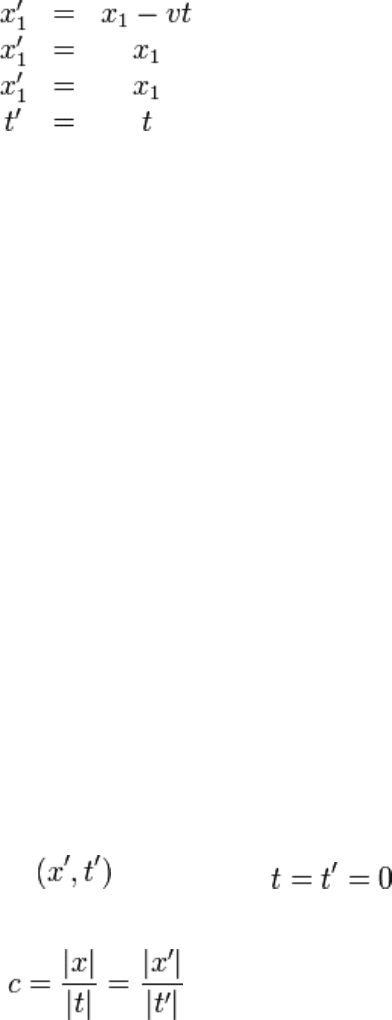
Remark: Classical mechanics laws are invariant by transformations belonging to Galileo
transformation group. A Galileo transformation of coordinates can be written:
Following Gallilean relativity, the light speed should depend on the Galilean reference
frame considered. In 1881, the experiment of Michelson and Morley attempting to
measure this dependance fails.
Relativistic mechanics (Special relativity)
Relativistic mechanics in the special case introduced by Einstein, as he was 26 years old,
is based on the following postulate:
Postulate: All the laws of Universe ({\it i. e. }laws of mechanics and electromagnetism)
are the same in all Galilean reference frames.
Because Einstein believes in the Maxwell equations (and because the Michelson Morley
experiment fails) c has to be a constant. So Einstein postulates:
Postulate: The light speed in vacuum c is the same in every Galilean reference frame.
This speed is an upper bound.
We will see how the physical laws have to be modified to obey to those postulates later
on\footnote{The fundamental laws of dyanmics is deeply modified section
secdynasperel section secdynasperel), but as guessed by Einstein Maxwell laws obey to
the special relativity postulates section seceqmaxcov.}. The existence of a universal
speed, the light speed, modifies deeply space--time structure. {space--time} It yields to
precise the metrics{metrics} appendix chaptens for an introduction to the notion of
metrics) adopted in special relativity. Let us consider two Galilean reference frames
characterized by coordinates: (x,t) and
. Assume that at both
coordinate system coincide. Then:
that is to say:
c t − x = 0
2 2 2
and
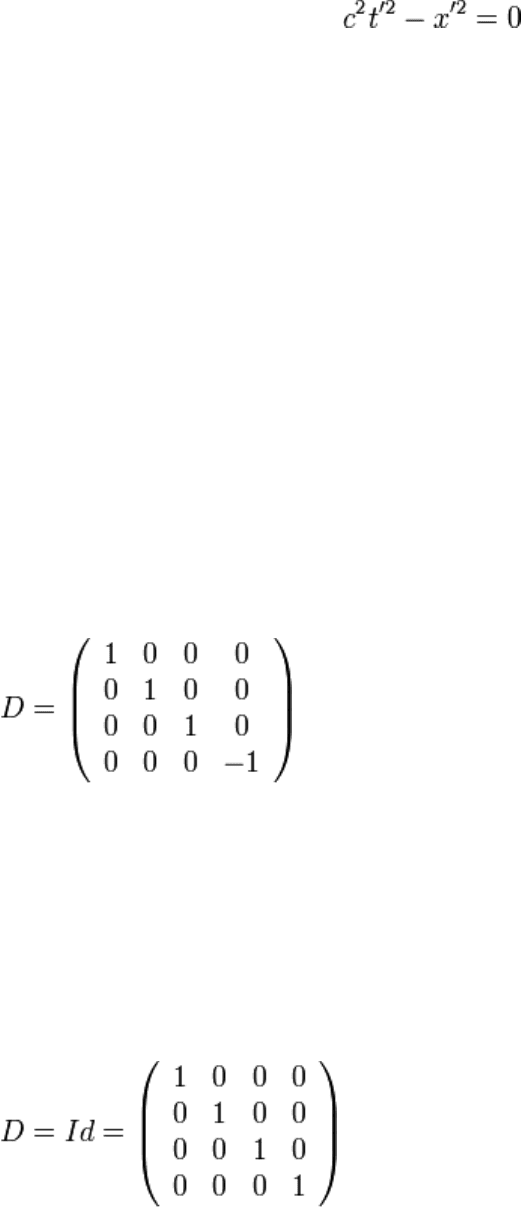
Quantity c t − x
2 2 2
is thus an invariant. The most natural metrics that should equip space--
time is thus:
ds = dx + dy + dz − c dt
2 2 2 2 2 2
It is postulated that this metrics should be invariant by Galilean change of coordinates.
Postulate: Metrics ds = dx + dy + dz − c dt
2 2 2 2 2 2
is invariant by change of Galilean
reference frame.
Let us now look for the representation of a transformation of space--time that keeps
unchanged this metrics. We look for transformations such that:{Lorentz transformation}
ds = dx + dy + dz − c dt
2 2 2 2 2 2
is invariant. From, the metrics, a "position vector" have to be defined. It is called four-
vector position, and two formalisms are possible to define it:{four--vector}.
• Either coordinates of four-vector position are taken equal to R = (x,y,z,ct) and
space is equipped by pseudo scalar product defined by matrix:
Then:
(R | R) = R DR
t
where R
t
represents the transposed of four-vector position R.
• Or coordinates of four-vector position are taken equal to R = (x,y,z,ict) and space
is equipped by pseudo scalar product defined by matrix:
Then:
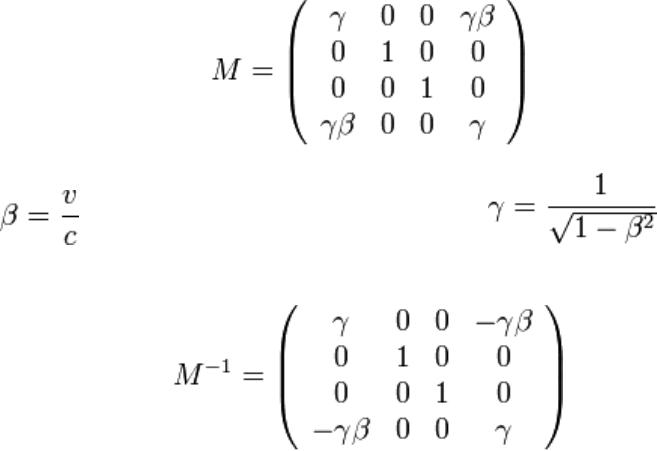
(R | R) = R R
t
where R
t
represents the transposed four-vector position R.
Once the formalism is chosen, the representation of transformations ({\it i. e.,} the
matrices), that leaves the pseudo-norm invariant can be investigated ). Here we will just
exhibit such matrices. In first formalism, condition that pseudo-product scalar is invariant
implies that:
(MR | MR) = (R | R)
thus
D = M DM
+
Following matrix suits:
where (v is the speed of the reference frame) and . The inverse
of M:
Remark:
Equation cond implies a condition for the determinant:
1 = det(M DM) = (det(M))
+ 2
Matrices M of determinant 1 form a group called Lorentz group. {Lorentz group}
In the second formalism, this same condition implies:
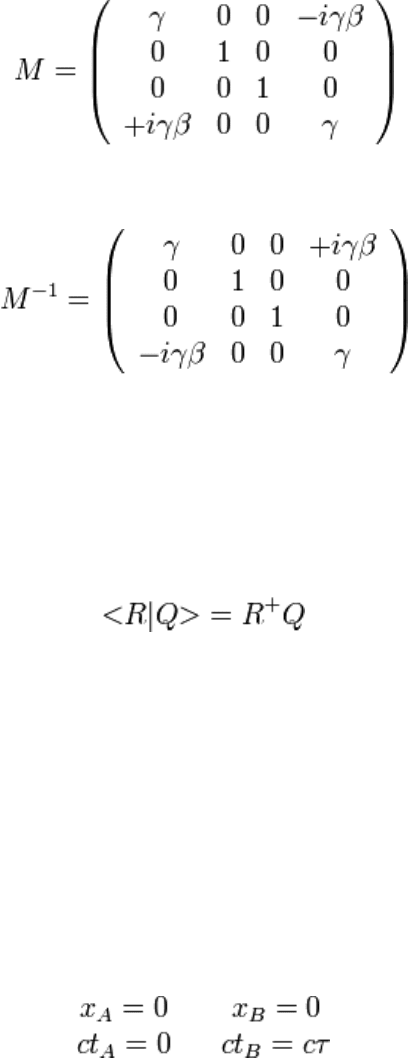
Id = M M
+
Following matrix suits:
and its inverse is:
Remark: A unitary matrix section secautresrep) is a matrix such that:
M M = 1 = MM
+ +
where M
+
is the adjoint matrix of M, that is the conjugated transposed matrix of M. Then,
scalar product defined by:
is preserved by the action of M.
Eigen time
Four-scalar (or Lorentz invariant) dτ allows to define other four-vectors (as four-vector
velocity):
Definition: Eigen time of a mobile is time marked by a clock travelling with this mobile.
If mobile travels at velocity v in reference frame R
2
, then events A and B that are
referenced in R
1
travelling the mobile by:
and are referenced in R
2
by: