
Cossey L. Introduction to Mathematical Physics
Подождите немного. Документ загружается.

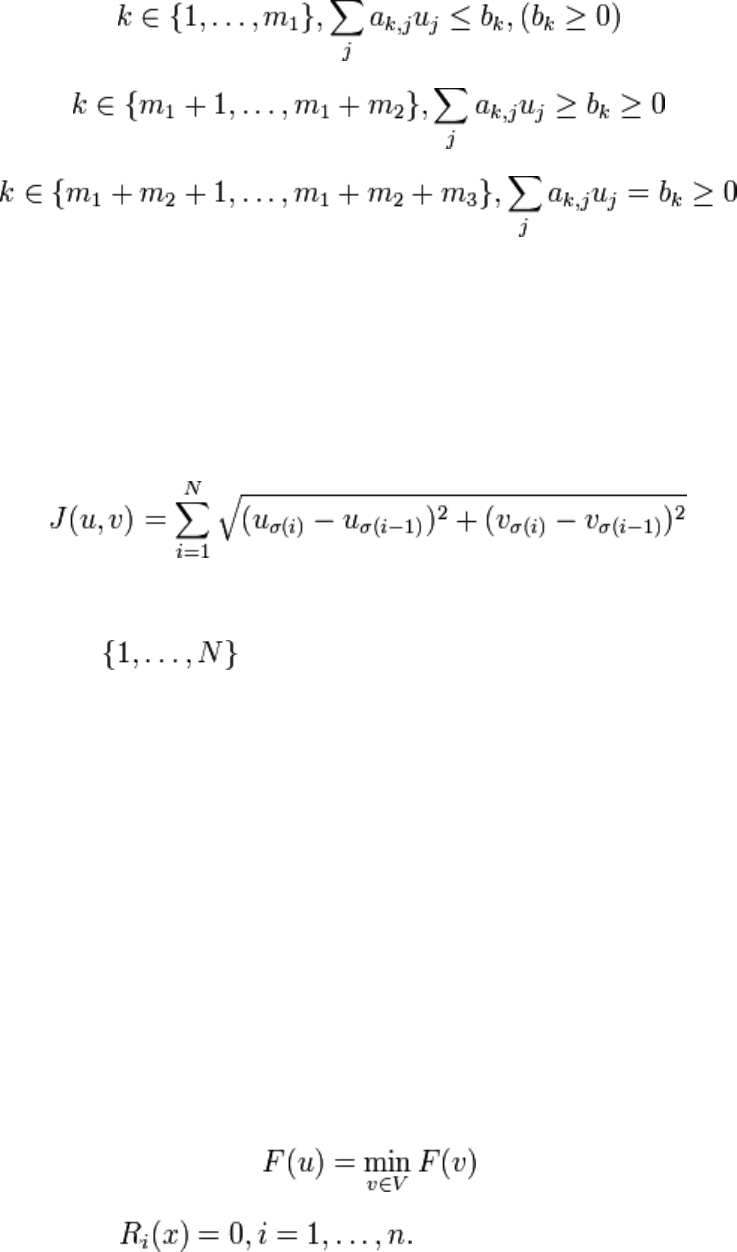
The numerical algorithm to solve this type of problem is presented in
Example: LABEL exmpsimul When the variables u
i
can take only discrete values, one
speaks about discrete or combinatorial optimization. The function to minimize can be for
instance (travelling salesman problem):
where u ,v
i i
are the coordinates of a city number i. The coordinates of the cities are
numbers fixed in advance but the order in which the N cities are visited ({\it i.e} the
permutation σ of ) is to be find to minimize J. Simulated annealing is a
method to solve this problem and is presented in
Lagrange multipliers
Lagrange multipliers method is an interesting approach to solve the minimization
problem of a function of N variables with constraints, {\it
i. e. } to solve the following problem:
\index{contrainte}\index{Lagrange multiplier}
Problem:
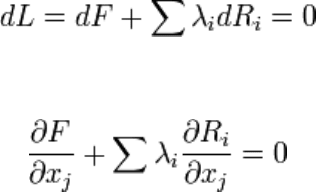
Find u in a space V of dimension N such that
with n constraints,
Lagrange multipliers method is used in statistical physics section
chapphysstat).
In a problem without any constraints, solution u verifies:
dF = 0
In the case with constraints, the n coordinates u
i
of u are not independent. Indeed, they
should verify the relations:
dR = 0
i
Lagrange multipliers method consists in looking for n numbers λ
i
called Lagrange
multipliers such that:
One obtains the following equation system:
Linear evolution problems, spectral
method
Spectral point of view
Spectral method is used to solve linear evolution problems of type Problem
probevollin. Quantum mechanics chapters chapmq and
chapproncorps ) supplies beautiful spectral problems
{\it via} Schr\"odinger equation. Eigenvalues of the linear operator considered (the
hamiltonian) are interpreted as energies associated to states (the eigenfunctions of the
hamiltonian). Electromagnetism leads also to spectral problems (cavity modes).
Spectral methods consists in defining first the space where the operator L of problem
probevollin acts and in providing it with the Hilbert space structure. Functions that verify:
Lu (x) = λ u (x)
k k k
are then seeked. Once eigenfunctions u
k(x)
are found, the problem is reduced to integration
of an ordinary differential equations (diagonal) system.
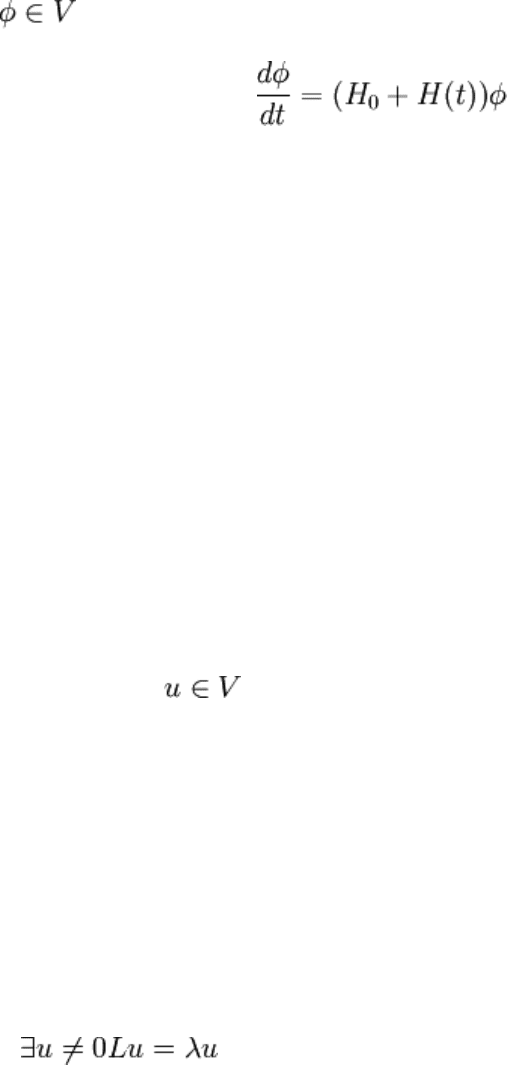
The following problem is a particular case of linear evolution problem \index{response
(linear)} (one speaks about linear response problem)
Problem:
Find such that:
where H
0
is a linear diagonalisable operator and H(t) is a linear operator "small" with
respect to H
0
.
This problem can be tackled by using a spectral method. Section
secreplinmq presents an example of linear response in quantum
mechanics.
Some spectral analysis theorems
In this section, some results on the spectral analysis of a linear operator L are presented.
Demonstration are given when L is a linear operator acting from a finite dimension space
E to itself. Infinite dimension case is treated in specialized books for instance )). let L be
an operator acting on E. The spectral problem associated to L is:
Problem:
Find non zero vectors (called eigenvectors) and numbers λ (called eigenvalues)
such that:
Lu = λu
Here is a fundamental theorem:
Theorem:
Following conditions are equivalent:
1.
2. matrix L − λI is singular
3. det(L − λI) = 0
A matrix is said diagonalisable if it exists a basis in which it has a diagonal form ).
Theorem:
If a squared matrix L of dimension n has n eigenvectors linearly independent, then L is
diagonalisable. Moreover, if those vectors are chosen as columns of a matrix S, then:
Λ = S LS with Λ diagonal
− 1
Proof:
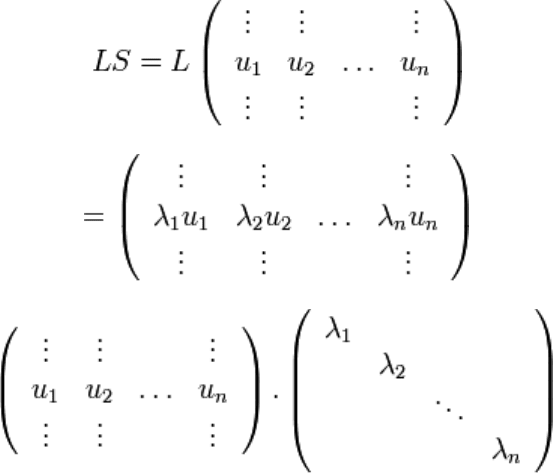
Let us write vectors u
i
as column of matrix S and let let us calculate LS:
LS = SΛ
Matrix S is invertible since vectors u
i
are supposed linearly independent, thus:
λ = S LS
− 1
Remark: LABEL remmatrindep If a matrix L has n distinct eigenvalues then its
eigenvectors are linearly independent.
Let us assume that space E is a Hilbert space equiped by the scalar product < . | . > .
Definition:
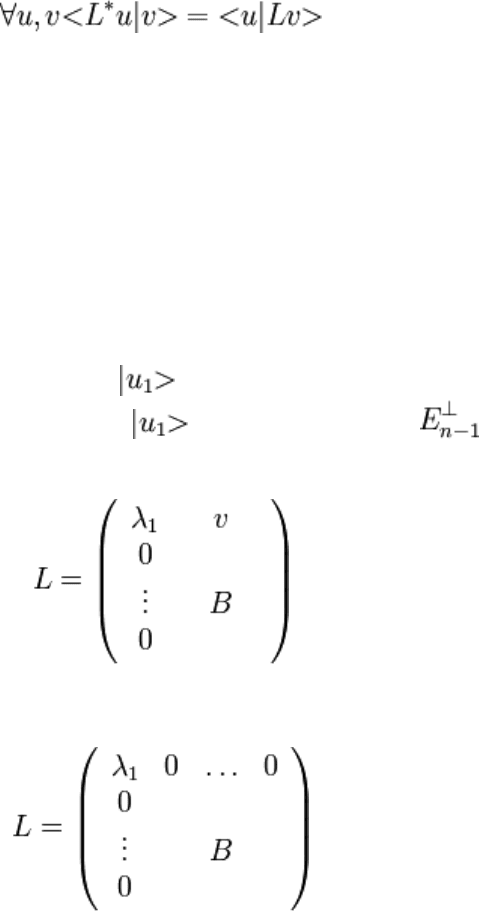
Operator L
*
adjoint of L is by definition defined by:
Definition:
An auto-adjoint operator is an operator L such that L = L
*
Theorem:
For each hermitic operator L, there exists at least one basis constituted by orthonormal
eigenvectors. L is diagonal in this basis and diagonal elements are eigenvalues.
Proof:
Consider a space E
n
of dimension n. Let be the eigenvector associated to eigenvalue
λ
1
of A. Let us consider a basis the space ( direct sum any basis of ). In this
basis:
The first column of L is image of u
1
. Now, L is hermitical thus:
By recurrence, property is prooved..
Theorem:
Eigenvalues of an hermitic operator L are real.
Proof:
Consider the spectral equation:
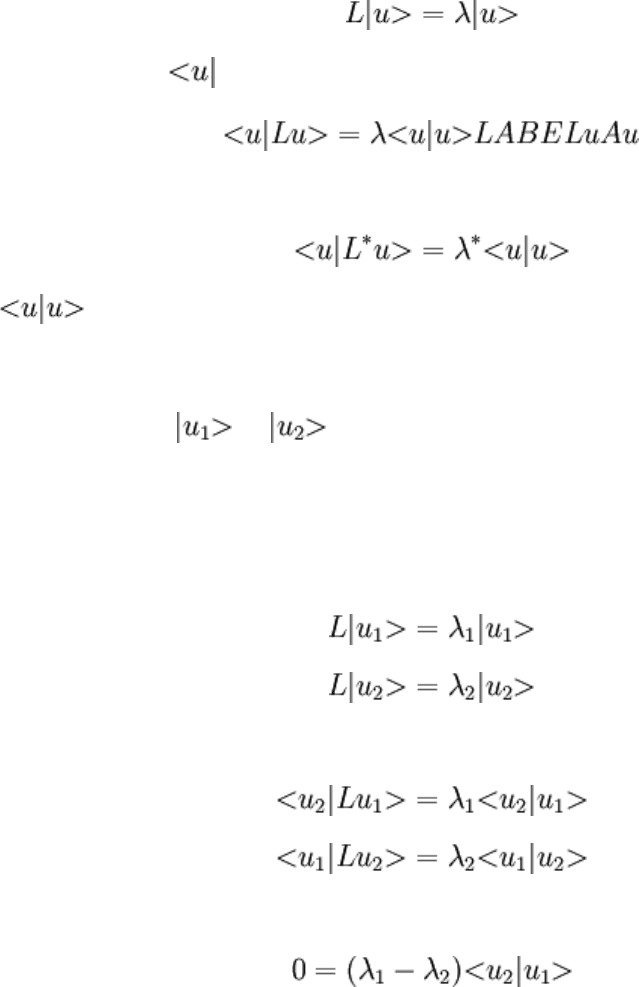
Multiplying it by , one obtains:
Complex conjugated equation of uAu is:
being real and L = L
*
, one has: λ = λ
*
Theorem:
Two eigenvectors and associated to two distinct eigenvalues λ
1
and λ
2
of an
hermitic operator are orthogonal.
Proof:
By definition:
Thus:
The difference between previous two equations implies:
which implies the result.
Let us now presents some methods and tips to solve spectral problems.
==Solving spectral problems==LABEL chapresospec
The fundamental step for solving linear evolution problems by doing the spectral method
is the spectral analysis of the linear operator involved. It can be done numerically, but
two cases are favourable to do the spectral analysis by hand: case where there are
symmetries, and case where a perturbative approach is possible.
Using symmetries
Using of symmetries rely on the following fundamental theorem:
Theorem:
If operator L commutes with an operator T, then eigenvectors of T are also eigenvectors
of L.
Proof is given in appendix chapgroupes. Applications of rotation invariance are presented
at section secpotcent. Bloch's theorem deals with translation invariance theorem
theobloch at section sectheobloch).
Perturbative approximation
A perturbative approach can be considered each time operator U to diagonalize can be
considered as a sum of an operator U
0
whose spectral analysis is known and of an
operator U
1
small with respect to U
0
. The problem to be solved is then the
following:\index{perturbation method}
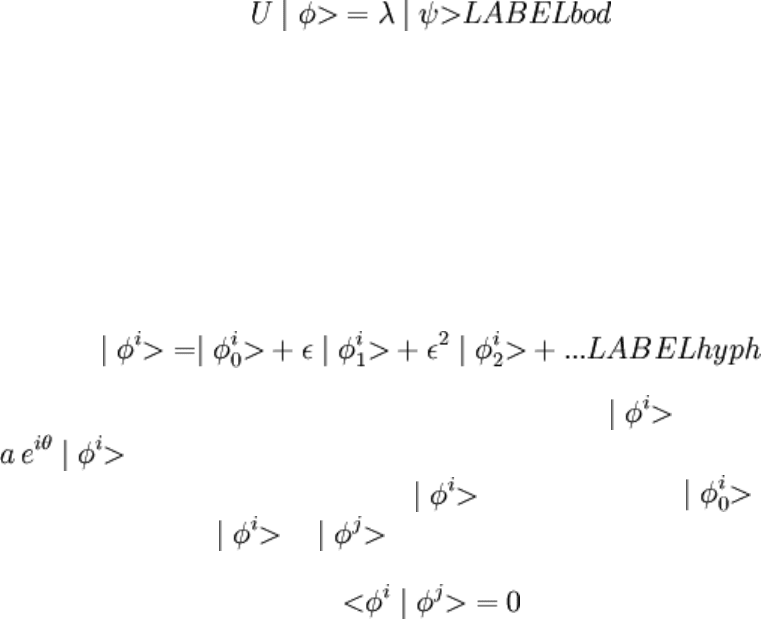
Introducing the parameter ε, it is assumed that U can be expanded as:
U = U + εU + ε U + ...
0 1
2
2
Let us admit\footnote{This is not obvious from a mathematical point of view
~{Kato}~ ))} that the eigenvectors can be expanded
in ε : For the i
th
eigenvector:
Equation ( bod) defines eigenvector, only to a factor. Indeed, if
is solution, then
is also solution. Let us fix the norm of the eigenvectors to 1. Phase can also
be chosen. We impose that phase of vector is the phase of vector .
Approximated vectors and should be exactly orthogonal.
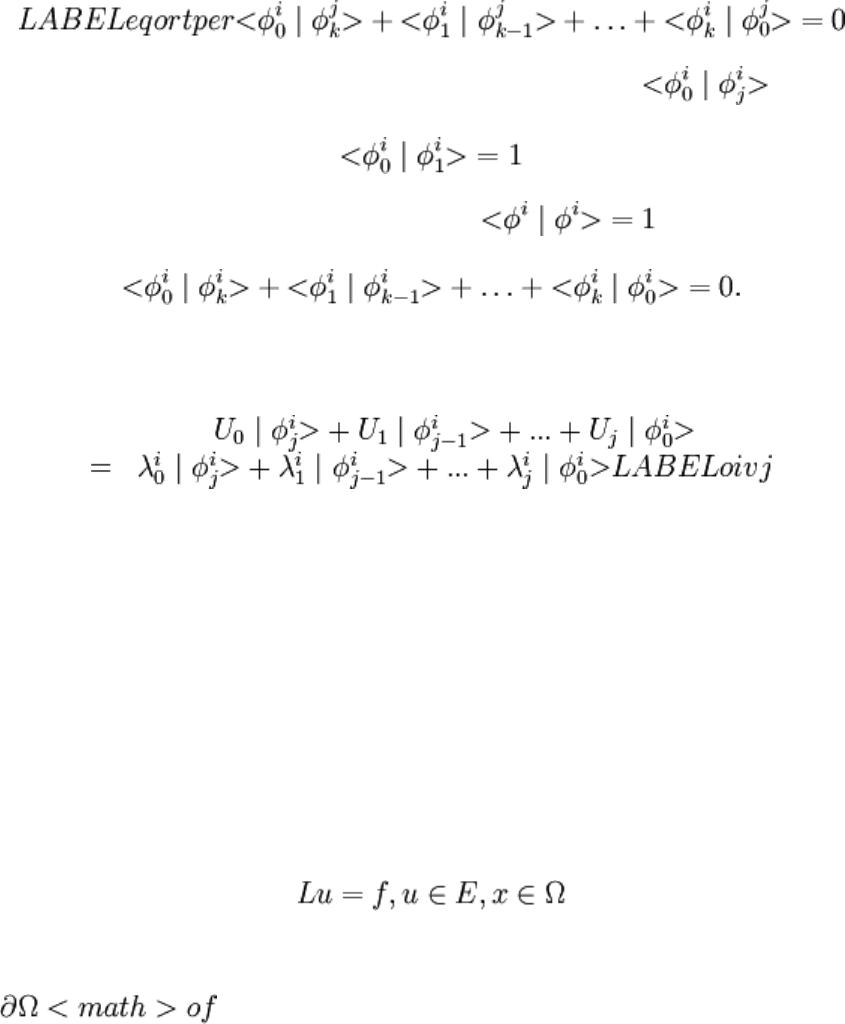
Egalating coefficients of ε
k
, one gets:
Approximated eigenvectors are imposed to be exactly normed and real:
Equalating coefficients in ε
k
with k > 1 in product , one gets:
Substituting those expansions into spectral equation bod and equalating coefficients of
successive powers of ε yields to:
Projecting previous equations onto eigenvectors at zero order, and using conditions
eqortper, successive corrections to eigenvectors and eigenvalues are obtained.
Variational approximation
In the same way that problem
Problem:
Find u such that:
1. u satisfies boundary conditions on the border
\Omega</math>.
can be solved by variational method, spectral problem:
Problem:
Find u and λ such that:
1. u satisfies boundary conditions on the border
of Ω.
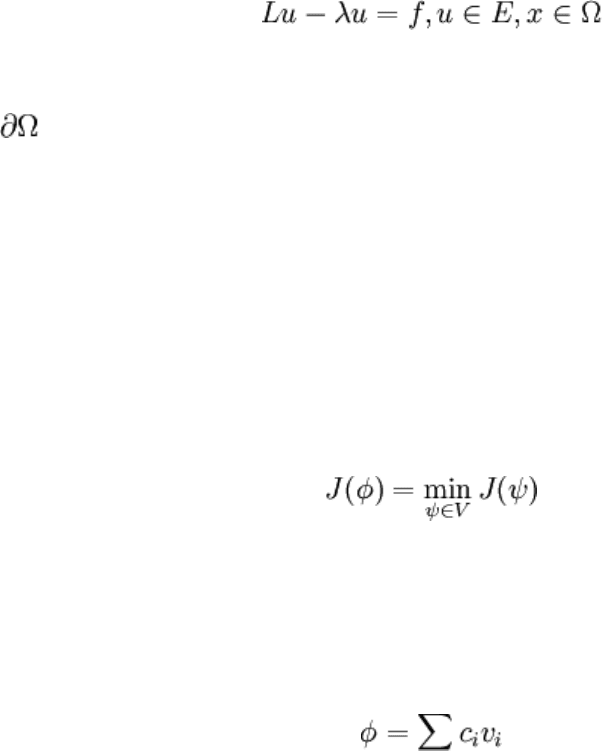
can also be solved by variational methods. In case where L is self adjoint and f is zero
(quantum mechanics case), problem can be reduced to a minimization problem . In
particular, one can show that:
Theorem:
The eigenvector φ with lowest energy E
0
of self adjoint operator H is solution of
problem: Find φ normed such that:
where J(ψ) = < ψ | Hψ > . Eigenvalue associated to φ is J(φ).
Demonstration is given in ). Practically, a family of vectors v
i
of V is chosen and one
hopes that eigenvector φ is well approximated by some linear combination of those
vectors:
Solving minimization problem is equivalent to finding coefficients c
i
. At chapter
chapproncorps, we will see several examples of good choices of families
v
i
.
Remark:
In variational calculations, as well as in perturbative calculations, symmetries should be
used each time they occur to simplify solving of spectral problems.
Nonlinear evolution problems,
perturbative methods
Problem statement
Perturbative methods allow to solve nonlinear evolution problems. They are used in
hydrodynamics, plasma physics for solving nonlinear fluid models for instance )).
Problems of nonlinear ordinary differential equations can also be solved by perturbative
methods for instance ) where averaging method is presented). Famous KAM theorem
(Kolmogorov--Arnold--Moser) gives important results about the perturbation of
hamiltonian systems. Perturbative methods are only one of the possible methods:
geometrical methods, normal form methods
) can give good results. Numerical technics will be
introduced at next section.
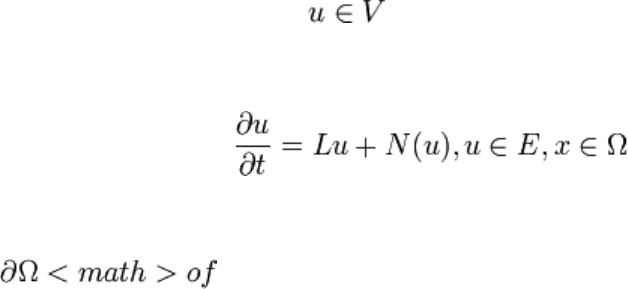
Consider the following problem:
Problem: LABEL proeqp Find such that:
1. u verifies boundary conditions on the border
\Omega</math>.
1. u verifies initial conditions.
Various perturbative methods are presented now.
Regular perturbation
Solving method can be described as follows:
Algorithm: