
Cossey L. Introduction to Mathematical Physics
Подождите немного. Документ загружается.

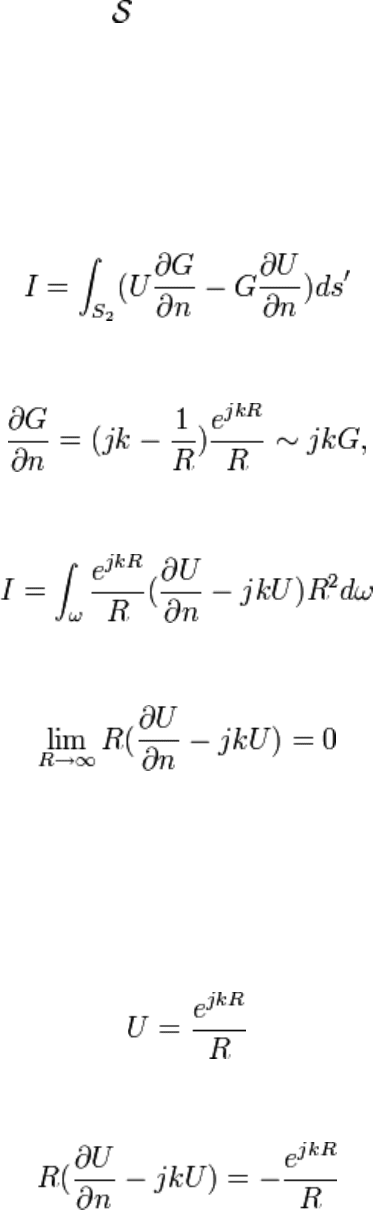
where n is directed outwards surface . Integral over S = S + S
1 2
is reduced to an integral
over S
1
if the {\it Sommerfeld radiation condition} {Sommerfeld radiation condition} is
verified:
Sommerfeld radiation condition
Consider the particular case where surface S
2
is the portion of sphere centred en P with
radius R. Let us look for a condition for the integral I defined by:
tends to zero when R tends to infinity. We have:
thus
where ω is the solid angle. If, in all directions, condition:
is satisfied, then I is zero.
Remark:
If U is a superposition of spherical waves, this condition is verified\footnote{ Indeed if U
is:
then
tends to zero when R tends to infinity. }.
Huyghens principle
From equation eqgreendif, G is zero on S
1
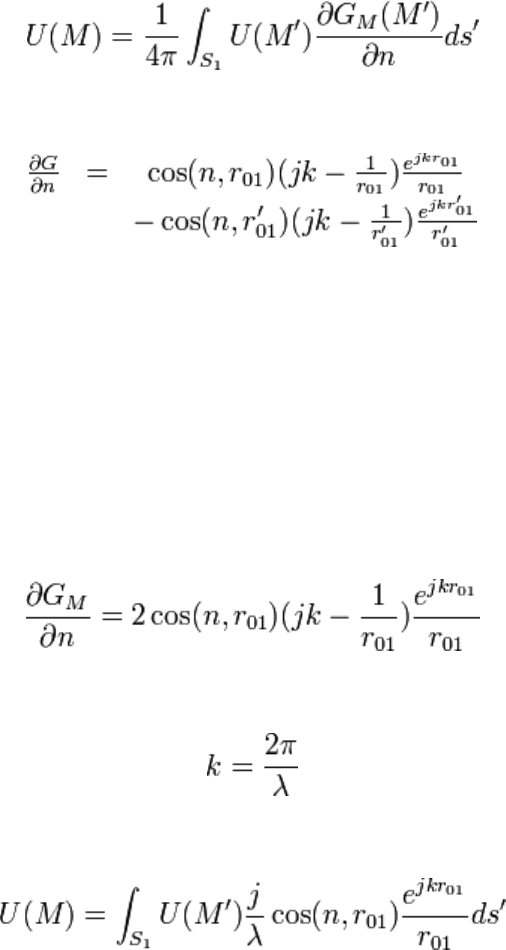
. {Huyghens principle} We thus have:
Now:
where r = MM'
01
and r' = M M'
01 s
, M' belonging to Σ and M
s
being the symmetrical point
of the point M where field U is evaluated with respect to the screen. Thus:
r = r'
01 01
and
cos(n,r' ) = − cos(n,r )
01 01
One can evaluate:
For r
01
large, it yields\footnote{Introducing the wave lenght λ defined by:
}:
This is the Huyghens principle :
Principle:
• Light propagates from close to close. Each surface element reached by it behaves
like a secondary source that emits spherical wavelet with amplitude proportional
to the element surface.
• Complex amplitude of light vibration in one point is the sum of complex
amplitudes produced by all secondary sources. It is said that vibrations interfere
to create the vibration at considered point.
Let O a point on S
1
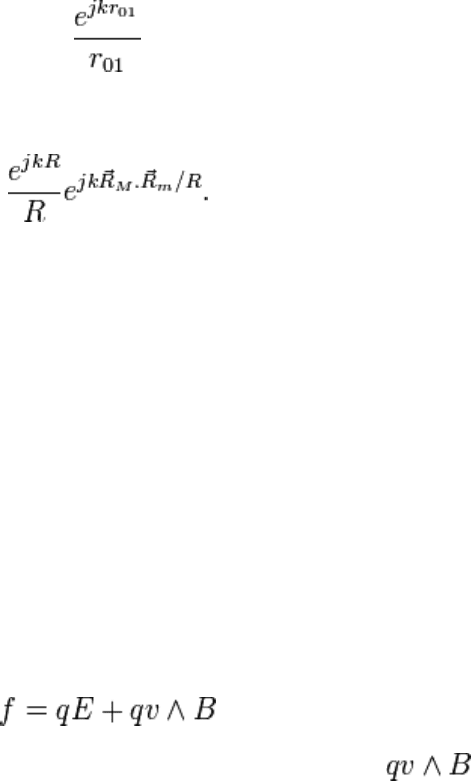
. Fraunhoffer approximation {Fraunhoffer approximation} consists in
approximating:
by
where R = OM, R = OM'
m
, R = OM
M
. Then amplitude Fourier transform{Fourier
transform} of light on S
1
is observed at M.
Electromagnetic interaction
Electromagnetic forces
Postulates of electromagnetism have to be completed by another postulate that deals with
interactions:
Postulate:
In the case of a charged particle of charge q, Electromagnetic force applied to this particle
is:
where qE is the electrical force (or Coulomb force) {Coulomb force} and is the
Lorentz force. {Lorentz force}
This result can be generalized to continuous media using Poynting vector.{Poynting
vector} ==Electromagnetic energy, Poynting vector==
Previous postulate using forces can be replaced by a "dual" postulate that uses energies:
Postulate:
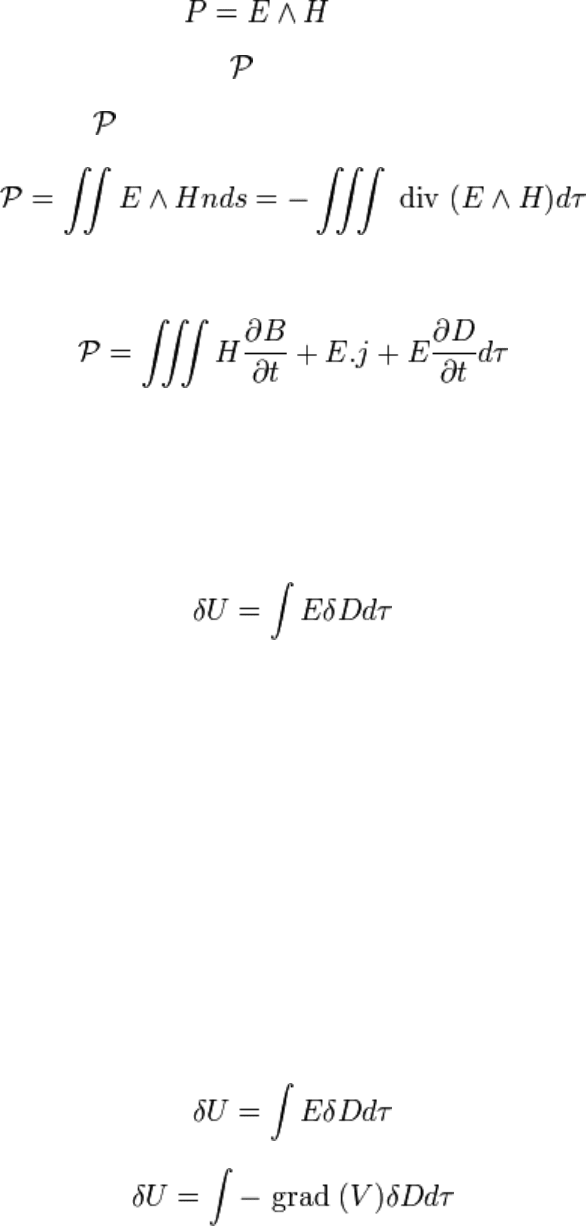
Consider a volume V. The vector is called Poynting vector. It is postulated
that flux of vector P trough surface S delimiting volume V, oriented by a entering normal
is equal to the Electromagnetic power given to this volume.
Using Green's theorem,
can be written as:
which yields, using Maxwell equations to:
Two last postulates are closely related. In fact we will show now that they basically say
the same thing (even if Poynting vector form can be seen a bit more general).
Consider a point charge q in a field E. Let us move this charge of dr. Previous postulated
states that to this displacement corresponds a variation of internal energy:
where dD is the variation of D induced by the charge displacement.
Theorem:
Internal energy variation is:
δU = − fδr
where f is the electrical force applied to the charge.
Proof:
In the static case, E field has conservative circulation ( rot E = 0) so it derives from a
potential. \medskip Let us write energy conservation equation:
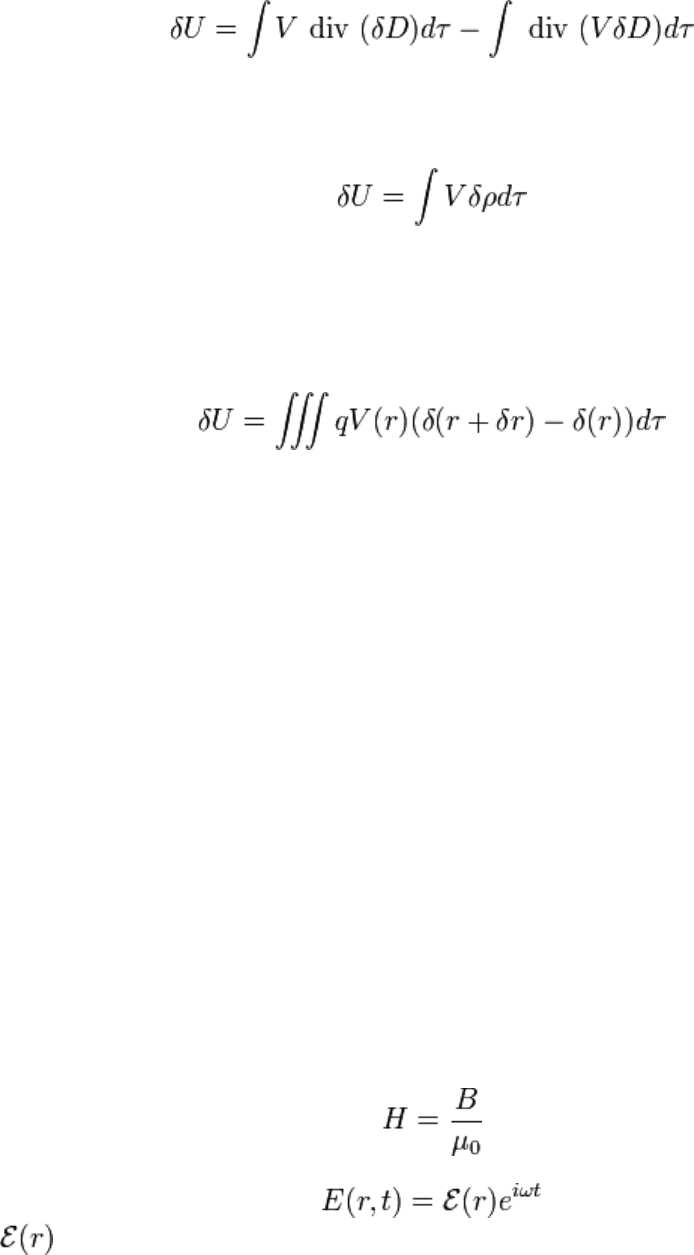
Flow associated to divergence of VδD is zero in all the space, indeed D decreases as 1 / r
2
and V as 1 / r and surface increases as r
2
. So:
Let us move charge of δr. Charge distribution goes from qδ(r) to qδ(r + dr) where δ(r) is
Dirac distribution. We thus have dρ(r) = q(δ(r + δr) − δ(r)). So:
,
thus
δU = qV(r + δr) − qV(r)
δU = grad (qV)δr
Variation is finally δU = − fdr. Moreover, we prooved that:
f = − grad (qV) = qE
Exercises
Exercice:
Assume constitutive relations to be:
D(r,t) = ε(r,t) * E(r,t)
where * represents temporal convolution{convolution} (value of D(r,t) field at time t S
depends on values of E at preceeding times) and
Show that in harmonical regime (
) and without any charges
field verifies Helmholtz equation :
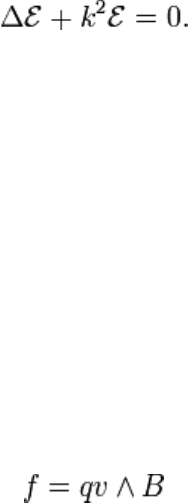
Give the expression of k
2
.
Exercice:
Proove charge conservation equation eqconsdelacharge from Maxwell equations.
Exercice:
Give the expression of electrical potential created by quadripole Q
ij
.
Exercice:
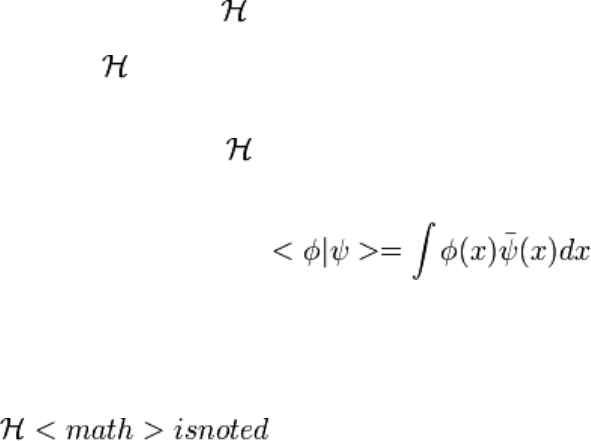
Show from the expression of magnetic energy that force acting on a point charge q with
velocity v is:
Introduction
In the current state of scientific knowledge, quantum mechanics is the theory used to
describe phenomena that occur at very small scale\footnote{ The way that quantum
mechanics has been obtained is very different from the way other theories, relativity for
instance, have been obtained. Relativity therory is based on geometric and invariance
principles. Quantum mechanics is based on observation (operators are called
observables).
Gravitational interaction is difficult to describe with the quantum mechanics tools.
Einstein, even if he played an important role in the construct of quantum mechanics, was
unsatisfied by this theory. His famous "God doesn't play dices" summerizes his point of
view. Electromagnetic interaction can be described using quantum dynamics: this is the
object of quantum electrodynamics (QED). This will not presented in this book, so the
reader should refer to specialized books, for instance .(atomic or subatomic). The goal of
this chapter is to present the mathematical formalism of quantum mechanics.
Applications of quantum mechanics will be seen at chapter chapproncorps. Quantum
physics relies on a sequence of postulates that we present now. The reader is invited to
refer to for physical justifications.
Postulates
State space
The first postulate deal with the description of the state of a system.
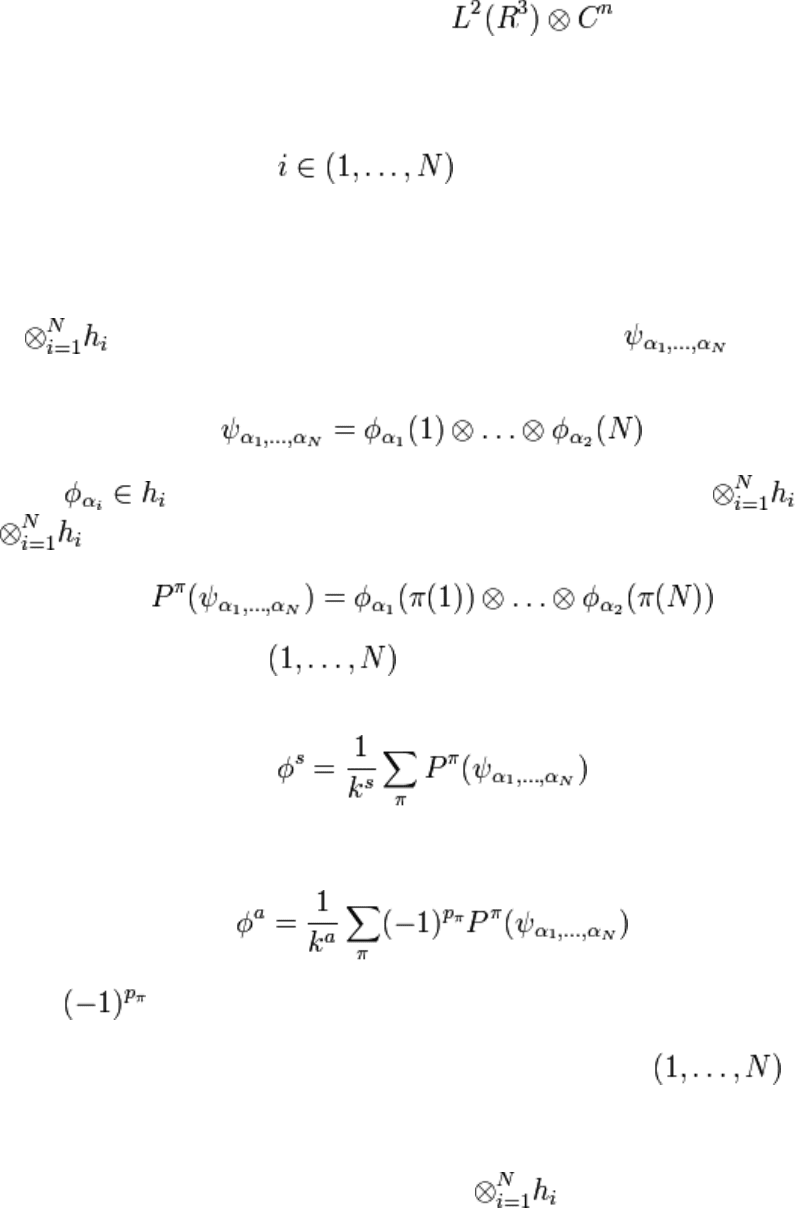
Postulate: (Description of the state of a system) To each physical system corresponds a
complex Hilbert space with enumerable basis.
The space
have to be precised for each physical system considered.
Example: For a system with one particle with spin zero in a non relativistic framework,
the adopted state space is L (R )
2 3
. It is the space of complex functions of squared
summable (relatively to Lebesgue measure) equipped by scalar product:
This space is called space of orbital states.{state space}
Quantum mechanics substitutes thus to the classical notion of position and speed a
function ψ(x) of squared summable. A element ψ(x) of
|\psi></math> using Dirac notations.
Example:
For a system constituted by a particle with non zero spin {spin}s, in a non relativistic
framework, state space is the tensorial product where n = 2s + 1.
Particles with entire spin are called bosons;{bosons} Particles with semi-entire spin are
called fermions.{fermions}
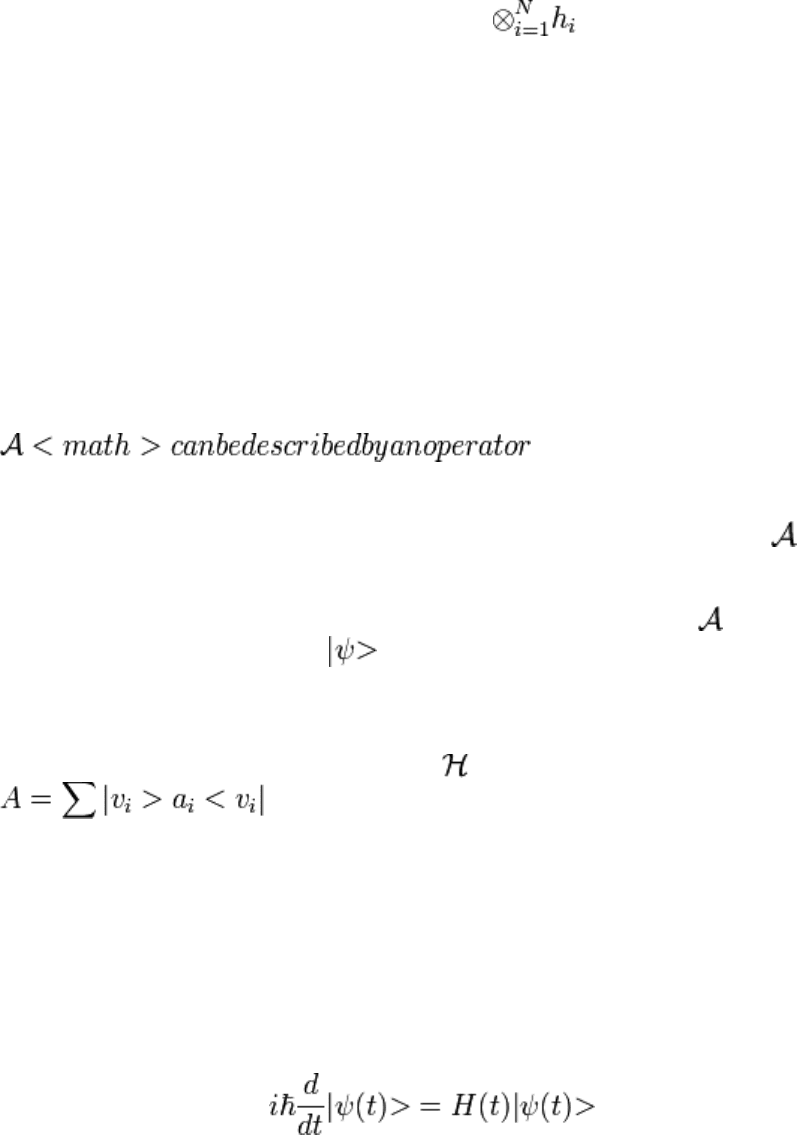
Example: For a system constituted by N distinct particles, state space is the tensorial
product of Hilbert spaces h
i
( ) where h
i
is the state space associated to
particle i.
Example: For a system constituted by N identical particles, the state space is a subspace
of
where h
i
is the state space associated to particle i. Let be a function
of this subspace. It can be written:
where . Let P
π
be the operator permutation {permutation} from into
defined by:
where π is a permutation of . A vector is called symmetrical if it can be
written:
A vector is called anti-symetrical if it can be written:
where is the signature {signature} (or parity) of the permutation π, p
π
being the
number of transpositions whose permutation π is product. Coefficients k
s
and k
a
allow to
normalize wave functions. Sum is extended to all permutations π of .
Depending on the particle, symmetrical or anti-symetrical vectors should be chosen as
state vectors. More precisely:
• For bosons, state space is the subspace of made by symmetrical vectors.
• For fermions, state space is the subspace of made by anti-symetrical
vectors.
To present the next quantum mechanics postulates, "representations" have to be defined.
Schr\"odinger representation
Here is the statement of the four next postulate of quantum mechanics in Schr\"odinger
representation.{Schr\"odinger representation}
Postulate:
(Description of physical quantities) Each measurable physical quantity
Aactingin\mathcal H</math>.
This operator is an observable.
Postulate: (Possible results) The result of a measurement of a physical quantity can be
only one of the eigenvalues of the associated observable A.
Postulate: (Spectral decomposition principle) When a physical quantity is measured in
a system which is in state normed , the average value of measurement is < A > :
< A > = < ψ | Aψ >
where < . | . > represents the scalar product in . In particular, if
, probability to obtain the value a
i
when doing a measurement
is:
P(a ) = < ψ | v > < v | ψ >
i i i
Postulate: (Evolution) The evolution of a state vector ψ(t) obeys the
Schr\"odinger\footnote{The Autria physicist Schr\"odinger first proposed this equation in
1926 as he was working in Zurich. He received the Nobel price in 1933 with Paul Dirac
for their work in atomic physics.} equation:
where H(t) is the observable associated to the system's energy.
Remark: State a time t can be expressed as a function of state a time 0:
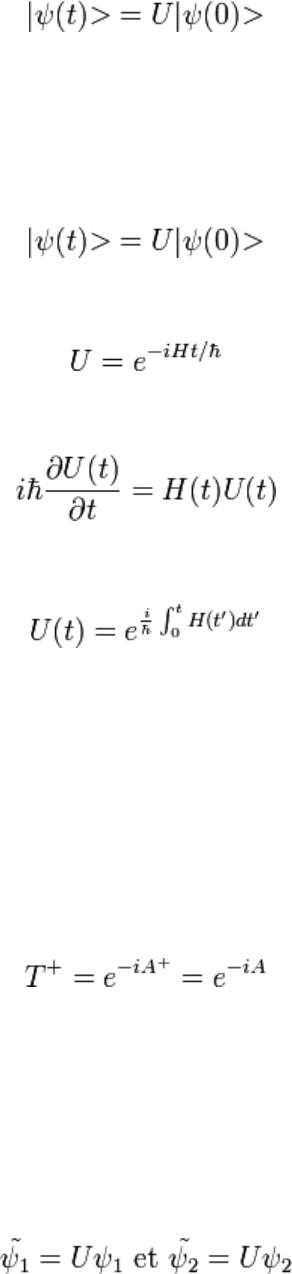
Operator U is called evolution operator.{evolution operator} It can be shown that U is
unitary.{unitary operator}
Remark: When operator H doesn't depend on time, evolution equation can be easily
integrated and it yields:
with
When H depends on time, solution of evolution equation
is not :
Other representations
Other representations can be obtained by unitary transformations.
Definition: By definition
Property: If A is hermitic, then operator T = e
iA
is unitary.
Proof: Indeed:
T T = e e = 1
+ − iA + iA
TT = e e = 1
+ iA − iA
Property: Unitary transformations conserve the scalar product.
Proof: Indeed, if