
Devore J.L., Berk K.N. Modern Mathematical Statistics with Applications
Подождите немного. Документ загружается.


mean ¼ 535 median ¼ 500 mode ¼ 500
sd ¼ 96 minimum ¼ 220 maximum ¼ 925
5th percentile ¼ 400 10th percentile ¼ 430
90th percentile ¼ 640 95th percentile ¼ 720
What can you conclude about the shape of a his-
togram of this data? Explain your reasoning.
79. The sample data x
1
, x
2
, ... , x
n
sometimes repre-
sents a time series, where x
t
¼ the observed value
of a response variable x at time t. Often the
observed series shows a great deal of random
variation, which makes it difficult to study
longer-term behavior. In such situations, it is
desirable to produce a smoothed version of the
series. One technique for doing so involves expo-
nential smoothing. The value of a smoothing
constant a is chosen (0 < a < 1). Then with x
t
¼ smoothed value at time t, we set
x
1
¼ x
1
, and
for t ¼ 2, 3, ... , n,
x
t
¼ ax
t
þ 1 aðÞ
x
t1
.
a. Consider the following time series in which
x
t
¼ temperature (
F) of effluent at a sewage
treatment plant on day t: 47, 54, 53, 50, 46, 46,
47, 50, 51, 50, 46, 52, 50, 50. Plot each x
t
against t on a two-dimensional coordinate sys-
tem (a time-series plot). Does there appear to
be any pattern?
b. Calculate the
x
t
’s using a ¼ .1. Repeat using
a ¼ .5. Which value of a gives a smoother
x
t
series?
c. Substitute
x
t1
¼ ax
t1
þ 1 aðÞ
x
t2
on the
right-hand side of the expression for
x
t
, then
substitute
x
t2
in terms of x
t2
and
x
t3
, and so
on. On how many of the values x
t
, x
t1
, ..., x
1
does
x
t
depend? What happens to the coeffi-
cient on x
tk
as k increases?
d. Refer to part (c). If t is large, how sensitive is
x
t
to the initialization
x
1
¼ x
1
? Explain.
[Note: A relevant reference is the article “Simple
Statistics for Interpreting Environmental Data,”
Water Pollution Contr. Fed. J., 1981: 167–175.]
80. Consider numerical observations x
1
, ... , x
n
.
It is frequently of interest to know whether the
x
t
’s are (at least approximately) symmetrically
distributed about some value. If n is at least
moderately large, the extent of symmetry can be
assessed from a stem-and-leaf display or histo-
gram. However, if n is not very large, such
pictures are not particularly informative. Consider
the following alternative. Let y
1
denote the smal-
lest x
i
, y
2
the second smallest x
i
, and so on.
Then plot the following pairs as points on a two-
dimensional coordinate system: (y
n
~
x,
~
x y
1
),
(y
n1
~
x,
~
x y
2
), (y
n2
~
x,
~
x y
3
), ... . There
are n/2 points when n is even and (n 1)/2 when
n is odd.
a. What does this plot look like when there is
perfect symmetry in the data? What does it
look like when observations stretch out more
above the median than below it (a long upper
tail)?
b. The accompanying data on rainfall (acre-feet)
from 26 seeded clouds is taken from the
article “A Bayesian Analysis of a Multiplica-
tive Treatment Effect in Weather Modi-
fication” (Technometrics, 1975: 161–166).
Construct the plot and comment on the extent
of symmetry or nature of departure from
symmetry.
4.1 7.7 17.5 31.4 32.7 40.6 92.4
115.3 118.3 119.0 129.6 198.6 200.7 242.5
255.0 274.7 274.7 302.8 334.1 430.0 489.1
703.4 978.0 1656.0 1697.8 2745.6
Bibliography
Chambers, John, William Cleveland, Beat Kleiner,
and Paul Tukey, Graphical Methods for Data Anal-
ysis, Brooks/Cole, Pacific Grove, CA, 1983.
A highly recommended presentation of both older
and more recent graphical and pictorial methodol-
ogy in statistics.
Freedman, David, Robert Pisani, and Roger Purves,
Statistics (4th ed.), Norton, New York, 2007. An
excellent, very nonmathematical survey of basic
statistical reasoning and methodology.
Hoaglin, David, Frederick Mosteller, and John Tukey,
Understanding Robust and Exploratory Data Anal-
ysis, Wiley, New York, 1983. Discusses why, as
well as how, exploratory methods should be
employed; it is good on details of stem-and-leaf
displays and boxplots.
Hoaglin, David and Paul Velleman, Applications,
Basics, and Computing of Exploratory Data Anal-
ysis, Duxbury Press, Boston, 1980. A good discus-
sion of some basic exploratory methods.
48
CHAPTER 1 Overview and Descriptive Statistics
Moore, David, Statistics: Concepts and Controversies
(7th ed.), Freeman, San Francisco, 2010. An
extremely readable and entertaining paperback
that contains an intuitive discussion of problems
connected with sampling and designed experi-
ments.
Peck, Roxy, and Jay Devore, Statistics: The Exploration
and Analysis of Data (7th ed.), Brooks/Cole, Boston,
MA, 2012. The first few chapters give a very
nonmathematical survey of methods for describing
and summarizing data.
Peck, Roxy, et al. (eds.), Statistics: A Guide to the
Unknown (4th ed.), Thomson-Brooks/Cole,
Belmont, CA, 2006. Contains many short, nontech-
nical articles describing various applications of
statistics.
Bibliography 49

CHAPTER TWO
Probability
Introduction
The term probability refe rs to the study of randomness and uncertainty. In any
situation in which one of a number of possible outcomes may occur, the theory of
probability provides methods for quantifying the chances, or likelihoods, asso-
ciated with the various outcome s. The language of probability is constantly used in
an informal manner in both written and spoken contexts. Examples include such
statements as “It is likely that the Dow Jones Industrial Average will increase by the
end of the year,” “There is a 50–50 chance that the incumbent will seek reelection,”
“There will probably be at least one section of that course offered next year,”
“The odds favor a quick settlement of the strike,” and “It is expected that at least
20,000 concert tickets will be sold.” In this chapter, we introduce some elementary
probability concepts, indicate how probabilities can be interpreted, and show how
the rules of probability can be applied to compute the probabilities of many
interesting events. The methodology of probability will then permit us to express
in precise language such informal statements as those given above.
The study of probability as a branch of mathematics goes back over
300 years, where it had its genesis in connection with questions involving games
of chance. Many books are devoted exclusively to probability and explore in great
detail numerous interesting aspects and applications of this lovely branch of
mathematics. Our objective here is more limited in scope: We will focus on those
topics that are central to a basic understanding and also have the most direct
bearing on problems of statistical inference.
J.L. Devore and K.N. Berk, Modern Mathematical Statistics with Applications, Springer Texts in Statistics,
DOI 10.1007/978-1-4614-0391-3_2,
#
Springer Science+Business Media, LLC 2012
50

2.1
Sample Spaces and Events
An experiment is any action or process whose outcome is subject to uncertainty.
Although the word experiment generally suggests a planned or carefully controlled
laboratory testing situation, we use it here in a muc h wider sense. Thus experiments
that may be of interest include tossing a coin once or several times, selecting a card
or cards from a deck, weighing a loaf of bread, ascertaining the commuting time
from home to work on a particular morning, obtaining blood types from a group of
individuals, or calling people to conduct a survey.
The Sample Space of an Experiment
DEFINITION
The sample space of an experiment, denoted by S , is the set of all possible
outcomes of that experiment.
Example 2.1 The simplest experiment to which probability applies is one with two possible
outcomes. One such experiment consists of examining a single fuse to see whether
it is defective. The sample space for this experiment can be abbreviated as
S ¼ N; D
fg
, where N represents not defective, D represents defective, and the
braces are used to enclose the elements of a set. Another such experiment would
involve tossing a thumbtack and noting whether it landed point up or point down,
with sample space S ¼ U; D
fg
, and yet another would consist of observing the
gender of the next child born at the local hospital, with S ¼ M; F
fg
.
■
Example 2.2 If we examine three fuses in sequence and note the result of each examination, then
an outcome for the entire experiment is any sequence of N’s and D’s of length 3, so
S ¼ NNN; NND; NDN; NDD; DNN; DND; DDN; DDD
fg
If we had tossed a thumbtack three times, the sample space would be obtained by
replacing N by U in S above. A similar notational change would yield the sample
space for the experiment in which the genders of three newborn children are
observed.
■
Example 2.3 Two gas stations are located at a certain intersection. Each one has six gas pumps.
Consider the experiment in which the number of pumps in use at a particular time
of day is determined for each of the stations. An experimental outcome specifies
how many pumps are in use at the first station and how many are in use at the
second one. One possi ble outcome is (2, 2), another is (4, 1), and yet another is
(1, 4). Th e 49 outcomes in S are displayed in the accompanying table. The sample
space for the experiment in which a six-sided die is thrown twice results from
deleting the 0 row and 0 column from the table, giving 36 outcomes.
2.1 Sample Spaces and Events 51

Second Station
First Station 0 1 2 3 4 5 6
0 (0, 0) (0, 1) (0, 2) (0, 3) (0, 4) (0, 5) (0, 6)
1 (1, 0) (1, 1) (1, 2) (1, 3) (1, 4) (1, 5) (1, 6)
2 (2, 0) (2, 1) (2, 2) (2, 3) (2, 4) (2, 5) (2, 6)
3 (3, 0) (3, 1) (3, 2) (3, 3) (3, 4) (3, 5) (3, 6)
4 (4, 0) (4, 1) (4, 2) (4, 3) (4, 4) (4, 5) (4, 6)
5 (5, 0) (5, 1) (5, 2) (5, 3) (5, 4) (5, 5) (5, 6)
6 (6, 0) (6, 1) (6, 2) (6, 3) (6, 4) (6, 5) (6, 6)
■
Example 2.4 If a new type-D flashlight battery has a voltage that is outside certain limits, that
battery is characterized as a failure (F); if the battery has a voltage within the
prescribed limits, it is a success (S). Suppose an experiment consists of testing each
battery as it comes off an assembly line until we first observe a success. Although it
may not be very likely, a possible outcome of this experiment is that the first 10 (or
100 or 1000 or ...) are F’s and the next one is an S. That is, for any positive integer
n, we may have to examine n batteries before seeing the first S. The sample space is
S ¼ S; FS; FFS; FFFS; ...
fg
, which contains an infinite number of possible
outcomes. The same abbreviated form of the sample space is appropriate for an
experiment in which, starting at a specified time, the gender of each newborn infant
is recorded until the birth of a male is observed.
■
Events
In our study of probability, we will be interested not only in the individual out-
comes of S but also in any collection of outcomes from S .
DEFINITION
An event is any collection (subset) of outcomes contained in the sample
space S . An event is said to be simple if it consists of exactly one outcome
and compound if it consists of more than one outcome.
When an experiment is performed, a particular event A is said to occur if the
resulting experimental outcome is contained in A. In general, exactly one simple
event will occur, but many compound events will occur simultaneously.
Example 2.5 Consider an experiment in which each of three vehicles taking a particular freeway
exit turns left (L) or rig ht (R) at the end of the exit ramp. The eight possible
outcomes that comprise the sample space are LLL, RLL, LRL, LLR, LRR, RLR,
RRL, and RRR. Thus there are eight simple events, among which are E
1
¼{LLL}
and E
5
¼{LRR}. Some compound events include
A ¼{RLL, LRL, LLR} ¼the event that exactly one of the three vehicles turns
right
B ¼{LLL, RLL, LRL, LLR} ¼the event that at most one of the vehicles turns
right
C ¼{LLL, RRR} ¼the event that all three vehicles turn in the same direction
52 CHAPTER 2 Probability

Suppose that when the experiment is performed, the outcome is LLL. Then the simple
event E
1
has occurred and so also have the events B and C (but not A). ■
Example 2.6
(Example 2.3
continued)
When the number of pumps in use at each of two 6-pump gas stations is observed,
there are 49 possible outcomes, so there are 49 simple events: E
1
¼{(0, 0)},
E
2
¼{(0, 1)}, ..., E
49
¼{(6, 6)}. Examples of compound events are
A ¼{(0, 0), (1, 1), (2, 2), (3, 3), (4, 4), (5, 5), (6, 6)} ¼the event that the
number of pumps in use is the same for both stations
B ¼{(0, 4), (1, 3), (2, 2), (3, 1), (4, 0)} ¼the event that the total number of
pumps in use is four
C ¼{(0, 0), (0, 1), (1, 0), (1, 1)} ¼the event that at most one pump is in use at
each station
■
Example 2.7
(Example 2.4
continued)
The sample space for the battery examination experiment contains an infinite
number of outcomes, so there are an infinite number of simple events. Compound
events include
A ¼{S, FS, FFS} ¼the event that at most three batteries are examined
E ¼{FS, FFFS, FFFFFS, ...} ¼the event that an even number of batteries
are examined
■
Some Relations from Set Theory
An event is nothing but a set, so relationships and results from elementary set theory
can be used to study events. The following operations will be used to construct new
events from given events.
DEFINITION
1. Th e union of two events A and B, denoted by A [ B and read “AorB,” is
the event consist ing of all outcomes that are either in A or in B or in both
events (so that the union includes outcomes for which both A and B occur
as well as outcomes for which exactly one occurs)—that is, all outcomes
in at least one of the events.
2. Th e intersection of two events A and B, denoted by A \ B and read “A and
B,” is the event consisting of all outcomes that are in both A and B.
3. Th e complement of an event A, denoted by A
0
, is the set of all outcomes in
S that are not contained in A.
Example 2.8
(Example 2.3
continued)
For the experiment in which the number of pumps in use at a single six-pump
gas station is observed, let A ¼{0, 1, 2, 3, 4}, B ¼{3, 4, 5, 6}, and C ¼{1, 3, 5}.
Then
A [ B ¼ 0; 1; 2; 3; 4; 5; 6fg¼S A [ C ¼ 0; 1; 2; 3; 4; 5fg
A \ B ¼ 3; 4fg A \ C ¼ 1; 3fgA
0
¼ 5; 6fgfA [ Cg
0
¼ 6fg
■
2.1 Sample Spaces and Events 53

Example 2.9
(Example 2.4
continued)
In the battery experiment, define A, B, and C by
A ¼ S; FS ; FFS
fg
B ¼ S; FFS ; FFFFS
fg
and
C ¼ FS; FFFS; FFFFFS; ...
fg
Then
A [ B ¼ S; FS; FFS; FFFFS
fg
A \ B ¼ S; FFS
fg
A
0
¼ FFFS; FFFFS; FFFFFS ; ...fg
and
C
0
¼ S; FFS; FFFFS; ...
fg
¼ an odd number of batteries are examined
fg
■
Sometimes A and B have no outcomes in common, so that the intersection of
A and B contains no outcomes.
DEFINITION
When A and B have no outcomes in common, they are said to be disjoint
or mutually exclusive events. Mathematicians write this compactly as
A \ B ¼∅ where ∅ denotes the event consisting of no outcomes whatso ever
(the “null” or “empty” event).
Example 2.10 A small city has three automobile dealerships: a GM dealer selling Chevrolets and
Buicks; a Ford dealer selling Fords and Lincolns; and a Chrysler dealer selling
Jeeps and Chryslers. If an experiment consists of observing the brand of the next car
sold, then the events A ¼{Chevrolet, Buick} and B ¼{Ford, Lincoln} are mutually
exclusive because the next car sold cannot be both a GM product and a Ford
product
■
The operations of union and intersection can be extended to more than two
events. For any three events A, B, and C, the event A [ B [ C is the set of outcomes
contained in at least one of the three events, whereas A \ B \ C is the set of
outcomes contained in all three events. Given events A
1
, A
2
, A
3
, ... , these events
are said to be mutually exclusive (or pairwise disjoint) if no two events have any
outcomes in common.
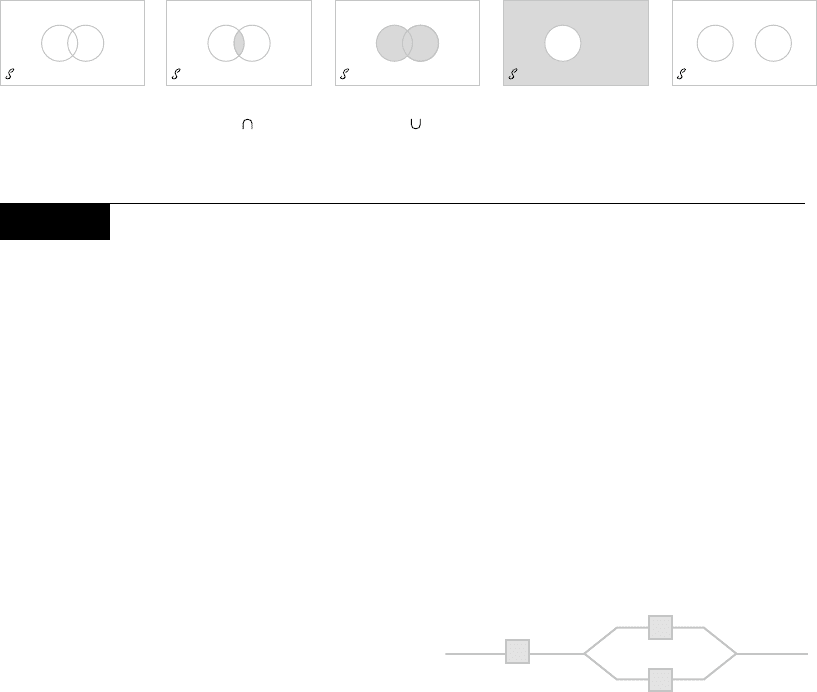
A pictorial representation of events and manipulations with events is
obtained by using Venn diagrams. To construct a Venn diagram, draw a rectangle
whose interior will represent the sample space S . Then any event A is represented as
the interior of a closed curve (often a circle) contained in S . Figure 2.1 shows
examples of Venn diagrams.
54 CHAPTER 2 Probability
Exercises Section 2.1 (1–12)
1. Ann and Bev have each applied for several jobs at
a local university. Let A be the event that Ann is
hired and let B be the event that Bev is hired.
Express in terms of A and B the events
a. Ann is hired but not Bev.
b. At least one of them is hired.
c. Exactly one of them is hired.
2. Two voters, Al and Bill, are each choosing
between one of three candidates – 1, 2, and 3 –
who are running for city council. An experimental
outcome specifies both Al’s choice and Bill’s
choice, e.g. the pair (3,2).
a. List all elements of S .
b. List all outcomes in the event A that Al and Bill
make the same choice.
c. List all outcomes in the event B that neither of
them vote for candidate 2.
3. Four universities—1, 2, 3, and 4—are participat-
ing in a holiday basketball tournament. In the first
round, 1 will play 2 and 3 will play 4. Then the two
winners will play for the championship, and the
two losers will also play. One possible outcome
can be denoted by 1324 (1 beats 2 and 3 beats 4
in first-round games, and then 1 beats 3 and
2 beats 4).
a. List all outcomes in S .
b. Let A denote the event that 1 wins the tourna-
ment. List outcomes in A.
c. Let B denote the event that 2 gets into the
championship game. List outcomes in B.
d. What are the outcomes in A [ B and in A \ B?
What are the outcomes in A
0
?
4. Suppose that vehicles taking a particular freeway
exit can turn right (R), turn left (L), or go straight
(S). Consider observing the direction for each of
three successive vehicles.
a. List all outcomes in the event A that all three
vehicles go in the same direction.
b. List all outcomes in the event B that all three
vehicles take different directions.
c. List all outcomes in the event C that exactly
two of the three vehicles turn right.
d. List all outcomes in the event D that exactly
two vehicles go in the same direction.
e. List outcomes in D
0
, C [ D, and C \ D.
5. Three components are connected to form a system
as shown in the accompanying diagram. Because
the components in the 2–3 subsystem are
connected in parallel, that subsystem will function
if at least one of the two individual components
functions. For the entire system to function, com-
ponent 1 must function and so must the 2–3 sub-
system.
2
1
3
The experiment consists of determining the condi-
tion of each component [S (success) for a func-
tioning component and F (failure) for a
nonfunctioning component].
a. What outcomes are contained in the event A
that exactly two out of the three components
function?
b. What outcomes are contained in the event B
that at least two of the components function?
c. What outcomes are contained in the event C
that the system functions?
d. List outcomes in C
0
, A [ C, A \ C, B [ C, and
B \ C.
6. Each of a sample of four home mortgages is clas-
sified as fixed rate (F) or variable rate (V).
a. What are the 16 outcomes in S ?
b. Which outcomes are in the event that exactly
three of the selected mortgages are fixed rate?
AB ABAB
A
AB
Venn diagram of
events A and
B
Shaded region
is A B
Shaded region
is A B
Shaded region
is A'
Mutually exclusive
events
ab cde
Figure 2.1 Venn diagrams
2.1 Sample Spaces and Events 55

c. Which outcomes are in the event that all four
mortgages are of the same type?
d. Which outcomes are in the event that at most
one of the four is a variable-rate mortgage?
e. What is the union of the events in parts (c) and
(d), and what is the intersection of these two
events?
f. What are the union and intersection of the two
events in parts (b) and (c)?
7. A family consisting of three persons—A, B, and
C—belongs to a medical clinic that always has a
doctor at each of stations 1, 2, and 3. During a
certain week, each member of the family visits the
clinic once and is assigned at random to a station.
The experiment consists of recording the station
number for each member. One outcome is (1, 2, 1)
for A to station 1, B to station 2, and C to station 1.
a. List the 27 outcomes in the sample space.
b. List all outcomes in the event that all three
members go to the same station.
c. List all outcomes in the event that all members
go to different stations.
d. List all outcomes in the event that no one goes
to station 2.
8. A college library has five copies of a certain text
on reserve. Two copies (1 and 2) are first print-
ings, and the other three (3, 4, and 5) are second
printings. A student examines these books in ran-
dom order, stopping only when a second printing
has been selected. One possible outcome is 5, and
another is 213.
a. List the outcomes in S .
b. Let A denote the event that exactly one book
must be examined. What outcomes are in A?
c. Let B be the event that book 5 is the one
selected. What outcomes are in B?
d. Let C be the event that book 1 is not examined.
What outcomes are in C?
9. An academic department has just completed vot-
ing by secret ballot for a department head. The
ballot box contains four slips with votes for
candidate A and three slips with votes for candi-
date B. Suppose these slips are removed from the
box one by one.
a. List all possible outcomes.
b. Suppose a running tally is kept as slips are
removed. For what outcomes does A remain
ahead of B throughout the tally?
10. A construction firm is currently working on three
different buildings. Let A
i
denote the event that
the ith building is completed by the contract date.
Use the operations of union, intersection, and
complementation to describe each of the follow-
ing events in terms of A
1
, A
2
, and A
3
, draw a Venn
diagram, and shade the region corresponding to
each one.
a. At least one building is completed by the con-
tract date.
b. All buildings are completed by the contract
date.
c. Only the first building is completed by the
contract date.
d. Exactly one building is completed by the con-
tract date.
e. Either the first building or both of the other two
buildings are completed by the contract date.
11. Use Venn diagrams to verify the following two
relationships for any events A and B (these are
called De Morgan’s laws):
a. ðA [ BÞ
0
¼ A
0
\ B
0
b. ðA \ BÞ
0
¼ A
0
[ B
0
12. a. In Example 2.10, identify three events that are
mutually exclusive.
b. Suppose there is no outcome common to all
three of the events A, B, and C. Are these three
events necessarily mutually exclusive? If your
answer is yes, explain why; if your answer is
no, give a counterexample using the experi-
ment of Example 2.10.
2.2
Axioms, Interpretations, and Properties
of Probability
Given an experiment and a sample space S , the objective of probability is to assign
to each event A a number P(A), called the probability of the event A, which will give
a precise measure of the chance that A will occur. To ensure that the probability
assignments will be consistent with our intuitive notions of probability, all assign-
ments should satisfy the following axioms (basic properties) of probability.
56 CHAPTER 2 Probability

AXIOM 1
AXIOM 2
AXIOM 3
For any event A, P(A) 0.
PðS Þ¼1:
If A
1
, A
2
, A
3
, ... is an infinite collection of disjoint events, then
PðA
1
[ A
2
[ A
3
Þ¼
P
1
i¼1
PðA
i
Þ
You might wonder why the third axiom contains no reference to a finite
collection of disjoint events. It is because the corresponding property for a finite
collection can be derived from our three axioms. We want our axiom list to be as
short as possible and not contain any property that can be derived from others on the
list. Axiom 1 reflects the intuitive notion that the chance of A occurring should be
nonnegative. The sample space is by definition the event that must occur when the
experiment is performed (S contains all possible outcomes), so Axiom 2 says that
the maximum possible probability of 1 is assigned to S . The third axiom formalizes
the idea that if we wish the probability that at least one of a number of events will
occur and no two of the events can occur simultaneously, then the chance of at least
one occurring is the sum of the chances of the individual events.
PROPOSITION
P(∅) ¼0 where ∅ is the null event. This in turn implies that the property
contained in Axiom 3 is valid for a finite collection of events.
Proof First consider the infinite collection A
1
¼ ; A
2
¼ ; A
3
¼ ; ....
Since \ ¼ , the events in this collection are disjoint and [ A
i
¼ . The
third axiom then gives
PðÞ¼
X
PðÞ
This can happen only if PðÞ¼0.
Now suppose that A
1
; A
2
; ... ; A
k
are disjoint events, and append to these
the infinite collection A
k
þ1
¼ ; A
k
þ2
¼ ; A
k
þ3
¼ ; .... Again invoking the
third axiom,
P
[
k
i¼1
A
i
!
¼ P
[
1
i¼1
A
i
!
¼
X
1
i¼1
PðA
i
Þ¼
X
k
i¼1
PðA
i
Þ
as desired. ■
Example 2.11 Consider tossing a thumbtack in the air. When it comes to rest on the ground, either
its point will be up (the outcome U) or down (the outcome D). The sample space for
this event is therefore S ¼ U; D
fg
. The axioms specify PðS Þ¼1, so the probability
assignment will be completed by determining P(U) and P(D). Since U and D are
disjoint and their union is S , the foregoing proposition implies that
1 ¼ PðS Þ¼PðUÞþPðDÞ
2.2 Axioms, Interpretations, and Properties of Probability 57