
Devore J.L., Berk K.N. Modern Mathematical Statistics with Applications
Подождите немного. Документ загружается.


The result of this integration is
g
3;5
ðy
3
; y
5
Þ¼
6!
2!1!1!
½Fðy
3
Þ
2
½Fðy
5
ÞFðy
3
Þ
1
½1 Fðy
5
Þ
1
f ð y
3
Þf ðy
5
Þ
1< y
3
< y
5
< 1
In the general case, the numerator in the leading expression involving factorials
becomes n! and the denominator becomes i 1ðÞ! j i 1ðÞ! n jðÞ!: The three
exponents on bracketed terms change in a corresponding way .
An Intuitive Derivation of Order Statistic PDF’s
Let D be a number quite close to 0, and consider the three class intervals
1; yð; y; y þ Dð, and y þ D; 1ðÞ. For a sing le X, the probabilities of these
three classes are
p
1
¼ FðyÞ p
2
¼
ð
yþD
y
f ð xÞdx f ðyÞD p
3
¼ 1 Fðy þ DÞ
For a random sample of size n, it is very unlikely that two or more X’s will fall in
the second interval. The probability that the ith order statistic falls in the second
interval is then approximately the probability that i 1 of the X’s are in the
first interval, one is in the second, and the remaining n iX’s are in the third
class. This is just a multinomial probability:
Pðy < Y
i
y þ DÞ
n!
ði 1Þ!1!ðn iÞ!
½Fðy
i
Þ
i1
f ðyÞD½1 Fðy þ DÞ
ni
Dividing both sides by D and taking the limit as D ! 0 gives exactly the pdf of Y
i
obtained earli er via integration.
Similar reasoning works with the joint pdf of Y
i
and Y
j
(i < j). In this
case there are five relevant class intervals: ð1; y
i
; y
i
; y
i
þ D
1
ð; y
i
þ D
1
; y
j
;
y
j
; y
j
þ D
2
; and ðy
j
þ D
2
; 1Þ
Exercises Section 5.5 (65–77)
65. A friend of ours takes the bus five days per week
to her job. The five waiting times until she can
board the bus are a random sample from a uniform
distribution on the interval from 0 to 10 min.
a. Determine the pdf and then the expected
value of the largest of the five waiting times.
b. Determine the expected value of the differ-
ence between the largest and smallest times.
c. What is the expected value of the sample
median waiting time?
d. What is the standard deviation of the largest
time?
66. Refer back to example 5.29. Because n ¼ 4, the
sample median is (Y
2
+ Y
3
)/2. What is the
expected value of the sample median, and how
does it compare to the median of the population
distribution?
67. Referring back to Exercise 65, suppose you learn
that the smallest of the five waiting times is 4
min. What is the conditional density function of
the largest waiting time, and what is the expected
value of the largest waiting time in light of this
information?
68. Let X represent a measurement error. It is natural
to assume that the pdf f(x) is symmetric about 0, so
that the density at a value c is the same as the
density at c (an error of a given magnitude is
278
CHAPTER 5 Joint Probability Distributions
equally likely to be positive or negative). Consider
arandomsampleofn measurements, where n ¼
2k +1,sothatY
k+1
is the sample median. What
can be said about E(Y
k +1
)? If the X distribution
is symmetric about some other value, so that
value is the median of the distribution, what
does this imply about E(Y
k+1
)? [Hints:For
the first question, symmetry implies that
1 FðxÞ¼PX> xðÞ¼PX< xðÞ¼F xðÞ.
For the second question, consider W ¼ X
~
m;
what is the median of the distribution of W?]
69. A store is expecting n deliveries between the
hours of noon and 1 p.m. Suppose the arrival
time of each delivery truck is uniformly
distributed on this one-hour interval and that the
times are independent of each other. What are the
expected values of the ordered arrival times?
70. Suppose the cdf F(x) is strictly increasing and let
F
1
(u) denote the inverse function for 0 < u < 1.
Show that the distribution of F(Y
i
) is the same as
the distribution of the ith smallest order statistic
from a uniform distribution on (0,1). [Hint: Start
with PðFY
i
ðÞuÞ and apply the inverse function
to both sides of the inequality.] [Note: This result
should not be surprising to you, since we have
already noted that F(X) has a uniform distribu-
tion on (0, 1). The result also holds when the cdf
is not strictly increasing, but then extra care is
necessary in defining the inverse function.]
71. Let X be the amount of time an ATM is in use
during a particular one-hour period, and suppose
that X has the cdf F(x) ¼ x
y
for 0 < x < 1 (where
y > 1). Give expressions involving the gamma
function for both the mean and variance of the ith
smallest amount of time Y
i
from a random sam-
ple of n such time periods.
72. The logistic pdf f ðxÞ¼e
x
= 1 þ e
x
ðÞ
2
for 1< x < 1 is sometimes used to describe
the distribution of measurement errors.
a. Graph the pdf. Does the appearance of the
graph surprise you?
b. For a random sample of size n, obtain an
expression involving the gamma function for
the moment generating function of the ith
smallest order statistic Y
i
. This expression
can then be differentiated to obtain moments
of the order statistics. [Hint: Set up the appro-
priate integral, and then let u ¼ 1/(1 + e
x
).]
73. An insurance policy issued to a boat owner has a
deductible amount of $1000, so the amount of
damage claimed must exceed this deductible
before there will be a payout. Suppose the
amount (1000s of dollars) of a randomly selected
claim is a continuous rv with pdf f(x) ¼ 3/x
4
for
x > 1. Consider a random sample of three claims.
a. What is the probability that at least one of the
claim amounts exceeds $5000?
b. What is the expected value of the largest
amount claimed?
74. Conjecture the form of the joint pdf of three order
statistics Y
i
, Y
j
, Y
k
in a random sample of size n.
75. Use the intuitive argument sketched in this section
to obtain a general formula for the joint pdf of two
order statistics
76. Consider a sample of size n ¼ 3 from the standard
normal distribution, and obtain the expected value
of the largest order statistic. What does this say
about the expected value of the largest order sta-
tistic in a sample of this size from any normal
distribution? [Hint: With f(x) denoting the stan-
dard normal pdf, use the fact that
d=dxðÞfðxÞ¼xfðxÞ along with integration by
parts.]
77. Let Y
1
and Y
n
be the smallest and largest order
statistics, respectively, from a random sample of
size n, and let W
2
¼ Y
n
Y
1
(this is the sample
range).
a. Let W
1
¼ Y
1
, obtain the joint pdf of the W
i
’s
(use the method of Section 5.4), and then
derive an expression involving an integral for
the pdf of the sample range.
b. For the case in which the random sample is
from a uniform (0, 1) distribution, carry out the
integration of (a) to obtain an explicit formula
for the pdf of the sample range.
5.5 Order Statistics 279
Supplementary Exercises (78–91)
78. Suppose the amount of rainfall in one region
during a particular month has an exponential dis-
tribution with mean value 3 in., the amount of
rainfall in a second region during that same
month has an exponential distribution with mean
value 2 in., and the two amounts are independent
of each other. What is the probability that the
second region gets more rainfall during this
month than does the first region?
79. Two messages are to be sent. The time (min)
necessary to send each message has an exponen-
tial distribution with parameter l ¼ 1, and the two
times are independent of each other. It costs $2 per
minute to send the first message and $1 per minute
to send the second. Obtain the density function of
the total cost of sending the two messages. [Hint:
First obtain the cumulative distribution function
of the total cost, which involves integrating the
joint pdf.]
80. A restaurant serves three fixed-price dinners cost-
ing $20, $25, and $30. For a randomly selected
couple dining at this restaurant, let X ¼ the cost of
the man’s dinner and Y ¼ the cost of the woman’s
dinner. The joint pmf of X and Y is given in the
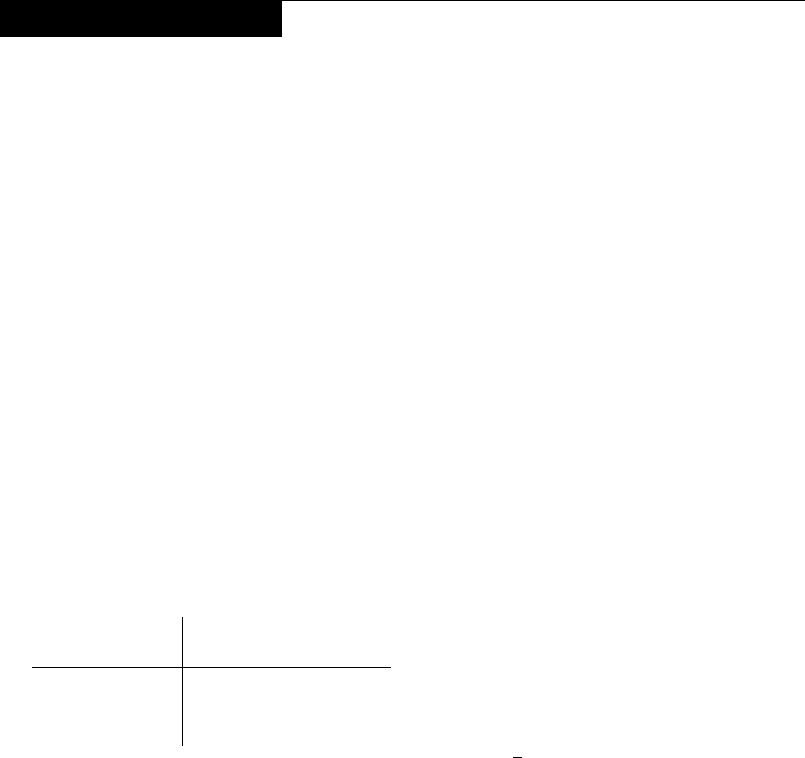
following table:
y
p(x, y) 20 25 30
x
20 .05 .05 .10
25 .05 .10 .35
30 0 .20 .10
a. Compute the marginal pmf’s of X and Y.
b. What is the probability that the man’s and the
woman’s dinner cost at most $25 each?
c. Are X and Y independent? Justify your answer.
d. What is the expected total cost of the dinner for
the two people?
e. Suppose that when a couple opens fortune
cookies at the conclusion of the meal, they
find the message “You will receive as a refund
the difference between the cost of the more
expensive and the less expensive meal that
you have chosen.” How much does the restau-
rant expect to refund?
81. A health-food store stocks two different brands of
a type of grain. Let X ¼ the amount (lb) of brand A
on hand and Y ¼ the amount of brand B on hand.
Suppose the joint pdf of X and Y is
f ðx; yÞ
¼
kxy x 0; y 0; 20 x þ y
30
0 otherwise
(
a. Draw the region of positive density and deter-
mine the value of k.
b. Are X and Y independent? Answer by first
deriving the marginal pdf of each variable.
c. Compute P( X + Y 25).
d. What is the expected total amount of this grain
on hand?
e. Compute Cov(X, Y) and Corr(X, Y).
f. What is the variance of the total amount of
grain on hand?
82. Let X
1
, X
2
, ..., X
n
be random variables denoting n
independent bids for an item that is for sale. Sup-
pose each X
i
is uniformly distributed on the inter-
val [100, 200]. If the seller sells to the highest
bidder, how much can he expect to earn on the
sale? [Hint: Let Y ¼ maxðX
1
; X
2
; :::; X
n
Þ. Find
F
Y
(y) by using the results of Section 5.5 or else
by noting that Y y iff each X
i
is y. Then obtain
the pdf and E(Y).]
83. Suppose a randomly chosen individual’s verbal
score X and quantitative score Y on a nationally
administered aptitude examination have joint pdf
f ðx; yÞ
¼
2
5
ð2x þ 3yÞ 0 x 1; 0 y 1
0 otherwise
8
>
<
>
:
You are asked to provide a prediction t of the
individual’s total score X + Y. The error of predic-
tion is the mean squared error E[(X + Y t)
2
].
What value of t minimizes the error of prediction?
84. Let X
1
and X
2
be quantitative and verbal
scores on one aptitude exam, and let Y
1
and Y
2
be corresponding scores on another exam. If
Cov(X
1
, Y
1
) ¼ 5, Cov(X
1
, Y
2
) ¼ 1, Cov(X
2
, Y
1
) ¼ 2,
and Cov(X
2
, Y
2
) ¼ 8, what is the covariance
between the two total scores X
1
+ X
2
and Y
1
+ Y
2
?
85. Simulation studies are important in investigating
various characteristics of a system or process.
They are generally employed when the mathe-
matical analysis necessary to answer important
280
CHAPTER 5 Joint Probability Distributions
questions is too complicated to yield closed-form
solutions. For example, in a system where the
time between successive customer arrivals has a
particular pdf and the service time of any particu-
lar customer has another pdf, simulation can pro-
vide information about the probability that the
system is empty when a customer arrives, the
expected number of customers in the system, and
the expected waiting time in queue. Such studies
depend on being able to generate observations
from a specified probability distribution.
The rejection method gives a way of generating an
observation from a pdf f(·) when we have a way of
generating an observation from g(·) and the ratio
f(x)/g(x) is bounded, that is, c for some finite c.
The steps are as follows:
1. Use a software package’s random number
generator to obtain a value u from a uniform
distribution on the interval from 0 to 1.
2. Generate a value y from the distribution with
pdf g(y).
3. If u f(y)/cg( y), set x ¼ y (“accept” x); other-
wise return to step 1. That is, the procedure is
repeated until at some stage u f (y)/cg(y).
a. Argue that c 1. [Hint:Ifc < 1, then f( y) <
g(y) for all y; why is this bad?]
b. Show that this procedure does result in
an observation from the pdf f
(·); that is,
P(accepted value x) ¼ F(x). [Hint:
This probability is PðfU f ðyÞ=cgðyÞg \
fY xgÞ; to calculate, first integrate with
respect to u for fixed y and then integrate
with respect to y.]
c. Show that the probability of “accepting” at
any particular stage is 1/c. What does this
imply about the expected number of stages
necessary to obtain an acceptable value?
What kind of value of c is desirable?
d. Let f(x) ¼ 20x(1 x)
3
for 0 < x < 1,
a particular beta distribution. Show that
taking g(y) to be a uniform pdf on (0, 1)
works. What is the best value of c in this
situation?
86. You are driving on a highway at speed X
1
. Cars
entering this highway after you travel at speeds
X
2
, X
3
, ... . Suppose these X
i
’s are independent
and identically distributed with pdf f(x) and cdf
F(x). Unfortunately there is no way for a faster car
to pass a slower one – it will catch up to the slower
one and then travel at the same speed. For exam-
ple, if X
1
¼ 52.3, X
2
¼ 37.5, and X
3
¼ 42.8, then
no car will catch up to yours, but the third car will
catch up to the second. Let N ¼ the number of cars
that ultimately travel at your speed (in your
“cohort”), including your own car. Possible values
of N are 1, 2, 3, ... . Show that the pmf of N is
p(n) ¼ 1/[n(n + 1)], and then determine the
expected number of cars in your cohort. [Hint: N
¼ 3 requires that X
1
< X
2
, X
1
< X
3
, X
4
< X
1
.]
87. Suppose the number of children born to an indi-
vidual has pmf p(x). A Galton–Watson branching
process unfolds as follows: At time t ¼ 0, the
population consists of a single individual. Just
prior to time t ¼ 1, this individual gives birth to
X
1
individuals according to the pmf p(x), so there
are X
1
individuals in the first generation. Just prior
to time t ¼ 2, each of these X
1
individuals gives
birth independently of the others according to the
pmf p(x), resulting in X
2
individuals in the second
generation (e.g., if X
1
¼ 3, then X
2
¼ Y
1
+ Y
2
+ Y
3
,
where Y
i
is the number of progeny of the ith
individual in the first generation). This process
then continues to yield a third generation of size
X
3
, and so on.
a. If X
1
¼ 3, Y
1
¼ 4, Y
2
¼ 0, Y
3
¼ 1, draw a tree
diagram with two generations of branches to
represent this situation.
b. Let A be the event that the process ultimately
becomes extinct (one way for A to occur would
be to have X
1
¼ 3 with none of these three
second-generation individuals having any
progeny) and let p* ¼ P(A). Argue that p*
satisfies the equation
p¼
X
ðpÞ
x
pðxÞ
That is, p* ¼ h(p*) where h(s) is the probability
generating function introduced in Exercise 138
from Chapter 3. Hint: A ¼[
x
(A \ {X
1
¼ x}),
so the law of total probability can be applied.
Now given that X
1
¼3, A will occur if and only
if each of the three separate branching pro-
cesses starting from the first generation ulti-
mately becomes extinct; what is the
probability of this happening?
c. Verify that one solution to the equation in (b)
is p* ¼ 1. It can be shown that this equation
has just one other solution, and that the proba-
bility of ultimate extinction is in fact the smal-
ler of the two roots. If p(0) ¼ .3, p(1) ¼ .5, and
p(2) ¼ .2, what is p*? Is this consistent with the
value of m, the expected number of progeny
from a single individual? What happens if
p(0) ¼ .2, p(1) ¼ .5, and p(2) ¼ .3?
88. Let f(x) and g(y) be pdf’s with corresponding cdf’s
F(x) and G(y), respectively. With c denoting a
numerical constant satisfying |c| 1, consider
f ðx; yÞ¼f ðxÞgðyÞf1 þ c½2FðxÞ1½2Gð
yÞ1g
Supplementary Exercises 281
Show that f(x, y) satisfies the conditions necessary
to specify a joint pdf for two continuous rv’s.
What is the marginal pdf of the first variable X?
Of the second variable Y? For what values of c are
X and Y independent? If f(x) and g(y) are normal
pdf’s, is the joint distribution of X and Y bivariate
normal?
89. The joint cumulative distribution function
of two random variables X and Y, denoted by
F(x, y), is defined by
Fðx; yÞ¼P½ðX xÞ\ðY yÞ
1< x < 1; 1 < y < 1
a. Suppose that X and Y are both continuous vari-
ables. Once the joint cdf is available, explain
how it can be used to determine the probability
P½ðX; YÞ2A, where A is the rectangular
region fðx; yÞ : a
x b; c y dg
b. Suppose the only possible values of X and Y
are 0, 1, 2, ... and consider the values a ¼ 5,
b ¼ 10, c ¼ 2, and d ¼ 6 for the rectangle
specified in (a). Describe how you would use
the joint cdf to calculate the probability that
the pair (X, Y) falls in the rectangle. More
generally, how can the rectangular probability
be calculated from the joint cdf if a, b, c, and d
are all integers?
c. Determine the joint cdf for the scenario of Exam-
ple 5.1. [Hint: First determine F(x, y)forx ¼100,
250 and y ¼ 0, 100, and 200. Then describe the
joint cdf for various other (x, y)pairs.]
d. Determine the joint cdf for the scenario of
Example 5.3 and use it to calculate the proba-
bility that X and Y are both between .25 and
.75. [Hint: For 0 x 1 and 0 y 1,
Fðx; yÞ¼
Ð
x
0
Ð
y
0
f ðu; vÞdvdu]
e. Determine the joint cdf for the scenario of
Example 5.5. [Hint: Proceed as in (d), but be
careful about the order of integration and con-
sider separately (x, y) points that lie inside the
triangular region of positive density and then
points that lie outside this region.]
90. A circular sampling region with radius X is chosen
by a biologist, where X has an exponential distri-
bution with mean value 10 ft. Plants of a certain
type occur in this region according to a (spatial)
Poisson process with “rate” .5 plant per square
foot. Let Y denote the number of plants in the
region.
a. Find EYjX ¼ xðÞand VYjX ¼ xðÞ
b. Use part (a) to find E(Y).
c. Use part (a) to find V(Y).
91. The number of individuals arriving at a post office
to mail packages during a certain period is a
Poisson random variable X with mean value 20.
Independently of the others, any particular cus-
tomer will mail either 1, 2, 3, or 4 packages with
probabilities .4, .3, .2, and .1, respectively. Let Y
denote the total number of packages mailed during
this time period.
a. Find EYjX ¼ xðÞand VYjX ¼ xðÞ.
b. Use part (a) to find E(Y).
c. Use part (a) to find V(Y).
92. Consider a sealed-bid auction in which each of the
n
bidders has his/her valuation (assessment of
inherent worth) of the item being auctioned. The
valuation of any particular bidder is not known
to the other bidders. Suppose these valuations
constitute a random sample X
1
; :::; X
n
from a dis-
tribution with cdf F(x), with corresponding order
statistics Y
1
Y
2
Y
n
. The rent of the
winning bidder is the difference between the win-
ner’s valuation and the price. The article “Mean
Sample Spacings, Sample Size and Variability in
an Auction-Theoretic Framework” (Oper. Res.
Lett., 2004: 103–108) argues that the rent is just
Y
n
Y
n1
(why?)
a. Suppose that the valuation distribution is
uniform on [0, 100]. What is the expected
rent when there are n ¼ 10 bidders?
b. Referring back to (a), what happens when there
are 11 bidders? More generally, what is the
relationship between the expected rent for n
bidders and for n + 1 bidders? Is this intuitive?
[Note: The cited article presents a counter-
example.]
93. Suppose two identical components are connected
in parallel, so the system continues to function as
long as at least one of the components does so.
The two lifetimes are independent of each other,
each having an exponential distribution with mean
1000 h. Let W denote system lifetime. Obtain the
moment generating function of W, and use it to
calculate the expected lifetime.
282
CHAPTER 5 Joint Probability Distributions

Bibliography
Larsen, Richard, and Morris Marx, An Introduction
to Mathematical Statistics and Its Applications
(4th ed.), Prentice Hall, Englewood Cliffs, NJ,
2005. More limited coverage than in the book by
Olkin et al., but well written and readable.
Olkin, Ingram, Cyrus Derman, and Leon Gleser,
Probability Models and Applications (2nd ed.),
Macmillan, New York, 1994. Contains a careful
and comprehensive exposition of joint distributions
and rules of expectation.
Bibliography 283

CHAPTER SIX
Statistics and
Sampling
Distributions
Introduction
This chapter helps make the transition between probability and inferential
statistics. Given a sample of n observations from a populat ion, we will be calculat-
ing estimates of the population mean, median, standard deviation, and various
other population characteristics (parameters). Prior to obtaining data, there is
uncertainty as to which of all possible s amples will occur. Because of this, estimates
such as
x,
~
x, and s will vary from one sample to another. The behavior of such
estimates in repeated sampling is described by what are called
sampling distribu-
tions
. Any particular sampling distribution will give an indication of how close the
estimate is likely to be to the value of the parameter being estimated.
The first three sections use probability results to study sampling distribu-
tions. A par ticularly important result is the Central Limit Theorem, which shows
how the behavior of the sample mean can be described by a particular normal
distribution when the sample size is large. The last section introduces several
distributions related to normal samples. These distributions play a major role in
the rest of the book.
J.L. Devore and K.N. Berk, Modern Mathematical Statistics with Applications, Springer Texts in Statistics,
DOI 10.1007/978-1-4614-0391-3_6,
#
Springer Science+Business Media, LLC 2012
284
6.1
Statistics and Their Distributions
The observations in a single sample were denoted in Chapter 1 by x
1
, x
2
, ..., x
n
.
Consider selecting two different samples of size n from the same population
distribution. The x
i
’s in the second sample will virtually always differ at least a
bit from thos e in the first sample. For example, a first sample of n ¼ 3 cars of a
particular model mig ht result in fuel efficiencies x
1
¼ 30.7, x
2
¼ 29.4, x
3
¼ 31.1,
whereas a second sample may give x
1
¼ 28.8, x
2
¼ 30.0, and x
3
¼ 31.1. Before we
obtain data, there is u ncertainty about the value of each x
i
. Because of this
uncertainty, before the data becomes available we view each observation as a
random variable and denote the sample by X
1
, X
2
, ..., X
n
(uppercase letters for
random variables).
This variation in observed values in turn implies that the value of any
function of the sample observations—such as the sample mean, sample standard
deviation, or sample fourth spread—also varies from sample to sample. That is,
prior to obtaining x
1
, ..., x
n
, there is uncertainty as to the value of
x, the value of s,
and so on.
Example 6.1 Sup pose that material strength for a randomly selected specimen of a particular
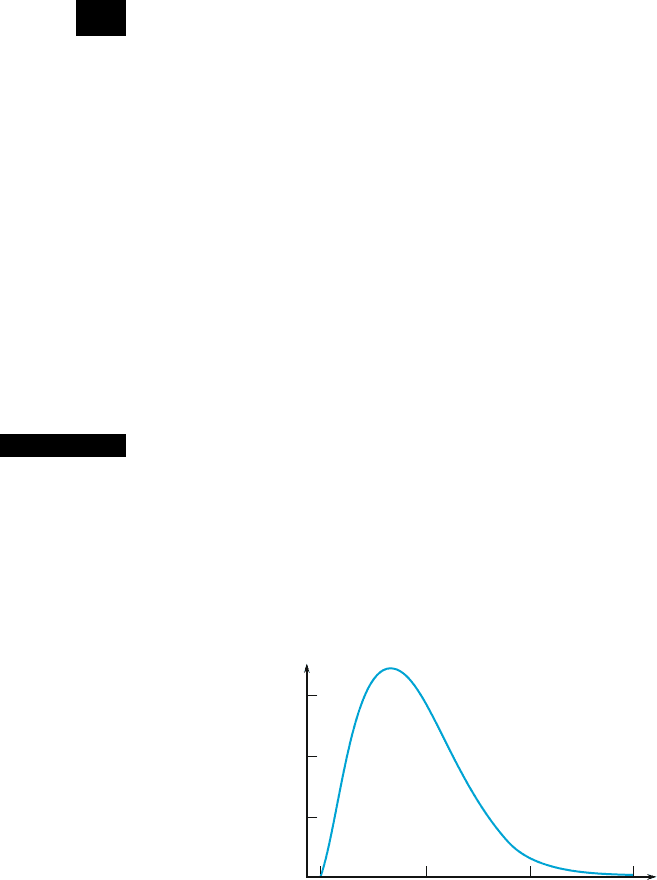
type has a Weibul l distribution with parameter values a ¼ 2 (shape) and b ¼ 5
(scale). The corresponding density curve is shown in Figure 6.1. Formulas from
Section 4.5 give
m ¼ EðXÞ¼4:4311
~
m ¼ 4:1628 s
2
¼ VðXÞ¼5:365 s ¼ 2:316
The mean exceeds the median because of the distribution’s positive skew.
We used MINITAB to generate six different samples, each with n ¼ 10,
from this distribution (material strengths for six different groups of ten specimens
each). The results appear in Table 6.1, followed by the values of the sample mean,
sample median, and sample standard deviation for each samp le. Notice first that the
ten observations in any particular sample are all differ ent from those in any
other sample. Second, the six values of the sample mean are all different from
each other, as are the six values of the sample median and the six values of
the sample standard deviation. The same is true of the sample 10% trimmed
means, sample fourth spreads, and so on.
0510
0
15
.05
.10
.15
x
f (x)
Figure 6.1 The Weibull density curve for Example 6.1
6.1 Statistics and Their Distributions 285

Furthermore, the value of the sample mean from any particular sample can be
regarded as a point estimate (“point” because it is a single number, corresponding
to a single point on the number line) of the population mean m, whose value is
known to be 4.4311. None of the estimates from these six samples is identical to
what is being estimated. The estimates from the second and sixth samples are much
too large, whereas the fifth sample gives a substantial underestimate. Similarly,
the sample standard deviation gives a point estimate of the population standard
deviation. All six of the resulting estimates are in error by at least a small amount.
In summary, the values of the individual sample observations vary from
sample to sample, so in general the value of any quantity computed from sample
data, and the value of a sample characteristic used as an estimate of the
corresponding population characteristic, will virtually never coincide with what
is being estimated.
■
DEFINITION
A stat istic is any quantity whose value can be calculated from sample data.
Prior to obtaining data, there is uncertainty as to what value of any particula r
statistic will result. Therefore, a statistic is a random variable and will be
denoted by an uppercase letter; a lower case letter is used to represent the
calculated or observed value of the statistic.
Thus the sample mean, regarded as a statistic (before a sample has been
selected or an experiment has been carried out), is denoted by
X; the calculated
value of this statistic is
x. Similarly, S represents the sample standard deviation
thought of as a statistic, and its computed value is s. Suppose a drug is given to a
Table 6.1 Sampl es from the Weibull distribution of Example 6.1
Sample
123456
Observation
1 6.1171 5.07611 3.46710 1.55601 3.12372 8.93795
2 4.1600 6.79279 2.71938 4.56941 6.09685 3.92487
3 3.1950 4.43259 5.88129 4.79870 3.41181 8.76202
4 0.6694 8.55752 5.14915 2.49759 1.65409 7.05569
5 1.8552 6.82487 4.99635 2.33267 2.29512 2.30932
6 5.2316 7.39958 5.86887 4.01295 2.12583 5.94195
7 2.7609 2.14755 6.05918 9.08845 3.20938 6.74166
8 10.2185 8.50628 1.80119 3.25728 3.23209 1.75468
9 5.2438 5.49510 4.21994 3.70132 6.84426 4.91827
10 4.5590 4.04525 2.12934 5.50134 4.20694 7.26081
Statistic
Mean 4.401 5.928 4.229 4.132 3.620 5.761
Median 4.360 6.144 4.608 3.857 3.221 6.342
SD 2.642 2.062 1.611 2.124 1.678 2.496
286
CHAPTER 6 Statistics and Sampling Distributions
sample of patient s, another drug is given to a second sample, and the cholesterol
levels are denoted by X
1
, ..., X
m
and Y
1
, ..., Y
n
, respectively. Then the statistic
X Y, the difference between the two sample mean cholesterol levels, may be
important.
Any statistic, being a random variable, has a probability distribution.
In particular, the sample mean
X has a probability distribution. Suppose, for
example, that n ¼ 2 components are randomly selected and the number of break-
downs while under warra nty is determined for each one. Possible values for the
sample mean number of breakdowns
X are 0 (if X
1
¼ X
2
¼ 0), .5 (if either X
1
¼ 0
and X
2
¼ 1orX
1
¼ 1 and X
2
¼ 0), 1, 1.5, .... Th e probability distribution of X
specifies Pð
X ¼ 0Þ, PðX ¼ : 5Þ and so on, from which other probabilities such as
Pð1
X 3Þ and PðX 2:5Þ can be calculated. Similarly, if for a sample of size
n ¼ 2, the only possible values of the sample variance are 0, 12.5, and 50 (which is
the case if X
1
and X
2
can each take on only the values 40, 45, and 50), then
the probability distribution of S
2
gives P (S
2
¼ 0), P(S
2
¼ 12.5), and P(S
2
¼ 50).
The probability distribution of a statistic is sometimes referred to as its sampling
distribution to emphasize that it describes how the statistic varies in value across
all samples that might be select ed.
Random Samples
The probability distribution of any particular statistic depends not only on the
population distribution (normal, uniform, etc.) and the sample size n but also on
the method of sampling. Consider selecting a sample of size n ¼ 2 from a popula-
tion consisting of just the three values 1, 5, and 10, and suppose that the statistic of
interest is the sample variance. If sampling is done “with replacement,” then S
2
¼ 0
will result if X
1
¼ X
2
. However, S
2
cannot equal 0 if sampling is “without replace-
ment.” So P(S
2
¼ 0) ¼ 0 for one sampling method, and this probability is positive
for the other method. Our next definition describes a sampling method often
encountered (at least approximately) in practice.
DEFINITION
The rv’s X
1
, X
2
, ..., X
n
are sai d to form a (simple) random sample of size n if
1. Th e X
i
’s are independent rv’s.
2. Ev ery X
i
has the same probability distribution.
Conditions 1 and 2 can be paraphrased by saying that the X
i
’s are independent and
identically distributed (iid). If sampling is either with replacement or from an
infinite (conceptual) population, Conditions 1 and 2 are satisfied exactly. These
conditions will be approximately satisfied if sampling is without replacement,
yet the sample size n is much smaller than the population size N. In practice,
if n/N .05 (at most 5% of the population is sampled), we can proceed as if
the X
i
’s form a random sample. The virtue of this sampling method is that the
probability distribution of any statistic can be more easily obtained than for any
other sampling method.
6.1 Statistics and Their Distributions 287