
Devore J.L., Berk K.N. Modern Mathematical Statistics with Applications
Подождите немного. Документ загружается.


If we think of the width of the interval as specifying its precision or accuracy,
then the confidence level (or reliability) of the interval is inversely related to its
precision. A highly reliable interval estimate may be imprecis e in that the endpoints
of the interval may be far apart, whereas a precise interval may entail relatively low
reliability. Thus it cannot be said unequivocally that a 99% interval is to be
preferred to a 95% interval; the gain in reliability entails a loss in precision.
An appealing strategy is to specify both the desired confidence level and
interval width and then determine the necessary sample size.
Example 8.4 Ex tensive monitoring of a computer time-sharing system has suggested that
response time to a particular editing command is normally distributed with standard
deviation 25 ms. A new operating system has been installed, and we wish to
estimate the true average response time m for the new environment. Assuming
that response times are still normally distributed with s ¼ 25, what sample size is
necessary to ensure that the resulting 95% CI has a width of (at most) 10? The
sample size n must satisfy
10 ¼ 2 ð1:96Þð25=
ffiffiffi
n
p
Þ
Rearranging this equation gives
ffiffiffi
n
p
¼ 2 ð1:96Þð25Þ=10 ¼ 9:80
so
n ¼ 9:80
2
¼ 96:04
Since n must be an integer, a sample size of 97 is required.
■
The general formula for the sample size n necessary to ensure an interval
width w is obtained from w ¼ 2 z
a=2
s=
ffiffiffi
n
p
as
n ¼ 2z
a=2
s
w
2
ð8:6Þ
The smaller the desired width w, the larger n must be. In addition, n is an increasing
function of s (more population variability necessitates a larger sample size) and of
the confidence level 100(1 a) (as a decreases, z
a/2
increases).
The half-width 1:96 s=
ffiffiffi
n
p
of the 95% CI is sometimes called the bound on
the error of estimation associated with a 95% confidence level; that is, with 95%
confidence, the point estimate
x will be no farther than this from m. Before
obtaining data, an investigator may wish to determine a sample size for which a
particular value of the bound is achieved. For example, with m representing the
average fuel efficiency (mpg) for all cars of a certain type, the objective of an
investigation may be to estimate m to within 1 mpg with 95% confidence. More
generally, if we wish to estimat e m to within an amount B (the specified bound on
the error of estimation) with 100(1 a)% confidence, the necessary sample size
results from replacing 2/w by 1/B in (8.6).
388 CHAPTER 8 Statistical Intervals Based on a Single Sample

Deriving a Confidence Interval
Let X
1
, X
2
, ... , X
n
denote the sample on which the CI for a parameter y is to be
based. Suppose a random variable satisfying the following two properties can be
found:
1. Th e variable depends functionally on both X
1
, ... , X
n
and y.
2. Th e probability distribution of the variable does not depend on y or on any other
unknown parameters.
Let h(X
1
, X
2
, ... , X
n
; y) denote this random variable. For example, if the
population distribution is normal with known s and y ¼ m, the variable
hðX
1
; ...; X
n
; yÞ¼ X mðÞ= s=
ffiffiffi
n
p
ðÞsatisfies both properties; it clearly depends
functionally on m, yet has the standard normal probability distribution, which
does not depend on m. In general, the form of the h function is usually suggested
by examining the distribution of an appropriate estimator
^
y.
For any a between 0 and 1, constants a and b can be found to satisfy
P½a < h ðX
1
; ...; X
n
; yÞ< b¼1 a ð8:7Þ
Because of the second property, a and b do not depend on y. In the normal example,
a ¼z
a/2
and b ¼ z
a/2
. Now suppose that the inequalities in (8.7) can be manipu-
lated to isolate y, giving the equivalent proba bility statement
P½lX
1
; ...; X
n
ðÞ< y < uX
1
; ...; X
n
ðÞ¼1 a
Then l(x
1
, x
2
, ... , x
n
) and u(x
1
, ... , x
n
) are the lower and upper confidence limits,
respectively, for a 1 00(1 a)% CI. In the normal example, we saw that
lX
1
; ...; X
n
ðÞ¼X z
a=2
s=
ffiffiffi
n
p
and uX
1
; ...; X
n
ðÞ¼X þ z
a=2
s=
ffiffiffi
n
p
.
Example 8.5 A theoretical model suggests that the time to breakdown of an insulating fluid
between electrodes at a particular voltage has an exponential distribution with
parameter l (see Section 4.4). A random sample of n ¼ 10 breakdown times yields
the following sample data (in min): x
1
¼ 41.53, x
2
¼ 18.73, x
3
¼ 2.99, x
4
¼ 30.34,
x
5
¼ 12.33, x
6
¼ 117.52, x
7
¼ 73.02, x
8
¼ 223.63, x
9
¼ 4.00, x
10
¼ 26.78.
A 95% CI for l and for the true average breakdown time are desired.
Let h(X
1
, X
2
, ... , X
n
; l ) ¼ 2lSX
i
. Using a moment generating function
argument, it can be shown that this random variable has a chi-squared distribution
with 2n degrees of freedom (df) (v ¼ 2n, as discussed in Sect ion 6.4). Appendix
Table A.6 pictures a typical chi-squared density curve and tabulates critical values
that capture specified tail areas. The relevant number of degrees of freedom here is
2(10) ¼ 20. The n ¼ 20 row of the table shows that 34.170 captures upper-tail area
.025 and 9.591 captures lower-tail area .025 (upper-tail area .975). Thus for n ¼ 10,
Pð9:591 < 2lSX
i
< 34:170Þ¼:95
Division by 2SX
i
isolates l, yielding
P 9:591= 2SX
i
ðÞ< l < 34:170= 2SX
i
ðÞ½¼:95
8.1 Basic Properties of Confidence Intervals 389

The lower limit of the 95% CI for l is 9.591/(2Sx
i
), and the upper limit is 34.170/
(2Sx
i
). For the given data, Sx
i
¼ 550.87, giving the interval (.00871, .03101).
The expected value of an exponential rv is m ¼ 1/l. Since
P 2SX
i
=34:170 < 1=l < 2SX
i
=9:591ðÞ¼:95
the 95% CI for true average breakdown time is (2Sx
i
/34.170, 2Sx
i
/9.591) ¼
(32.24, 114.87). This interval is obviously quite wide, ref lecting substantial varia-
bility in breakdown times and a small sample size.
■
In general, the upper and lower confidence limits result from replacing each
< in (8.7) by ¼ and solving for y. In the insu lating fluid example just considered,
2lSx
i
¼ 34.170 gives l ¼ 34.170/(2Sx
i
) as the upper confidence limit, and the
lower limit is obtained from the other equation. Notice that the two interval limits
are not equidistant from the point estimate, since the interval is not of the form
^
y c.
Exercises Section 8.1 (1–11)
1. Consider a normal population distribution with the
value of s known.
a. What is the confidence level for the interval
x 2:81s=
ffiffiffi
n
p
?
b. What is the confidence level for the interval
x 1:44s=
ffiffiffi
n
p
?
c. What value of z
a/2
in the CI formula (8.5)
results in a confidence level of 99.7%?
d. Answer the question posed in part (c) for a
confidence level of 75%.
2. Each of the following is a confidence interval for
m ¼ true average (i.e., population mean) reso-
nance frequency (Hz) for all tennis rackets of a
certain type:
(114.4, 115.6) (114.1, 115.9)
a. What is the value of the sample mean reso-
nance frequency?
b. Both intervals were calculated from the same
sample data. The confidence level for one of
these intervals is 90% and for the other is 99%.
Which of the intervals has the 90% confidence
level, and why?
3. Suppose that a random sample of 50 bottles of
a particular brand of cough syrup is selected and
the alcohol content of each bottle is determined.
Let m denote the average alcohol content for the
population of all bottles of the brand under study.
Suppose that the resulting 95% confidence inter-
val is (7.8, 9.4).
a. Would a 90% confidence interval calculated
from this same sample have been narrower or
wider than the given interval? Explain your
reasoning.
b. Consider the following statement: There is a
95% chance that m is between 7.8 and 9.4. Is
this statement correct? Why or why not?
c. Consider the following statement: We can be
highly confident that 95% of all bottles of this
type of cough syrup have an alcohol content
that is between 7.8 and 9.4. Is this statement
correct? Why or why not?
d. Consider the following statement: If the pro-
cess of selecting a sample of size 50 and then
computing the corresponding 95% interval is
repeated 100 times, 95 of the resulting intervals
will include m. Is this statement correct? Why or
why not?
4. A CI is desired for the true average stray-load loss
m (watts) for a certain type of induction motor
when the line current is held at 10 amps for a
speed of 1,500 rpm. Assume that stray-load loss
is normally distributed with s ¼ 3.0.
a. Compute a 95% CI for m when n ¼ 25 and
x ¼ 58:3.
b. Compute a 95% CI for m when n ¼ 100 and
x ¼ 58:3.
c. Compute a 99% CI for m when n ¼ 100 and
x ¼ 58:3.
d. Compute an 82% CI for m when n ¼ 100 and
x ¼ 58:3.
e. How large must n be if the width of the 99%
interval for m is to be 1.0?
5. Assume that the helium porosity (in percentage)
of coal samples taken from any particular seam is
normally distributed with true standard devia-
tion .75.
390
CHAPTER 8 Statistical Intervals Based on a Single Sample

a. Compute a 95% CI for the true average porosity
of a certain seam if the average porosity for 20
specimens from the seam was 4.85.
b. Compute a 98% CI for true average porosity of
another seam based on 16 specimens with a
sample average porosity of 4.56.
c. How large a sample size is necessary if the
width of the 95% interval is to be .40?
d. What sample size is necessary to estimate true
average porosity to within .2 with 99% confi-
dence?
6. On the basis of extensive tests, the yield point of a
particular type of mild steel reinforcing bar is
known to be normally distributed with s ¼ 100.
The composition of the bar has been slightly mod-
ified, but the modification is not believed to have
affected either the normality or the value of s.
a. Assuming this to be the case, if a sample of 25
modified bars resulted in a sample average
yield point of 8439 lb, compute a 90% CI for
the true average yield point of the modified bar.
b. How would you modify the interval in part (a)
to obtain a confidence level of 92%?
7. By how much must the sample size n be increased
if the width of the CI (8.5) is to be halved? If the
sample size is increased by a factor of 25, what
effect will this have on the width of the interval?
Justify your assertions.
8. Let a
1
> 0, a
2
> 0, with a
1
+ a
2
¼ a. Then
P z
a
1
<
X m
s=
ffiffiffi
n
p
< z
a
2
¼ 1 a
a. Use this equation to derive a more general
expression for a 100(1 a)% CI for m of
which the interval (8.5) is a special case.
b. Let a ¼ .05 and a
1
¼ a/4, a
2
¼ 3a/4. Does
this result in a narrower or wider interval than
the interval (8.5)?
9. a. Under the same conditions as those leading to
the CI (8.5), P
X mðÞ= s=
ffiffiffi
n
p
ðÞ<1:645½¼:95.
Use this to derive a one-sided interval for m
that has infinite width and provides a lower
confidence bound on m. What is this interval
for the data in Exercise 5(a)?
b. Generalize the result of part (a) to obtain
a lower bound with a confidence level of
100(1 a)%.
c. What is an analogous interval to that of part (b)
that provides an upper bound on m? Compute
this 99% interval for the data of Exercise 4(a).
10. A random sample of n ¼ 15 heat pumps of a
certain type yielded the following observations
on lifetime (in years):
2.0 1.3 6.0 1.9 5.1 .4 1.0 5.3
15.7 .7 4.8 .9 12.2 5.3 .6
a. Assume that the lifetime distribution is expo-
nential and use an argument parallel to that of
Example 8.5 to obtain a 95% CI for expected
(true average) lifetime.
b. How should the interval of part (a) be altered to
achieve a confidence level of 99%?
c. What is a 95% CI for the standard deviation of
the lifetime distribution? [Hint: What is the
standard deviation of an exponential random
variable?]
11. Consider the next 1,000 95% CIs for m that a
statistical consultant will obtain for various
clients. Suppose the data sets on which the inter-
vals are based are selected independently of one
another. How many of these 1,000 intervals do
you expect to capture the corresponding value of
m? What is the probability that between 940 and
960 of these intervals contain the corresponding
value of m?[Hint: Let Y ¼ the number among
the 1,000 intervals that contain m. What kind of
random variable is Y?]
8.2
Large-Sample Confidence Intervals
for a Population Mean and Proportion
The CI for m given in the previous section assumed that the population distribution
is normal and that the value of s is known. We now present a large-sample CI
whose validity does not require these assumptions. After showing how the argu-
ment leading to this interval generalizes to yield other large-sample intervals, we
focus on an interval for a population proportion p.
8.2 Large-Sample Confidence Intervals for a Population Mean and Proportion 391

A Large-Sample Interval for m
Let X
1
, X
2
, ... , X
n
be a random sample from a population having a mean m and
standard deviation s. Provided that n is large, the Central Limit Theorem (CLT)
implies that
X has approximately a normal distribution whatever the nature of the
population distribution. It then follows that Z ¼ð
X mÞ=ðs=
ffiffiffi
n
p
Þ has approxi-
mately a standard normal distribution, so that
P z
a=2
<
X m
s=
ffiffiffi
n
p
< z
a=2
1 a
An argument parallel with that given in Section 8.1 yields
x z
a=2
s=
ffiffiffi
n
p
as a
large-sample CI for m with a confidence level of approximately 100(1 a)%. That
is, when n is large, the CI for m given previously remains valid whatever the
population distribution, provided that the qualifier “approximately” is inserted in
front of the confidence level.
One practical difficulty with this development is that computation of the
interval requires the value of s, which will almost never be known. Consider the
standardized variable
Z ¼
X m
S=
ffiffiffi
n
p
in which the sample standard deviation S replaces s. Previously there was random-
ness only in the numerator of Z (by virtue of
X). Now there is randomness in both
the numerator and the denominator—the values of both
X and S vary from sample
to sample. However, when n is large, the use of S rather than s adds very little extra
variability to Z. More specifically, in this case the new Z also has approximatel y a
standard normal distribution. Manipulation of the inequalities in a probability
statement involving this new Z yields a gener al large-sample interval for m.
PROPOSITION
If n is sufficiently large, the standardized variable
Z ¼
X m
S=
ffiffiffi
n
p
has approximately a standard normal distribution. This implies that
x z
a=2
s
ffiffiffi
n
p
ð8:8Þ
is a large-sample confidence interval for m with confidence level approxi-
mately 100(1 a)%. This formula is valid regardless of the shape of the
population distribution.
Generally speaking, n > 40 will be sufficient to justify the use of this interval. This
is somewhat more conservative than the rule of thumb for the CLT because of the
additional variability introduced by using S in place of s.
392 CHAPTER 8 Statistical Intervals Based on a Single Sample
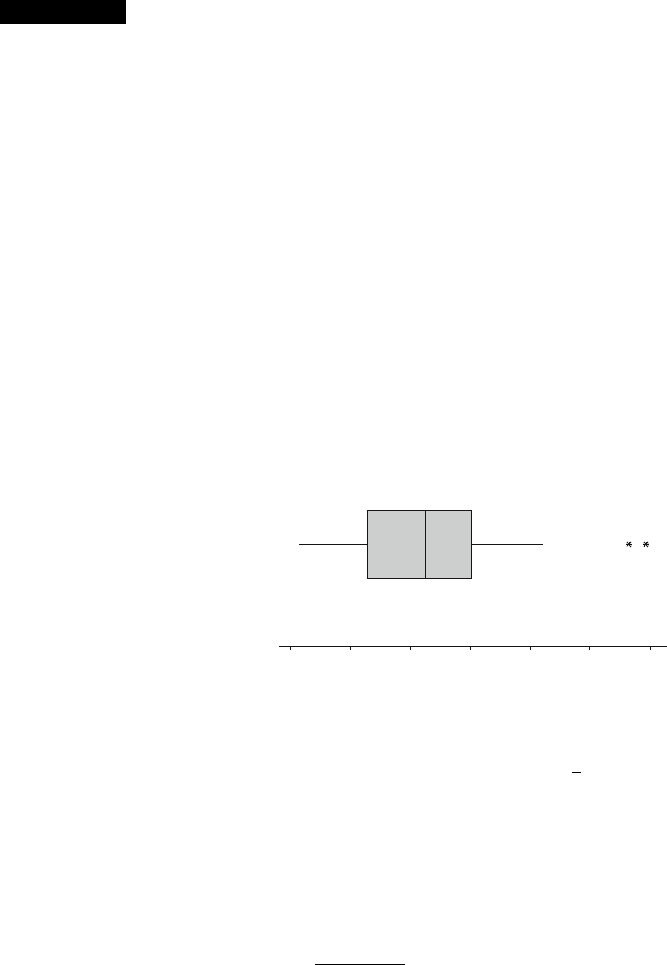
Example 8.6 Haven’t you always wanted to own a Porsche? One of the authors thought maybe he
could afford a Boxster, the cheapest model. So he went to www.cars.com on Nov.
18, 2009 and found a total of 1,113 such cars listed. Asking prices ranged from
$3,499 to $130,000 (the latter price was one of only two exceeding $70,000). The
prices depressed him, so he focused instead on odometer readings (miles). Here are
reported readings for a sample of 50 of these Boxsters:
2948 2996 7197 8338 8500 8759 12710 12925
15767 20000 23247 24863 26000 26210 30552 30600
35700 36466 40316 40596 41021 41234 43000 44607
45000 45027 45442 46963 47978 49518 52000 53334
54208 56062 57000 57365 60020 60265 60803 62851
64404 72140 74594 79308 79500 80000 80000 84000
113000 118634
A boxplot of the data (Figure 8.5) shows that, except for the two mild outliers at the
upper end, the distribution of values is reasonably symmetric (in fact, a normal
probability plot exhibits a reasonably linear pattern, though the points
corresponding to the two smallest and two largest observations are somewhat
removed from a line fit through the remaining points).
Summary quantitie s include n ¼ 50,
x ¼ 45;679: 4;
~
x ¼ 45;013: 5;
s ¼ 26;641:675; f
s
¼ 34;265. The mean and median are reasonably close (if the
two largest values were each reduced by 30,000, the mean would fall to 44,479.4
while the median would be unaffected). The boxplot and the magnitudes of s and f
s
relative to the mean and median both indicate a substantial amount of variability.
A confidence level of about 95% requires z
.025
¼ 1.96, and the interval is
45;679:4 ð1:96Þ
26;641:675
ffiffiffiffiffi
50
p
¼ 45;679:4 7384:7 ¼ð38;294:7; 53;064:1Þ
That is, 38,294.7 < m < 53,064.1 with 95% confidence. This interval is rather
wide because a sample size of 50, even though large by our rule of thumb, is not
large enough to overcome the substantial variability in the sample. We do not have
a very precise estimat e of the population mean odometer reading.
Is the interval we’ve calculated one of the 95% that in the long run includes
the parameter being estimated, or is it one of the “bad” 5% that does not do so?
Without knowing the value of m, we cannot tell. Remember that the confidence
0 20000 40000 60000 80000 100000 120000
mileage
Figure 8.5 A boxplot of the odometer reading data from Example 8.6
8.2 Large-Sample Confidence Intervals for a Population Mean and Proportion 393

level refers to the long run capture percentage when the formula is used repeatedly
on various samples; it cannot be interpreted for a single sample and the resulting
interval.
■
Unfortunately, the choice of sample size to yield a desired interval width is
not as straightforward here as it was for the case of known s. This is because the
width of (8.8)is2z
a
=2
s=
ffiffiffi
n
p
. Since the value of s is not available before data
collection, the width of the interval cannot be determined solely by the choice of
n. The only option for an investigator who wishes to specify a desired width is to
make an educated guess as to what the value of s might be. By being conservative
and guessing a larger value of s,ann larger than necessary will be chosen. The
investigator may be able to specify a reasonably accurate value of the population
range (the difference between the largest and smallest values). Then if the popula-
tion distribution is not too skewed, dividing the range by four gives a ballpark value
of what s might be. The idea is that roughly 95% of the data lie within 2s of the
mean, so the range is roughly 4 s (range/6 might be too optimistic).
Example 8.7 An investigator wishes to estimate the true average score on an algebra placement
test. Suppose she believes that virtually all values in the p opulation are between 10
and 30. Then (30 10)/4 ¼ 5 gives a reasonable value for s. The appropriate
sample size for estimating the true average mileage to within one with confidence
level 95%—that is, for the 95% CI to have a width of 2—is
n ¼ 1:96ðÞ5ðÞ=1½
2
96
■
A General Large-Sample Confidence Interval
The large-sample intervals x z
a=2
s=
ffiffiffi
n
p
and x z
a=2
s=
ffiffiffi
n
p
are special cases of
a general large-sample CI for a parameter y. Suppose that
^
y is an estimator satisfying
the following properties: (1) It has approximat ely a normal distribution; (2) it is (at
least approximately) unbiased; and (3) an expression for s
^
y
, the standard deviation
of
^
y, is available. For example, in the case y ¼ m,
^
m ¼
X is an unbiased estimator
whose distribution is approximately normal when n is large and s
^m
¼ s
x
¼ s=
ffiffiffi
n
p
.
Standardizing
^
y yields the rv Z ¼ð
^
y yÞ=s
^
y
, which has approximately a standar d
normal distribution. This justifies the probability statement
P z
a=2
<
^
y y
s
^
y
< z
a=2
!
1 a ð8:9Þ
Suppose, first, that s
^
y
does not involve any unknown parameters (e.g., known
s in the case y ¼ m). Then replacing each < in (8.9)by¼ results in
y ¼
^
y z
a=2
s
^
y
, so the lower and upper confidence limits are
^
y z
a=2
s
^
y
and
^
y þ z
a=2
s
^
y
, respectively. Now suppose that s
^
y
does not involve y but does involve
at least one other unknown parameter. Let s
^
y
be the estimate of s
^
y
obtained by using
estimates in place of the unknown parameters (e.g., s=
ffiffiffi
n
p
estimates s=
ffiffiffi
n
p
). Under
general conditions (essentially that s
^
y
be close to s
^
y
for most samples), a valid CI is
^
y z
a=2
s
^
y
. The interval x z
a=2
s=
ffiffiffi
n
p
is an example.
394 CHAPTER 8 Statistical Intervals Based on a Single Sample

Finally, suppose that s
^
y
does involve the unknown y. This is the case, for
example, when y ¼ p, a population proportion. Then ð
^
y yÞ=s
^
y
¼ z
a=2
can be
difficult to solve. An approximate solution can often be obtained by replacing y in
s
^
y
by its estimate
^
y. This results in an estimated standard deviation s
^
y
, and the
corresponding interval is again
^
y z
a=2
s
^
y
.
A Confidence Interval for a Population Proportion
Let p denote the proportion of “successes” in a population, where success identifies
an individual or object that has a specified property . A random sample of n
individuals is to be selected, and X is the number of successes in the sample.
Provided that n is small compared to the population size, X can be regarded as a
binomial rv with E(X) ¼ np and s
X
¼
ffiffiffiffiffiffiffiffiffiffiffiffiffiffiffiffiffiffiffiffi
npð1 pÞ
p
. Furthermore, if n is large
(np 10 and nq 10), X has approximately a normal distribution.
The natural estimator of p is
^
p ¼ X=n, the sample fraction of successes. Since
^
p is just X multiplied by a constant 1/n,
^
p also has approximately a normal
distribution. As shown in Section 7.1, Eð
^
pÞ¼p (unbiasedness) and
s
^
p
¼
ffiffiffiffiffiffiffiffiffiffiffiffiffiffiffiffiffiffiffiffiffiffi
pð1 pÞ=n
p
. The standard deviation s
^
p
involves the unknown parameter
p. Standardizi ng
^
p by subtracting p and dividing by s
^
p
then implies that
P z
a=2
<
^
p p
ffiffiffiffiffiffiffiffiffiffiffiffiffiffiffiffiffiffiffiffiffiffi
pð1 pÞ=n
p
< z
a=2
!
1 a
Proceeding as suggested in the subsection “Deriving a Confidence Interval”
(Section 8.1), the confidence limit s result from replacing each < by ¼ and solving
the resulting quadratic equation for p. With
^
q ¼ 1
^
p, this gives the two roots
p ¼
^
p þ z
2
a=2
=2n
1 þ z
2
a=2
=n
z
a=z
ffiffiffiffiffiffiffiffiffiffiffiffiffiffiffiffiffiffiffiffiffiffiffiffiffiffiffiffiffiffiffiffiffiffiffiffiffiffiffiffiffiffiffiffi
^
pð1
^
pÞ=n þ z
2
a=2
=4n
2
q
1 þ z
2
a=2
=n
¼
~
p z
a=2
ffiffiffiffiffiffiffiffiffiffiffiffiffiffiffiffiffiffiffiffiffiffiffiffiffiffiffiffiffiffiffiffiffiffiffiffiffiffiffiffiffiffiffiffi
^
pð1
^
pÞ=n þ z
2
a=2
=4n
2
q
1 þ z
2
a=2
=n
PROPOSITION
Let
~
p ¼
^
p þ z
2
a=2
=2n
1 þ z
2
a=2
=n
. Then a confidence interval for a pop ulation propor-
tion p with confidence level approximately 100(1 a)% is
~
p z
a=2
ffiffiffiffiffiffiffiffiffiffiffiffiffiffiffiffiffiffiffiffiffiffiffiffiffiffiffiffiffiffiffiffi
^
p
^
q=n þ z
2
a=2
=4n
2
q
1 þ z
2
a=2
=n
ð8:10Þ
where
^
q ¼ 1
^
p and, as before, the in (8.10) corr esponds to the lower
confidence limit and the + to the upper confidence limit .
This is often referred to as the “score CI” for p.
8.2 Large-Sample Confidence Intervals for a Population Mean and Proportion 395
If the sample size n is very large, then z
2
/2n is generally quite negligible
(small) compared to
^
p and z
2
/n is quite negligible compared to 1, from which
~
p
^
p.
In this case z
2
/4n
2
is also negligible compared to
^
p
^
q=n (n
2
is a much larger divisor
than is n); as a result, the dominant term in the expression is z
a=2
ffiffiffiffiffiffiffiffiffiffi
^
p
^
q=n
p
and the
score interval is approximately
^
p z
a=2
ffiffiffiffiffiffiffiffiffiffi
^
p
^
q=n
p
ð8:11Þ
This latter interval has the general form
^
y z
a=2
^
s
^
y
of a large-sample interval
suggested in the last subsection. The approximate CI (8.11) is the one that for
decades has appeared in introductory statistics textbooks. It clearly has a much
simpler and more appealing form than the score CI. So why bother with the latter?
First of all, suppos e we use z
.025
¼ 1.96 in the traditional formula (8.11).
Then our nominal confidence level (the one we think we’re buying by using that z
critical value) is approximately 95%. So before a sample is selected, the probability
that the random interval includes the actual value of p (i.e., the coverage probabil-
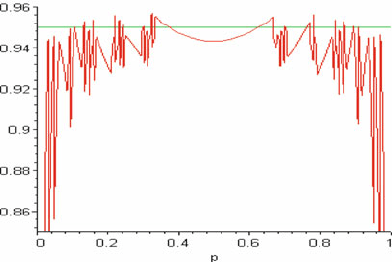
ity) should be about .95. But as Figure 8.6 shows for the case n ¼ 100, the actual
coverage probability for this interval can differ considerably from the nominal
probability .95, particularly when p is not close to .5 (the graph of coverage
probability versus p is very jagged because the underlying binomial probability
distribution is discrete rather than continuous). This is generally speaking a defi-
ciency of the traditional interval – the actual confidence level can be quite different
from the nominal level even for reasonably large sample sizes. Recent research has
shown that the score interval rectifies this behavior – for virtually all sample sizes
and values of p, its actual confiden ce level will be quite close to the nominal level
specified by the choice of z
a/2
. This is due largely to the fact that the score interval is
shifted a bit toward .5 compared to the traditional interval. In particular, the
midpoint
~
p of the score interval is always a bit closer to .5 than is the midpoint
^
p
of the traditional interval. This is especially important when p is close to 0 or 1.
In addition, the score interval can be used with nearly all sample sizes and
parameter values. It is thus not necessary to check the condi tions n
^
p 10 and
nð1
^
pÞ10 which would be required were the traditional interval employed. So
rather than asking when n is large enough for (8.11) to yield a good approximation
Figure 8.6 Actual coverage probability for the interval (8.11) for varying values of
p when n ¼ 100
396
CHAPTER 8 Statistical Intervals Based on a Single Sample

to (8.10), our recommendation is that the score CI should always be used. The slight
additional tediousness of the computation is outweighed by the desirable properties
of the interval.
Example 8.8 Th e article “Repeatability and Reproducibility for Pass/Fail Data” (J. Testing Eval.,
1997: 151–153) reported that in n ¼ 48 trials in a particular laboratory, 16 resulted
in ignition of a particular type of substrate by a lighted cigarette. Let p denote the
long-run proportion of all such trials that would result in ignition. A point estimate
for p is
^
p ¼ 16=48 ¼ :333. A confidence interval for p with a confidence level of
approximately 95% is
:333 þ 1:96
2
=96
1 þ 1:96
2
=48
1:96
ffiffiffiffiffiffiffiffiffiffiffiffiffiffiffiffiffiffiffiffiffiffiffiffiffiffiffiffiffiffiffiffiffiffiffiffiffiffiffiffiffiffiffiffiffiffiffiffiffiffiffiffiffiffiffiffiffiffiffiffiffiffiffiffiffiffiffi
ð:333Þð:667Þ=48 þ 1:96
2
=ð4 48
2
Þ
p
1 þ 1:96
2
=48
¼ :346 :129 ¼ð:217;:475Þ
The traditional interval is
:333 1:96
ffiffiffiffiffiffiffiffiffiffiffiffiffiffiffiffiffiffiffiffiffiffiffiffiffiffiffiffiffiffiffiffi
ð:333Þð:667Þ=48
p
¼ :333 :133 ¼ð:200;:466Þ
These two intervals would be in much closer agreement were the sample size
substantially larger.
■
Equating the width of the CI for p to a prespecified width w gives a quadratic
equation for the sample size n necessary to give an interval with a desired degree of
precision. Suppressing the subscript in z
a/2
, the solution is
n ¼
2z
2
^
p
^
q z
2
w
2
ffiffiffiffiffiffiffiffiffiffiffiffiffiffiffiffiffiffiffiffiffiffiffiffiffiffiffiffiffiffiffiffiffiffiffiffiffiffiffiffiffiffiffiffiffiffi
4z
4
^
p
^
qð
^
p
^
q w
2
Þþw
2
z
4
p
w
2
ð8:12Þ
Neglecting the terms in the numerator involving w
2
gives
n ¼
4z
2
^
p
^
q
w
2
This latter expression is what results from equating the width of the traditional
interval to w.
These formulas unfortunately involve the unknown p. The most conservative
approach is to take advantage of the fact that
^
p
^
q½¼
^
pð1
^
pÞ is a maximum when
^
p ¼ :5. Thus if
^
p ¼
^
q ¼ :5 is used in (8.12), the width will be at most w regardless
of what value of
^
p results from the sample. Alternatively, if the investigator
believes strongly, based on prior information, that p p
0
.5, then p
0
can be
used in place of
^
p. A similar comment applies when p p
0
.5.
Example 8.9 Th e width of the 95% CI in Example 8.8 is .258. The value of n neces sary to ensure
a width of .10 irrespective of the value of p is
n ¼
2ð1:96Þ
2
ð:25Þð1:96 Þ
2
ð:01Þ
ffiffiffiffiffiffiffiffiffiffiffiffiffiffiffiffiffiffiffiffiffiffiffiffiffiffiffiffiffiffiffiffiffiffiffiffiffiffiffiffiffiffiffiffiffiffiffiffiffiffiffiffiffiffiffiffiffiffiffiffiffiffiffiffiffiffiffiffiffiffiffiffiffiffiffiffiffiffi
4ð1:96Þ
4
ð:25Þð:25 :01Þþð:01Þð1:96Þ
4
q
:01
¼ 380:3
8.2 Large-Sample Confidence Intervals for a Population Mean and Proportion 397