
Devore J.L., Berk K.N. Modern Mathematical Statistics with Applications
Подождите немного. Документ загружается.


37. The n ¼ 26 observations on escape time given in
Exercise 33 of Chapter 1 give a sample mean and
sample standard deviation of 370.69 and 24.36,
respectively.
a. Calculate an upper confidence bound for pop-
ulation mean escape time using a confidence
level of 95%.
b. Calculate an upper prediction bound for the
escape time of a single additional worker
using a prediction level of 95%. How does
this bound compare with the confidence
bound of part (a)?
c. Suppose that two additional workers will be
chosen to participate in the simulated escape
exercise. Denote their escape times by X
27
and
X
28
, and let X
new
denote the average of these
two values. Modify the formula for a PI for a
single x value to obtain a PI for
X
new
, and
calculate a 95% two-sided interval based on
the given escape data.
38. A study of the ability of individuals to walk in a
straight line (“Can We Really Walk Straight?”
Amer. J. Phys. Anthropol., 1992: 19–27) reported
the accompanying data on cadence (strides per
second) for a sample of n ¼ 20 randomly selected
healthy men.
.95 .85 .92 .95 .93 .86 1.00 .92 .85 .81
.78 .93 .93 1.05 .93 1.06 1.06 .96 .81 .96
A normal probability plot gives substantial sup-
port to the assumption that the population distri-
bution of cadence is approximately normal. A
descriptive summary of the data from MINITAB
follows:
Variable N Mean Median TrMean StDev SEMean
Cadence 20 0.9255 0.9300 0.9261 0.0809 0.0181
Variable Min Max Q1 Q3
Cadence 0.7800 1.0600 0.8525 0.9600
a. Calculate and interpret a 95% confidence inter-
val for population mean cadence.
b. Calculate and interpret a 95% prediction inter-
val for the cadence of a single individual ran-
domly selected from this population.
39. A sample of 25 pieces of laminate used in the
manufacture of circuit boards was selected and
the amount of warpage (in.) under particular con-
ditions was determined for each piece, resulting in
a sample mean warpage of .0635 and a sample
standard deviation of .0065. Calculate a prediction
for the amount of warpage of a single piece of
laminate in a way that provides information about
precision and reliability.
40. Exercise 69 of Chapter 1 gave the following
observations on a receptor binding measure
(adjusted distribution volume) for a sample of 13
healthy individuals: 23, 39, 40, 41, 43, 47, 51, 58,
63, 66, 67, 69, 72.
a. Is it plausible that the population distribution
from which this sample was selected is nor-
mal?
b. Predict the adjusted distribution volume of a
single healthy individual by calculating a 95%
prediction interval.
41. Here are the lengths (in minutes) of the 63 nine-
inning games from the first week of the 2001
major league baseball season:
194 160 176 203 187 163 162 183 152 177
177 151 173 188 179 194 149 165 186 187
187 177 187 186 187 173 136 150 173 173
136 153 152 149 152 180 186 166 174 176
198 193 218 173 144 148 174 163 184 155
151 172 216 149 207 212 216 166 190 165
176 158 198
Assume that this is a random sample of nine-
inning games (the mean differs by 12 s from the
mean for the whole season).
a. Give a 95% confidence interval for the popula-
tion mean.
b. Give a 95% prediction interval for the length of
the next nine-inning game. On the first day of
the next week, Boston beat Tampa Bay 3–0 in
a nine-inning game of 152 min. Is this within
the prediction interval?
c. Compare the two intervals and explain why one
is much wider than the other.
d. Explore the issue of normality for the data and
explain how this is relevant to parts (a) and (b).
42. A more extensive tabulation of t critical values
than what appears in this book shows that for the
t distribution with 20 df, the areas to the right of
the values .687, .860, and 1.064 are .25, .20, and
.15, respectively. What is the confidence level for
each of the following three confidence intervals
for the mean m of a normal population distribu-
tion? Which of the three intervals would you rec-
ommend be used, and why?
a. ð
x :687s=
ffiffiffiffiffi
21
p
; x þ 1:725s=
ffiffiffiffiffi
21
p
Þ
b. ð
x :860s=
ffiffiffiffiffi
21
p
; x þ 1:325s=
ffiffiffiffiffi
21
p
Þ
c. ð
x 1:064s=
ffiffiffiffiffi
21
p
; x þ 1:064s=
ffiffiffiffiffi
21
p
Þ
43. Use the results of Section 6.4 to show that the
variable T on which the PI is based does in fact
have a t distribution with n 1 df.
408
CHAPTER 8 Statistical Intervals Based on a Single Sample
8.4
Confidence Intervals for the Variance
and Standard Deviation of a Normal
Population
Although inferences concerning a population varianc e s
2
or standard deviation
s are usually of less interest than those about a mean or proportion, there are
occasions when such procedures are needed. In the case of a normal population
distribution, inferences are based on the following result from Section 6.4
concerning the sample variance S
2
.
THEOREM
Let X
1
, X
2
, ... , X
n
be a random sample from a normal distribution with
parameters m and s
2
. Then the rv
ðn 1ÞS
2
s
2
¼
P
ðX
i
XÞ
2
s
2
has a chi-squared (w
2
) probability distribution with n 1 df.
As disc ussed in Sections 4.4 and 6.4, the chi-squared distribution is a continu-
ous probability distribution with a single parameter n, the number of degrees of
freedom, with possible values 1, 2, 3, .... To specify inferential procedures that use
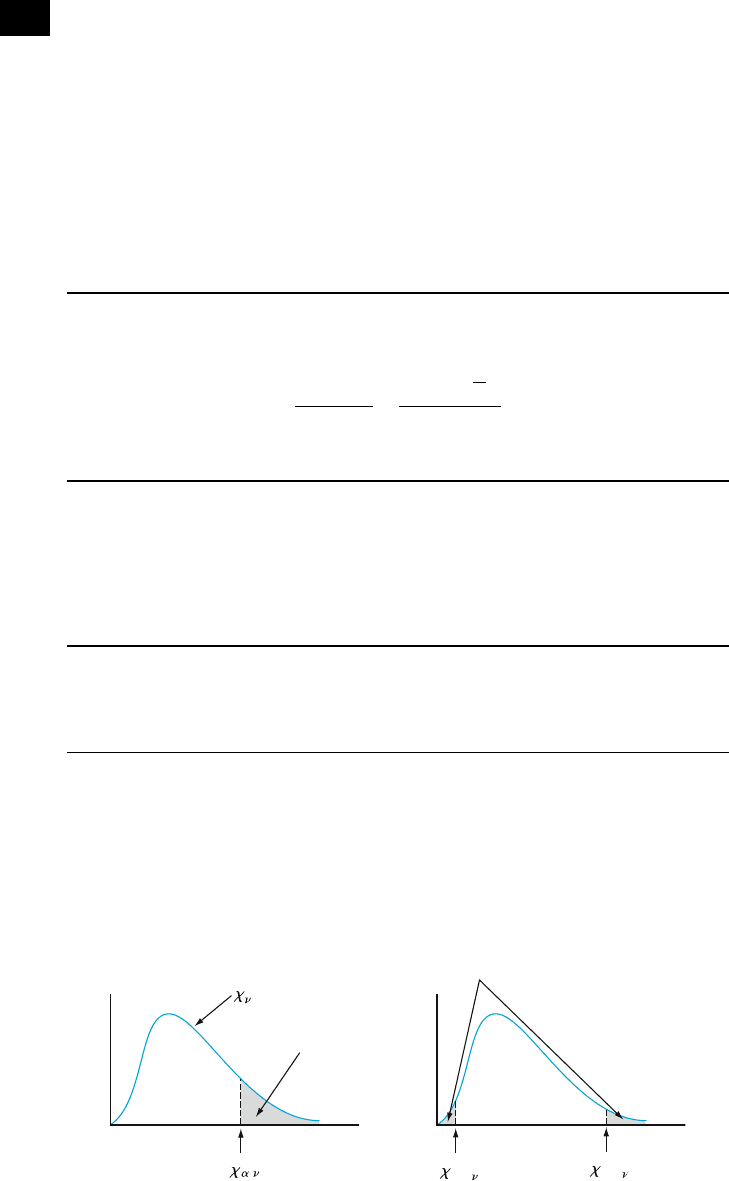
the chi-squared distribution, recall the notation for critical values from Section 6.4.
NOTATION
Let w
2
a;n
, called a chi-squared critical value, denote the number on the
measurement axis such that a of the area under the chi-squared curve with
n df lies to the right of w
2
a;n
.
Because the t distribution is symmetric, it was necessary to tabulate only
upper-tail critica l values (t
a,n
for small values of a). The chi-squared distribution is
not symmetric, so Appendix Table A.6 contains values of w
2
a;n
for a both near 0 and
near 1, as illustrated in Figure 8.9(b). For example, w
2
:025;14
¼ 26:119 and w
2
:95;20
(the
5th percentile) ¼ 10.851.
2
pdf
Shaded area = a
2
,
2
.99,
2
.01,
Each shaded
area = .01
ab
Figure 8.9 w
2
a;u
notation illustrated
8.4 Confidence Intervals for the Variance and Standard Deviation of a Normal Population 409

The rv (n 1)S
2
/s
2
satisfies the two properties on which the general method
for obtaining a CI is based: It is a function of the parameter of interest s
2
, yet its
probability distribution (chi-squared) does not depend on this parameter. The area
under a chi- squared curve with n df to the rig ht of w
2
a=2;n
is a/2, as is the area to the
left of w
2
1a=2;n
. Thus the area captured between these two critical values is 1 a.
As a consequence of this and the theorem just stated,
P w
2
1a=2;n1
<
ðn 1ÞS
2
s
2
< w
2
a=2;n1
¼ 1 a ð8:17Þ
The inequalities in (8.17) are equivalent to
ðn 1ÞS
2
w
2
a=2;n1
< s
2
<
ðn 1ÞS
2
w
2
1a=2;n1
Substituting the computed value s
2
into the limits gives a CI for s
2
, and taking
square roots gives an interval for s.
A 100(1 a)% confidence interval for the variance s
2
of a normal
population has lower limit
ðn 1Þs
2
=w
2
a=2;n1
and upper limit
ðn 1Þs
2
=w
2
1a=2;n1
A confidence interval for s has lower and upper limits that are the square
roots of the corresponding limits in the interval for s
2
.
Example 8.14 Recall the beer alcohol percentage data from Example 8.11, where the normal plot
was acceptably straight and the standard deviation was found to be s ¼ .8483.
Then the sample variance is s
2
¼ .8483
2
¼ .7196, and we wish to estimate the
population variance s
2
. With df ¼ n 1 ¼ 15, a 95% confidence interval requires
w
2
:975;15
¼ 6:262 and w
2
:025;15
¼ 27:488. The interval for s
2
is
15ð:7196Þ
27:488
;
15ð:7196Þ
6:262
¼ð:393; 1:724Þ
Taking the square root of each endpoint yields (.627, 1.313) as the 95% confidence
interval for s. With lower and upper limits differing by more than a factor of two,
this interval is quite wide. Precise estimat es of variability require large samples.
■
Unfortunately, our confidence interval requires that the data be normal or nearly
normal. In the case of nonnormal data the interval could be very far from valid; for
example, the true confidence level could be 70% where 95% is intended. See Exercise
57 in the next section for a method that does not require the normal distribution.
410 CHAPTER 8 Statistical Intervals Based on a Single Sample

Exercises Section 8.4 (44–48)
44. Determine the values of the following quantities:
a. w
2
:1;15
b. w
2
:1;25
c. w
2
:01;25
d. w
2
:005;25
e. w
2
:99;25
f. w
2
:995;25
45. Determine the following:
a. The 95th percentile of the chi-squared distribu-
tion with n ¼ 10
b. The 5th percentile of the chi-squared distribu-
tion with n ¼ 10
c. P(10.98 w
2
36.78), where w
2
is a chi-
squared rv with n ¼ 22
d. P(w
2
< 14.611 or w
2
> 37.652), where w
2
is a
chi-squared rv with n ¼ 25
46. Exercise 34 gave a random sample of 20 ACT
scores from students taking college freshman calcu-
lus. Calculate a 99% CI for the standard deviation of
the population distribution. Is this interval valid
whatever the nature of the distribution? Explain.
47. Here are the names of 12 orchestra conductors and
their performance times in minutes for Beetho-
ven’s Ninth Symphony:
Bernstein 71.03 Furtw
€
angler 74.38
Leinsdorf 65.78 Ormandy 64.72
Solti 74.70 Szell 66.22
Bohm 72.68 Karajan 66.90
Masur 69.45 Rattle 69.93
Steinberg 68.62 Tennstedt 68.40
a. Check to see that normality is a reasonable
assumption for the performance time distribu-
tion.
b. Compute a 95% CI for the population standard
deviation, and interpret the interval.
c. Supposedly, classical music is 100% deter-
mined by the composer’s notation, including
all timings. Based on your results, is this true
or false?
48. Refer to the baseball game times in Exercise 41.
Calculate an upper confidence bound with
confidence level 95% for the population
standard deviation of game time. Interpret your
interval. Explore the issue of normality for the
data and explain how this is relevant to your
interval.
8.5
Bootstrap Confidence Intervals
How can we find a confidence interval for the mean if the population distribution is
not normal and the sample size n is not large? Can we find confidence intervals for
other parameters such as the population median or the 90th percentile of the
population distribution? The bootstrap, developed by Bradley Efron in the late
1970s, allows us to calculate estimates in situations where statistical theory does
not produce a formula for a confidence interval. The method substitutes heavy
computation for theory, and it has been feasible only fairly recently with the
availability of fast computers. The bootstrap was introduced in Section 7.1 for
applications with known distribution (the parametri c bootstrap), but here we are
concerned with the case of unknown distribution (the nonparametric bootstrap).
Example 8.15 In a student project, Erich Brandt studied tips at a restaurant. Here is a random
sample of 30 observed tip percentages:
22.7, 16.3, 13.6, 16.8, 29.9, 15.9, 14.0, 15.0, 14.1, 18.1, 22.8, 27.6, 16.4, 16.1, 19.0,
13.5, 18.9, 20.2, 19.7, 18.2, 15.4, 15.7, 19.0, 11.5, 18.4, 16.0, 16.9, 12.0, 40.1, 19.2
We would like to get a confidence interval for the population mean tip percentage at
this restaurant. However, this is not a large sample and there is a problem with
positive skewness, as shown in the normal probability plot of Figure 8.10.
8.5 Bootstrap Confidence Intervals 411
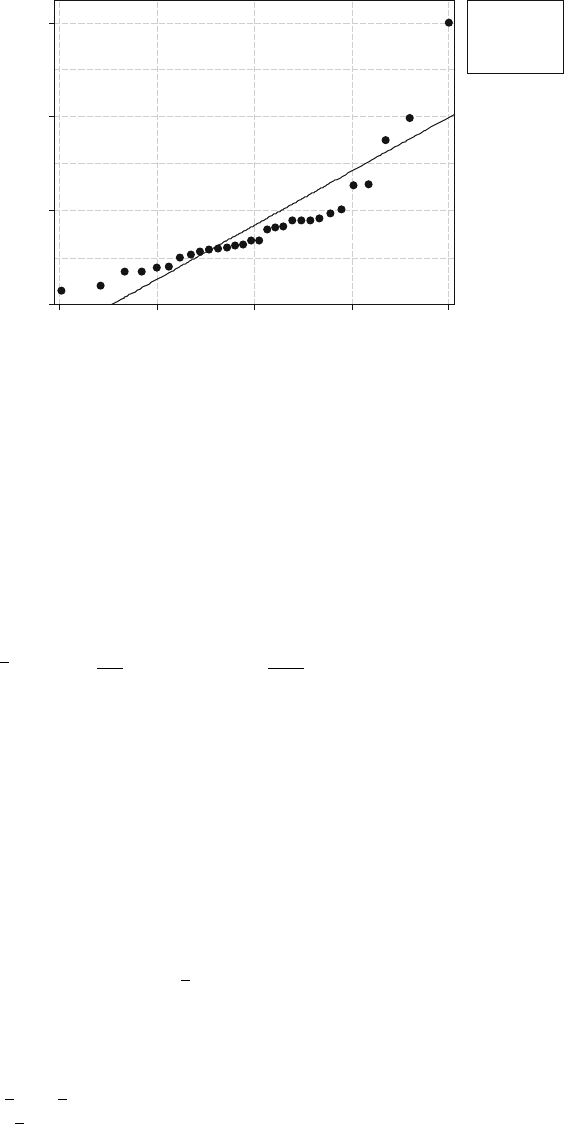
Most of the tips are between 10% and 20%, but a few big tips cause enough
skewness to invalidate the normality assumption. The sample mean is 18.43% and
the sample standard deviation is 5.76%.
If population normality were plausible, then we could form a confidence
interval using the mean and standard deviation calculated from the sample. From
Section 8.3, the resulting 95% confidence interval for the population mean would
be
x t
:025;n1
s
ffiffiffi
n
p
¼ 18:43 2:045
5:76
ffiffiffiffiffi
30
p
¼ 18:43 2:15 ¼ð16 :3; 20:6Þ
How does the bootstrap approach differ from this? For the moment, we
regard the 30 obser vations as constituting a population, and take a large number
of random samples (999 is a common choice), each of size 30, from this population.
These are sample s with replacement, so repetitions are allowed. For each of these
samples we compute the mean (or the median or whatever statistic estimates the
population parameter). Then we use the distribution of these 999 means to get a
confidence interval for the population mean. To help get a feeling for how this
works, here is the first of the 999 samples:
22.8, 16.8, 16.0, 19.0, 19.2, 20.2, 13.6, 15.9, 22.8, 11.5, 15.9, 14.0, 29.9, 19.2, 16.0,
27.6, 14.1, 13.5, 16.8, 15.4, 20.2, 16.4, 20.2, 16.9, 16.8, 22.8, 19.7, 18.2, 22.7, 18.2
This sample has mean x
1
¼ 18:41, where the asterisk emphasizes that this is
the mean of a bootstrap sample.
Of course, when we take a random sample with replaceme nt, repetitions
usually occur as they do here, and this implies that not all of the 30 observations
will appear in each sample. After doing this 998 more times and computing the
means
x
2
; :::; x
999
for these 999 samples, we construct Figure 8.11, the histogram of
the 999
x
values.
40
30
20
10
−2 −1102
N30
AD
Tip Percentage
z Score
Mean
StDev
P-Value
18.43
5.761
1.828
<0.005
Figure 8.10 Normal probability plot from MINITAB of the tip percentages
412
CHAPTER 8 Statistical Intervals Based on a Single Sample
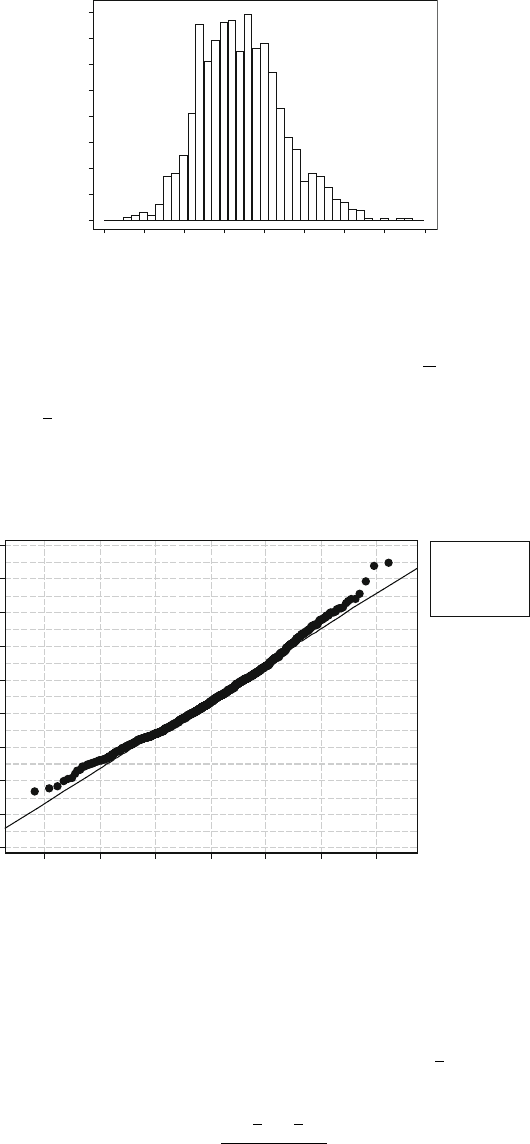
This describ es approximately the sampling distribution of X for samples of 30
from the true tip population. That is, if we could draw the pdf for the true population
distribution of
x values, then it should look something like the histogram in
Figure 8.11. Does the distribution appear to be normal? The histogram is not
exactly symmetric, and the distribution looks skewed to the right. Figure 8.12 has
the normal probability plot from MINITAB:
The pattern in this plot gives evidence of slight positive skewnes s (see
Section 4.6). If this plot were straighter, then we could form a 9 5% confidence
interval for the population mean in the following way. Let s
boot
denote the sample
standard deviation of the 999 bootstrap means. That is, defining
x
to be the mean
of the 999 bootstrap means,
s
2
boot
¼
P
ð
x
i
x
Þ
2
999 1
17 232016 2219
15
2118
80
70
60
50
40
30
20
10
0
Boot Tips
Frequency
Figure 8.11 Histogram of the tip bootstrap distribution, from MINITAB
23
22
21
20
19
18
17
16
15
14
−3 −2 −11230
N999
AD
Mean
StDev
P-Value
18.46
1.043
3.101
<0.005
Boot Tips
z Score
Figure 8.12 Normal plot of the tip bootstrap distribution
8.5 Bootstrap Confidence Intervals 413

The value of s
boot
turns out to be 1.043. The sample mean of the original 30 tip
percentages is
x ¼ 18:43, giving the 95% confidence interval
x z
:025
s
boot
¼ 18:43 1:96ð 1 :043Þ¼18:43 2:04 ¼ð16:4; 20:5Þ
Notice that this is very similar to the previous interval based on the method of
Section 8.3. The difference is mainly due to using the z critical value instead of the
t critical value, because the bootstrap standard deviation s
boot
¼ 1.043 is close to
the estimated standard error s=
ffiffiffi
n
p
¼ 1:052. There should be good agreem ent if the
original data set looks normal. Even if the normality assumpt ion is not satisfied,
there should be good agreement if the sample size n is big enough.
■
The Percentile Interval
In the case that the bootstrap distribution (as represented here by the histogram of
Figure 8.11) is n ormal, the foregoing interval uses the middle 95% of the bootstrap
distribution. Because the 999 bootstrap means do not fit a normal curve, we need an
alternative approach to finding a confidence interval. To allow for a nonnormal
bootstrap distribution, we need to use something other than the standard deviation
and the t table to determine the confidence limits. The percentile interval uses the
2.5 percentile and the 97.5 percentile of the bootstrap distribution for confidence
limits of a 95% confidence interval. Computationally, one way to find the two
percentiles is to sort the 999 means and then use the 25th value from each end.
DEFINITION
The bootstrap percentile interval with a confidence level of 100(1 a)%
for a specified parameter is obtained by first generating B boots trap
samples, for each one calculating the value of some particular statistic that
estimates the para meter, and sorting these values from smallest to largest.
Then we compute k ¼ a(B + 1)/2 and choose the kth value from each end
of the sorted list. These two values form the confiden ce limits for the
confidence interval. If k is not an integer, then interpolation can be used,
but this is not crucial. As an example, if a ¼ .05 and B ¼ 999, then
k ¼ a(B + 1)/2 ¼ (.05)(999 + 1)/2 ¼ 25.
Example 8.16
(Example 8.15
continued)
For the tip data the 2.5 percentile is 16.7 and the 97.5 percentile is 20.8, so the 95%
bootstrap percentile interval (16.65, 20.80). Because the bootstrap distribution is
positively skewed, the percentile interval is shifted slightly to the right compared to
the interval based on a normal bootstrap distribution.
■
A Refined Interval
When the percentile method is used to obtain a confidence interval, under some
circumstances the actual confidence level may differ substantially from the nomi-
nal level (the level you think you are getting); in our example, the nominal level
was 95%, and the actual level could be quite different from this. There are refined
bootstrap intervals that often yield an improvement in this respect. In particular,
414 CHAPTER 8 Statistical Intervals Based on a Single Sample

the BCa (bias corrected and accelerated) interval, implemented in the R, Stata, and
Systat software packa ges, is a method that corrects for bias . Here bias refers to the
difference between the mean of the bootstrap distribution compared to the value of
the estimate based on the original sample. For example, in estimating the mean for
the tip data, the mean of the 30 tips in the original sample is 18.43 but the mean of
the 999 bootstrap sample means is 18.46, so there is just a slight bias of
18.46 18.43 ¼ .03.
The acceleration aspect of the BCa interval is an adjustment for dependence
of the standard error of the estimator on the parameter that is being estimated. For
example, suppose we are trying to estimate the mean in the case of exponential
data. In this case the standard deviation is equal to the mean, and the standard error
of
X is s=
ffiffiffi
n
p
¼ m=
ffiffiffi
n
p
, so the standard error of the estimator X depends strongly on
the parameter m that is being estimated. If the histogram in Figure 8.11 resembled
the exponential pdf, we would expect the BCa method to make a substantial
correction to the percentile interval.
Example 8.17
(Example 8.16
continued)
Recall that the percentile interval for the mean of the tip data is (16.7, 20.8).
Compared to this, the BCa interval (16.9, 21.8) is shifted a little to the right.
■
Is the bootstrap guaranteed to work, or is it possible that the method can give
grossly incorrect estimates? The key here is how closely the original sample
represents the whole distribution of the random variable X. When the sample is
small, then there is a possibility that important features of the distribution are not
included in the data set. In terms of our 30 observations, the value 40.1% is highly
influential. If we drew another sample of 30 observations independent of this
sample, the luck of the draw might give no values above 25, and the sample
would yield very different conclusions. The bootstrap is a useful method for
making inferences from data, but it is dependent on a good sample. If this is all
the data that we can get, we will never know how well our sample represents the
distribution, and therefore how good our answer is. Of course, no statistical method
will give good answers if the sample is not representative of the population.
Bootstrapping the Median
We do have a statistic that is less sensitive to the influence of individual observa-
tions. For the 30 tip percent ages, the median is 16.85, substantially less than the
mean of 18.43. The mean is pulled upward by the few large values, but these
extremes have little effect on the median. In general, the median is less affected by
outliers than the mean. However, it is more difficult to get confidence intervals for
the median. There is a nice statistic to estimate the standard deviation of the mean
ðS=
ffiffiffi
n
p
Þ, but unfortunately there is nothing like this for the median.
Example 8.18
(Example 8.15
continued)
Let’s use the bootstrap method to get a confi dence interval for the median of the tip
data. We can use the same 999 samples of 30 as we did previously, but now we
instead look at the 999 medians. The first sample has mean
x
1
¼ 18:41, whereas its
median is
~
x
1
¼ 17:55. The histogram of this and the other 998 bootstrap medians
~
x
2
; ...;
~
x
999
is shown in Figure 8.13.
8.5 Bootstrap Confidence Intervals 415
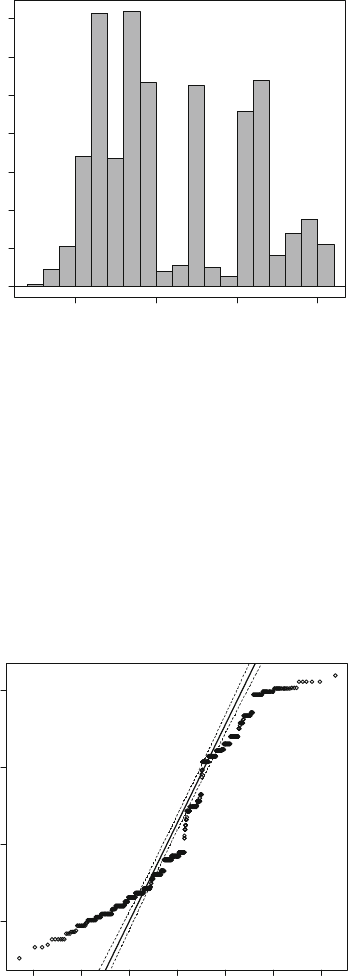
It should be apparent that the distribution of the 999 bootstrap medians is not
normal. As is often the case with the median, the boots trap distribution takes on just
a few values and there are many repeats. Instead of 999 different values, as would
be expected if we took 999 samples from a true continuous distribution, here there
are only 72 values, and some appear mor e than 50 times. These are apparent in the
normal probability plot, shown in Figure 8.14. In contrast to what MINITAB does,
the values here are plotted vertically, so the horizontal segments indicate repeats.
The mean of the 999 bootstrap medians is 17.20 with standard deviation .917.
Even though the procedure is inappropriate because of nonnormality, we can for
comparative purposes use the median
~
x ¼ 16:85 of the original 30 observations
Boot Median
frequency
16 17 18 19
140
120
100
80
60
40
20
0
Figure 8.13 Histogram of the bootstrap medians from R
−3 −2 −10
12
3
norm quantiles
Boot Median
19
18
17
16
Figure 8.14 Normal probability plot of the bootstrap medians from R
416
CHAPTER 8 Statistical Intervals Based on a Single Sample
together with the bootstrap standard deviation
~
s
boot
¼ :917 to get a confidence
interval based on the normal distribution:
~
x z
:025
~
s
boot
¼ 16:85 1:96ð :917Þ¼16:85 1:80 ¼ð15:1; 18:6Þ
Because the bootstrap distribution is so nonnormal, it is more appropriate to
use the percentile interv al in which the confidence limits for a 95% confidence
interval are taken from the 2.5 and 97.5 percentiles of the bootstrap distribution.
When the 999 bootstrap medians are sorted, the 25th value is 15.94 and the 25th
value from the top is 18.98, so the 95% confidence interval for the popul ation
median is (15.94, 18.98). In accord with the nonnormal bootstrap distribution, this
interval differs from the interval that assumes normality.
The bias corrected and accelerated BCa refinement gives only a slight change
to the percentile interval for the median. To estimate the bias, subtract the median
of the original sample from the mean of the bootstrap medians, which is
17.20 16.85 ¼ .35. The percentile interval gives only a slight refinement from
(15.94, 18.98) to (15.87, 18.94).
■
We should be a bit uncomfortable with the results of bootstrapping the
median. Given that the bootstrap distribution takes on just a few valu es but the
true sampling distribution is continuous, we should worry a little about how well
the bootstrap distribution approximates the true sampling distribution. On the other
hand, the situation here is nowhere near as bad as it could be. Sometimes, especially
when the sample size is smaller, the bootstrap distribution has far fewer values.
What can be done to see if the bootstrap results are valid for the med ian? We
performed a simulation experiment with data from the exponential distribution, a
distribution that is more strongly skewed than the tip percentages. We generated
100 samples, each of size 30, and then took 999 bootstrap samples from each of
them. In this way we obtained 95% percentile confidence intervals for the mea n and
the median from each of the 100 samples. We used the exponential distribution
with mean m ¼ 1/l ¼ 1, for which the median
~
m ¼ lnð2Þ¼:693. In checking each
of the 100 confidence intervals for the mean, we found that 93 of them contained
the true mean. Similarly, we found that 93 of the confidence intervals for the
median contained the true median. It is gratifying to see that, in spite of the strange
distribution of the bootstrapped medians, the performance of the percentile confi-
dence intervals is reasonably on target.
The Mean Versus the Median
For the tip percentages is it better to use the mean or the median? The median is
much less affected by the extreme observations in this skewed data set. This
suggests that the mean will vary a lot depending on whether a particular sample
has outliers. Here, the variability shows up in a higher standar d deviation 1.043 for
the 999 bootstrap means as com pared to the standard deviation .917 for the 999
bootstrap medians. Furthermore, the percentile interval with 95% confidence for
the mean has width 4.15 whereas the interval for the median has a width of only
3.04. In terms of precision, we are better off with the median. For a prospective
server at this restaurant, it might also be more meaningful to give the median, the
middle tip value in the sense that roughly half are above and half are below.
8.5 Bootstrap Confidence Intervals 417