
Devore J.L., Berk K.N. Modern Mathematical Statistics with Applications
Подождите немного. Документ загружается.

variance that is nearly as small as can be achieved by any unbiased estimator.
Stated another way, the mle
^
y is approximately the MVUE of y.
Because of this result and the fact that calculus-based techniques can usually be
used to derive the mle’s (although often numerical methods, such as Newton’s
method, are necessary), maximum likelihood estimation is the most widely used
estimation technique among statisticians. Many of the estimators used in the
remainder of the book are mle’s. Obtaining an mle, however, does require that
the underlying distribution be specified.
Note that there is no similar result for method of moments estimators. In general,
if there is a choice between maximum likelihood and moment estimators, the mle is
preferable. For example, the maximum likelihood method applied to estimating
gamma distribution parameters tends to give better estimates (closer to the parameter
values) than does the method of moments, so the extra computation is worth the price.
Some Complications
Sometimes calculus cannot be used to obtain mle’s.
Example 7.23 Suppose the waiting time for a bus is uniformly distributed on [0, y] and the results
x
1
,...,x
n
of a random sample from this distribution have been observed. Since
f(x; y) ¼ 1/y for 0 x y and 0 otherwise,
f ðx
1
; ...; x
n
; yÞ¼
1=y
n
0 x
1
y; ...; 0 x
n
y
0 otherwise
As long as max(x
i
) y , the likelihood is 1/y
n
, which is positive, but as soon as
y < max(x
i
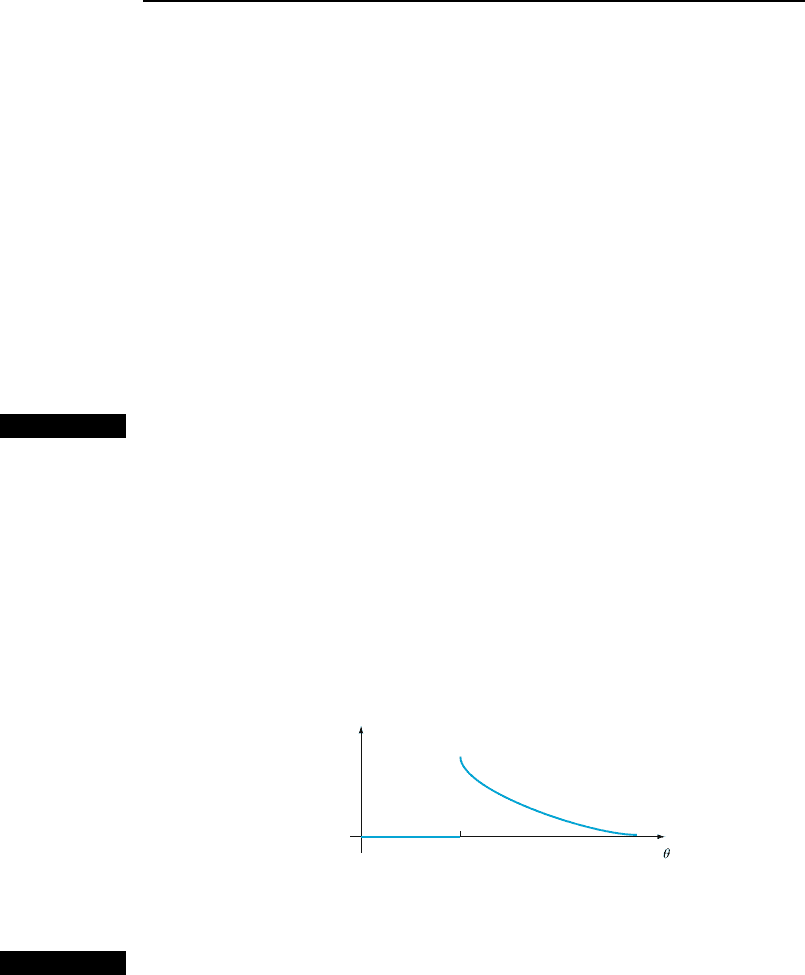
), the likelihood drops to 0. This is illustrated in Figure 7.7.Calculuswill
not work because the maximum of the likelihood occurs at a point of discontinuity,
but the figure shows that
^
y ¼ max x
i
ðÞ. Thus if my waiting times are 2.3, 3.7, 1.5, .4,
and 3.2, then the mle is
^
y ¼ 3:7. Note that the mle is biased (see Example 7.5).
Example 7.24 A method that is often used to estimate the size of a wildlife population involves
performing a capture/recapture experiment. In this exper iment, an initial sample of
M animals is captured, each of these animals is tagged, and the animals are then
returned to the population. After allowing enough time for the tagged individuals to
mix into the population, another sample of size n is captured. With X ¼ the number
of tagged animals in the second sample, the objective is to use the observed x to
estimate the population size N.
Likelihood
max(x
i
)
Figure 7.7 The likelihood function for Example 7.23 ■
358
CHAPTER 7 Point Estimation

The parameter of interest is y ¼ N, which can assume only integer values, so
even after determining the likelihood function (pmf of X here), using calculus to
obtain N would present difficulties. If we think of a success as a previously tagged
animal being recaptured, then sampling is without replacement from a population
containing M successes and N – M failures, so that X is a hypergeometric rv and the
likelihood function is
pðx; NÞ¼hðx; n; M; NÞ¼
M
x
N M
n x
N
n
The integer-valued natu re of N notwithstanding, it would be difficult to take the
derivative of p(x; N). However, let’s consider the ratio of p(x; N)top(x; N – 1):
pðx; NÞ
pðx; N 1Þ
¼
ðN MÞðN nÞ
NðN M n þ xÞ
This ratio is larger than 1 if and only if (iff) N < Mn/x. The value of N for which
p(x; N) is maximized is therefore the largest integer less than Mn/x. If we use
standard mathematical notation [r] for the largest integer less than or equal to r,
the mle of N is
^
N ¼½Mn=x. As an illustration, if M ¼ 200 fish are taken from a
lake and tagged, subsequently n ¼ 100 fish are recaptured, and among the 100
there are x ¼ 11 tagged fish, then
^
N ¼½ð200Þð100Þ=11¼½1818:18¼1818. The
estimate is actually rather intuitive; x/n is the proportion of the recaptured sample
that is tagged, whereas M/N is the proportion of the entire popul ation that is tagged.
The estimate is obtained by equating these two propor tions (estimating a population
proportion by a sample proportion).
■
Suppose X
1
, X
2
,...,X
n
is a random sample from a pdf f(x; y) that is
symmetric about y, but the investigator is unsure of the form of the f function. It
is then desirable to use an estimator
^
y that is robust, that is, one that performs well
for a wide variety of underlying pdf’s. One such estimator is a trimmed mean. In
recent years, statisticians have proposed another type of estimator, called an M-
estimator, based on a generalization of maximum likelihood estimation. Instead of
maximizing the log likelihood Sln[f(x; y)] for a specified f, one seeks to max imize
Sr(x
i
; y). The “objective function” r is selected to yield an estimator with good
robustness properties. The book by David Hoaglin et al. (see the bibliography)
contains a good exposition on this subject.
Exercises Section 7.2 (21–31)
21. A random sample of n bike helmets manufactured
by a company is selected. Let X ¼ the number
among the n that are flawed, and let p ¼ P
(flawed). Assume that only X is observed, rather
than the sequence of S’s and F’s.
a. Derive the maximum likelihood estimator of p.
If n ¼ 20 and x ¼ 3, what is the estimate?
b. Is the estimator of part (a) unbiased?
c. If n ¼ 20 and x ¼ 3, what is the mle of the
probability (1 –p)
5
that none of the next five
helmets examined is flawed?
22. Let X have a Weibull distribution with parameters
a and b,so
EðXÞ¼b Gð1 þ 1=aÞ
VðXÞ¼b
2
fGð1 þ 2=aÞ½Gð1 þ 1=aÞ
2
g
7.2 Methods of Point Estimation 359

a. Based on a random sample X
1
,...,X
n
, write
equations for the method of moments estimators
of b and a. Show that, once the estimate of a has
been obtained, the estimate of b can be found
from a table of the gamma function and that the
estimate of a is the solution to a complicated
equation involving the gamma function.
b. If n ¼ 20,
x ¼ 28:0, and
P
x
2
i
¼ 16; 500;
compute the estimates. [Hint:[G(1.2)]
2
/G(1.4)
¼ .95.]
23. Let X denote the proportion of allotted time that a
randomly selected student spends working on a
certain aptitude test. Suppose the pdf of X is
f ðx; yÞ¼
ðy þ 1Þx
y
0 x 1
0 otherwise
where 1 < y. A random sample of ten students
yields data x
1
¼ .92, x
2
¼ .79, x
3
¼ .90,
x
4
¼ .65, x
5
¼ .86, x
6
¼ .47, x
7
¼ .73, x
8
¼ .97,
x
9
¼ .94, x
10
¼ .77.
a. Use the method of moments to obtain an esti-
mator of y, and then compute the estimate for
this data.
b. Obtain the maximum likelihood estimator of y,
and then compute the estimate for the given
data.
24. Two different computer systems are monitored for
atotalofn weeks. Let X
i
denote the number of
breakdowns of the first system during the ith week,
and suppose the X
i
’s are independent and drawn
from a Poisson distribution with parameter l
1
. Sim-
ilarly, let Y
i
denote the number of breakdowns of
thesecondsystemduringtheith week, and assume
independence with each Y
i
Poisson with parameter
l
2
. Derive the mle’s of l
1
, l
2
,andl
1
– l
2
.[Hint:
Using independence, write the joint pmf (likeli-
hood)oftheX
i
’s and Y
i
’s together.]
25. Refer to Exercise 21. Instead of selecting n ¼ 20
helmets to examine, suppose we examine helmets
in succession until we have found r ¼ 3 flawed
ones. If the 20th helmet is the third flawed one (so
that the number of helmets examined that were not
flawed is x ¼ 17), what is the mle of p? Is this the
same as the estimate in Exercise 21? Why or why
not? Is it the same as the estimate computed from
the unbiased estimator of Exercise 17?
26. Six Pepperidge Farm bagels were weighed, yield-
ing the following data (grams):
117.6 109.5 111.6 109.2 119.1 110.8
(Note:4oz¼ 113.4 g)
a. Assuming that the six bagels are a random
sample and the weight is normally distributed,
estimate the true average weight and standard
deviation of the weight using maximum likeli-
hood.
b. Again assuming a normal distribution, estimate
the weight below which 95% of all bagels will
have their weights. [Hint: What is the 95th
percentile in terms of m and s? Now use the
invariance principle.]
c. Suppose we choose another bagel and weigh it.
Let X ¼ weight of the bagel. Use the given
data to obtain the mle of P(X 113.4). (Hint:
P(X 113.4) ¼ F[(113.4 – m)/s)].)
27. Suppose a measurement is made on some physical
characteristic whose value is known, and let X
denote the resulting measurement error. For an
unbiased measuring instrument or technique, the
mean value of X is 0. Assume that any particular
measurement error is normally distributed with
variance s
2
. Let X
1
,...X
n
be a random sample
of measurement errors.
a. Obtain the method of moments estimator of s
2
.
b. Obtain the maximum likelihood estimator
of s
2
.
28. Let X
1
,...,X
n
be a random sample from a gamma
distribution with parameters a and b.
a. Derive the equations whose solution yields the
maximum likelihood estimators of a and b.Do
you think they can be solved explicitly?
b. Show that the mle of m ¼ ab is
^
m ¼
X.
29. Let X
1
, X
2
,...,X
n
represent a random sample from
the Rayleigh distribution with density function
given in Exercise 15. Determine
a. The maximum likelihood estimator of y and
then calculate the estimate for the vibratory
stress data given in that exercise. Is this estima-
tor the same as the unbiased estimator sug-
gested in Exercise 15?
b. The mle of the median of the vibratory stress
distribution. [Hint: First express the median in
terms of y.]
30. Consider a random sample X
1
, X
2
,...,X
n
from the
shifted exponential pdf
f ðx; l; yÞ¼
le
lðxyÞ
x y
0 otherwise
Taking y ¼ 0 gives the pdf of the exponential
distribution considered previously (with positive
density to the right of zero). An example of the
360
CHAPTER 7 Point Estimation

shifted exponential distribution appeared in
Example 4.5, in which the variable of interest
was time headway in traffic flow and y ¼ .5 was
the minimum possible time headway.
a. Obtain the maximum likelihood estimators of
y and l.
b. If n ¼ 10 time headway observations are
made, resulting in the values 3.11, .64, 2.55,
2.20, 5.44, 3.42, 10.39, 8.93, 17.82, and 1.30,
calculate the estimates of y and l.
31. At time t ¼ 0, 20 identical components are
put on test. The lifetime distribution of each is
exponential with parameter l. The experimenter
then leaves the test facility unmonitored. On
his return 24 h later, the experimenter immedi-
ately terminates the test after noticing that
y ¼ 15 of the 20 components are still in operation
(so 5 have failed). Derive the mle of l.
[Hint: Let Y ¼ the number that survive 24 h.
Then Y~Bin(n, p). What is the mle of p?
Now notice that p ¼ P(X
i
24), where X
i
is
exponentially distributed. This relates l to p,so
the former can be estimated once the latter
has been.]
7.3
Sufficiency
An investigator who wishes to make an inference about some parameter y will base
conclusions on the value of one or more statistics – the sample mean
X, the sample
variance S
2
, the sample range Y
n
Y
1
, and so on. Intuitively, some statistics will
contain more information about y than will others. Sufficiency, the topic of this
section, will help us decide which functions of the data are most informative for
making inferences.
As a first point, we note that a statistic T ¼ t(X
1
,...,X
n
) will not be useful for
drawing conclusions about y unless the distribution of T depends on y. Consider, for
example, a random sample of size n ¼ 2 from a normal distribution with mean m
and variance s
2
, and let T ¼ X
1
X
2
.ThenT has a normal distribution with mean
0 and variance 2s
2
, which does not depend on m. Thus this statistic cannot be used
as a basis for drawing any conclusions about m, although it certainly does carry
information about the variance s
2
.
The relevance of this obser vation to sufficiency is as follows. Sup pose an
investigator is given the value of some statistic T, and then examines the condi-
tional distribution of the sample X
1
, X
2
,...,X
n
given the value of the statistic – for
example, the conditional distribution given that
X ¼ 28:7. If this conditional
distribution does not depend upon y, then it can be concluded that there is no
additional information about y in the data over and above what is provided by T.
In this sense, for purposes of making inferences about y,itissufficient to know
the value of T, which contains all the information in the data relevant to y.
Example 7.25 An investigation of major defects on new vehicles of a certain type involved
selecting a random sample of n ¼ 3 vehicles and determining for each one the
value of X ¼ the number of major defects. This resulted in observations x
1
¼ 1,
x
2
¼ 0, and x
3
¼ 3. You, as a consulting statistician, have been provided with a
description of the experiment, from which it is reasonable to assume that X has a
Poisson distribution, and told only that the total number of defects for the three
sampled vehi cles was four.
Knowing that T ¼ ∑X
i
¼ 4, would there be any additional advantage in
having the observed values of the individual X
i
’s when making an inference
about the Poisson parameter l? Or rather is it the case that the statistic T contains
all relevant information about l in the data? To address this issue, consider the
conditional distribution of X
1
, X
2
, X
3
given that ∑ X
i
¼ 4. First of all, there are only
7.3 Sufficiency 361

a few possibl e (x
1
, x
2
, x
3
) triples for which x
1
+ x
2
+ x
3
¼ 4. For example, (0, 4, 0)
is a possibility, as are (2, 2, 0) and (1, 0, 3), but not (1, 2, 3) or (5, 0, 2). That is,
PðX
1
¼ x
1
; X
2
¼ x
2
; X
3
¼ x
3
j
P
3
i¼1
X
i
¼ 4Þ¼0 unless x
1
þ x
2
þ x
3
¼ 4
Now consider the triple (2, 1, 1), which is consistent with ∑X
i
¼ 4. If we let
A denote the event that X
1
¼ 2, X
2
¼ 1, and X
3
¼ 1 and B denote the event that
∑X
i
¼ 4, then the event A implies the event B (i.e., A is contained in B), so the
intersection of the two events is just the smaller event A.Thus
PðX
1
¼ 2; X
2
¼ 1; X
3
¼ 1j
P
3
i¼1
X
i
¼ 4Þ¼PðAjBÞ¼
PðA \ BÞ
PðBÞ
¼
PðX
1
¼ 2; X
2
¼ 1; X
3
¼ 1Þ
P SX
i
¼ 4ðÞ
A moment generating function argument shows that ∑X
i
has a Poisson distribution
with parameter 3l. Thus the desired conditional probability is
e
l
l
2
2!
e
l
l
1
1!
e
l
l
1
1!
e
3l
3lðÞ
4
4!
¼
4!
3
4
2!
¼
4
27
Similarly,
PðX
1
¼ 1; X
2
¼ 0; X
3
¼ 3j
P
3
i¼1
X
i
¼ 4Þ¼
4!
3
4
3!
¼
4
81
The complete conditional distribution is as follows:
PðX
1
¼ x
1
; X
2
¼ x
2
; X
3
¼ x
3
j
P
3
i¼1
X
i
¼ 4Þ
¼
6
81
ðx
1
; x
2
; x
3
Þ¼ð2; 2; 0Þ; ð2; 0; 2 Þ ; ð0; 2; 2Þ
12
81
ðx
1
; x
2
; x
3
Þ¼ð2; 1; 1Þ; ð1; 2; 1 Þ ; ð1; 1; 2Þ
1
81
ðx
1
; x
2
; x
3
Þ¼ð4; 0; 0Þ; ð0; 4; 0 Þ ; ð0; 0; 4Þ
4
81
ðx
1
; x
2
; x
3
Þ¼ð3; 1; 0Þ; ð1; 3; 0 Þ ; ð3; 0; 1Þ; ð1; 0; 3Þ; ð0; 1; 3Þ; ð0; 3; 1Þ
8
>
>
>
>
>
>
>
>
>
>
>
<
>
>
>
>
>
>
>
>
>
>
>
:
This condition al distribution does not involve l. Thus once the value of the statistic
∑X
i
has been provided, there is no additional information about l in the individual
observations.
To put this another way, think of obtaining the data from the experiment in
two stages:
1. Observe the value of T ¼ X
1
+ X
2
+ X
3
from a Poisson distribution with
parameter 3l.
2. Having observed T ¼ 4, now obtain the individual x
i
’s from the conditional
distribution
362 CHAPTER 7 Point Estimation

PðX
1
¼ x
1
; X
2
¼ x
2
; X
3
¼ x
3
j
P
3
i¼1
X
i
¼ 4Þ
Since the conditional distribution in step 2 does not involve l, there is no addi tional
information about l resulting from the secon d sta ge of the data generation process.
This argument holds more generally for any sample size n and any value t other
than 4 (e.g., the total number of defects among ten randomly selected vehicles
might be ∑X
i
¼ 16). Once the value of ∑X
i
is known, there is no further informa-
tion in the data about the Poisson parameter.
■
DEFINITION
A statistic T ¼ t(X
1
,...,X
n
) is said to be sufficient for making inferences
about a parameter y if the joint distribution of X
1
, X
2
,...,X
n
given that T ¼ t
does not depend upon y for every possible value t of the statistic T.
The notion of sufficiency formalizes the idea that a statistic T contains all relevant
information about y. Onc e the value of T for the given data is available, it is of no
benefit to know anything else about the sample.
The Factorization Theorem
How can a sufficient statistic be identified? It may seem as though one would have
to select a statistic, determine the conditional distribution of the X
i
’s given any
particular value of the statistic, and keep doing this until hitting paydirt by finding
one that satisfies the defining condition. This would be terribly time-consuming,
and when the X
i
’s are continuous there are additional technical difficulties in
obtaining the relevant conditional distribution. Fortunately, the next result provides
a relatively straightforward way of proceeding.
THE NEYMA N
FACTORI-
ZATION
THEOREM
Let f(x
1
, x
2
,...,x
n
; y) denote the joint pmf or pdf of X
1
, X
2
,...,X
n
. Then
T ¼ t(X
1
,...,X
n
) is a sufficient statistic for y if and only if the joint pmf or
pdf can be represented as a product of two factors in which the first factor
involves y and the data only thr ough t(x
1
,...,x
n
) whereas the second factor
involves x
1
,...,x
n
but does not depend on y:
fx
1
; x
2
; :::; x
n
; yðÞ¼gtx
1
; :::; x
n
ðÞ; yðÞhx
1
; :::; x
n
ðÞ
Before sketching a proof of this theorem, we consider several examp les.
Example 7.26 Let’s generalize the previous example by considering a random sample X
1
, X
2
,...,
X
n
from a Poisson distribution with parameter l, for example, the numbers of
blemishes on n independently selected DVD’s or the numbers of errors in n batches
of invoices where each batch consists of 200 invoices. The joint pmf of these
variables is
7.3 Sufficiency 363
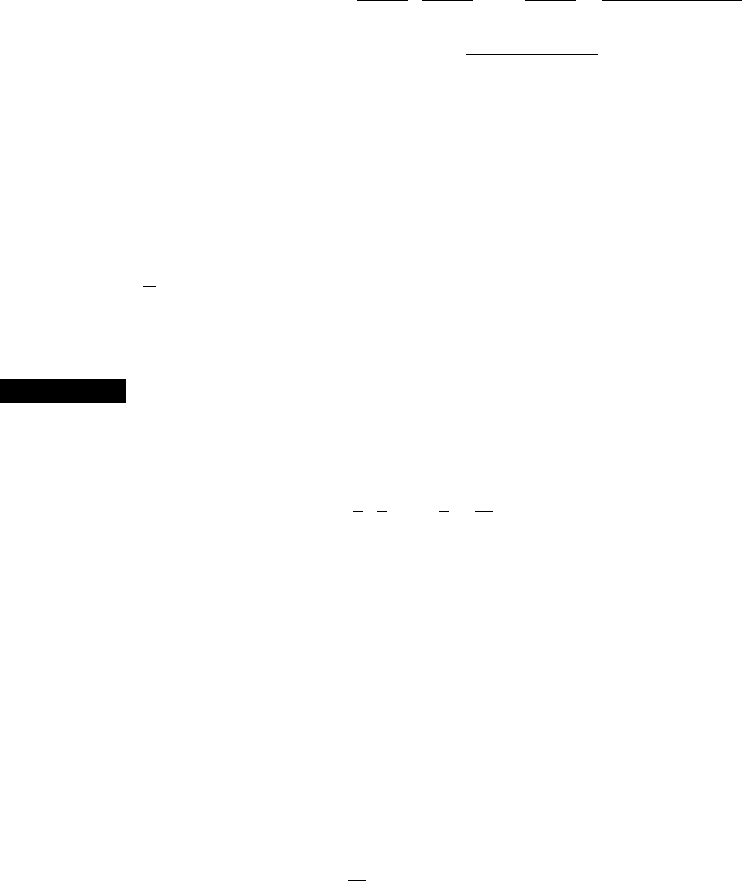
f ð x
1
; ...; x
n
; lÞ¼
e
l
l
x
1
x
1
!
e
l
l
x
2
x
2
!
e
l
l
x
n
x
n
!
¼
e
nl
l
x
1
þx
2
þþx
n
x
1
! x
2
! x
n
!
¼ e
nl
l
Sx
i
1
x
1
! x
2
! x
n
!
The factor inside the first set of parentheses involves the parameter l and the
data only through ∑x
i
, whereas the factor inside the second set of parentheses
involves the data but not l. So we have the desired factorization, and the sufficient
statistic is T ¼ ∑X
i
as we previously ascertained directly from the defini tion of
sufficiency.
■
A sufficient statistic is not unique; any one-to-one function of a sufficient
statistic is itself sufficient. In the Poisson example, the sample mean
X ¼ð1=nÞ
P
X
i
is a one-to-one function of ∑X
i
(knowing the value of the sum
of the n observations is equivalent to knowing their mean), so the sample mean is
also a sufficient statistic.
Example 7.27 Suppose that the waiting time for a bus on a weekday morning is uniformly
distributed on the interval from 0 to y, and consider a random sample X
1
,...,X
n
of waiting times (i.e., times on n independe ntly selected mornings). The joint pdf of
these times is
f ð x
1
; ...; x
n
; yÞ¼
1
y
1
y
1
y
¼
1
y
n
0 x
1
y; ...; 0 x
n
y
0 otherwise
8
<
:
To obtain the desired factorization, we introduce notation for an indicator function
of an event A: I(A) ¼ 1if(x
1
, x
2
,...,x
n
) lies in A and I(A) ¼ 0 otherwise. Now let
A ¼ x
1
; x
2
; :::; x
n
ðÞ: 0 x
1
y; 0 x
2
y; :::; 0 x
n
y
fg
That is, A is the indicator for the event that all x
i
’s are between 0 and y. But all n of
the x
i
’s will be between 0 and y if and only if the smallest of the x
i
’s is at least 0 and
the largest is at most y. Thus
IðAÞ¼I 0 minfx
1
; :::; x
n
gðÞI max x
1
; :::; x
n
fg
ygðÞ
We can now use this indicator function notation to write a one-line expression for
the joint pdf:
f ð x
1
; x
2
; ...; x
n
; yÞ¼
1
y
n
Iðmaxfx
1
; ...; x
n
gyÞ
Ið0 minfx
1
; ...; x
n
gÞ
The factor inside the square brackets involves y and the x
i
’s only through the
function t(x
1
,...,x
n
) ¼ max{x
1
,...,x
n
}. Voila, we have our desired factorization,
and the sufficient statistic for the uniform parameter y is T ¼ max{X
1
,...,X
n
}, the
largest order statistic. All the information about y in this uniform random sample is
contained in the largest of the n observations. This result is much more difficult to
obtain directly from the definition of sufficiency.
■
Proof of the Factorization Theorem A general proof when the X
i
’s
constitute a random sample from a continuous distribution is fraught with technical
details that are beyond the level of our text. So we content ourselves with a proof in
364 CHAPTER 7 Point Estimation

the discrete case. For the sake of concise notation, denote X
1
, X
2
,...,X
n
by X and
x
1
, x
2
,...,x
n
by x.
Suppose first that T ¼ t(x) is sufficient, so that P(X ¼ x | T ¼ t) does not
depend upon y. Focus on a value t for which t(x) ¼ t (e.g., x ¼ 3, 0, 1, t(x) ¼ ∑x
i
,
so t ¼ 4). The event that X ¼ x is then identical to the event that both X ¼ x and
T ¼ t because the former equality implies the latter one. Thus
f x; yðÞ¼P X; yðÞ¼P X ¼ x; T ¼ t; yðÞ
¼ P X ¼ x T ¼ t; y
j
ðÞPT¼ t; yðÞ¼P X ¼ x T ¼ t
j
ðÞPT¼ t; yðÞ
Since the first factor in this latter product does not involve y and the second one
involves the data only through t, we have our desired factorization.
Now let’s go the other way: assume a factorization, and show that T is
sufficient, i.e., that the conditional probability that X ¼ x given that T ¼ t does
not involve y.
PðX ¼xjT ¼t
;yÞ¼
PðX ¼x;T ¼t;yÞ
PðT ¼t;yÞ
¼
PðX ¼x;yÞ
PðT ¼t;yÞ
¼
gðt;yÞhðxÞ
P
u:tðuÞ¼t
PðX ¼u;yÞ
¼
gðt;yÞhðxÞ
P
u:tðuÞ¼t
g½tðu;yÞhðuÞ
¼
hðxÞ
P
u:tðuÞ¼t
hðuÞ
Sure enough, this latter ratio does not involve y. ■
Jointly Sufficient Statistics
When the joint pmf or pdf of the data involves a single unknown parameter y, there is
frequently a single statistic (single function of the data) that is sufficient. However,
when there are several unknown parameters—for example, the mean m and standard
deviation s of a normal distribution, or the shape parameter a and scale parameter b
of a gamma distribution—we must expand our notion of sufficiency.
DEFINITION
Suppose the joint pmf or pdf of the data involves k unknown parameters y
1
,
y
2
,...,y
k
. The m statistics T
1
¼ t
1
(X
1
,...,X
n
), T
2
¼ t
2
(X
1
,...,X
n
),...,
T
m
¼ t
m
(X
1
,...,X
n
) are said to be jointly sufficient for the parameters if the
conditional distribution of the X
i
’s given that T
1
¼ t
1
, T
2
¼ t
2
,...,T
m
¼ t
m
does not depend on any of the unknown parameters, and this is true for all
possible values t
1
, t
2
,...,t
m
of the statistics.
Example 7.28 Consider a random sample of size n ¼ 3 from a continuous distribution, and let T
1
, T
2
,
and T
3
be the three order statistics – that is, T
1
¼ the smallest of the three X
i
’s, T
2
¼ the
second smallest X
i
,andT
3
¼ the largest X
i
(these order statistics were previously
denoted by Y
1
, Y
2
,andY
3
.). Then for any values t
1
, t
2
,andt
3
satisfying t
1
< t
2
< t
3
,
7.3 Sufficiency 365
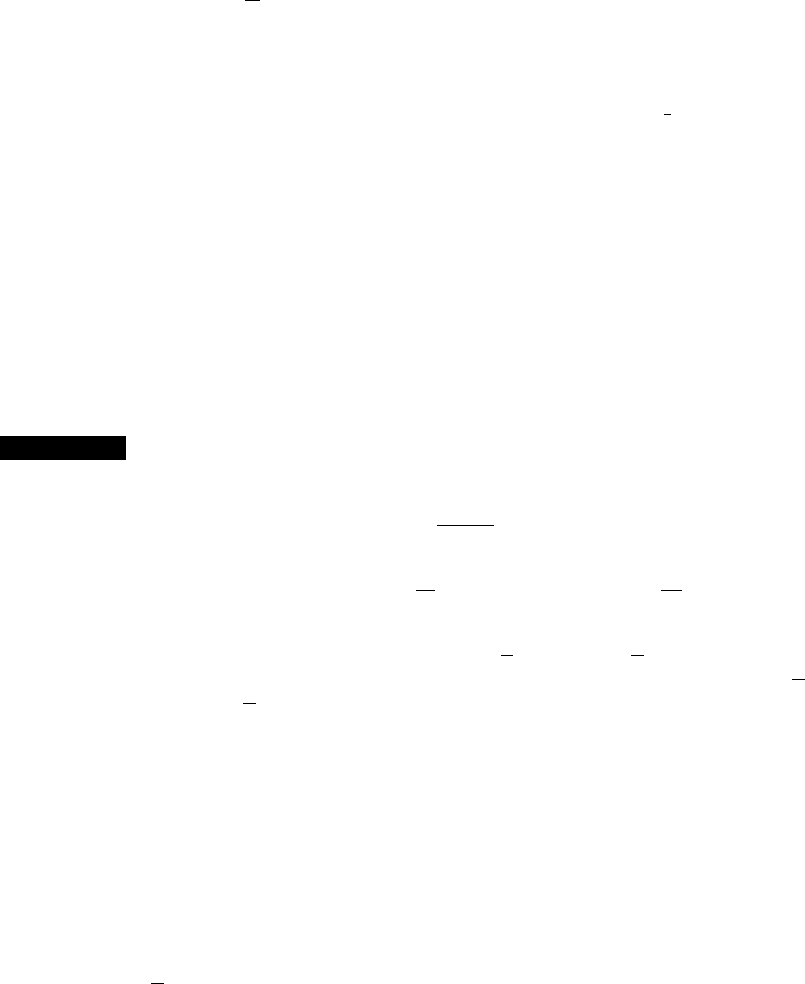
PX
1
¼ x
1
; X
2
¼ x
2
; X
3
¼ x
3
jT
1
¼ t
1
; T
2
¼ t
2
; T
3
¼ t
3
ðÞ
¼
1
3!
x
1
; x
2
; x
3
¼ t
1
; t
2
; t
3
; t
1
; t
3
; t
2
; t
2
; t
1
; t
3
; t
2
; t
3
; t
1
; t
3
; t
1
; t
2
; t
3
; t
2
; t
1
0 otherwise
8
>
<
>
:
For example, if the three ordered values are 21.4, 23.8, and 26.0, then the condi-
tional probability distribution of the three X
i
’s places probability
1
6
on each of the 6
permutations of these three numbers (23.8, 21.4, 26.0, and so on). This conditional
distribution clearly does not involve any unknown parameters.
Generalizing this argument to a sample of size n, we see that for a random
sample from a continuous distribution, the order statistics are jointly sufficient for
y
1
, y
2
,...,y
k
regardless of whether k ¼ 1 (e.g., the exponential distributio n has a
single parameter) or 2 (the normal distribution) or even k > 2.
■
The factorization theorem extends to the case of jointly sufficient statistics:
T
1
, T
2
,...,T
m
are jointly sufficient for y
1
, y
2
,...,y
k
if and only if the joint pmf or
pdf of the X
i
’s can be represented as a product of two factors, where the first
involves the y
i
’s and the data only through t
1
, t
2
,...,t
m
and the second does not
involve the y
i
’s.
Example 7.29 Let X
1
,...,X
n
be a random sample from a normal distribution with mean m and
variance s
2
. The joint pdf is
f ð x
1
; ...; x
n
; m; s
2
Þ¼
Y
n
i¼1
1
ffiffiffiffiffiffiffiffiffiffi
2ps
2
p
e
ðx
i
mÞ
2
=ð2s
2
Þ
¼
1
s
n
e
Sx
2
i
2mSx
i
þnm
2
ðÞ
=ð2s
2
Þ
1
2p
n=2
This factor ization shows that the two statistics SX
i
and SX
2
i
are jointly sufficient for
the two parameters m and s
2
. Since SðX
i
XÞ
2
¼ SX
2
i
n XðÞ
2
there is a one-to-
one correspondence between the two sufficient statistics and the statistics
X
and SðX
i
XÞ
2
; that is, values of the two original sufficient statist ics uniquely
determine values of the latter two statistics, and vice-versa. This implies that the
latter two statistics are also jointly sufficient, which in turn implies that the sample
mean and sample variance (or sample standard deviation) are jointly sufficient
statistics. The sample mean and sample variance encapsulate all the information
about m and s
2
that is contained in the sample data. ■
Minimal Sufficiency
When X
1
,...,X
n
constitute a random sample from a normal distribution, the n order
statistics Y
1
,...,Y
n
are jointly sufficient for m and s
2
, and the sample mean and
sample variance are also jointly sufficient. Both the order statistics and the pair
ð
X; S
2
Þ reduce the data without any information loss, but the sample mean and
variance represent a greater reduction. In general, we would like the greatest
possible reduction without information loss. A minimal (possibly jointly) suffi-
cient statistic is a function of every other sufficient statistic. That is, given the
value(s) of any other sufficient statistic(s), the value(s) of the minimal sufficient
statistic(s) can be calculated. The minimal suffic ient statistic is the sufficient
366 CHAPTER 7 Point Estimation

statistic having the smallest dimensionality, and thus represents the greatest possi-
ble reduction of the data without any information loss.
A general discussion of minimal sufficiency is beyond the scope of our text.
In the case of a normal distribution with values of both m and s
2
unknown, it can be
shown that the sample mean and sample variance are jointly minimal sufficient (so
the same is true of
P
X
i
and
P
X
2
i
). It is intuitively reasonable that because there
are two unknown parame ters, there should be a pair of sufficient statistics. It is
indeed often the case that the number of the (jointly) sufficient statistic(s) matches
the number of unknown parameters. But this is not always true. Consider a random
sample X
1
,...,X
n
from the pdf f(x ;y) ¼ 1/{p[1 + (x y)]
2
} for 1< x < 1,
i.e., from a Cauchy distribution with location parameter y. The graph of this pdf
is bell shaped and centered at y, but its tails decrease much more slowly than those
of a normal density curve. Because the Cauchy distribution is continuous, the order
statistics are jointly sufficient for y. It would seem, though, that a single sufficient
statistic (one-dimensional) could be found for the single parameter. Unfortunat ely
this is not the case; it can be show n that the order statistics are minimal sufficient!
So going beyond the order statistics to any single function of the X
i
’s as a point
estimator of y entails a loss of information from the original data.
Improving an Estimator
Because a sufficient statistic cont ains all the information the data has to offer
about the value of y, it is reasonable that an estim ator of y or any function of y
should depend on the data only through the sufficient statistic. A general result
due to Rao and Blackwell shows how to start with an unbiased statistic that is
not a function of sufficient statistics and create an improved estimator that is
sufficient.
THEOREM
Suppose that the joint distribution of X
1
,...,X
n
depends on some
unknown parameter y and that T is sufficient for y. Consider estimating
h(y), a specified function of y.IfU is an unbiased statistic for estimating
h(y) that does not involve T, then the estimator U* ¼ E(U | T) is also
unbiased for h(y) and has variance no greater than the original unbiased
estimator U.
Proof First of all, we must show that U* is indeed an estimator—that it is a
function of the X
i
’s which does not depend on y. This follows because, given that T
is sufficient, the distribution of U conditional on T does not involve y, so the
expected value calculated from the conditional distribution will of course not
involve y. The fact that U* has smaller variance than U is a consequence of a
conditional expectation-conditional variance formula for V(U) introduced in Sec-
tion 5.3:
VðUÞ¼VEUjTðÞ½þEV UjTðÞ½¼VU
ðÞþEV UjTðÞ½
Because V(U | T), being a variance, is positive, it follows that V(U) V(U*) as
desired. ■
7.3 Sufficiency 367