
Devore J.L., Berk K.N. Modern Mathematical Statistics with Applications
Подождите немного. Документ загружается.


Exercises Section 7.4 (42–48)
42. Assume that the number of defects in a car
has a Poisson distribution with parameter l.
To estimate l we obtain the random sample X
1
,
X
2
, ..., X
n
.
a. Find the Fisher information in a single obser-
vation using two methods.
b. Find the Crame
´
r–Rao lower bound for the var-
iance of an unbiased estimator of l.
c. Use the score function to find the mle of l and
show that the mle is an efficient estimator.
d. Is the asymptotic distribution of the mle in
accord with the second theorem? Explain.
43. In Example 7.23 f(x; y) ¼ 1/y for 0 x y and
0 otherwise. Given a random sample, the maxi-
mum likelihood estimate
^
y is the largest observa-
tion.
a. Letting
~
y ¼½ðn þ 1Þ=n
^
y, show that
~
y is unbi-
ased and find its variance.
b. Find the Crame
´
r–Rao lower bound for the var-
iance of an unbiased estimator of y.
c. Compare the answers in parts (a) and (b) and
explain why it is apparent that they disagree.
What assumption is violated, causing the theo-
rem not to apply here?
44. Survival times have the exponential distribution
with pdf f(x; l) ¼ le
–lx
, x 0, and f(x; l) ¼ 0
otherwise, where l > 0. However, we wish to
estimate the mean m ¼ 1/ l based on the random
sample X
1
, X
2
, ..., X
n
, so let’s re-express the pdf in
the form (1/m)e
–x/m
.
a. Find the information in a single observation
and the Crame
´
r–Rao lower bound.
b. Use the score function to find the mle of m.
c. Find the mean and variance of the mle.
d. Is the mle an efficient estimator? Explain.
45. Let X
1
, X
2
, ..., X
n
be a random sample from the
normal distribution with known standard devia-
tion s.
a. Find the mle of m.
b. Find the distribution of the mle.
c. Is the mle an efficient estimator? Explain.
d. How does the answer to part (b) compare with
the asymptotic distribution given by the second
theorem?
46. Let X
1
, X
2
, ..., X
n
be a random sample from the
normal distribution with known mean m but with
the variance s
2
as the unknown parameter.
a. Find the information in a single observation
and the Crame
´
r–Rao lower bound.
b. Find the mle of s
2
.
c. Find the distribution of the mle.
d. Is the mle an efficient estimator? Explain.
e. Is the answer to part (c) in conflict with the
asymptotic distribution of the mle given by the
second theorem? Explain.
47. Let X
1
, X
2
, ..., X
n
be a random sample from the
normal distribution with known mean m but with
the standard deviation s as the unknown parame-
ter.
a. Find the information in a single observation.
b. Compare the answer in part (a) to the answer in
part (a) of Exercise 46. Does the information
depend on the parameterization?
48. Let X
1
, X
2
, ..., X
n
be a random sample from a
continuous distribution with pdf f(x; y). For large
n, the variance of the sample median is approxi-
mately 1/{4n[f(
~
m;y)]
2
}. If X
1
, X
2
, ..., X
n
is a ran-
dom sample from the normal distribution with
known standard deviation s and unknown m,
determine the efficiency of the sample median.
Supplementary Exercises (49–63)
49. At time t ¼ 0, there is one individual alive in a
certain population. A pure birth process then
unfolds as follows. The time until the first birth is
exponentially distributed with parameter l. After
the first birth, there are two individuals alive. The
time until the first gives birth again is exponen-
tial with parameter l, and similarly for the sec-
ond individual. Therefore, the time until the next
birth is the minimum of two exponential (l)
variables, which is exponential with parameter
2l. Similarly, once the second birth has
occurred, there are three individuals alive, so
the time until the next birth is an exponential rv
with parameter 3l, and so on (the memoryless
property of the exponential distribution is being
used here). Suppose the process is observed until
the sixth birth has occurred and the successive
birth times are 25.2, 41.7, 51.2, 55.5, 59.5, 61.8
378
CHAPTER 7 Point Estimation

(from which you should calculate the times
between successive births). Derive the mle of l.
[Hint: The likelihood is a product of exponential
terms.]
50. Let X
1
,..., X
n
be a random sample from a
uniform distribution on the interval [y, y].
a. Determine the mle of y.[Hint: Look back at
what we did in Example 7.23.]
b. Give an intuitive argument for why the mle is
either biased or unbiased.
c. Determine a sufficient statistic for y.[Hint:
See Example 7.27.]
d. Determine the joint pdf of the smallest order
statistic Y
1
(¼ min(X
i
)) and the largest order
statistic Y
n
(¼ max(X
i
)) [Hint: In Section 5.5
we determined the joint pdf of two particular
order statistics]. Then use it to obtain the
expected value of the mle. [Hint: Draw the
region of joint positive density for Y
1
and Y
n
,
and identify what the mle is for each part of
this region.]
e. What is an unbiased estimator for y?
51. Carry out the details for minimizing MSE in
Example 7.6: show that c ¼ 1/(n + 1) minimizes
the MSE of
^
s
2
¼ c
P
ðX
i
XÞ
2
when the popu-
lation distribution is normal.
52. Let X
1
,...,X
n
be a random sample from a pdf
that is symmetric about m. An estimator for m that
has been found to perform well for a variety of
underlying distributions is the Hodges–Lehmann
estimator. To define it, first compute for each
i j and each j ¼ 1, 2, . . ., n the pairwise
average
X
i;j
¼ðX
i
þ X
j
Þ=2. Then the estimator
is
^
m ¼ the median of the
X
i;j
’s. Compute the
value of this estimate using the data of Exercise
41 of Chapter 1.[Hint: Construct a square table
with the x
i
’s listed on the left margin and on top.
Then compute averages on and above the diago-
nal.]
53. For a normal population distribution, the statistic
median fj X
1
e
XÞj; ...; jX
n
e
XÞjg=:6745 can be
used to estimate s. This estimator is more resis-
tant to the effects of outliers (observations far
from the bulk of the data) than is the sample
standard deviation. Compute both the corres-
ponding point estimate and s for the data of
Example 7.2.
54. When the sample standard deviation S is based
on a random sample from a normal population
distribution, it can be shown that
EðSÞ¼
ffiffiffiffiffiffiffiffiffiffiffiffiffiffiffiffiffiffiffiffi
2=ðn 1Þ
p
Gðn=2Þs=G½ðn 1Þ=2
Use this to obtain an unbiased estimator for s of
the form cS. What is c when n ¼ 20?
55. Each of n specimens is to be weighed twice on
the same scale. Let X
i
and Y
i
denote the two
observed weights for the ith specimen. Suppose
X
i
and Y
i
are independent of each other, each
normally distributed with mean value m
i
(the
true weight of specimen i) and variance s
2
.
a. Show that the maximum likelihood
estimator of s
2
is
^
s
2
¼
P
ðX
i
Y
i
Þ
2
=ð4nÞ
[Hint:Ifz ¼ðz
1
þz
2
Þ=2, then
P
ðz
i
zÞ
2
¼
ðz
1
z
2
Þ
2
=2.]
b. Is the mle
^
s
2
an unbiased estimator of s
2
?
Find an unbiased estimator of s
2
.[Hint: For
any rv Z, E(Z
2
) ¼ V(Z) + [E(Z)]
2
. Apply this
to Z ¼ X
i
–Y
i
.]
56. For 0 < y < 1 consider a random sample from a
uniform distribution on the interval from y to 1/y.
Identify a sufficient statistic for y.
57. Let p denote the proportion of all individuals who
are allergic to a particular medication. An inves-
tigator tests individual after individual to obtain a
group of r individuals who have the allergy. Let
X
i
¼ 1 if the ith individual tested has the allergy
and X
i
¼ 0 otherwise (i ¼ 1, 2, 3, . . .). Recall
that in this situation, X ¼ the number of nonaller-
gic individuals tested prior to obtaining the
desired group has a negative binomial distribu-
tion. Use the definition of sufficiency to show that
X is a sufficient statistic for p.
58. The fraction of a bottle that is filled with a particu-
lar liquid is a continuous random variable X with
pdf f(x; y) ¼ y x
y1
for 0 < x < 1(wherey > 0).
a. Obtain the method of moments estimator for y.
b. Is the estimator of (a) a sufficient statistic? If
not, what is a sufficient statistic, and what is
an estimator of y (not necessarily unbiased)
based on a sufficient statistic?
59. Let X
1
,...,X
n
be a random sample from a normal
distribution with both m and s unknown. An
unbiased estimator of y ¼ P (X c) based on
the jointly sufficient statistics is desired. Let
k ¼
ffiffiffiffiffiffiffiffiffiffiffiffiffiffiffiffiffiffiffiffi
n=ðn 1Þ
p
and w ¼ðc
xÞ=s. Then it
can be shown that the minimum variance unbi-
ased estimator for y is
^
y ¼
0 kw 1
PT<
kw
ffiffiffiffiffiffiffiffiffiffiffi
n 2
p
ffiffiffiffiffiffiffiffiffiffiffiffiffiffiffiffiffiffi
1 k
2
w
2
p
1 < kw < 1
1 kw 1
8
>
<
>
:
9
>
=
>
;
where T has a t distribution with n–2 df. The
article “Big and Bad: How the S.U.V. Ran over
Automobile Safety” (The New Yorker, Jan. 24,
Supplementary Exercises 379
2004) reported that when an engineer with
Consumers Union (the product testing and rating
organization that publishes Consumer Reports)
performed three different trials in which a
Chevrolet Blazer was accelerated to 60 mph
and then suddenly braked, the stopping distances
(ft) were 146.2, 151.6, and 153.4, respectively.
Assuming that braking distance is normally
distributed, obtain the minimum variance unbi-
ased estimate for the probability that distance is
at most 150 ft, and compare to the maximum
likelihood estimate of this probability.
60. Here is a result that allows for easy identification
of a minimal sufficient statistic: Suppose there
is a function t(x
1
,...,x
n
) such that for any two
sets of observations x
1
,...,x
n
and y
1
,...,y
n
, the
likelihood ratio f(x
1
,...,x
n
; y)/f(y
1
,...,y
n
; y)
doesn’t depend on y if and only if t(x
1
,...,x
n
)
¼t(y
1
,...,y
n
). Then T ¼ t(X
1
,...,X
n
) is a minimal
sufficient statistic. The result is also valid if y is
replaced by y
1
,...,y
k
, in which case there will
typically be several jointly minimal sufficient sta-
tistics. For example, if the underlying pdf is expo-
nential with parameter l, then the likelihood ratio is
l
Sx
i
Sy
i
, which will not depend on l if and only if
P
x
i
¼
P
y
i
,soT ¼
P
x
i
is a minimal sufficient
statistic for l (and so is the sample mean).
a. Identify a minimal sufficient statistic when the
X
i
’s are a random sample from a Poisson distri-
bution.
b. Identify a minimal sufficient statistic or jointly
minimal sufficient statistics when the X
i
’s are a
random sample from a normal distribution with
mean y and variance y.
c. Identify a minimal sufficient statistic or jointly
minimal sufficient statistics when the X
i
’s are a
random sample from a normal distribution with
mean y and standard deviation y.
61. The principle of unbiasedness (prefer an unbiased
estimator to any other) has been criticized on the
grounds that in some situations the only unbiased
estimator is patently ridiculous. Here is one such
example. Suppose that the number of major
defects X on a randomly selected vehicle has a
Poisson distribution with parameter l. You are
going to purchase two such vehicles and wish to
estimate y ¼ P(X
1
¼ 0, X
2
¼ 0) ¼ e
2l
, the
probability that neither of these vehicles has any
major defects. Your estimate is based on observ-
ing the value of X for a single vehicle. Denote this
estimator by
^
y ¼ dðXÞ. Write the equation implied
by the condition of unbiasedness, E[d(X)] ¼ e
2l
,
cancel e
–l
from both sides, then expand what
remains on the right-hand side in an infinite series,
and compare the two sides to determine d( X). If
X ¼ 200, what is the estimate? Does this seem
reasonable? What is the estimate if X ¼ 199? Is
this reasonable?
62. Let X, the payoff from playing a certain game,
have pmf
f ðx; yÞ¼
y x ¼1
ð1 yÞ
2
y
x
x ¼ 0; 1; 2; ...
a. Verify that f(x; y) is a legitimate pmf, and
determine the expected payoff. [Hint: Look
back at the properties of a geometric random
variable discussed in Chapter 3.]
b. Let X
1
,...,X
n
be the payoffs from n indepen-
dent games of this type. Determine the mle
of y.[Hint: Let Y denote the number of obser-
vations among the n that equal 1 {that is,
Y ¼ SI(Y
i
¼1), where I(A) ¼ 1 if the
event A occurs and 0 otherwise}, and write
the likelihood as a single expression in terms
of
P
x
i
and y.]
c. What is the approximate variance of the mle
when n is large?
63. Let x denote the number of items in an order and y
denote time (min) necessary to process the order.
Processing time may be determined by various
factors other than order size. So for any particular
value of x, we now regard the value of total pro-
duction time as a random variable Y. Consider the
following data obtained by specifying various
values of x and determining total production time
for each one.
x 10 15 18 20 25 27 30 35 36 40
y 301 455 533 599 750 810 903 1054 1088 1196
a. Plot each observed (x, y) pair as a point on a
two-dimensional coordinate system with a hor-
izontal axis labeled x and vertical axis labeled y.
Do all points fall exactly on a line passing
through (0, 0)? Do the points tend to fall close
to such a line?
b. Consider the following probability model for
the data. Values x
1
, x
2
,...,x
n
are specified, and
at each x
i
we observe a value of the dependent
variable y. Prior to observation, denote the y
values by Y
1
, Y
2
,...,Y
n
, where the use of
uppercase letters here is appropriate because
we are regarding the y values as random vari-
ables. Assume that the Y
i
’s are independent and
normally distributed, with Y
i
having mean
380
CHAPTER 7 Point Estimation

value bx
i
and variance s
2
. That is, rather than
assume that y ¼ bx, a linear function of x
passing through the origin, we are assuming
that the mean value of Y is a linear function
of x and that the variance of Y is the same for
any particular x value. Obtain formulas for the
maximum likelihood estimates of b and s
2
, and
then calculate the estimates for the given data.
How would you interpret the estimate of b?
What value of processing time would you pre-
dict when x ¼ 25? [Hint: The likelihood is a
product of individual normal likelihoods with
different mean values and the same variance.
Proceed as in the estimation via maximum
likelihood of the parameters m and s
2
based
on a random sample from a normal population
distribution (but here the data does not consti-
tute a random sample as we have previously
defined it, since the Y
i
’s have different mean
values and therefore don’t have the same dis-
tribution).] [Note: This model is referred to as
regression through the origin.]
Bibliography
DeGroot, Morris, and Mark Schervish, Probability
and Statistics (3rd ed.), Addison-Wesley, Boston,
MA, 2002. Includes an excellent discussion of
both general properties and methods of point esti-
mation; of particular interest are examples
showing how general principles and methods
can yield unsatisfactory estimators in particular
situations.
Efron, Bradley, and Robert Tibshirani, An Introduc-
tion to the Bootstrap, Chapman and Hall, New
York, 1993. The bible of the bootstrap.
Hoaglin, David, Frederick Mosteller, and John Tukey,
Understanding Robust and Exploratory Data
Analysis, Wiley, New York, 1983. Contains several
good chapters on robust point estimation, including
one on M-estimation.
Hogg, Robert, Allen Craig, and Joseph McKean, Intro-
duction to Mathematical Statistics (6th ed.), Pren-
tice Hall, Englewood Cliffs, NJ, 2005. A good
discussion of unbiasedness.
Larsen, Richard, and Morris Marx, Introduction to
Mathematical Statistics (4th ed.), Prentice Hall,
Englewood Cliffs, NJ, 2005. A very good discus-
sion of point estimation from a slightly more math-
ematical perspective than the present text.
Rice, John, Mathematical Statistics and Data Analysis
(3rd ed.), Duxbury Press, Belmont, CA, 2007.
A nice blending of statistical theory and data.
Bibliography 381

CHAPTER EIGHT
Statistical Intervals
Based on a Single
Sample
Introduction
A point estimate, because it is a single number, by itself provides no information
about the precision and reliability of estimation. Consider, for example, using the
statistic
X
to calculate a point estimate for the true average breaking strength (g) of
paper towels of a certain brand, and suppose that
x
¼ 9322:7. Because of sam-
pling variability, it is virtually never the case that
x
¼ m. The point estimate says
nothing about how close it might be to m. An alternative to reporting a single
sensible value for the parameter being estimated is to calculate and report an entire
interval of plausible values—an interval estimate or confidence interval (CI).
A confidence interval is always calculated by first selecting a confidence level,
which is a measure of the degree of reliability of the interval. A confidence interval
with a 95% confidence level for the true average breaking strength might have a
lower limit of 9162.5 and an upper limit of 9482.9. Then at the 95% confidence
level, any value of m between 9162.5 and 9482.9 is plausi ble. A confidence level of
95% implies that 95% of all samples would give an interval that includes m,or
whatever other parameter is being estimated, and only 5% of all samples would
yield an erroneous interval. The most frequently used confidence levels are 95%,
99%, and 90%. The higher the confidence level, the more strongly we believe that
the value of the parameter being estimated lies within the interval (an interpreta-
tion of any particular confidence level will be given shortly).
Information about the precision of an interval estimate is conveyed by the
width of the interval. If the confidence level is high and the resulting interval is
quite narrow, our knowledge of the value of the parameter is reasonably precise.
A very wide confidence interval, however, gives the message that there is a great
deal of uncertainty concerning the value of wha t we are estimating. Figure 8.1
shows 95% confidence intervals for true average breaking strengths of two
J.L. Devore and K.N. Berk, Modern Mathematical Statistics with Applications, Springer Texts in Statistics,
DOI 10.1007/978-1-4614-0391-3_8,
#
Springer Science+Business Media, LLC 2012
382

different brands of paper towels. One of these intervals suggests precise knowledge
about m, whereas the other suggests a very wide range of plausible values.
8.1
Basic Properties of Confidence Intervals
The basic concepts and properties of confidence intervals (CIs) are most easily
introduced by first focusing on a simple, albeit somewhat unrealistic, probl em
situation. Suppose that the parameter of interest is a population mean m and that
1. Th e population distribution is normal.
2. Th e value of the population standard deviation s is known.
Normality of the population distribution is often a reasonable assumption. However,
if the value of m is unknown, it is unlikely that the value of s would be available
(knowledge of a population’s center typically precedes information concerning
spread). In later sections, we will develop methods based on less restrictive
assumptions.
Example 8.1 Indus trial engineers who specialize in ergonomics are concerned with designing
workspace and devices operated by workers so as to achieve high productivity and
comfort. The article “Studies on Ergonomically Designed Alphanumeric Key-
boards” (Hum. Fa ctors, 1985: 175–187) reports on a study of preferred height for
an experimental keyboard with large forearm–wrist suppor t. A sample of n ¼ 31
trained typists was selected, and the preferred keyboard heig ht was determined for
each typist. The resulting sample average preferred height was
x ¼ 80 cm. Assum-
ing that the preferred height is normally distribut ed with s ¼ 2.0 cm (a value
suggested by data in the article), obtain a CI for m, the true average preferred height
for the population of all experienced typists.
■
The actual sample observations x
1
, x
2
, ..., x
n
are assumed to be the result of a
random sample X
1
, ... , X
n
from a normal distribution with mean value m and
standard deviation s. The results of Chapter 6 then imply that irrespective of the
sample size n, the sample mean
X is normally distributed with expected value m and
standard deviation s=
ffiffiffi
n
p
. Standardizing
X by first subtracting its expected value
and then dividing by its standard deviation yields the variable
Z ¼
X m
s=
ffiffiffi
n
p
ð8:1Þ
which has a standard normal distribution. Because the area under the standard
normal curve between 1.96 and 1.96 is .95,
Brand 1:
Brand 2:
Strength
Strength
( )
( )
Figure 8.1 Confidence intervals indicating precise (brand 1) and imprecise (brand 2)
information about m
8.1 Basic Properties of Confidence Intervals 383

P 1:96 <
X m
s=
ffiffiffi
n
p
< 1:96
¼ :95 ð8:2Þ
The next step in the development is to manipulate the inequalities inside the
parentheses in (8.2 ) so that they appear in the equivalent form l < m < u, where the
endpoints l and u involve
X and s=
ffiffiffi
n
p
. This is achieved through the following
sequence of operations, each one yielding inequalities equivalent to those we
started with:
1. Mul tiply through by s=
ffiffiffi
n
p
to obtain
1:96
s
ffiffiffi
n
p
<
X m < 1:96
s
ffiffiffi
n
p
2. Subtract
X from each term to obtain
X 1 :96
s
ffiffiffi
n
p
< m <
X þ 1:96
s
ffiffiffi
n
p
3. Mul tiply through by 1 to eliminate the minus sign in front of m (which reverses
the direction of each inequality) to obtain
X þ 1 :96
s
ffiffiffi
n
p
> m >
X 1 :96
s
ffiffiffi
n
p
that is,
X 1 :96
s
ffiffiffi
n
p
< m <
X þ 1 :96
s
ffiffiffi
n
p
Because each set of inequalities in the sequence is equivalent to the original
one, the probability associated with each is .95. In particular,
P
X 1:96
s
ffiffiffi
n
p
< m <
X þ 1:96
s
ffiffiffi
n
p
¼ :95 ð8:3Þ
The event inside the parentheses in (8.3) has a somewhat unfamiliar appearance;
always before, the random quantity has appeared in the middle with constants on
both ends, as in a Y b.In(8.3) the random quantity appears on the two ends,
whereas the unknown constant m appears in the middle. To interpret (8.3), think of a
random interval having left endpoint
X 1:96 s=
ffiffiffi
n
p
and right endpoint
X þ 1:96 s=
ffiffiffi
n
p
, which in interval notation is
X 1:96
s
ffiffiffi
n
p
;
X þ 1:96
s
ffiffiffi
n
p
ð8:4Þ
The interval (8.4) is random because the two endpoints of the interval involve a
random variable (rv). Note that the interval is centered at the sample mean
X and
384 CHAPTER 8 Statistical Intervals Based on a Single Sample
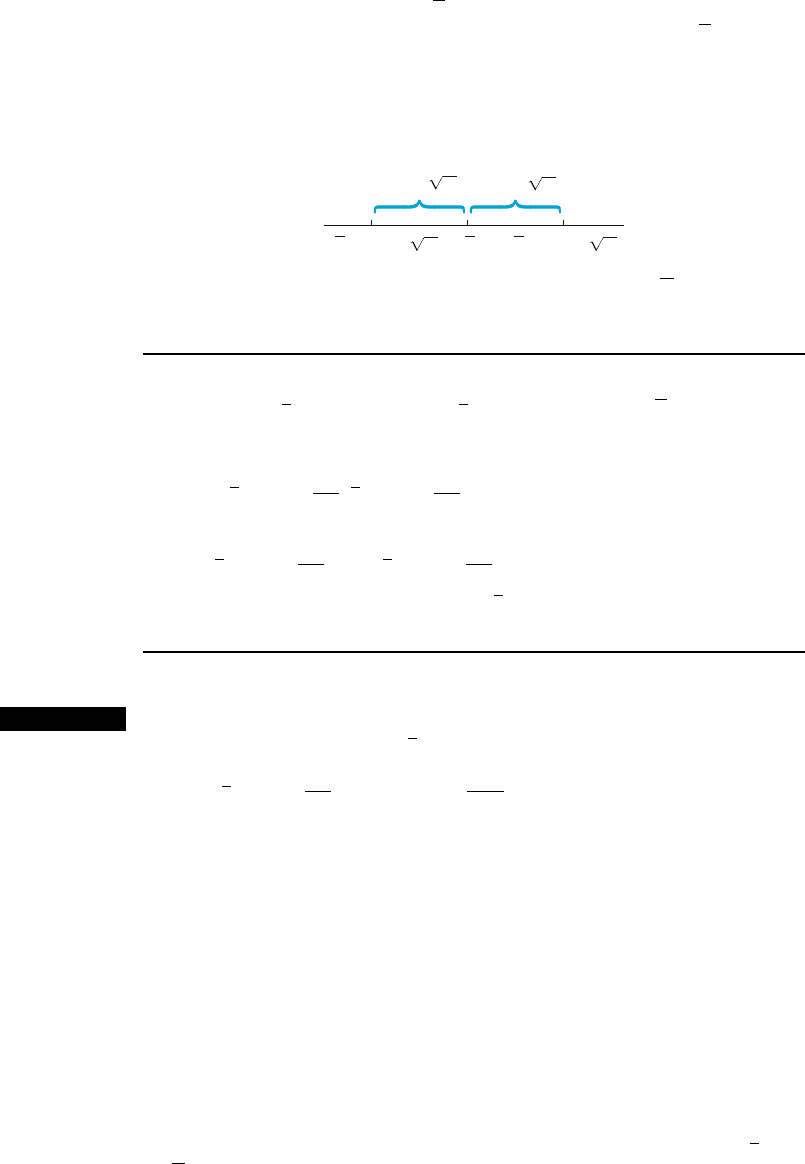
extends 1:96 s=
ffiffiffi
n
p
to each side of X. Thus the interval’s width is 2 1:96 s=
ffiffiffi
n
p
,
which is not random; only the location of the interval (its midpoint
X) is random
(Figure 8.2). Now ( 8.3) can be paraphrased as “the probability is .95 that the
random interval (8.4 ) includes or covers the true value of m.” Before any experi-
ment is performed and any data is gathered , it is quite likely (probability .95) that m
will lie inside the interval in Expression (8.4).
DEFINITION
If after observing X
1
¼ x
1
, X
2
¼ x
2
, ... , X
n
¼ x
n
, we compute the observed
sample mean
x and then substitute x into (8.4) in place of X, the resulting
fixed interval is called a 95% confidence interval for m. This CI can be
expressed either as
x 1:96
s
ffiffiffi
n
p
;
x þ 1:96
s
ffiffiffi
n
p
is a 95% confidence interval for m
or as
x 1:96
s
ffiffiffi
n
p
< m <
x þ 1:96
s
ffiffiffi
n
p
with 95% confidence
A concise expression for the interval is
x 1:96 s=
ffiffiffi
n
p
, where – gives the
left endpoint (lower limit) and + gives the right endpoint (upper limit).
Example 8.2
(Example 8.1
continued)
The quantities needed for computation of the 95% CI for true average preferred
height are s ¼ 2.0, n ¼ 31, and
x ¼ 80:0. The resulting interval is
x 1:96
s
ffiffiffi
n
p
¼ 80:0 1:96
2:0
ffiffiffiffiffi
31
p
¼ 80:0 :7 ¼ð79:3; 80:7Þ
That is, we can be highly confident, at the 95% confidence level, that 79.3 < m <
80.7. This interval is relatively narrow, indicating that m has been rather precisely
estimated.
■
Interpreting a Confidence Level
The confidence level 95% for the interval just defined was inherited from the
probability .95 for the random interval (8.4). Intervals having other levels of
confidence will be introdu ced shortly. For now, though, consider how 95% confi-
dence can be interpreted.
Because we started with an event whose probability was .95—that the
random interval (8.4) would capture the true value of m—and then used the data
in Example 8.1 to compute the fixed interval (79.3, 80.7), it is tempting to conclude
that m is within this fixed interv al with probability .95. But by substituting
x ¼ 80
for
X, all randomne ss disappears; the interval (79.3, 80.7) is not a random interv al,
X X
1.96s /
1.96s
/
n
− 1.96s
/
n
X
+ 1.96s /
n
n
Figure 8.2 The random interval (8.4) centered at
X
8.1 Basic Properties of Confidence Intervals 385
and m is a constant (unfortunately unknown to us). So it is incorrect to write the
statement P[m lies in (79.3, 80.7)] ¼ .95.
A correct interpretation of “95% confidence” relies on the long-run relative
frequency interpretation of probability: To say that an event A has probability .95 is
to say that if the experiment on which A is defined is performed over and over
again, in the long run A will occur 95% of the time. Suppose we obtain another
sample of typists’ preferred heights and compute another 95% interval. Then we
consider repeating this for a third sample, a fourth sample, and so on. Let A be the
event that
X 1 :96 s=
ffiffiffi
n
p
< m < X þ 1 :96 s=
ffiffiffi
n
p
. Since P(A) ¼ .95, in the long
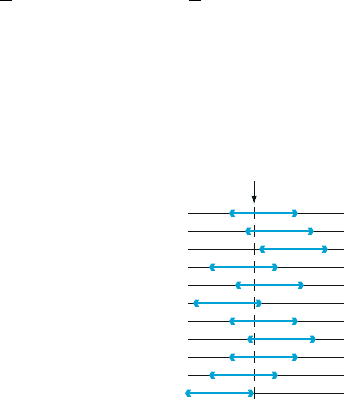
run 95% of our computed CIs will contain m. This is illustrated in Figure 8.3, where
the vertical line cuts the measurement axis at the true (but unknown) value of m.
Notice that of the 11 intervals pictured, only intervals 3 and 11 fail to contain m.In
the long run, only 5% of the intervals so constructed would fail to contain m.
According to this interpretation, the confidence level 95% is not so much a
statement about any particular interval such as (79.3, 80.7), but pertains to what
would happen if a very large number of like intervals were to be constructed using
the same formula. Although this may seem unsatisfactory, the root of the difficulty
lies with our interp retation of probability—it applies to a long sequence of replica-
tions of an experiment rather than just a single replic ation. There is another
approach to the construc tion and interpretation of CIs that uses the notion of
subjective probability and Bayes’ theorem, as discu ssed in Sect ion 14.4. The
interval pres ented here (as well as each interval presented subsequently) is called
a “classical” CI because its interpretation rests on the classical notion of probability
(although the main ideas were developed as recently as the 1930s).
Other Levels of Confidence
The confidence level of 95% was inherited from the probability .95 for the initial
inequalities in (8.2). If a confidence level of 99% is desired, the initial probability
of .95 must be replaced by .99, which necessitates changing the z critical value from
1.96 to 2.58. A 99% CI then resu lts from using 2.58 in place of 1.96 in the formula
for the 95% CI.
This suggests that any desired level of confidence can be achieved by
replacing 1.96 or 2.58 with the appropriate standard normal critical value. As
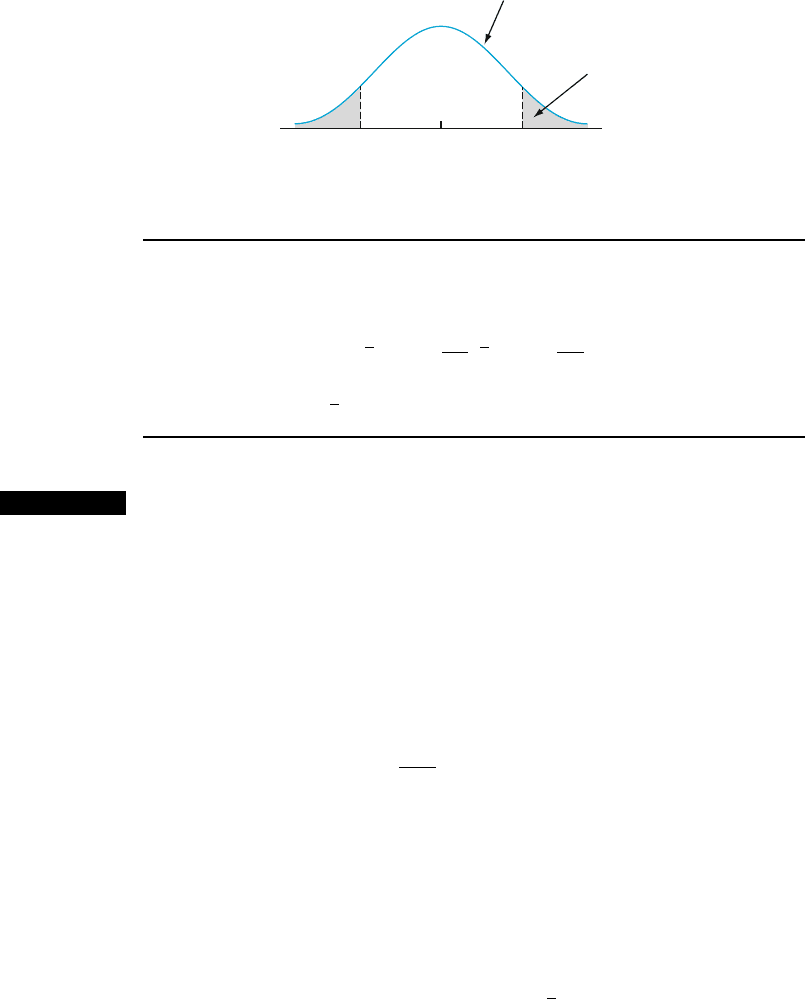
Figure 8.4 shows, a probability of 1 a is achieved by using z
a/2
in place of 1.96.
Interval
number
(1)
(2)
(3)
(4)
(5)
(6)
(7)
(8)
(9)
(10)
(11)
True value of m
Figure 8.3 Repeated construction of 95% CIs
386
CHAPTER 8 Statistical Intervals Based on a Single Sample
DEFINITION
A 100(1 a)% confidence interval for the mean m of a normal population
when the value of s is known is given by
x z
a=2
s
ffiffiffi
n
p
;
x þ z
a=2
s
ffiffiffi
n
p
ð8:5Þ
or, equivalently, by
x z
a=2
s=
ffiffiffi
n
p
.
Example 8.3 A finite mathematics course has recently been changed, and the homework is now
done online via computer instead of from the textbook exercises. How can we see if
there has been improvement? Past experience suggests that the distribution of final
exam scores is normally distributed with mean 65 and standard deviation 13. It is
believed that the distribution is still normal with standard deviation 13, but the
mean has likely changed. A sample of 40 students has a mean final exam score of
70.7. Let’s calculate a confidence interval for the population mean using a confi-
dence level of 90%. This require s that 100(1 a) ¼ 90, from which a ¼ .10 and
z
a/2
¼ z
.05
¼ 1.645 (corresponding to a cumulative z-curve area of .9500).
The desired interval is then
70:7 1:645
13
ffiffiffiffiffi
40
p
¼ 70:7 3:4 ¼ð67:3; 74:1Þ
With a reasonably high degree of confidence, we can say that 67.3 < m < 74.1.
Furthermore, we are confident that the population mean has improved over the
previous value of 65.
■
Confidence Level, Precision, and Choice of Sample Size
Why settle for a confidence level of 95% when a level of 99% is achievable?
Because the price paid for the higher confidence level is a wider interval. The
95% interval extends 1:96 s=
ffiffiffi
n
p
to each side of
x, so the width of the interval is
2ð1:96Þs=
ffiffiffi
n
p
¼ 3:92 s=
ffiffiffi
n
p
. Similarly, the width of the 99% interval is
2ð2:58Þs=
ffiffiffi
n
p
¼ 5:16 s=
ffiffiffi
n
p
. That is, we have more confidence in the 99%
interval precisely because it is wider. The higher the desired degree of confidence,
the wider the resulting interval. In fact, the only 100% CI for m is (1, 1), which
is not terribly informative because, even before sampling, we knew that this
interval covers m.
0
z curve
1 − a
Shaded area = a /2
−z
a/2
z
a/2
Figure 8.4
P
(
-z
a
/2
Z
z
a
/2
) ¼ 1a
8.1 Basic Properties of Confidence Intervals 387